
Satellite Solar Cell Materials Market Size and Share
Market Overview
| Study Period | 2022 - 2032 |
|---|---|
| Market Size (2027) | USD 60.81 Million |
| Market Size (2032) | USD 112.15 Million |
| Growth Rate (2027 - 2032) | 13.02 % |
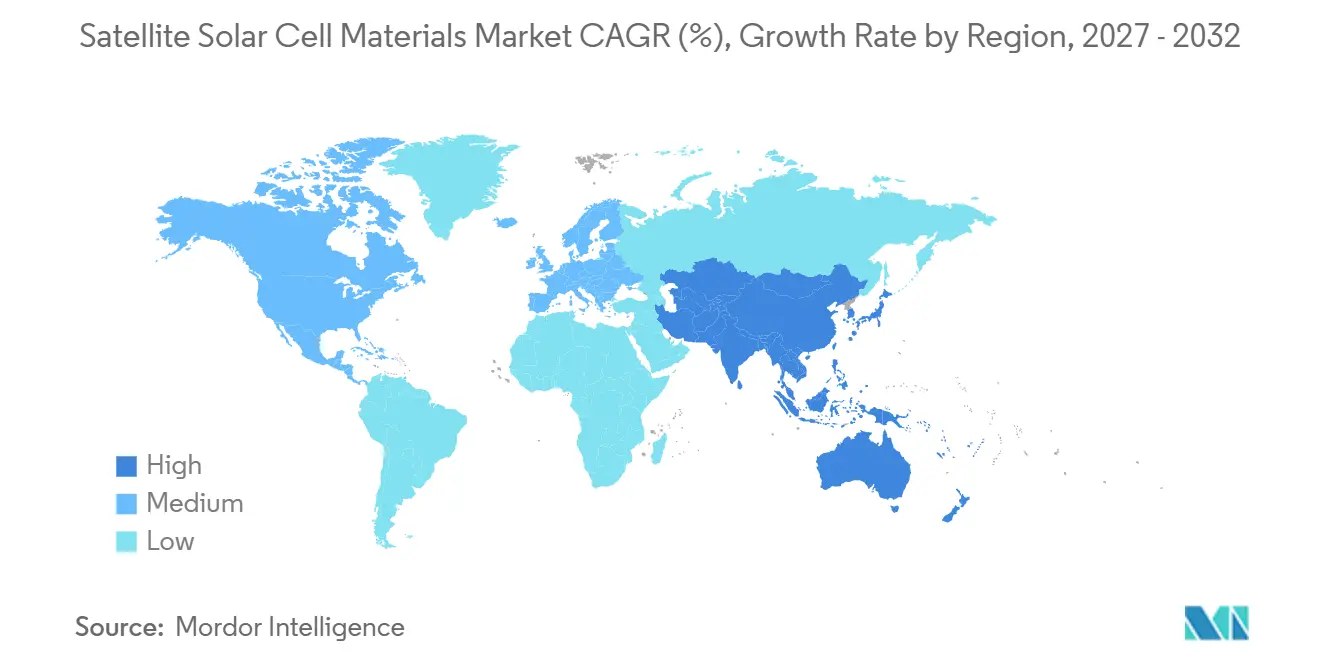
| Fastest Growing Market | Asia-Pacific |
| Largest Market | North America |
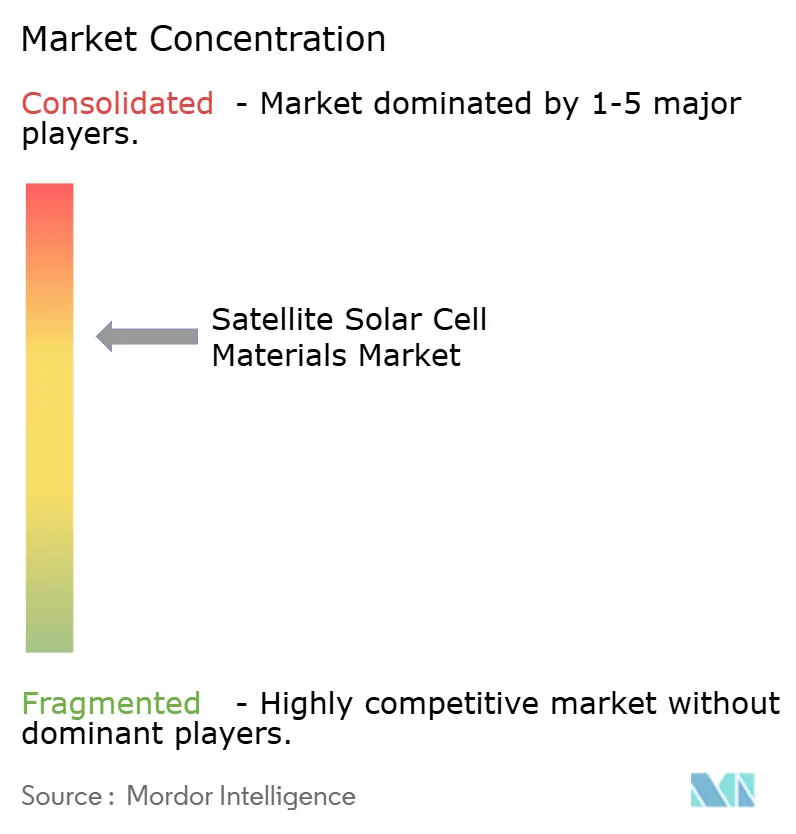
| Market Concentration | Medium |
Major Players *Disclaimer: Major Players sorted in no particular order Image © Mordor Intelligence. Reuse requires attribution under CC BY 4.0. | |
Satellite Solar Cell Materials Market Analysis by Mordor Intelligence
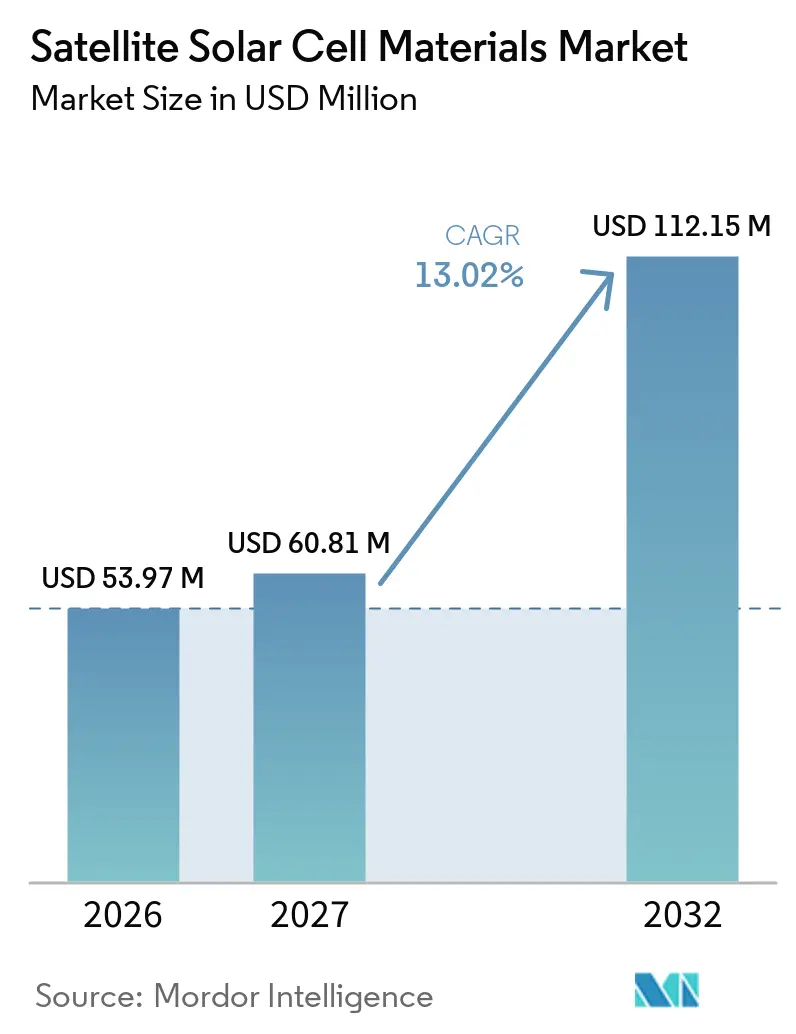
The satellite solar cell materials market size was valued at USD 53.97 million in 2026 and is estimated to grow from USD 60.81 million in 2027 to reach USD 112.15 million by 2032, at a CAGR of 13.02% during the forecast period (2027-2032). Growth is tied to the deployment of Low Earth Orbit (LEO) broadband and Earth observation constellations, which require more solar-array capacity and place pressure on qualified cell supply. The European Space Agency identifies telecom satellites as the largest source of addressable solar-generator demand, while Earth observation also represents a material source of demand. Suppliers are increasing capacity and developing higher-efficiency multi-junction cells, but qualification cycles limit how quickly new designs can enter flight programs. Public programs in Japan, Europe, and the United States are also supporting domestic production and component development. Material availability remains important because gallium and germanium supply is concentrated, and the U.S. Geological Survey analysis describes the potential effects of export restrictions on these inputs.
Key Report Takeaways
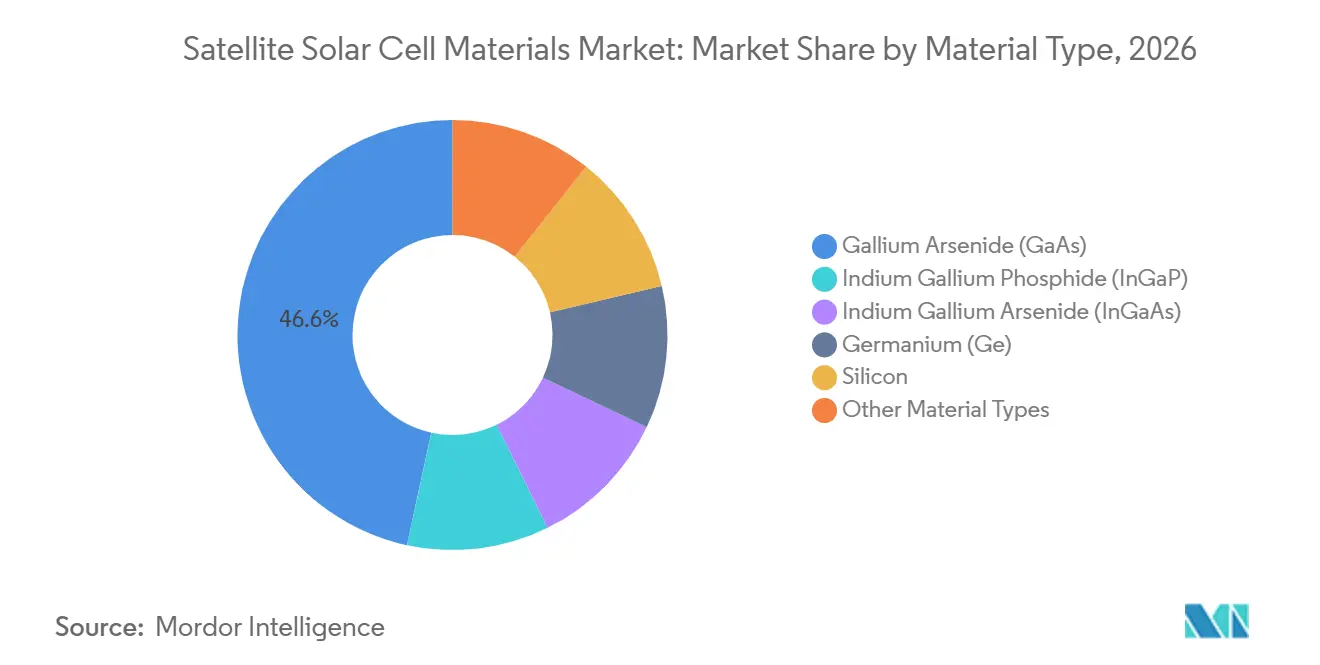
- By material type, gallium arsenide (GaAs) held 46.61% of the satellite solar cell materials market share in 2026 and is forecast to advance at a 13.67% CAGR through 2032.
- By orbit, Low Earth Orbit (LEO) held 44.83% of the satellite solar cell materials market share in 2026 and is forecast to advance at a 13.91% CAGR through 2032.
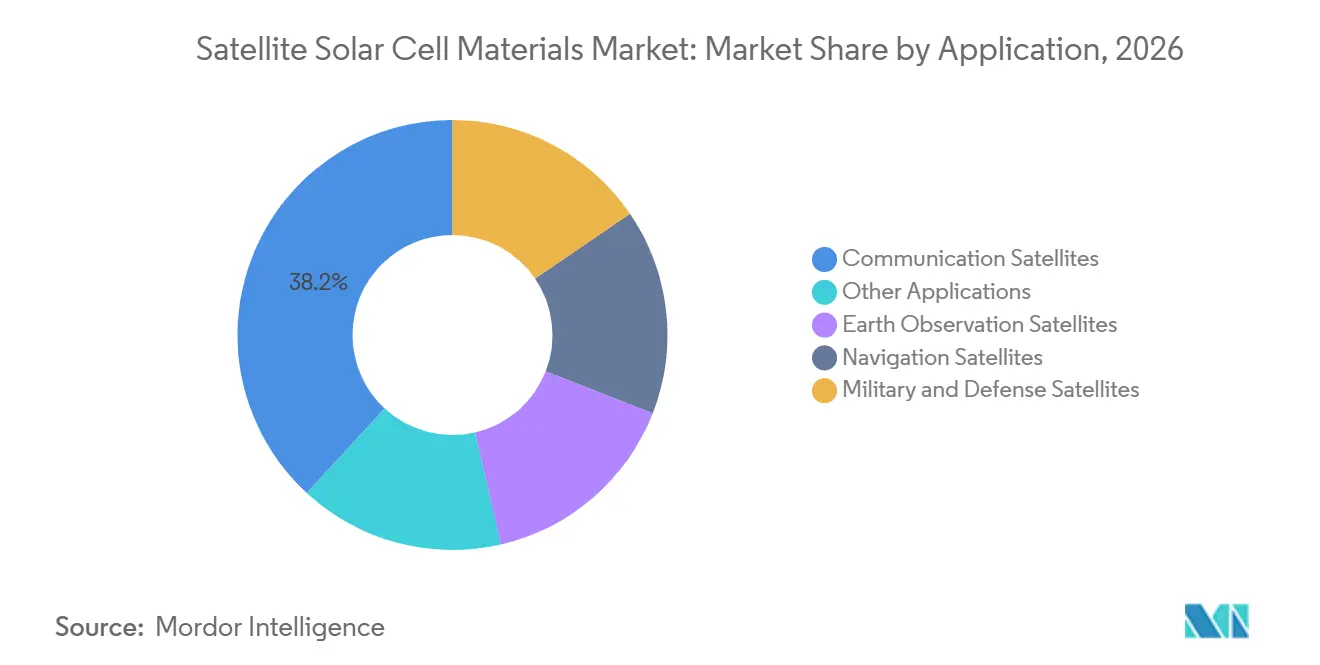
- By application, communication satellites held 38.15% of the satellite solar cell materials market share in 2026 and are forecast to advance at a 14.06% CAGR through 2032.
- By geography, North America held 41.48% of the satellite solar cell materials market share in 2026, while Asia-Pacific is forecast to advance at a 13.72% CAGR through 2032.
Note: Market numbers in this report are based on Mordor Intelligence's proprietary estimation framework, which combines nine months of actuals with Q4 projections for base year 2026.
Market Trends and Insights
Drivers Impact Analysis of Satellite Solar Cell Materials Market*
| Driver | (~) % Impact on CAGR Forecast | Geographic Relevance | Impact Timeline |
|---|---|---|---|
| Expansion of LEO Broadband and Earth Observation Constellations | +4.1% | Global, concentrated in North America, APAC, and Europe | Short term (≤ 2 years) |
| Advancements in High-Efficiency Multi-Junction Solar Cell Technologies | +2.8% | North America, Europe, Japan | Medium term (2-4 years) |
| Government-Funded Space Programs and Strategic Supply Localization | +2.2% | Japan, Europe (Italy, Germany), North America | Medium term (2-4 years) |
| Rising Power Density Requirements for Smaller Spacecraft | +1.9% | Global, spillover from North America and APAC | Short to Medium term |
| Longer Mission Lifetimes and Radiation-Resilient Power Requirements | +1.2% | GEO-dominant: North America, Europe; expanding MEO | Long term (≥ 4 years) |
| Source: Mordor Intelligence | |||
Expansion of LEO Broadband and Earth Observation Constellations
LEO constellation deployment is increasing the demand for qualified satellite solar cells and arrays. The European Space Agency forecast 32 MW of addressable installed power and demand for 20 million solar cells from European and Canadian suppliers through 2033[1]. Its assessment assigned 46% of addressable power demand to telecom satellites and 17% to Earth observation satellites. Large deployment programs can absorb significant cell volumes before satellite integration is complete. This strengthens the value of dependable delivery schedules for the satellite solar cell materials market. It also encourages buyers to qualify more than one supply option where mission requirements permit.
Rising Power Density Requirements for Smaller Spacecraft
Smaller spacecraft need more power as onboard processing and communications requirements increase. A 2025 Acta Astronautica study found that power use in mega-constellations varies with service demand and orbital conditions. LEO missions also experience repeated eclipse periods, which place tight requirements on the power system. Higher cell efficiency can reduce the required array area and launch mass for a given power output. Research published in Advanced Science reported 27.67% beginning-of-life efficiency and 23.38% end-of-life efficiency for a protected GaAs triple-junction thin-film cell under an eight-year equivalent LEO exposure. These requirements support demand within the satellite solar cell materials market for materials with proven performance in the space environment.
Government-Funded Space Programs and Strategic Supply Localization
Government programs are supporting new capacity and domestic supply options for space solar cells. Mitsubishi Electric Corporation was selected in August 2025 to lead a six-year Japan Aerospace Exploration Agency Space Strategy Fund program for satellite solar cells, cover glass, and solar arrays. The program runs from May 2025 through March 2031 and addresses supply constraints for LEO constellation components. CESI S.p.A. opened a production line in March 2025 through a EUR 20 million investment and reported a 200% capacity increase. SolAero by ROCKET LAB USA also described a capacity expansion for radiation-hard III-V solar cells at the 2025 IEEE Photovoltaic Specialists Conference. These programs can broaden the manufacturing base available to the satellite solar cell materials market.
Longer Mission Lifetimes and Radiation-Resilient Power Requirements
Long mission lives make end-of-life power retention important for satellite solar-cell selection. The European Space Agency states that triple-junction GaAs cells used on geostationary satellites retain 88% of their original performance after 15 years, with 24.6% end-of-life efficiency. Higher-junction architectures are being developed to improve beginning-of-life and end-of-life margins. SolAero by ROCKET LAB USA reported that its Z4J+ cell reaches 31.3% beginning-of-life efficiency and delivers more than a 6% improvement at the beginning of life relative to heritage three-junction products. Greater radiation resilience can extend useful satellite life and reduce replacement needs. This requirement remains particularly important for the satellite solar cell materials market in geostationary missions and applies increasingly to LEO fleets.
Restraints Impact Analysis of Satellite Solar Cell Materials Market*
| Restraint | (~) % Impact on CAGR Forecast | Geographic Relevance | Impact Timeline |
|---|---|---|---|
| Limited Supply of GaAs, Germanium, and III-V Epitaxy Inputs | -3.5% | Global; sharpest in North America and Europe | Short to Medium term |
| High Qualification Cost and Long Space-Heritage Cycles | -2.8% | Global; highest barrier in GEO-class missions | Medium to Long term |
| ITAR, Export Controls, and Sovereign Procurement Fragmentation | -1.9% | North America (ITAR); EU/non-US allies (EAR/EU controls) | Medium term (2-4 years) |
| Source: Mordor Intelligence | |||
High Qualification Cost and Long Space-Heritage Cycles
Space heritage remains a significant entry barrier for new solar-cell architectures. New designs require qualification for thermal cycling, proton and electron radiation, atomic oxygen exposure, and long-term degradation performance under ECSS-E-ST-20-08C. Qualification can take 18-24 months for each cell architecture. Within the satellite solar cell materials market, flight programs are reluctant to change designs when a new option lacks long-duration performance evidence. This favors established suppliers with radiation-test data and completed missions. The restraint slows the adoption of four-junction, epitaxial lift-off, and copper indium gallium selenide alternatives within the satellite solar cell materials market.
ITAR, Export Controls, and Sovereign Procurement Fragmentation
Export-control requirements affect how suppliers sell radiation-hard solar-cell materials across borders. The U.S. Bureau of Industry and Security issued revisions to space-related export controls in October 2024[2]. National programs may favor domestic sourcing when supply security is a priority. This can divide demand among regional supply chains rather than a single open procurement market. It can also increase the value of local qualifications and production capability. The result is a more complex sourcing environment in the satellite solar cell materials market for satellite manufacturers and constellation operators.
*Our forecasts treat driver/restraint impacts as directional, not additive. The impact forecasts reflect baseline growth, mix effects, and variable interactions.
Satellite Solar Cell Materials Market Segment Analysis
By Material Type:
GaAs Leads Both Scale and GrowthGallium arsenide (GaAs) held 46.61% share in 2026 and is projected to advance at a 13.67% CAGR through 2032. Its position in the satellite solar cell materials market reflects a long record of high efficiency and radiation tolerance in demanding missions. The European Space Agency identifies triple-junction GaAs as a technology used for geostationary satellites with 15-year operating requirements. AZUR SPACE delivered its 6 millionth multi-junction solar cell in 2025. The company also introduced a quadruple-junction variant for deep-space missions, including Mars.
Germanium supports GaInP/GaAs/Ge triple-junction structures as a substrate. Indium gallium phosphide and indium gallium arsenide are active layers in multi-junction designs, rather than direct substitutes for GaAs. Silicon can serve cost-focused LEO programs where high production volumes outweigh peak conversion efficiency. The European Space Agency notes renewed silicon use in constellation programs. Copper indium gallium selenide thin films serve a small-satellite and rapid-deployment portion of the satellite solar cell materials market. Ascent Solar Technologies, Inc. reported a 15.7% Air Mass Zero (AM0) production-scale efficiency result for its copper indium gallium selenide (CIGS) technology in June 2025.

By Orbit:
LEO Leads Both Scale and GrowthLow Earth Orbit (LEO) held 44.83% share in 2026 and is projected to advance at a 13.91% CAGR through 2032. This satellite solar cell materials market segment benefits from broadband and Earth observation constellation deployments. LEO satellites move through repeated day-night cycles that create frequent charge and discharge demands on the power system. The Acta Astronautica study reported that constellation power profiles are variable and respond to real-time service demand. These operating conditions require adequate power margins throughout the mission. They also increase the importance of degradation resistance and predictable array output.
Geostationary Earth Orbit remains a key satellite solar cell materials market application area for the most demanding solar-cell specifications. Its long mission life and radiation exposure favor cell families with extensive flight records. The European Space Agency documented 88% power retention after 15 years for triple-junction GaAs cells in this setting. Medium Earth Orbit supports navigation and communications systems with long procurement cycles. Other orbits include highly elliptical trajectories, lunar transfer paths, and deep-space missions. These programs require cells tested under low-intensity, low-temperature, and high-intensity, high-temperature conditions.
By Application:
Communication Satellites Lead Both Demand and GrowthCommunication satellites held a 38.15% share in 2026 and are projected to advance at a 14.06% CAGR through 2032. The European Space Agency estimated that telecom satellites account for 46% of addressable solar-cell power demand. Geostationary communications platforms tend to use high-efficiency cells with long flight heritage. LEO broadband fleets may assess silicon and CIGS options to manage per-satellite costs. This creates different material needs within the satellite solar cell materials market application group. The satellite solar cell materials industry, therefore, serves both high-specification and volume-focused communications programs.
Earth observation missions often use smaller spacecraft and shorter procurement cycles. AAC Clyde Space power systems have supported the KazEOSat-MR program and the European Space Agency Arctic Weather Satellite. Navigation satellites provide a stable demand linked to established infrastructure programs. Military and defense satellites require radiation-hard components and may have classified specifications. SolAero by ROCKET LAB USA linked its capacity expansion to the demand for radiation-hard III-V cells. These applications can support higher-value demand in the satellite solar cell materials market even when public procurement information is limited.
Geography Analysis
North America held a 41.48% share in 2026. The region includes Spectrolab, SolAero by ROCKET LAB USA, Redwire Corporation, Ascent Solar Technologies, Inc., Northrop Grumman, and MicroLink Devices. Boeing stated that Spectrolab had delivered more than 7 million multi-junction space solar cells by October 2026. Boeing also reported more than 10 MW of Spectrolab space-grade power in orbit. In September 2025, Boeing announced a 3D-printed solar-array substrate approach that cuts composite build-cycle time by up to 50%.
Asia-Pacific is projected to advance at a 13.72% CAGR through 2032. Japan is building domestic capability for the satellite solar cell materials market through public programs and established manufacturers. Mitsubishi Electric Corporation’s JAXA program covers domestic cells, cover glass, and solar arrays. SHARP CORPORATION is a JAXA-certified domestic solar-cell manufacturer with cells selected for the Martian Moons eXploration (MMX) Mars moon mission. China’s expanding LEO constellation plans create domestic solar-cell demand. China’s position in gallium and germanium production may affect its material costs relative to overseas buyers.
Europe has a substantial satellite solar cell materials market, manufacturing, and integration base through AZUR SPACE, CESI S.p.A., AIRBUS, and Thales Alenia Space. CESI S.p.A. opened its production line in Milan in March 2025 and increased capacity by 200%. AZUR SPACE is based in Germany and reported its 6 millionth multi-junction solar-cell delivery in 2025. South America and the Middle East and Africa represent emerging demand areas. Brazil and Saudi Arabia have satellite ambitions that can increase procurement needs. These regions generally source commercial-scale cells from North American and European producers.
Competitive Landscape
The satellite solar cell materials market is moderately concentrated, with the top five players including Spectrolab, AZUR SPACE, ROCKET LAB USA, SHARP CORPORATION, and CESI S.p.A. Integration is more dispersed across companies such as Redwire Corporation, Northrop Grumman, AAC Clyde Space, AIRBUS, Thales Alenia Space, GomSpace, and DHV Technology. These companies compete through array design, integration capability, and satellite compatibility. This division leaves cell producers with a strong position in high-radiation and long-life missions.
Capacity expansion is a central competitive strategy. SolAero by ROCKET LAB USA presented an expansion of capacity and capabilities for radiation-hard III-V solar cells in 2025. Boeing’s 3D-printed substrate work aims to reduce manufacturing time for Spectrolab solar-array systems. CESI S.p.A. added 5 evaporators and a new metal-organic chemical vapor deposition reactor at its expanded production line. These steps improve satellite solar cell materials market production capacity and strengthen regional supply options. They also respond to longer procurement periods for qualified components.
Alternative cell architectures are another source of differentiation. Ascent Solar Technologies, Inc. is developing CIGS thin-film products for lightweight and flexible applications. MicroLink Devices is pursuing epitaxial lift-off GaAs modules for space applications. Redwire Corporation completed a 60 kW Roll-Out Solar Array deployment test in July 2025 for the Lunar Gateway Power and Propulsion Element. Redwire Corporation also received a contract in September 2025 to supply Roll-Out Solar Array wings for Axiom Station’s first module. The satellite solar cell materials market remains broader at the array and power-system level than at the qualified cell-production level.
Satellite Solar Cell Materials Industry Leaders
-
Spectrolab
-
AZUR SPACE
-
ROCKET LAB USA
-
SHARP CORPORATION
-
CESI S.p.A.
- *Disclaimer: Major Players sorted in no particular order
Satellite Solar Cell Materials Market Companies Covered in this Report
- AAC Clyde Space
- AIRBUS
- Ascent Solar Technologies, Inc.
- AZUR SPACE
- CESI S.p.A.
- DHV Technology
- GomSpace
- MicroLink
- Mitsubishi Electric Corporation
- Northrop Grumman
- Redwire Corporation
- ROCKET LAB USA
- SHARP CORPORATION
- Spectrolab
- Thales Alenia Space
Recent Industry Developments in Satellite Solar Cell Materials Market
- September 2026: ROCKET LAB USA announced the production release of its Inverted Metamorphic Multijunction (IMM) Apex solar cell, achieving 31.5% beginning-of-life conversion efficiency and 40% lower cell mass. The design eliminates germanium substrates used in conventional multi-junction cells, supporting the satellite solar cell materials market by reducing dependence on supply-constrained materials while improving power-to-weight performance and radiation resilience.
- August 2026: Source Energy and Fraunhofer Institute for Solar Energy Systems ISE introduced a silicon-based solar module product line for satellites using shingle-matrix cell interconnection technology. The development supports the satellite solar cell materials market by offering a lower-cost alternative to conventional III-V solar cells, with reduced vulnerability to localized damage and a shorter manufacturing lead time.
Global Satellite Solar Cell Materials Market Report Scope
Satellite solar cell materials are semiconductor materials used to manufacture photovoltaic cells that convert sunlight into electrical energy for spacecraft. These materials are selected for their power-generation efficiency, radiation resistance, and ability to operate under the demanding conditions of space.
The Satellite Solar Cell Materials Market is segmented by material type, orbit, application, and geography. By material type, the market is segmented into gallium arsenide (GaAs), indium gallium phosphide (InGaP), indium gallium arsenide (InGaAs), germanium (Ge), silicon, and other material types. By orbit, the market is segmented into low Earth orbit (LEO), medium Earth orbit (MEO), geostationary Earth orbit (GEO), and other orbits. By application, the market is segmented into communication satellites, Earth observation satellites, navigation satellites, military and defense satellites, and other applications. The report also covers the market size and forecasts for satellite solar cell materials across 15 countries. For each segment, the market sizing and forecasts have been done on the basis of value (USD).
Segmentation Overview
| Gallium Arsenide (GaAs) |
| Indium Gallium Phosphide (InGaP) |
| Indium Gallium Arsenide (InGaAs) |
| Germanium (Ge) |
| Silicon |
| Other Material Types |
| Low Earth Orbit (LEO) |
| Medium Earth Orbit (MEO) |
| Geostationary Earth Orbit (GEO) |
| Other Orbits |
| Communication Satellites |
| Earth Observation Satellites |
| Navigation Satellites |
| Military and Defense Satellites |
| Other Applications |
| Asia-Pacific | China |
| India | |
| Japan | |
| South Korea | |
| ASEAN Countries | |
| Rest of Asia-Pacific | |
| North America | United States |
| Canada | |
| Mexico | |
| Europe | Germany |
| United Kingdom | |
| France | |
| Italy | |
| NORDIC Countries | |
| Rest of Europe | |
| South America | Brazil |
| Argentina | |
| Rest of South America | |
| Middle East and Africa | Saudi Arabia |
| South Africa | |
| Rest of Middle East and Africa |
| By Material Type | Gallium Arsenide (GaAs) | |
| Indium Gallium Phosphide (InGaP) | ||
| Indium Gallium Arsenide (InGaAs) | ||
| Germanium (Ge) | ||
| Silicon | ||
| Other Material Types | ||
| By Orbit | Low Earth Orbit (LEO) | |
| Medium Earth Orbit (MEO) | ||
| Geostationary Earth Orbit (GEO) | ||
| Other Orbits | ||
| By Application | Communication Satellites | |
| Earth Observation Satellites | ||
| Navigation Satellites | ||
| Military and Defense Satellites | ||
| Other Applications | ||
| By Geography | Asia-Pacific | China |
| India | ||
| Japan | ||
| South Korea | ||
| ASEAN Countries | ||
| Rest of Asia-Pacific | ||
| North America | United States | |
| Canada | ||
| Mexico | ||
| Europe | Germany | |
| United Kingdom | ||
| France | ||
| Italy | ||
| NORDIC Countries | ||
| Rest of Europe | ||
| South America | Brazil | |
| Argentina | ||
| Rest of South America | ||
| Middle East and Africa | Saudi Arabia | |
| South Africa | ||
| Rest of Middle East and Africa | ||
Key Questions Answered in the Report
What is the size of the satellite solar cell materials market?
The satellite solar cell materials market size was valued at USD 53.97 million in 2026 and is estimated to grow from USD 60.81 million in 2027 to reach USD 112.15 million by 2032, at a CAGR of 13.02% during the forecast period (2027-2032).
What is driving demand for satellite solar cell materials?
Low Earth Orbit (LEO) broadband and earth observation deployments are increasing the demand for qualified cells and arrays. The European Space Agency expects 20 million addressable solar cells for European and Canadian suppliers through 2033.
Which material type held the largest share in 2026?
Gallium arsenide (GaAs) held a 46.61% share in 2026.
Which orbit held the largest share in 2026?
Low Earth Orbit (LEO) held a 44.83% share in 2026.