
SaaS Data Security Market Size and Share
Market Overview
| Study Period | 2020 - 2031 |
|---|---|
| Market Size (2026) | USD 10.05 Billion |
| Market Size (2031) | USD 20.99 Billion |
| Growth Rate (2026 - 2031) | 15.87 % |
| Fastest Growing Market | Asia-Pacific |
| Largest Market | North America |
| Market Concentration | Low |
Major Players *Disclaimer: Major Players sorted in no particular order Image © Mordor Intelligence. Reuse requires attribution under CC BY 4.0. | |
SaaS Data Security Market Analysis by Mordor Intelligence
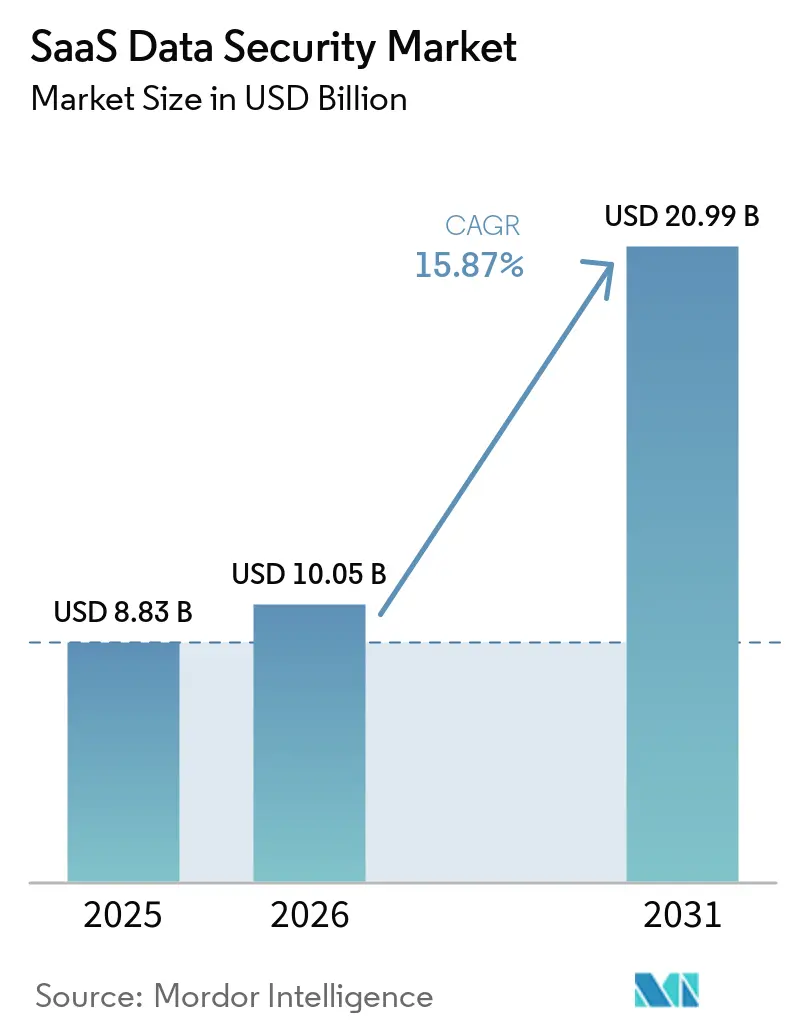
The SaaS data security market size was valued at USD 8.83 billion in 2025 and is estimated to grow from USD 10.05 billion in 2026 to reach USD 20.99 billion by 2031, at a CAGR of 15.87% during the forecast period (2026-2031). Organizations are managing larger SaaS portfolios, which increases the number of permissions, integrations, and data-sharing settings that security teams must oversee. Regulatory enforcement is also making continuous governance a more regular part of enterprise security planning. The SaaS data security market is therefore moving beyond periodic reviews toward ongoing monitoring and remediation. Vendors are responding by combining data controls, access governance, and AI-related oversight in broader platforms. These conditions create opportunities for providers that can work across complex software estates while meeting regional data requirements.
Key Report Takeaways
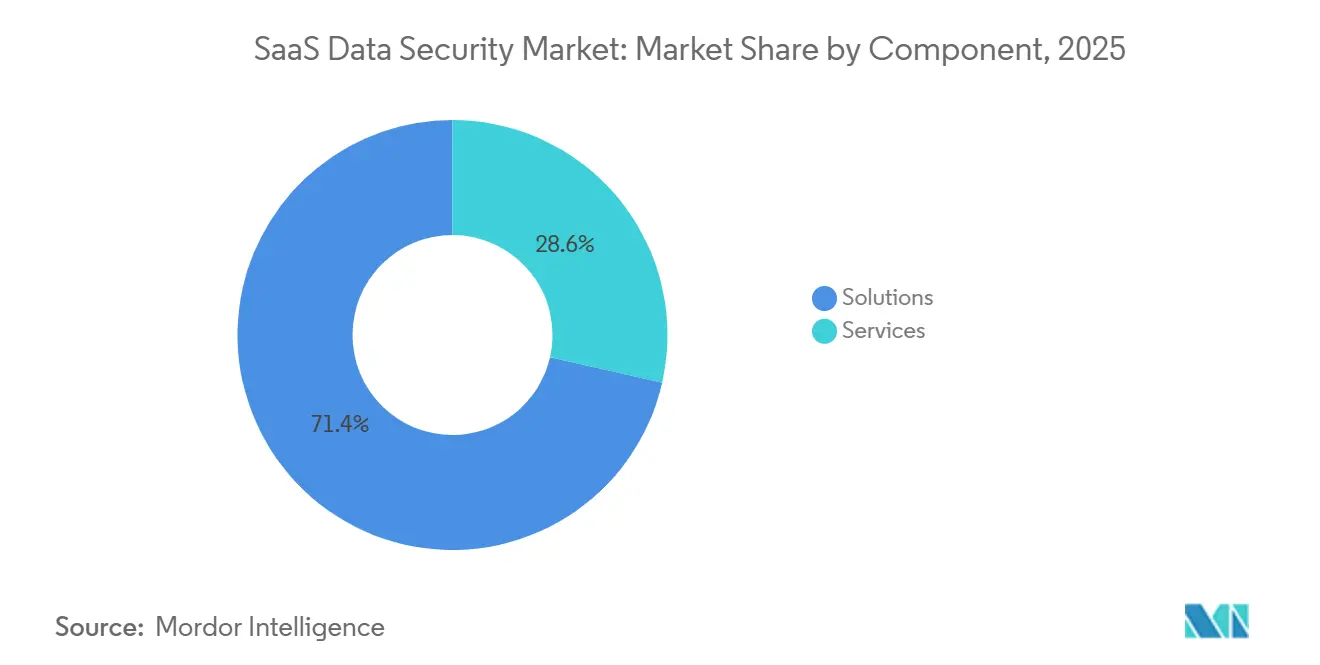
- By component, solutions held 71.44% of the SaaS data security market revenue in 2025, while services are projected to expand at a 17.91% CAGR through 2031.
- By deployment model, cloud-hosted security controls accounted for 67.89% of the SaaS data security market revenue in 2025, while hybrid security controls are projected to grow at a 17.21% CAGR through 2031.
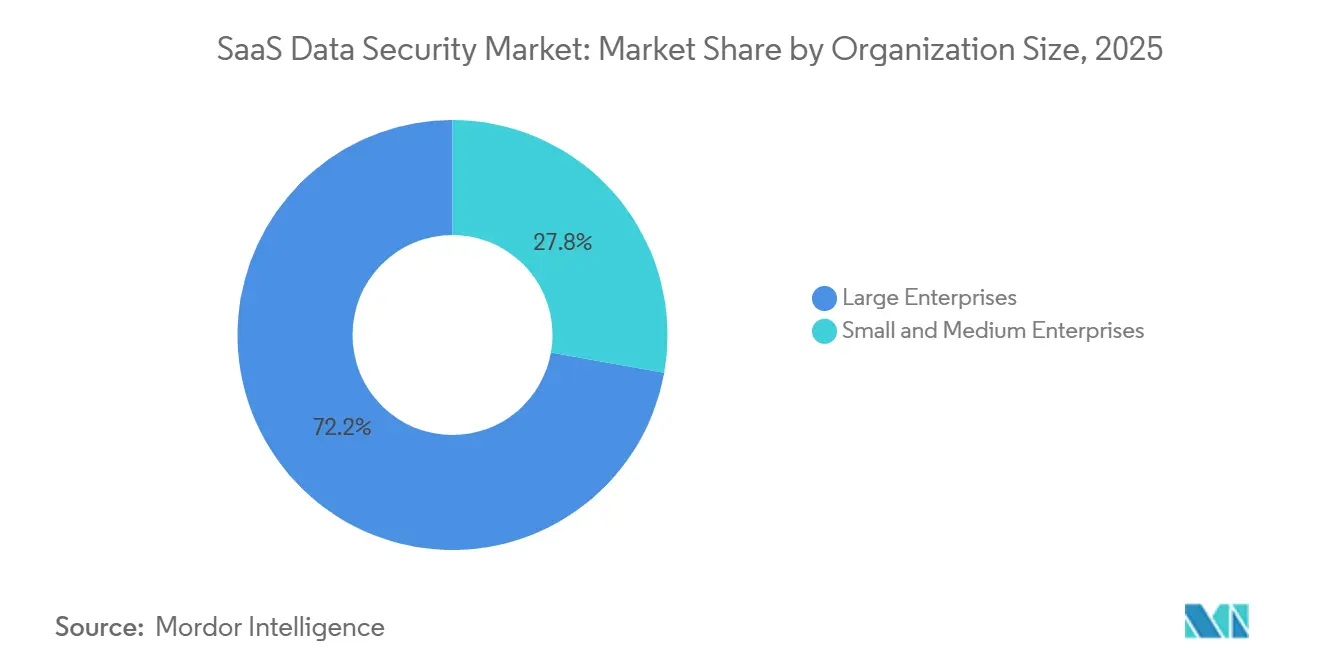
- By organization size, large enterprises accounted for 72.20% of the SaaS data security market in 2025, while SMEs are projected to grow at a 17.55% CAGR through 2031.
- By industry vertical, BFSI held 24.15% of the SaaS data security market revenue in 2025, while healthcare and life sciences are projected to expand at a 16.56% CAGR through 2031.
- By geography, North America held 35.77% of the SaaS data security market revenue in 2025, while Asia-Pacific is projected to expand at a 16.89% CAGR through 2031.
Note: Market size and forecast figures in this report are generated using Mordor Intelligence’s proprietary estimation framework, updated with the latest available data and insights as of January 2026.
Global SaaS Data Security Market Trends and Insights
Drivers Impact Analysis*
| Driver | (~) % Impact on CAGR Forecast | Geographic Relevance | Impact Timeline |
|---|---|---|---|
| Expansion of SaaS Application Footprints | +3.5% | Global | Short term (≤ 2 years) |
| Convergence of SSPM, DSPM, CASB, DLP, and Zero Trust | +3.2% | North America and EU, spillover to Asia-Pacific | Medium term (2-4 years) |
| Rising Shadow SaaS and Shadow AI Exposure | +2.9% | Global | Short term (≤ 2 years) |
| Regulatory Pressure for Continuous Data Governance | +2.3% | EU core, spillover to North America and Asia-Pacific | Medium term (2-4 years) |
| Overprivileged Non-Human Identities and AI Agents | +1.7% | North America, EU, Asia-Pacific | Medium term (2-4 years) |
| SaaS-Specific Cyber-Insurance and Procurement Requirements | +1.2% | North America and EU | Short term (≤ 2 years) |
| Source: Mordor Intelligence | |||
Expansion of SaaS Application Footprints
Enterprise SaaS use reached a level in 2025 that required more complete application-level security oversight. Thales Group reported that organizations managed an average of 90 SaaS applications, spanning multi-tenant systems, OAuth integrations, and partner portals. Each additional application brings separate permissions, third-party connections, and data-sharing boundaries. Those settings interact across the software estate and can increase exposure as the portfolio expands. Buyers in the SaaS data security market are moving away from tools used only for periodic audits. They are seeking platforms that continuously monitor posture, identify configuration changes, and support remediation without extensive manual effort.
Convergence of SSPM, DSPM, CASB, DLP, and Zero Trust
The boundaries among SSPM, DSPM, CASB, and DLP are increasingly blurred in enterprise security programs. Palo Alto Networks reported that 75% of organizations planned to implement DSPM by mid-2026, with integrated deployments gaining interest. SaaS data may be shared via a collaboration platform, accessed in a browser, synchronized with an endpoint, used by an AI agent, and transferred via an API in a single session. A single control layer cannot address all of these paths on its own. This supports demand in the SaaS data security market for platforms that integrate posture management, data classification, traffic inspection, and loss prevention. Zero-trust access functions can further use current data sensitivity signals rather than relying on static network boundaries.
Rising Shadow SaaS and Shadow AI Exposure
Shadow SaaS and shadow AI became more significant security concerns in 2025 and 2026. IBM found that organizations with extensive shadow AI faced average breach costs USD 670,000 higher than those of peers with minimal unauthorized AI use, and 1 in 5 breached organizations linked the incident to shadow AI activity.[1] Cloud Security Alliance research found that 53% of organizations had experienced AI agents exceeding intended permissions. The exposure includes unsanctioned consumer AI tools used by employees. It also includes AI features that vendors add to approved SaaS applications after the original risk assessment. The SaaS data security market is responding with continuous application discovery, AI feature inventories, and controls for agent access.
Regulatory Pressure for Continuous Data Governance
The regulatory environment for SaaS data security became more demanding in 2025 and 2026. DORA became fully applicable to EU financial entities in January 2025 and requires a structured register covering ICT third-party contracts. NIS2 issued its first administrative penalties in the first quarter of 2026, expanding obligations for cloud providers and SaaS platforms serving essential entities. The EU AI Act's high-risk system obligations became enforceable on August 2, 2026. The SaaS data security market benefits as organizations subject to GDPR, DORA, NIS2, HIPAA, PCI DSS, India’s Digital Personal Data Protection Act, and China’s Personal Information Protection Law need continuous evidence of governance.
Restraints Impact Analysis*
| Restraint | (~) % Impact on CAGR Forecast | Geographic Relevance | Impact Timeline |
|---|---|---|---|
| Integration Complexity Across Heterogeneous SaaS Environments | -2.1% | Global | Short term (≤ 2 years) |
| Limited SaaS Security Awareness and Ownership Ambiguity | -1.5% | Asia-Pacific, South America, Middle East and Africa | Short term (≤ 2 years) |
| SaaS Security Alert Fatigue and Remediation Bottlenecks | -0.9% | North America and EU | Medium term (2-4 years) |
| Sovereign Data Processing and SaaS-to-SaaS Trust Boundaries | -0.7% | EU, India, Asia-Pacific | Long term (≥ 4 years) |
| Source: Mordor Intelligence | |||
Integration Complexity Across Heterogeneous SaaS Environments
Complex SaaS estates can limit deployment completeness and reduce operating efficiency. Organizations must connect SaaS security tools with application APIs, while vendors regularly update those APIs and their data structures. An update can change a schema, alert format, or data model, creating a gap in visibility. Enterprises that use both legacy on-premises tools and cloud-native monitoring also need to normalize data from multiple sources. Inconsistent event models can reduce the effectiveness of detection logic across the environment. The SaaS data security market is addressing this issue through self-healing integrations and normalized telemetry, although migrations can create temporary coverage gaps.
Limited SaaS Security Awareness and Ownership Ambiguity
Many organizations still lack a clear owner for SaaS security responsibilities. A January 2026 survey covering 383 security leaders found that 92% were not confident that legacy IAM tools could manage AI and non-human identity risk, while 78% had no formal policy for creating or removing AI identities. Some organizations treat SaaS security as the vendor’s responsibility and leave enterprise-side misconfiguration, oversharing, and OAuth sprawl unaddressed. The issue is more visible in South America, the Middle East and Africa, and Southeast Asia, where procurement may occur outside formal security review cycles. Vendors have introduced tiered pricing, automated onboarding, and prebuilt compliance dashboards. Even so, limited awareness remains a near-term constraint on adoption among mid-market buyers and SMEs.
*Our forecasts treat driver/restraint impacts as directional, not additive. The impact forecasts reflect baseline growth, mix effects, and variable interactions.
Segment Analysis
By Component: Solutions Lead Revenue While Services Grow Faster
Solutions accounted for 71.44% of the SaaS data security market share in 2025. Large enterprises use SSPM, DSPM, CASB, and integrated DLP platforms as core controls across their SaaS environments. Initial deployments often include API setup, policy configuration, regulatory mapping, and continuing tuning. These requirements create switching costs and can support longer contracts for established vendors. Organizations that embed these platforms into compliance processes need ongoing coverage for audits and cyber insurance reviews. This makes the solution spend less discretionary for many regulated buyers.[2] As regulatory complexity and cyber-risk exposure continue to increase, enterprises are expected to prioritize sustained investments in cybersecurity regulatory intelligence platforms.
Services are projected to advance at a 17.91% CAGR from 2026 to 2031. The category includes consulting, implementation, integration, managed SaaS security, training, and support. Heterogeneous SaaS estates and AI-agent integrations create requirements that many organizations cannot meet with internal teams alone. Enterprise procurement contracts also increase demand for organized implementation and advisory support. Providers are helping customers prepare evidence packages for ISO 27001 and SOC 2 Type II reviews. This supports services revenue for vendors and channel partners serving the SaaS data security market.
By Deployment Model: Cloud-Hosted Controls Lead While Hybrid Models Grow Faster
Cloud-hosted security controls held 67.89% of the SaaS data security market revenue in 2025. Their position reflects faster deployment, native SaaS API connections, and operational scalability. These tools allow security teams to apply monitoring and governance functions without building equivalent on-premises infrastructure. Cloud-hosted architecture also supports use across distributed application portfolios. It remains well-suited to organizations that need standardized oversight across many SaaS services. The model continues to provide a practical route for broad security coverage.
Hybrid security controls are projected to expand at a 17.21% CAGR through 2031. Data residency and processing obligations can require some data categories to remain within defined jurisdictions. GDPR, DORA, India’s Digital Personal Data Protection Act, and China’s Personal Information Protection Law shape those choices. Organizations can place customer-managed controls alongside cloud-hosted detection and governance capabilities. Customer-managed models remain important for financial institutions, defense-adjacent enterprises, and public sector organizations with strict audit sovereignty requirements. Vendors in the SaaS data security market can strengthen their position by providing consistent policy management across cloud-hosted, customer-managed, and hybrid deployments.
By Organization Size: Large Enterprises Lead Spending While SMEs Gain Ground
Large enterprises accounted for 72.20% of SaaS data security revenue in 2025. Their broad use of SaaS, sensitive data holdings, and regulatory exposure create a substantial need for continuous security controls. Third-party relationships also add OAuth-based access paths and data movement between SaaS applications. DORA, SEC cybersecurity disclosure rules, and sector-specific requirements add to the operational need for governance. These organizations often have the budgets and internal resources to deploy full platform programs. Their demand supports the current scale of the SaaS data security market.
SMEs are projected to expand at a 17.55% CAGR from 2026 to 2031. Cloud-hosted platforms have supported more accessible pricing models for smaller organizations. Security questionnaires in enterprise procurement processes also require SME suppliers to show evidence of their security posture. Managed SaaS security services can substitute for dedicated internal security staff. Vendors have introduced SME-focused tiers with automated remediation, prebuilt compliance templates, and no-code onboarding. This approach lowers implementation barriers and gives providers opportunities to serve accounts that may grow into larger customers.
By Industry Vertical: BFSI Leads Revenue While Healthcare and Life Sciences Grow Faster
BFSI held 24.15% of the SaaS data security market share in 2025. The sector operates under DORA, PCI DSS, GDPR, and national banking supervisory frameworks. These requirements support spending on data classification, access governance, and continuous posture management. SaaS applications containing customer financial records, trading data, and risk models are important targets for attackers. A configuration error can expose highly sensitive information. Financial institutions, therefore, require strong controls across their software environments.
Healthcare and life sciences are projected to expand at a 16.56% CAGR through 2031. SaaS-enabled clinical and administrative workflows are widening the data environment that providers must protect. AI features in electronic health record platforms and revenue cycle management tools add AI-generated outputs, training inputs, and agent-mediated record access to the HIPAA-regulated data surface. These uses create additional security and audit requirements. Government and public administration, IT and telecommunications, and retail and e-commerce also remain significant users of SaaS security tools. Government demand is supported in jurisdictions implementing NIS2 and comparable cybersecurity requirements for critical infrastructure.
Geography Analysis
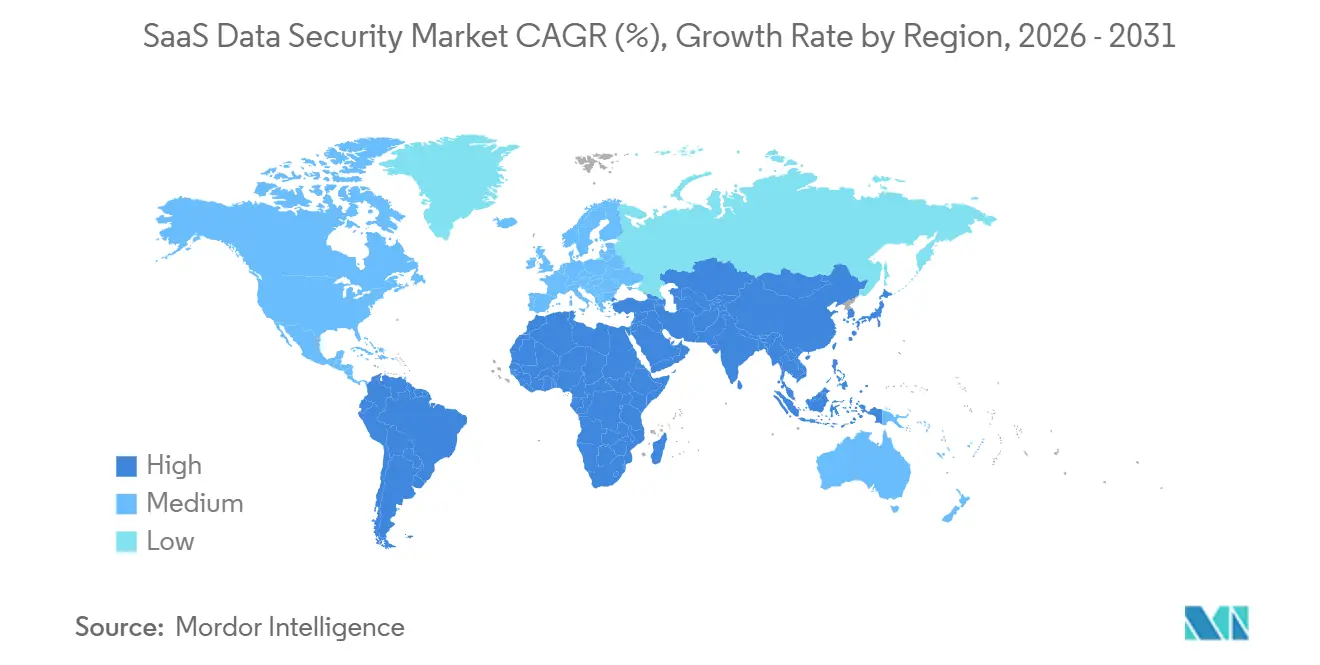
North America held 35.77% of the SaaS data security market revenue in 2025. The region has a high concentration of regulated enterprise buyers and leading SaaS vendors. HIPAA, PCI DSS, the California Privacy Rights Act, and SEC cybersecurity disclosure rules support compliance spending. The United States is the largest national market in the region because enterprises manage large and complex SaaS estates. Canada adds demand as multinational organizations manage cross-border data flows. These operating conditions support continued use of posture management and data governance platforms.[3] Growing emphasis on data sovereignty and secure SaaS adoption is expected to accelerate demand for SaaS data security solutions across organizations.
Europe is emerging as a major regional market, supported by GDPR, DORA, NIS2, and the EU AI Act. Germany, the United Kingdom, and France have large financial services and industrial manufacturing sectors with extensive use of SaaS. European data sovereignty concerns are encouraging customer-managed and hybrid security designs. The CLOUD Act’s extraterritorial reach and EU requirements for AI system inventories add to these concerns. BENELUX benefits from its role in the EU regulatory and financial infrastructure. South America remains smaller, although Brazil’s LGPD supports compliance spending in BFSI and retail, while SaaS adoption among mid-market enterprises expands the addressable base for cloud-hosted controls.
Asia-Pacific is projected to grow at a 16.89% CAGR from 2026 to 2031. China’s AI infrastructure spending is expected to exceed USD 70 billion in 2026, expanding the SaaS estate that domestic security controls must govern. Japan, South Korea, and Australia are mature markets with enterprise demand in financial services and healthcare. Indonesia, Malaysia, Vietnam, and the Philippines offer opportunities for cloud-hosted platforms. The Middle East and Africa are at an earlier stage, with the UAE and Saudi Arabia advancing digital programs, while South Africa, Nigeria, and Egypt form the region’s developing base.
Competitive Landscape
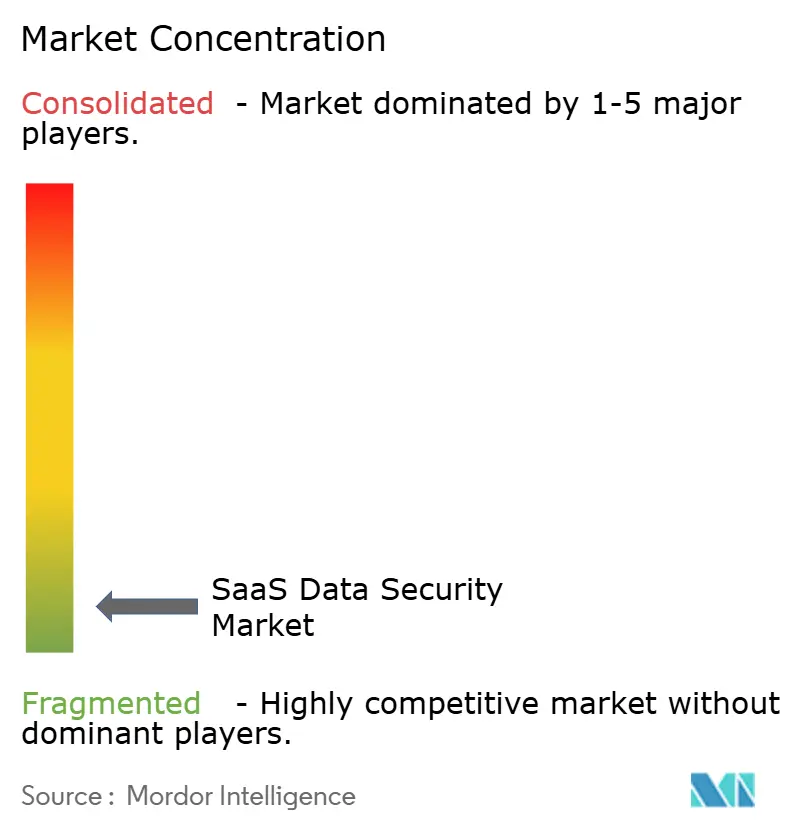
The SaaS data security market has a fragmented mid-market tier of specialists focused on SSPM, DSPM, CASB, DLP, and non-human identity governance. At the same time, platform vendors are adding SaaS security capabilities through product development and acquisitions. Cyera raised USD 600 million at a USD 12 billion valuation in June 2026 to develop its AI-native data security platform.[4] This investment illustrates the level of funding available to vendors seeking broader data and identity security coverage. AppOmni, Obsidian Security, Grip Security, Valence Security, and Wing Security compete through application coverage, OAuth and non-human identity governance, and automated remediation. The SaaS data security market continues to favor vendors that can address these areas in a unified operating model.
Smaller vendors are targeting gaps that broader platforms may not fully address. Push Security, Nudge Security, and LayerX Security provide identity-focused, browser-layer SaaS discovery tools that can identify shadow applications and AI exposure without requiring full API-level integration. Reco AI and Concentric AI apply machine learning to semantic data classification and behavior-based anomaly detection in SaaS settings. Spin.AI acquired DoControl in August 2026, combining access governance, DLP, SSPM, browser security, and ransomware resilience. This move reflects the shift toward bundled platforms designed around customer outcomes. It also shows how providers are joining complementary capabilities to reduce tool fragmentation.
AI agents are creating another area of competition across SaaS estates. Providers are developing tools to monitor delegated access, establish boundaries, and remediate excessive permissions. Proofpoint acquired Acuvity in February 2026 to add AI-native visibility, governance, and runtime protection for agentic workflows. Netskope launched the Netskope One DataSec Command Center in August 2026 to unite data discovery, tracking, and protection across AI, cloud, network, on-premises, endpoints, and email environments. FedRAMP authorization, ISO 27001 certification, and SOC 2 Type II attestation have become common procurement requirements. Those requirements raise the investment needed for newer vendors to compete.
SaaS Data Security Industry Leaders
-
AppOmni, Inc.
-
Obsidian Security, Inc.
-
Grip Security, Inc.
-
Valence Security Corporation
-
DoControl, Inc.
- *Disclaimer: Major Players sorted in no particular order
Recent Industry Developments
- August 2026: Spin.AI acquired DoControl, an Israeli cybersecurity company specializing in SaaS data access governance and DLP. The combined entity covers 5 layers of SaaS and AI risk, access governance, DLP, SSPM, browser security, and ransomware resilience, creating a more comprehensive platform for enterprise buyers managing complex SaaS estates and non-human identity risks.
- August 2026: Netskope launched the Netskope One DataSec Command Center, a unified control plane for discovering, tracking, and protecting sensitive data across AI environments, cloud, the network, on-premises infrastructure, endpoints, and email. The product provides security teams with a consolidated path from discovery to remediation across the entire data landscape, addressing fragmented visibility in SaaS security programs.
- June 2026: Cyera raised USD 600 million at a USD 12 billion valuation, led by Evolution Equity Partners with participation from Cyberstarts and Temasek, bringing total funding above USD 2 billion. The company reported tripling annual recurring revenue for 3 consecutive years and planned to use the round to expand its AI-native data security platform, which covers DSPM, DLP, identity governance, and agentic AI security.
- May 2026: AppOmni launched Marlin AI, an autonomous AI-powered SaaS security engine that correlates security indicators, conducts automated investigations, and provides guided remediation without requiring manual setup or configuration. The product reduces time to investigate and remediate across complex enterprise SaaS estates.
Global SaaS Data Security Market Report Scope
The SaaS Data Security Market comprises solutions and services that help organizations protect, govern, monitor, discover, classify, manage, and secure data stored, processed, and shared across Software-as-a-Service (SaaS) applications. These solutions provide capabilities such as SaaS security posture management (SSPM), data loss prevention (DLP), access governance, identity and access controls, threat detection, encryption, compliance management, risk assessment, data discovery and classification, insider-risk monitoring, and SaaS application security. The market also includes consulting, implementation, managed security, training, and support services that enable organizations to strengthen data protection, regulatory compliance, and cyber resilience across SaaS environments.
The SaaS Data Security Market Report is Segmented by Component (Solutions, and Services [Consulting and Advisory Services, Implementation and Integration Services, Managed SaaS Security Services, and Training and Support Services]), Deployment Model (Cloud-Hosted Security Controls, Customer-Managed Security Controls, and Hybrid Security Controls), Organization Size (Small and Medium Enterprises, and Large Enterprises), Industry Vertical (Government and Public Administration, Industrial Manufacturing, Retail and E-Commerce, Transportation and Logistics, IT and Telecommunication, Healthcare and Life Sciences, Banking, Financial Services, and Insurance [BFSI], and Other Industry Verticals), and Geography (North America, South America, Europe, Asia-Pacific, and Middle East and Africa). The Market Forecasts are Provided in Terms of Value (USD).
| Solutions | |
| Services | Consulting and Advisory Services |
| Implementation and Integration Services | |
| Managed SaaS Security Services | |
| Training and Support Services |
| Cloud-Hosted Security Controls |
| Customer-Managed Security Controls |
| Hybrid Security Controls |
| Small and Medium Enterprises |
| Large Enterprises |
| Government and Public Administration |
| Industrial Manufacturing |
| Retail and E-Commerce |
| Transportation and Logistics |
| IT and Telecommunication |
| Healthcare and Life Sciences |
| Banking, Financial Services, and Insurance (BFSI) |
| Other Industry Verticals |
| North America | United States | |
| Canada | ||
| South America | Brazil | |
| Mexico | ||
| Rest of South America | ||
| Europe | Germany | |
| United Kingdom | ||
| France | ||
| Italy | ||
| Rest of Europe | ||
| Asia-Pacific | China | |
| Japan | ||
| India | ||
| South Korea | ||
| Rest of Asia-Pacific | ||
| Middle East and Africa | Middle East | United Arab Emirates |
| Saudi Arabia | ||
| Rest of Middle East | ||
| Africa | South Africa | |
| Rest of Africa | ||
| By Component | Solutions | ||
| Services | Consulting and Advisory Services | ||
| Implementation and Integration Services | |||
| Managed SaaS Security Services | |||
| Training and Support Services | |||
| By Deployment Model | Cloud-Hosted Security Controls | ||
| Customer-Managed Security Controls | |||
| Hybrid Security Controls | |||
| By Organization Size | Small and Medium Enterprises | ||
| Large Enterprises | |||
| By Industry Vertical | Government and Public Administration | ||
| Industrial Manufacturing | |||
| Retail and E-Commerce | |||
| Transportation and Logistics | |||
| IT and Telecommunication | |||
| Healthcare and Life Sciences | |||
| Banking, Financial Services, and Insurance (BFSI) | |||
| Other Industry Verticals | |||
| By Geography | North America | United States | |
| Canada | |||
| South America | Brazil | ||
| Mexico | |||
| Rest of South America | |||
| Europe | Germany | ||
| United Kingdom | |||
| France | |||
| Italy | |||
| Rest of Europe | |||
| Asia-Pacific | China | ||
| Japan | |||
| India | |||
| South Korea | |||
| Rest of Asia-Pacific | |||
| Middle East and Africa | Middle East | United Arab Emirates | |
| Saudi Arabia | |||
| Rest of Middle East | |||
| Africa | South Africa | ||
| Rest of Africa | |||
Key Questions Answered in the Report
What is the projected size of the SaaS data security market?
The SaaS data security market is estimated to grow from USD 10.05 billion in 2026 to USD 20.99 billion by 2031, at a 15.87% CAGR.
What is driving adoption of SaaS data security platforms?
Larger SaaS portfolios, shadow AI exposure, and more demanding data governance requirements are increasing demand for continuous monitoring and remediation.
Which component leads revenue?
Solutions led revenue with 71.44% in 2025 because enterprises use platform controls for posture management, data protection, and compliance workflows.
Which deployment approach is growing fastest?
Hybrid security controls are projected to grow at a 17.21% CAGR through 2031 as organizations respond to data residency and sovereignty requirements.
Which organization type is growing fastest?
SMEs are projected to grow at a 17.55% CAGR through 2031, supported by tiered pricing, managed services, and simpler onboarding.
Which region is expanding fastest?
Asia-Pacific is projected to grow at a 16.89% CAGR through 2031, supported by cloud adoption, technology investment, and local data requirements.