
Market Overview
| Study Period | 2019 - 2030 |
|---|---|
| Forecast Data Period | 2025 - 2030 |
| Historical Data Period | 2019 - 2023 |
| Growth Rate | 7.00 % |
| Market Concentration | Low |
Major Players *Disclaimer: Major Players sorted in no particular order Image © Mordor Intelligence. Reuse requires attribution under CC BY 4.0. | |
Russia Automotive Reed Sensors/Switches Market Analysis by Mordor Intelligence
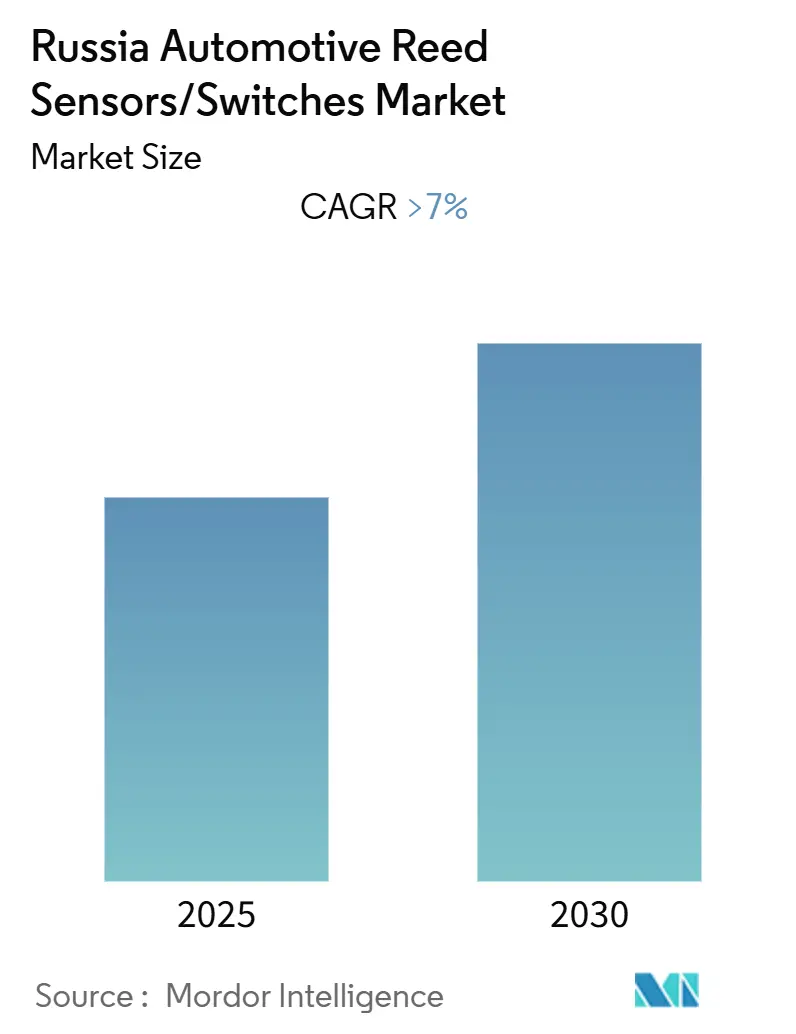
The Russia automotive reed sensors/switches market is expected to register a CAGR of greater than 7% during the forecast period.
- The automotive reed sensor/switch market is driven by demand from the end-use industry, primarily for high miniaturization and highly reliable reed switches. Reed switches are sealed, thus significantly utilized in electronic applications. Reliable data can be transferred without requiring physical contact. Even in environments containing dirt, vibration, moisture, gas, and oil, reed switches are incredibly durable, making them a popular choice for several automotive applications.
- However, high costs may hinder the market's growth. However, with growing technological advancements in sensors and switches, many new opportunities are anticipated for the forecasted period. Also, Automotive Reed switches also provide an extended product life cycle since only its internal components bend, and the electricity is wholly contained in the reeds and lead wires. As a result, manufacturers are continually making improvements to automotive reed switches to meet the changing needs of the market.
Note: Market size and forecast figures in this report are generated using Mordor Intelligence’s proprietary estimation framework, updated with the latest available data and insights as of January 2026.
Russia Automotive Reed Sensors/Switches Market Trends and Insights
Increasing use of Electronic Components
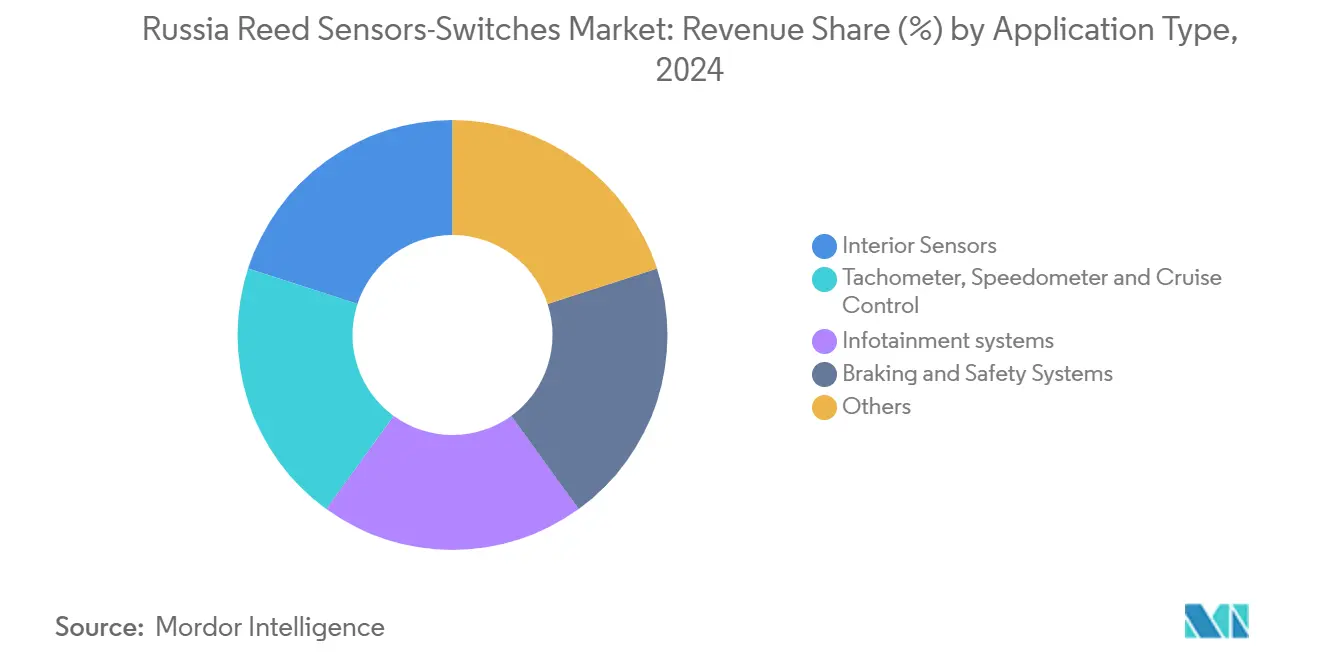
Automotive interiors typically incorporate zero power consumption and low-profile reed switch sensors to operate efficiently and safely. These may range from door lock actuation, speedometer, power window operation, infotainment, and in-vehicle navigation centres. Also, side and rear-view mirrors, cruise control and power steering, visual indicators of battery life, and interior dome lighting and emergency lights utilize reed sensors.
As the switches are free from mechanical wear and are hermetically sealed, this helps extend life. Companies also provide custom reed switches, which can be in SPST, with choice of NO or NC contacts and SPDT configurations. For instance, Reed Switch Developments Corp. offers different sized reed switches, and customers may choose from various reed materials with varying sensitivities and wattages (0.25W - 100W). A wide selection of available case materials includes Celanex, Celcon, Lexan, Epoxy, and Valox. Aluminum, stainless steel, and brass housings.
Magnetic reed switch actuators are also one of the most sold interiors. These include custom molded magnets, configured to meet user-specific mounting and operational requirements. In comparison, wire and cable options are also commonly sold, surrounded by an insulating material ranging from 18-26 AWG sizes.
Rise in Safety Features in Vehicles Driving Growth
With a rise in the number of light commercial vehicles and increasing accidents at the global level, the demand for safety features is increasing, especially in the mid-level cars. To turn down the number of accidents and enhance consumers' safety, many nations worldwide have introduced safety norms in the automotive industry.
Reed switches are also finding more significant application as a component in electric vehicle chargers. Reed switches allow chargers to detect when they're plugged into the car and how much electricity to conduct, and they also minimize the risk of electric leakage or misfiring. The increasing popularity of these eco-friendly cars means higher sales of the switches.
Today, the Reed switch market is hugely driven by the evolution of the internet of things (IoT). IoT offers an increase in automotive safety solutions and automation. However, the advanced reed switch is yet to make a mark in the market. Functional issues associated with reed switches like high demand for smaller and higher durability are becoming vital opportunities for the future.
Competitive Landscape
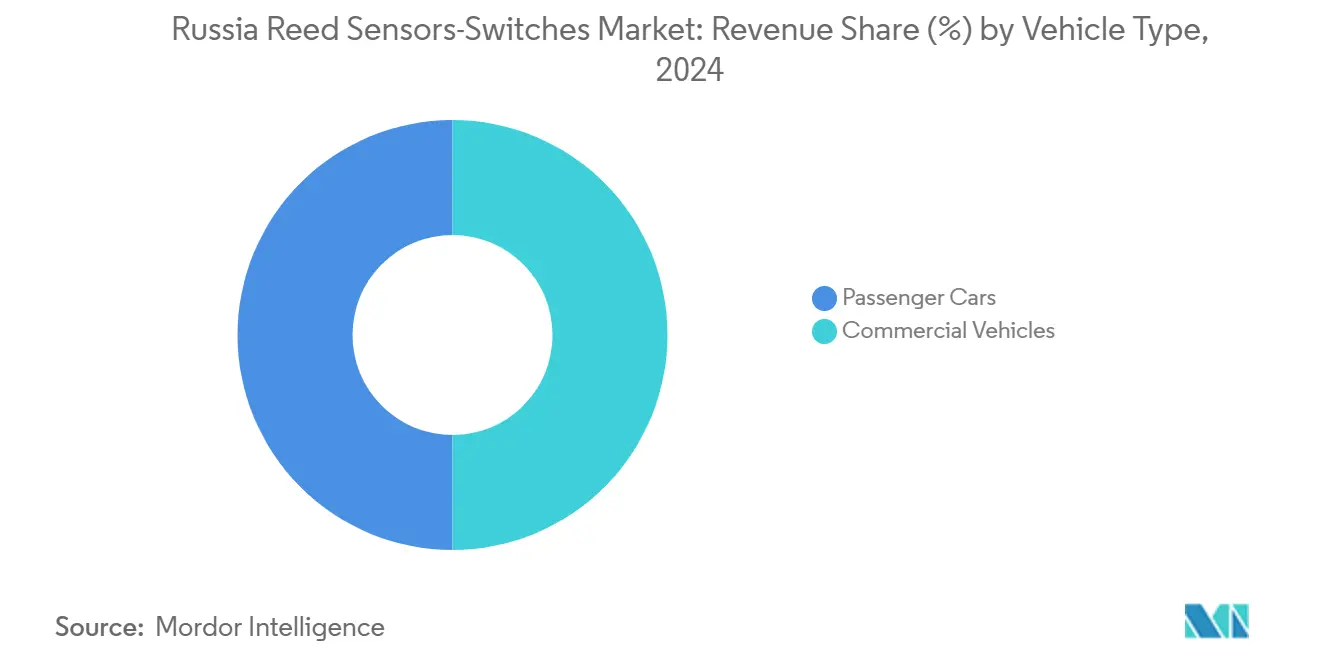
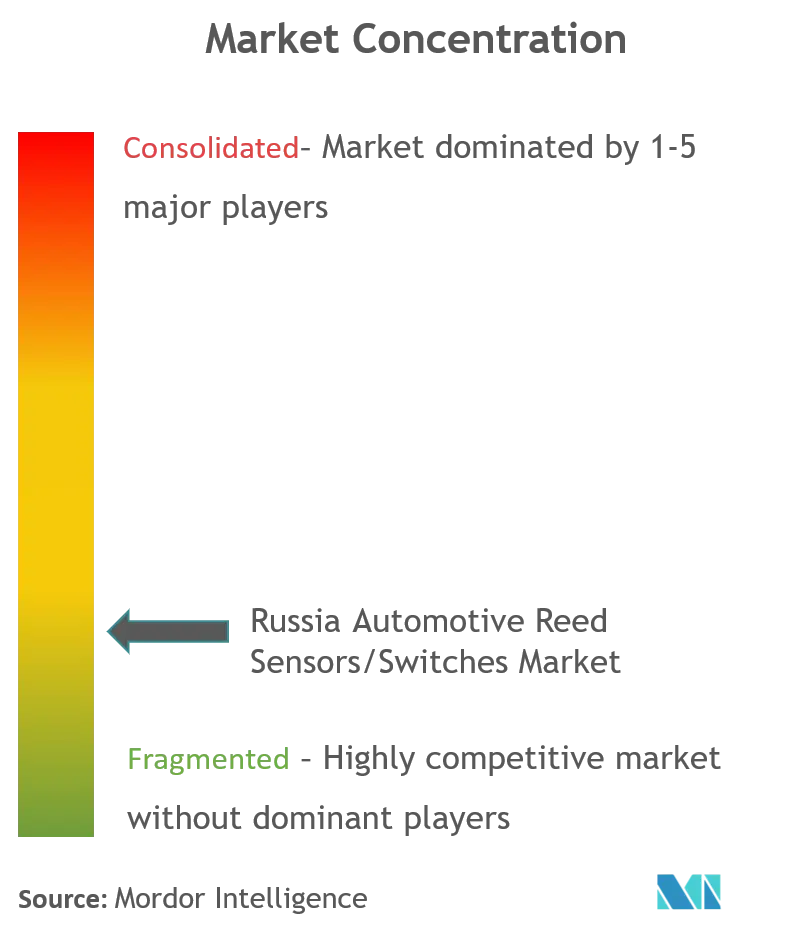
The Russia Automotive Reed Sensors/Switches is dominated with various international and regional players such as. Although to have the edge over its competitors, the major automotive reed sensors manufacturing companies are making joint-ventures, partnerships to launch newer products.
In 2019, ZF Friedrichshafen AG announced a new position and speed sensor in their sensors category. Through this launch, the company will expand its product portfolio in the reed sensor market.
In 2020, Madison Company announces its C4954-xxxxx Miniature Continuous Float Level Sensor for applications with a small tank footprint.
Russia Automotive Reed Sensors/Switches Industry Leaders
-
PIC GmbH
-
TE Connectivity
-
Standex-Meder Electronics, Inc.
-
Reed Switch Development Corporation
-
Littlefuse Inc.
- *Disclaimer: Major Players sorted in no particular order
Market Opportunities and Future Outlook
Russia's automotive import-substitution push is creating practical whitespace for locally sourced automotive electronics and subcomponents adjacent to reed sensors and switches. This is most visible where OEMs and Tier-1 suppliers are redesigning modules to fit available domestic parts. In March 2026, AvtoVAZ cited expanded localization of electronic components with more than 300 parts supplied by NPP Itelma, including instrument panels and ABS/ESC systems. That signals ongoing re-engineering and sourcing activity across vehicle electronics, where reed switches can be specified for functions such as door/hood sensing, position sensing, and auxiliary actuation feedback.
Supply-chain investments aimed at bottleneck electronics manufacturing also support a clearer path for domestically assembled sensor-switch solutions. In May 2026, the Moscow government highlighted an upcoming large-scale PCB contract manufacturing plant in the Rudnevo industrial park, including capability for 24-layer boards. In 2026, Element Group communicated plans around 32-bit RISC-V automotive microcontrollers for functions such as engine management and telematics. Alongside state-backed financing, including Industrial Development Fund support referenced for component production projects, these steps broaden local capabilities (PCBs, controllers, harnessing, and module assembly) that can pull through demand for sealed, vibration-tolerant switching and sensing elements in safety, charging, and interior applications.
Recent Industry Developments
- May 2026: The Moscow government announced the upcoming launch of a large-scale PCB contract manufacturing plant at the Rudnevo industrial park, including capability for 24-layer boards. This adds domestic capacity for automotive electronics manufacturing and module builds, which supports localization programs that can incorporate reed sensors and switches into locally assembled control and interface products.
- April 2026: TE Connectivity published its fiscal Q2 2026 update, reporting results above guidance and highlighting performance across its Transportation and Industrial segments. While not Russia-specific, the update reflects continued strategic focus and resourcing behind automotive interconnect and sensor-adjacent portfolios, which are relevant for suppliers serving OEMs and Tier-1s navigating redesign and sourcing shifts.
- December 2024: Russia continued executing its Automotive Industry Development Strategy centered on increasing localization of critical components and subcomponents via state-backed concessional financing mechanisms. The policy direction supports domestic substitution efforts across automotive electronics and related parts, which helps shape a procurement and qualification environment where localized reed sensors and switches can gain share within vehicle and charging-system applications.
Research Methodology Framework and Report Scope
Market Definition and Coverage
This market tracks the value of reed sensors and reed switches used in vehicles produced for, or sold into, Russia, where the device is used to detect position, proximity, or open-close status in an automotive system.
Scope exclusions: It excludes non-automotive reed sensors/switches and adjacent sensing technologies (such as Hall-effect devices) even when used for similar vehicle functions.
Segmentation Overview
- Application Type
- Cruise Control
- Infotainment Systems
- Safety Systems
- Others
- Vehicle Type
- Passenger Car
- Commercial Vehicle
Data Sources, Market Sizing, and Validation
Desk Research
Desk research was used to set the demand context and to anchor the model to Russia vehicle activity and automotive electronics content. We referenced public and official sources such as Russia vehicle production and sales/registration statistics from national statistics and transport agencies, UN Comtrade and national customs publications for trade flows that can proxy component availability, and standards and regulations published by bodies such as UNECE that shape in-vehicle safety and sensing requirements.
To keep the product lens practical, we also reviewed patent filings and patent office databases to map where reed switching is being engineered for automotive use, peer-reviewed journals and conference papers for reliability and design constraints, and technical notes released by suppliers that describe typical automotive use cases. General secondary sources like company filings, investor presentations, association websites, and reputed press were used to cross-check timelines and narrative claims. Where helpful, a paid subscription for company financials and intelligence and a patent database were used for cross-verification. These desk sources are illustrative only, and many other public and paid references were also used to collect data, validate assumptions, and clarify open points.
Primary Interviews and Surveys
Interviews and surveys with experts in Russia cover automakers, component suppliers, distributors, and service specialists across CXO, functional, and manager roles. Respondent input helps test reed-device content, local sourcing, ASP movement, replacement demand, and supply disruptions. Analysts then compare these findings with secondary data and reconcile the assumptions used in the market estimate.
Distribution of primary research fieldwork respondents
| Company type | Respondent position |
|---|---|
| Top tier: 30% | CXOs: 15% |
| Mid tier: 50% | Functional/Unit leaders: 30% |
| Smaller Players: 20% | Managers: 55% |
Market-Sizing & Forecasting
Sizing was built using top-down demand pool logic where Russia vehicle production and sales signals are reconstructed first, which are then translated into reed device demand using penetration and unit-content assumptions for common automotive functions (for example, door and hood position sensing and selected safety-related switching). After that structure was set, results were corroborated with selective bottom-up approximations such as sampling typical unit prices from distributor listings and applying a limited volume cross-check using implied units by application.
Inputs used in the model include vehicle production and parc trends, the share of vehicles fitted with functions that commonly use reed switching, typical sensors per application point, average selling price ranges by device type and packaging, and the share of imported content that can shift ruble-denominated pricing. For forecasting, scenario analysis was applied so vehicle output paths, feature fitment rates, and pricing progression could be stressed separately, and then aligned to the most repeated view shared in expert discussions. Where bottom-up checks had gaps, conservative interpolation tied to vehicle volumes and application penetration was used rather than forcing a full supplier roll-up.
Data Validation & Update Cycle
Outputs were validated by triangulating the demand pool, the implied units, and the implied pricing, and then comparing them with independent signals such as visible swings in Russia vehicle output and observed price movements in public catalogs. If a segment result moved sharply without a matching external trigger, the assumptions were reopened and the related interview notes were revisited before internal sign-off.
The work goes through multi-step analyst review, including a separate pass for calculation logic and year-on-year variance checks. Reports are refreshed annually, with interim updates when material events affect volumes, sourcing routes, or pricing. Before delivery, an analyst performs a fresh pass so clients receive the latest updated view.
Mordor Intelligence's Russia Automotive Reed Sensors Switches Market Size Compared With Other Published Estimates
Published market values for this niche can look inconsistent because the product scope is not always kept consistent, and because unit and price assumptions are sometimes applied as broad averages without clear links to vehicle activity. Gaps also come from base year choices, the way OEM-installed content is separated from replacement demand, and the refresh cadence used when trade and production conditions shift.
The main gap comes from whether adjacent magnetic sensors and general automotive sensor revenues are blended into the total, where Mordor Intelligence counts only reed sensors and reed switches tied to automotive use in Russia and sizes demand from vehicle production, feature fitment, and unit-content checks.
Benchmark comparison
| Source | Market Size | Gaps in Research Methodology |
|---|---|---|
| Mordor Intelligence | USD 0.13 B (2024) | |
| Regional Consultancy A | USD 0.22 B (2032) | Uses a longer-dated forward year and applies a straight CAGR build from a 2024 base, which can overstate value if vehicle volumes and fitment rates do not rise in step across the full period. |
| Industry Research Group B | USD 0.16 B (2026) | Often mixes reed devices with adjacent magnetic sensing components and applies blended ASP progression, which can lift totals compared with a reed-only count filtered by automotive application points. |
The spread across figures is largely explained by time horizon differences and by whether reed-only revenues are separated from adjacent sensor categories. When the model is anchored to vehicle activity and then cross-checked using implied units and public price signals, the resulting number stays traceable to repeatable steps.
Key Questions Answered in the Report
What is the current Russia Automotive Reed Sensors Switches Market size?
The Russia Automotive Reed Sensors Switches Market is projected to register a CAGR of greater than 7% during the forecast period (2025-2030)
Who are the key players in Russia Automotive Reed Sensors Switches Market?
PIC GmbH, TE Connectivity, Standex-Meder Electronics, Inc., Reed Switch Development Corporation and Littlefuse Inc. are the major companies operating in the Russia Automotive Reed Sensors Switches Market.
What years does this Russia Automotive Reed Sensors Switches Market cover?
The report covers the Russia Automotive Reed Sensors Switches Market historical market size for years: 2019, 2020, 2021, 2022, 2023 and 2024. The report also forecasts the Russia Automotive Reed Sensors Switches Market size for years: 2025, 2026, 2027, 2028, 2029 and 2030.