
Rotavators Market Size and Share
Market Overview
| Study Period | 2022 - 2032 |
|---|---|
| Market Size (2027) | USD 3.49 Billion |
| Market Size (2032) | USD 4.80 Billion |
| Growth Rate (2027 - 2032) | 6.55 % |
| Fastest Growing Market | Europe |
| Largest Market | Asia-Pacific |
| Market Concentration | Medium |
Major Players *Disclaimer: Major Players sorted in no particular order Image © Mordor Intelligence. Reuse requires attribution under CC BY 4.0. | |
Rotavators Market Analysis by Mordor Intelligence
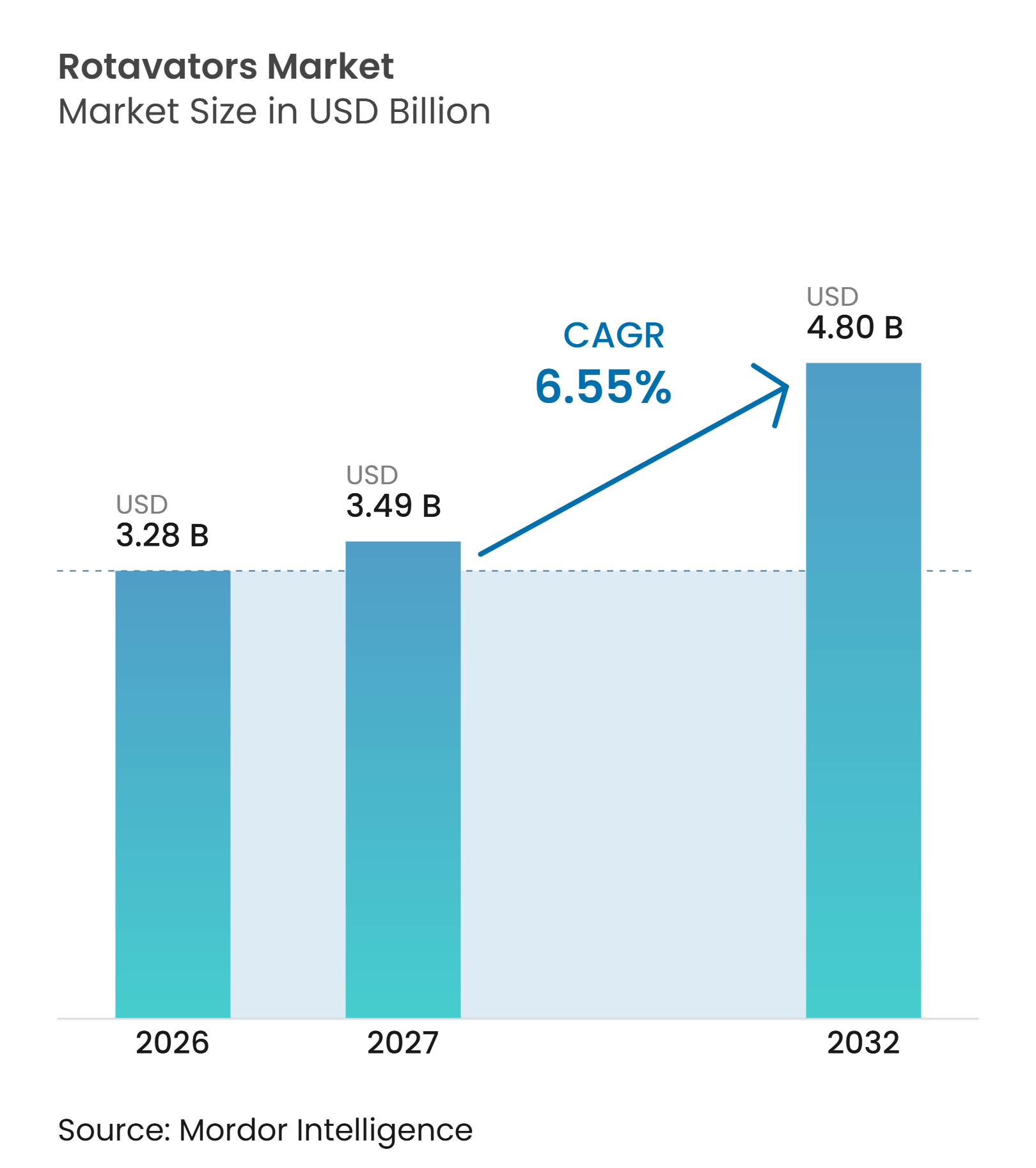
The Rotavators Market size was valued at USD 3.28 billion in 2026 and is estimated to grow from USD 3.49 billion in 2027 to reach USD 4.80 billion by 2032, at a CAGR of 6.55% during the forecast period (2027-2032). Rising farm labor costs and tighter planting schedules are increasing the value of equipment that prepares a seedbed in one pass across the Rotavators Market. Public mechanization programs and shared-equipment services are widening access for farms that cannot justify individual ownership, bringing new users into the Rotavators Market. Manufacturers are responding with heavier-duty models, connected implements, and service packages that support intensive use. Demand is likely to remain shaped by the balance between affordable standard equipment and higher-capacity products for commercial farms and rental fleets. High acquisition costs, limited rural financing, and uneven repair coverage remain material barriers, particularly in developing farm economies that are important to the Rotavators Market and where the value of a machine depends heavily on timely local support, practical financing, and predictable rental availability.
Key Report Takeaways
-
By product type, Standard Rotavators were the largest segment with 44.3% revenue share in 2026, while Heavy-Duty Rotavators are the fastest-growing segment with a projected 7.6% CAGR through 2032.
-
By power range, 20 to 50 HP was the largest segment, with 41.7% of Rotavator market share in 2026, while Above 50 HP is the fastest-growing segment, with a projected 8.2% CAGR through 2032.
-
By operation, Tractor-Mounted Rotavators were the largest segment with a 28.4% share in 2026, while Self-Propelled Rotavators are the fastest-growing segment with a projected 9.1% CAGR through 2032.
-
By end user, Mid-Sized Farms were the largest segment with a 32.3% share in 2026, while Rental Services and Custom Hiring Centers are the fastest-growing segments with a projected 8.9% CAGR through 2032.
-
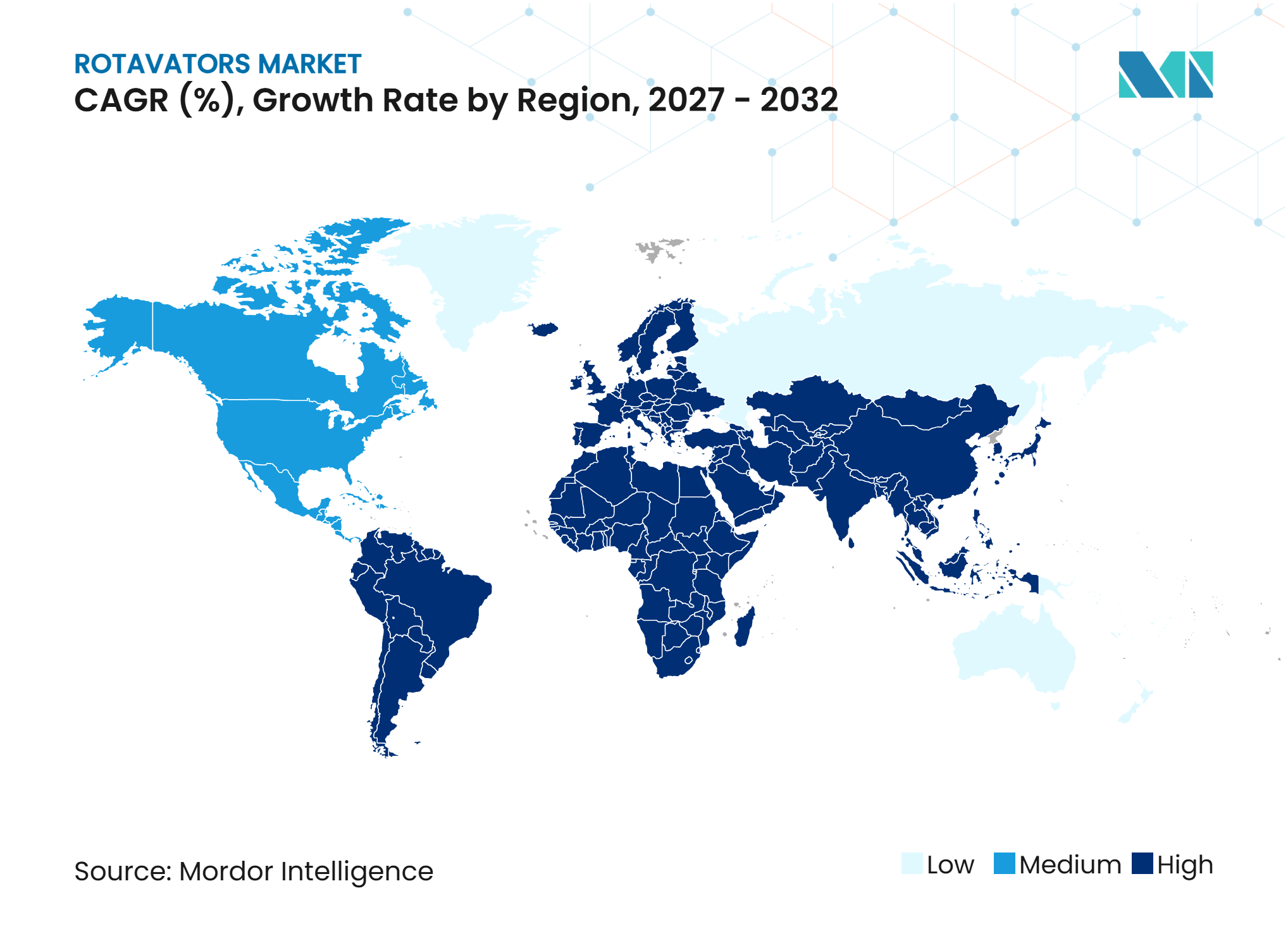
By geography, Asia-Pacific was the largest segment, with 55.8% of the Rotavators Market share in 2026, while Europe is the fastest-growing segment, with a projected 8.7% CAGR through 2032.
Note: Market numbers in this report are based on Mordor Intelligence's proprietary estimation framework, which combines nine months of actuals with Q4 projections for base year 2026.
Market Trends and Insights
Drivers Impact Analysis of Rotavators Market*
| Driver | (~) % Impact on CAGR Forecast | Geographic Relevance | Impact Timeline |
|---|---|---|---|
| Farm Mechanization and Narrower Planting Windows | +1.2% | Global, concentrated in South Asia and Southeast Asia | Short term (≤ 2 years) |
| Government Subsidies and Custom Hiring Access | +1.1% | South Asia, East Asia, and emerging African markets | Medium term (2-4 years) |
| Crop Residue Incorporation and Stubble Burning Restrictions | +0.9% | India, China, and Europe | Medium term (2-4 years) |
| Tractor and Implement Integration With Precision Controls | +0.8% | North America, Western Europe, and East Asia | Medium term (2-4 years) |
| Digital Rotavators That Optimize Tractor Speed and Fuel Use | +0.7% | Europe, North America, and advanced Asia-Pacific markets | Long term (≥ 4 years) |
| Short-Window Multi-Cropping Creates Demand for Single-Pass Tillage | +0.6% | Southeast Asia and South Asia | Medium term (2-4 years) |
| Source: Mordor Intelligence | |||
Farm Mechanization and Narrower Planting Windows
Labor shortages are a persistent driver of rotavator adoption, but the limited time between crop cycles is often the more immediate purchase trigger, as it directly affects whether the next crop can be planted on schedule. In rice and wheat systems, harvesting and planting may be separated by only 10 to 15 days in northern India, leaving little capacity for repeated field passes or delayed access to hired labor. Tractor-mounted equipment helps farmers prepare a fine seedbed without requiring a separate tillage pass, making the available tractor time more productive for both owners and Custom Hiring Center operators. A 2025 study of agricultural implement demand in Madhya Pradesh reported an upward trend in rotavator adoption linked to labor shortages and changing cropping patterns, rather than a temporary change in equipment preference. The study indicates that demand can continue beyond a one-time subsidy cycle because the equipment addresses routine operating pressures during each planting season. The Food and Agriculture Organization of the United Nations and the Organization for Economic Co-operation and Development expect productivity improvements, rather than land expansion, to drive agricultural output growth in Asia and Africa, supporting continued interest in timely mechanized field preparation.
Government Subsidies and Custom-Hiring Access
Public support programs and Custom Hiring Centers, abbreviated as CHCs, convert interest in mechanization into access to practical equipment for farms that cannot absorb the full cost of ownership. India’s revised Sub-Mission on Agricultural Mechanization guidelines for 2025 provide 40%-50% financial assistance for eligible rotavator purchases, reducing the initial financial burden for eligible applicants. The higher support rate is available to small, marginal, women, and Scheduled Caste or Scheduled Tribe farmers under the stated eligibility conditions[1]. CHCs separate equipment use from ownership, allowing small farms to hire machinery for the short field window that matters most while avoiding a purchase that could be underused for much of the year. This model also creates repeat demand for servicing, parts, and eventual replacement units because equipment is used across multiple farms rather than only one holding. China’s 2025 agricultural policy similarly prioritizes high-performance and intelligent farm machinery by providing direct procurement support to farm households.
Crop Residue Incorporation and Stubble Burning Restrictions
Restrictions on open-field residue burning are supporting demand for models that chop and mix stubble into the soil in one pass, especially where farmers must act quickly after paddy harvesting. India’s Commission for Air Quality Management issued Direction No. 95 in October 2025, strengthening accountability for the enforcement of the paddy-stubble-burning ban in Punjab, Haryana, and nearby districts. This regulatory direction makes residue-management equipment more relevant to farmers and service providers because the machine can complete residue incorporation and soil preparation within the same working period. A 2025 research paper found that the ban reduced fire counts by 30% relative to the pre-ban mean, although its effect weakened when enforcement fell[2]. The finding shows why consistent enforcement matters for sustained equipment demand and why manufacturers benefit when local service networks are ready during the post-harvest season. Hunan Province’s crop-residue rules, effective from March 2025, give priority to returning straw to fields and support mechanized rotary tillage for that purpose.
Tractor and Implement Integration with Precision Controls
Electronics that connect the implement to the tractor are changing the role of the rotavator in precision farming, moving it beyond a stand-alone mechanical attachment. ISOBUS, an international communication standard for farm equipment, supports data exchange between compatible tractors and implements and can simplify how operators control field work. Global Positioning System-linked depth control and automatic speed adjustment can help operators match tillage settings to changing soil conditions, which is useful where fuel use and field consistency are closely monitored. These functions are most developed in Western Europe and North America, where mid- and high-horsepower equipment is commonly used in precision systems and farm data platforms. Compatibility with a tractor terminal and farm management software can affect replacement decisions as strongly as the equipment brand when a farm seeks to avoid disconnected systems. The Rotavators Market therefore rewards manufacturers that can provide open-standard electronics, practical setup support, and dealers able to service the combined tractor and implement system.
Restraints Impact Analysis of Rotavators Market*
| Restraint | (~) % Impact on CAGR Forecast | Geographic Relevance | Impact Timeline |
|---|---|---|---|
| High Upfront Cost and Weak Smallholder Financing | -0.9% | Sub-Saharan Africa, South Asia, and Southeast Asia | Medium term (2-4 years) |
| Blade, Bearing, and Hydraulic Wear During Peak-Season Use | -0.5% | Global, especially areas with limited dealer coverage | Medium term (2-4 years) |
| Soil Structure and Moisture Retention Concerns From Intensive Tillage | -0.6% | Europe and North America | Long term (≥ 4 years) |
| Rural Service Gaps and Skilled Operator Scarcity | -0.4% | Sub-Saharan Africa, inland Southeast Asia, and mountainous South Asia | Long term (≥ 4 years) |
| Source: Mordor Intelligence | |||
High Upfront Cost and Weak Smallholder Financing
The purchase price of a mid-specification tractor-mounted rotavator can exceed the annual net income of a marginal farm household in India or Bangladesh several times over, making ownership a difficult decision even when the equipment could improve timeliness. A 2025 study in northern Bangladesh found that 56.8% of surveyed households had adopted a rotavator, while adoption of other precision machinery remained below 2.5%, showing that farms make selective choices based on immediate practical value. The results point to equipment uptake based on cost and operating benefits rather than broad adoption of every available technology. Limited farm lending, weak documentation, and collateral requirements make the problem more severe in many African markets where formal credit is harder to obtain. Subsidies reduce the purchase cost but may not remove the need for affordable credit, insurance, and predictable payment terms. CHCs offer a practical alternative, although their availability remains uneven outside district centers and may not coincide with every farmer’s required field date.
Blade, Bearing, and Hydraulic Wear During Peak-Season Use
Rotavators work under high stress when harvest and planting happen close together, leaving little room for extended maintenance or delays in obtaining replacement parts. Wet soil, dense residue, and excessive loading can accelerate wear on blades, bearings, and hydraulic systems, especially when equipment is used continuously by a rental operator. A failure during a short planting window can leave a farm without enough time to finish preparation before the next crop should be planted. Replacement parts and repair work can make the total ownership cost substantial over several years of intensive operation, even when the original equipment price appeared manageable. The constraint is sharper in areas where authorized dealers and genuine spare parts are not readily available, since transport and ordering delays can turn a minor repair into several lost field days. Manufacturers with local parts inventories, trained technicians, and condition-monitoring tools are better placed to limit this risk and strengthen the value of their equipment after the original sale.
*Our forecasts treat driver/restraint impacts as directional, not additive. The impact forecasts reflect baseline growth, mix effects, and variable interactions.
Rotavators Market Segment Analysis
By Product Type:
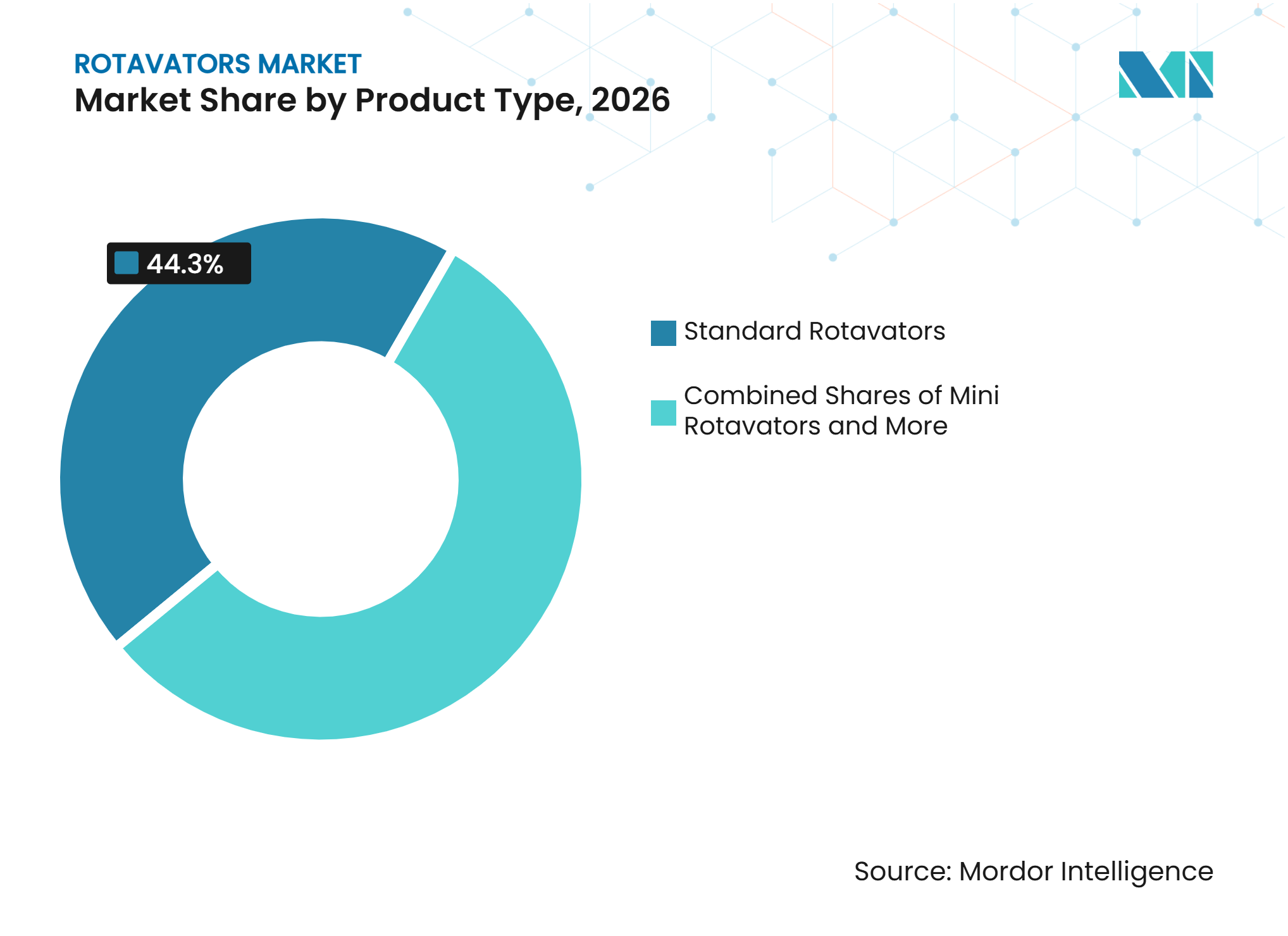
Standard Models Remain Largest While Heavy-Duty Equipment Grows FastestStandard Rotavators held 44.3% of the Rotavator market share in 2026, making them the largest product segment. Their cost and operating profile suit the 1- to 5-hectare holdings that make up a large part of farming activity across South Asia and Southeast Asia. Working widths of 4 to 6 feet and compatibility with 35 to 60-horsepower tractors allow the equipment to be used across a range of soil conditions and crop cycles. The familiar blade design also makes routine maintenance more manageable for local operators, dealers, and rental fleets. Individual farmers and Custom Hiring Centers select these products when they need dependable seedbed preparation without the power, price, and transport requirements associated with wider heavy-duty products.
Mini Rotavators remain relevant for small plots, terrace paddy systems, and locations where slopes or narrow field boundaries restrict tractor access. Japan, Vietnam, and Nepal provide settings in which these compact products can address field conditions that standard equipment cannot easily handle. A 2025 study of wheat-growing farms in Nepal found that 85.8% of surveyed farmers used rotavators for land preparation, and compact equipment was important in hilly areas. Heavy-Duty Rotavators are the fastest-growing product segment, with the Rotavators Market size for this segment forecast to grow at a 7.6% CAGR through 2032. Mahindra and Mahindra Ltd. launched the Mahavator and Mahavator HD series in March 2026, covering 4 to 9-foot models and including a Tez-e intelligent variant with Bluetooth connectivity for field data use[3].



By Power Range:
Mid-Power Equipment Is Largest and High-Power Equipment Is FastestThe 20-50 horsepower range accounted for 41.7% of Rotavators market share in 2026, making it the largest power segment. It matches the 35 to 55 horsepower tractor fleets that are common in India, China, and Southeast Asia. Equipment in this range can prepare wet paddy, cereal, and vegetable fields without the acquisition and operating demands of a large commercial tractor. It covers standard and mid-duty rotavators commonly selected by individual farmers and Custom Hiring Centers. This balance of field coverage, fuel use, tractor compatibility, and purchase cost supports broad use where average farm sizes are moderate.
Products below 20 horsepower serve compact tractors and power tillers used in horticulture, terracing, and small plots. Japan’s agricultural implement production increased 11.8% year over year in 2025, reflecting ongoing replacement demand in smaller soil-preparation equipment categories. Products above 50 horsepower are the fastest-growing segment, with the Rotavators Market size forecast to grow at an 8.2% CAGR through 2032. Large tractors are increasingly paired with 8- to 12-foot heavy-duty rotavators for single-pass work in cereal and oilseed fields in Eastern Europe, Australia, Brazil, and other large-farm environments. India’s 2025 mechanization guidelines support rotavators up to 9 feet, facilitating comparison between high-output and mid-duty products for Custom Hiring Center procurement.
By Operation:
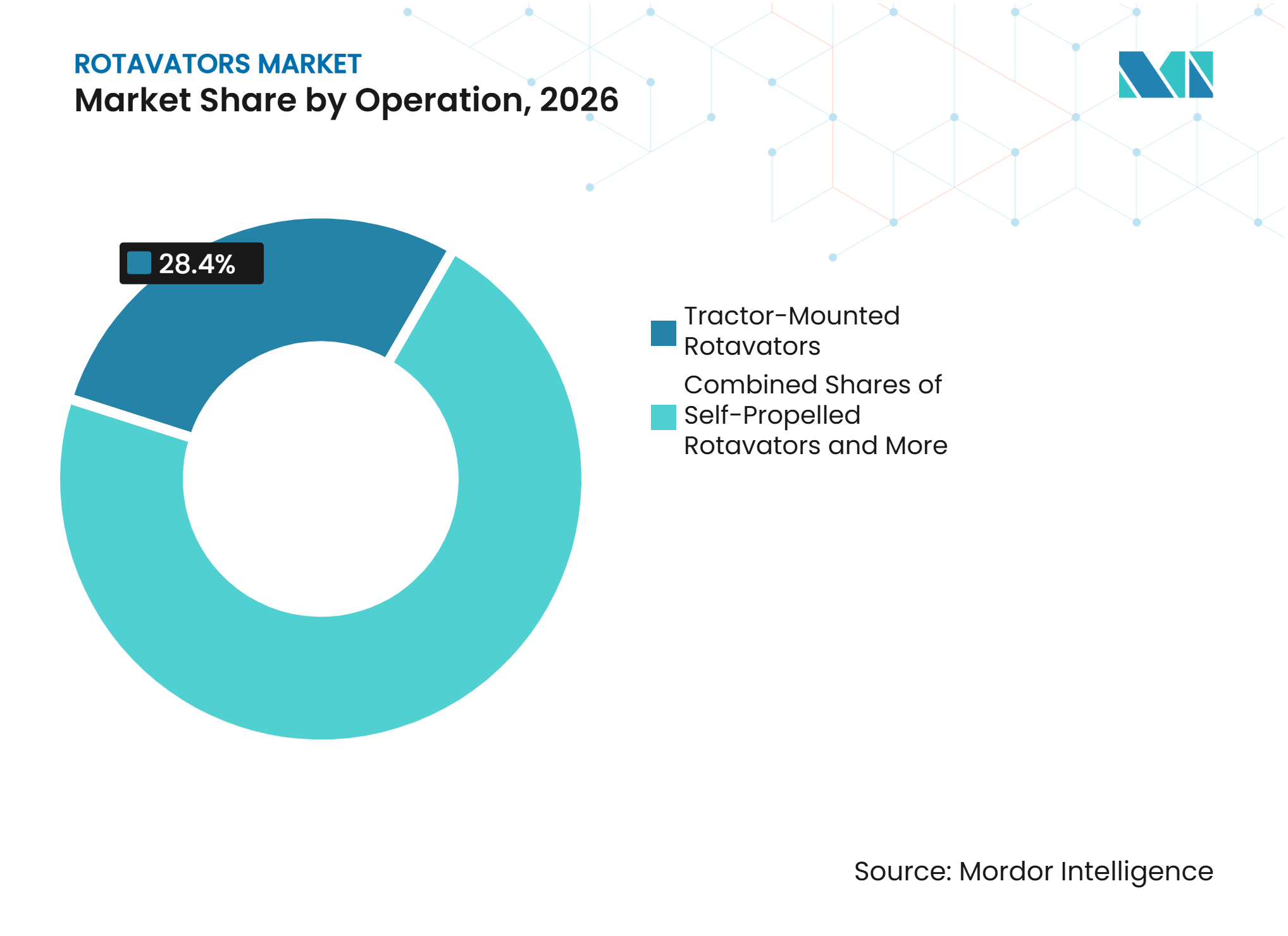
Tractor-Mounted Products Are Largest and Self-Propelled Products Are FastestTractor-Mounted Rotavators represented 28.4% of Rotavators Market share in 2026, making them the largest operating category. Their position reflects an established base of owned and rented tractors across major agricultural markets. Power take-off (PTO) configurations give farmers a familiar method for using an implement within the tractor’s appropriate horsepower range. The same tractor can handle field preparation and other work, improving the utilization of an asset already owned or hired. These operating advantages keep tractor-mounted systems important for farm owners, service providers, and rental fleets that value straightforward equipment combinations.
Self-Propelled Rotavators are the fastest-growing segment, with a projected 9.1% CAGR through 2032. Large farms in Europe and North America are considering autonomous and semi-autonomous products to reduce labor dependence during short operating windows. In Asia, walk-behind electric cultivators serve a separate need among small farms and in terraced landscapes where larger equipment is less practical. China Agricultural University reported in 2025 that an electric micro-tiller achieved an average depth of 122.3 millimeters and a width of 703.1 millimeters, meeting performance standards for small and medium rotavators. Electric equipment and manual products consequently serve different parts of the Rotavators Market, while European soil rules can encourage the use of precision systems that limit unnecessary disturbance.

By End User:
Mid-Sized Farms Are Largest and Rental Services and Custom Hiring Centers Are FastestMid-Sized Farms held a 32.3% share in 2026, making them the largest end-user segment. Holdings of 5 to 50 hectares can often support individual ownership when their seasonal workload creates sufficient equipment use. Double-cropping patterns improve the case for ownership because rotavators can be used repeatedly during the same year. These farms also tend to have tractor capacity suitable for standard and heavy-duty implements. Large commercial farms typically choose wide-cut models for faster coverage, while smallholder farmers remain more dependent on rental access than on ownership.
Rental Services and Custom Hiring Centers are the fastest-growing end-user segment, with a projected 8.9% CAGR through 2032. Their model spreads a machine’s cost across many users and can give price-sensitive farms access to equipment when they need it most. Operators prioritize fuel consumption, parts availability, repair response time, and uptime because these factors determine whether the fleet can serve multiple farms within a short season. This buyer behavior makes the Rotavators Market more attractive to suppliers that pair equipment with dependable service networks. Fleet scheduling, digital monitoring, and preventive maintenance are increasingly relevant as rental operations become more formalized.
Geography Analysis
Asia-Pacific: Broad Mechanization Needs Support the Largest Regional Position
Asia-Pacific accounted for 55.8% of Rotavators Market share in 2026 and was the largest geography. India and China support this position through intensive crop systems, large smallholder populations, and national programs that promote mechanization. India’s 2025 Sub-Mission on Agricultural Mechanization guidelines provide eligible support for individual purchases and Custom Hiring Centers. China’s 2025 policy prioritizes intelligent and high-performance machinery, including support for farm households' procurement. Vietnam and Indonesia provide room for growth as rice producers replace repeated passes with one-pass field preparation.
Japan remains a replacement market, where equipment demand is supported by an aging farm fleet and continued investment in appropriate small machinery. Data from the Japan Agricultural Machinery Manufacturers Association showed 11.8% year-over-year growth in total implement production in 2025. Australia supports a different pattern of demand because large grain farms use equipment with more than 50 horsepower for broader coverage. Across the region, the ongoing shift from individual ownership to shared access expands the customer base beyond farmers who can purchase implements outright. The combination of subsidies, rental services, and diverse farm structures keeps product needs varied within the Rotavators Market.
Europe: Regulatory Requirements Support the Fastest Regional Growth
Europe is the fastest-growing region, with the Rotavators Market size forecast to grow at an 8.7% CAGR through 2032. The European Union Common Agricultural Policy and Good Agricultural and Environmental Conditions influence equipment decisions at farms receiving payments. Good Agricultural and Environmental Conditions 3 addresses restrictions on stubble burning, and Good Agricultural and Environmental Conditions 6 covers minimum soil cover. These requirements support shallow-pass and residue-incorporating equipment that can manage organic matter while protecting soil condition. This regulatory influence shifts attention from deep conventional tillage toward controlled, precise field preparation.
Germany, France, and Italy remain important markets for premium precision equipment. Poland, Hungary, and the Czech Republic are also gaining relevance as larger operating units emerge through farm consolidation. Russia supports demand for wide-cut heavy-duty equipment on large commercial grain farms, although supply limitations can affect access to Western premium products. The United Kingdom and Spain sustain demand through mixed livestock and cereal systems. Compliance with European Union requirements and the broader focus on soil monitoring create a reason to replace older equipment with products better suited to low-disturbance operation.
North America, South America, the Middle East, and Africa: Distinct Equipment Requirements Shape Demand
North America is a mature geography where large farms assess equipment partly on its ability to work with precision agriculture platforms. Strip-till and no-till practices moderate demand for conventional products and support interest in hybrid residue-management designs. Mexico differs from the United States and Canada in that smaller vegetable and grain farms commonly use 20- to 50-horsepower equipment. Brazil and Argentina use heavy-duty equipment for soybean and sugarcane field preparation, while Turkey’s grain and vegetable base supports steady demand for tractor-mounted implements. South Africa has a more established commercial farming base, but Nigeria and Egypt remain in the early stages of mechanization, where financing, access to technology, and service capacity will shape uptake.
Competitive Landscape
Market Concentration
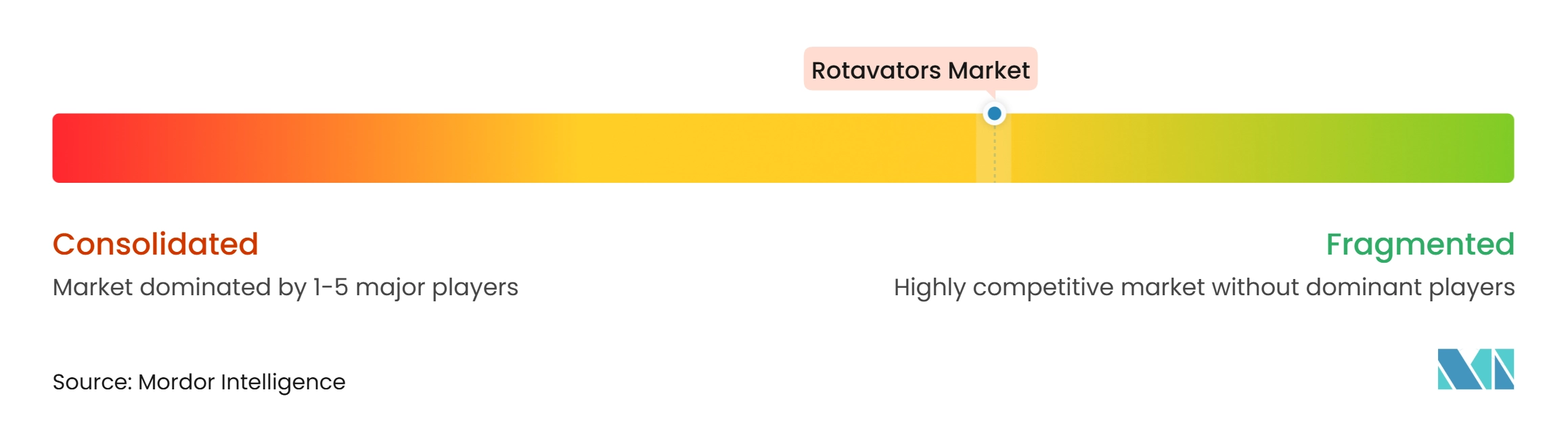
The Rotavators Market is moderately fragmented, with global agricultural original equipment manufacturers competing alongside specialist implement producers and regional suppliers. Key participants in the rotavators industry include Mahindra and Mahindra Ltd., Kubota Corporation, Deere & Company, CNH Industrial N.V., AGCO Corporation, MASCHIO GASPARDO S.p.A., Tirth Agro Technology Private Limited, Foton Lovol International Heavy Industry Co., Ltd., and YTO Group Corporation. Large OEMs benefit from established dealer coverage, financing options, and broader machinery portfolios. These capabilities matter in Custom Hiring Center procurement, where buyers may source tractors, implements, maintenance arrangements, and service support through the same supplier. Specialist manufacturers compete through products designed for vegetable, cereal, vineyard, and other crop uses.
MASCHIO GASPARDO S.p.A. offers product configurations for these uses, allowing it to serve specialty farming applications that broader tractor manufacturers may address less directly. Product connectivity is also becoming a meaningful basis for competition in the rotavators industry. ISOBUS-compatible controls, automatic speed adjustment, and equipment data can make a rotavator easier to use with a precision farming system. Mahindra and Mahindra Ltd. introduced the Tez-e intelligent rotavator with Bluetooth-based field data connectivity in March 2026. GRIMME Landmaschinenfabrik GmbH and Co. KG launched the GF 400 rotary tiller in September 2025 with a redesigned rotor, new tine geometry, a quick-change tine system, and a weight-optimized frame.
CLAAS KGaA mbH deepened its collaboration with AgXeed in 2025, extending its work on autonomous solutions integrated with the CLAAS connect digital ecosystem. Autonomous and semi-autonomous systems create an opportunity in Western Europe and North America, while electrical compact products address smaller Asian plots and terraces. ISO 11684, European Union conformity requirements, and Bureau of Indian Standards certification under India’s Agricultural Implements Quality Control Order affect market access and subsidy-linked procurement. These compliance requirements can raise barriers for new suppliers, but the reported range of participants supports a competitive structure in the rotavators industry, rather than control by a few companies.
Rotavators Industry Leaders
-
Mahindra & Mahindra Ltd.
-
Kubota Corporation
-
Deere & Company
-
MASCHIO GASPARDO S.p.A.
-
Tirth Agro Technology Private Limited
- *Disclaimer: Major Players sorted in no particular order
Rotavators Market Companies Covered in this Report
- Mahindra & Mahindra Ltd.
- Kubota Corporation
- Deere & Company
- MASCHIO GASPARDO S.p.A.
- Tirth Agro Technology Private Limited
- Tractors and Farm Equipment Limited
- CNH Industrial N.V.
- AGCO Corporation
- Yanmar Holdings Co., Ltd.
- CLAAS KGaA mbH
- SDF S.p.A.
- Bucher Industries AG
- Foton Lovol International Heavy Industry Co., Ltd.
- YTO Group Corporation
- Escorts Kubota Limited
Recent Industry Developments in Rotavators Market
- March 2026: Mahindra and Mahindra Ltd. launched the Mahavator and Mahavator HD rotavator series across the 4 to 9 feet heavy-duty category from its manufacturing facilities in Nabha, Punjab, and Zaheerabad, Telangana. The company also introduced the Tez-e Intelligent Rotavator with patented Bluetooth field-data connectivity.
- September 2025: GRIMME Landmaschinenfabrik GmbH and Co. KG launched the new generation GF 400 rotary tiller with its Go-Clean concept at Agritechnica 2025. The product includes a redesigned rotor, new tine geometry, a quick-change tine system, and a weight-optimized frame that reduces drive-force requirements.
- April 2025: India’s Central Mechanical Engineering Research Institute, abbreviated as CSIR-CMERI, unveiled the E-Tractor and E-Tiller at Ludhiana during an 11-city demonstration campaign. The equipment was designed for small and marginal farmers and emphasized zero emissions, low vibration, and ergonomics.
Global Rotavators Market Report Scope
Rotavators are agricultural implements that break, pulverize, and mix soil using rotating blades. They prepare a fine seedbed, incorporate crop residues, and improve soil conditions for sowing while reducing the need for multiple tillage operations.
The Rotavators Market is Segmented by Product Type (Standard, Mini, Heavy-Duty Rotavators), Power Range (Below 20 HP, 20–50 HP, Above 50 HP), Operation (Tractor-Mounted, Self-Propelled, Electric, Manual), End User (Smallholder Farmers, Mid-Sized Farms, Large Commercial Farms, Agri-Equipment Service Providers, Rental and Custom Hiring Centers), and Geography (North America, South America, Europe, Asia-Pacific, Middle East, Africa). Market Forecasts are Provided in Terms of Value (USD).
Segmentation Overview
| Standard Rotavators |
| Mini Rotavators |
| Heavy-Duty Rotavators |
| Below 20 HP |
| 20 to 50 HP |
| Above 50 HP |
| Tractor-Mounted Rotavators |
| Self-Propelled Rotavators |
| Electric Rotavators |
| Manual Rotavators |
| Smallholder Farmers |
| Mid-Sized Farms |
| Large Commercial Farms |
| Agri-Equipment Service Providers |
| Rental Services and Custom Hiring Centers |
| North America | United States |
| Canada | |
| Mexico | |
| Rest of North America | |
| South America | Brazil |
| Argentina | |
| Rest of South America | |
| Europe | Germany |
| France | |
| Italy | |
| Spain | |
| Russia | |
| United Kingdom | |
| Rest of Europe | |
| Asia-Pacific | China |
| India | |
| Japan | |
| Indonesia | |
| Thailand | |
| Vietnam | |
| Australia | |
| Rest of Asia-Pacific | |
| Middle East | Saudi Arabia |
| United Arab Emirates | |
| Turkey | |
| Rest of Middle East | |
| Africa | South Africa |
| Egypt | |
| Nigeria | |
| Rest of Africa |
| By Product Type | Standard Rotavators | |
| Mini Rotavators | ||
| Heavy-Duty Rotavators | ||
| By Power Range | Below 20 HP | |
| 20 to 50 HP | ||
| Above 50 HP | ||
| By Operation | Tractor-Mounted Rotavators | |
| Self-Propelled Rotavators | ||
| Electric Rotavators | ||
| Manual Rotavators | ||
| By End User | Smallholder Farmers | |
| Mid-Sized Farms | ||
| Large Commercial Farms | ||
| Agri-Equipment Service Providers | ||
| Rental Services and Custom Hiring Centers | ||
| By Geography | North America | United States |
| Canada | ||
| Mexico | ||
| Rest of North America | ||
| South America | Brazil | |
| Argentina | ||
| Rest of South America | ||
| Europe | Germany | |
| France | ||
| Italy | ||
| Spain | ||
| Russia | ||
| United Kingdom | ||
| Rest of Europe | ||
| Asia-Pacific | China | |
| India | ||
| Japan | ||
| Indonesia | ||
| Thailand | ||
| Vietnam | ||
| Australia | ||
| Rest of Asia-Pacific | ||
| Middle East | Saudi Arabia | |
| United Arab Emirates | ||
| Turkey | ||
| Rest of Middle East | ||
| Africa | South Africa | |
| Egypt | ||
| Nigeria | ||
| Rest of Africa | ||
Key Questions Answered in the Report
What is the projected growth rate for rotavators through 2032?
The Rotavators Market is projected to grow at a 6.55% CAGR from 2027 to 2032, reaching USD 4.80 billion by 2032.
Which rotavator product type has the largest share?
Standard Rotavators were the largest product type, accounting for 44.3% share in 2026.
Which power range is growing fastest for rotavators?
Above 50 horsepower equipment is the fastest power range, with a projected CAGR of 8.2% through 2032.
Why are Custom Hiring Centers important for rotavator demand?
Custom Hiring Centers allow small farms to access equipment without purchasing it, while creating recurring demand for service, parts, and replacement units.
Which region leads rotavator demand?
Asia-Pacific was the largest region with 55.8% share in 2026, supported by intensive cropping and mechanization programs.
What is limiting wider rotavator adoption?
High upfront costs, limited smallholder financing, repair coverage gaps, and concerns around intensive tillage remain key constraints.