
Rooftop Solar Photovoltaic (PV) Module Market Size and Share
Market Overview
| Study Period | 2022 - 2032 |
|---|---|
| Market Size (2027) | USD 71.48 Billion |
| Market Size (2032) | USD 107.67 Billion |
| Growth Rate (2027 - 2032) | 8.54 % |
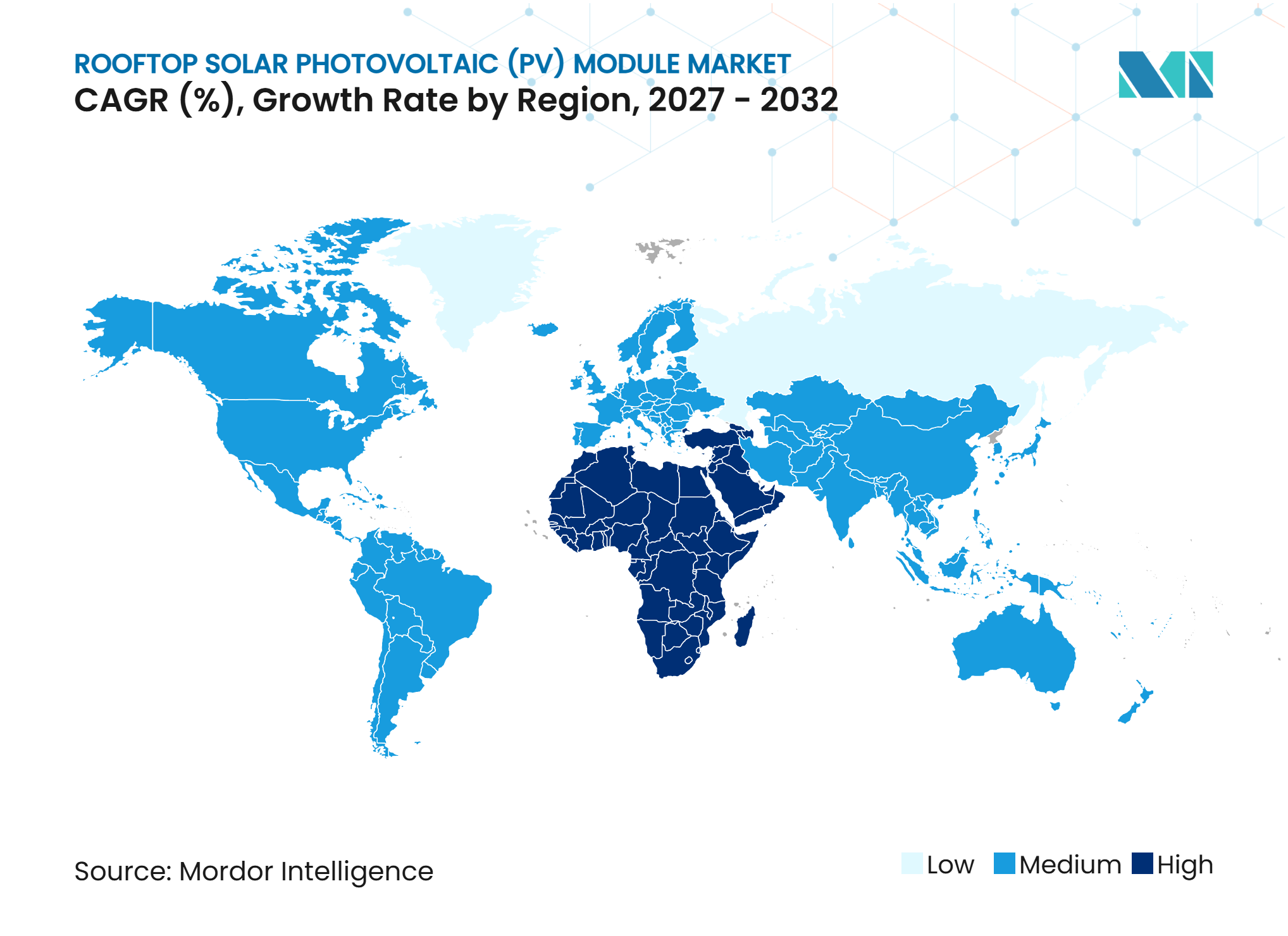
| Fastest Growing Market | Middle East and Africa |
| Largest Market | Asia-Pacific |
| Market Concentration | Medium |
Major Players *Disclaimer: Major Players sorted in no particular order Image © Mordor Intelligence. Reuse requires attribution under CC BY 4.0. | |
Rooftop Solar Photovoltaic (PV) Module Market Analysis by Mordor Intelligence
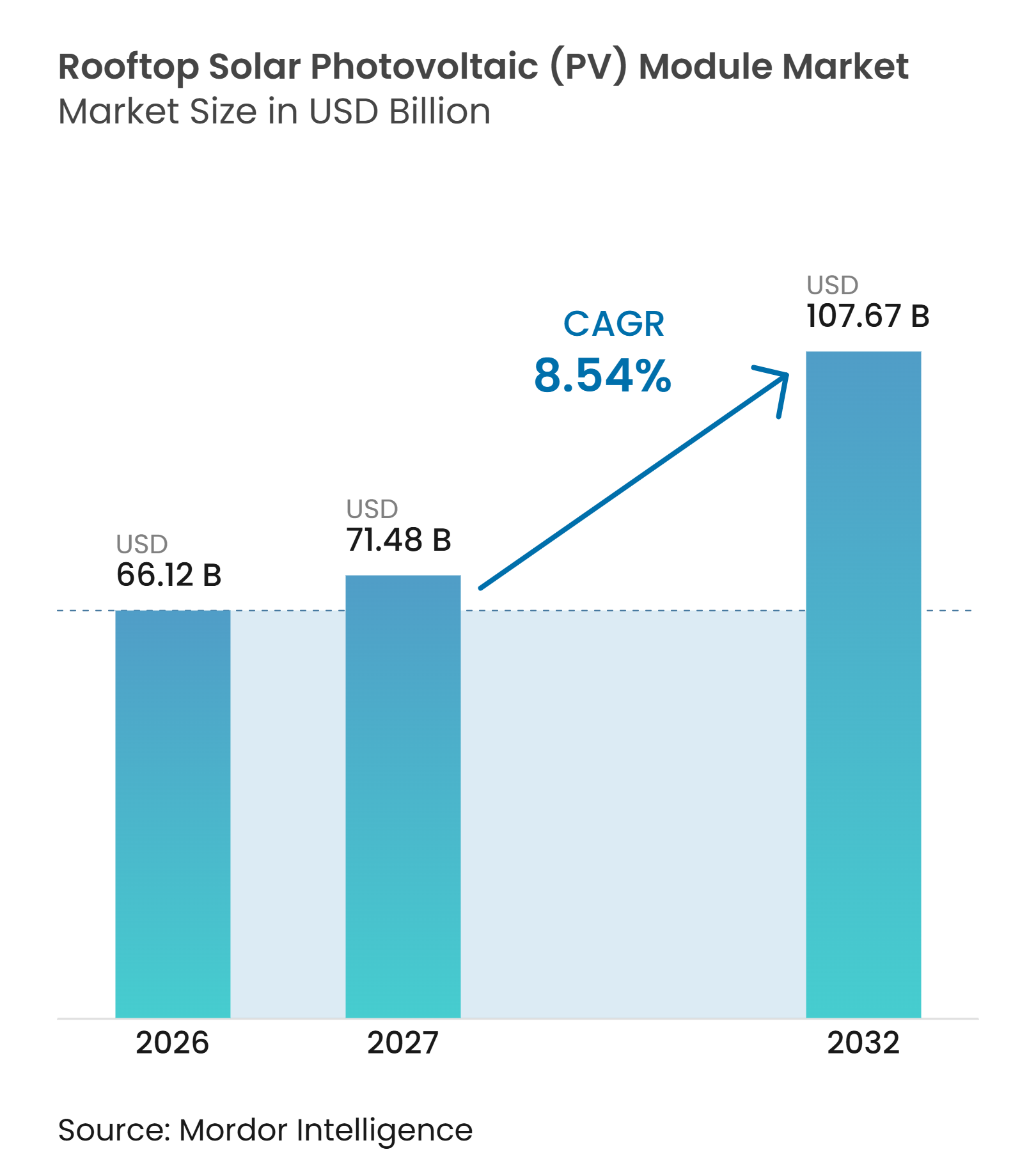
The Rooftop Solar Photovoltaic Module Market size is expected to grow from USD 66.12 billion in 2026 to USD 71.48 billion in 2027 and is forecast to reach USD 107.67 billion by 2032 at 8.54% CAGR over 2027-2032. Falling module prices have shortened project payback periods and made rooftop systems more viable for commercial and industrial buyers that previously relied on financial incentives, particularly where daytime demand is high and roof space can be used without major construction changes. Building rules in Europe and distributed PV rules in China are making solar part of building compliance in key locations, which gives developers better demand visibility and encourages earlier consideration of solar during design, permitting, and facility investment decisions. Higher electricity costs are also moving buyers toward self-generation and storage-backed systems that can reduce peak-demand exposure, improve continuity of supply, and limit the financial impact of changing retail tariffs or lower export compensation. The Global rooftop solar photovoltaic (PV) module market is increasingly shaped by grid access, equipment quality, the ability to use power on site rather than export it, the readiness of existing building roofs, and the availability of installers with technical and compliance capabilities.
Key Report Takeaways
- By module type, Tunnel Oxide Passivated Contact (TOPCon) held 41.6% of the Global rooftop solar photovoltaic (PV) module market share in 2026, while Heterojunction Technology (HJT) is projected to grow at a 10.2% CAGR through 2032.
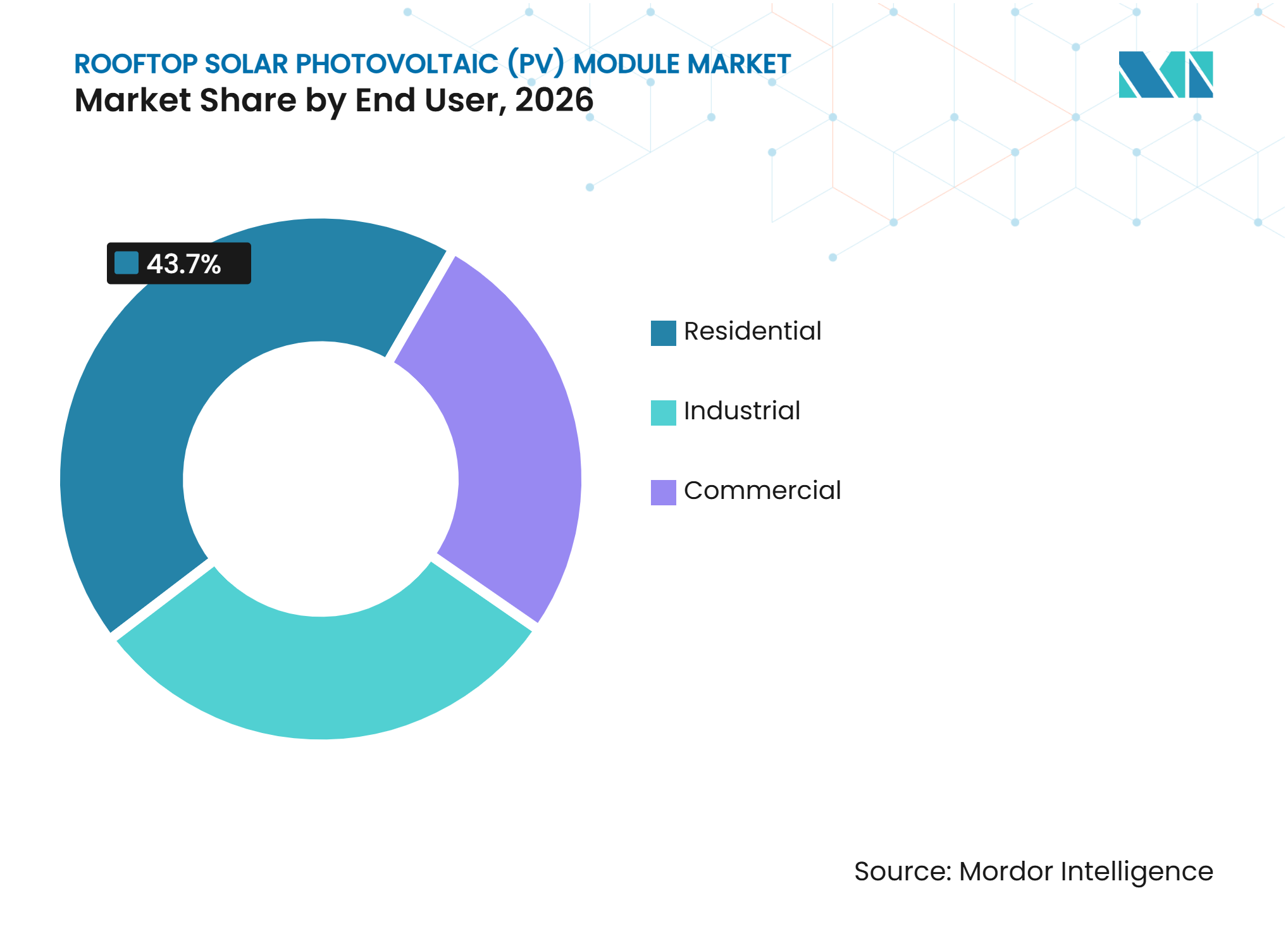
- By end user, residential installations accounted for 43.7% of the Global rooftop solar photovoltaic (PV) module market size in 2026, while industrial installations are projected to grow at a 9.3% CAGR through 2032.
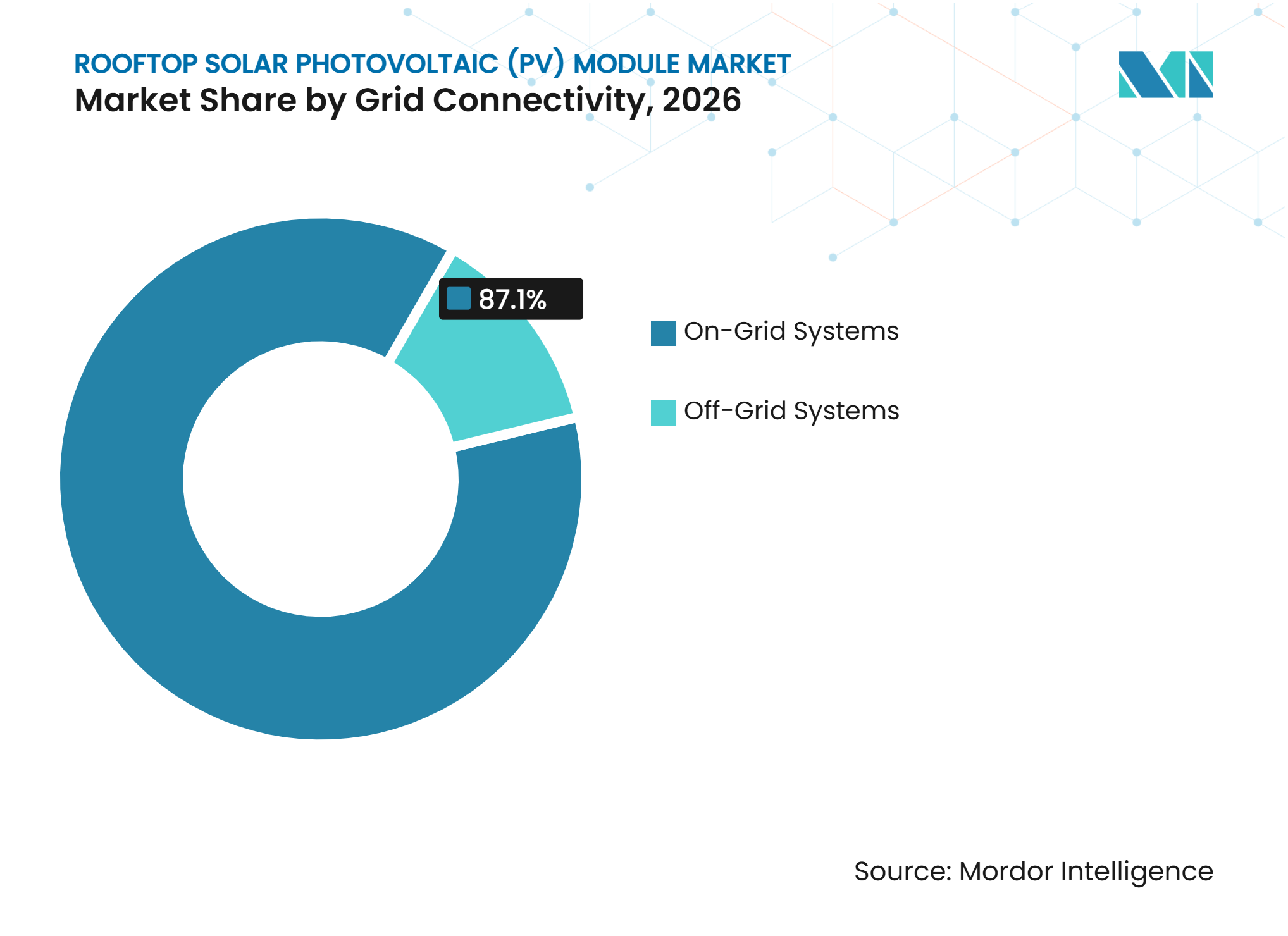
- By grid connectivity, on-grid systems held 87.1% share in 2026, while off-grid systems are projected to grow at a 9.7% CAGR through 2032.
- By geography, Asia-Pacific accounted for 35.3% share in 2026, while the Middle East and Africa are projected to grow at an 8.9% CAGR through 2032.
Note: Market numbers in this report are based on Mordor Intelligence's proprietary estimation framework, which combines nine months of actuals with Q4 projections for base year 2026.
Market Trends and Insights
Drivers Impact Analysis of Rooftop Solar Photovoltaic (PV) Module Market*
| Driver | (~) % Impact on CAGR Forecast | Geographic Relevance | Impact Timeline |
|---|---|---|---|
| Falling Module Prices and Shorter Payback Periods | +2.3% | Global, with high sensitivity in Europe, India, and emerging Asia-Pacific markets | Short term (≤ 2 years) |
| Rooftop Mandates, Incentives, and Self-Consumption Policies | +1.8% | European Union, China, India, and Japan | Medium term (2-4 years) |
| Rising Commercial Electricity Costs and Energy Resilience Demand | +1.5% | North America, Europe, Southeast Asia, and Australia | Short term (≤ 2 years) |
| N-Type Efficiency Gains in Space-Constrained Rooftops | +1.2% | Asia-Pacific, Europe, and North American commercial and industrial rooftops | Medium term (2-4 years) |
| Storage, Smart Inverters, and Virtual Power Plant Integration | +0.9% | Australia, Germany, the United States, and Japan | Medium term (2-4 years) |
| Roof-Area Monetization Without New Land Conversion | +0.6% | Urban and land-constrained markets, including Japan, the Netherlands, and Singapore | Long term (≥ 4 years) |
| Source: Mordor Intelligence | |||
Falling Module Prices and Shorter Payback Periods
Lower crystalline silicon module prices are improving the economics of the Global rooftop solar photovoltaic (PV) module market, especially for customers with consistent daytime electricity demand. Commercial systems that needed 8-10 years to recover their cost in 2022 can now deliver payback within 4-6 years in Germany and within 5 years in India. Lower hardware costs are shifting more project value toward installation, monitoring, energy management services, and the engineering needed to adapt systems to individual roofs. This favors installers that can manage system performance, provide reliable after-sales service, and combine solar assets with virtual power plant functions. China’s 2025 efficiency standards set Grade 1 thresholds at 23.6% for TOPCon modules and 23.9% for Heterojunction Technology (HJT) modules, which supports higher-performing equipment across price tiers.[1] The use of existing roof space also avoids land conversion, reduces site acquisition needs, and strengthens the case for rooftop projects in dense cities.
Rooftop Mandates, Incentives, and Self-Consumption Policies
Policy support is changing how demand develops in the Global rooftop solar photovoltaic (PV) module market and is giving property owners clearer reasons to include solar in planned construction work. The revised European Energy Performance of Buildings Directive requires solar installations on new public and commercial buildings above 250 m² by December 31, 2026, subject to the directive’s conditions.[2] China’s 2025 distributed PV rules require general commercial projects to use at least 20% of annual generation themselves, directing development toward sites with matching electricity demand. India’s PM Surya Ghar program increased the reach of residential rooftop solar through financial assistance and installation support.[3] Japan is moving support toward rooftop systems as it ends Feed-in Tariff (FIT) and Feed-in Premium (FIP) support for new ground-mounted commercial solar from FY2027.[4] Together, these policy changes provide a more durable installation base than short-term export incentives alone and favor projects built around local electricity use.
Rising Commercial Electricity Costs and Energy Resilience Demand
Rising electricity costs have made rooftop solar a resilience measure as well as a cost-control tool for commercial users in the Global rooftop solar photovoltaic (PV) module market. The United States continued to add state-level distributed energy policies through October 2025 as federal support declined. Commercial buyers are placing greater value on reduced peak charges, stronger energy security, and backup capability when storage is included, rather than reviewing solar only as a simple payback decision. This is increasing demand for larger rooftop systems with monitoring, control features, and system designs that can respond to site-level load patterns. Industrial sites often need higher-power modules, longer warranties, and storage from the start, which supports demand for more advanced products. The Global rooftop solar photovoltaic (PV) module market also benefits when businesses can use electricity directly, manage procurement risk, and reduce their exposure to changing retail tariffs.
N-type Efficiency Gains in Space-Constrained Rooftops
N-type technology is increasingly important where roof area or structural loading limits system size. The Global rooftop solar photovoltaic (PV) module market benefits when high-efficiency modules add capacity without requiring a larger roof, added land, or major structural modification. LONGi reported a mass-production conversion efficiency of 24.8% and peak power of 670 W for its Hybrid Passivated Back Contact (HPBC) 2.0 modules in 2025. AIKO reported 26% mass-production efficiency for its ABC technology and 14.71 GW of ABC module sales in 2025. Australia required IEC 61215:2021 compliance for modules seeking small-scale technology certificates from April 2025. Storage, smart inverters, and virtual power plant links can further raise the value of each kilowatt generated on constrained roofs and support owners facing lower export rates.
Restraints Impact Analysis of Rooftop Solar Photovoltaic (PV) Module Market*
| Restraint | (~) % Impact on CAGR Forecast | Geographic Relevance | Impact Timeline |
|---|---|---|---|
| Interconnection Queues and Distribution-Grid Hosting Limits | -1.5% | United States, China, and Germany | Short term (≤ 2 years) |
| Lower Export Compensation Under Net Billing | -0.8% | United States, China, and Japan | Medium term (2-4 years) |
| Tariff, Origin-Traceability, and Domestic-Content Volatility | -0.7% | North America, India, and the European Union | Medium term (2-4 years) |
| Weak Roof Structures and Retrofit Engineering Constraints | -0.5% | South and Southeast Asia, South America, and Middle East and Africa residential markets | Long term (≥ 4 years) |
| Source: Mordor Intelligence | |||
Interconnection Queues and Distribution-Grid Hosting Limits
Grid hosting capacity is a central constraint for the Global rooftop solar photovoltaic (PV) module market in mature locations, particularly where distributed generation has grown faster than network investment. The U.S. Department of Energy aims to reduce median interconnection time for systems from 50 kW to 5 MW to fewer than 75 days by 2030. Existing processes can take 12-18 months in congested utility territories. China’s 2025 rules require provinces to disclose hosting capacity and manage development queues, recognizing constraints in areas such as Shandong, Zhejiang, and Henan. Distribution grids were built mainly for one-way electricity flow, so upgrades for bidirectional power need new investment, digital controls, and clear cost recovery. Storage-backed self-consumption systems can reduce exports and local congestion, but they cannot fully replace grid modernization.
Lower Export Compensation Under Net Billing
Lower export compensation can weaken returns for owners who cannot use solar electricity when it is generated. California’s Net Energy Metering (NEM) 3.0 framework reduced residential export credits by 75%, while Nevada, Virginia, and West Virginia considered successor net-metering tariffs in late 2025. Japan also shifted residential support away from long-term feed-in tariff (FIT) purchase prices toward an initial-investment support model. Tariff and origin-traceability rules add further compliance work for smaller installers, especially in North America and India, while domestic-content requirements can affect equipment selection. Weak roof structures can also require costly engineering upgrades in older buildings and limit otherwise suitable projects. These pressures support batteries, AC-coupled inverters, and energy management systems that help owners use more electricity on site and reduce reliance on export revenue.
*Our forecasts treat driver/restraint impacts as directional, not additive. The impact forecasts reflect baseline growth, mix effects, and variable interactions.
Rooftop Solar Photovoltaic (PV) Module Market Segment Analysis
By Module Type:
TOPCon Leads, Heterojunction Technology (HJT) Redefines ValueTOPCon held 41.6% in 2026. Its position reflects a rapid shift from Passivated Emitter and Rear Cell (PERC) technology since 2022 and a balance of efficiency, cost, and manufacturing requirements. Heterojunction Technology (HJT) is forecast to grow at a 10.2% CAGR through 2032. Its lower temperature coefficient of -0.24% per degree Celsius compares with -0.35% for Tunnel Oxide Passivated Contact (TOPCon) modules, which can improve energy output on hot roofs. PERC retains a large installed base in cost-sensitive markets, but manufacturers are moving new capacity toward N-type production.
The International Energy Agency Photovoltaic Power Systems Programme identified UV-induced degradation in TOPCon modules as an emerging reliability issue in 2025. That finding may favor suppliers with stronger degradation performance as buyers place more weight on long-term output. Bifacial designs are gaining use on commercial roofs with reflective membranes because they can capture albedo gains. Back-contact products are also gaining use in appearance-sensitive residential projects in Europe and Japan. China’s 2025 Grade 1 efficiency thresholds differentiate TOPCon, Heterojunction Technology (HJT), and back-contact products and are influencing procurement specifications
By End User:
Residential Anchors Volume, Industrial Scales ValueResidential installations accounted for 43.7% of Global rooftop solar photovoltaic (PV) module market size in 2026. India added 7.1 GW of residential rooftop capacity in 2025, up 123% year over year, and residential users contributed 76% of new installations. Industrial installations are forecast to grow at a 9.3% CAGR through 2032. Factory rooftops can support large systems at a lower marginal renewable energy cost for manufacturers. Commercial sites, including retail, hospitality, and logistics properties, offer useful project scale but can face financing and lease-related constraints.
Industrial buyers normally require high-power modules, extended performance warranties, and storage integration. That specification profile favors suppliers that offer both TOPCon and Heterojunction Technology (HJT) products. Guangdong required 50% solar coverage for newly built factory rooftops by 2025 and full coverage by 2030, reinforcing industrial demand. Residential demand remains important because public support lowers the entry barrier for households. The Global rooftop solar photovoltaic (PV) module industry therefore includes both large industrial procurement and broad residential adoption.


By Grid Connectivity:
On-Grid Dominance, Off-Grid AcceleratingOn-grid systems held 87.1% of the global rooftop solar photovoltaic (PV) module market share in 2026. Their historical lead came from access to net metering, export credits, and connection to established electricity networks. Off-grid systems are forecast to grow at 9.7% CAGR through 2032. Falling storage costs and energy access programs are improving the case for off-grid systems in Africa and island economies. India’s program guidance includes a utility-led aggregation and Renewable Energy Service Company (RESCO) approach for rural and economically weaker households, including locations with unreliable distribution company connections.
Export compensation is declining in the United States, Japan, and parts of Europe. This is changing on-grid installations from export-led projects to high-self-consumption systems. Systems with large battery ratios and low grid exports can operate much like microgrids even if they remain connected. That reduces the practical distance between on-grid and off-grid designs. In turn, inverter and energy management providers can use common hardware and software platforms for both types of installation.

Geography Analysis
Asia-Pacific: The Market’s Center of Gravity
Asia-Pacific held 35.3% of the global rooftop solar photovoltaic (PV) module market size in 2026. China had 370 GW of cumulative distributed PV capacity at the end of 2024, with rooftop solar forming most of that base. India added a record 7.1 GW of rooftop capacity in 2025, while the PM Surya Ghar program had provided central financial assistance to 2.614 million households by December 2025. Japan’s 2025 Strategic Energy Plan prioritizes rooftop PV and targets solar deployment on 50% of installable public-sector buildings by 2030. Australia’s International Electrotechnical Commission (IEC) 61215:2021 requirement creates a higher product qualification standard for suppliers.
Middle East and Africa: Fastest-Growing, Underestimated Opportunity
The Middle East and Africa are forecast to expand at an 8.9% CAGR through 2032. Gulf energy strategies and the needs of people without reliable grid access support commercial, industrial, and off-grid installations. In Nigeria, Kenya, and Ghana, rooftop systems can serve as a primary power source for commercial premises, making heat and humidity performance important purchasing factors. JinkoSolar reported its Saudi Arabia joint venture with Renewable Energy Localization Company and Vision Industries, which indicates a growing focus on local manufacturing.
Regional Trends Beyond the Headlines
North America faces long interconnection queues and changing net-billing policies, but the Department of Energy is funding queue-management work through its i2X program. Europe’s building compliance cycle is reshaping permit and design requirements in Germany, France, Italy, Spain, and the Netherlands. In South America, Brazil’s distributed generation rules under Agência Nacional de Energia Elétrica (ANEEL) provide a policy base for continued residential and commercial development. Colombia and Argentina are building commercial solar activity, while Indonesia and other lower-base markets benefit from growing project finance access and local installer capability. Across these mixed regions, system design is moving toward self-consumption, storage readiness, and clearer compliance with local grid rules.
Competitive Landscape
Market Concentration
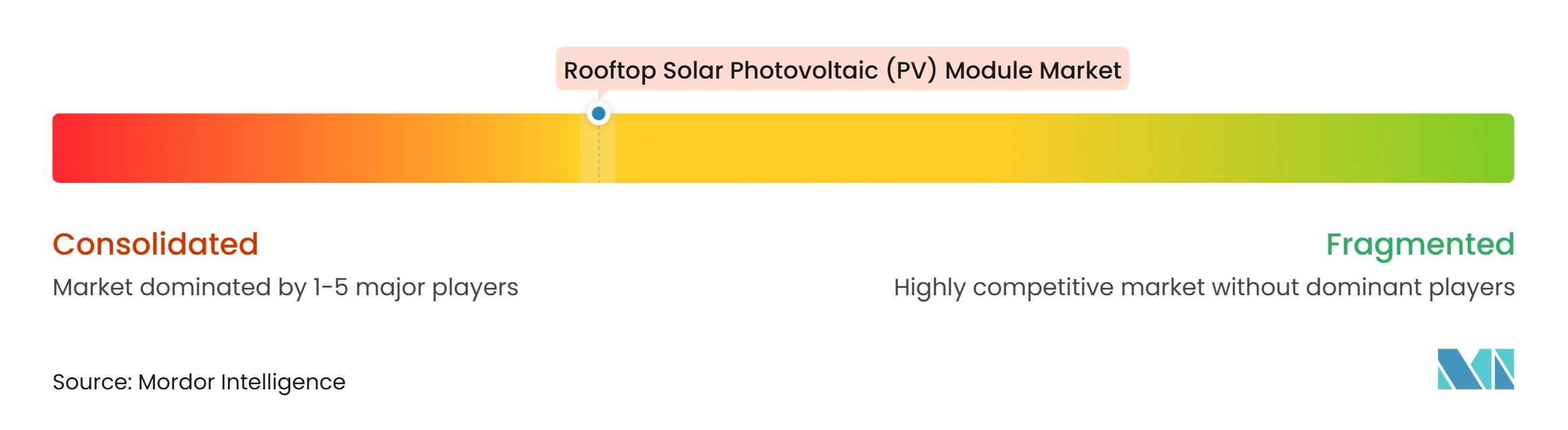
The Global rooftop solar photovoltaic (PV) module market is moderately concentrated. JinkoSolar shipped 86 GW of modules in 2025, while LONGi shipped 86.58 GW and Tongwei sold 43.25 GW. Large shipment volumes have not prevented losses because price competition remains severe and production growth has outpaced near-term demand in some channels. Suppliers are responding by investing in TOPCon, HJT, and back-contact technologies, while preserving scale and customer relationships. This makes technology performance, supply-chain compliance, and proven long-term product output more important competitive tools than volume alone.
AIKO reported that All Back Contact (ABC) modules represented 68% of its 2025 revenue and sold at a 10-50% export price premium over standard TOPCon products. Hanwha Q CELLS used its Cartersville, Georgia Solar Hub to build a North American supply chain from ingots through modules, a position that supports domestic-content requirements. LONGi secured voting control in PotisEdge during 2025, extending its position into energy storage. These moves show that manufacturers are expanding from module sales toward broader solar and storage solutions, particularly where customers want a single provider for equipment, controls, and long-term performance support.
The Global rooftop solar photovoltaic (PV) module market also offers room for application-specific design. Lightweight products can address aging industrial roofs, while fire-rated and building-integrated products can serve commercial premises and facades where standard modules cannot meet building needs. DMEGC Solar highlighted a 7.5 kg per square meter lightweight module for specialized rooftop use. Indian manufacturers, including Adani Solar, Waaree Energies, Premier Energies, and Vikram Solar, are using domestic-content policies and local capacity expansion to strengthen their positions in a large and policy-supported home market. The competitive structure is separating into a volume-focused tier and a differentiated premium tier, while local supply chains create protected positions in some markets.
Rooftop Solar Photovoltaic (PV) Module Industry Leaders
-
LONGi Green Energy Technology Co., Ltd.
-
JinkoSolar Holding Co., Ltd.
-
JA Solar Technology Co., Ltd.
-
Trina Solar Co., Ltd.
-
Tongwei Co., Ltd.
- *Disclaimer: Major Players sorted in no particular order
Rooftop Solar Photovoltaic (PV) Module Market Companies Covered in this Report
- Adani Solar
- AIKO Solar
- Canadian Solar Inc.
- Chint New Energy Technology Co., Ltd.
- DMEGC Solar
- First Solar, Inc.
- GCL System Integration Technology Co., Ltd.
- Hanwha Solutions Corporation
- JA Solar Technology Co., Ltd.
- JinkoSolar Holding Co., Ltd.
- LONGi Green Energy Technology Co., Ltd.
- Premier Energies Limited
- Risen Energy Co., Ltd.
- Suntech Power Holdings Co., Ltd.
- Talesun Solar Technologies Co., Ltd.
- Tongwei Co., Ltd.
- Trina Solar Co., Ltd.
- Vikram Solar Limited
- Waaree Energies Limited
- Yingli Solar
Recent Industry Developments in Rooftop Solar Photovoltaic (PV) Module Market
- April 2026: JinkoSolar confirmed its 2026 integrated production capacity target of 100 GW, including 14 GW from overseas facilities, and disclosed full-year 2026 module shipment guidance of 75-85 GW. The company’s energy storage capacity at year-end 2025 was 17 GWh of pack capacity and 5 GWh of cell capacity.
- November 2025: First Solar commenced production at its Louisiana manufacturing facility. Full-year 2025 module sales reached 17.5 GW, net sales reached USD 5.2 billion, and year-end backlog reached 50.1 GW.
- October 2025: Trina Solar launched Vertex N TOPCon Ultra modules for commercial and industrial rooftops and utility-scale projects. Its cumulative module shipments exceeded 320 GW by the end of 2025.
- June 2025: Hanwha Q CELLS completed its Solar Hub in Cartersville, Georgia, establishing total United States-based module production capacity of 8.4 GW. The facility supports production across ingots, wafers, cells, and finished modules.
Global Rooftop Solar Photovoltaic (PV) Module Market Report Scope
A rooftop solar photovoltaic (PV) module, commonly referred to as a solar panel, is an assembly of interconnected semiconductor solar cells mounted on a structural frame and installed on the roof of a residential, commercial, or industrial building to convert sunlight directly into direct current (DC) electricity.
The rooftop solar photovoltaic (PV) module market is segmented into module type, end user, grid connectivity, and geography. By module type, the market is divided into passivated emitter and rear cell (PERC) modules, tunnel oxide passivated contact (TOPCon) modules, heterojunction technology (HJT) modules, bifacial solar PV modules, monofacial solar PV modules, and other module types. By end user, the market is segmented into residential, commercial, and industrial. By grid connectivity, the market is segmented into on-grid systems and off-grid systems. The report also covers the market size and forecasts for the global rooftop solar photovoltaic (PV) module market across 26 countries in key regions. For each segment, the market sizing and forecasts are provided on the basis of value (USD).
Segmentation Overview
| Passivated Emitter and Rear Cell (PERC) Modules |
| Tunnel Oxide Passivated Contact (TOPCon) Modules |
| Heterojunction Technology (HJT) Modules |
| Bifacial Solar PV Modules |
| Monofacial Solar PV Modules |
| Other Module Types |
| Residential |
| Commercial |
| Industrial |
| On-Grid Systems |
| Off-Grid Systems |
| North America | United States |
| Canada | |
| Mexico | |
| Europe | Germany |
| France | |
| Italy | |
| Spain | |
| United Kingdom | |
| Netherlands | |
| Norway | |
| Russia | |
| Rest of Europe | |
| Asia-Pacific | China |
| India | |
| Japan | |
| Australia | |
| Indonesia | |
| Malaysia | |
| Thailand | |
| Rest of Asia-Pacific | |
| South America | Brazil |
| Argentina | |
| Colombia | |
| Rest of South America | |
| Middle East and Africa | Saudi Arabia |
| United Arab Emirates | |
| Egypt | |
| Oman | |
| Nigeria | |
| Rest of Middle East and Africa |
| By Module Type | Passivated Emitter and Rear Cell (PERC) Modules | |
| Tunnel Oxide Passivated Contact (TOPCon) Modules | ||
| Heterojunction Technology (HJT) Modules | ||
| Bifacial Solar PV Modules | ||
| Monofacial Solar PV Modules | ||
| Other Module Types | ||
| By End User | Residential | |
| Commercial | ||
| Industrial | ||
| By Grid Connectivity | On-Grid Systems | |
| Off-Grid Systems | ||
| By Geography | North America | United States |
| Canada | ||
| Mexico | ||
| Europe | Germany | |
| France | ||
| Italy | ||
| Spain | ||
| United Kingdom | ||
| Netherlands | ||
| Norway | ||
| Russia | ||
| Rest of Europe | ||
| Asia-Pacific | China | |
| India | ||
| Japan | ||
| Australia | ||
| Indonesia | ||
| Malaysia | ||
| Thailand | ||
| Rest of Asia-Pacific | ||
| South America | Brazil | |
| Argentina | ||
| Colombia | ||
| Rest of South America | ||
| Middle East and Africa | Saudi Arabia | |
| United Arab Emirates | ||
| Egypt | ||
| Oman | ||
| Nigeria | ||
| Rest of Middle East and Africa | ||
Key Questions Answered in the Report
What is the expected growth rate for rooftop solar PV modules market?
The global rooftop solar photovoltaic (PV) market is forecast to grow at a CAGR of 8.54% from 2027 to 2032 and reach USD 107.67 billion by 2032.
Which rooftop PV module technology leads global demand?
TOPCon held 41.6% share in 2026. In the Global rooftop solar photovoltaic (PV) module market, HJT is the fastest-growing module type at a projected 10.2% CAGR through 2032 because rooftop projects value efficiency, heat performance, and energy yield from limited roof space.
Which end user is growing fastest for rooftop PV modules?
Industrial installations are forecast to grow at a 9.3% CAGR through 2032. The Global rooftop solar photovoltaic (PV) module market serves industrial buyers that often require high-power modules, long performance warranties, storage integration, and controls aligned to operating loads.
Why are batteries becoming important for rooftop solar projects?
Lower export compensation encourages owners to use power at their own sites. For the Global rooftop solar photovoltaic (PV) module market, storage helps capture daytime generation, support backup power, manage peak demand, and improve project value where grid exports earn less.
Which region is expanding fastest for rooftop solar PV modules?
The Middle East and Africa are projected to grow at an 8.9% CAGR through 2032. The Global rooftop solar photovoltaic (PV) module market is supported there by off-grid needs, Gulf energy strategies, hot-climate operating requirements, and interest in local supply chains.
What is the main barrier to faster rooftop solar deployment?
Interconnection queues and limited distribution-grid hosting capacity can delay projects. The Global rooftop solar photovoltaic (PV) module market relies on faster grid review, transparent hosting-capacity data, and investments that allow utilities to manage bidirectional power flow.