
Roofing Membranes Market Size and Share
Market Overview
| Study Period | 2021 - 2031 |
|---|---|
| Market Size (2026) | USD 10.87 Billion |
| Market Size (2031) | USD 13.86 Billion |
| Growth Rate (2026 - 2031) | 4.97 % |
| Fastest Growing Market | Asia Pacific |
| Largest Market | Asia Pacific |
| Market Concentration | Medium |
Major Players *Disclaimer: Major Players sorted in no particular order Image © Mordor Intelligence. Reuse requires attribution under CC BY 4.0. | |
Roofing Membranes Market Analysis by Mordor Intelligence
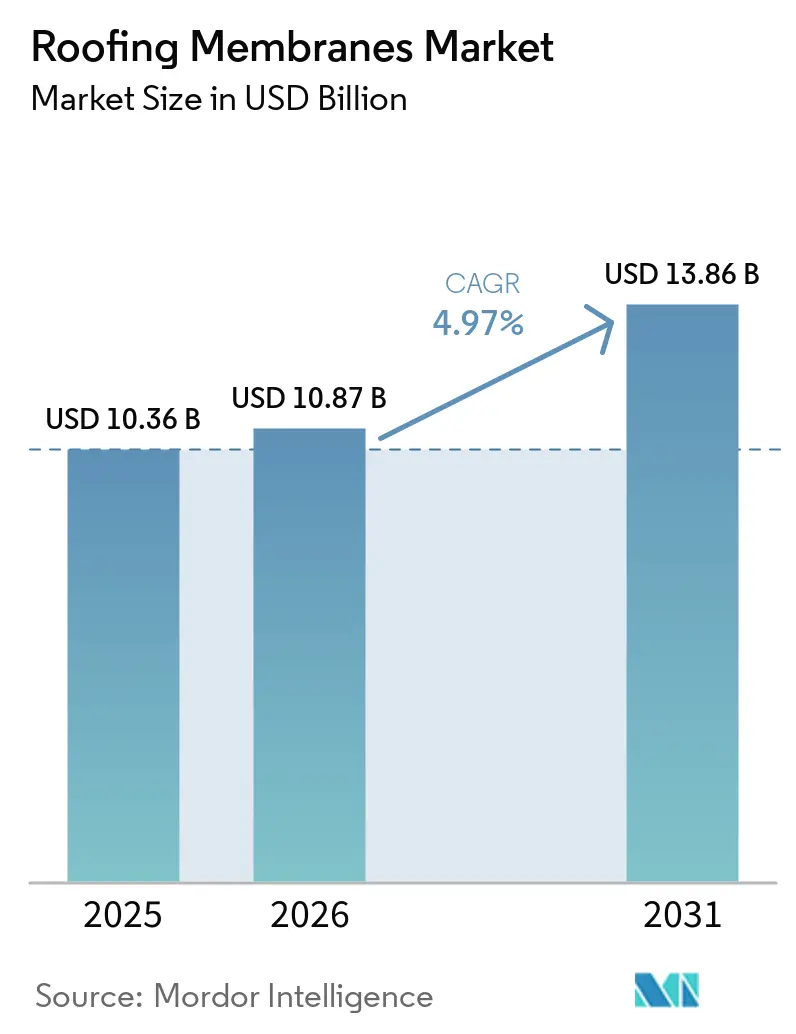
The Roofing Membranes Market size was valued at USD 10.36 billion in 2025 and is estimated to grow from USD 10.87 billion in 2026 to reach USD 13.86 billion by 2031, at a CAGR of 4.97% during the forecast period (2026-2031). Rising code-mandated cool-roof reflectance, growth in modular construction, and the accelerating shift toward solar-ready rooftops are keeping demand for single-ply sheets and fluid-applied systems on a steady upward trajectory. Liquid-applied acrylic and silicone chemistries keep gaining share because they deliver seamless coverage, comply with volatile-organic-compound limits, and can be sprayed over existing substrates without full tear-offs, trimming project schedules across constrained labor markets. Fully adhered assemblies are displacing ballast in hurricane- and seismic-prone corridors, driven by insurers that reward higher wind-uplift ratings with premium discounts. Asia-Pacific leads volume growth, supported by China’s Belt and Road construction pipeline and India’s smart-city housing surge, while North America benefits from data-center, warehouse, and cold-storage investment that prioritizes reflective membranes to lower HVAC loads. Stringent fire and chemical regulations in Europe and parts of Asia are widening the gap between global formulators that control polymer R&D and smaller converters that rely on toll-blended resins.
Key Report Takeaways
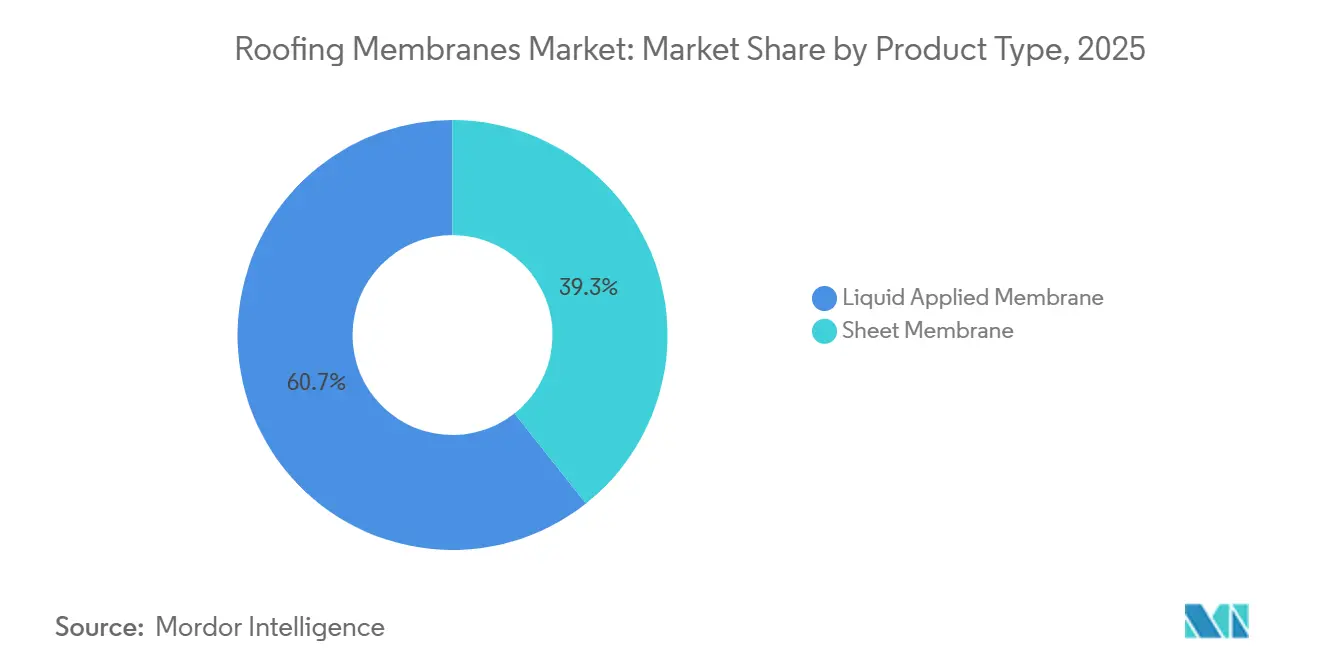
- By product type, the liquid-applied membranes segment held a 60.66% revenue share in 2025 and is expected to expand at a 5.34% CAGR during the forecast period (2026-2031).
- By installation type, fully adhered systems accounted for 46.78% of 2025 revenue and are projected to grow at a 5.22% CAGR during the forecast period (2026-2031).
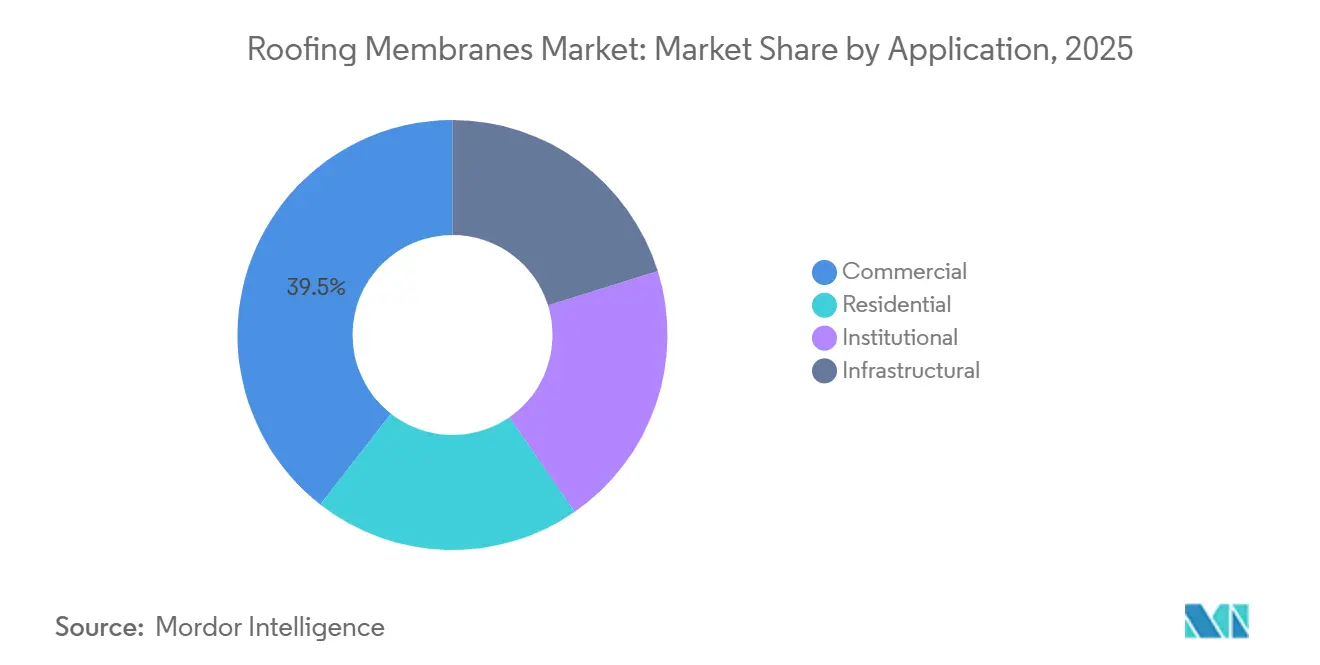
- By application, the commercial buildings segment accounted for a 39.45% share of the global roofing membranes market in 2025, growing at a 5.57% CAGR during the forecast period (2026-2031).
- By geography, the Asia-Pacific region commanded 45.56% of the revenue in 2025 and is expected to grow at a rate of 6.33% annually during the forecast period (2026-2031).
Note: Market size and forecast figures in this report are generated using Mordor Intelligence’s proprietary estimation framework, updated with the latest available data and insights as of 2026.
Market Trends and Insights
Drivers Impact Analysis of Roofing Membranes Market*
| Driver | (~) % Impact on CAGR Forecast | Geographic Relevance | Impact Timeline |
|---|---|---|---|
| Demand for cool-roof compliance and energy-code stringency | +0.8% | North America, Europe, APAC (China, Japan, South Korea) | Medium term (2-4 years) |
| Expansion of green-building certification programs | +0.7% | Global, with concentration in North America, Western Europe, and APAC urban centers | Long term (≥ 4 years) |
| Construction boom in emerging economies | +1.2% | APAC (India, ASEAN, China), Middle East (Saudi Arabia, UAE), South America (Brazil) | Short term (≤ 2 years) |
| Rooftop-solar retrofit creating need for reflective membranes | +0.6% | Europe (Germany, Spain, Italy), North America (California, Texas), APAC (China, India) | Medium term (2-4 years) |
| Prefabricated modular roof-kit adoption accelerating membrane demand | +0.5% | North America, Western Europe, APAC manufacturing hubs | Short term (≤ 2 years) |
| Source: Mordor Intelligence | |||
Demand for Cool-Roof Compliance and Energy-Code Stringency
Building-energy standards in California, the International Energy Conservation Code, and China’s GB 55015-2021 are tightening reflectance thresholds, effectively disqualifying darker elastomeric products and shifting specifications toward white TPO, PVC, and high-albedo liquid coatings. Title 24’s 2025 update raised minimum aged solar reflectance, prompting rapid adoption of acrylic and silicone systems that achieve Solar Reflectance Index scores above 100 while sidestepping costly tear-offs[1]. Similar mandates in Sun Belt U.S. states and hot-summer Chinese provinces are sustaining premium pricing for reflective chemistries. Compliance deadlines have forced distributors to widen inventories of light-colored rolls and low-VOC primers to avoid project delays during permitting. Manufacturers that market CRRC-listed products with documented aged-value retention now win close-rate advantages on public-bid work in schools, hospitals, and government offices.
Expansion of Green-Building Certification Programs
LEED v5, BREEAM International 2024, and India’s GRIHA v5 have moved beyond reflectance, layering in credits for embodied-carbon reduction and verified environmental product declarations. Specifiers increasingly demand membranes containing recycled content, bio-based polyols, or water-blown foams, creating a dual metric of cool-roof performance plus life-cycle transparency. Global chemical majors that publish ISO 14025-aligned EPDs are qualifying for preferred-supplier status on multinational corporate campuses. The convergence of rating systems is standardizing submittal formats, cutting consultant costs, and accelerating bid evaluations because comparable LCA data are now available across most single-ply and liquid lines[2].
Construction Boom in Emerging Economies
Saudi Arabia’s Vision 2030 giga-projects, the UAE pipeline, India’s National Infrastructure Program, and ASEAN industrial-park development triggered spot shortages for polyolefin films, polyester scrims, and polyisocyanurate insulation during 2025. Global producers responded by debottlenecking lines in China, Indonesia, and India, yet lead times for specialty cool-roof grades stretched to eight weeks at peak. Regional governments are bundling energy-efficiency and waterproofing mandates in public tenders, pushing even budget-sensitive housing segments to specify reflective EPDM or cost-optimized acrylic top-coats.
Rooftop-Solar Retrofit Creating Need for Reflective Membranes
The EU’s Energy Performance of Buildings Directive and California’s updated Solar Equipment Lists require solar-ready substrates, reinforcing white TPO and PVC as the default membranes in retrofit PV installations. Field studies confirm 10°C-15°C reductions in module operating temperature, boosting array output by up to 4%, which offsets the 5%-10% premium these membranes command versus black EPDM. Ballasted roofs now face structural constraints when overlaid with crystalline-silicon panels, spurring conversions to fully adhered sheets that distribute weight evenly. Reflective membranes, therefore, serve both energy and structural compliance, a dual benefit resonating with asset-management firms that must meet ESG targets.
Restraints Impact Analysis of Roofing Membranes Market*
| Restraint | (~) % Impact on CAGR Forecast | Geographic Relevance | Impact Timeline |
|---|---|---|---|
| Stringent fire-safety and VOC/REACH regulations | -0.4% | Europe, North America, APAC (Japan, South Korea) | Medium term (2-4 years) |
| Shortage of certified single-ply installers | -0.5% | North America, Western Europe, Australia | Short term (≤ 2 years) |
| Competition from spray-applied continuous-roof coatings | -0.3% | North America, Europe | Long term (≥ 4 years) |
| Source: Mordor Intelligence | |||
Stringent Fire-Safety and VOC/REACH Regulations
European Broof(t1) fire classifications, California’s 50 g/L VOC cap for roof coatings, and the EU REACH PFAS restrictions are driving reformulation costs upward and fragmenting product portfolios. Manufacturers must finance multiple full-scale EN 13501-1 tests for each membrane-insulation-deck combination, hampering cross-border product portability. Shifts to non-fluorinated surfactants have raised raw-material input costs up to 18%, prompting selective price surcharges across polyurethane and acrylic lines. Fast-to-market regional converters lacking in-house R&D are increasingly sourcing from multinational toll blenders, shrinking margins.
Shortage of Certified Single-Ply Installers
North America and Western Europe face an aging installer base and insufficient apprenticeship enrollments. The median U.S. roofing mechanic age reached 48 years in 2025, while certification enrollment for programs such as RCI’s Registered Roof Observer declined by 14%. Tight labor is inflating fully adhered TPO installation costs to USD 9-12 per square foot, eroding the delta between sheet systems and spray polyurethane foam. In response, manufacturers are rolling out self-adhered rolls and induction-weld protocols that reduce skilled-labor minutes per square, yet productivity gains have only partly offset wage escalation.
*Our forecasts treat driver/restraint impacts as directional, not additive. The impact forecasts reflect baseline growth, mix effects, and variable interactions.
Roofing Membranes Market Segment Analysis
By Product Type:
Liquid Formulations Dominate Retrofit ApplicationsLiquid-applied systems secured 60.66% revenue in 2025 and are projected to advance at a 5.34% CAGR through 2031. That scale translates into the single largest portion of the Roofing Membranes market size because acrylic and silicone coatings can be installed over existing substrates, satisfy VOC rules, and achieve CRRC-listed reflectance without seams. Acrylics remain the volume leader due to low cost and UV stability, while polyurea’s rapid 15-second set time is unlocking plaza-deck and parking-garage use cases where fast return to service is critical. Sheet membranes claimed the remaining revenue, still favored for new-build logistics halls where large planes allow efficient roll-out. Thermoplastic polyolefin is steadily eroding legacy PVC share in North America, supported by formulations such as Carlisle’s Sure-Weld TPO that deliver ASTM D5034 tensile strengths beyond 350 lbf/in. EPDM maintains relevance in sub-zero climates, though its dark surface conflicts with cool-roof rules. Specialty self-adhesive bitumen rolls are expanding among European residential re-roofing, while self adhered roofing membranes are carving green-roof niches due to root-barrier properties.
Premium HDPE and light-weight TPO variants, such as IKO’s 1.2 kg/m² fleece products, are positioned to capture structural-capacity constrained retrofits. Price differentials will remain narrow as higher polymer costs are offset by reduced labor minutes per roof, preserving lifecycle cost parity across product families.
By Installation Type:
Fully Adhered Systems Lead Wind-Uplift PerformanceFully adhered assemblies captured 46.78% share in 2025 and are on track for a 5.22% CAGR during the forecast period (2026-2031), giving them the largest single slice of the Roofing Membranes market share in hurricane-exposed coastal corridors. Factory Mutual Class 1-90 ratings obtained with low-rise polyurethane adhesives drive insurer acceptance for logistics hubs and data centers. Water-based acrylic bonding agents are gaining popularity in VOC-regulated states because they cure through evaporation and permit rapid trades handoff. Mechanically attached roofs are attractive in retrofit scenarios where deck conditions or budget preclude adhesives. Electromagnetic induction welding is cutting leak incidence by eliminating fastener penetrations, a feature showcased in GAF’s EverGuard Extreme TPO that achieved FM 1-120 ratings at 12-inch plate spacing. Ballasted assemblies suffer headwinds from wind-code tightening and PV load constraints. Hybrid configurations, the remaining 7%, are expanding in seismic zones because perimeter adhesion paired with mechanically fastened fields affords building-movement tolerance.
Demand dynamics favor fully adhered growth inside both new construction and retrofit solar markets, yet mechanically attached systems will remain indispensable where structural, moisture, or cost hurdles override adhesive benefits. All installation formats are converging on digital fastening-layout software and on-deck pull-test verification, tightening construction quality control and reducing warranty claims frequency.
By Application:
Commercial Buildings Drive Volume GrowthCommercial facilities held a 39.45% share of the Roofing membranes market size in 2025 and are projected to grow at 5.57% during the forecast period (2026-2031). Warehouse and data-center developers favor white TPO or PVC sheets to comply with LEED v5 credits and to temper roof-surface temperatures; Microsoft’s Azure campuses in Arizona and Texas documented 18°C drops compared with gray membranes, cutting chiller loads. Cold-storage build-outs demand high-R-value assemblies exceeding R-30, supporting upselling of polyisocyanurate insulation laminates. Residential use is split between liquid-applied acrylic restorations on existing asphalt shingle roofs and self-adhesive bitumen rolls for low-slope multifamily complexes. Institutional facilities represented 18%, buoyed by US federal energy-upgrade budgets that earmark USD 1.2 billion for cool-roof retrofits. Infrastructure and industrial sites made up the remaining 15%, with polyurea and polyurethane liquid systems preferred for chemical resistance on water-treatment plants and process-facility decks.
Commercial demand will stay foremost as e-commerce logistics footprints expand, hyperscale cloud operators race to commission capacity, and cold-chain players retrofit older warehouses to higher insulation values. Residential share growth hinges on rebate programs for cool-roof shingle restoration, while institutional uptake will follow public-sector energy-performance mandates that dovetail with renewable-energy procurement strategies.

Geography Analysis
APAC Roofing Membranes Market
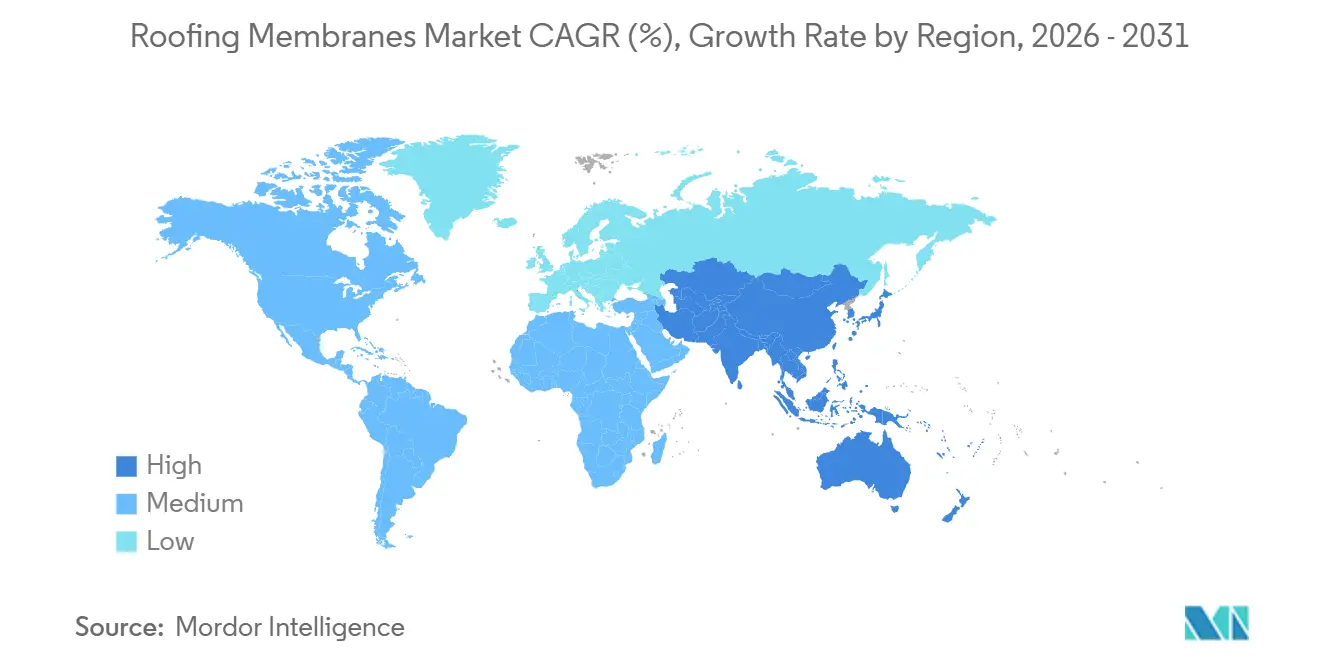
Asia-Pacific generated 45.56% of 2025 global revenues and is expected to rise at a 6.33% CAGR during the forecast period (2026-2031), adding the largest incremental Roofing membranes market size among regions. China’s Belt and Road contracts worth USD 66.2 billion and India’s USD 120 billion smart-city housing allocation underpin near-term demand for cost-effective EPDM and reflective TPO. Seismic-resilient mechanically attached assemblies secured 58% of Tokyo’s 2025 commercial reroof activity, reflecting heightened risk awareness after the 2024 Noto event. ASEAN public-private partnerships are driving fungal-resistant polyurethane coatings on industrial parks where humidity exceeds 80% year-round.
North America Roofing Membranes Market
North America’s revenue in 2025 was held up by re-roofing cycles, hurricane-code dictate, and a wave of data-center and cold-storage jobs. Warehouse builders across Florida, Texas, and the Carolinas specify FM-rated fully adhered TPO to qualify for insurance credits. California’s Title 24 cool-roof rule sustains white membrane volume in the state’s USD 12 billion annual roofing spend. Mexico’s near-shoring manufacturing drive is pivoting to rapid-cure polyurea membranes in Nuevo León industrial zones, while Canadian residential refurbishments are switching to low-VOC acrylic coatings that postpone full tear-offs by a decade.
Europe Roofing Membranes Market
In Europe, the Renovation Wave aims to upgrade 35 million buildings by 2030, with rooftop solar mandates pushing reflective sheets. Germany installed 14.1 GW of rooftop PV in 2025, 62% on commercial roofs that needed TPO substrates to match 25-year PV warranties. France’s RE 2020 carbon caps are channeling interest toward bio-based liquid polyurethane, while Eastern European Cohesion Fund projects rely on EPDM and bitumen rolls for affordable housing. Turkish seismic reconstruction is boosting uptake of flexible mechanically attached systems.
MEA and South America Roofing Membranes Market
In the Middle East and Africa, Saudi Vision 2030 giga-projects, the UAE's USD 792 billion pipeline, and South Africa’s renewable-energy facilities all prefer reflective membranes to moderate ambient heat. Saudi mass-housing uses peel-and-stick bitumen for rapid construction, whereas Dubai’s Estidama Pearl standards are driving TPO and PVC adoption. South America’s share is paced by Brazil’s Minha Casa Minha Vida housing, though macroeconomic volatility continues to constrain import supply, leaving local EPDM makers to meet budget-driven demand.
Mordor Intelligence provides coverage of the roofing membranes market across other key regional markets, including North America, each with their regulatory frameworks and demand patterns.
Regulatory Landscape
Regulation for roofing membranes is tightening around building-energy performance and construction-product compliance, shifting specifications toward documented reflectance, fire performance, and low-emissions chemistries. In the United States, California Energy Commission Title 24 2025 Building Energy Efficiency Standards took effect for permits submitted on or after January 2026, reinforcing minimum cool-roof performance thresholds and supporting demand for CRRC-listed, high-albedo sheet and liquid systems.
In Europe, the Construction Products Regulation 2024 entered into force on January 8, 2026, creating a long transition from the 2011 regime through 2040. The rule increases requirements for sustainability information and introduces digital product passports for construction products placed on the EU market. Compliance continues to rely on established test and product standards such as EN 13956 for flexible sheets for roof waterproofing, while broader environmental disclosures are increasingly tied to EPD frameworks aligned with EN 15804+A2 and ISO 14025, raising the documentation burden for smaller converters without in-house regulatory teams.
Value Chain Analysis
The value chain starts with petrochemical and specialty-chemical inputs, then moves through membrane compounding and sheet or coating production before distribution to roofing contractors and building owners. Key upstream inputs include PVC resin (via vinyl chloride monomer plus plasticizers), EPDM polymers (ethylene, propylene, and diene monomers), and TPO feedstocks built on polypropylene and ethylene-based chemistries; these feedstocks are concentrated in major clusters such as the US Gulf Coast and China, increasing exposure to regional disruptions and pricing volatility. Manufacturing is capital-intensive, relying on calendering or extrusion for sheets and controlled blending for liquid-applied products, which favors scale players that can run high utilization and qualify multiple code and warranty assemblies.
Downstream, producers typically route products through regional distributors and certified applicator networks because installation quality and warranty compliance drive purchasing decisions. Trade and standards bodies such as SPRI and the Cool Roof Rating Council influence specification and testing alignment, while sustainability programs, including PVC recycling initiatives (for example, Pathway to Circularity) and EPD programs, are increasingly embedded in procurement for public and corporate projects. Because rolls and boards have a high weight-to-value ratio, logistics and local stocking matter, so manufacturers are expanding service-bundled models (training, certified welders, and third-party validation) to reduce callbacks and protect margins.
Competitive Landscape
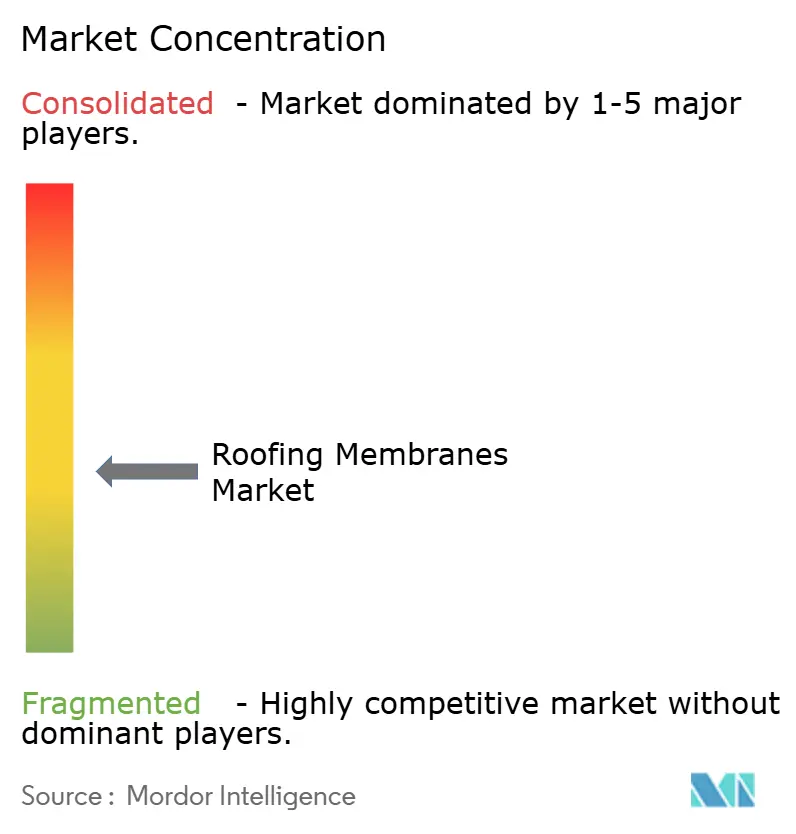
The Roofing Membranes market is moderately fragmented. Strategic differentiation rests on the formulation of intellectual property that meets evolving cool-roof, VOC, and fire codes; vertical integration into installation or service programs; and verifiable sustainability credentials such as closed-loop take-back schemes. White-space plays center on ultra-light sheets for structural-capacity-constrained retrofits, integrated photovoltaic membranes that eliminate racking, and circular-economy service models that sell leak-free uptime rather than material.
Roofing Membranes Industry Leaders
-
Carlisle SynTec Systems
-
GAF Materials LLC
-
Sika AG
-
Soprema Group
-
Standard Industries Inc.
- *Disclaimer: Major Players sorted in no particular order
Roofing Membranes Market Companies Covered in this Report
- Carlisle SynTec Systems
- Dow
- Duro-last Inc.
- Fosroc Inc.
- GAF Materials LLC
- Holcim
- IB Roof
- IKO Polymeric
- Isomat SA
- Johns Manville
- Juta Ltd
- Kemper System America Inc.
- Kingspan Group
- Nordic Waterproofing
- Owens Corning
- Paul Bauder GMBH & Co. KG
- Ph Plastics
- Saint-Gobain
- Sika AG
- Soprema Group
- Standard Industries Inc.
Market Opportunities and Future Outlook
Code-driven cool-roof compliance and solar-ready roof requirements are creating premium lanes for white TPO/PVC sheets and high-albedo liquid-applied systems that can be installed over existing substrates to avoid full tear-offs. California Title 24 updates effective January 2026 reinforce aged reflectance thresholds at permitting, which supports demand for CRRC-listed membranes and low-VOC primers and adhesives in hot-climate reroofing. Another opportunity is the move toward fast-curing liquid systems for complex details such as flashings, penetrations, and irregular substrates, where schedule compression and labor scarcity favor spray- and roll-applied approaches over multi-piece sheet detailing.
Regulatory and owner procurement shifts toward verified environmental documentation create whitespace for manufacturers that can provide EPD-backed submittals and align to emerging construction-product regime reforms. In Europe, the Construction Products Regulation 2024, effective January 2026, expands expectations for sustainability information, including digital product data, alongside traditional performance declarations, increasing the value of compliant product portfolios and documentation services. In the United Kingdom, the Construction Products Reform White Paper consultation (February to May 2026) focuses on product safety, market surveillance, and carbon footprint themes, highlighting demand for suppliers that can support evolving proof requirements while maintaining fire and energy-code compliance.
Recent Industry Developments in Roofing Membranes Market
- March 2026: Carlisle SynTec Systems introduced 16-foot-wide Sure-Weld TPO with SeamShield technology and added a High Slope option aimed at large commercial roof areas. The wider format reduces seams and can cut installation time per square. It also supports wind and water performance by minimizing field welds.
- February 2026: Sika began construction on a new highly automated single-ply thermoplastic roofing membrane plant in Sealy, Texas. The investment strengthens domestic supply capability for thermoplastic membranes and supports faster lead times and specification support for North American commercial reroofing and new-build projects.
- February 2025: Sika launched Sarnafil AT FSH self-healing PVC membrane and the SikaShield HB79 hybrid modified bitumen sheet for North American re-roofing applications. The releases broaden solution sets for aging roof inventories by pairing higher-durability PVC options with hybrid redundancy approaches. They target leak-risk reduction and longer service intervals.
Roofing Membranes Market Report Scope and Research Methodology
Market Definition and Coverage
This market covers roofing membranes used to create a continuous water barrier on flat and low-slope roofs, where performance is typically measured by weatherproofing and long-term durability. We size the market in value terms for membranes sold into roofing applications across major end users.
Scope exclusions: We exclude steep-slope shingles and tiles, structural roof components, and unrelated waterproofing uses outside roofing.
Segments Covered in This Report
- By Product Type
- Liquid Applied Membrane
- Acrylic
- Polyurethane
- Polyurea
- Others
- Sheet Membrane
- Polyvinyl Chloride (PVC)
- Ethylene Propylene Diene Monomer (EPDM)
- Thermoplastic Polyolefin (TPO)
- Self-adhesive Bitumen
- High-density Polyethylene (HDPE)
- Others
- Liquid Applied Membrane
- By Installation Type
- Mechanically Attached
- Fully Adhered
- Ballasted
- Other Installation Types
- By Application
- Residential
- Commercial
- Institutional
- Infrastructural
- By Geography
- Asia-Pacific
- China
- India
- Japan
- South Korea
- ASEAN Countries
- Rest of Asia-Pacific
- North America
- United States
- Canada
- Mexico
- Europe
- Germany
- United Kingdom
- France
- Italy
- Spain
- Romania
- Poland
- Serbia
- Turkey
- Russia
- Rest of Europe
- South America
- Brazil
- Argentina
- Chile
- Rest of South America
- Middle-East and Africa
- Saudi Arabia
- United Arab Emirates
- South Africa
- Rest of Middle-East and Africa
- Asia-Pacific
Data Sources, Market Sizing, and Validation
Desk Research
Desk work starts by building the demand backdrop for roof replacement and new build activity, and then tying that to membrane adoption on low-slope roofs. Public datasets and references, such as US Census construction spending, US Bureau of Labor Statistics input cost series, International Energy Agency building efficiency material, and Eurostat construction indicators, are used to keep the macro direction grounded.
We also review documents that help us understand product standards and installation practices, such as ICC code updates, ASTM references, and guidance published on association and regulator websites. Along with that, we use annual reports, investor presentations, and trusted trade news to map capacity additions, regional supply shifts, and pricing commentary. Where helpful, paid subscriptions for company financials and intelligence, news and financials, patent databases, and shipment-level import and export data are used to cross-check volumes and trade flows. These examples are not exhaustive, and many other public sources were also reviewed for data collection, validation, and clarification.
Primary Interviews and Surveys
Primary work is used to pressure-test what we built from public data, especially around membrane mix shifts, typical installation choices, and how pricing moves during resin and bitumen cycles. We speak with participants across manufacturing, distribution, contracting, and specification roles, and we cover the major demand centers across APAC, EMEA, and the Americas so the assumptions are not shaped by one region's construction cycle.
Distribution of primary research fieldwork respondents
| Company type | Respondent position | Region |
|---|---|---|
| Top tier: 35% | CXOs: 13% | APAC: 51% |
| Mid tier: 49% | Functional/Unit leaders: 35% | EMEA: 31% |
| Smaller Players: 16% | Managers: 52% | Americas: 18% |
Market-Sizing & Forecasting
Our sizing starts with a top-down build that reconstructs the addressable low-slope roofing demand pool using construction output and reroofing intensity, and then applies membrane penetration by building type. Once the totals are formed, selective bottom-up checks are run using sampled volume by membrane type and typical average selling prices (ASPs) by region, followed by channel checks with contractors and distributors to correct obvious under or over statements.
Key inputs used in the model include new build versus reroofing split, low-slope share within total roofing, membrane mix by material family (for example, thermoplastic, thermoset, and modified bitumen), typical thickness or reinforcement level for major applications, installation method shares (mechanically attached, fully adhered, and ballasted), and region-level input costs that influence realized ASPs. When data is thin for smaller countries, gaps are handled by using proxy construction indicators, climate driven roof design patterns, and interview-based adoption ranges, and then these are normalized to regional totals.
For forecasting, scenario analysis is applied around construction cycles and reroofing cadence, and the resulting path is then smoothed using trend consistency checks so year-to-year movement does not break known industry behavior. Assumptions on ASP progression are updated using a mix of input cost outlook and primary feedback on contract pricing pass-through.
Data Validation & Update Cycle
Validation is done by triangulating the model with independent signals such as regional construction direction, trade flow movement for key membrane inputs and finished goods, and the implied consumption per roof area that practitioners consider realistic. Outliers are flagged, investigated, and corrected through follow-up calls when a region shows growth or pricing patterns that do not match the underlying drivers.
Before sign-off, the work goes through multi-step analyst reviews that test sensitivity to the main inputs and check for math and unit consistency across regions and years. The report is refreshed on an annual cycle, and interim updates are triggered when material events occur, such as sharp input cost swings, policy changes affecting cool-roof requirements, or sudden construction slowdowns. Right before delivery, a final pass is completed so clients receive the most recent view available.
Mordor Intelligence's Roofing Membranes Market Estimate Compared With Other Published Estimates
Published market sizes for roofing membranes can look far apart, even when they all talk about the same end use, because each publisher makes different choices on product coverage, year anchors, and price assumptions. We also see differences when one estimate leans heavily on shipment volume, and another is mainly built from construction spending proxies.
Some published figures group the topic under a wider roof membrane or building waterproofing umbrella, which can pull in adjacent uses beyond flat and low-slope roofing. In Mordor Intelligence, the count is limited to roofing membranes used as roof sealing systems, and the model is tied to installation type, application, and region-specific demand indicators, which keeps the total from being inflated by non-roof uses or broader waterproofing categories.
Benchmark comparison
| Source | Market Size | Gaps in Research Methodology |
|---|---|---|
| Mordor Intelligence | USD 10.36 B (2025) | |
| Industry Data Provider A | USD 9.59 B (2024) | Uses a roof membrane framing that is closer to production and consumption accounting, and it can mix revenue and output views across regions, which shifts totals depending on trade and stock effects. |
| Sector Report Publisher B | USD 8.70 B (2025) | Leans on a narrower revenue base year with broader type groupings, and it typically applies uniform growth and pricing progression, which can understate regions where reroofing and specification-led upgrades lift ASPs. |
The spread in the table mainly comes from how roof-only usage is separated from wider membrane reporting, and from how each source translates volume activity into revenue through ASP logic. By keeping the scope aligned to low-slope roofing demand and then checking results against install mix and regional construction signals, we get a market value that is easier to trace back to clear, repeatable inputs.
Key Questions Answered in the Report
What is the projected global size of roofing-membrane demand by 2031?
Spending is forecast to reach USD 13.86 billion in 2031, expanding from USD 10.87 billion in 2026 at a 4.97% CAGR over 2026-2031.
Which product category is expected to add the most square meters through 2031?
Liquid-applied acrylic, silicone, polyurethane, and polyurea systems will add about 760 million m² thanks to seamless installation over existing roofs and easy compliance with VOC limits.
Why are fully adhered assemblies gaining share over ballasted roofs?
Insurers favor their Factory Mutual wind-uplift ratings, and they avoid the structural dead-load penalties that ballast imposes on PV-ready retrofits, especially in hurricane and seismic zones.
Which region will contribute the largest incremental revenue between 2026 and 2031?
Asia-Pacific, led by China’s Belt and Road projects and India’s smart-city housing, is forecast to grow at a 6.33% CAGR and already accounts for 45.56% of 2025 revenue.
How are new regulations shaping membrane formulation trends?
Title 24, REACH PFAS restrictions, and Broof(t1) fire tests are forcing a switch to chlorine-free TPO, non-fluorinated surfactants, and low-VOC water-based adhesives, rewarding suppliers with strong in-house polymer R&D.