
Market Overview
| Study Period | 2021 - 2031 |
|---|---|
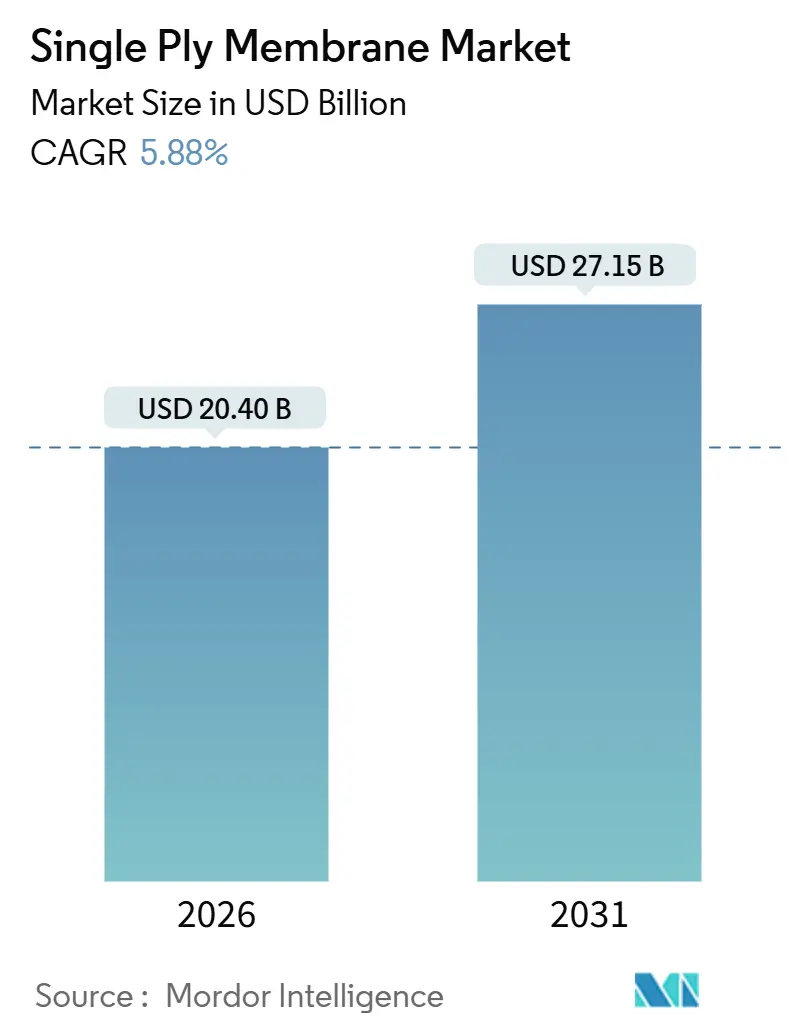
| Market Size (2026) | USD 20.40 Billion |
| Market Size (2031) | USD 27.15 Billion |
| Growth Rate (2026 - 2031) | 5.88 % |
| Fastest Growing Market | Asia Pacific |
| Largest Market | Asia Pacific |
| Market Concentration | Medium |
Major Players *Disclaimer: Major Players sorted in no particular order Image © Mordor Intelligence. Reuse requires attribution under CC BY 4.0. | |
Single Ply Membrane Market Analysis by Mordor Intelligence
The Single Ply Membrane Market size is estimated at USD 20.40 billion in 2026, and is expected to reach USD 27.15 billion by 2031, at a CAGR of 5.88% during the forecast period (2026-2031). Demand momentum stems from overlapping forces. Commercial reroofing cycles in the United States and Canada have entered peak replacement years, data-center construction is scaling across Asia-Pacific, and green-building mandates such as the European Union’s 2024/1275 directive are tightening performance thresholds for roofing assemblies. Thermoplastic and elastomeric sheets are displacing built-up roofs because they install faster, offer higher solar reflectance, and deliver superior life-cycle economics. Labor-saving 16-foot-wide TPO rolls, cool-roof utility rebates, and growing solar-ready specifications are further widening the cost–benefit gap in favor of single-ply membranes. Competitive intensity remains moderate, yet regional specialists are carving out share in installer-constrained markets and in niches such as green-roof systems and photovoltaic-integrated assemblies.
Key Report Takeaways
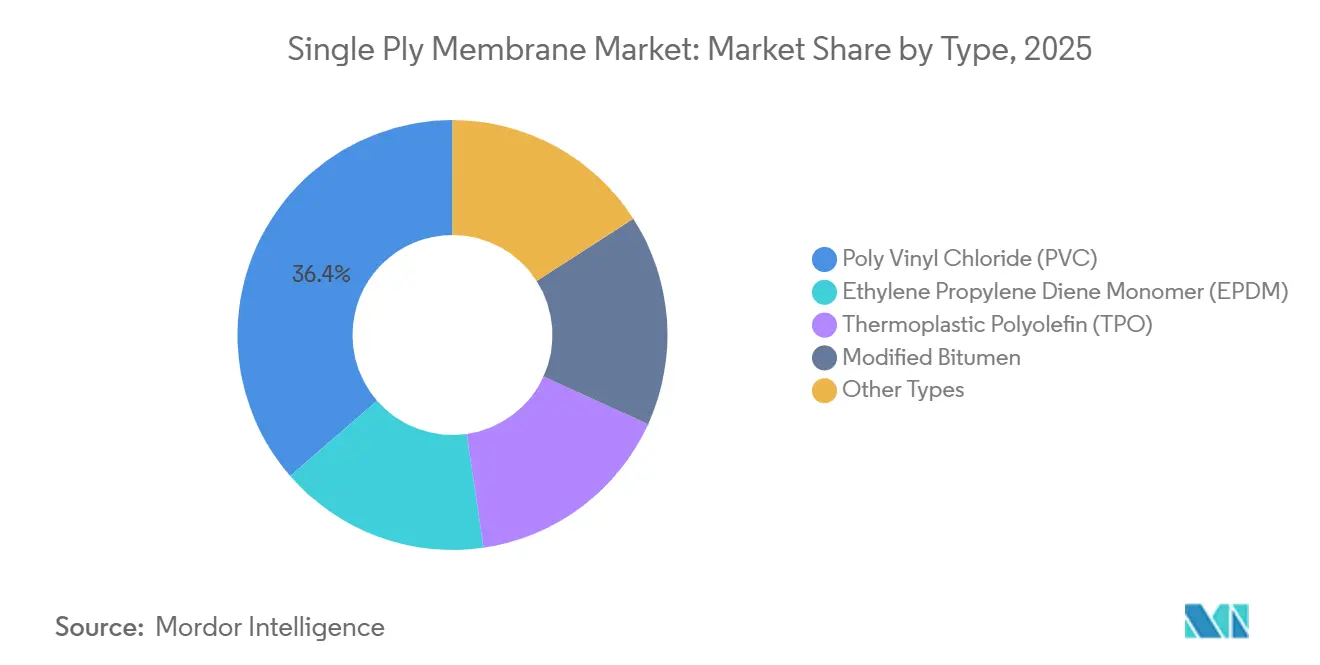
- By product type, Poly Vinyl Chloride held 36.39% of the single ply membrane market share in 2025, while Thermoplastic Polyolefin is projected to record the fastest 7.01% CAGR to 2031.
- By application, infrastructure topped revenue with 44.17% share in 2025; residential retrofits are expected to advance at a 5.95% CAGR through 2031.
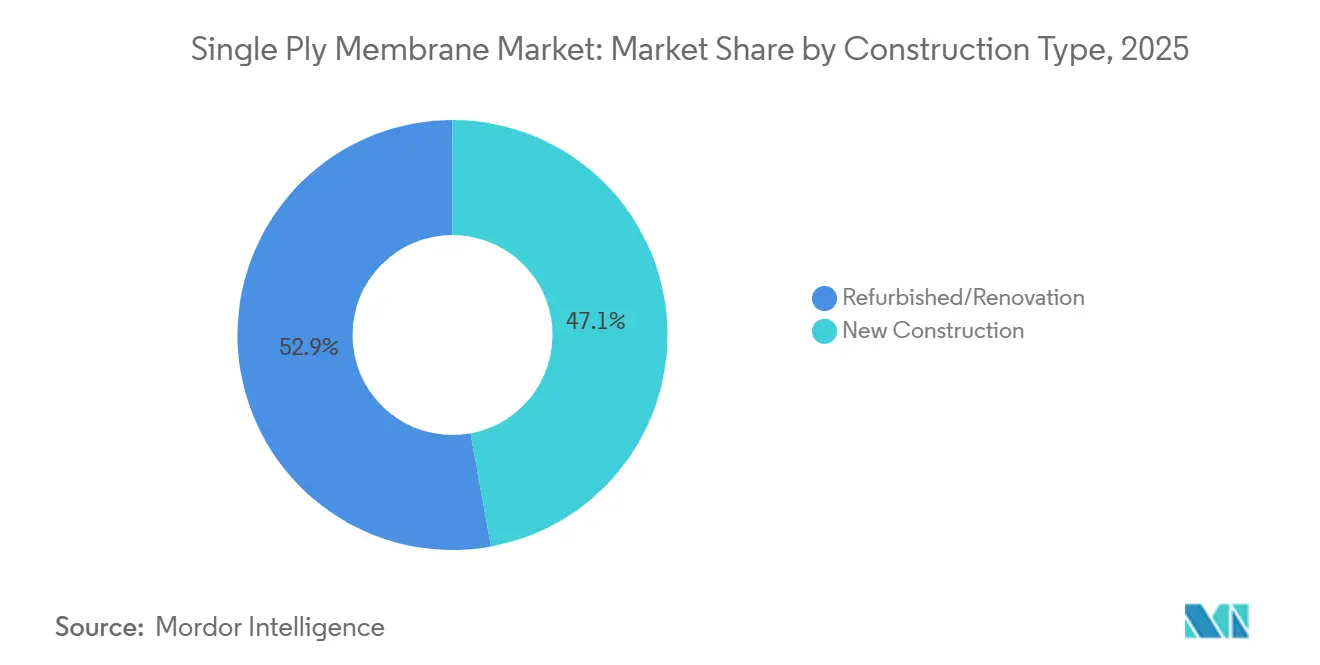
- By construction type, renovation captured 52.87% of the single ply membrane market size in 2025, whereas new-build demand is forecast to scale at a 6.23% CAGR over 2026-2031.
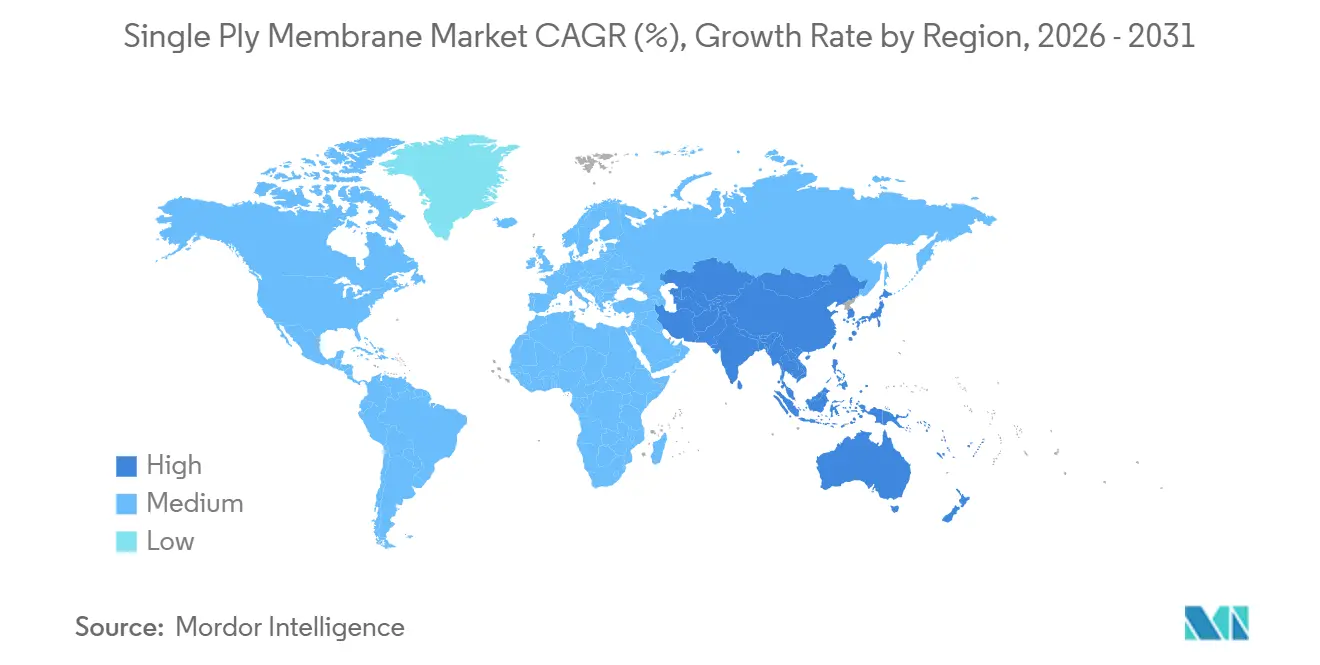
- By region, Asia-Pacific led with a 33.97% share in 2025 and is set to accelerate at a 6.55% CAGR, outpacing all other geographies.
Note: Market size and forecast figures in this report are generated using Mordor Intelligence’s proprietary estimation framework, updated with the latest available data and insights as of January 2026.
Market Trends and Insights
Drivers Impact Analysis of Single Ply Membrane Market*
| Drivers | (~) % Impact on CAGR Forecast | Geographic Relevance | Impact Timeline |
|---|---|---|---|
| Rising demand for energy-efficient and cool-roof systems | +1.2% | Global, with concentration in North America and Europe | Medium term (2-4 years) |
| Commercial reroofing boom in North America | +1.5% | North America, particularly United States and Canada | Short term (≤ 2 years) |
| Urbanization-led construction up-cycle in Asia-Pacific | +1.3% | Asia-Pacific core, spill-over to Middle-East and Africa | Long term (≥ 4 years) |
| Government incentives and stricter green-building codes | +0.9% | North America, Europe, select Asia-Pacific markets | Medium term (2-4 years) |
| Adoption of 16-ft wide TPO rolls cuts labour 15-20% | +0.6% | North America and Europe | Short term (≤ 2 years) |
| Source: Mordor Intelligence | |||
Rising Demand for Energy-Efficient and Cool-Roof Systems
Cool-roof membranes enable ENERGY STAR certification and LEED v4 points, all while meeting the Cool Roof Rating Council’s stringent aged-reflectance standards[1]Cool Roof Rating Council, “CRRC‐1 Program Manual,” coolroofs.org. California’s Title 24 code now mandates cool roofs on every low-slope commercial building, pushing contractor lead times for white TPO and PVC beyond eight weeks in late 2024[2]California Energy Commission, “2024 Title 24 Building Standards,” energy.ca.gov. The U.S. EPA is expanding its Heat-Island Reduction Program to 15 new metro areas in 2026, triggering municipal subsidies for reflective retrofits on government facilities. Large-scale solar developers favor bright membranes that limit thermal stress on photovoltaic modules, a requirement addressed by Carlisle’s SeamShield coating that pairs high albedo with induction-welded seams.
Commercial Reroofing Boom in North America
In 2024, the U.S. nonresidential roofing sector experienced significant growth, supported by aging low-slope stock. Contractors predominantly favor single-ply membranes, which constitute the majority of their project mix. Within this category, TPO holds the largest share, followed by PVC and EPDM. Carlisle's construction-materials revenue was bolstered by a strong EBITDA margin, thanks to normalized distributor inventories and robust contractor backlogs. GAF's upcoming shingle plant in Newton, Kansas, announced in March 2024 and set to break ground in June 2025, underscores the company's faith in sustained reroofing demand. However, with automation in play, the workforce expansion is limited to a modest number of roles.
Urbanization-Led Construction Up-Cycle in Asia-Pacific
In 2024, ASEAN drew in significant foreign direct investment, with a notable surge in construction inflows. The region's data-center capacity has now expanded across numerous facilities, all of which are in need of high-performance low-slope roofing systems. In its 2024-25 budget, India set aside substantial funds for capital projects, with a significant portion directed towards logistics corridors, often opting for cost-efficient TPO or EPDM assemblies. While China's real-estate investment saw a year-over-year decline in early 2024, the renovation of existing industrial assets has somewhat mitigated this downturn. Research from OECD on climate risks is prompting coastal governments to mandate membranes that adhere to strict wind-uplift ratings, with a clear preference for mechanically fastened TPO and PVC in areas vulnerable to typhoons.
Government Incentives and Stricter Green-Building Codes
In 2024, the EU Building Energy Performance Directive 2024/1275 mandated a 2030 zero-emission target for all new structures, emphasizing the importance of solar-readiness and life-cycle carbon disclosure. LEED v5 beta has tightened its standards, raising embodied-carbon thresholds and offering bonus points for membranes containing recycled content. Notably, Carlisle achieved this benchmark in 2024 by reclaiming post-consumer scrap. Meanwhile, the U.S. Department of Energy rolled out its 2024 Cool-Surfaces Deployment Plan, providing grants for municipal retrofits. In parallel, India's Bureau of Energy Efficiency is formulating cool-roof mandates for its major metropolitan areas.
Restraints Impact Analysis of Single Ply Membrane Market*
| Restraints | (~) % Impact on CAGR Forecast | Geographic Relevance | Impact Timeline |
|---|---|---|---|
| Polymer and additive price volatility | -0.8% | Global, with acute impact in Europe and Asia-Pacific | Short term (≤ 2 years) |
| Shortage of certified single-ply installers | -0.5% | North America and Europe | Medium term (2-4 years) |
| Municipal PVC bans in parts of EU | -0.3% | Europe, concentrated in Germany, France, and Nordic countries | Long term (≥ 4 years) |
| Source: Mordor Intelligence | |||
Polymer and Additive Price Volatility
In June 2025, PVC resin prices in the U.S. declined year over year. Meanwhile, European prices increased, tightening the margins for global producers. Propylene, the feedstock for TPO, experienced fluctuations throughout 2024, influenced by turnarounds at Gulf Coast refineries. Ethylene prices for EPDM also varied, primarily due to outages at crackers. After peaking in 2023, titanium-dioxide costs stabilized in 2025. However, with supply concentrated among just three global vendors, an oligopoly pricing power remains intact. In a strategic move, major membrane producers are securing multi-year resin contracts. These contracts, featuring floor-and-ceiling clauses, shield a significant portion of their feedstock exposure but cap potential gains when spot prices dip.
Shortage of Certified Single-Ply Installers
NRCA ProCertification costs discourage entry-level roofers and stifle workforce growth, especially in rural regions. The Technical Roofing Academy's certification capacity falls short of North America's projected demand. In Q2 2024, Carlisle noted that many of its contractor partners grappled with labor shortages, pushing project starts back significantly. GAF's training initiative for 2025 targets the certification of more installers by 2027, but its stipulation for brand exclusivity risks fragmenting the industry. Handwerkskammer in Germany highlights a decline in roofing apprenticeships since 2020, pointing to analogous challenges across Europe.
*Our forecasts treat driver/restraint impacts as directional, not additive. The impact forecasts reflect baseline growth, mix effects, and variable interactions.
Single Ply Membrane Market Segment Analysis
By Type:
TPO Gains as PVC Navigates Regulatory HeadwindsThermoplastic Polyolefin is projected to post a 7.01% CAGR from 2026-2031, the fastest rate among material classes, buoyed by labor-saving 16-foot rolls and stricter cool-roof codes. Poly Vinyl Chloride retained a 36.39% single ply membrane market share in 2025, protected by strong chemical resistance and fire-safety credentials, yet municipal bans in Germany, France, and Nordic countries are eroding its European footprint. Ethylene Propylene Diene Monomer remains popular for warehouse roofs where capital cost eclipses reflectivity, although EPDM’s darker color disqualifies it from many utility rebates. Modified bitumen continues to lose relevance as contractors migrate toward hot-air-welded thermoplastic polyolefin membranes that cut installation schedules.
Innovation is witnessing a resurgence. Sika’s felt-back self-adhered PVC is designed for sub-40 °F applications, where traditional solvent-based adhesives falter. Meanwhile, Carlisle’s Sure-Weld TPO boasts tensile strengths exceeding ASTM standards. While specialty blends like KEE and composite sheets command a modest share, they're increasingly chosen for green roofs and photovoltaic-integrated setups due to their puncture resistance and electrical insulation properties. With FM Global Class 90 ratings becoming essential for facilities in hurricane-prone areas, there's a noticeable uptick in investments towards seam-welding and uplift-test capabilities.



By Application:
Infrastructure Dominates, Residential AcceleratesInfrastructure accounted for 44.17% of 2025 demand, spanning logistics hubs, transit terminals, and solar farms that prioritize durability and low maintenance. The residential segment, though smaller, is projected to lead growth at a 5.95% CAGR as homeowners chase utility rebates and FORTIFIED insurance discounts by retrofitting shingle roofs with cool TPO and PVC assemblies. While North America and ASEAN data-center hubs continue to see robust commercial demand, China's market is cooling as new real-estate projects decline. To earn LEED v5 points, institutional projects like schools and hospitals are increasingly opting for membranes containing recycled content.
GAF's partnership with the Insurance Institute for Business and Home Safety streamlines the FORTIFIED certification process, leading to a reduction in insurance premiums for homeowners in the Gulf Coast. Prefabricated membrane panels, which combine insulation and cover boards at the factory, are becoming popular in occupied buildings, especially where obtaining on-site hot-work permits proves challenging. In densely populated European cities, green-roof assemblies are opting for root-resistant PVC or KEE sheets, trading stormwater credits against a premium. Additionally, PV-ready roofs are now requiring membranes thicker than 72 mils to endure mounting-rail loads and thermal cycling.
By Construction Type:
Renovation Leads, New Construction Gains MomentumRenovation captured 52.87% of global revenue in 2025, underscoring the prevalence of aging low-slope roofs. By using mechanically fastened TPO overlays, contractors can often skip the tear-off process, leading to cost savings and shorter project timelines. New construction is forecast to rise at a 6.23% CAGR, fueled by greenfield projects set to launch across ASEAN in 2024 and bolstered by India's ambitious capex plan for logistics corridors. In new builds, fully adhered or self-adhered membranes are preferred for their ability to achieve higher wind ratings and seamlessly integrate with below-grade waterproofing. Meanwhile, in China, developers are shifting their focus to renovating existing industrial properties, maintaining demand levels even as interest in residential towers wanes.
Geography Analysis
APAC Single Ply Membrane Market
Asia-Pacific controlled 33.97% of global revenue in 2025 and is expected to outpace every other region with a 6.55% CAGR to 2031. Cross-border investments in electronics, electric vehicles (EVs), and pharmaceuticals are driving the construction of factories that increasingly favor clean-roof PVC systems. Concurrently, data centers have boosted their capacity significantly, each requiring sturdy low-slope roofs to support heavy HVAC equipment. India's unprecedented infrastructure allocations, coupled with mandatory cool-roof initiatives in hotter regions, are further propelling regional adoption. Despite a pullback in China's real estate sector, the ongoing renovation of its vast existing stock continues to bolster demand, particularly for cost-effective EPDM overlays.
North America Single Ply Membrane Market
North America stands as the second-largest market for single-ply membranes. The U.S. nonresidential roofing sector is experiencing growth, with single-ply assemblies taking center stage in project portfolios. The push from Title 24 cool-roof mandates, alongside FORTIFIED hurricane standards, is accelerating the adoption of TPO and PVC. While Canada reaps the benefits of federal infrastructure investments, Mexico's automotive and electronics near-shoring boom is driving the construction of logistics parks in states like Nuevo León and Guanajuato. However, labor shortages are extending lead times and inflating labor costs, particularly in Alberta, British Columbia, and the U.S. Sunbelt.
EMEA and South America Single Ply Membrane Market
Europe is navigating a landscape of contradictions. The tightening of lead limits in PVC by Commission Regulation 2023/923, along with bans on PVC roofs for public buildings in several municipalities, is pushing the market towards TPO and EPDM alternatives. On the other hand, the EU's zero-emission-building mandate is spurring a surge in retrofit activities, especially in Germany, France, and the U.K. Here, property owners are overlaying existing roofs with reflective TPO to align with carbon reduction targets. However, declining apprenticeship rates in Germany and labor shortages post-Brexit in the U.K. are extending project timelines. In Russia, due to market constraints from sanctions, there's a preference for locally produced EPDM and bitumen. Meanwhile, countries like Brazil, Saudi Arabia, and South Africa are witnessing selective growth, driven by projects in airports, stadiums, and utilities.

Value Chain Analysis
The single-ply membrane value chain starts upstream with petrochemical-derived base resins and key additives, then moves into compounding and sheet formation. Manufacturers formulate TPO, PVC, or EPDM compounds with fillers and stabilizer packages, then convert them into reinforced sheets using extrusion and/or calendering, typically incorporating fiberglass or polyester scrims for dimensional stability and strength. Performance and compliance requirements from bodies such as SPRI and associations such as SPRA influence product specifications and testing protocols, while environmental documentation (EPDs) has become a common downstream requirement for institutional and green-building projects.
Midstream and downstream, installation capability is as influential as product availability. Membranes are distributed through building-material distributors and direct-to-contractor programs, but demand is often constrained by factory-certified installer networks and the availability of key accessories (adhesives, cover tapes, flashing systems, fasteners). Logistics also shape ordering patterns because rolls are bulky and damage-sensitive, which encourages regional production footprints and supply planning around major construction corridors. A persistent bottleneck remains in specialized additive supply, particularly UV-stabilizer packages sourced from a limited supplier base, along with the availability of certified labor for heat-welded and mechanically fastened assemblies.
Competitive Landscape
The global single-ply membranes market is moderately fragmented. Carlisle’s USD 2.025 billion divestiture of its interconnect unit and USD 410 million acquisition of MTL Holdings in 2024 sharpened its focus on building products. Sika is executing a diversification play, purchasing Cromar in the U.K., Elmich in Singapore, and Gulf Seal in Saudi Arabia to cross-sell waterproofing and green-roof solutions. Distributor consolidation is another flashpoint. QXO’s USD 11 billion hostile bid for Beacon Roofing Supply in January 2025 signals tightening channel leverage that could compress supplier margins for firms lacking direct-to-contractor programs. Technology is a differentiator: leaders invest in prefabricated membrane panels that cut field labor 20%, self-adhered sheets that eliminate VOCs, and recycled-content formulations that satisfy LEED v5 credits.
Single Ply Membrane Industry Leaders
Carlisle SynTec Systems
GAF
Holcim Elevate (Firestone)
Sika AG
Johns Manville
- *Disclaimer: Major Players sorted in no particular order

Single Ply Membrane Market Companies Covered in this Report
- Bauder GmbH
- BMI Group (Icopal)
- Carlisle SynTec Systems
- Dow
- Duro-Last Inc.
- Firestone Building Products Company LLC
- GAF
- Godfrey Roofing Inc.
- Holcim Elevate (Firestone)
- IKO Industries
- Johns Manville
- Kingspan Group
- Owens Corning
- Protan AS
- RENOLIT SE
- Seaman Corporation
- Sika AG
- Soprema Group
- Versico Roofing Systems

Market Opportunities and Future Outlook
Near-term whitespace is concentrated around capacity localization, faster-installation systems, and compliance-ready specifications for cool roofs and low-carbon building programs. Sika breaking ground in February 2026 on a new, highly automated thermoplastic single-ply roofing production plant in Sealy, Texas (over USD 90 million, under the Texas JETI program) signals an effort to shorten lead times and raise service levels in high-throughput reroofing and data-center corridors. In Europe, Bauder’s major expansion at Schwepnitz, Germany, to increase FPO output and add new PVC membrane production reflects continued investment to support renovation-heavy demand and shifting specification needs.
System opportunities are also showing up where owners and contractors want fewer field steps and tighter detailing around penetrations, perimeters, and rooftop equipment. Product and system portfolio broadening by specialist brands adds substitution pressure toward heat-weldable thermoplastics for projects prioritizing reflective performance and installation speed. At the same time, installer scarcity and documentation requirements such as EPDs, recycled content claims, and system warranties create space for training, prefabrication, and take-back or recycling programs that reduce jobsite labor intensity and help projects meet green-building criteria.
Recent Industry Developments in Single Ply Membrane Market
- July 2026: Sika announced the Sikalastic Rapid PMMA product line, consolidating previous PMMA flashing and field membrane solutions under a single global brand. The simplified branding and system alignment supports specification continuity across regions and can reduce contractor learning curves for detailing and repairs.
- March 2026: IB Roof Systems (Kingspan Group) expanded its commercial roofing portfolio to include TPO membranes alongside its established PVC and liquid-applied offerings. Adding TPO broadens bid coverage on cool-roof and thermoplastic specifications, strengthening Kingspan-linked single-ply participation in US low-slope reroofing channels.
- September 2024: Johns Manville launched JM TPO Heat Weldable Cover Tape, a reinforced solution designed to heat-weld detailing at metal flanges and other transitions. The product targets faster, more consistent field fabrication of critical details, supporting higher-throughput installation in labor-constrained contractor markets.


Single Ply Membrane Market Report Scope and Research Methodology
Market Definition and Coverage
For this study, the market covers revenue generated from single-ply roofing membranes used to waterproof and protect buildings with flat or low-slope roofs, across new build and roof replacement activity, and across major regions.
Scope exclusions: We do not count non-membrane roof components such as insulation, fasteners, adhesives, coatings, or full roofing system installation labor unless it is bundled into the membrane product revenue.
Segments Covered in This Report
- By Type
- Ethylene Propylene Diene Monomer (EPDM)
- Thermoplastic Polyolefin (TPO)
- Poly Vinyl Chloride (PVC)
- Modified Bitumen
- Other Types
- By Application
- Residential
- Commercial
- Institutional
- Infrastructure
- By Construction Type
- New Construction
- Refurbished/Renovation
- By Geography
- Asia-Pacific
- China
- India
- Japan
- South Korea
- ASEAN Countries
- Rest of Asia-Pacific
- North America
- United States
- Canada
- Mexico
- Europe
- Germany
- United Kingdom
- Italy
- France
- Spain
- Russia
- NORDIC Countries
- Rest of Europe
- South America
- Brazil
- Argentina
- Rest of South America
- Middle-East and Africa
- Saudi Arabia
- South Africa
- Rest of Middle-East and Africa
- Asia-Pacific
Data Sources, Market Sizing, and Validation
Desk Research
Desk work starts by mapping the demand pool for flat and low-slope roofing, and then linking it to membrane consumption patterns by region. We mainly use public construction and building data, such as national statistics offices and housing ministries, and we also pull international datasets like the World Bank and UN Comtrade for trade direction checks where they are relevant.
To avoid building the model on one narrow data stream, we also refer to sources such as building code guidance and energy-efficiency program documentation (cool roof guidance), trade associations for roofing and building materials, and peer-reviewed papers that discuss membrane performance and replacement cycles. Company filings, investor presentations, and reputable industry news are used to validate product mix shifts and pricing commentary. A paid subscription for company financials and intelligence, and an import-export shipment-level database, are used selectively to cross-check scale and flows where public reporting is thin. These desk sources are not exhaustive, and we reviewed many other public documents to compile inputs, validate assumptions, and clarify gaps.
Primary Interviews and Surveys
Primary inputs were collected through expert interviews and structured surveys with manufacturers, distributors, roofing contractors, specifiers, and large building owners, so our assumptions on demand and pricing could be confirmed by people closest to transactions. Because this is a global market, we spread conversations across the Americas, EMEA, and APAC to reflect differences in refurbishment intensity, commercial construction activity, and material preferences by climate and building codes.
Distribution of primary research fieldwork respondents
| Company type | Respondent position | Region |
|---|---|---|
| Top tier: 34% | CXOs: 15% | APAC: 44% |
| Mid tier: 47% | Functional/Unit leaders: 31% | EMEA: 31% |
| Smaller Players: 19% | Managers: 54% | Americas: 25% |
Market-Sizing & Forecasting
Sizing is built using a top-down structure where construction and reroofing indicators are translated into a roof area demand pool, which is then converted to membrane value using adoption shares and average selling prices. The demand pool is shaped using practical inputs such as commercial floor space additions, the mix of flat and low-slope roofs, reroofing frequency for aging stock, and typical membrane thickness and yield assumptions that affect material usage.
To keep the outputs realistic, we corroborate totals with selective bottom-up checks based on sampled supplier revenue disclosures, channel feedback on volumes, and price bands by material type. When data is missing for smaller countries, we fill gaps using proxy ratios from comparable markets (similar climate, construction intensity, and building code strictness), and then review the approach with regional experts before accepting it.
Forecasts are produced using scenario analysis, where base construction activity and refurbishment cycles are tested with assumptions on interest rates, non-residential project pipelines, and roof-energy regulations that influence reflective membrane adoption. Pricing is projected using an input-cost and mix approach, and then adjusted after our calls confirm whether recent price moves are sticking in bids and contracts.
Data Validation & Update Cycle
Validation is done in steps, and it starts with checking whether modeled demand aligns with independent signals such as construction spending trends, reroofing intensity commentary, and regional product mix shifts. Outliers are flagged early, and then the drivers are rechecked, including conversion rates, currency timing, and price assumptions, before the numbers are finalized.
A second analyst reviews the model logic and key inputs, and follow-up calls are triggered when a large variance is seen versus trade flows, company commentary, or regional construction indicators. Reports are refreshed annually, and interim updates are made when material events occur, such as major regulatory changes or sharp raw material price moves. Before delivery, we run a final update pass so clients receive the latest consistent view.
Mordor Intelligence's Single Ply Membranes Market Size Versus Other Published Estimates
Different published market sizes for single-ply membranes can look far apart because the coverage choices are not always the same, even when the titles sound similar. The biggest differences usually come from what is counted as revenue, what years are used for the base and forecast, and how pricing is treated across materials and regions.
Some estimates blend in adjacent roofing layers or treat full installed roofing system value as the market, which inflates totals when labor and accessories are included. Mordor Intelligence counts only single-ply membrane product revenues across EPDM, TPO, PVC, modified bitumen, and similar membranes, and it keeps add-on roofing components and stand-alone installation services outside the market value so the number stays tied to membrane demand and pricing.
Benchmark comparison
| Source | Market Size | Gaps in Research Methodology |
|---|---|---|
| Mordor Intelligence | USD 20.40 B (2026) | |
| Industry Publisher A | USD 8.94 B (2024) | Uses an earlier base year and appears to frame the market around flat and low-slope roofing membrane demand with a different revenue capture point, which can miss later-cycle price changes and shifts in refurbishment intensity. |
| Market Publisher B | USD 3.90 B (2024) | Reports a much smaller value that likely reflects a narrower counted scope or a constrained regional and application mix, and the page shows inconsistent headline figures across years that can affect comparability. |
Reading the three figures together, the spread mainly comes from the year used and what revenue line is treated as the market, not from disagreement that demand is growing. By keeping the model tied to roof-area demand signals, realistic adoption shares, and reviewed price bands, our estimate stays traceable to clear inputs that can be checked and updated in a repeatable way.


Key Questions Answered in the Report
How large is the single-ply membrane market in 2026?
The single-ply membrane market size is valued at USD 20.40 billion in 2026.
What is the projected CAGR for single-ply membranes to 2031?
The market is forecast to grow at a 5.88% CAGR between 2026 and 2031, reaching USD 27.15 billion.
Which material type is expected to grow fastest through 2031?
Thermoplastic Polyolefin is poised for the quickest expansion at a 7.01% CAGR.
Why is Asia-Pacific the leading growth region?
Robust data-center builds, rising infrastructure budgets, and cool-roof mandates drive Asia-Pacific’s 6.55% CAGR outlook.
What factors limit faster market expansion?
Price volatility in polymer feedstocks, a shortage of certified installers, and localized PVC bans in Europe restrain growth.
Page last updated on:


 Your data is secure and never sold or shared.


