
Rice Derivatives Market Size and Share
Market Overview
| Study Period | 2021 - 2031 |
|---|---|
| Market Size (2026) | USD 17.45 Billion |
| Market Size (2031) | USD 23.28 Billion |
| Growth Rate (2026 - 2031) | 5.94 % |
| Fastest Growing Market | Asia-Pacific |
| Largest Market | North America |
| Market Concentration | Low |
Major Players *Disclaimer: Major Players sorted in no particular order Image © Mordor Intelligence. Reuse requires attribution under CC BY 4.0. | |
Rice Derivatives Market Analysis by Mordor Intelligence
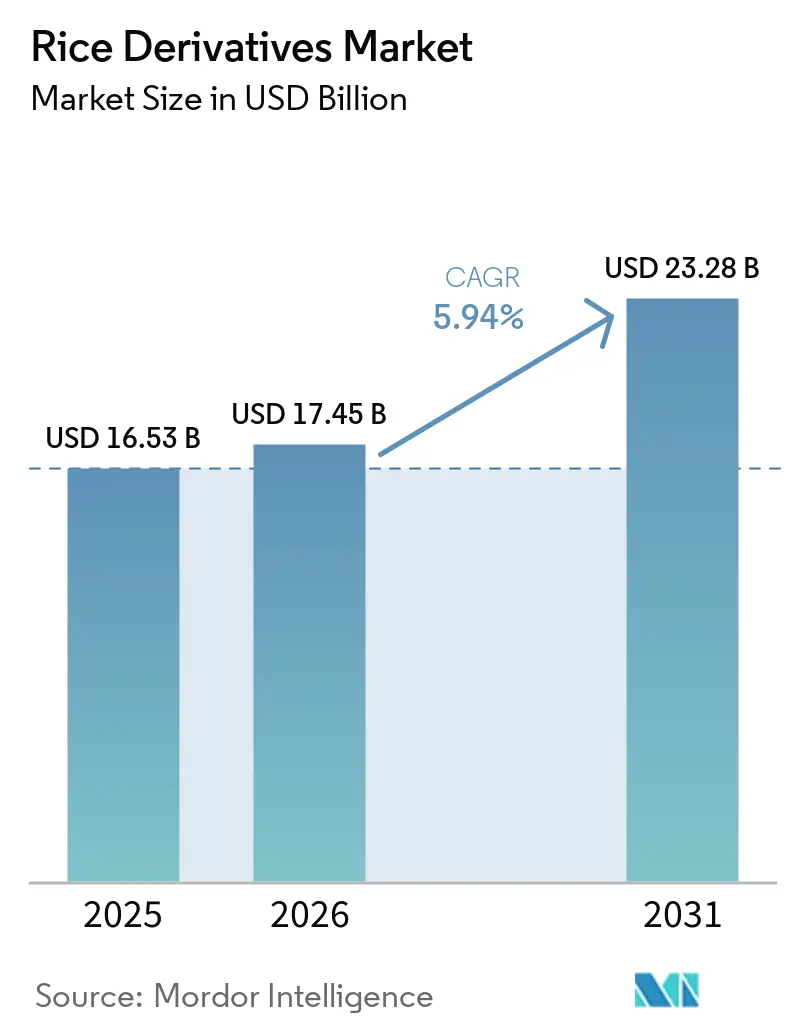
The rice derivatives market size was valued at USD 16.53 billion in 2025 to USD 17.45 billion in 2026, and is forecast to reach USD 23.28 billion by 2031 at a 5.94% CAGR over 2026-2031. Food manufacturers drive the rice derivative market by seeking gluten-free and allergen-friendly ingredients for mainstream products. Pharmaceutical and personal care manufacturers also use rice-based materials when small particle size, neutral color, and plant-based positioning are important. Food processors benefit from a substantial global rice supply; however, rice bran value depends on rapid stabilization after milling. Consequently, the market favors processors that can ensure traceability, quality control, and specialized processing capabilities rather than relying solely on raw material supply. The strongest opportunities lie in products that combine functional performance with clear labeling and certified sourcing.
Key Report Takeaways
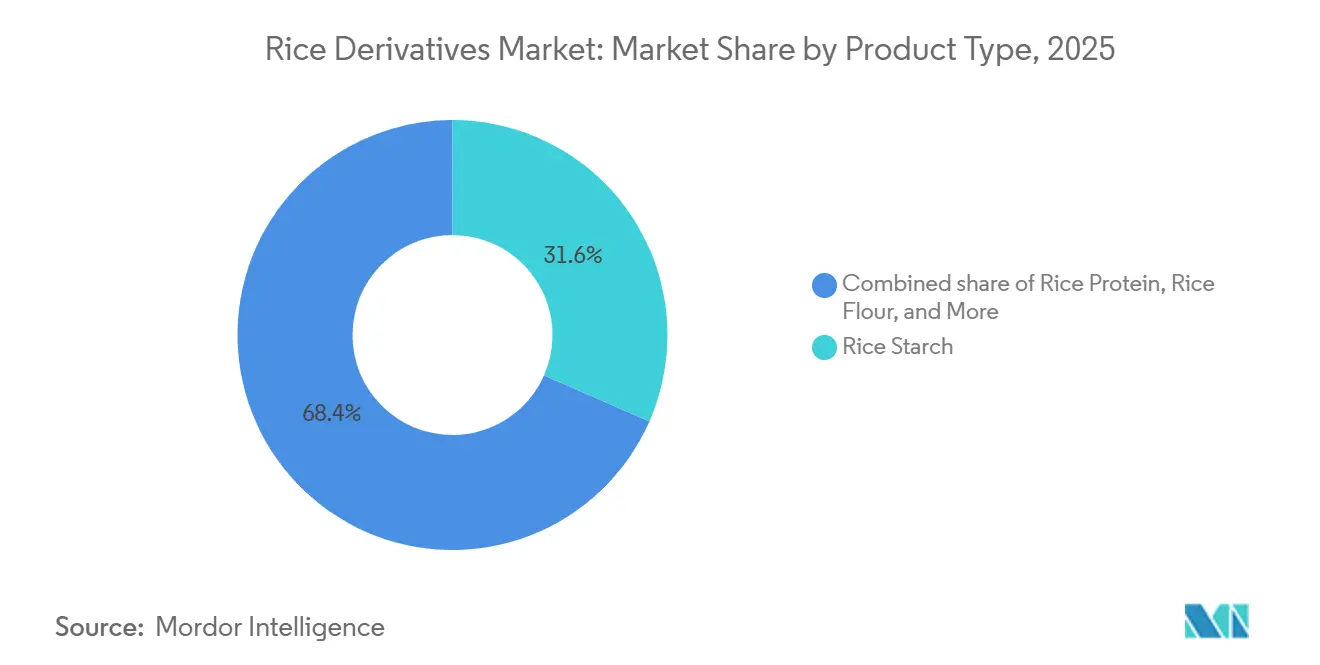
- By product type, rice starch led the rice derivatives market with a share of 31.58% in 2025, while rice protein is anticipated to register the fastest CAGR of 6.73% during 2026-2031.
- By form, powder retained a 42.35% share in 2025, whereas liquid is forecast to expand at a 6.25% CAGR through 2031.
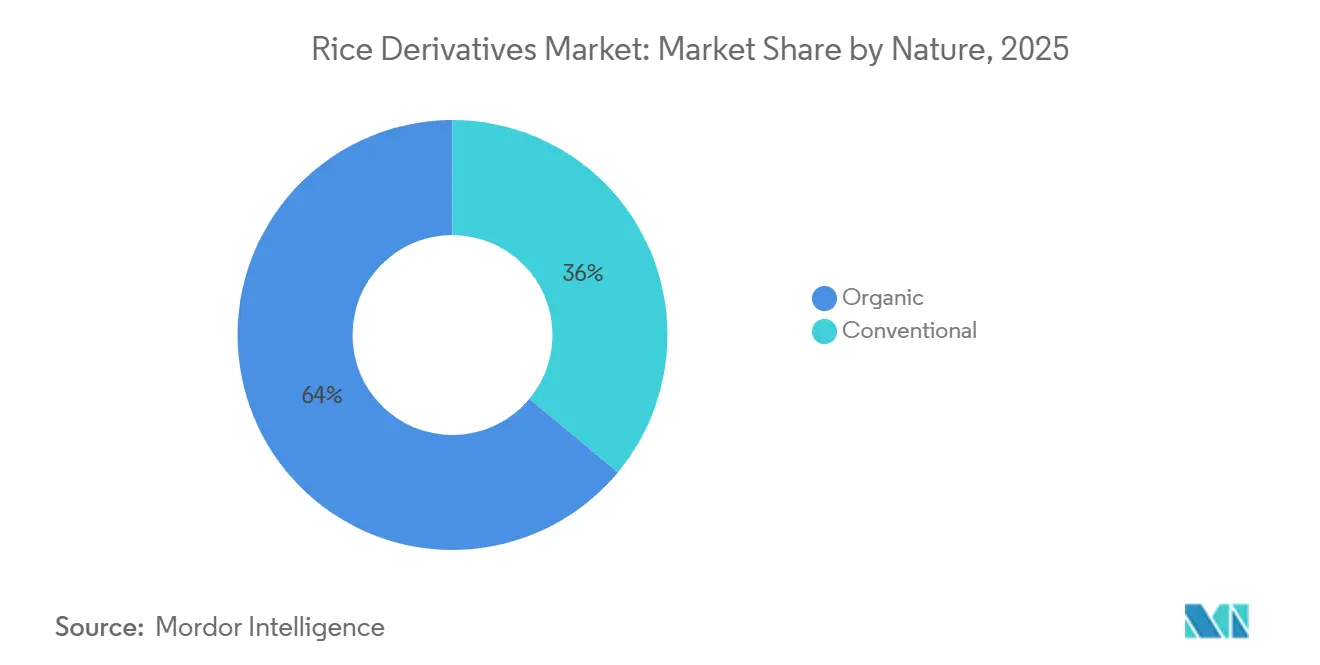
- By nature, organic led the market with a share of 63.98% in 2025, while conventional is anticipated to register the fastest CAGR of 7.13% during 2026-2031.
- By distribution channel, industrial led the market with a share of 67.45% in 2025, while retail is anticipated to register the fastest CAGR of 6.82% during 2026-2031.
- By geography, North America led the rice derivatives market in 2025 with a 37.12% share, while Asia-Pacific is projected to advance at a 7.24% CAGR through 2031.
Note: Market size and forecast figures in this report are generated using Mordor Intelligence’s proprietary estimation framework, updated with the latest available data and insights as of January 2026.
Market Trends and Insights
Drivers Impact Analysis of Rice Derivatives Market*
| Driver | (~) % Impact on CAGR Forecast | Geographic Relevance | Impact Timeline |
|---|---|---|---|
| Rising demand for rice-based ingredients in processed foods | +1.4% | Global | Short term (≤ 2 years) |
| Expansion of gluten-free and allergen-free products | +1.1% | North America and Europe | Medium term (2-4 years) |
| Increasing use of rice milling by-products in animal feed | +0.6% | Asia-Pacific, with spillover to Sub-Saharan Africa | Medium term (2-4 years) |
| Growth of functional, nutraceutical, and plant-based nutrition | +1.0% | Global, especially North America and Asia-Pacific | Long term (≥ 4 years) |
| Expanding industrial applications for rice starch | +0.8% | Global | Medium term (2-4 years) |
| Rising demand for high-purity and customized ingredients | +0.7% | North America and Europe | Long term (≥ 4 years) |
| Source: Mordor Intelligence | |||
Rising Demand for Rice-Based Ingredients in Processed Foods
Ready-to-eat and minimally processed food products use rice starch and rice flour as binding and texturizing ingredients. According to an article published by Multidisciplinary Digital Publishing Institute (MDPI) in 2025, rice starch thickens, stabilizes, gels, and encapsulates ingredients in soups, sauces, puddings, and confectionery products. Its neutral color and mild taste also support its use in clear broths and infant foods[1]. Large consumer packaged goods companies are incorporating rice flour into standard product lines, shifting procurement beyond specialty retail and generating more consistent bulk demand. Rice milling by-products also supply animal feed ingredients, particularly in Asia-Pacific, where processors can improve material utilization across each milling stream. This supply position enables the rice derivatives market to compete with wheat-based inputs in processed foods and encourages integrated processors to capture value from multiple outputs.
Expansion of Gluten-Free and Allergen-Free Products
The United States Food and Drug Administration provides allergen-labeling guidance that helps food manufacturers manage ingredient disclosure and reformulation decisions. Manufacturers use rice flour and rice starch in gluten-free bakery, snack, and infant nutrition formulations because these ingredients provide a familiar plant-based option with neutral sensory properties. Larger contracts can increase millers’ volumes but may also pressure unit margins, favoring vertically integrated processors with reliable milling, testing, and logistics capabilities. The rice derivatives market is better positioned when processors combine scale with consistent specifications and customer support. In the European Union, rice is not among the 14 allergens requiring labeling under Regulation (EU) No. 1169/2011, as stated by European Union law in January 2025[2]. This regulatory position supports the broader use of rice-based ingredients in allergen-friendly formulations and drives demand for high-purity ingredients that meet technical requirements.
Growth of Functional, Nutraceutical, and Plant-Based Nutrition
Rice protein is the fastest-growing product type in the rice derivatives market, driven by its suitability for plant-based and allergen-friendly formulations. Manufacturers use pea and rice protein blends in sports nutrition powders because their complementary amino acid profiles support products that avoid soy and dairy ingredients. Rice protein also supports applications in ready-to-drink sports hydration and juice-fortification products, where conventional powdered proteins may create grittiness or remain insoluble. Japan further supports the commercialization of rice flour and rice protein through initiatives led by the Ministry of Agriculture, Forestry and Fisheries. These developments create opportunities for the rice derivatives market to enter higher-value nutrition categories and provide a model for policy support in other rice-producing countries.
Expanding Industrial Applications for Rice Starch
Rice starch applications beyond food generate demand from pharmaceutical, personal care, packaging, paper, and textile industries. Its small granule size and paste clarity make rice starch suitable for tablet manufacturing and cosmetic powders, where product appearance and dosing performance are critical. Biodegradable packaging films and textile sizing agents also create demand that is independent of consumer food spending. Research has evaluated rice starch-based co-processed excipients for direct compression and colon-targeted drug delivery. Industrial users place high value on consistent specifications, controlled particle properties, and reliable supply, increasing the importance of processing controls. These requirements support a broader application base for the rice derivatives market and provide customized materials with a clearer route to premium pricing.
Restraints Impact Analysis of Rice Derivatives Market*
| Restraint | (~) % Impact on CAGR Forecast | Geographic Relevance | Impact Timeline |
|---|---|---|---|
| Rapid rancidity of rice bran limits storage flexibility | -0.8% | Global, most acute in tropical Asia-Pacific climates | Short term (≤ 2 years) |
| High sensitivity of rice derivatives to fluctuations in rice and energy prices | -0.7% | Global | Short term (≤ 2 years) |
| Limited awareness of value-added products | -0.4% | Middle East, Africa, and South America | Long term (≥ 4 years) |
| Inconsistent milling by-product quality | -0.5% | Asia-Pacific and South America | Medium term (2-4 years) |
| Source: Mordor Intelligence | |||
Rapid Rancidity of Rice Bran Limits Storage Flexibility
Rice bran deteriorates rapidly after milling because lipase and lipoxygenase activity causes hydrolytic and oxidative rancidity. Small and mid-sized mills must either invest in stabilization equipment or accept lower value from the bran stream, a challenge that is particularly significant in price-sensitive producing regions. Cold plasma, ultra-high-pressure processing, and electron beam irradiation can extend shelf life under controlled conditions. However, capital requirements, equipment availability, and industrial scalability remain challenging for many mills in Asia. The rice derivatives market faces constraints in areas where milling infrastructure cannot preserve bran quality quickly enough for high-value downstream conversion.
High Sensitivity of Rice Derivatives to Fluctuations in Rice and Energy Prices
Rice derivative margins weaken when paddy and energy costs increase simultaneously. The Food and Agriculture Organization (FAO) All Rice Price Index declined in 2025, as large harvests increased global rice availability[3]. Lower rice prices can reduce feedstock costs; however, they can also lower bran prices and weaken returns from bran oil and bran extracts. Low-price conditions may also reduce incentives for paddy segregation and careful post-harvest handling, potentially creating feedstock quality variations for specialized applications. Solvent extraction, spray drying, and enzymatic processing require substantial energy inputs, particularly in markets that rely on imported energy. Therefore, the rice derivatives market depends on processors that can effectively manage procurement, energy consumption, and product quality throughout volatile commodity cycles.
*Our forecasts treat driver/restraint impacts as directional, not additive. The impact forecasts reflect baseline growth, mix effects, and variable interactions.
Rice Derivatives Market Segment Analysis
By Product Type:
Rice Starch Leads Revenue While Rice Protein Records Faster GrowthRice starch accounted for 31.58% of the rice derivatives market size in 2025, making it the largest product type. Demand across food, pharmaceutical, and personal care applications supports its leading position. Its small granule size of 2–7 micrometers and high paste clarity enable its use in tablet molding and dusting applications. Rice flour supports gluten-free bakery products, infant nutrition, and convenience foods. Rice bran oil serves edible oil and nutraceutical applications, while rice syrup, rice bran wax, and rice germ oil remain smaller, specialized products.
Rice protein is projected to grow at a CAGR of 6.73% during 2026–2031, representing the fastest growth rate among product types. Its increasing use in sports nutrition, allergen-friendly infant products, and functional beverages supports this growth. Water-soluble rice protein enables its application in high-acid beverages, where conventional powdered proteins are unsuitable. Rising demand for clean-label and plant-based protein alternatives further drives its adoption across emerging food and beverage applications. The rice derivatives industry can benefit from investments in stabilization and oil extraction facilities near rice mills.

By Form:
Powder Retains Broad Use While Liquid Supports New ApplicationsPowder accounted for 42.35% of category revenue in 2025, driven by its ease of handling, ambient shelf stability, and compatibility with dry-mixing and direct-compression processes. Manufacturers use powdered rice starch in precision-dosing pharmaceutical products and powdered rice protein in sports nutrition mixes and meal replacements. Powdered rice flour is well suited for bakery and snack products that require moisture control. Its established advantages in storage, transportation, and processing further support widespread industrial adoption. Growing demand for shelf-stable, convenient ingredient formats continues to reinforce the preference for powdered rice derivatives across end-use industries.
Liquid rice derivatives are projected to grow at a CAGR of 6.25% during the 2026–2031 forecast period. Liquid starch suspensions support wet-process paper applications by distributing through fibers differently than powdered slurries. Rice protein formulations for clear beverages also enable liquid products to enter ready-to-drink nutrition formats. Growing demand for convenient liquid formulations is expected to further expand their use across beverage and industrial applications. Granular products remain relevant for textile sizing, adhesives, and paper coatings. Other formats include modified and pre-gelatinized materials, which offer rapid hydration and cold-water dispersibility.
By Nature:
Organic Holds Higher Value While Conventional Adds VolumeOrganic products account for 63.98% of the rice derivatives market in 2025. Premium product development in North America and Europe has supported this leading position for several years. The United States Department of Agriculture has enforced its Strengthening Organic Enforcement requirements since March 2024, enhancing traceability across the organic supply chain. Similarly, European Regulation 2018/848 requires documentation and controls for organic products entering European markets. Growing consumer preference for certified and traceable ingredients further supports demand for organic rice derivatives in premium food and beverage applications.
Conventional products are forecast to grow at a CAGR of 7.13% during 2026–2031. Asia-Pacific, South America, and the Middle East and Africa rely more heavily on lower-cost regional supply chains, which often lack organic certification infrastructure. Bulk food manufacturing, animal feed, and papermaking drive conventional rice starch volumes in these regions. Lower production costs and wider availability make conventional derivatives suitable for high-volume industrial applications. While organic products maintain higher margins in specialty channels across developed markets, conventional production capacity serves larger volumes in emerging markets.
By Distribution Channel:
Industrial Buying Holds the Lead While Retail ExpandsIndustrial distribution accounted for 67.45% of the rice derivatives market size in 2025. Most rice starch, flour, and protein volumes are supplied through bulk contracts between processors and institutional buyers. Food manufacturers, pharmaceutical formulators, feed compounders, paper mills, and textile producers rely on consistent product specifications and reliable deliveries. Their purchasing decisions prioritize quality audits, logistics, price per specification, and technical support. Online procurement is also gaining traction among mid-sized food manufacturers in Asia-Pacific.
Retail distribution is projected to expand at a CAGR of 6.82% during 2026–2031. Consumer packaged goods containing rice derivatives are gaining shelf space in supermarkets and hypermarkets. E-commerce platforms also enable specialist brands to sell organic rice protein, gluten-free rice flour, and rice bran oil directly to consumers. Retail demand is more influenced by consumer branding and convenience. However, industrial channels remain critical because they account for the majority of ingredient volumes. The rice derivatives market benefits when producers can serve long-term industrial customers while also addressing higher-value retail formats.
Geography Analysis
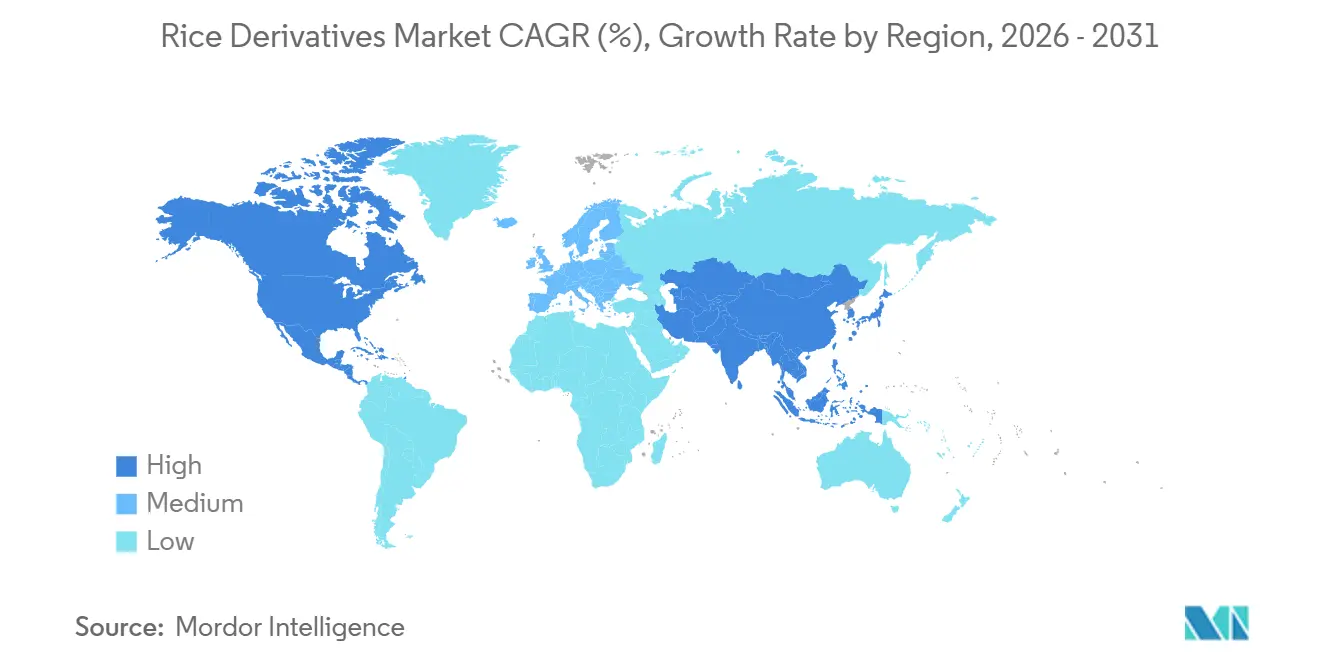
North America held 37.12% of regional revenue in 2025, the largest geographic share. The region has established food processing capabilities and strong demand for gluten-free, plant-based, and organic products. Large food manufacturers are incorporating rice flour into standard bakery, snack, and infant nutrition products. Rice protein is also used in ready-to-drink beverages, energy bars, and direct-to-consumer supplements. These applications extend demand beyond small specialty brands.
Europe sustains demand through premium consumer segments in Germany, France, the United Kingdom, the Netherlands, and Italy. Organic-certified rice starch and rice protein command higher prices than conventional products in these markets. Regulatory requirements for organic products further reinforce the importance of verified supply chains. South America combines local rice production with a developing food processing base, while the Middle East and Africa remain more dependent on imports for standard rice starch and flour. Food security programs and investments in agricultural supply chains could support future demand growth.
Asia-Pacific is projected to record the highest CAGR among all regions, at 7.24% during 2026–2031. The region benefits from abundant rice availability, expanding processing capacity, and government support for rice-based ingredients. China is expanding its rice starch and rice protein production capacity. Growing demand from the food, beverage, and animal feed industries is further strengthening regional processing capabilities and export opportunities. Improvements in processing infrastructure may also increase exports of bran-derived products from the region.
Competitive Landscape
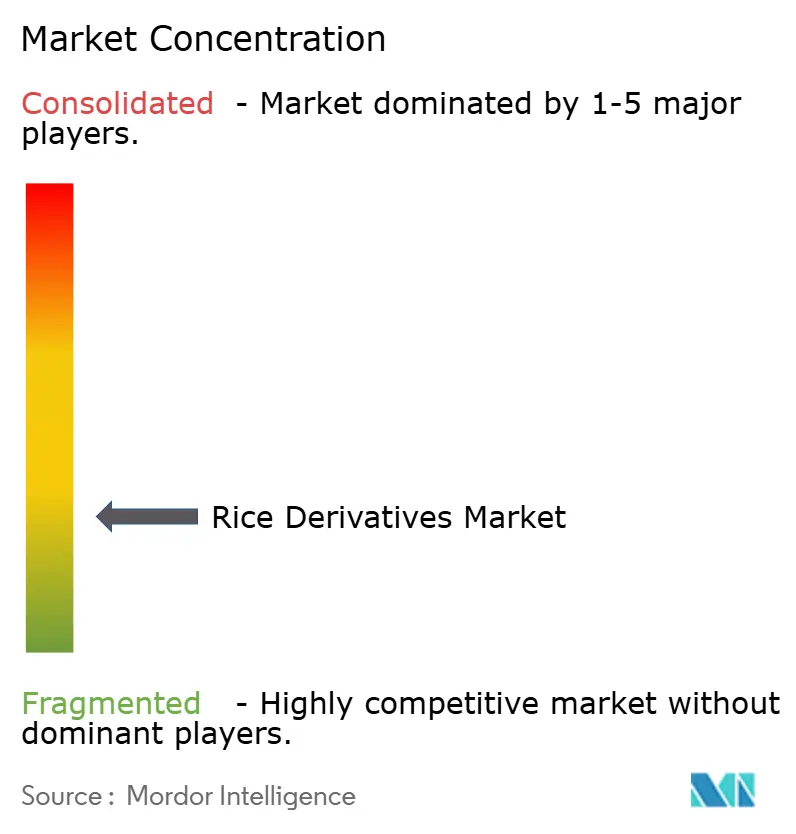
The rice derivatives market has a fragmented structure. Large companies compete in standardized starch and industrial-grade products by ensuring supply reliability, broad geographic coverage, application testing, and formulation support. Regional specialists remain important in organic rice protein, modified starches, and nutraceutical-grade bran extracts, which require rigorous documentation. Commodity-grade products are often interchangeable, limiting product exclusivity and making dependable supply a key purchasing criterion. High-purity and certified products provide stronger differentiation for smaller processors that can meet stringent customer specifications.
Roquette reported that specialty products remain its primary performance driver amid challenging market conditions anticipated in 2025, including soft demand and overcapacity in commodity starch. This outcome would demonstrate the value of portfolios serving pharmaceutical and technical customers with differentiated materials. Axiom Foods markets clear rice protein for acidic beverages, establishing a specialized position in a category where traditional powdered proteins are unsuitable. Companies with validated processing methods can compete on performance, beverage clarity, formulation flexibility, and customer qualification rather than solely on raw ingredient price.
BENEO launched a sustainable rice farming program in Vietnam in July 2025 to support certified rice ingredients through farmer training, traceability initiatives, and sustainability monitoring. This initiative reflects increasing buyer attention to verified agricultural practices and supply chain documentation across European and North American channels. Organic enforcement rules in the United States also increase the value of established certification systems. Leading manufacturers are likely to combine traceable sourcing with product development for food, pharmaceutical, personal care, and pet food customers. The rice derivative market remains accessible to regional producers that consistently meet stringent specifications, while scale continues to benefit suppliers of standard products.
Rice Derivatives Industry Leaders
-
Cargill, Incorporated
-
Ingredion Incorporated
-
Roquette Frères
-
Archer Daniels Midland Company
-
Südzucker Group
- *Disclaimer: Major Players sorted in no particular order
Rice Derivatives Market Companies Covered in this Report
- Cargill, Incorporated
- Adani Wilmar Ltd.
- Ingredion Incorporated
- Südzucker Group
- Archer Daniels Midland Company
- Roquette Frères
- Olam International
- BCL Industries
- Manildra Group
- Thai Flour Industry Co., Ltd.
- Sacchetto S.p.A.
- RIBUS, Inc.
- Agarwal Industries Pvt. Ltd.
- Riceland Foods, Inc.
- Ricela Group
- Tsuno Group Co., Ltd.
- King Rice Oil Group
- Ebro Ingredients
- Shafi Gluco Chem
- Producers Rice Mill
Recent Industry Developments in Rice Derivatives Market
- July 2026: Tate & Lyle shareholders approved Ingredion's GBP 3.7 billion cash acquisition with a near-unanimous 99% vote. Subject to regulatory clearance, the transaction created a combined entity with annual sales of approximately USD 10 billion.
- June 2025: Agrana and Ingredion signed a joint venture agreement to invest EUR 35 million (USD 40 million) in expanding starch production at AGFD Tandarei in Romania. Construction began in June 2025 and is expected to be completed within 2.5 years.
- June 2025: Ingredion announced a USD 50 million expansion of its starch facility in Cedar Rapids, Iowa. The investment aims to enhance the value of starches used in the packaging and papermaking industry. Construction is expected to be completed in 2027 and is projected to generate 200,000 contractor hours.
- January 2025: Axiom Foods launched Oryzatein® 2.0, a white, grit-free rice protein with ultra-low heavy metal content for plant-based foods and infant nutrition. The product provides improved solubility, a neutral taste, and a neutral color, supporting its use in allergen-free beverages, plant-based milk and dairy alternatives, and protein-based infant nutrition.
Global Rice Derivatives Market Report Scope
Rice derivatives are value-added ingredients produced by processing rice and rice by-products into products such as rice starch, rice flour, rice protein, rice bran oil, and rice syrup. These derivatives are widely used in food and beverage, animal feed, nutraceutical, and industrial applications.
The rice derivatives market is segmented by product type, form, nature, distribution channel, and geography. By product type, the market is segmented into rice starch, rice flour, rice bran oil, rice protein, and others. By form, the market is segmented into powder, liquid, granular, and others. By nature, the market is segmented into organic and conventional. By distribution channel, the market is segmented into industrial and retail (supermarkets/hypermarkets, online retail stores, and other distribution channels). Based on geography, the market is classified into North America, Europe, South America, Asia-Pacific, and the Middle East and Africa. The market forecasts are provided in terms of value (USD).
Segmentation Overview
| Rice Starch |
| Rice Flour |
| Rice Bran Oil |
| Rice Protein |
| Others |
| Powder |
| Liquid |
| Granular |
| Others |
| Organic |
| Conventional |
| Industrial | |
| Retail | Supermarkets and Hypermarkets |
| Online Retail | |
| Other Distribution Channels |
| North America | United States |
| Canada | |
| Mexico | |
| Rest of North America | |
| Europe | Germany |
| United Kingdom | |
| Italy | |
| France | |
| Spain | |
| Netherlands | |
| Poland | |
| Belgium | |
| Sweden | |
| Rest of Europe | |
| Asia-Pacific | China |
| India | |
| Japan | |
| Australia | |
| Indonesia | |
| South Korea | |
| Thailand | |
| Singapore | |
| Rest of Asia-Pacific | |
| South America | Brazil |
| Argentina | |
| Colombia | |
| Chile | |
| Peru | |
| Rest of South America | |
| Middle East and Africa | South Africa |
| Saudi Arabia | |
| United Arab Emirates | |
| Nigeria | |
| Egypt | |
| Morocco | |
| Turkey | |
| Rest of Middle East and Africa |
| By Product Type | Rice Starch | |
| Rice Flour | ||
| Rice Bran Oil | ||
| Rice Protein | ||
| Others | ||
| By Form | Powder | |
| Liquid | ||
| Granular | ||
| Others | ||
| By Nature | Organic | |
| Conventional | ||
| By Distribution Channel | Industrial | |
| Retail | Supermarkets and Hypermarkets | |
| Online Retail | ||
| Other Distribution Channels | ||
| By Geography | North America | United States |
| Canada | ||
| Mexico | ||
| Rest of North America | ||
| Europe | Germany | |
| United Kingdom | ||
| Italy | ||
| France | ||
| Spain | ||
| Netherlands | ||
| Poland | ||
| Belgium | ||
| Sweden | ||
| Rest of Europe | ||
| Asia-Pacific | China | |
| India | ||
| Japan | ||
| Australia | ||
| Indonesia | ||
| South Korea | ||
| Thailand | ||
| Singapore | ||
| Rest of Asia-Pacific | ||
| South America | Brazil | |
| Argentina | ||
| Colombia | ||
| Chile | ||
| Peru | ||
| Rest of South America | ||
| Middle East and Africa | South Africa | |
| Saudi Arabia | ||
| United Arab Emirates | ||
| Nigeria | ||
| Egypt | ||
| Morocco | ||
| Turkey | ||
| Rest of Middle East and Africa | ||
Key Questions Answered in the Report
What is the current size and growth outlook of the rice derivatives market?
The rice derivatives market was valued at USD 16.53 billion in 2025 and is estimated to reach USD 17.45 billion in 2026. The market is projected to grow to USD 23.28 billion by 2031, registering a CAGR of 5.94% during 2026-2031.
Which product type held the largest share of the rice derivatives market in 2025?
Rice starch was the largest product type segment, accounting for 31.58% of market in 2025.
Which form dominated the rice derivatives market in 2025?
The powder form dominated the market with a 42.35% share in 2025.
Which nature segment accounted for the largest market share in 2025?
The organic segment led the market, capturing 63.98% of total revenue in 2025.
Which distribution channel held the largest share of the rice derivatives market in 2025?
The industrial distribution channel was the leading segment, accounting for 67.45% of the market in 2025.