
Reverse Mortgage Market Size and Share
Market Overview
| Study Period | 2021 - 2032 |
|---|---|
| Market Size (2027) | USD 19.90 Billion |
| Market Size (2032) | USD 27.60 Billion |
| Growth Rate (2027 - 2032) | 6.80 % |
| Fastest Growing Market | Asia-Pacific |
| Largest Market | North America |
| Market Concentration | High |
Major Players *Disclaimer: Major Players sorted in no particular order Image © Mordor Intelligence. Reuse requires attribution under CC BY 4.0. | |
Reverse Mortgage Market Analysis by Mordor Intelligence
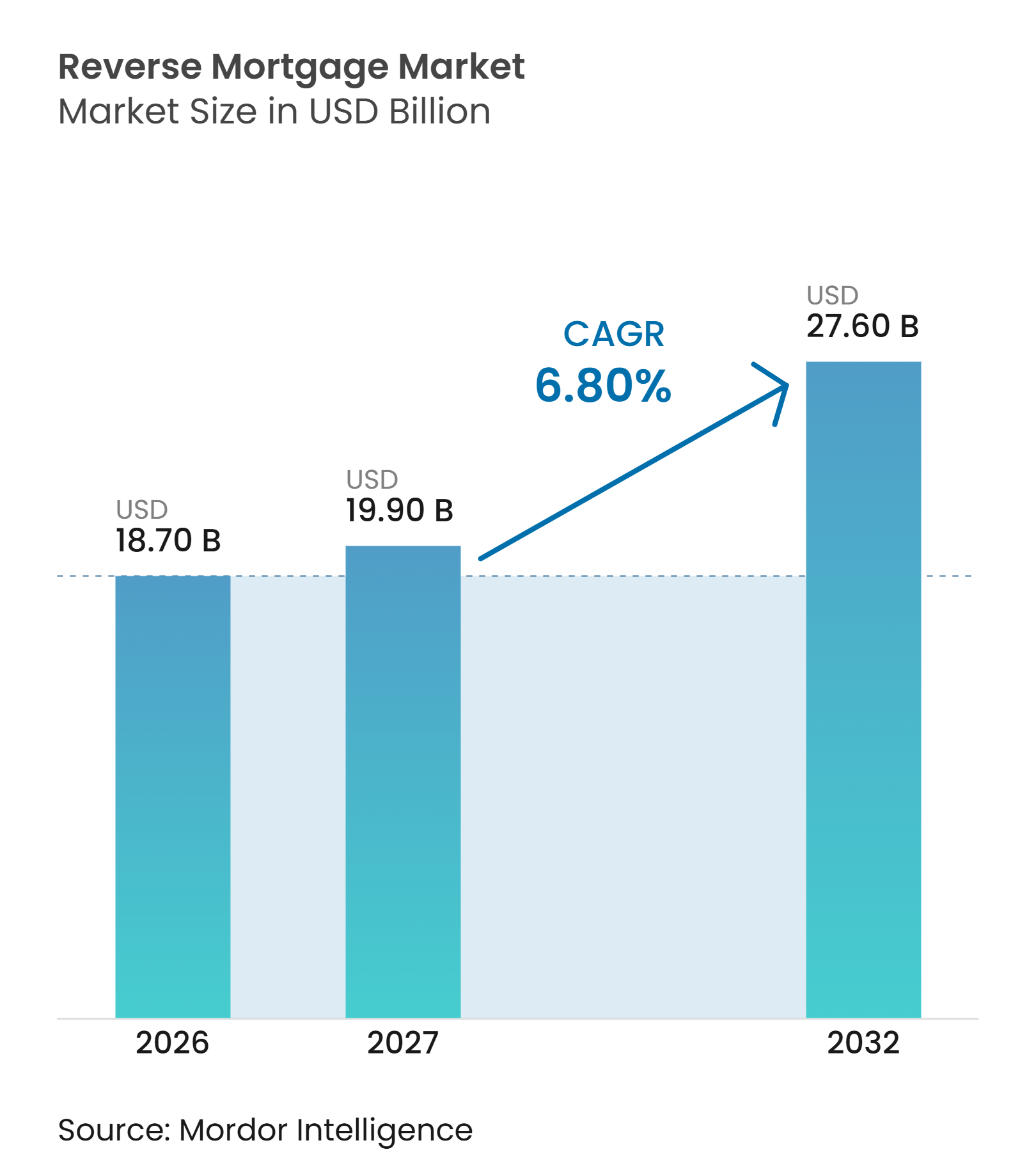
The Reverse Mortgage Market size is projected to expand from USD 18.70 billion in 2026 and USD 19.90 billion in 2027 to USD 27.60 billion by 2032, registering a CAGR of 6.80% between 2027 and 2032.
Demand rests on the substantial housing wealth held by older homeowners and gaps in retirement income. Senior homeowners aged 62 and older held USD 14.92 trillion in housing wealth in the United States in Q1 2026, while fewer than 9 in 10,000 eligible senior owner households used reverse mortgages. More than 4 million Americans reach age 65 each year from 2024 through 2027, and Vanguard reported that 40% of baby boomers are financially on track for retirement. The reverse mortgage market is also changing as proprietary products broaden eligibility, product design, and distribution options. Government-backed products remain central, but lenders are investing in second-lien facilities, fixed-rate offerings, and credit structures that address different borrower needs.
Key Report Takeaways
- By product type, government-insured reverse mortgages captured 54.8% of the reverse mortgage market share in 2026, while proprietary and private-sector lifetime mortgages are projected to grow at a 13.6% CAGR through 2032.
- By disbursement method, line of credit and drawdown facilities captured 34.4% of the reverse mortgage market share in 2026, while combination structures are projected to grow at a 9.5% CAGR through 2032.
- By property type, detached and semi-detached houses and single-family homes captured 70.1% of the reverse mortgage market share in 2026, while apartments, flats, and condominiums are projected to grow at an 8.9% CAGR through 2032.
- By lender type, specialized reverse-mortgage and lifetime-mortgage lenders captured 45.3% of the reverse mortgage market share in 2026, while other mortgage companies are projected to grow at a 9.7% CAGR through 2032.
- By geography, North America captured 57.8% of the reverse mortgage market share in 2026, while Asia-Pacific is projected to grow at a 10.5% CAGR through 2032.
Note: Market numbers in this report are based on Mordor Intelligence's proprietary estimation framework, which combines nine months of actuals with Q4 projections for base year 2026.
Market Trends and Insights
Drivers Impact Analysis of Reverse Mortgage Market*
| Driver | (~) % Impact on CAGR Forecast | Geographic Relevance | Impact Timeline |
|---|---|---|---|
| Growing Retiree Population and Retirement-Income Gaps | +1.4% | Global, most acute in North America, Western Europe, and East Asia | Long term (≥ 4 years) |
| High Home Equity and Limited Retirement Savings | +1.2% | North America, Australia, and the United Kingdom | Medium term (2-4 years) |
| Rising Healthcare and Long-Term-Care Expenses | +0.9% | Global, with the highest cost concentration in North America | Medium term (2-4 years) |
| Demand for In-Home Aging and Financial Independence | +0.8% | North America, Europe, and Asia-Pacific | Long term (≥ 4 years) |
| Expansion of Proprietary Reverse Mortgage Products | +1.1% | North America, with spillover to Australia and the United Kingdom | Short term (≤ 2 years) |
| Integration of Home Equity Into Retirement Planning | +0.7% | Global, with early uptake in North America and Australia | Medium term (2-4 years) |
| Source: Mordor Intelligence | |||
Growing Retiree Population and Retirement-Income Gaps
More than 4.1 million Americans are expected to turn 65 annually from 2024 through 2027, equivalent to more than 11,000 people daily, expanding the population entering retirement. Vanguard's Retirement Outlook found that only 40% of baby boomers are financially on track for retirement, while median-income baby boomers face an estimated annual retirement spending shortfall of USD 9,000, with projected sustainable income replacing approximately 56% of pre-retirement income[1]. Meanwhile, the Federal Reserve reported a 66% homeownership rate in 2025, while median net housing value among homeowners increased to USD 230,000 from USD 218,900 in 2022. The combination of retirement-income gaps and accumulated housing equity creates an opportunity for reverse mortgage providers to offer older homeowners an additional source of retirement funding.
High Home Equity and Limited Retirement Savings
Senior housing wealth reached USD 14.92 trillion in Q1 2026 and increased by USD 314.8 billion during the quarter[2]. Harvard analysis of federal survey data placed median home equity for homeowners aged 65 and older at USD 250,000. The level was 47% above its pre-pandemic level. Reverse mortgage use remained limited, with 31,829 originations in 2025 and fewer than 9 loans for every 10,000 eligible senior owner-occupied households. The difference between available equity and limited use leaves considerable scope for the Reverse mortgage market. A lower mortgage rate can also support available proceeds by improving loan terms for eligible borrowers.
Rising Healthcare and Long-Term-Care Expenses
Long-term care remains a large financial risk for retirees because care needs can extend over several years. The national median cost of a private nursing home room was USD 129,575 annually in 2025, or USD 355 per day[3]. In-home care at 44 hours per week cost USD 80,080 annually, while assisted living averaged USD 74,400 per year. The United States Department of Health and Human Services estimates that 56% of older Americans will need paid long-term care during their lives for an average of 3.1 years. A line of credit can help a borrower hold an undrawn reserve and access it when care expenses occur. This use case supports the reverse mortgage market without requiring a homeowner to take all proceeds at origination.
Demand for In-Home Aging and Financial Independence
Older homeowners often seek to remain in their homes while meeting healthcare, repair, and daily living costs. Reverse mortgage products can offer access to housing wealth without a required monthly mortgage payment. The structure can support financial independence when other retirement resources are insufficient. Line-of-credit products can also align withdrawals with actual expenses instead of a single advance. Consumer protections shape confidence in this decision, especially where products carry long repayment horizons. The United Kingdom Equity Release Council introduced Standards 2.0 in May 2025, including a protection for borrowers moving permanently to a relative’s home for care[4]. These factors support demand in the reverse mortgage market across aging populations.
Restraints Impact Analysis of Reverse Mortgage Market*
| Restraint | (~) % Impact on CAGR Forecast | Geographic Relevance | Impact Timeline |
|---|---|---|---|
| High Upfront Costs and Compounding Loan Balances | -0.6% | Global, most pronounced in North America where HECM mortgage insurance adds cost | Short term (≤ 2 years) |
| Interest-Rate Sensitivity and Reduced Borrowing Capacity | -0.8% | North America, with spillover to floating-rate markets globally | Medium term (2-4 years) |
| Property-Charge Defaults and Foreclosure Risk | -0.4% | North America and Europe, with emerging exposure in Asia-Pacific core markets | Long term (≥ 4 years) |
| Funding and Secondary-Market Liquidity Constraints | -0.5% | North America, Southern Europe, and select Asia-Pacific markets | Medium term (2-4 years) |
| Source: Mordor Intelligence | |||
High Upfront Costs and Compounding Loan Balances
Government-insured HECM products can carry high costs at closing. The HECM origination fee can reach USD 6,000, and the initial mortgage insurance premium equals 2% of the maximum claim amount. At the 2026 HECM limit of USD 1,249,125, that premium equals USD 24,982. Appraisal, title, and closing charges can reduce net proceeds by USD 15,000 to USD 30,000. Loan balances also grow as interest and fees accrue, which can reduce equity for healthcare, estate planning, and emergency needs. These costs can limit participation in the Reverse mortgage market, particularly among homeowners with a long expected borrowing period.
Interest-Rate Sensitivity and Reduced Borrowing Capacity
HECM principal limits are linked to the expected rate, which combines the 10-year Constant Maturity Treasury rate and the lender margin. An increase in the expected rate can reduce the proceeds available to a borrower with the same age and property value. This sensitivity can make government-insured products less attractive when interest rates are high. Proprietary products may offset some of this effect because their terms are not identical to HECM principal-limit rules. The resulting product mix can favor lenders with the funding and operating capacity to offer both product categories. Rate sensitivity therefore remains a restraint on the Reverse mortgage market, even as private alternatives expand.
*Our forecasts treat driver/restraint impacts as directional, not additive. The impact forecasts reflect baseline growth, mix effects, and variable interactions.
Reverse Mortgage Market Segment Analysis
By Product Type:
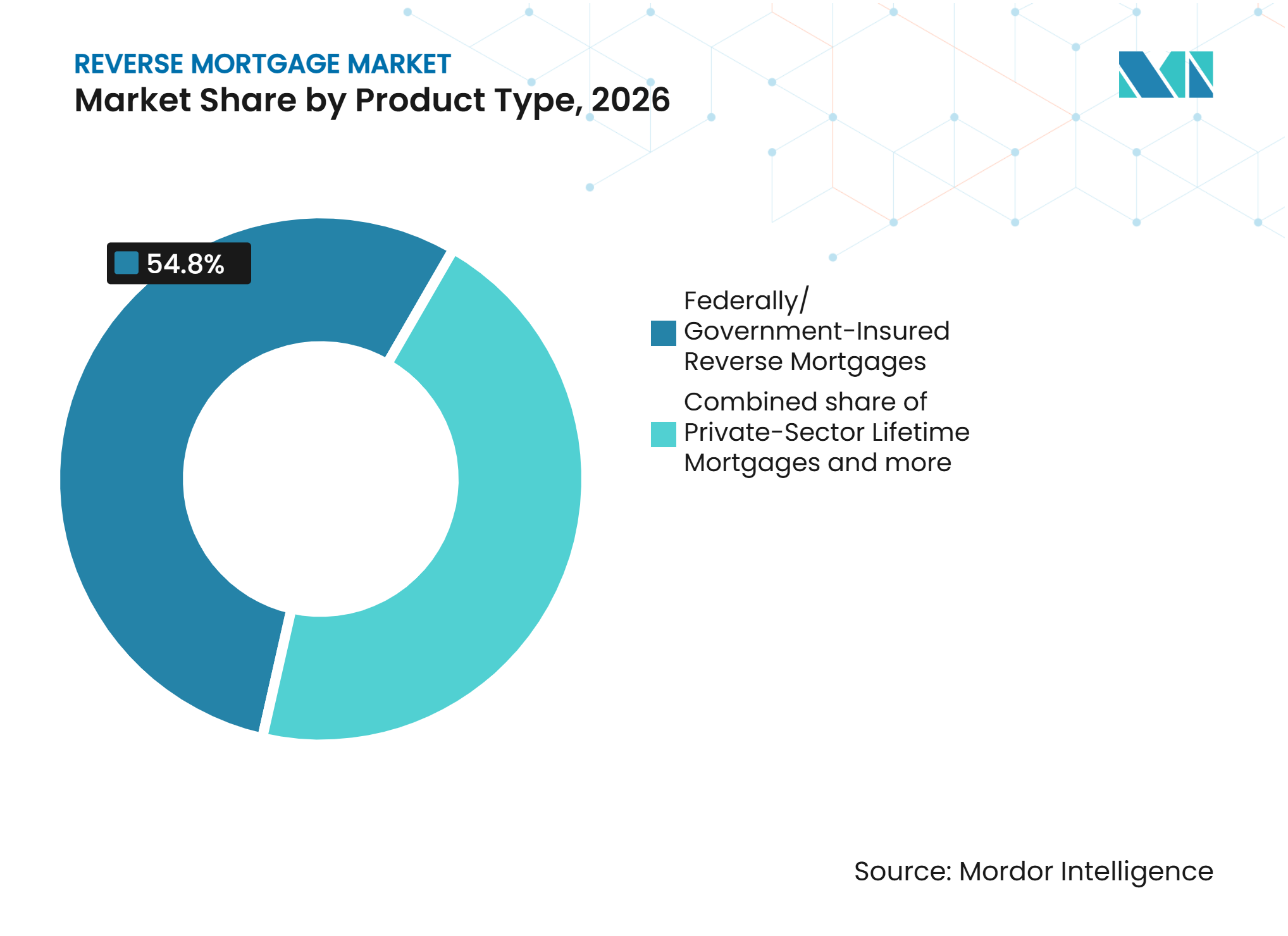
Proprietary Products Redefining Competitive BoundariesGovernment-insured HECMs held a 54.8% share in 2026. The Federal Housing Administration has insured more than 1.3 million HECM loans since 1990. The program provides a no-negative-equity guarantee and requires independent counseling through HUD-approved agencies. These features keep government-insured products important for eligible borrowers. Single-purpose reverse mortgages continue to serve a narrower, income-restricted group through nonprofit and government programs. They are generally used for defined needs such as property taxes or home rehabilitation.
Proprietary and private-sector lifetime mortgages are the fastest-growing product category, with a projected 13.6% CAGR through 2032. The Reverse mortgage market size for this category is supported by products that can serve younger borrowers and higher-value properties. Finance of America’s HomeSafe Second product uses a second-lien structure and lets homeowners retain an existing first mortgage. Mutual of Omaha Mortgage’s SecureEquity offers a USD 4 million maximum loan amount for borrowers as young as 55. Proprietary structures do not carry the HECM upfront mortgage insurance premium. These features widen the borrower pool and increase competition between private and government-backed options.


By Disbursement Method:
Credit Lines Dominant, Combination Structures Gaining ShareLine of credit and drawdown facilities held a 34.4% share of the Reverse mortgage market in 2026. The structure allows a borrower to access proceeds when a specific cash-flow need occurs. Home repairs, healthcare spending, and retirement income supplementation can all prompt a draw. Unused balances can grow under product terms tied to the loan interest rate and mortgage insurance premium rate. This reserve can be useful when property values fluctuate or when expenses are uncertain. The product therefore suits homeowners who prefer flexibility over an immediate full disbursement.
Combination structures are projected to grow at a 9.5% CAGR through 2032. These products combine an initial lump sum or regular payment with a remaining credit-line reserve. The Reverse mortgage market size for combination structures reflects demand from borrowers who want both immediate and future access to equity. Finance of America’s HomeSafe Second Line of Credit requires an initial 25% draw and permits later discretionary draws. Lump-sum products remain widely used outside North America. Regular-payment arrangements remain relevant for borrowers seeking predictable monthly income.
By Property Type:
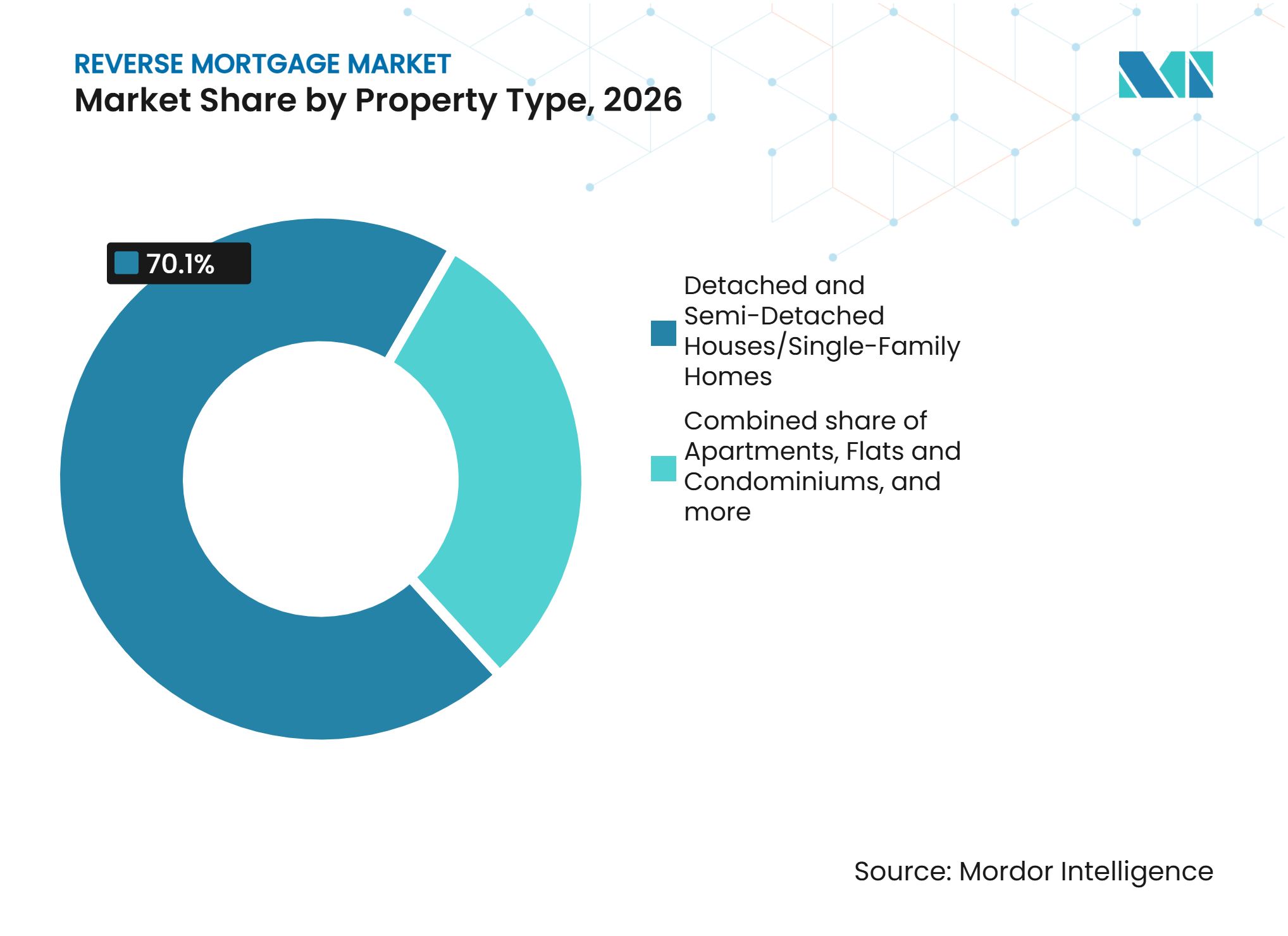
Single-Family Homes Remain Central as Condominiums ExpandDetached and semi-detached houses and single-family homes held a 70.1% share of the Reverse mortgage market in 2026. This concentration reflects the large installed base of owner-occupied single-family housing among older households. These properties are familiar collateral for lenders and fit established HECM eligibility practices. They can also offer homeowners substantial equity in mature residential areas. Single-family homes commonly support property values that meet loan requirements. Their role will remain important as the Reverse mortgage market develops across established lending regions.
Apartments, flats, and condominiums are projected to grow at an 8.9% CAGR through 2032. The growth reflects changes in urban housing patterns and increasing ownership among older residents in metropolitan areas. HUD requested feedback in October 2025 on whether HECM and HMBS property eligibility rules adequately serve changing United States housing stock, including condominiums. Two- to four-unit properties can combine owner occupancy with rental income. This income may help borrowers manage property charges and other costs. Manufactured and mobile homes remain subject to stricter eligibility standards, which can limit access for some senior homeowners.

By Lender Type:
Specialists Lead While Other Mortgage Companies Broaden AccessSpecialized reverse-mortgage and lifetime-mortgage lenders held a 45.3% share of the Reverse mortgage market in 2026. Their position reflects product expertise, counseling relationships, servicing capacity, and access to capital markets. Dedicated lenders can originate government-insured HECMs and proprietary products. They can also structure loan servicing around a product that may remain outstanding for many years. This focus can support borrower communication and regulatory compliance. Specialist lenders therefore remain important to the current lending model.
Other mortgage companies are projected to grow at a 9.7% CAGR through 2032. Growth in this lender group is supported by forward mortgage originators adding retirement-finance products. Expanded distribution can help reach homeowners who already have a relationship with a mortgage provider. Wholesale partnerships can also allow proprietary lenders to extend their reach without a large retail branch network. Banks and credit unions have historically had limited participation because of reputational and balance-sheet concerns. Deposit-funded institutions can still operate specialist businesses where regulation, market structure, and demographic demand are favorable.
Geography Analysis
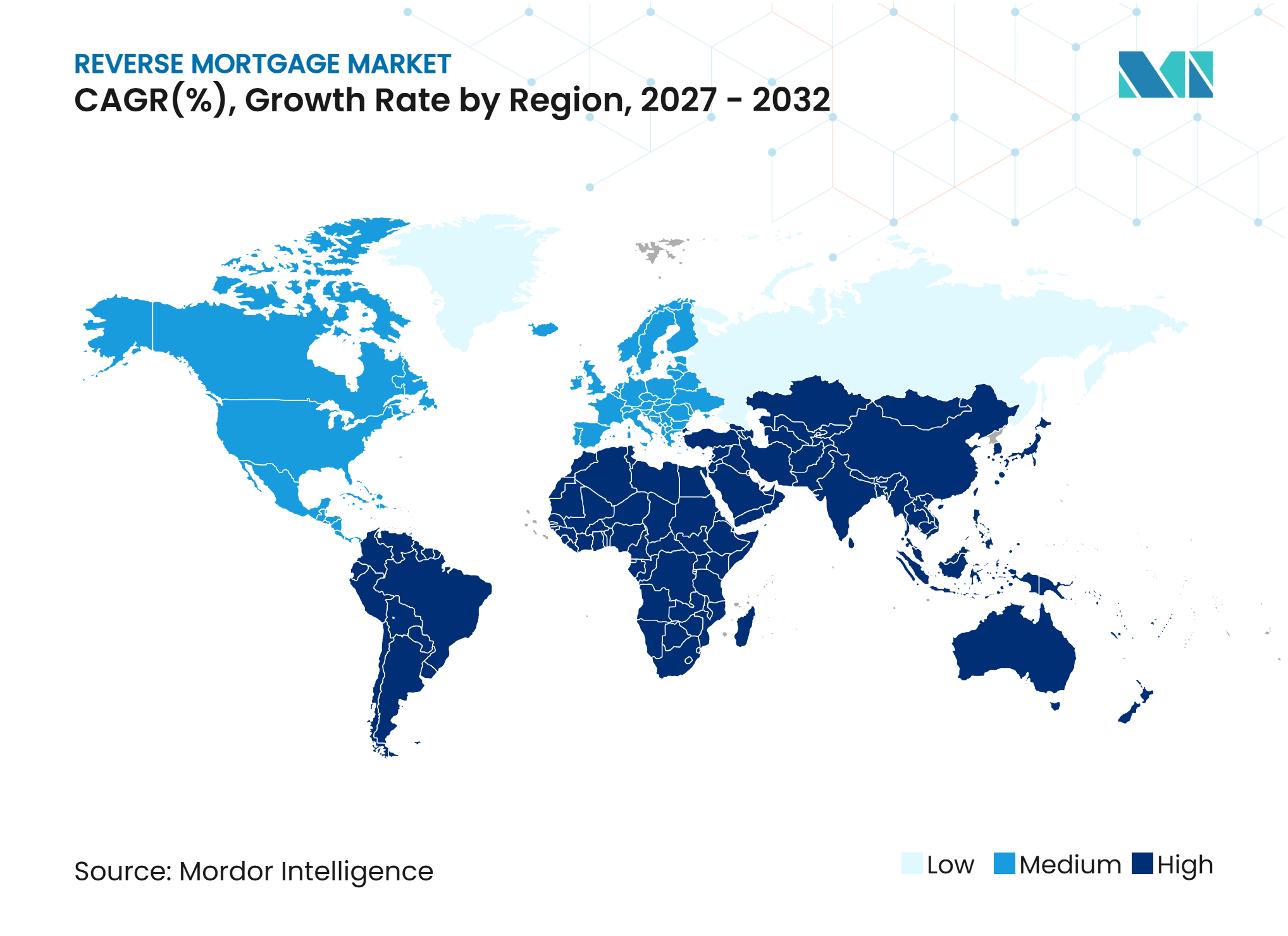
North America held a 57.8% share of the reverse mortgage market in 2026. The United States has the deepest government-insured product framework through the HECM program and the HMBS secondary market. Ginnie Mae issued USD 6.4 billion of HMBS in fiscal year 2025, compared with USD 5.9 billion in fiscal year 2024. HUD set the 2026 HECM maximum claim amount at USD 1,249,125, up from USD 1,209,750 in 2025. The reverse mortgage market size in North America is also supported by a large base of homeowners with substantial accumulated equity.
Europe has meaningful activity led by the United Kingdom equity release sector. The Equity Release Council reported GBP 636 million (USD 858.03 million) of total lending in the second quarter of 2025, a 10% increase from the prior-year quarter. New borrowers took an average of GBP 126,422 (USD 170,557) during the quarter. Standards 2.0 introduced a new consumer protection for borrowers who move permanently to a relative’s home for care. France, Germany, Italy, and Spain have developing equity release markets. Sweden, Norway, and Ireland use domestically structured products that reflect local inheritance law and regulation.
Asia-Pacific is projected to grow at a 10.5% CAGR through 2032. The region includes markets at different stages of development, with Australia among the more established settings and Japan operating the Reverse 60 program. Japan Housing Finance Agency recorded 1,225 Reverse 60 loan executions in fiscal year 2025, totaling JPY 19.59 billion (USD 125.38 million). South Korea has identified greater reverse mortgage use as an important policy task because many older households hold their wealth in real estate. The Asia-Pacific reverse mortgage market also includes early-stage potential in other economies facing population aging. The Middle East and Africa remain early-stage, with South Africa showing the most developed activity and the United Arab Emirates and Saudi Arabia lacking formal reverse mortgage frameworks.
Competitive Landscape
Market Concentration
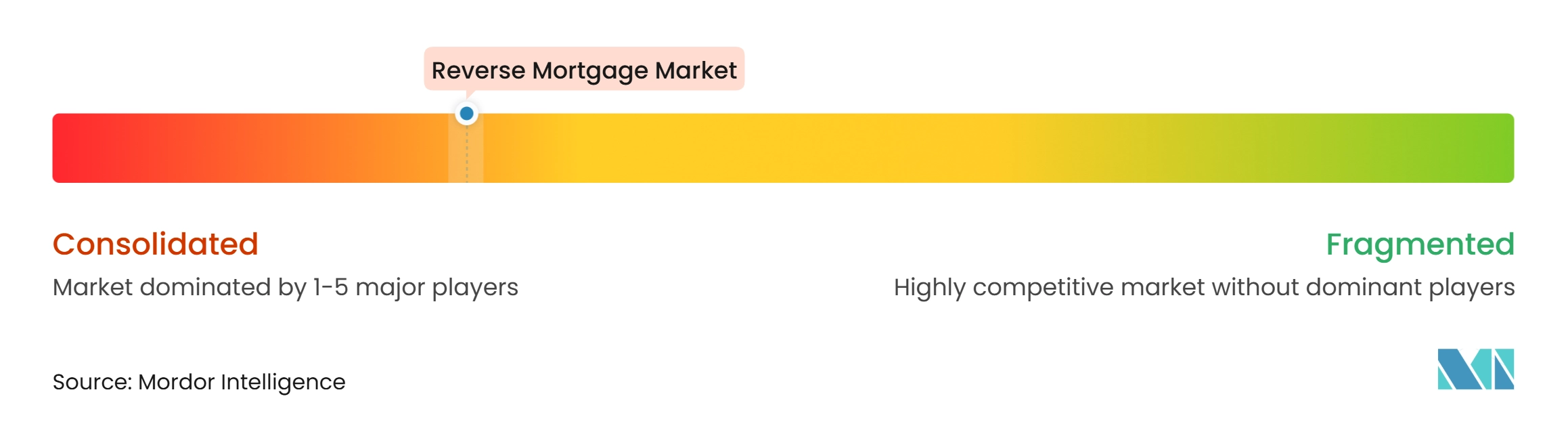
The Reverse mortgage market is consolidated. The top 3 HECM endorsement lenders, Mutual of Omaha Mortgage, Finance of America, and Longbridge Financial, held 55.8% of endorsements in 2025. Finance of America completed an all-cash acquisition of 20,000 Ginnie Mae HECM loans with USD 5.2 billion in unpaid principal balance from Onity Mortgage Corporation in July 2026. Onity remained the subservicer under a 3-year agreement to support borrower continuity. The transaction adds servicing scale while allowing Onity to redirect resources. Concentration makes servicing capacity, funding access, and regulatory capability meaningful competitive factors.
Product development is an important way for lenders to compete in the Reverse mortgage market. Finance of America launched HomeSafe Second Line of Credit in California in April 2026. The product offers a second-lien option for homeowners aged 55 and older who do not want to refinance their first mortgage. Longbridge Financial launched Platinum Preserve in May 2025, allowing eligible borrowers to earmark 10% to 40% of equity for heirs. Mutual of Omaha Mortgage entered the proprietary category in April 2025 through SecureEquity, with a USD 4 million maximum loan amount. These moves show how lenders are seeking borrowers beyond the traditional government-insured product base.
Technology and compliance also influence competitive positions in the Reverse mortgage market. Longbridge Financial deployed AI-powered voice agents in February 2026 to handle routine borrower servicing inquiries. Finance of America has integrated its HomeSafe Second product into a digital origination system. Lenders with Federal Housing Administration approval and Ginnie Mae issuer status can participate in government-backed origination and securitization. HECM financial assessments, mandatory counseling, and Life Expectancy Set-Aside requirements add operating complexity but support borrower protections. The planned HMBS 2.0 initiative remains relevant because changes to pooling requirements could affect secondary-market liquidity.
Reverse Mortgage Industry Leaders
-
Mutual of Omaha Mortgage, Inc.
-
Finance of America Companies Inc.
-
Longbridge Financial, LLC
-
Fairway Independent Mortgage Corporation
-
Onity Mortgage (Liberty Reverse Mortgage)
- *Disclaimer: Major Players sorted in no particular order
Reverse Mortgage Market Companies Covered in this Report
- Finance of America Reverse LLC
- Mutual of Omaha Mortgage, Inc.
- Longbridge Financial, LLC
- Fairway Independent Mortgage Corporation
- Onity Mortgage (Liberty Reverse Mortgage)
- Legal & General Group plc
- Aviva plc
- Just Group plc
- HighTechLending, Inc.
- Pure Retirement Limited
- HomeEquity Bank
- Household Capital Pty Ltd.
- Heartland Bank Limited
- Seniors Money Mortgages (Ireland) DAC (Spry Finance)
- GoodLife Home Loans
- Shonai Bank
- Ashikaga Bank
- Joyo Bank
- Chiba Bank
- Korea Housing Finance Corporation
Recent Industry Developments in Reverse Mortgage Market
- July 2026: Finance of America Reverse completed the all-cash acquisition of approximately 20,000 Ginnie Mae HECM loans with USD 5.2 billion in unpaid principal balance from Onity Mortgage Corporation. Onity was retained as subservicer under a 3-year agreement to ensure borrower continuity.
- April 2026: Finance of America launched HomeSafe Second Line of Credit in California, marketed as the mortgage industry’s first second-lien reverse mortgage line of credit. The product allows homeowners aged 55 and older to draw equity over time after an initial 25% advance, without refinancing their existing first mortgage or making monthly mortgage payments.
- March 2026: PHH Mortgage Corporation rebranded as Onity Mortgage Corporation, consolidating its corporate identity under the parent company, Onity Group. The change followed the reverse mortgage servicing rights sale to Finance of America.
- November 2025: Finance of America announced a USD 2.5 billion strategic partnership and received a USD 50 million equity investment from funds managed by Blue Owl Capital. The arrangement supports proprietary-product origination and capital-markets activity.
Global Reverse Mortgage Market Report Scope
Segmentation Overview
| Federally / Government-Insured Reverse Mortgages |
| Proprietary / Private-Sector Lifetime Mortgages and Reverse Mortgages |
| Single-Purpose / Government- or Nonprofit-Linked Reverse Mortgages |
| Lump-Sum (Single Advance at Origination) |
| Line of Credit / Drawdown Facility (Initial Advance Plus Undrawn Reserve) |
| Regular Payments (Tenure, Term or Annuity) |
| Combination (Explicit Residual for Mixed Structures Chosen at Origination) |
| Detached and Semi-Detached Houses / Single-Family Homes |
| Apartments, Flats and Condominiums |
| Two- to Four-Unit Residential Properties |
| Manufactured / Mobile Homes |
| Other Eligible Residential |
| Specialised Reverse-Mortgage / Lifetime-Mortgage Lenders |
| Banks and Credit Unions |
| Other Mortgage Companies |
| Nonprofit and Government-Linked Providers |
| North America | United States |
| Canada | |
| Mexico | |
| South America | Brazil |
| Argentina | |
| Rest of South America | |
| Europe | United Kingdom |
| Germany | |
| France | |
| Italy | |
| Spain | |
| Rest of Europe | |
| Asia-Pacific | China |
| India | |
| Japan | |
| Australia | |
| Rest of Asia-Pacific | |
| Middle East & Africa | United Arab Emirates |
| Saudi Arabia | |
| South Africa | |
| Rest of Middle East & Africa |
| By Product Type | Federally / Government-Insured Reverse Mortgages | |
| Proprietary / Private-Sector Lifetime Mortgages and Reverse Mortgages | ||
| Single-Purpose / Government- or Nonprofit-Linked Reverse Mortgages | ||
| By Disbursement Method | Lump-Sum (Single Advance at Origination) | |
| Line of Credit / Drawdown Facility (Initial Advance Plus Undrawn Reserve) | ||
| Regular Payments (Tenure, Term or Annuity) | ||
| Combination (Explicit Residual for Mixed Structures Chosen at Origination) | ||
| By Property Type | Detached and Semi-Detached Houses / Single-Family Homes | |
| Apartments, Flats and Condominiums | ||
| Two- to Four-Unit Residential Properties | ||
| Manufactured / Mobile Homes | ||
| Other Eligible Residential | ||
| By Lender Type | Specialised Reverse-Mortgage / Lifetime-Mortgage Lenders | |
| Banks and Credit Unions | ||
| Other Mortgage Companies | ||
| Nonprofit and Government-Linked Providers | ||
| By Geography | North America | United States |
| Canada | ||
| Mexico | ||
| South America | Brazil | |
| Argentina | ||
| Rest of South America | ||
| Europe | United Kingdom | |
| Germany | ||
| France | ||
| Italy | ||
| Spain | ||
| Rest of Europe | ||
| Asia-Pacific | China | |
| India | ||
| Japan | ||
| Australia | ||
| Rest of Asia-Pacific | ||
| Middle East & Africa | United Arab Emirates | |
| Saudi Arabia | ||
| South Africa | ||
| Rest of Middle East & Africa | ||
Key Questions Answered in the Report
What is the projected size of the reverse mortgage market by 2032?
The reverse mortgage market is projected to reach USD 27.6 billion by 2032, expanding at a 6.8% CAGR from 2027.
Which reverse mortgage product type is growing fastest?
Proprietary and private-sector lifetime mortgages are projected to grow at a 13.6% CAGR through 2032.
Why do older homeowners consider a reverse mortgage?
These products can provide access to home equity for retirement income, healthcare expenses, home repairs, or other household needs without required monthly mortgage payments.
Which region has the largest share of reverse mortgage lending?
North America held 57.8% share in 2026, supported by the United States HECM framework and HMBS market.
Which region is forecast to grow fastest through 2032?
Asia-Pacific is projected to grow at a 10.5% CAGR through 2032 as aging populations and policy attention support product development.
What costs should borrowers consider before taking a reverse mortgage?
Borrowers should assess origination, mortgage insurance, appraisal, title, closing costs, accrued interest, and ongoing property-tax and insurance obligations.