
Residential Electrical Components Market Size and Share
Market Overview
| Study Period | 2021 - 2032 |
|---|---|
| Market Size (2027) | USD 6.37 Billion |
| Market Size (2032) | USD 10.92 Billion |
| Growth Rate (2027 - 2032) | 11.37 % |
| Fastest Growing Market | Asia-Pacific |
| Largest Market | Asia-Pacific |
| Market Concentration | Low |
Major Players *Disclaimer: Major Players sorted in no particular order Image © Mordor Intelligence. Reuse requires attribution under CC BY 4.0. | |
Residential Electrical Components Market Analysis by Mordor Intelligence
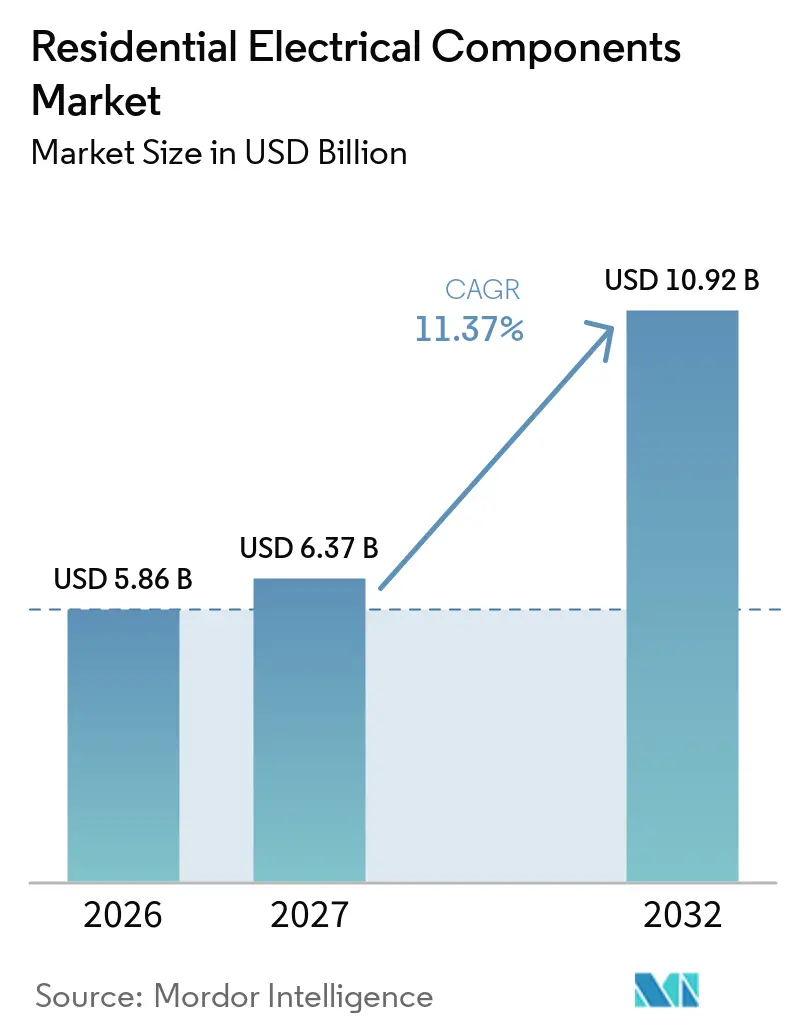
The Residential Electrical Components Market size is projected to expand from USD 5.86 billion in 2026 and USD 6.37 billion in 2027 to USD 10.92 billion by 2032, at a CAGR of 11.37% between 2027 and 2032. The residential electrical components market is supported by housing construction, renovation work, and wider home electrification. Higher household loads from EV chargers, heat pumps, and rooftop solar systems are increasing demand for upgraded panels, circuit protection, and surge protection. Safety codes also create replacement demand when housing starts are weak. Connected controls are moving from premium projects into more standard residential installations as compatibility improves. Manufacturers are therefore competing through connected products, compliant portfolios, and better access to local distribution channels.
Key Report Takeaways
- By product, switches held 22.6% of the residential electrical components market share in 2026, while surge protection devices are forecast to grow at an 11.8% CAGR through 2032.
- By form, standard mechanical components accounted for 61.3% of the residential electrical components market share in 2026, while smart and connected devices are forecast to expand at a 12.5% CAGR through 2032.
- By technology, electromechanical products held 54.3% of the residential electrical components market share in 2026, while IoT-connected technology is forecast to grow at a 14.3% CAGR through 2032.
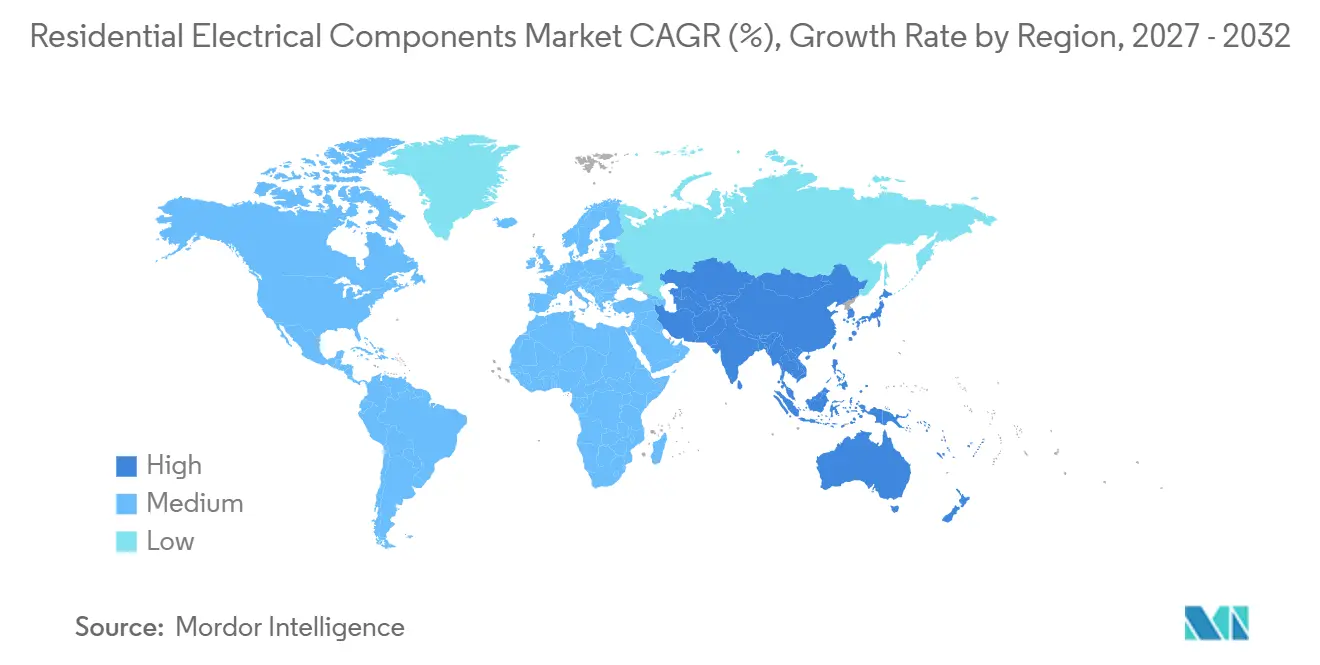
- By geography, Asia-Pacific accounted for 40.8% of the residential electrical components market share in 2026 and is forecast to grow at an 11.7% CAGR through 2032.
Note: Market numbers in this report are based on Mordor Intelligence's proprietary estimation framework, which combines nine months of actuals with Q4 projections for base year 2026.
Market Trends and Insights
Drivers Impact Analysis of Residential Electrical Components Market*
| Driver | % Impact on CAGR Forecast | Geographic Relevance | Impact Timeline |
|---|---|---|---|
| Residential Construction and Urban Housing Formation | +2.10% | Global; highest intensity in Asia-Pacific and South America | Medium term (2–4 years) |
| Smart-Home and Connected Wiring Adoption | +3.20% | North America, EU, Asia-Pacific core | Long term (≥ 4 years) |
| Electrical Safety and Energy-Efficiency Code Upgrades | +1.80% | North America, EU, Australia; spill-over to MEA | Short term (≤ 2 years) |
| Aging-Housing Retrofit and Replacement Cycles | +1.50% | North America and EU; early gains in Japan and South Korea | Medium term (2–4 years) |
| Electrification of EV Charging, Heat Pumps and Distributed Energy | +2.00% | EU core, North America, APAC | Medium term (2–4 years) |
| Installer-Led Demand for Faster, Modular and Labor-Saving Devices | +1.00% | North America, Germany, UK, Australia | Short term (≤ 2 years) |
| Source: Mordor Intelligence | |||
Residential Construction and Urban Housing Formation
The residential electrical components market benefits from a housing supply shortfall that supports demand for baseline electrical installations. The National Association of Home Builders forecast 940,000 U.S. single-family starts for 2026, up 1%, while estimating a national shortage of 1.2 million homes[1]. Each new dwelling needs switches, outlets, wiring accessories, circuit protection, and a distribution board. Townhouse construction adds demand because shared-entry systems, EV provision, and energy submetering are often specified at the project level. India’s housing programs and China’s renovation program also support demand for standard electrical products in large-volume housing projects. This creates an installation base that can later support upgrades to connected devices.
Housing activity does not affect every product category in the same way. Basic switches, sockets, connectors, and enclosures remain closely linked to unit construction and refurbishment. Distribution boards and protective devices receive a greater lift where developers provide for future heat pumps, solar systems, or electric vehicle charging. Material price inflation can raise project costs, yet code requirements limit the ability to remove core safety devices from an electrical fitout. The residential electrical components market therefore has support from both new housing formation and the electrical specification required in those homes. Manufacturers that offer complete, code-compliant product ranges can serve contractors through a single procurement relationship.
Smart Home and Connected Wiring Adoption
The residential electrical components market is gaining value as connected switches, sockets, dimmers, and load controls become easier to install and use. Common device standards reduce compatibility problems between products from different suppliers. This matters because homeowners often add connected devices in stages rather than purchasing a full system at once. Germany’s smart-meter rollout and building efficiency measures are increasing the practical value of connected products for energy monitoring and demand response. France’s MaPrimeRénov’ program supports eligible renovation work and can direct spending toward energy controls and related electrical upgrades. These programs make connected devices relevant to renovation budgets rather than only to luxury home projects.
The route to market is changing as retrofit activity becomes more important in Europe. Trade distributors remain important for work led by installers, but retail and online channels matter when homeowners choose a smart socket or lighting control directly. Products need simple setup, reliable software updates, and clear compatibility information. This gives established electrical brands an advantage where they can combine installer trust with accessible consumer support. The residential electrical components market also benefits when connected devices provide clear energy visibility rather than only remote switching. Manufacturers that integrate these functions into familiar wiring devices can lower the perceived complexity of smart-home adoption.
Electrical Safety and Energy Efficiency Code Upgrades
The residential electrical components market receives near-term support from electrical codes that expand the use of protective devices. The 2020 National Electrical Code required surge protection at residential service entrances, and the 2023 edition extended requirements to feeders and certain occupancies[2]. The 2026 edition further covers mobile homes, manufactured homes, and emergency responder sleeping quarters. California’s 2025 Electrical Code became effective in January 2026 and is based on the 2023. These requirements support demand for surge protection, ground-fault protection, and arc-fault protection during both construction and permitted renovation work.
Code changes create demand that does not depend only on headline construction volumes. A homeowner who delayed work under a prior code may need to meet more recent requirements when applying for a new permit. This increases the replacement need for receptacles, breakers, and protection equipment in kitchens, bathrooms, garages, and outdoor circuits. Electrical contractors also prefer products with straightforward documentation and recognized approvals because compliance errors can delay a project. The residential electrical components market benefits when safety standards are adopted across more jurisdictions. Suppliers with tested products and local technical support are better placed to convert code changes into repeat sales.
Electrification, Retrofit, and Installer Needs
Residential electrification is raising the capacity required from consumer units and distribution boards. A household using a Level 2 EV charger and a heat pump can place a larger load on older electrical panels. A 2025 study modeled short-duration transformer overloading where EV charging and heat-pump use occurred at the same time in residential networks. This supports upgrades to breakers, busbars, panels, and incoming wiring. ISO New England’s 2026 heat-pump forecast also recognizes rising electricity use from residential electrification. The residential electrical components market benefits when power demand moves from fossil-fuel equipment to electrically powered household systems.
Older homes are an important source of replacement demand, especially in North America, Europe, Japan, and South Korea. Installers working on these properties value modular panels, plug-on breakers, and tool-free connections that reduce installation time. Labor shortages make installation speed more important for contractors and developers. ABB acquired Lumin to add home energy management that coordinates electric vehicle charging, heat pumps, and solar storage through the electrical panel[3]. This move shows why electrical equipment is becoming a control point for household energy use. Products that simplify retrofit work while adding visible energy management can meet both installer and homeowner needs.
Restraints Impact Analysis of Residential Electrical Components Market*
| Restraint | % Impact on CAGR Forecast | Geographic Relevance | Impact Timeline |
|---|---|---|---|
| Copper, Resin and Steel Input-Cost Volatility | -1.20% | Global; most acute for manufacturers in APAC and South America | Medium term (2–4 years) |
| Interoperability and Cybersecurity Risks in Connected Devices | -0.60% | North America and EU; spill-over to APAC core | Long term (≥ 4 years) |
| Skilled-Installer and Compliance-Certification Bottlenecks | -0.50% | North America, Western Europe, Australia | Short term (≤ 2 years) |
| Low-Cost Counterfeit and Non-Compliant Product Competition | -0.40% | Global; concentrated in e-commerce channels | Short term (≤ 2 years) |
| Source: Mordor Intelligence | |||
Copper, Resin, and Steel Input Cost Volatility
Input cost volatility can limit margins for the residential electrical components market, particularly in price-sensitive mechanical product lines. Copper is a high-cost material in wiring-related products, terminals, busbars, and electrical connections. TTI Europe identified continuing raw-material pressure in the electronic component supply chain in its 2025 analysis[4]. Producers cannot always pass higher material costs to distributors and contractors immediately. This is more difficult where low-priced imports compete for the same standard product categories. Long-term purchasing arrangements and efficient product design can reduce exposure, but they do not remove the risk.
Cost pressure also affects the pace of product upgrades. Builders may choose standard mechanical products when the initial cost of connected alternatives rises. Smaller suppliers can face greater pressure because they have less buying power and fewer options to hedge raw-material purchases. Copper, resin, and steel costs can also affect the working capital required to maintain inventory. The residential electrical components market remains exposed to this constraint because safety products cannot readily substitute away from conductive materials. Scale, local sourcing, and disciplined pricing are therefore important for preserving margins.
Interoperability and Cybersecurity Risks in Connected Devices
Connected wiring products introduce cybersecurity and interoperability concerns that do not arise with conventional mechanical switches and sockets. In January 2026, CISA identified denial-of-service vulnerabilities affecting Schneider Electric Wiser Zigbee product lines, including smart socket outlets and connected dimmer switches. Schneider Electric issued mitigation guidance for affected products. NIST’s 2026 guidance describes foundational cybersecurity activities that IoT product manufacturers should implement before products reach the market. These expectations can add development and compliance costs for suppliers that lack dedicated software security resources. Buyers may delay adoption when they are uncertain about privacy, device updates, or system compatibility.
Interoperability matters because a connected home often includes devices bought at different times and through different channels. Products that cannot work with major platforms can lose relevance even if the electrical hardware is reliable. Secure firmware updates, transparent support periods, and standards-based connectivity can reduce buyer concerns. Cybersecurity failures can also damage trust in the broader category rather than only in the affected brand. The residential electrical components market needs dependable controls as it becomes more software-enabled. Suppliers that treat digital maintenance as part of the product can better protect long-term demand.
*Our forecasts treat driver/restraint impacts as directional, not additive. The impact forecasts reflect baseline growth, mix effects, and variable interactions.
Residential Electrical Components Market Segment Analysis
By Product:
Surge Protection Gains Through Code AdoptionSwitches held 22.6% of the residential electrical components market share in 2026 because every dwelling requires them, and replacement demand remains steady. Their wide use spans new construction, renovation, and routine maintenance. Sockets and receptacles also retain high volumes because protected variants are required in locations such as kitchens, bathrooms, garages, and outdoor areas. Circuit protection devices serve safety needs across the electrical system. Distribution boards and consumer units are gaining value where homes require higher service capacity. Wiring accessories, connectors, terminals, junction boxes, and enclosures remain necessary supporting products for each installation.
Surge protection devices have the strongest outlook, with the residential electrical components market size for this product group forecast to grow at an 11.8% CAGR through 2032. The result reflects broader code requirements at services, feeders, and additional residential occupancies. The category is also moving beyond a basic compliance product as suppliers add diagnostic features and monitoring links. Eaton, Leviton, and Siemens have product portfolios that position panel-level protection alongside home energy management systems. CPSC action against counterfeit safety marks strengthens the importance of trusted approvals in this category. This combination of regulation and feature upgrades supports demand for certified surge protection products.
By Form:
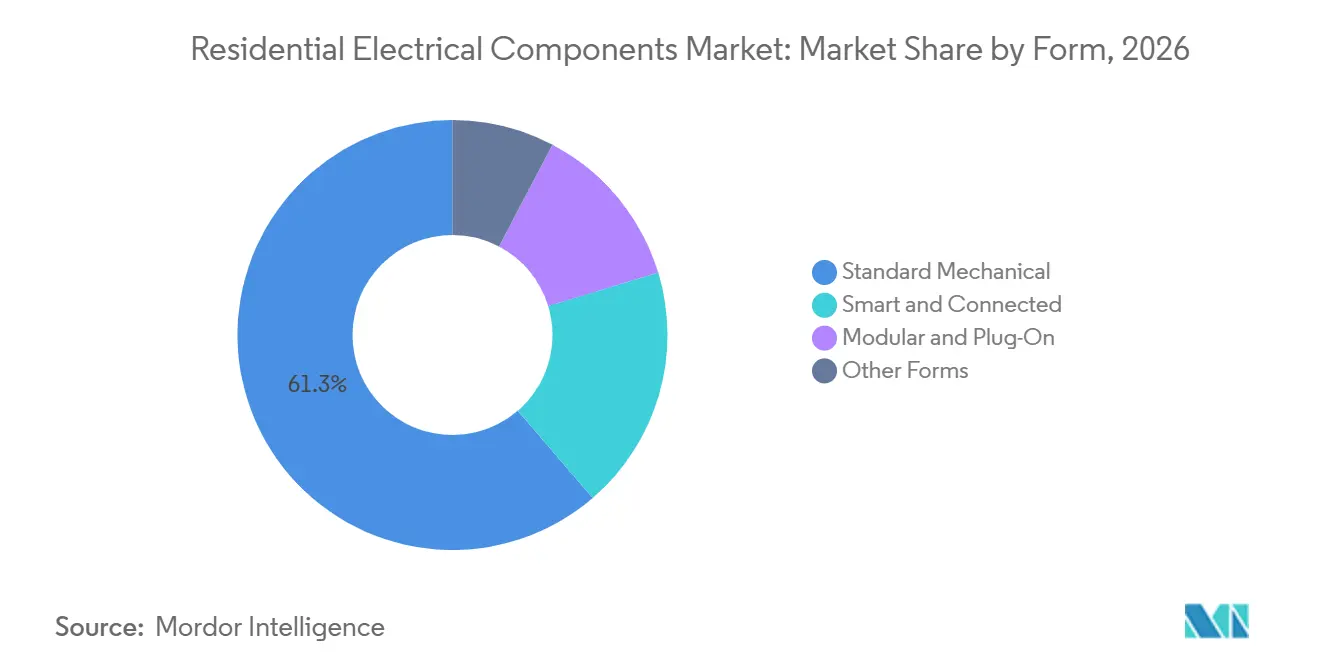
Connected Products Expand From a Mechanical BaseStandard mechanical components commanded 61.3% of the residential electrical components market share in 2026. Their large installed base and lower initial cost support continued use in volume housing markets. They remain especially relevant in Asia, South America, and parts of the Middle East, where affordability guides many specifications. Mechanical products also have familiar installation practices and established distributor inventories. Modular and plug-on designs are gaining interest where labor availability is limited. These formats can reduce panel assembly time and simplify service work.
Smart and connected devices are forecast to grow at a 12.5% CAGR through 2032. Falling wireless module costs and wider interoperability support their use in mainstream projects. Connected switches, sockets, and control modules can deliver energy visibility, lighting control, and remote device management. Renovation programs and smart-meter deployment strengthen the reason to install these devices in existing homes. The form category will still need clear installation guidance because connected products can create technical support needs after the electrical work is complete. Suppliers that pair easy commissioning with durable physical products can increase adoption without disrupting installer workflows.
By Technology:
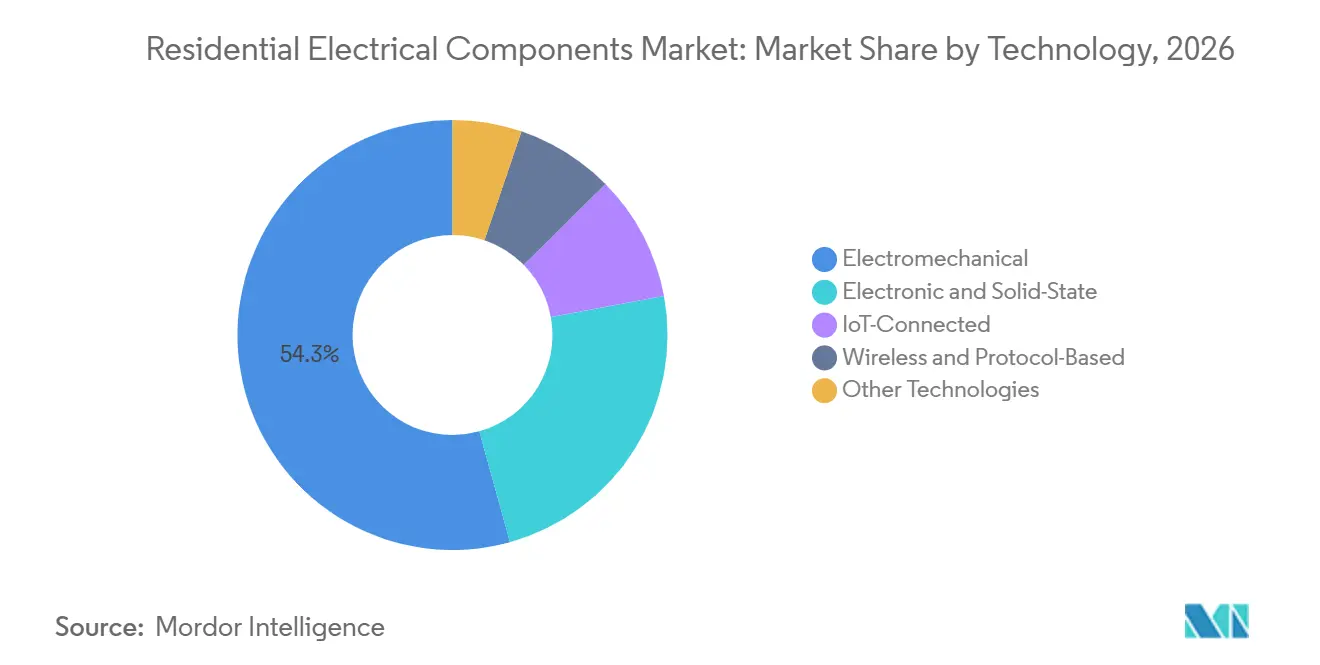
IoT-Connected Devices Lead the Growth OutlookElectromechanical technology held 54.3% of the residential electrical components market share in 2026. It remains central to product categories where durability, predictable operation, and low cost are essential. Long-standing supply chains also support its role in large construction markets. Electronic and solid-state products serve applications that need dimming, switching control, or lower standby energy use. Wireless and protocol-based products are particularly useful in retrofits where new data wiring would be difficult. These technologies give homeowners more options for upgrading existing electrical systems.
IoT-connected technology is forecast to grow at a 14.3% CAGR through 2032, the highest rate among the technology categories. Integrated wireless systems and standardized setup processes can narrow the gap between connected and conventional products. Connected sockets, panels, and switches can provide data to energy management platforms as well as perform a basic electrical function. This supports retrofit demand where homeowners want practical improvements without major reconstruction. The category’s progress depends on secure firmware, device compatibility, and reliable support throughout the product life cycle. Manufacturers that address these conditions can make connected technology more acceptable to mid-priced residential projects.
Geography Analysis
APAC Residential Electrical Components Market
Asia-Pacific held 40.8% of the residential electrical components market share in 2026 and is forecast to grow at an 11.7% CAGR through 2032. China supports regional demand through residential renovation, a large housing base, and wider use of connected devices. India adds demand through housing delivery and residential electrification. Southeast Asian markets benefit from urbanization and construction activity. Japan and South Korea offer a different opportunity through the renovation of mature housing stock. The region combines demand for basic electrical equipment with rising interest in smart products.
North America and Europe Residential Electrical Components Market
North America and Europe form a major demand cluster shaped by retrofit work and safety compliance. The U.S. Census Bureau reported annualized housing starts of 1.275 million in August 2026, including 918,000 single-family starts. U.S. renovation permits also support upgrades to ground-fault protection, arc-fault protection, and surge protection. Canada recorded housing starts at a seasonally adjusted annual rate of 229,000 in August 2026. Europe is shaped by building energy rules, smart-meter rollout, and renovation activity. Germany remains important for KNX and Matter-compatible products that support connected home controls.
MEA and South America Residential Electrical Components Market
South America, the Middle East, and Africa are earlier-stage markets for premium connected devices, but their basic electrical demand is expanding. Brazil’s housing programs sustain requirements for distribution boards, wiring accessories, and standard switches. Argentina and Chile add demand in larger urban centers where housing density is increasing. Saudi Arabia and the United Arab Emirates support technically advanced residential development through large urban projects. Egypt, Morocco, and South Africa add demand as grid connections reach more homes. The residential electrical components market size in these regions can gain further support as local standards align with IEC practices and import prices improve.
Competitive Landscape
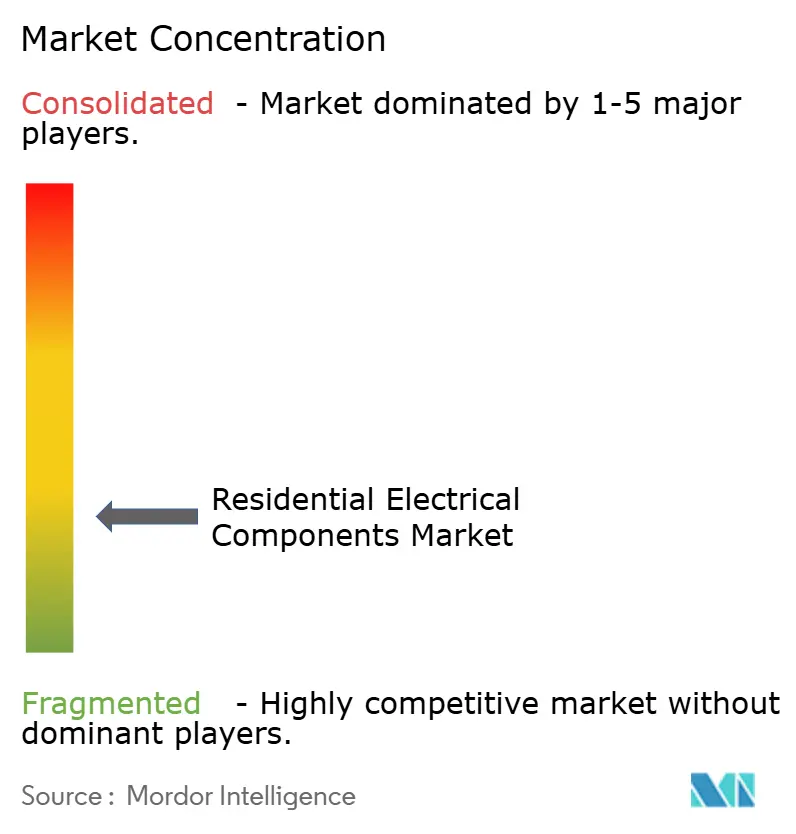
The residential electrical components market is fragmented, which includes global suppliers such as Schneider Electric, ABB, Legrand, Eaton, and Siemens. These companies compete with regional specialists, including Havells, CHINT, Leviton, Lutron, Panasonic, Hager, Niko, Vimar, Gewiss, ALBRECHT JUNG, and Simon. Large suppliers have advantages in product breadth, approvals, engineering resources, and distributor relationships. Regional companies can compete through local market knowledge, pricing, design, and specialized channel coverage. The competition is moving beyond conventional switches and sockets toward connected products, energy controls, and compliant retrofit equipment. This favors companies that can link electrical hardware with digital support and channel access.
Schneider Electric announced a voluntary public takeover offer for Shelly Group in September 2026, valued at EUR 1.2 billion, to add IoT and smart-building capabilities. ABB also acquired Lumin to broaden its residential energy management offer. These moves show that technology platforms and local access to installers are both strategic assets. Companies are increasingly acquiring capabilities that would take time to build internally. The result is stronger competition for connected-home positions and for distribution in high-growth regions.
White space remains in Eastern Europe, Southeast Asia, and parts of the Middle East, where demand for compliant connected products is still developing. CHINT continues to compete in emerging markets through pricing aligned with IEC standards. Havells is extending its smart-home accessories range for urban Indian buyers. Niko, Hager, Simon, and ALBRECHT JUNG maintain premium positions through design-led products and regional compliance knowledge. The CPSC campaign against fake safety labels may raise the cost of noncompliant imports and support established certified brands. The residential electrical components market is moderately concentrated at the top, but product specialization and local distribution leave space for well-positioned challengers.
Residential Electrical Components Industry Leaders
-
Schneider Electric SE
-
Legrand S.A.
-
Siemens AG
-
ABB Ltd.
-
Eaton Corporation plc
- *Disclaimer: Major Players sorted in no particular order
Residential Electrical Components Market Companies Covered in this Report
- ABB Ltd
- ALBRECHT JUNG GMBH & CO. KG
- CHINT Group Co., Ltd.
- Eaton Corporation plc
- GEWISS S.p.A.
- Hager SE
- Havells India Limited
- Hubbell Incorporated
- Legrand S.A.
- Leviton Manufacturing Co., Inc.
- Lutron Electronics Co., Inc.
- Mitsubishi Electric Corporation
- Niko Group NV
- Panasonic Holdings Corporation
- Polycab India Ltd.
- Resideo Technologies Inc.
- Schneider Electric SE
- Siemens AG
- Simon, S.A.
- Vimar S.p.A.
Recent Industry Developments in Residential Electrical Components Market
- September 2026: Schneider Electric announced a voluntary public takeover offer for Shelly Group, a provider of IoT and smart building solutions, in an all-cash transaction valued at EUR 1.2 billion, offering EUR 70 per share and supported by co-founders holding 57% of outstanding shares. The deal will integrate Shelly's software-led home energy management platform with Schneider Electric's hardware capabilities across residential, retrofit, and small commercial buildings. The transaction is expected to close by Q1 2027, subject to regulatory approvals.
- September 2026: Eaton signed an agreement to acquire COL Group, a European manufacturer of SF₆-free medium-voltage switchgear, grid automation technologies, and modular power systems, for EUR 810 million. The deal expands Eaton's European power distribution manufacturing footprint, and the transaction is expected to close in Q1 2027.
- July 2026: ABB announced an agreement to acquire Advantics, a France-based Silicon Carbide-based power conversion specialist, expanding ABB's direct current portfolio across EV infrastructure, residential electrification, and industrial microgrid applications. The transaction is expected to close by Q4 2026.
- July 2026: ABB announced a recommended cash offer to acquire Rotork plc, a global provider of intelligent flow control and electric actuators, financed through USD 5.8 billion in existing cash and committed bank facilities, further reinforcing ABB's electrification and automation product range.
Global Residential Electrical Components Market Report Scope
The residential electrical components market covers electrical products and devices used in residential buildings to distribute, control, protect, connect, and manage electrical power. These components are installed in new residential construction, renovation, and replacement applications.
The Residential Electrical Components Market is segmented by product, form, technology, and geography. By product, the market is segmented into switches, sockets, circuit protection devices, distribution boards, wiring accessories, junction boxes, and surge protection devices. By form, the market is segmented into standard mechanical, smart and connected, and modular. By technology, the market is segmented into electromechanical, solid-state, IoT-connected, and wireless. The report also covers the market size and forecasts for the global residential electrical components market across 26 countries in key regions. For each segment, the market sizing and forecasts have been provided on the basis of value (USD).
Segmentation Overview
| Switches |
| Sockets and Receptacles |
| Circuit Protection Devices |
| Distribution Boards and Consumer Units |
| Wiring and Cable Accessories |
| Connectors and Terminals |
| Junction Boxes and Enclosures |
| Surge Protection Devices |
| Other Products |
| Standard Mechanical |
| Smart and Connected |
| Modular and Plug-On |
| Other Forms |
| Electromechanical |
| Electronic and Solid-State |
| IoT-Connected |
| Wireless and Protocol-Based |
| Other Technologies |
| North America | United States |
| Canada | |
| Mexico | |
| Europe | Germany |
| France | |
| Italy | |
| Spain | |
| United Kingdom | |
| Poland | |
| Russia | |
| Rest of Europe | |
| Asia-Pacific | China |
| India | |
| Japan | |
| South Korea | |
| Australia | |
| Indonesia | |
| Vietnam | |
| Thailand | |
| Rest of Asia-Pacific | |
| South America | Brazil |
| Argentina | |
| Chile | |
| Rest of South America | |
| Middle East and Africa | Saudi Arabia |
| United Arab Emirates | |
| Egypt | |
| South Africa | |
| Morocco | |
| Rest of Middle East and Africa |
| By Product | Switches | |
| Sockets and Receptacles | ||
| Circuit Protection Devices | ||
| Distribution Boards and Consumer Units | ||
| Wiring and Cable Accessories | ||
| Connectors and Terminals | ||
| Junction Boxes and Enclosures | ||
| Surge Protection Devices | ||
| Other Products | ||
| By Form | Standard Mechanical | |
| Smart and Connected | ||
| Modular and Plug-On | ||
| Other Forms | ||
| By Technology | Electromechanical | |
| Electronic and Solid-State | ||
| IoT-Connected | ||
| Wireless and Protocol-Based | ||
| Other Technologies | ||
| By Geography | North America | United States |
| Canada | ||
| Mexico | ||
| Europe | Germany | |
| France | ||
| Italy | ||
| Spain | ||
| United Kingdom | ||
| Poland | ||
| Russia | ||
| Rest of Europe | ||
| Asia-Pacific | China | |
| India | ||
| Japan | ||
| South Korea | ||
| Australia | ||
| Indonesia | ||
| Vietnam | ||
| Thailand | ||
| Rest of Asia-Pacific | ||
| South America | Brazil | |
| Argentina | ||
| Chile | ||
| Rest of South America | ||
| Middle East and Africa | Saudi Arabia | |
| United Arab Emirates | ||
| Egypt | ||
| South Africa | ||
| Morocco | ||
| Rest of Middle East and Africa | ||
Key Questions Answered in the Report
What is the forecast growth rate for residential electrical components?
The residential electrical components market is forecast to grow at an 11.37% CAGR from 2027 to 2032, reaching USD 10.92 billion in 2032.
Which residential electrical product is growing fastest?
Surge protection devices are forecast to grow at an 11.8% CAGR through 2032, supported by wider safety-code requirements.
Why are smart electrical devices gaining adoption in homes?
Connected switches, sockets, and controls support energy monitoring, device management, and retrofit upgrades, while better compatibility lowers installation barriers.
Which region leads demand for residential electrical components?
Asia-Pacific held 40.8% share in 2026 and is forecast to grow at an 11.7% CAGR through 2032.
How do EV chargers and heat pumps affect household electrical systems?
They can require higher-capacity panels, upgraded circuit protection, and home energy management to handle increased household electrical loads.
Who are the leading companies in residential electrical equipment?
Major suppliers include Schneider Electric, ABB, Legrand, Eaton, Siemens, Havells, CHINT, Leviton, Lutron, Panasonic, and Hager.