
Residential Construction Market Size and Share
Market Overview
| Study Period | 2021 - 2032 |
|---|---|
| Market Size (2027) | USD 5.68 Trillion |
| Market Size (2032) | USD 7.23 Trillion |
| Growth Rate (2027 - 2032) | 4.95 % |
| Fastest Growing Market | South America |
| Largest Market | Asia-Pacific |
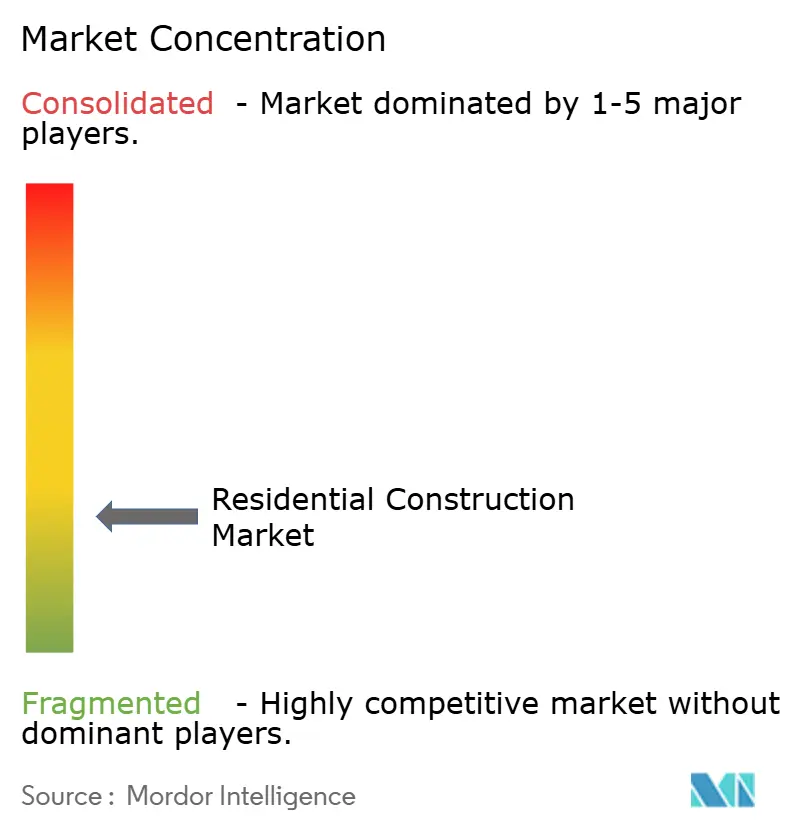
| Market Concentration | Low |
Major Players *Disclaimer: Major Players sorted in no particular order Image © Mordor Intelligence. Reuse requires attribution under CC BY 4.0. | |
Residential Construction Market Analysis by Mordor Intelligence
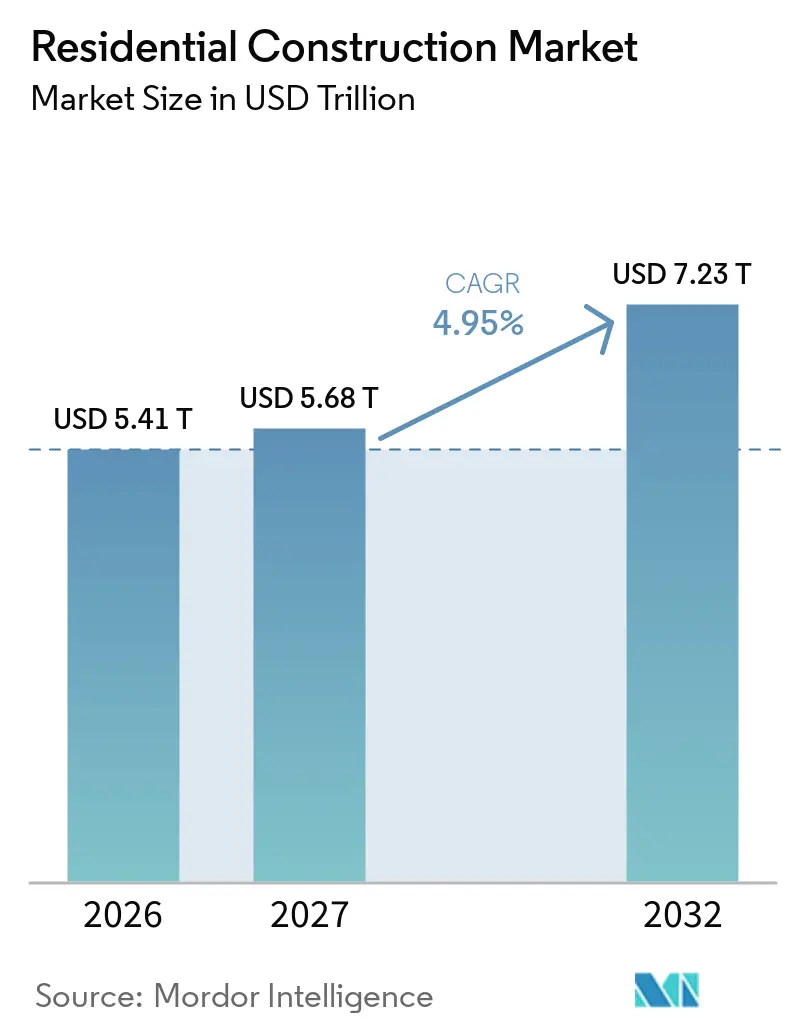
The Residential Construction Market size is expected to increase from USD 5.41 trillion in 2026 to USD 5.68 trillion in 2027 and reach USD 7.23 trillion by 2032, growing at a CAGR of 4.95% over 2027-2032.
The global residential construction market is driven by housing shortages, household formation, and public programs that provide builders and developers with longer planning horizons. Public funding is gaining importance as private buyers face high borrowing costs, particularly in affordable and mixed-tenure projects. Energy regulations are also reshaping project design, requiring more efficient building systems in new homes and upgrades to existing housing stock. The market presents opportunities in apartment construction, renovation, rental housing, and factory-based building systems. However, high material costs, planning delays, and labor shortages continue to constrain project delivery. Competitive advantage increasingly depends on access to land, public-sector partnerships, technical capabilities, and reliable supply chains.
Key Report Takeaways
- By property type, villas and landed houses held 57.8% of the global residential construction market share in 2026, while apartments and condominiums are forecast to grow at a 5.66% CAGR through 2032.
- By construction type, new construction accounted for 65.7% of the global residential construction market share in 2026, while renovation is forecast to grow at a 5.52% CAGR through 2032.
- By construction method, conventional on-site construction held 83.4% of the global residential construction market size in 2026, while modern methods of construction, prefabricated, modular, and related systems are forecast to grow at a 5.91% CAGR through 2032.
- By investment source, private investment accounted for an 80.1% share of the global residential construction market in 2026, while public investment is forecast to grow at a 5.78% CAGR through 2032.
- By geography, Asia-Pacific held a 35.6% share of the global residential construction market in 2026, while South America is forecast to grow at a 6.01% CAGR through 2032.
Note: Market numbers in this report are based on Mordor Intelligence's proprietary estimation framework, which combines nine months of actuals with Q4 projections for base year 2026.
Market Trends and Insights
Drivers Impact Analysis of Residential Construction Market*
| Drivers | (~) % Impact on CAGR Forecast | Geographic Relevance | Impact Timeline |
|---|---|---|---|
| Government-Backed Affordable Housing Programs | +1.5% | Global, concentrated in the United Kingdom, European Union, Brazil, Saudi Arabia, and India | Medium term (2-4 years) |
| Household Formation and Changing Family Structures | +1.2% | Global, strongest in Sub-Saharan Africa, South Asia, and South America | Long term (≥ 4 years) |
| Adoption of Modular Construction and Prefabricated Building Systems | +0.7% | North America, Europe, Asia-Pacific, with spillover into the Middle East and Africa | Short term (≤ 2 years) |
| Transport Infrastructure Supporting New Residential Locations | +0.6% | Asia-Pacific, South America, and North America | Medium term (2-4 years) |
| Energy-Efficiency Standards for Residential Buildings | +0.5% | European Union, North America, Australia, and the Middle East | Short term (≤ 2 years) |
| Urban Redevelopment Supporting Higher-Density Housing | +0.4% | Europe, East Asia, and North America | Long term (≥ 4 years) |
| Source: Mordor Intelligence | |||
Government Housing Programs Providing a Demand Base
Government housing programs provide the global residential construction market with a more stable source of demand when private home purchases weaken. The United Kingdom confirmed the Social and Affordable Homes Program for 2026–2036, targeting 300,000 social and affordable homes, with at least 60% allocated to Social Rent[1]. In December 2025, the European Commission launched its first European Affordable Housing Plan, aiming to deliver more than 2 million new homes annually by 2035. The European Investment Bank also expanded its housing financing for 2026 and approved the HousingTechEU initiative to support industrialized construction methods. These programs improve project visibility for contractors by enabling them to plan work around funded pipelines rather than short-term private-sector sales. They also shift the global residential construction market toward partnerships among developers, housing agencies, and long-term investors.
Household Formation and Changing Family Structures
Household formation drives demand for new housing units and upgrades to existing homes in the global residential construction market. The European Commission’s Joint Research Centre estimates that the European Union will require more than 2 million additional homes annually through 2035. Canada’s Parliamentary Budget Officer projects average annual household formation of 159,000 from 2025 to 2035, while the Mortgage Bankers Association forecasts average annual housing demand of 1.13 million units in the United States over the same period. Smaller households, single-person living, and multigenerational households are increasing demand for a broader range of apartment, rental, and landed-home formats. This trend benefits developers that can adapt unit sizes and site layouts while maintaining construction efficiency.
Adoption of Modular Construction and Prefabricated Building Systems
Modular and prefabricated building systems enable residential developers to manufacture building components in factories and assemble them on-site, reducing construction time and improving quality consistency. Vistry Works is targeting more than 6,000 units in 2026, demonstrating the scalability of factory-based housing production[2]. Adoption is particularly strong in projects with standardized designs, repeatable layouts, and sufficient construction volumes to maximize the benefits of off-site manufacturing. Factory-based production also reduces dependence on on-site labor and improves material utilization. Integration of modular systems supports more predictable project schedules and reduces exposure to weather-related disruptions. However, successful adoption requires early design coordination, efficient transportation, and reliable supplier networks to ensure timely delivery and assembly.
Transport Infrastructure Opening Residential Locations
Transport infrastructure investment is expanding the areas suitable for residential development, with road and rail projects strengthening the appeal of India’s Tier 2 cities. New transport corridors improve access to employment centers and make peri-urban locations more viable, often offering lower land costs than central urban areas. Better connectivity enables developers to cater to diverse housing needs across unit sizes and price points. Monitoring infrastructure project timelines also helps developers identify emerging residential growth corridors and align land acquisition, design, and funding decisions with planned connectivity improvements, reducing the risk of premature investment in locations lacking essential infrastructure.
Restraints Impact Analysis of Residential Construction Market*
| Restraints | (~) % Impact on CAGR Forecast | Geographic Relevance | Impact Timeline |
|---|---|---|---|
| Elevated Mortgage Borrowing Costs | -0.9% | North America, Europe, Brazil, and global markets | Short term (≤ 2 years) |
| Construction Material Price Volatility | -0.7% | Global, most acute in North America and the United Kingdom | Short term (≤ 2 years) |
| Skilled Construction Worker Shortages | -0.5% | North America, Europe, and Australia | Medium term (2-4 years) |
| Land-Use Rules and Lengthy Project Approvals | -0.4% | North America, Europe, and East Asia | Long term (≥ 4 years) |
| Source: Mordor Intelligence | |||
Elevated Mortgage Borrowing Costs
High mortgage costs constrain homebuyer affordability and slow demand for new housing. The National Association of Home Builders expects mortgage rates to remain above 6% through 2027, potentially shifting demand toward rental housing and supporting apartment and build-to-rent projects. This also increases the role of institutional investors and public housing programs in residential development. Higher borrowing costs can delay home purchases and reduce demand for new single-family homes. Developers may adjust project launches, pricing strategies, and housing mix to maintain sales and manage financial risks. Affordable housing initiatives and rental-focused developments could help sustain construction activity amid prolonged mortgage cost pressures.
Construction Material Price Volatility
Rising material costs and skilled-labor shortages increase construction expenses and delay project delivery. Associated General Contractors of America data show that new-construction input costs rose 11.9% year over year in September 2026, with steel mill products increasing 27.6%, copper and brass mill shapes 30%, and aluminum mill shapes 25.2%[3]. In the United Kingdom, new-housing material prices rose 5.6% year over year in August 2026, while fabricated structural steel prices increased 21.2%. Additionally, 88% of surveyed firms reported that craft-worker roles were as hard or harder to fill than a year earlier. Developers are responding through early procurement, simplified designs, modular construction, and phased project execution.
*Our forecasts treat driver/restraint impacts as directional, not additive. The impact forecasts reflect baseline growth, mix effects, and variable interactions.
Residential Construction Market Segment Analysis
By Type:
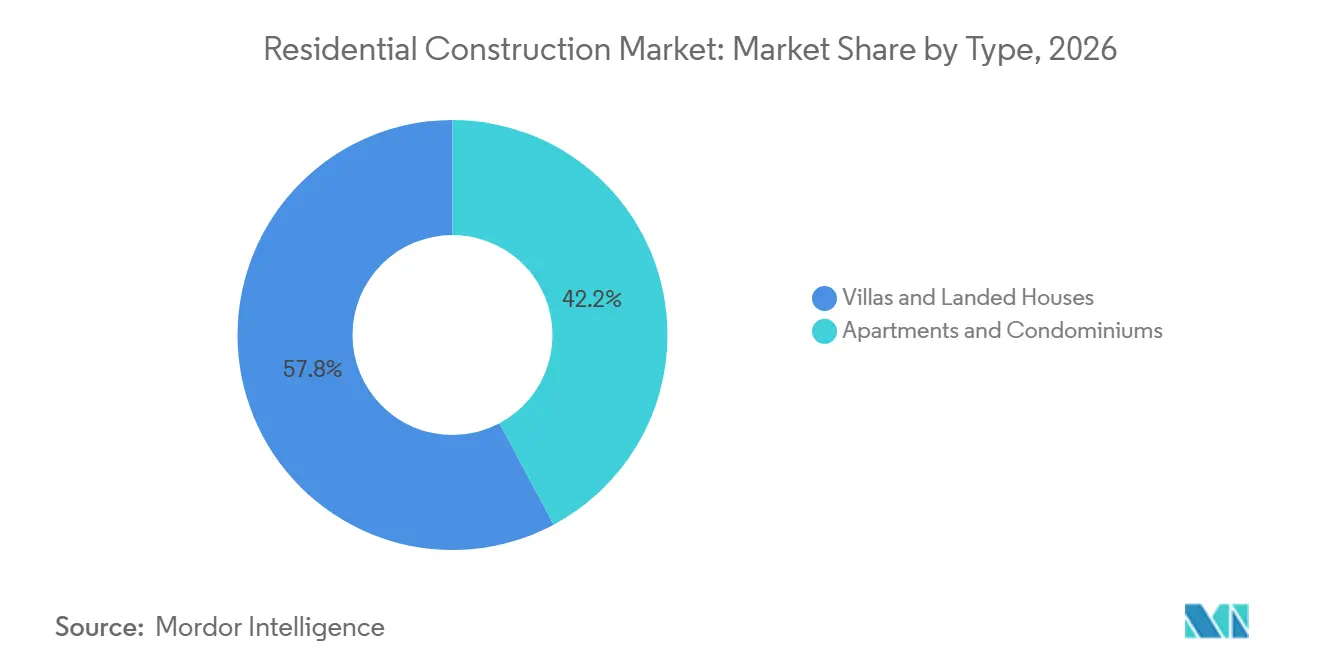
Villas and Landed Houses Lead While Apartments and Condominiums Grow FasterVillas and landed houses are projected to account for 57.8% of the global residential construction market in 2026, making them the largest property type. Demand remains strong in suburban markets across North America, Southeast Asia, and Australia, where households prioritize space and lower-density living. Improved transport connectivity also makes peri-urban locations more practical for buyers working in larger cities. The continued strength of custom homebuilding in the United States further supports demand for differentiated landed homes.
Apartments and condominiums are forecast to grow at a CAGR of 5.66% from 2027 to 2032. Urban-density policies, rental demand, and institutional investment in build-to-rent projects are supporting new multifamily supply. New apartment developments can integrate efficient heating systems and building controls from the outset, enabling developers to meet future standards. However, developers must balance high land acquisition and construction costs against rental demand and the limited availability of well-connected urban land.

By Construction Type:
New Construction Is Largest and Renovation Gains MomentumNew construction is projected to account for 65.7% of the global residential construction market in 2026, reflecting the scale of greenfield development in high-growth regions. Affordable housing shortages and urban expansion are driving new residential projects across South and Southeast Asia, the Middle East, and South America. Public programs also support new construction as governments seek to expand housing stock rapidly. Brazil is expected to build 438,000 housing units between April 2025 and April 2026, with nearly half associated with government programs targeting low-income households. New construction can deliver the largest immediate addition to housing supply when land, infrastructure, and approvals are available. It also enables builders to incorporate efficient heating, water, and energy systems without the design constraints of older properties. This capability helps developers meet standards that may be more difficult to achieve through limited upgrades. The global residential construction market continues to rely on new construction to expand housing supply in markets with significant deficits.
Renovation is the fastest-growing construction type, with a forecast CAGR of 5.52% through 2032; regulations requiring improved energy performance from existing housing support the segment's growth. European Union rules prioritize the renovation of the most energy-inefficient dwellings as part of efforts to reduce residential energy consumption. The National Green Building Standard includes a renovation certification pathway, providing builders with a recognized framework for upgrade projects. Renovation offers a practical option in cities where developable land is scarce, and planning approvals for new projects are difficult to obtain. It also enables property owners to retain existing housing stock while reducing operating costs. However, renovation projects may require more detailed site assessments than new construction because older properties vary in structure and condition. Contractors with technical renovation expertise and reliable subcontractor networks are better positioned to serve this growing category.
By Construction Method:
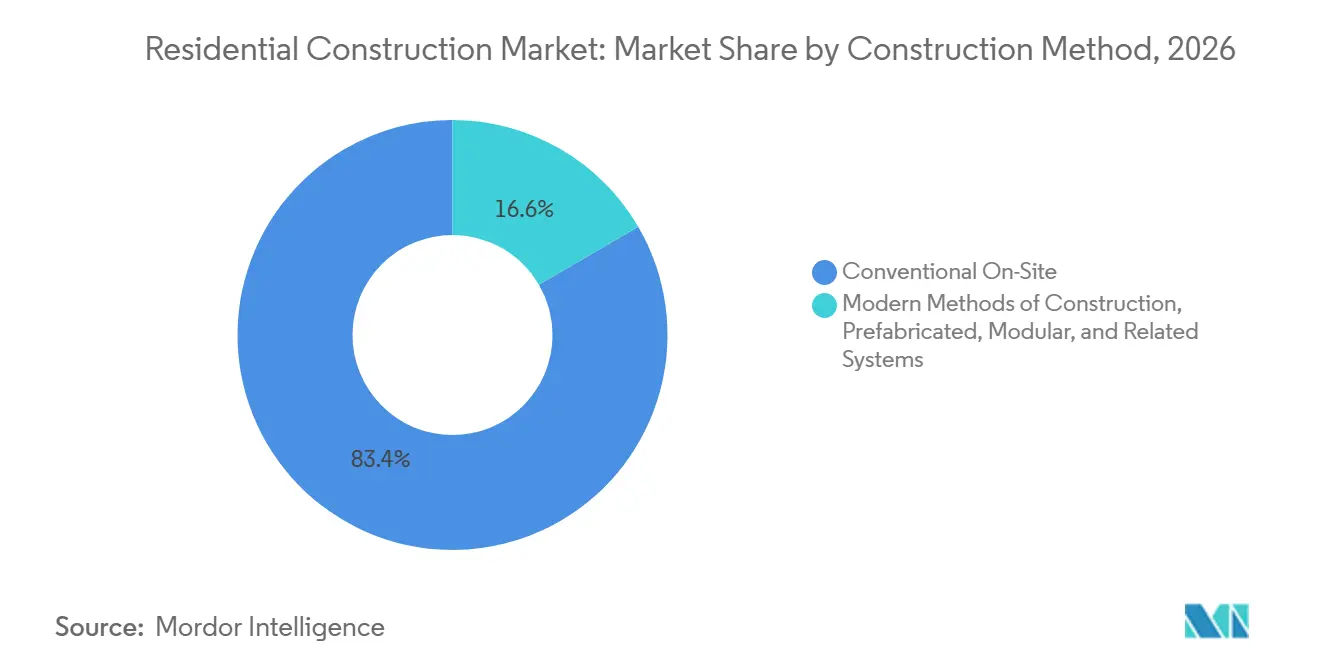
Conventional On-Site Delivery Retains Scale While Modern Methods of Construction, Prefabricated, Modular, and Related Systems AdvanceConventional on-site construction is projected to account for 83.4% of the global residential construction market in 2026. It remains the default approach in markets characterized by diverse design requirements, limited factory capacity, and labor-based construction systems. On-site delivery can adapt to local materials, regulations, and irregular land parcels. It is particularly relevant for smaller residential projects or in areas where standardized components are not readily available. Conventional delivery also remains familiar to buyers, lenders, and local contractors. These factors explain why this method maintains a substantially larger base than factory-based approaches. However, schedule uncertainty and labor availability can make on-site construction more difficult to manage. Therefore, the global residential construction market is likely to retain conventional methods while increasing the use of prefabricated elements in selected projects.
Modern methods of construction, including prefabricated, modular, and related systems, are projected to expand at a CAGR of 5.91% through 2032. The Modular Building Institute projects that permanent modular construction in the United States will generate USD 20.5 billion in 2025, with an annual growth outlook of 6.5% through 2030. Vistry Works is expected to deliver 4,643 timber-frame units in 2025, compared with 2,900 units in 2024, and plans to exceed 6,000 units in 2026. The company states that timber-frame construction can reduce construction time by six weeks and embodied carbon by 30% compared with brick-and-block construction. Factory production can reduce weather-related disruptions and improve purchasing control for repetitive designs. This method is best suited to projects with sufficient volume and design repetition to justify factory setup and logistics. However, it does not eliminate the need for local approvals, foundations, utility connections, and final on-site work. Its value proposition is strongest where project speed, labor constraints, and consistent quality are critical requirements.
By Investment Source:
Private Capital Dominates and Public Funding Grows FasterPrivate investment held 80.1% of the global residential construction market in 2026. Private developers, individual buyers, institutional investors, and lenders remain the main sources of funding for residential projects in most countries. Their activity depends on household incomes, interest rates, land values, and the availability of development finance. Private capital is particularly important in suburban for-sale housing, apartment projects, and rental portfolios. It can also finance land acquisition and early project work before public funding is confirmed. The large private base means that mortgage rates and buyer confidence still have major effects on construction starts. Institutional rental owners may provide a more stable source of capital where owner-occupied demand is weak. The global residential construction market needs private capital to meet demand at the scale required by housing shortages.
Public investment is expected to grow at a 5.78% CAGR from 2027 to 2032. The United Kingdom’s Social and Affordable Homes Program provides a long funding horizon for delivery partners. The European Commission’s Affordable Housing Plan and the European Investment Bank’s housing financing also show a broader public role in supporting supply. Public funding can lower risk for builders by supporting infrastructure, land assembly, or affordable units. It can also impose stronger reporting, affordability, and delivery obligations. Partnerships work best when public agencies provide clear requirements, and developers bring delivery capacity. This structure creates opportunities for builders that can manage large sites and mixed-tenure housing. It also reduces reliance on short-term private sales in markets where affordability is under pressure.
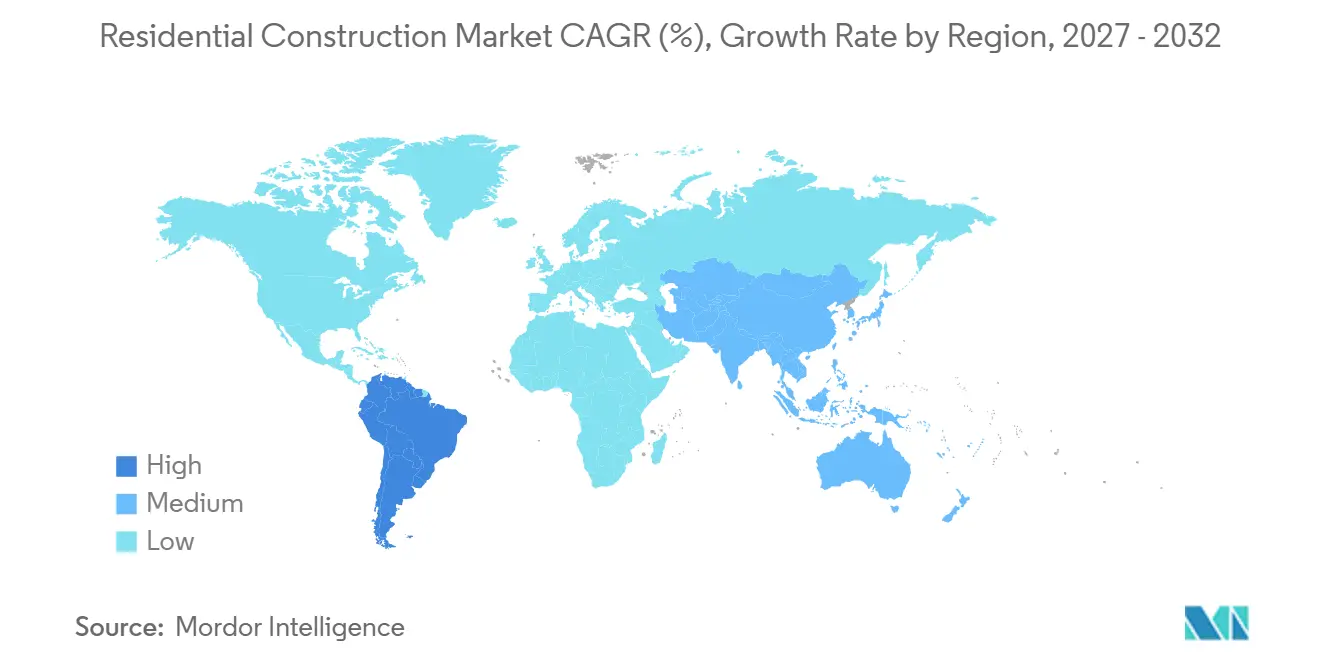
Geography Analysis
Asia-Pacific is projected to account for a 35.6% share of global residential construction in 2026, supported by activity in India, China, and Southeast Asia. China’s National Bureau of Statistics reported a 16.3% decline in residential investment in 2025. The region benefits from ongoing urbanization, transport infrastructure expansion, and diverse housing requirements. However, developers must navigate uneven policy support, buyer confidence, and local supply conditions across countries.
South America is forecast to be the fastest-growing region in the global residential construction market, registering a 6.01% CAGR through 2032. Brazil represents a key source of activity, as public housing programs support housing delivery for lower-income households. According to the United States International Trade Administration, Brazil is expected to build 438,000 housing units between April 2025 and April 2026, with nearly half associated with low-income housing programs. The Inter-American Development Bank documented 69.5 million housing units with qualitative deficits across Latin America and the Caribbean in 2026. This deficit is expected to support new construction, renovation activity, industrialized construction methods, and financing models for underserved households.
Europe combines demand for new housing with substantial retrofit requirements under energy regulations, while public financing and affordable housing policies provide support. North America faces high borrowing costs and labor constraints; however, long-term household demand remains significant in Canada and the United States. The Middle East benefits from planned communities and large-scale infrastructure programs. African markets offer long-term potential driven by urbanization and household formation, although financing availability and formal housing supply remain constrained. Australia and other Oceania markets benefit from housing initiatives but continue to face labor and contractor capacity pressures.
Competitive Landscape
The global residential construction market is fragmented at the international level, while individual national markets can be far more concentrated. Larger builders benefit from scale in land acquisition, procurement, planning teams, and access to funding. Smaller local developers remain important because housing design, regulations, and customer needs vary by city and country. Government programs favor firms that can meet affordability requirements, manage reporting, and deliver large volumes on time. Firms that control land, use standardized designs, or maintain long-term partnerships can reduce execution risk.
Strategic moves increasingly focus on partnership delivery, rental housing, and industrialized construction. Greystar acquired a 904-home build-to-rent portfolio at Elephant Park in London in June 2026, further expanding its Momento residential brand. Greystar also topped out Stratford Mill in East London in October 2025, a 247-home project with 205 rental units and 42 affordable homes. Vistry Works delivered 4,643 timber-frame units in 2025 and targets more than 6,000 in 2026, showing a shift toward factory-based delivery. These moves show continued interest in professionally managed rental housing and standardized building methods.
Technology and compliance are widening the gap between companies with in-house capabilities and those dependent on fragmented supply chains. New European energy rules require builders to understand zero-emission building standards and renovation needs. The National Green Building Standard provides a certification framework for energy, water, and indoor environmental performance in the United States. Compliance can raise entry barriers because it requires design, engineering, material, and documentation expertise.
Residential Construction Industry Leaders
-
Barratt Redrow plc
-
Persimmon plc
-
Taylor Wimpey plc
-
Bellway plc
-
Vistry Group plc
- *Disclaimer: Major Players sorted in no particular order
Residential Construction Market Companies Covered in this Report
- Barratt Redrow plc
- Persimmon plc
- Taylor Wimpey plc
- Bellway plc
- Vistry Group plc
- Berkeley Group Holdings plc
- Crest Nicholson Holdings plc
- Cala Group Ltd
- Bloor Homes Limited
- Miller Homes Limited
- Kier Group plc
- Morgan Sindall Group plc
- Mace Group
- Lendlease Corporation
- Balfour Beatty plc
- Bouygues UK
- Skanska UK plc
- Laing O’Rourke plc
- Galliford Try Holdings plc
- Willmott Dixon Holdings Ltd
- Greystar Real Estate Partners, LLC
- Grainger plc
- Emaar Properties PJSC (UAE)
- D.R. Horton, Inc.
- Lennar Corporation (USA)
Recent Industry Developments in Residential Construction Market
- October 2026: Development Victoria selected a Hamton-Hostplus joint venture to deliver Arden Central, a 12-hectare transit-oriented precinct in Melbourne's inner north. Anchored by Arden Station, the development will include more than 5,400 homes, with at least 10% allocated to affordable housing. Stage 1 mobilization is expected to begin in 2027, supporting an estimated 3,800 construction jobs and more than 1,100 ongoing precinct-wide jobs.
- June 2026: Greystar, through its USD 2.9 billion Greystar Equity Partners Europe II fund, acquired a 904-home build-to-rent (BTR) portfolio at Elephant Park in London from CPP Investments and Lendlease for approximately USD 650 million.
- April 2026: Places for People (PfP) and Barratt Redrow announced a joint venture to develop an 8,500-home garden town community on the outskirts of Gilston, East Hertfordshire. The project, one of the United Kingdom’s most ambitious single-site residential developments, will comprise six interconnected, walkable villages across 660 hectares of public open space and include at least 1,950 affordable homes. The partnership combines Barratt Redrow’s large-scale development capabilities with PfP’s expertise in long-term community stewardship.
Global Residential Construction Market Report Scope
Segmentation Overview
| Apartments and Condominiums |
| Villas and Landed Houses |
| New Construction |
| Renovation |
| Conventional On-Site |
| Modern Methods of Construction, Prefabricated, Modular, and Related Systems |
| Public |
| Private |
| North America | United States |
| Canada | |
| Mexico | |
| South America | Brazil |
| Argentina | |
| Chile | |
| Rest of South America | |
| Europe | United Kingdom |
| Germany | |
| France | |
| Italy | |
| Spain | |
| Netherlands | |
| Russia | |
| Rest of Europe | |
| Asia-Pacific | China |
| India | |
| Japan | |
| South Korea | |
| Australia | |
| Indonesia | |
| Rest of Asia-Pacific | |
| Middle East | Saudi Arabia |
| United Arab Emirates | |
| Turkey | |
| Rest of Middle East | |
| Africa | South Africa |
| Nigeria | |
| Rest of Africa | |
| Oceania | Australia |
| New Zealand | |
| Rest of Oceania |
| By Type | Apartments and Condominiums | |
| Villas and Landed Houses | ||
| By Construction Type | New Construction | |
| Renovation | ||
| By Construction Method | Conventional On-Site | |
| Modern Methods of Construction, Prefabricated, Modular, and Related Systems | ||
| By Investment Source | Public | |
| Private | ||
| By Geography | North America | United States |
| Canada | ||
| Mexico | ||
| South America | Brazil | |
| Argentina | ||
| Chile | ||
| Rest of South America | ||
| Europe | United Kingdom | |
| Germany | ||
| France | ||
| Italy | ||
| Spain | ||
| Netherlands | ||
| Russia | ||
| Rest of Europe | ||
| Asia-Pacific | China | |
| India | ||
| Japan | ||
| South Korea | ||
| Australia | ||
| Indonesia | ||
| Rest of Asia-Pacific | ||
| Middle East | Saudi Arabia | |
| United Arab Emirates | ||
| Turkey | ||
| Rest of Middle East | ||
| Africa | South Africa | |
| Nigeria | ||
| Rest of Africa | ||
| Oceania | Australia | |
| New Zealand | ||
| Rest of Oceania | ||
Key Questions Answered in the Report
What is the forecast growth rate for global residential construction?
The residential construction market is forecast to grow at a 4.95% CAGR from 2027 to 2032.
Which property type leads residential construction worldwide?
Villas and landed houses lead, with a 57.8% share in 2026.
Which residential format is growing fastest?
Apartments and condominiums are forecast to grow at a 5.66% CAGR through 2032.
Why is renovation growing in residential building?
Energy rules and inefficient housing stock support renovation growth at a 5.52% CAGR.
How important is modular construction for housing delivery?
Modern methods of construction, prefabricated, modular, and related systems are forecast to grow at a 5.91% CAGR through 2032.
Which region is expected to grow fastest in residential construction?
South America is forecast to grow at a 6.01% CAGR through 2032.