
Renters Insurance Market Size and Share
Market Overview
| Study Period | 2021 - 2032 |
|---|---|
| Market Size (2027) | USD 16.90 Billion |
| Market Size (2032) | USD 22.10 Billion |
| Growth Rate (2027 - 2032) | 5.50 % |
| Fastest Growing Market | Asia-Pacific |
| Largest Market | North America |
| Market Concentration | Low |
Major Players *Disclaimer: Major Players sorted in no particular order Image © Mordor Intelligence. Reuse requires attribution under CC BY 4.0. | |
Renters Insurance Market Analysis by Mordor Intelligence
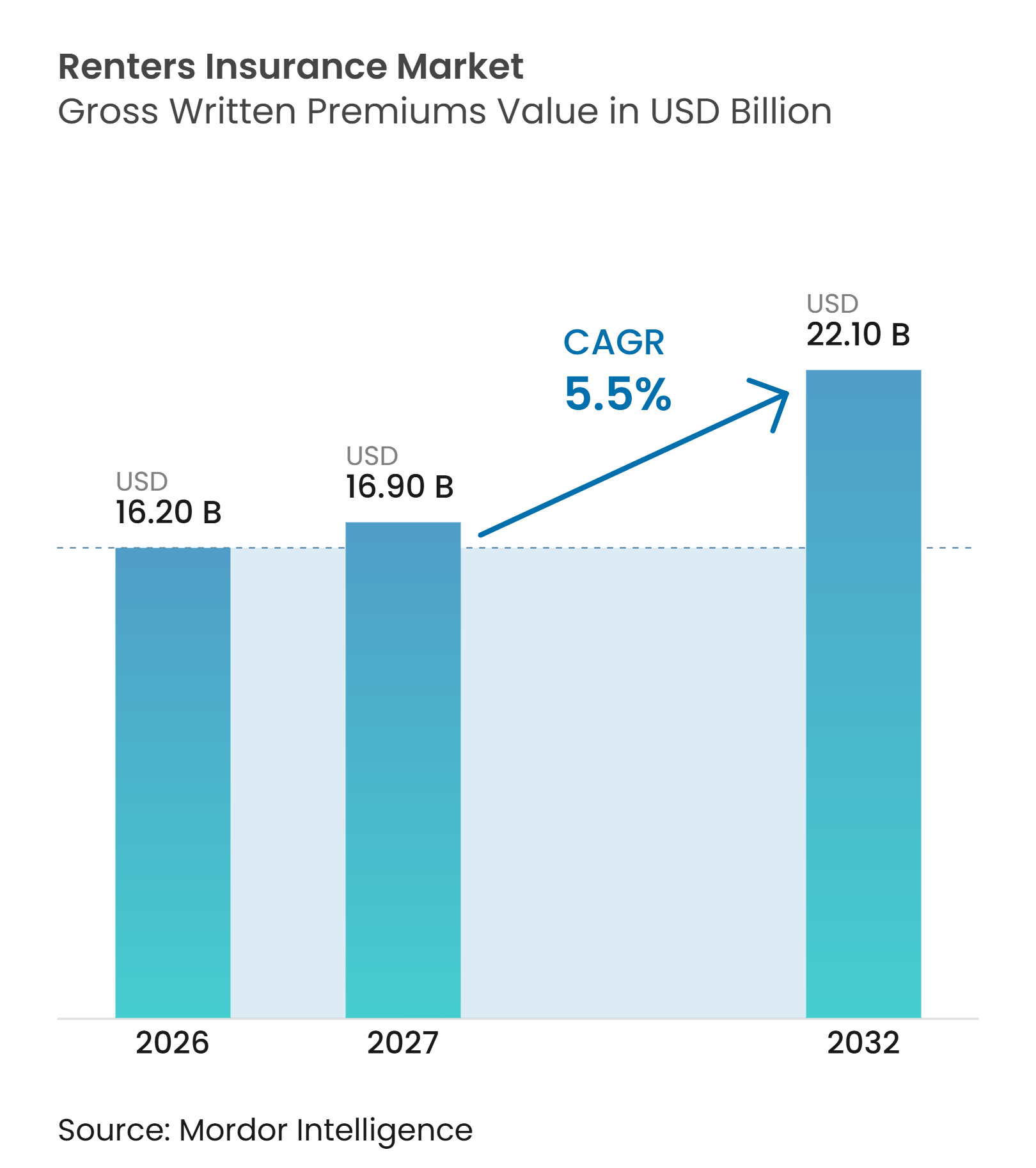
The Renters Insurance Market size in terms of gross written premiums value was valued at USD 16.20 billion in 2026 and is estimated to grow from USD 16.90 billion in 2027 to reach USD 22.10 billion by 2032, at a CAGR of 5.5% during the forecast period (2027-2032).
The renters insurance market is supported by a longer period of renting, as home purchase costs and borrowing conditions delay homeownership for many households. A larger renter base can extend the premium opportunity, particularly where insurers can make coverage easier to understand and buy. Lease requirements, mobile purchasing, and property management integrations are changing how renters encounter coverage. The competitive response includes digital claims servicing, broader embedded distribution, and selective withdrawals from high-risk locations. Low awareness, affordability pressure, policy cancellations, and coverage gaps continue to limit adoption in the renters insurance industry.
Key Report Takeaways
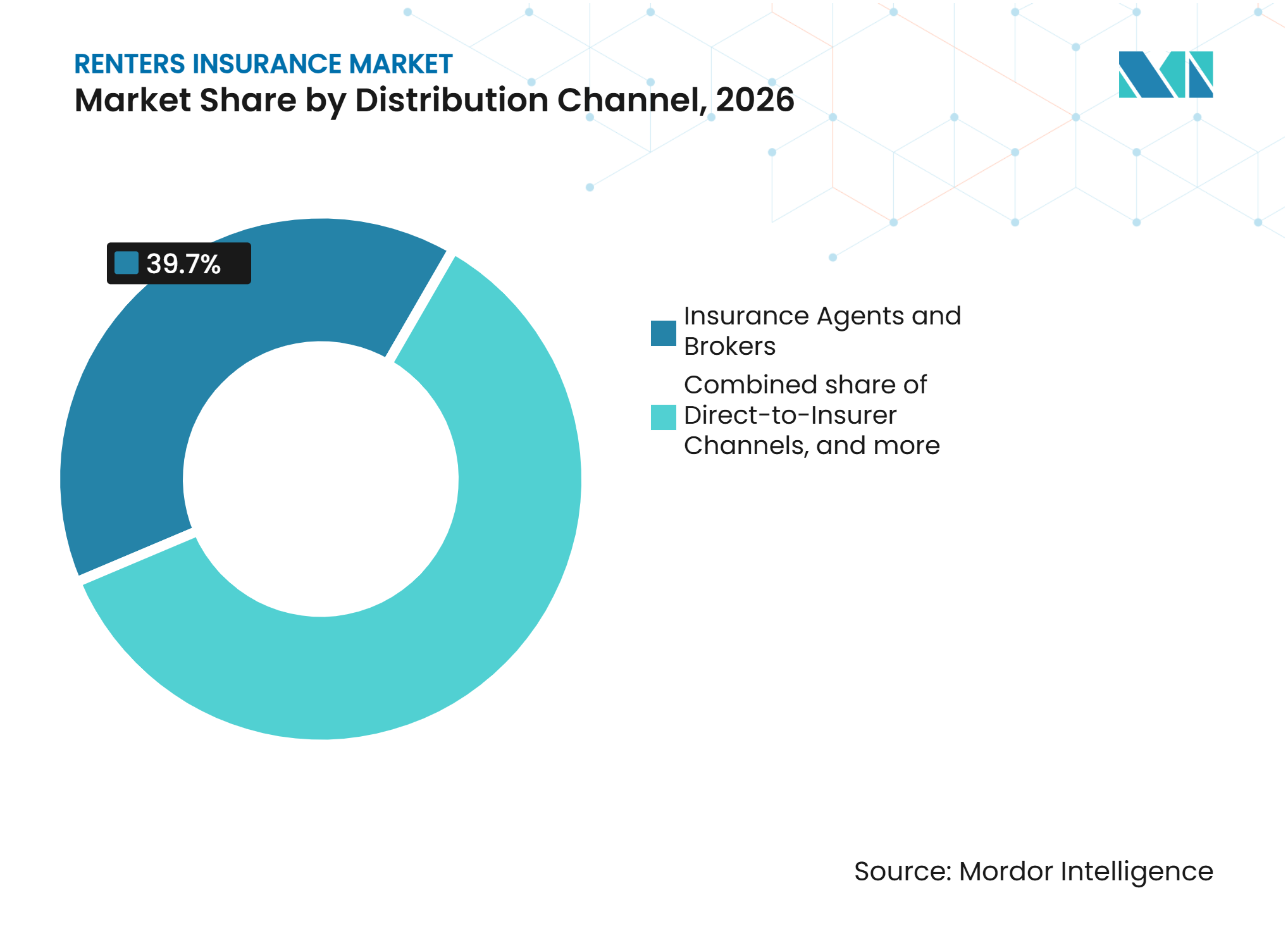
- By distribution channel, insurance agents and brokers captured 39.7% of the renters insurance market share in 2026, while rental platforms and property-manager embedded channels are projected to grow at a 9.8% CAGR through 2032.
- By type of rented residence, apartments and multifamily rental units captured 44.8% of the renters insurance market share in 2026, while purpose-built student accommodation is projected to grow at a 7.5% CAGR through 2032.
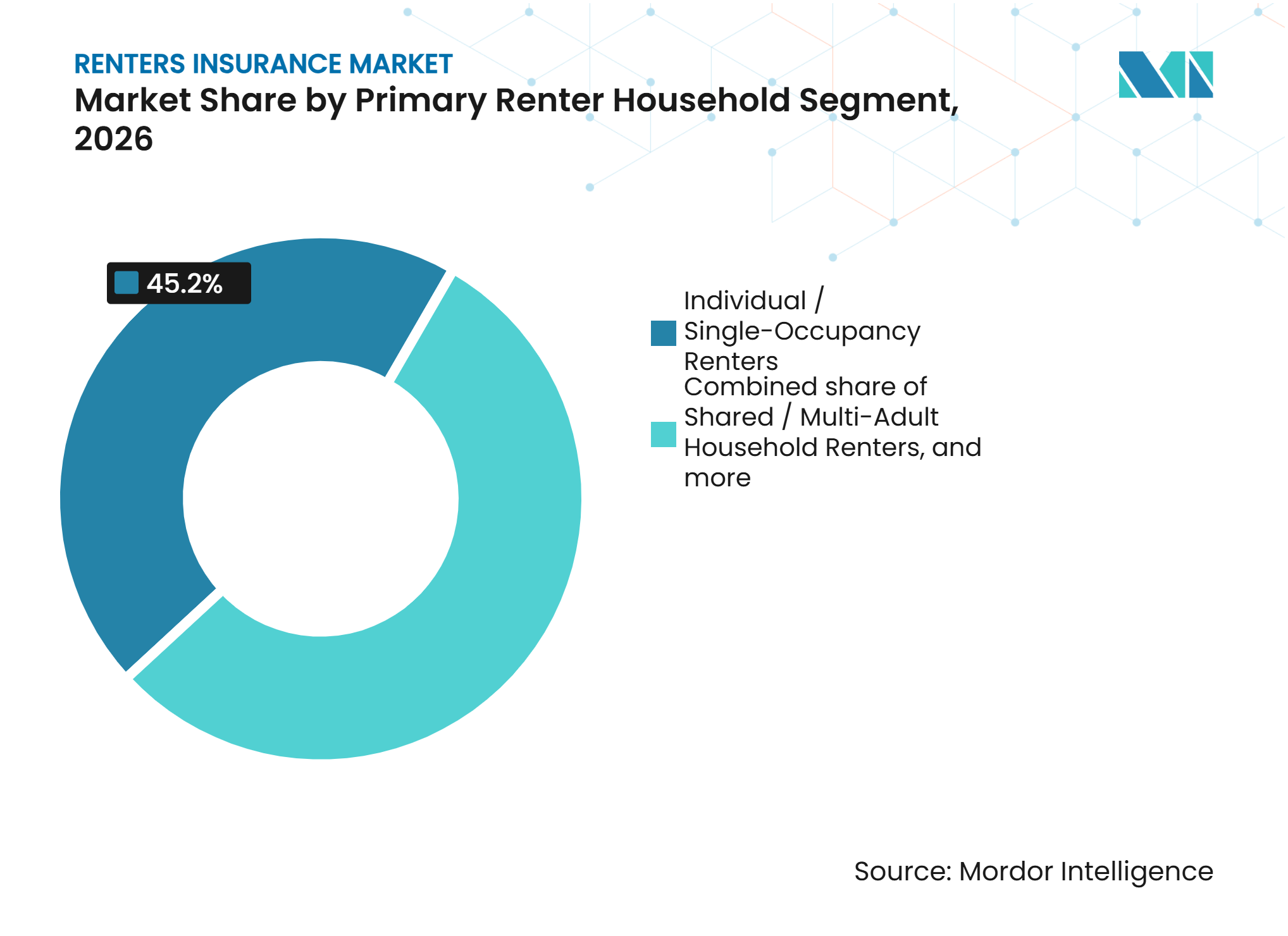
- By primary renter household segment, individual and single-occupancy renters captured 45.2% of the renters insurance industry share in 2026, while corporate, relocation, and employer-sponsored renters are projected to grow at a 6.8% CAGR through 2032.
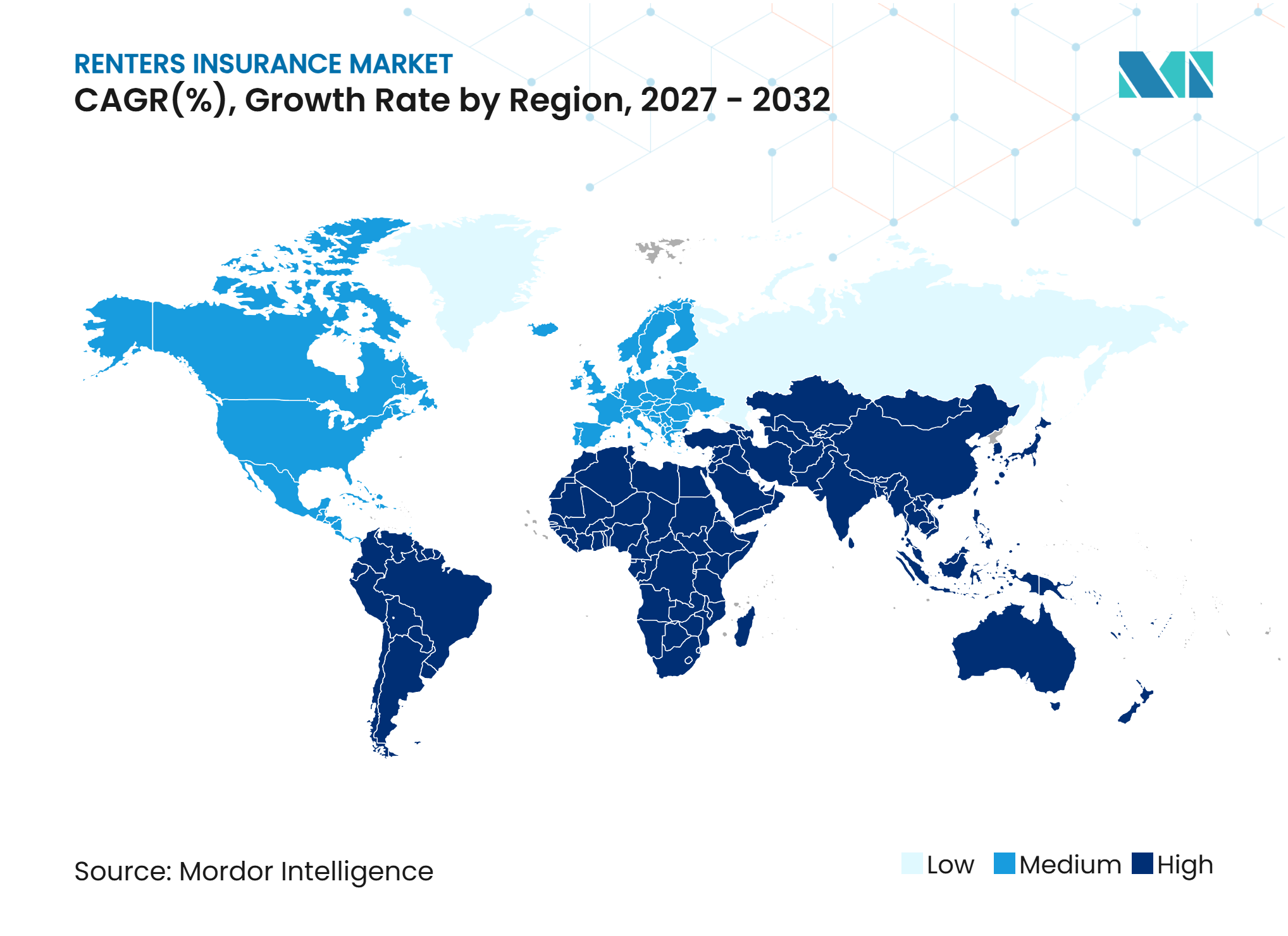
- By geography, North America captured 43.1% of the renters insurance industry share in 2026, while Asia-Pacific is projected to grow at a 7.8% CAGR through 2032.
Note: Market numbers in this report are based on Mordor Intelligence's proprietary estimation framework, which combines nine months of actuals with Q4 projections for base year 2026.
Market Trends and Insights
Drivers Impact Analysis of Renters Insurance Market*
| Driver | (~) % Impact on CAGR Forecast | Geographic Relevance | Impact Timeline |
|---|---|---|---|
| Growth in Rental Households and Prolonged Renting | +1.2% | North America and Europe | Short term (≤ 2 years) |
| Landlord-Imposed Renters Insurance Requirements | +0.9% | North America and Australia | Short term (≤ 2 years) |
| Digital-First Purchase and Claims Servicing | +0.7% | Global, led by North America and Asia-Pacific | Medium term (2-4 years) |
| Embedded Distribution Through Rental Platforms | +0.8% | North America, Canada, and Europe | Short term (≤ 2 years) |
| Higher Value of Personal Belongings and Contents Protection Needs | +0.5% | Global | Medium term (2-4 years) |
| Rising Awareness of Liability and Property-Loss Risks | +0.4% | Global | Medium term (2-4 years) |
| Source: Mordor Intelligence | |||
Growth in Rental Households and Prolonged Renting
Homeownership barriers are extending the period during which many households rent, creating a broader base for the renters insurance market. TransUnion reported that renters represented 35.0% of occupied households in the United States in Q2 2026. The same research described a median renter age of 40 years, median household income of USD 56,000, and average tenure at the same address of 3.3 years[1]. These characteristics challenge the assumption that renters are uniformly short-term and difficult to retain. They also support more targeted underwriting and product design for households that may remain in rental housing for longer periods.
Landlord-Imposed Renters Insurance Requirements
Lease clauses that require renters insurance create a direct connection between housing occupancy and policy purchase. These provisions are especially important in professionally managed multifamily housing, where requirements can be applied consistently across large portfolios. The practice can reduce uncertainty for tenants and property managers by specifying liability or contents coverage before move-in. State rules in the United States, including Oregon ORS 90.222 and Virginia §55-248.7:2, provide a framework for landlord insurance requirements and consumer protections. The renters insurance market benefits when these requirements are communicated clearly, and premium collection practices remain transparent. Property managers can also use verification tools to identify policies that lapse during a lease term.
Digital-First Renters Insurance Purchase and Claims Servicing
Digital servicing can lower the administrative cost of issuing and managing small-premium renters policies. Lemonade stated in its 2025 annual report that its AI systems handled 96% of first notices of loss without human intervention as of December 31, 2025[2]. The company also stated that its automated claims process could complete some simple claims decisions in seconds after fraud checks. Automation can make it more practical to serve renters seeking lower-cost coverage through a mobile interface. It can also shorten the time between a loss report and an initial decision for straightforward claims.
Embedded Insurance Distribution Through Rental Platforms and Lease Workflows
Embedded distribution places insurance in the systems renters already use to lease a home, schedule a move, or upload documents. In October 2026, MSI embedded its renters coverage in Moved's platform, which serves more than 4,000 properties and over 1 million units nationwide[3]. The arrangement allows residents to obtain a policy within the move-in process rather than completing a separate application. In May 2026, Yardi expanded RentCafe Renter Essentials in Canada through a partnership with APOLLO Insurance[4]. These agreements show how the renters insurance market can reach renters at a time when coverage is immediately relevant.
Restraints Impact Analysis of Renters Insurance Market*
| Restraint | (~) % Impact on CAGR Forecast | Geographic Relevance | Impact Timeline |
|---|---|---|---|
| Low Awareness of Renters Insurance and Landlord Coverage Limitations | -0.8% | Asia-Pacific, Middle East and Africa, South America, and emerging European markets | Long term (≥ 4 years) |
| Premium Affordability Constraints Among Cost-Sensitive Renters | -0.7% | Global, concentrated in Asia-Pacific and lower-income United States renters | Medium term (2-4 years) |
| Coverage Exclusions, Deductibles, and Protection Gaps | -0.3% | Global | Long term (≥ 4 years) |
| Fraud Losses and Verification Challenges | -0.4% | North America and emerging Asia-Pacific markets | Medium term (2-4 years) |
| Source: Mordor Intelligence | |||
Low Awareness of Renters Insurance and Landlord Coverage Limitations
Low awareness remains a major constraint because many renters do not know that a landlord policy usually does not protect their personal belongings. The North Carolina Department of Insurance cited a National Association of Insurance Commissioners survey showing that only 21% of Gen Z adults held renters insurance in 2025. The gap is not limited to the United States, as renters in the United Kingdom may also misunderstand responsibility for contents coverage. Carriers can address this by using short, plain explanations at lease signing and during onboarding. Education must explain both the value of personal property coverage and the role of personal liability protection.
Premium Affordability Constraints Among Cost-Sensitive Renters
Affordability is a restraint because renters with the greatest financial exposure may be least able to add another recurring expense. The Insurance Information Institute reported an average annual renters insurance premium in the United States of USD 170 in 2025. Even a modest annual payment can compete with rent, utilities, debt repayments, and other essential expenses. This challenge is more pronounced in locations where catastrophe risk contributes to higher property insurance pricing. Flexible payment frequency and clear coverage tiers can help renters compare a policy with the financial consequences of an uninsured loss.
*Our forecasts treat driver/restraint impacts as directional, not additive. The impact forecasts reflect baseline growth, mix effects, and variable interactions.
Renters Insurance Market Segment Analysis
By Distribution Channel:
Agents and Brokers Retain Scale While Embedded Channels Lead GrowthInsurance agents and brokers captured 39.7% of the renters insurance market share in 2026. Their position reflects the long-standing importance of licensed advice in personal insurance, especially when renters bundle coverage with auto or other policies. Agents can help customers evaluate contents values, liability limits, and the differences between actual cash value and replacement cost coverage. This remains useful for renters with valuable possessions, complex household arrangements, or questions about landlord requirements. The renters insurance market size associated with agents and brokers reflects demand for accessible advice rather than only a legacy distribution structure.
Rental platforms and property-manager embedded channels are projected to grow at 9.8% CAGR through 2032. MSI's 2026 Moved relationship shows how a single platform partnership can connect coverage to more than 1 million units. These channels can make policy purchase faster and can provide continuous verification after enrollment. Their success will depend on transparent choice, a reliable claims experience, and a process for renters who need help beyond automated prompts. The renters insurance industry will continue to rely on both advisers and embedded technology as different renter needs require different service models.


By Type of Rented Residence:
Multifamily Housing Leads While Student Housing ExpandsApartments and multifamily rental units captured 44.8% of the renters insurance market share in 2026. The segment benefits from the concentration of renters in buildings managed by organizations that can apply insurance requirements across many units. Assurant stated that more than half of the 50 largest property management companies in the United States work with it for renters insurance. Single-family rental homes and individually rented condominium units also represent meaningful opportunities, although their insurance requirements may be less standardized. Manufactured and mobile homes add a distinct need for coverage because the exposure to weather events can be high relative to household resources.
Purpose-built student accommodation is projected to grow at a 7.5% CAGR through 2032. The segment brings together professionally managed accommodation, frequent changes in occupancy, and renters who may be purchasing coverage for the first time. The United Kingdom's Renters' Rights Act 2025 created a specific exemption for approved purpose-built student accommodation, preserving fixed-term leasing arrangements for this housing type from May 1, 2026. A 2025 Rider University program that embedded group insurance in its housing portal increased student participation 50-fold compared with the prior semester. The renters insurance market can expand in this segment when student coverage is clear, inexpensive, and integrated with the housing process.
By Primary Renter Household Segment:
Single Occupants Lead While Corporate Renters Grow FastestIndividual and single-occupancy renters captured 45.2% of the renters insurance market share in 2026. TransUnion's 2026 renter research indicates that the median renter household income is USD 56,000 and the average tenure at the same address is 3.3 years. These attributes can support more tailored coverage offers and retention programs. Shared and multi-adult households require careful treatment of liability and possessions because not all occupants may have the same protection needs. Student renters may also need guidance when parental homeowners coverage no longer applies to an independent rental.
Corporate, relocation, and employer-sponsored renters are projected to grow at 6.8% CAGR through 2032. The segment is supported by mobility programs that include temporary housing and insurance as part of a broader relocation package. ECA International reported that 96% of employers prioritize temporary accommodation in relocation packages in 2026. This offers insurers a lower-acquisition-cost route than individual customer marketing, but service must meet the needs of both the employer and the employee. The segment is also likely to benefit as global mobility broadens beyond senior executive roles.

Geography Analysis
North America captured 43.1% of the renters insurance market share in 2026. The United States supports the region's position through a mature personal lines insurance system, strong agent networks, and a large multifamily rental base. National Association of Insurance Commissioners data show that State Farm held 18.63% of United States renters written premium, Allstate held 8.44%, and Liberty Mutual held 6.86%. Canada is also developing embedded distribution, as Yardi expanded RentCafe Renter Essentials with APOLLO Insurance for Canadian Voyager users in May 2026. North America combines established coverage practices with new technology-led enrollment channels.
The United States also shows the effects of risk management decisions in catastrophe-exposed states. Liberty Mutual planned to exit California condo and renters lines in 2026, while Mercury Insurance announced a transition program for affected Safeco customers through its agent network. State Farm reopened California renters and condo coverage for certain existing policyholders moving within the state in January 2026. Such actions can reshape availability at the state level without changing the national importance of the renters insurance market. Insurers must balance portfolio risk with a clear and fair transition for policyholders. Digital providers may find openings where established carriers narrow underwriting criteria.
Asia-Pacific is projected to grow at 7.8% CAGR through 2032, making it the fastest-growing regional segment in the renters insurance market. The opportunity is linked to urban migration, growing rental housing, and the ability to enroll customers through mobile channels. Japan remains more mature because fire insurance is commonly associated with rental agreements, while other markets have greater room for first-time adoption. Growth will vary across the region because local regulations, insurance awareness, and property management practices differ widely. Insurers need local distribution partners and clear consumer explanations rather than a single regional strategy. The Asia-Pacific renters insurance market size will depend on whether embedded channels can build confidence while meeting local compliance requirements.
Europe presents a mixed picture of established rental populations and uneven contents insurance uptake. Germany has a large renter population and a strong culture of personal liability coverage, which can create a path to broader contents protection. In the United Kingdom, contents insurance penetration among private renters declined from 51% in 2023 to 46% in 2025. This decline shows that awareness and affordability can weaken adoption even where the insurance product is familiar. South America, the Middle East, and Africa remain smaller contributors to the renters insurance market, but expanding urban housing can create future demand. Insurers in these regions need to consider currency conditions, local regulation, and the availability of digital payment systems before scaling distribution.
Competitive Landscape
Market Concentration
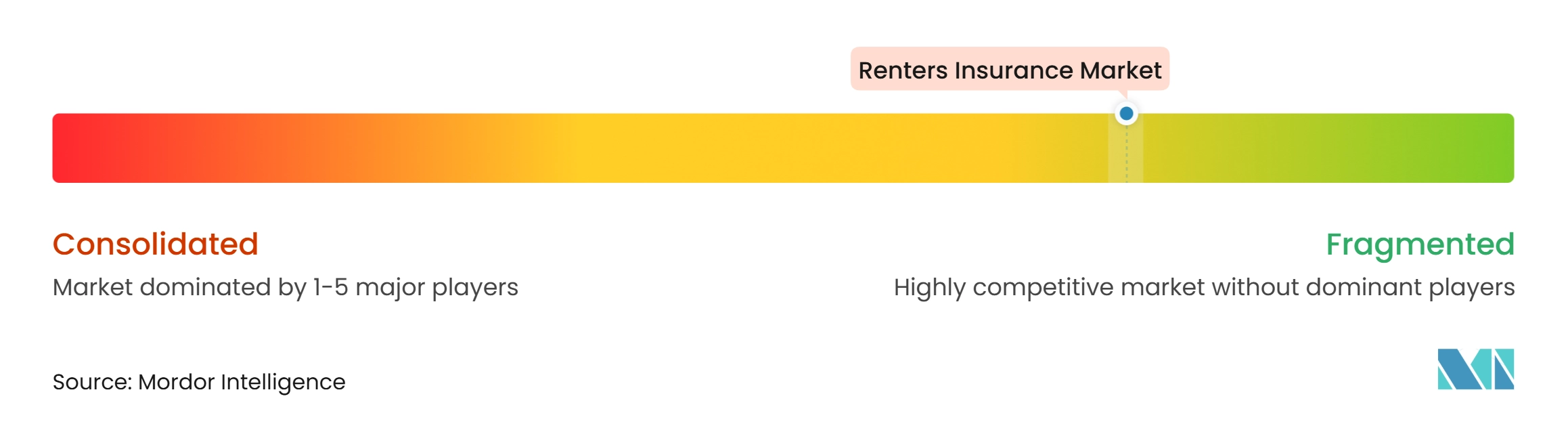
The renters insurance market is fragmented, particularly across global regions, with competition spanning traditional insurers, specialist providers, digital insurers, and managing general agencies. Although the top five carriers accounted for 43% of written premium in the United States, the market includes numerous providers competing through pricing, bundled coverage, distribution partnerships, and digital services. State Farm, Allstate, Nationwide, and The Travelers Companies leverage established brands and broad distribution networks, while Assurant and Intact Financial focus on relationships with property managers. Competitive positioning therefore depends on both consumer reach and access to rental property portfolios.
Insurers are strengthening their positions through acquisitions, expanded policy benefits, and embedded distribution partnerships. Assurant acquired QBE Insurance Group's North America renters business in May 2025, expanding its multifamily insurance presence and property management relationships. Allstate also introduced identity theft protection as a standard benefit for eligible home, auto, and renters policyholders in 14 states in April 2026. Meanwhile, digital insurers such as Lemonade compete through faster enrollment, mobile policy servicing, and automated claims processes. Partnerships involving Aviva, Lemonade, and BNP Paribas Cardif further illustrate how established insurers are leveraging digital distribution to reach customers.
Fragmentation also creates opportunities for providers targeting small and midsized property managers through integrated insurance and technology solutions. MSI's collaboration with Moved expands access to renters insurance through the property technology ecosystem, while Sure and Groma launched an integrated renters insurance, compliance verification, and tenant legal liability program in October 2026. These initiatives demonstrate how specialist providers can compete without relying solely on large direct-sales networks. Overall, the market is expected to remain fragmented as traditional carriers, digital insurers, specialist providers, and embedded insurance platforms compete through differentiated products, distribution partnerships, and improved customer experiences.
Renters Insurance Industry Leaders
-
State Farm Mutual Automobile Insurance Company
-
Allstate Corporation
-
Liberty Mutual Insurance
-
The Travelers Companies, Inc.
-
Nationwide Mutual Insurance Company
- *Disclaimer: Major Players sorted in no particular order
Renters Insurance Market Companies Covered in this Report
- State Farm
- Allstate
- Liberty Mutual
- The Travelers Companies
- Nationwide
- USAA
- Lemonade
- American Family Insurance
- Farmers Insurance Group
- Chubb
- Erie Insurance
- Amica Mutual Insurance
- Assurant
- The Hartford
- Auto-Owners Insurance
- Intact Financial Corporation
- Allianz
- QBE Insurance Group
- Suncorp Group
- Aviva
Recent Industry Developments in Renters Insurance Market
- October 2026: Sure and Groma launched integrated renters insurance, AI-powered compliance verification, and a Tenant Legal Liability program. The combined rollout across Groma's multifamily portfolio was completed in under 30 days, providing portfolio-wide coverage, automated compliance tracking via Sure's Verify tool, and TLL protection for non-compliant units. The launch marked one of the first fully integrated renters insurance and compliance solutions deployed simultaneously across a multifamily investment portfolio.
- October 2026: MSI embedded renters insurance into Moved's proptech platform, reaching over 1 million units. Under the collaboration, MSI's policies, which offered liability coverage from USD 100,000 to USD 300,000 and contents coverage up to USD 100,000, were available with guaranteed approval within Moved's existing resident move-in workflow. LeaseTrack provided continuous compliance monitoring.
- May 2026: Yardi expanded RentCafe Renter Essentials in Canada through a partnership with APOLLO Insurance. The integration embedded tenant insurance directly into the RentCafe leasing workflow for all Canadian Voyager users. It enabled residents to purchase or upload proof of insurance without leaving the platform.
- April 2026: Allstate became the first major United States insurer to include identity theft protection as a standard benefit. The rollout began in 14 states for 6.8 million customers holding home, auto, or renters policies. Expansion across additional states was planned through 2026.
Global Renters Insurance Market Report Scope
Segmentation Overview
| Insurance Agents and Brokers |
| Direct-to-Insurer Channels |
| Rental Platforms and Property-Manager Embedded Channels |
| Affinity, Partnership, and Other Intermediated Channels |
| Apartments and Multifamily Rental Units |
| Single-Family Rental Homes |
| Individually Rented Condominium Units |
| Purpose-Built Student Accommodation |
| Manufactured and Mobile Homes |
| Other Residential Rentals |
| Individual / Single-Occupancy Renters |
| Shared / Multi-Adult Household Renters |
| Student Renters |
| Corporate, Relocation and Employer-Sponsored Renters |
| Other / Unclassified |
| North America | United States |
| Canada | |
| Mexico | |
| South America | Brazil |
| Argentina | |
| Rest of South America | |
| Europe | United Kingdom |
| Germany | |
| France | |
| Italy | |
| Spain | |
| Rest of Europe | |
| Asia-Pacific | China |
| Japan | |
| India | |
| South Korea | |
| Australia | |
| Indonesia | |
| Thailand | |
| Malaysia | |
| Singapore | |
| Vietnam | |
| Rest of Asia-Pacific | |
| Middle East and Africa | Saudi Arabia |
| United Arab Emirates | |
| Turkey | |
| South Africa | |
| Egypt | |
| Rest of Middle East and Africa |
| By Distribution Channel | Insurance Agents and Brokers | |
| Direct-to-Insurer Channels | ||
| Rental Platforms and Property-Manager Embedded Channels | ||
| Affinity, Partnership, and Other Intermediated Channels | ||
| By Type of Rented Residence | Apartments and Multifamily Rental Units | |
| Single-Family Rental Homes | ||
| Individually Rented Condominium Units | ||
| Purpose-Built Student Accommodation | ||
| Manufactured and Mobile Homes | ||
| Other Residential Rentals | ||
| By Primary Renter Household Segment | Individual / Single-Occupancy Renters | |
| Shared / Multi-Adult Household Renters | ||
| Student Renters | ||
| Corporate, Relocation and Employer-Sponsored Renters | ||
| Other / Unclassified | ||
| By Geography | North America | United States |
| Canada | ||
| Mexico | ||
| South America | Brazil | |
| Argentina | ||
| Rest of South America | ||
| Europe | United Kingdom | |
| Germany | ||
| France | ||
| Italy | ||
| Spain | ||
| Rest of Europe | ||
| Asia-Pacific | China | |
| Japan | ||
| India | ||
| South Korea | ||
| Australia | ||
| Indonesia | ||
| Thailand | ||
| Malaysia | ||
| Singapore | ||
| Vietnam | ||
| Rest of Asia-Pacific | ||
| Middle East and Africa | Saudi Arabia | |
| United Arab Emirates | ||
| Turkey | ||
| South Africa | ||
| Egypt | ||
| Rest of Middle East and Africa | ||
Key Questions Answered in the Report
What is the projected growth rate for renters insurance?
The renters insurance market is projected to grow at a CAGR of 5.5% from 2027 to 2032, reaching USD 22.1 billion by 2032.
Which distribution channel has the largest share?
Insurance agents and brokers hold the largest share at 39.7% in 2026, while embedded rental platforms have the highest projected growth at 9.8% CAGR.
Why are rental platforms important for coverage adoption?
They present coverage during leasing or move-in, which reduces the separate steps required for renters to buy a policy and submit proof of insurance.
Which rented residence type is growing fastest?
Purpose-built student accommodation is projected to grow at 7.5% CAGR through 2032, supported by professionally managed housing and lease-based enrollment.
Which region is growing fastest?
Asia-Pacific is projected to grow at 7.8% CAGR through 2032, supported by urban rental growth and mobile-first distribution opportunities.
How concentrated is competition among insurers?
The United States top 5 carriers account for 43% of written premium, while global competition remains fragmented across regions and distribution models.