
Remote Deposit Capture Market Size and Share
Market Overview
| Study Period | 2021 - 2032 |
|---|---|
| Market Size (2027) | USD 396.73 Million |
| Market Size (2032) | USD 528.46 Million |
| Growth Rate (2027 - 2032) | 5.82 % |
| Fastest Growing Market | Asia-Pacific |
| Largest Market | North America |
| Market Concentration | Medium |
Major Players *Disclaimer: Major Players sorted in no particular order Image © Mordor Intelligence. Reuse requires attribution under CC BY 4.0. | |
Remote Deposit Capture Market Analysis by Mordor Intelligence
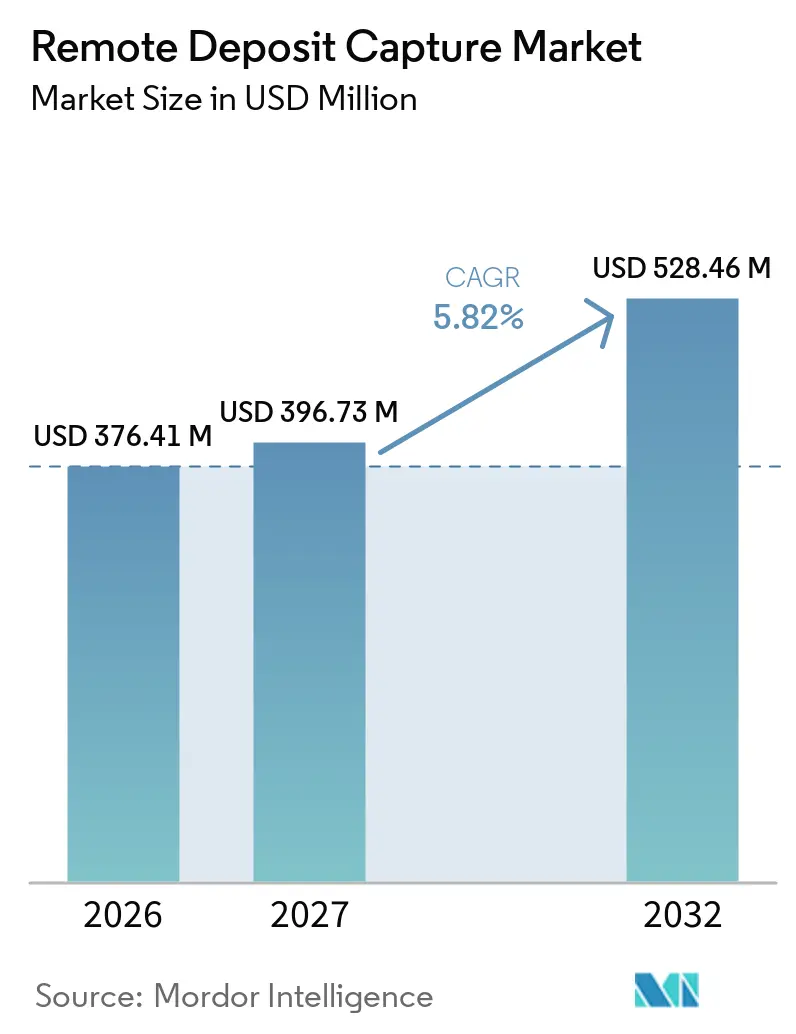
The remote deposit capture market size is projected to expand from USD 376.41 million in 2026 and USD 397.73 million in 2027 to USD 528.46 million by 2032, registering a CAGR of 5.82% between 2027 and 2032. The remote deposit capture market continues to serve a smaller but commercially important pool of checks, where faster availability of funds, lower handling costs, and stronger controls remain important to banks and their business customers. Commercial deposit workflows and treasury processes are becoming increasingly important because higher-value business payments have not fully transitioned to electronic methods. Vendors are responding by linking capture tools with fraud screening, receivables automation, and banking software rather than presenting remote capture as a separate utility. The remote deposit capture market also benefits from the shift from branch deposits to distributed image capture, although declining check use limits the number of transactions that can be addressed. Competition, therefore, centers on integration quality, shared fraud intelligence, and the ability to support multiple capture channels within a single operating environment.
Key Report Takeaways
- By component, solutions held 59.7% of the remote deposit capture market share in 2026, while services are projected to expand at a 7.16% CAGR through 2032.
- By deployment, on-premises systems accounted for 54.3% of the remote deposit capture market share in 2026, while cloud-based deployment is expected to expand at an 8.09% CAGR through 2032.
- By enterprise size, small and medium-sized enterprises held 51.1% of the market in 2026, while large enterprises are projected to expand at a 7.26% CAGR through 2032.
- By capture channel, mobile remote deposit capture accounted for 43.8% of the remote deposit capture market share in 2026 and is projected to expand at an 8.77% CAGR through 2032.
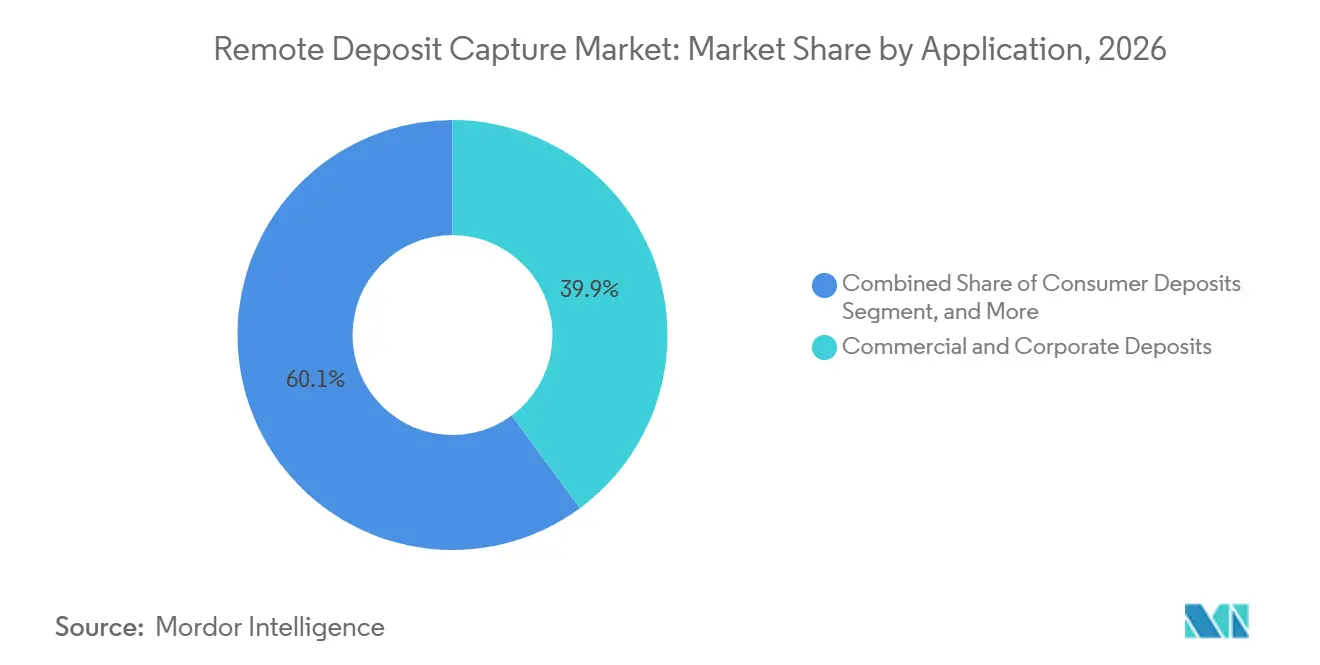
- By application, commercial and corporate deposits held 39.9% share of the remote deposit capture market in 2026, while treasury and accounts receivable automation is expected to expand at an 8.49% CAGR through 2032.
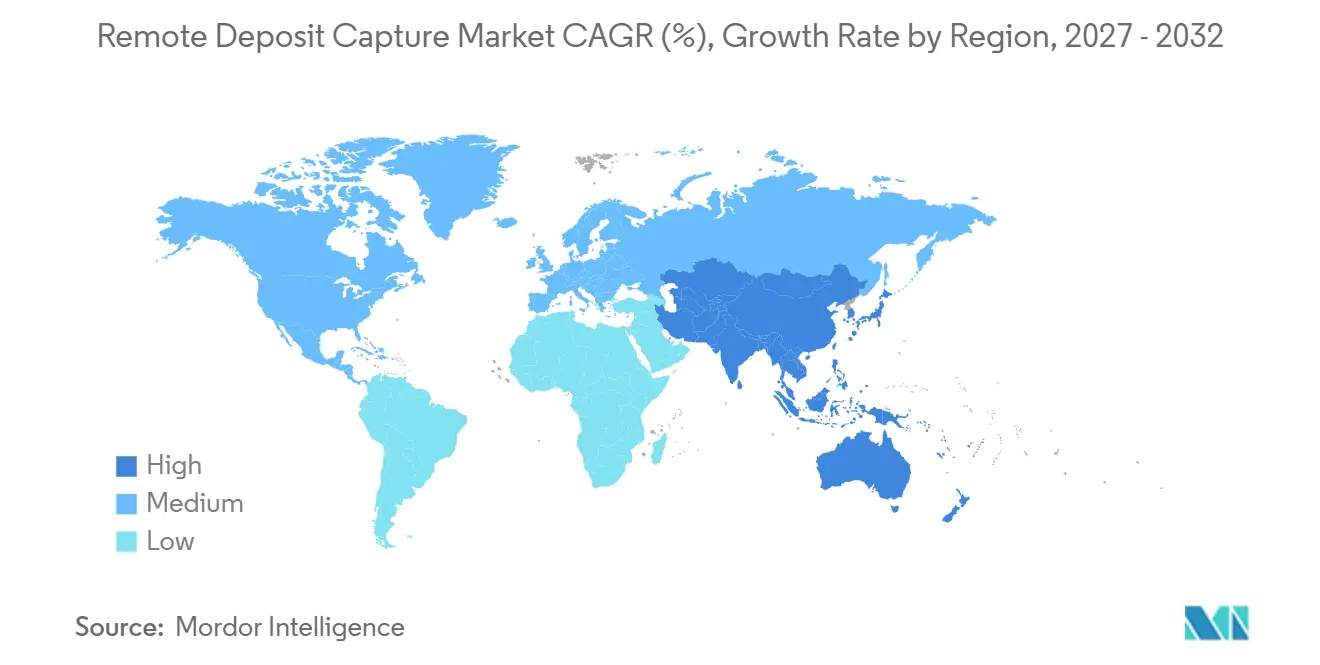
- By geography, North America accounted for 36.4% of the market in 2026, while Asia-Pacific is projected to expand at a 6.91% CAGR through 2032.
Note: Market numbers in this report are based on Mordor Intelligence's proprietary estimation framework, which combines nine months of actuals with Q4 projections for base year 2026.
Global Remote Deposit Capture Market Trends and Insights
Drivers Impact Analysis*
| Driver | (~) % Impact on CAGR Forecast | Geographic Relevance | Impact Timeline |
|---|---|---|---|
| Rising Mobile and Digital Banking Adoption | +2.3% | Global, concentrated in North America and Asia-Pacific core markets | Short term (≤ 2 years) |
| Growing Small and Medium-Sized Enterprise Demand for Faster Funds Availability | +1.5% | North America and Europe, with spillover to Asia-Pacific and South America | Medium term (2-4 years) |
| Migration From Branch Deposits to Distributed Capture | +1.2% | Global, with early gains in North America and the United Kingdom | Medium term (2-4 years) |
| AI-Enabled Image Quality and Fraud Decisioning | +1.0% | Global, accelerating in North America | Medium term (2-4 years) |
| Check-Heavy Business-to-Business Receivables Workflows | +0.7% | North America, with niche pockets in Japan and South America | Long term (≥ 4 years) |
| Embedded Remote Deposit Capture in Fintech and Banking-as-a-Service Platforms | +0.5% | North America and Europe, with early adoption in Asia-Pacific | Long term (≥ 4 years) |
| Source: Mordor Intelligence | |||
Rising Mobile and Digital Banking Adoption
Mobile banking adoption remains a central demand driver for the remote deposit capture market because it moves deposit activity away from a branch visit and into the customer’s daily banking interface. Businesses gain a practical way to submit checks from locations where a branch visit would interrupt collections or staff schedules. This capability also creates more frequent digital engagement between banks and commercial account holders. Mobile capture is no longer treated only as a consumer convenience feature, since business users expect dependable image intake and clear deposit status through the same channel. Providers that support immediate image-quality feedback, endorsement recognition, and cross-channel duplicate checks can make mobile deposit easier to use without weakening controls. For the Remote deposit capture market, the broader expansion of mobile banking functions makes this level of deposit access an increasingly expected part of a competitive business banking offering.
Growing Small and Medium-Sized Enterprise Demand for Faster Funds Availability
Small and medium-sized businesses often view deposit timing as a working-capital issue because delayed posting can affect payroll, supplier payments, and other routine obligations. Remote deposit capture reduces the time and travel associated with taking paper checks to a physical branch. A 2025 U.S. Bank survey of more than 1,000 small-business owners found that 80% preferred providers that combine digital banking, payments, and operating tools. That preference supports products that combine image submission, deposit updates, and reconciliation tools in one workflow. The remote deposit capture market can therefore reach smaller firms through a clear operational proposition, especially when providers explain posting rules and exception handling in simple terms. This demand also supports banks that want to bundle deposit capabilities with broader digital services for business customers.
Migration From Branch Deposits to Distributed Capture
The movement from branch deposits to distributed capture changes where checks enter the clearing process and how bank staff manage them. Instead of relying on couriers, branch drop bags, or centralized deposit rooms, commercial customers can submit images at the point where a payment is received. That approach can lower handling costs and reduce the time between receipt and deposit. The shift does not remove operational complexity because images, remittance information, and exception records still need to connect with core banking systems. The remote deposit capture market favors vendors that offer pre-built connections to widely used cores and can reduce the amount of custom work required during implementation. Reliable integration also helps customers preserve controls as they add more distributed deposit locations.
AI-Enabled Image Quality and Fraud Decisioning
AI-supported review is moving fraud controls closer to the moment when a check image is captured. A bank can use this approach to identify poor image quality, possible duplicate presentment, or unusual check attributes before funds are made available. Earlier decisioning can reduce the cost and customer disruption associated with resolving a case after a deposit has posted. CSI introduced a check-fraud tool in February 2025 that uses Mitek Systems’ consortium intelligence and evaluates 24 check attributes before posting decisions. A 2025 peer-reviewed study also reported 98.72% accuracy and 3.18-millisecond latency for a transformer-based check-fraud framework.[1] For the remote deposit capture market, these developments make real-time image assessment and fraud scoring more relevant to institutions that want mobile convenience without accepting a larger exposure to loss.
Restraints Impact Analysis*
| Restraint | (~) % Impact on CAGR Forecast | Geographic Relevance | Impact Timeline |
|---|---|---|---|
| Declining Check Volumes in Electronic-Payment Economies | -1.6% | Global, most acute in Western Europe, Canada, and urban United States markets | Short term (≤ 2 years) |
| Fraud, Duplicate Presentment, and Loss-Severity Risk | -0.6% | Global | Medium term (2-4 years) |
| Heterogeneous Core-Banking and Scanner Integration | -0.4% | Global, most pronounced among community banks and credit unions | Medium term (2-4 years) |
| Compressed Funds-Availability Decision Windows | -0.2% | North America, with regulatory influence on institutional policy | Long term (≥ 4 years) |
| Source: Mordor Intelligence | |||
Declining Check Volumes in Electronic-Payment Economies
Declining check volumes are the clearest limit on the remote deposit capture market because each paper payment that shifts to electronic processing removes a potential item for capture. NACHA reported that the ACH Network processed 35.2 billion payments in 2025, nearly 5% more than in 2024, while business-to-business ACH volume increased 10% to nearly 8.1 billion payments.[2] The Federal Reserve projected a 5.4% decline in total forward check volume for 2025 and indicated that its Foreign and Canadian Check Service would end by the close of 2026. At the same time, 87% of U.S. businesses used checks for at least some business-to-business payments in 2025, and checks accounted for 24-27% of their business-to-business payment volume on average.[3] The remaining check base is thus concentrated in business transactions where payment value and remittance detail can still justify dedicated capture tools. This pattern preserves the service's importance while placing a permanent ceiling on item volume expansion.
*Our forecasts treat driver/restraint impacts as directional, not additive. The impact forecasts reflect baseline growth, mix effects, and variable interactions.
Segment Analysis
By Component: Solutions Lead Current Revenue While Services Gain Ground
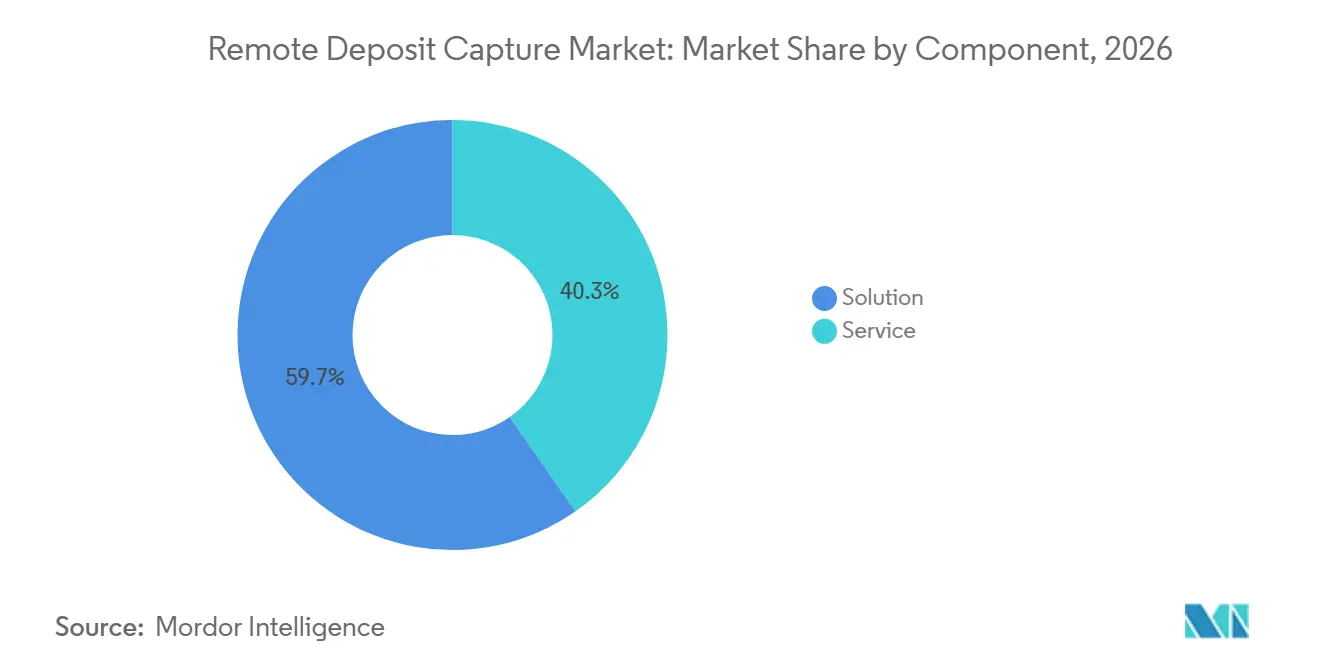
Solutions held 59.7% of the remote deposit capture market share in 2026 because software forms the operating core for image intake, review, decisioning, and record handling. Every mobile, desktop, ATM, or branch workflow needs software to receive the image and apply business rules. This installed role supports the continued importance of solution licenses and platform subscriptions. Providers also use software capabilities to differentiate through application programming interfaces, workflow settings, reporting, and support for several channels. Alogent states that its Unify platform processes more than 320 million deposits each year and offers a Mobile Deposit Services option that removes the need for institutions to operate imaging infrastructure internally. That type of offering shows why institutions can preserve core capture capability while changing who operates the underlying environment.
Services are projected to expand at a 7.16% CAGR through 2032, outpacing the broader rate, as many institutions prefer a managed deployment model. Under this model, a provider manages software maintenance, compliance updates, monitoring, and version changes. The approach is particularly relevant to community banks and mid-tier institutions that may not have sufficient processing volume to justify the fixed costs of internal infrastructure. Managed services can also make it easier to adopt newer fraud controls because updates can be applied across the provider’s customer base. For established vendors, the opportunity is to combine platform access with implementation, support, and operational services without making customers feel locked into a closed system. The Remote deposit capture industry is therefore shifting part of its value from the original software purchase toward continuing operational support.
By Deployment: On-Premises Systems Remain Established While Cloud Use Expands
On-premises systems accounted for 54.3% of the remote deposit capture share in 2026, reflecting the presence of existing scanner fleets and long-standing banking technology environments. Many institutions still prefer local deployment because they have established data governance practices and systems that were designed before modern application programming interfaces were common. This installed base can make a full migration costly and operationally sensitive. On-premises configurations also remain practical where large desktop scanner workflows are already integrated into daily commercial deposit operations. Institutions in this group tend to make changes carefully because funds availability logic and image archives sit close to core banking processes. The remote deposit capture market, therefore, retains a substantial local deployment base even as cloud offerings become more attractive.
Cloud-based deployment is expected to expand at an 8.09% CAGR through 2032 as credit unions and institutions without legacy infrastructure adopt newer architectures. Cloud delivery can reduce the need for local system maintenance and can support access through application programming interfaces. FIS introduced its Embedded Banking Platform in September 2026 to enable banks to deliver account and payment capabilities within corporate customers’ business software through application programming interfaces. The platform reflects a model in which deposit-related capability is treated as a service that can sit within a wider business workflow. Regulation CC threshold adjustments that took effect in July 2025 also required changes to funds-availability decisioning, with the large-deposit threshold rising to USD 6,725 and next-day availability to USD 275. Cloud deployments can apply such updates across users more consistently, while locally deployed systems may require separate patching cycles.
By Enterprise Size: Small and Medium-Sized Enterprises Provide Scale While Large Enterprises Raise Requirements
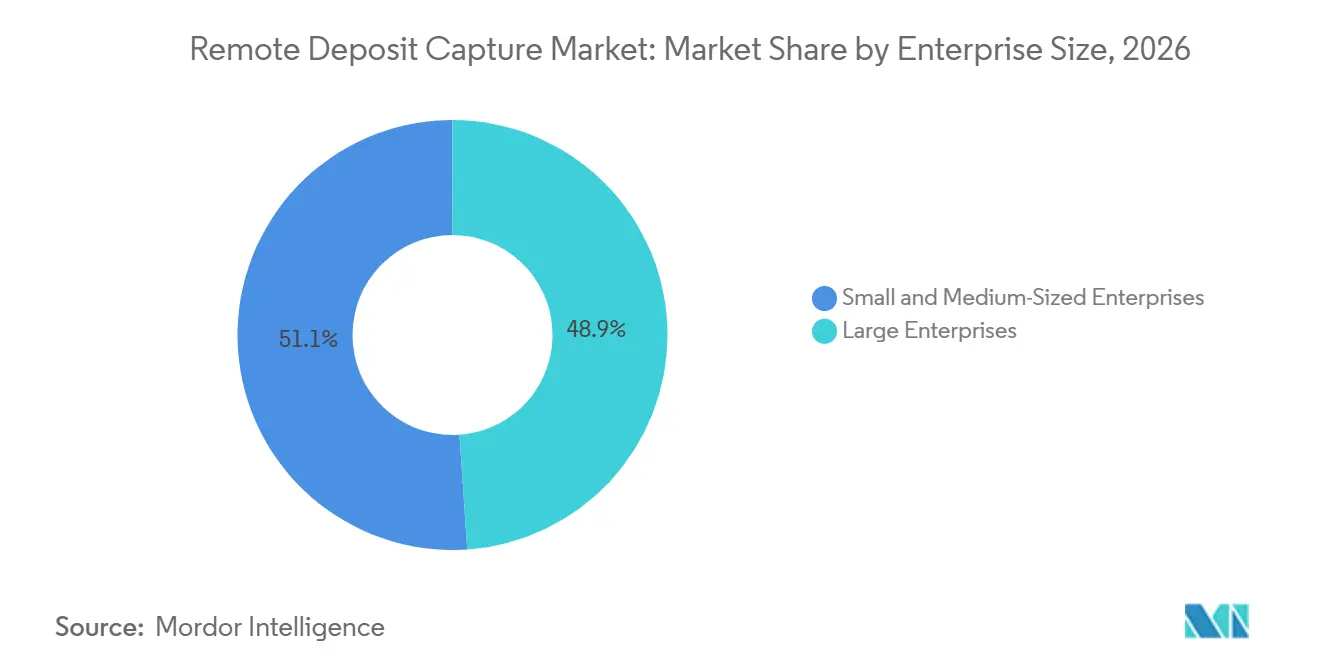
Small and medium-sized enterprises held 51.1% of the remote deposit capture market size in 2026 because many rely on mobile and desktop deposit access as a standard business banking feature. These firms often have limited staff and cannot allocate time to repeated branch trips or manual deposit preparation. A convenient capture process can help them deposit customer checks closer to the time of receipt. Community banks and credit unions use these functions to meet basic commercial banking expectations and to retain accounts that need practical cash-flow tools. For many smaller firms, the most important features are a simple interface, visible deposit status, and clear support when an image or endorsement is rejected. The segment’s scale shows that remote capture remains a working tool for ordinary business banking, not only an advanced treasury product.
Large enterprises are projected to expand at a 7.26% CAGR through 2032 as they centralize treasury activity across multiple locations and banking relationships. Their requirement extends beyond image capture because they want to check information to move into enterprise resource planning and receivables processes. Truist launched an AI-enabled receivables platform in February 2026 for commercial and corporate clients to match payments across check and electronic rails and accelerate cash application. This supports a shift in the buying decision from the bank’s treasury service staff toward corporate finance leaders who assess working-capital outcomes. Vendors serving this segment need to show how capture can support reconciliation, exception management, and cash application. Longer contract periods and larger technology budgets make large businesses an important area for solution providers despite their lower current share.
By Capture Channel: Mobile Capture Holds Current and Forecast Leadership
Mobile remote deposit capture held 43.8% of the market in 2026 and is projected to expand at an 8.77% CAGR through 2032. Holding the largest share and the fastest expansion rate indicates that mobile use is still moving into new business banking settings rather than only adding transactions from existing consumer users. Mobile capture gives businesses a direct route to submit checks without a desktop scanner or visit to an ATM or branch. It is useful for field-based employees, dispersed locations, and smaller businesses that receive a modest but regular volume of checks. The channel’s success depends on immediate feedback about image quality and on clear rules for endorsements, limits, and funds availability. For the remote deposit capture market, mobile capability is becoming a central part of the service rather than an optional add-on.
Desktop and branch remote deposit capture remain relevant for merchants and enterprises that process higher volumes of checks via scanners. These users need reliable reading of magnetic ink character recognition data and workflows designed for large-item batches. ATM and interactive teller machine capture add a separate path for customers who want extended deposit access but prefer not to use a mobile device for a high-value check. The strongest platforms increasingly coordinate mobile, desktop, ATM, and back-office images through one archive and a unified fraud model. Alogent received Federal Reserve authorization in April 2026 to directly exchange X9 check image files for client financial institutions, removing intermediary processors from that exchange path. This type of direct connection reinforces the value of a coordinated platform when institutions use several capture channels.
By Application: Commercial Deposits Lead While Treasury Automation Broadens Value
Commercial and corporate deposits held 39.9% of the remote deposit capture market in 2026, reflecting the concentration of check-based receipts among mid-market and large corporate banking customers. These organizations often collect higher-value payments across many customer locations and need a dependable way to move items into bank and accounting systems. Consumer and small-business uses remain important, but they typically place more weight on the experience of the mobile interface and on rapid resolution of deposit exceptions. Corporate users more often require controls, user permissions, reporting, and integration with internal receivables records. The application segment demonstrates why paper checks retain value for some commercial flows even as electronic payment adoption increases. It also keeps banks focused on building tools that work for both simple deposits and controlled enterprise workflows.
Treasury and accounts receivable automation is projected to expand at an 8.49% CAGR through 2032 as finance teams seek to reduce manual matching of checks to invoices. Users want deposited images and remittance data to enter their receivables processes without staff re-keying details from a separate screen. Monk introduced Cash Application 2.0 in July 2026 with lockbox and check upload capabilities designed to recover remittance information that may be lost in bank data feeds. This use case changes the value proposition from depositing a check to completing a finance process. Providers that connect image capture with invoice matching can address buyers in treasury and finance, not only retail or commercial banking teams. The Remote deposit capture industry is therefore moving closer to the accounts-receivable automation category while preserving its core role in deposit processing.

Geography Analysis
North America accounted for 36.4% of the regional remote deposit capture share in 2026, supported by the United States’ established commercial check ecosystem and long-running image-clearing framework. Check 21 and Regulation CC have supported image-based clearing for more than 2 decades, providing the rules and infrastructure that made remote capture practical for financial institutions. The Federal Reserve Bank of Cleveland reported that 87% of U.S. businesses used checks for at least some business-to-business transactions in 2025, with checks representing 24-27% of business-to-business payment volumes on average. That continuing business use supports investment in capture even as total volumes fall. Canada represents a smaller opportunity because of lower historical check use, while Mexico can benefit as small-business digital banking use expands. The Federal Reserve’s 2025 request for comment on the future of its check services also shows that vendors need to prepare for a changing settlement landscape.
Asia-Pacific is projected to expand at a 6.91% CAGR through 2032, making it the fastest-growing regional area in the remote deposit capture market. Demand comes from varied local circumstances rather than a single regional payment pattern. In India, retail payment modernization is well established, but mid-market businesses outside major urban centers can still have paper receivables that benefit from mobile image capture. Japan retains enterprise check activity connected with domestic intercompany payment practices that have not fully shifted to electronic alternatives. In China, corporate treasury digitization and a large mobile internet user base support cloud-native capture capability within banking-as-a-service arrangements. These different use cases require providers to adapt their product design and partner approach to local banking infrastructure.
Europe is more limited because electronic payment rails are widely used, leaving remote capture concentrated in selected corporate and cross-border receivables uses. The United Kingdom has niche demand within treasury management settings shaped by open banking requirements. South America is still developing, with Brazil offering the clearest business opportunity despite the effect of the Pix instant payment system on consumer and small-business check use. High-value commercial check flows in major Brazilian business centers can still justify enterprise capture and reconciliation tools. In the Middle East, the United Arab Emirates and Saudi Arabia are adopting cloud-based banking services within banking-as-a-service environments that can include capture capability. Africa presents a longer-term opportunity as smartphone use and formal banking enrollment widen, particularly where mobile-money systems shape the route into digital financial services.
Competitive Landscape
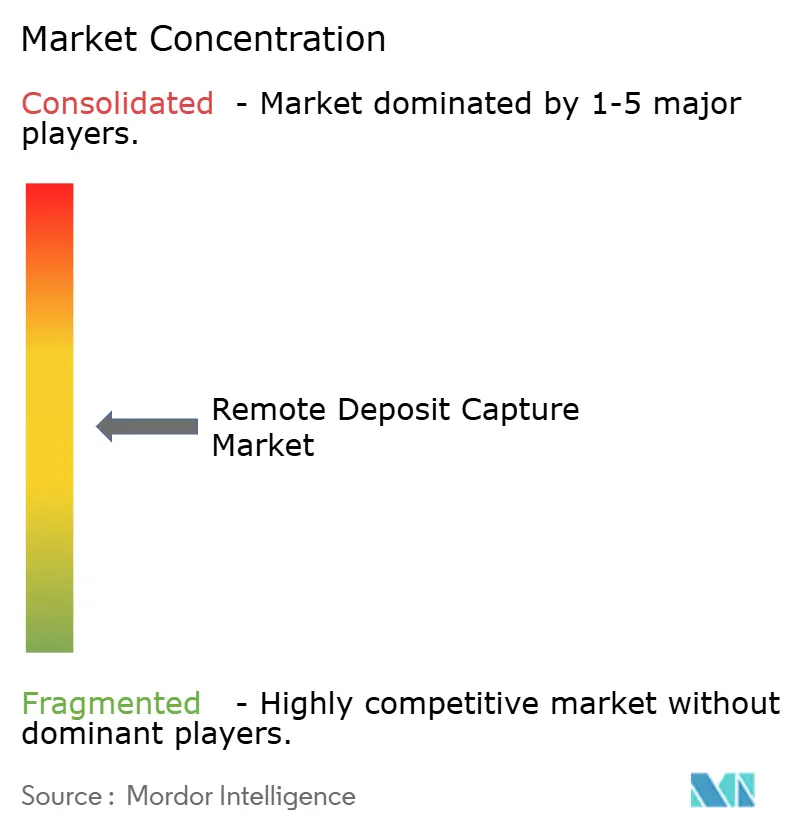
The remote deposit capture market is moderately concentrated, with integrated banking technology providers holding important positions alongside focused providers that specialize in capture, image processing, or fraud controls. No participant share data is provided for the leading vendors, so the competition is best understood through capability and product positioning rather than a published ranking. Providers compete on how well they connect capture services to core banking systems, how many channels they support, and how quickly they can identify fraud or duplicate presentment. The market is moving beyond feature comparison because a standard mobile deposit function alone offers limited differentiation. Direct image exchange capability, shared fraud intelligence, and established connections to core systems can shorten implementation and strengthen a supplier’s position with community banks and credit unions. This competitive pattern favors companies that can combine dependable processing with manageable integration work.
FIS demonstrated an ecosystem approach in September 2026 when it launched an Embedded Banking Platform that allows banks to provide account and payment capabilities within corporate business software. The move supports a model where deposit capability can be placed within a company’s existing operating workflow rather than accessed only through a separate banking application. Alogent followed a platform consolidation path when Centris Federal Credit Union selected its Unify SaaS platform in June 2026 to bring teller, ATM, mobile, and back-office deposit processing into a single cloud-native environment. Alogent’s April 2026 authorization to exchange X9 check image files directly with the Federal Reserve provides another example of infrastructure investment that can simplify the operating chain. These actions show that vendors are trying to become broader deposit infrastructure partners instead of remaining single-function capture suppliers.
A meaningful opportunity remains in the mid-market treasury segment, where businesses need check-to-enterprise-resource-planning reconciliation but may not have access to large-bank treasury resources. Banking-as-a-service is also a relevant channel because it can bring capture functionality into platforms used by business customers. FIS identifies remote deposit capture as part of the banking capability that can be delivered through its banking-as-a-service offering. Newer providers can enter with application-programming-interface-based services for image capture, magnetic ink character recognition extraction, image-quality checks, and fraud scoring. Patent activity described in the supplied research indicates interest in zero-shot field detection and multimodal language-model analysis for checks, which could reduce the amount of labeled data and manual exception rules required. Panini remains relevant on the equipment side because its check scanners and deposit automation hardware support desktop and branch capture environments. The remote deposit capture market is likely to reward providers that can pair specialized capabilities with clear implementation and control standards.
Remote Deposit Capture Industry Leaders
-
Fiserv, Inc.
-
Fidelity National Information Services, Inc.
-
Jack Henry & Associates, Inc.
-
Mitek Systems, Inc.
-
NCR Voyix Corporation
- *Disclaimer: Major Players sorted in no particular order
Recent Industry Developments
- September 2026: FIS launched its Embedded Banking Platform, enabling U.S. banks to offer accounts and payment capabilities, including deposit services, directly within corporate customers’ business software. Pilot banks include Cogent Bank, Commercial Bank of California, and M and T Bank, with full capabilities planned for Q4 2026. The move repositions FIS as an embedded-finance infrastructure layer targeting treasury and accounts-receivable workflows that rely on integrated check capture.
- July 2026: Monk launched Cash Application 2.0 with lockbox and check upload capabilities, using AI extraction to recover remittance detail stripped by bank data feeds and lift auto-match rates for mid-market commercial clients.
- June 2026: Alogent announced that Centris Federal Credit Union, a USD 1.5 billion institution in Omaha, Nebraska, selected its Unify SaaS platform to consolidate all deposit capture and processing operations, teller, ATM, mobile deposit, and back-office workflows, onto a single cloud-native platform, migrating away from a multi-vendor, multi-system deposit architecture.
- April 2026: Alogent received Federal Reserve authorization to directly send and receive X9 check image exchange files on behalf of financial institution clients, eliminating intermediary processors. The authorization positions Alogent among a limited group of technology providers trusted to exchange check images directly with the Federal Reserve, with a foundation for potential direct connectivity to FedNow, Fedwire, and FedACH.
Global Remote Deposit Capture Market Report Scope
The Remote Deposit Capture (RDC) Market refers to the market for digital banking solutions that enable individuals, businesses, and financial institutions to deposit checks electronically by capturing images of checks and transmitting them to a bank for processing, without physically submitting the original checks at a bank branch or ATM. The market includes RDC software, check imaging devices, mobile banking applications, scanners, and associated services that facilitate image capture, data extraction, check verification, fraud detection, and electronic deposit processing. RDC solutions are deployed through mobile devices, desktop scanners, and dedicated check-scanning systems to improve deposit convenience, reduce processing costs, and accelerate fund availability for retail customers, small and medium-sized enterprises, and large corporations.
The Remote Deposit Capture Market Report is Segmented by Component (Solution, Service), Deployment (On-Premises, Cloud-Based), Enterprise Size (Small and Medium-Sized Enterprises, Large Enterprises), Capture Channel (Mobile Remote Deposit Capture, Desktop and Branch Remote Deposit Capture, ATM and Interactive Teller Machine Remote Deposit Capture), Application (Consumer Deposits, Small-Business Deposits, Commercial and Corporate Deposits, Treasury and Accounts-Receivable Automation), and Geography (North America, South America, Europe, Asia-Pacific, Middle East, Africa). The Market Forecasts are Provided in Terms of Value (USD).
| Solution |
| Service |
| On-Premises |
| Cloud-Based |
| Small and Medium-Sized Enterprises |
| Large Enterprises |
| Mobile RDC |
| Desktop and Branch RDC |
| ATM and Interactive Teller Machine RDC |
| Consumer Deposits |
| Small-Business Deposits |
| Commercial and Corporate Deposits |
| Treasury and Accounts-Receivable Automation |
| North America | United States |
| Canada | |
| Mexico | |
| South America | Brazil |
| Rest of South America | |
| Europe | United Kingdom |
| Germany | |
| France | |
| Italy | |
| Rest of Europe | |
| Asia-Pacific | China |
| Japan | |
| India | |
| South Korea | |
| Rest of Asia-Pacific | |
| Middle East | United Arab Emirates |
| Saudi Arabia | |
| Israel | |
| Rest of Middle East | |
| Africa | South Africa |
| Egypt | |
| Rest of Africa |
| By Component | Solution | |
| Service | ||
| By Deployment | On-Premises | |
| Cloud-Based | ||
| By Enterprise Size | Small and Medium-Sized Enterprises | |
| Large Enterprises | ||
| By Capture Channel | Mobile RDC | |
| Desktop and Branch RDC | ||
| ATM and Interactive Teller Machine RDC | ||
| By Application | Consumer Deposits | |
| Small-Business Deposits | ||
| Commercial and Corporate Deposits | ||
| Treasury and Accounts-Receivable Automation | ||
| By Geography | North America | United States |
| Canada | ||
| Mexico | ||
| South America | Brazil | |
| Rest of South America | ||
| Europe | United Kingdom | |
| Germany | ||
| France | ||
| Italy | ||
| Rest of Europe | ||
| Asia-Pacific | China | |
| Japan | ||
| India | ||
| South Korea | ||
| Rest of Asia-Pacific | ||
| Middle East | United Arab Emirates | |
| Saudi Arabia | ||
| Israel | ||
| Rest of Middle East | ||
| Africa | South Africa | |
| Egypt | ||
| Rest of Africa | ||
Key Questions Answered in the Report
What is the size of the remote deposit capture market?
The remote deposit capture market size is projected to expand from USD 376.40 million in 2026 and USD 397.70 million in 2027 to USD 528.40 million by 2032, at a 5.82% CAGR. The Remote deposit capture market remains relevant where commercial checks need controlled and timely processing.
What is driving demand for remote deposit capture?
Mobile banking use, faster access to deposited funds, distributed business operations, and demand for fraud controls support adoption. The Remote deposit capture market also benefits when banks link deposit tools with receivables workflows.
Which deployment model is expanding fastest?
Cloud-based deployment is projected to expand at an 8.09% CAGR through 2032 as institutions seek easier updates and application-programming-interface access. In the Remote deposit capture market, cloud delivery can simplify broad software and compliance updates.
Which users account for the largest share of demand?
Small and medium-sized enterprises held 51.1% of demand in 2026, supported by the need to deposit checks without regular branch visits. The Remote deposit capture market serves these users with mobile and desktop options that reduce routine handling work.
Which capture channel is used most widely?
Mobile remote deposit capture held 43.8% in 2026 and is projected to expand at an 8.77% CAGR through 2032. The Remote deposit capture market uses mobile capability to serve dispersed business locations and field staff.
Why are fraud controls important for remote deposits?
Institutions need real-time image review and cross-channel matching to address duplicate presentment, image-quality problems, and potential check fraud. These controls help providers support convenient deposit options while protecting customers and financial institutions.