
Regenerated Cellulose Market Size and Share
Market Overview
| Study Period | 2022 - 2032 |
|---|---|
| Market Size (2027) | USD 18.21 Billion |
| Market Size (2032) | USD 26.91 Billion |
| Growth Rate (2027 - 2032) | 8.12 % |
| Fastest Growing Market | Asia-Pacific |
| Largest Market | Asia-Pacific |
| Market Concentration | Low |
Major Players *Disclaimer: Major Players sorted in no particular order Image © Mordor Intelligence. Reuse requires attribution under CC BY 4.0. | |
Regenerated Cellulose Market Analysis by Mordor Intelligence
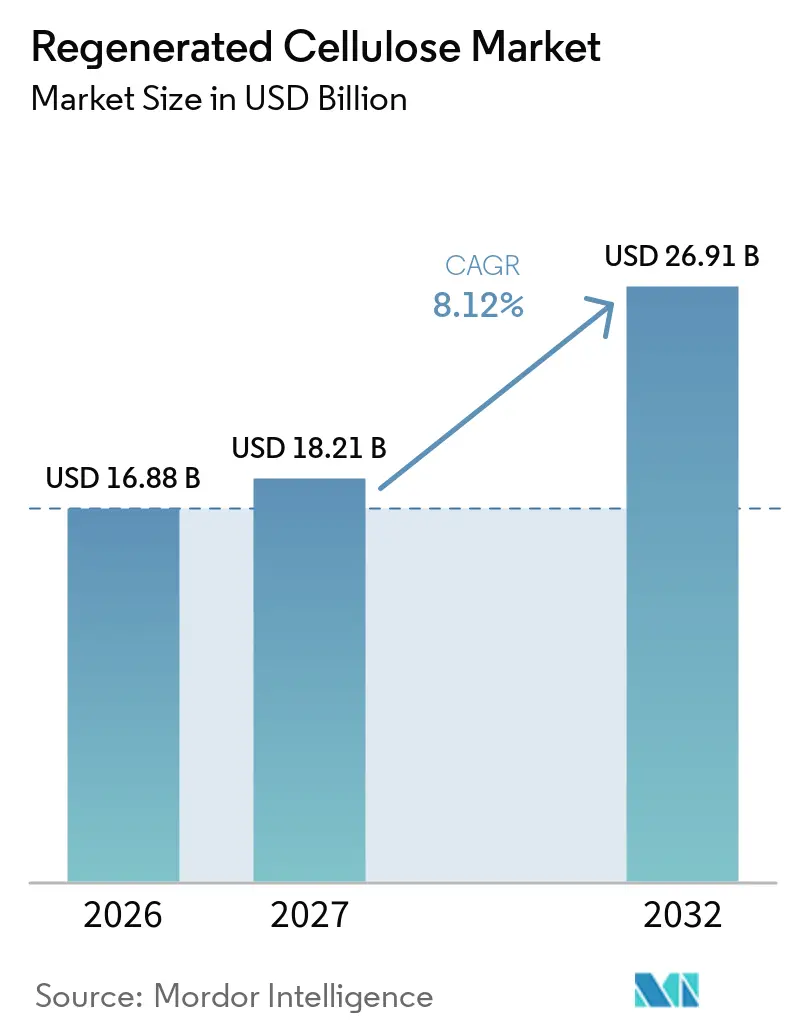
The Regenerated Cellulose Market size was valued at USD 16.88 billion in 2026 and is estimated to grow from USD 18.21 billion in 2027 to reach USD 26.91 billion by 2032, at a CAGR of 8.12% during the forecast period (2027-2032). The regenerated cellulose market is being supported by textile buyers that are moving away from petroleum-based materials and seeking fibers with biodegradable properties. Demand is also widening in hygiene and medical nonwovens, especially in Asia, where higher use of wipes, feminine hygiene products, and baby care products supports cellulose-based absorbent materials. Closed-loop lyocell production is moving beyond a premium textile niche as producers add capacity and reduce the gap between specialty and mainstream applications. Regulatory requirements for traceability, recycled content, and deforestation-free sourcing are increasing the value of verified pulp supply chains in the regenerated cellulose market. These forces favor producers that can combine scale, reliable pulp access, and documented environmental performance, while exposing non-integrated producers to greater cost and compliance pressure.
Key Report Takeaways
- By product type, viscose held 58.21% of the regenerated cellulose market share in 2026, while lyocell is forecast to advance at an 8.57% CAGR through 2032.
- By fiber form, staple fiber held 64.34% of the regenerated cellulose market share in 2026, while filament fiber is forecast to advance at an 8.79% CAGR through 2032.
- By source, wood pulp held 73.67% of the regenerated cellulose market share in 2026, while cotton linters are forecast to advance at an 8.91% CAGR through 2032.
- By application, apparel held 66.06% of the regenerated cellulose market share in 2026, while medical and hygiene products are forecast to advance at a 9.15% CAGR through 2032.
- By geography, Asia-Pacific held 40.72% of the regenerated cellulose market share in 2026 and is forecast to advance at a 9.08% CAGR through 2032.
Note: Market numbers in this report are based on Mordor Intelligence's proprietary estimation framework, which combines nine months of actuals with Q4 projections for base year 2026.
Market Trends and Insights
Drivers Impact Analysis of Regenerated Cellulose Market*
| Driver | (~) % Impact on CAGR Forecast | Geographic Relevance | Impact Timeline |
|---|---|---|---|
| Sustainability-Led Substitution for Petroleum-Based Fibers | +2.8% | Global, led by EU, North America, and East Asia | Medium term (2-4 years) |
| Expansion of Sustainable Apparel and Home Textiles | +2.3% | Global with APAC core, spillover to MEA | Medium term (2-4 years) |
| Growth in Hygiene and Medical Nonwovens | +1.7% | APAC core, North America & EU | Short term (≤ 2 years) |
| Regulatory Pressure for Recycled and Traceable Textile Inputs | +1.3% | EU, North America, with supply chain pull into China, India | Long term (≥ 4 years) |
| Textile-to-Textile Dissolving Pulp Scale-Up | +0.9% | China, EU, with selective global adoption | Long term (≥ 4 years) |
| Source: Mordor Intelligence | |||
Sustainability-Led Substitution for Petroleum-Based Fibers
Concern over plastic shedding and end-of-life impacts is increasing attention to alternatives to petroleum-based fibers. Regenerated cellulose fibers can biodegrade under standard composting conditions, giving brands a material option that is not available from conventional synthetic fibers. H&M and Patagonia have included preferred material expectations in their sourcing approaches, which supports demand for fibers with recognized environmental attributes. The shift is not uniform across price tiers because premium apparel is adopting lyocell and modal, while price-sensitive manufacturers in Bangladesh, Vietnam, and Indonesia continue to rely on competitively priced viscose staple fiber. This split supports different product strategies within the regenerated cellulose market rather than a single pattern of demand. Sateri reported that global lyocell capacity exceeded 1.3 million metric tons in 2025, indicating that lyocell is gaining the production base needed to enter a broader range of apparel categories.
Expansion of Sustainable Apparel and Home Textiles
Cellulosic fiber demand in apparel is becoming part of purchasing specifications and product certification requirements, rather than depending only on public sustainability pledges. Grasim Industries Limited reported INR 15,987 crore in cellulosic fiber revenue for FY2025, equivalent to approximately USD 1.91 billion, and stated that revenue increased 6% year over year through higher volumes. The result shows continued customer demand even when pricing conditions are difficult for producers. Home textile applications are also widening as Eastman Chemical Company introduced Naia Renew for comforter and quilt filling at Heimtextil in January 2025. Filling applications create a route for lyocell beyond flat fabrics, where down and polyester have traditionally been common choices. Sateri’s reported 400,000 metric tons of lyocell output in 2025 suggests that scale can support broader access to mass-market home textile applications.
Regulatory Pressure for Recycled and Traceable Textile Inputs
Directive (EU) 2025/1892 introduced harmonized extended producer responsibility rules for textiles across European Union member states. The rules require producers to finance the collection, sorting, and recycling of post-consumer textile waste, strengthening demand for traceable fiber inputs[1]. Regulation (EU) 2024/1781 provides the wider Ecodesign for Sustainable Products framework, including the basis for product requirements that can favor recycled content and better material information. European brands face direct responsibility, but Asian fiber producers will need reliable certified recycled dissolving pulp if they want to supply compliant materials. Tangshan Sanyou Xingda Chemical Fiber CO.,Ltd and Circ announced a five-year supply partnership in July 2025 to make lyocell staple fibers containing 30% recycled content. In the United States, the Textile Fiber Products Identification Act requires accurate generic fiber labeling, which reinforces the need for auditable fiber claims.
Textile-to-Textile Dissolving Pulp Scale-Up
A 1,000-metric-ton ionic liquid-based regenerated cellulose fiber plant began operating in Henan Province in July 2025. The plant was developed by the Chinese Academy of Sciences’ Institute of Process Engineering and marked a commercial step for a process intended to reduce solvent-related emissions[2]. The process reportedly recovers more than 99% of its solvent and reduces carbon dioxide emissions by 5,000 metric tons each year compared with fossil-fiber benchmarks. Yibin Grace Group Co., Ltd. commissioned a recycled dissolving pulp facility in Sichuan in April 2025 with an initial capacity of 1,500 metric tons per year. The company plans to raise capacity to 60,000 metric tons by 2027, using post-industrial and post-consumer textile waste. These projects indicate that next-generation feedstocks are progressing from small trials toward capacity that can influence sourcing choices in the regenerated cellulose market.
Restraints Impact Analysis of Regenerated Cellulose Market*
| Restraint | (~) % Impact on CAGR Forecast | Geographic Relevance | Impact Timeline |
|---|---|---|---|
| High Production Costs Versus Cotton and Polyester | -2.0% | Global, most acute in South Asia and ASEAN | Short term (≤ 2 years) |
| Dissolving Pulp and Energy Price Volatility | -1.4% | Global, most pronounced in Europe and non-integrated Asian producers | Medium term (2-4 years) |
| Insufficient Collection Infrastructure for Textile Waste and Agricultural Residues | -0.8% | Emerging markets across South Asia, MEA | Long term (≥ 4 years) |
| Source: Mordor Intelligence | |||
High Production Costs Versus Cotton and Polyester
Regenerated cellulose production, especially viscose, needs caustic soda, carbon disulfide, water treatment, and specialized processing equipment. These requirements create a cost burden that does not apply in the same way to polyester production. Viscose staple fiber production cost can run 30%-50% above polyester staple fiber in a similar denier range, while cotton can become more competitive during strong harvest periods. Grasim Industries Limited stated that high raw material prices contributed to a 12% year-over-year decline in FY2025 cellulosic fiber business profitability despite growth. European producers also face higher energy and environmental compliance costs, as shown by Kelheim Fibres GmbH entering self-administered insolvency proceedings in October 2024. Extended producer responsibility rules may narrow the lifecycle cost gap with plastics, but regulatory change will not remove short-term price pressure on fiber producers.
Dissolving Pulp and Energy Price Volatility
Dissolving wood pulp accounts for 50%-55% of viscose production cost, making margins sensitive to changes in pulp pricing. Pulp supply is concentrated in a limited group of producer regions, while softwood dissolving pulp availability can remain constrained over the medium term. Supply disruptions in South America or Southeast Asia can pass through quickly to fiber manufacturing economics because a limited group of locations supplies major volumes. European specialty producers face an additional challenge from volatile energy costs in regulated carbon markets, which can limit their ability to compete on standard-grade products.
*Our forecasts treat driver/restraint impacts as directional, not additive. The impact forecasts reflect baseline growth, mix effects, and variable interactions.
Regenerated Cellulose Market Segment Analysis
By Product Type:
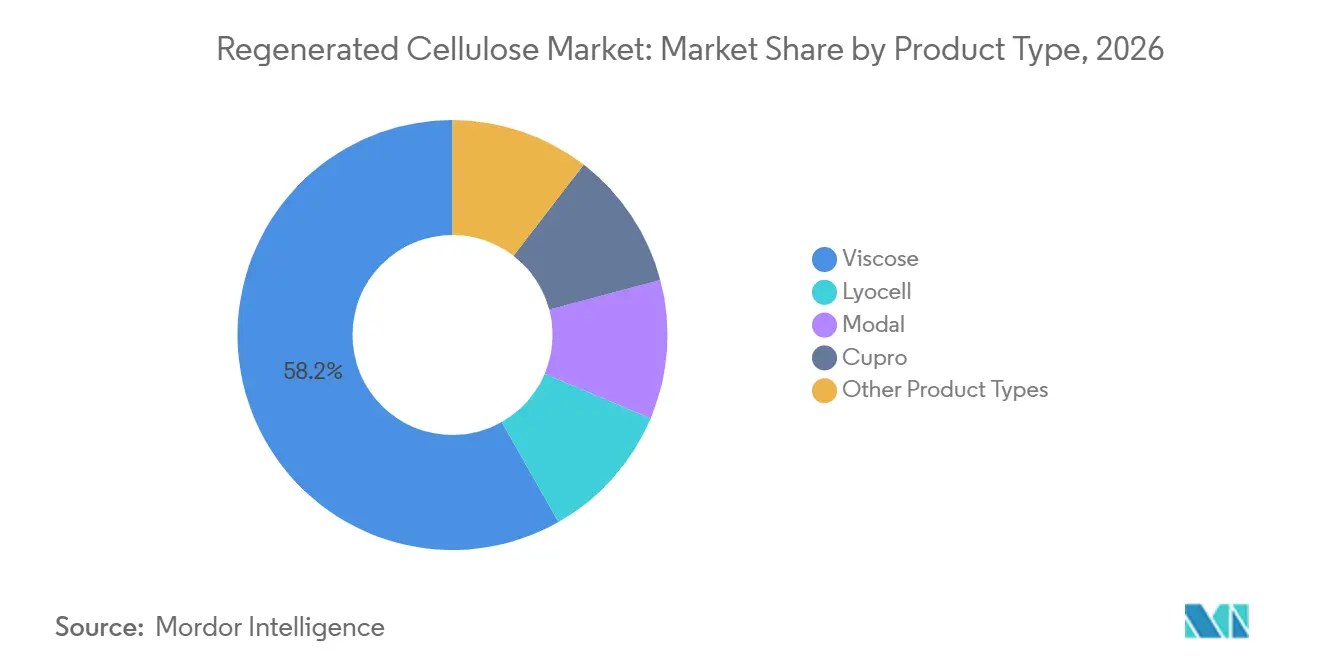
Lyocell Advances Against Viscose’s Revenue BaseViscose held 58.21% of the regenerated cellulose market share in 2026, reflecting the large installed production base in China and India. Spinning mills in Bangladesh, Vietnam, and Association of Southeast Asian Nations (ASEAN) countries continue to use viscose because it is versatile across a wide range of fiber deniers. Its established supply chain means rapid replacement is unlikely in the near term. However, brands are monitoring carbon disulfide emissions from conventional viscose production more closely. This places greater emphasis on verified operating practices and pulp traceability. Lyocell is projected to advance at an 8.57% CAGR through 2032 as capacity expands and applications move beyond premium apparel. Sateri reported that it reached 600,000 metric tons of lyocell capacity across 4 sites in China by mid-2026. Its September 2025 launch of The Lyocell Company showed its effort to position the material for a broader commercial audience.
Lyocell is being used in denim, filling materials, woven apparel, and technical nonwovens. Its closed-loop production profile makes it relevant where brands want stronger environmental documentation without giving up fiber performance. Modal remains important in intimate apparel because its softness and durability can support a premium product position. Cupro serves luxury linings and fashion fabrics where drape and breathability are valued. Asahi Kasei Corporation produces Bemberg cupro from cotton linters through a closed-loop copper ammonium process, which shows the continued role of specialty cellulosic fibers. Lenzing AG introduced TENCEL Lyocell HV100 in 2025 using Variocut technology for varied fiber lengths intended to resemble cotton textures. The regenerated cellulose industry therefore includes both high-volume viscose supply and specialty materials that compete on performance, sourcing, and certification.

By Fiber Form:
Staple Fiber’s Scale Meets Filament Fiber’s MomentumStaple fiber held 64.34% of the regenerated cellulose market in 2026 and remains the main form used by global yarn-spinning systems. The format fits established apparel supply chains and supports uses in woven fabrics, knitwear, nonwovens, and blended yarns. Its broad compatibility keeps staple fiber central to demand. Filament fiber is projected to advance at an 8.79% CAGR through 2032. Growth is being supported by luxury apparel requirements for alternatives to silk and nylon in lightweight fabrics. Fine-denier lyocell filament development also broadens the scope of regenerated cellulose in premium fabrics. Eastman Chemical Company and Huafon Chemical announced a joint venture in August 2025 to produce Naia cellulose acetate filament yarn in China. The partners introduced high-tenacity yarn samples at Intertextile Shanghai 2025 for use by Chinese textile mills.
Filament production requires specialized capability, which gives established producers opportunities in apparel categories with higher performance expectations. Xinxiang Chemical Fiber Co., Ltd. has a 30,000-metric-ton biomass cellulose filament line under construction, supporting the development of locally produced material for this form. The project reflects growing interest in cellulose filament for both fashion and technical textile uses. Nonwoven fiber is also gaining importance as consumer brands seek biodegradable materials for wipes, hygiene pads, and geotextiles. These products can use staple-based materials while serving different demand conditions from apparel. Yarn and other forms supply smaller specialty applications, including industrial and composite uses. Their contribution to demand is lower, but technical performance requirements can support higher realized value. The regenerated cellulose market therefore has a stable staple fiber base alongside faster-moving filament and specialty formats.
By Source:
Wood Pulp Anchors Supply, Cotton Linters Gain MomentumWood pulp held 73.67% of the regenerated cellulose market in 2026 because plantation-based dissolving pulp infrastructure has been developed over several decades. Most large-scale viscose and lyocell production processes were built around wood-derived cellulose. This feedstock has a broad supplier base, but it also links fiber producers to forestry certification and deforestation-related compliance. Georgia-Pacific announced a USD 800 million modernization and expansion project for its Alabama River Cellulose mill, which is expected to add 100,000 metric tons of softwood pulp capacity. Its scale highlights continued investment in wood pulp as the core source for cellulosic derivatives. Wood-based supply will remain important, but customers increasingly evaluate how it is traced, certified, and processed.
Bamboo pulp is emerging as a non-wood alternative for producers that can secure certified supply. Jilin Chemical Fiber Co., Ltd. began commercial production of REBOOCEL in May 2025 at 30,000 metric tons per year, using 70% Forest Stewardship Council-certified bamboo and 30% recycled bamboo. Agricultural-residue pulp remains at an early commercial stage, although policy interest is increasing in China. Cotton linters are projected to advance at an 8.91% CAGR through 2032. Their use supports cupro, pharmaceutical-grade microcrystalline cellulose, and chemical applications requiring high-alpha cellulose purity. The Federal Trade Commission’s fiber labeling rules also encourage clear content disclosure for textile products sold in the United States. Source diversification can reduce dependence on a single raw material, but each alternative must meet reliable quality and traceability standards.
By Application:
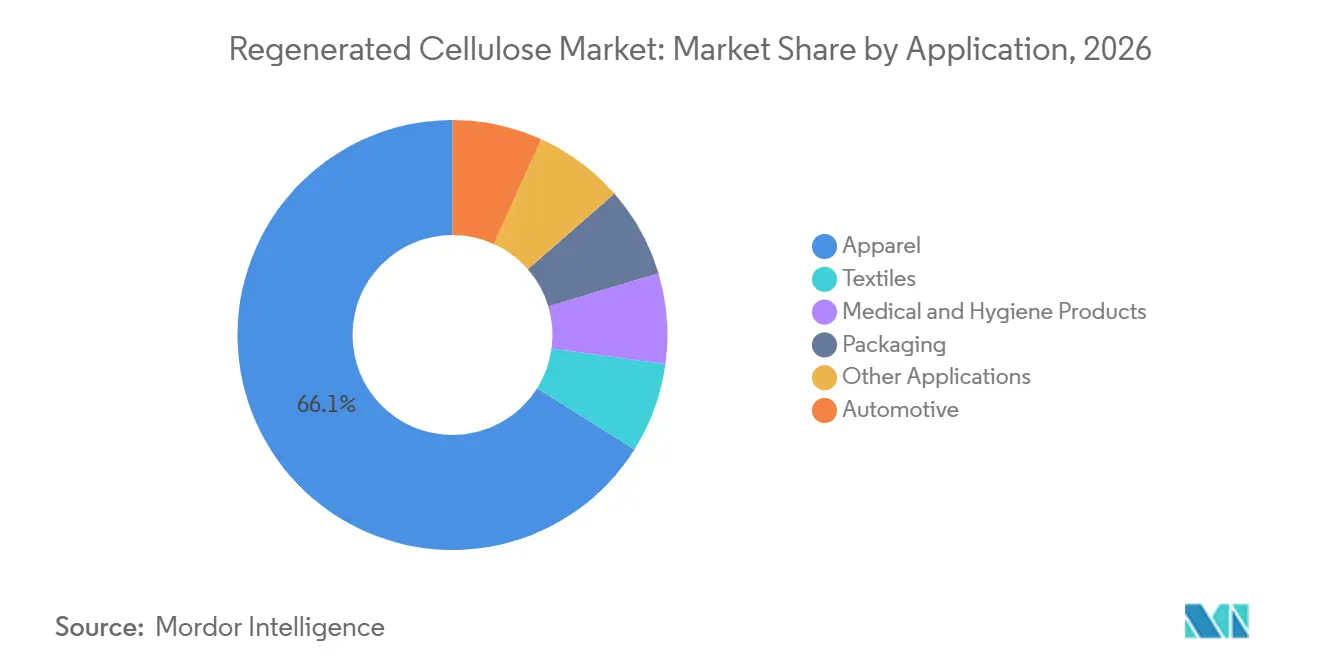
Apparel Anchors Revenue, Medical and Hygiene Products Propel GrowthApparel held 66.06% of the regenerated cellulose market in 2026 and remains the main outlet for viscose, lyocell, modal, and cupro. The segment benefits from the breathability, moisture handling, and feel associated with cellulosic fibers. Brands can use these properties in fashion products where comfort is a purchasing consideration. Apparel demand also supports large spinning and weaving systems across Asia. Medical and hygiene products are projected to advance at a 9.15% CAGR through 2032. Premium dry and wet wipe demand in China is supporting spunlace nonwoven consumption. Consumers increasingly associate biodegradable materials with hygiene-oriented product positioning. This gives fiber suppliers an avenue to grow through applications that are less dependent on apparel cycles.
Aging populations in developed countries support demand for adult incontinence products with absorbent cellulose components. Growing use of feminine hygiene and baby care products in South and Southeast Asia provides another source of demand. Daicel Corporation introduced BELLOCEA BS7 in March 2025 as a biodegradable cellulose acetate spherical particle for cosmetics designed to replace synthetic microbeads. The product shows how regulatory limits on plastic particles can create demand outside conventional textiles. Home textiles, packaging, and automotive uses add further application diversity. Cellulose acetate films can be used as alternatives to polyethylene terephthalate in selected packaging applications. Automotive nonwovens can be used in headliners and seat-lining materials. These use cases provide incremental demand while apparel and hygiene remain the main application areas for the regenerated cellulose market.
Geography Analysis
Asia-Pacific
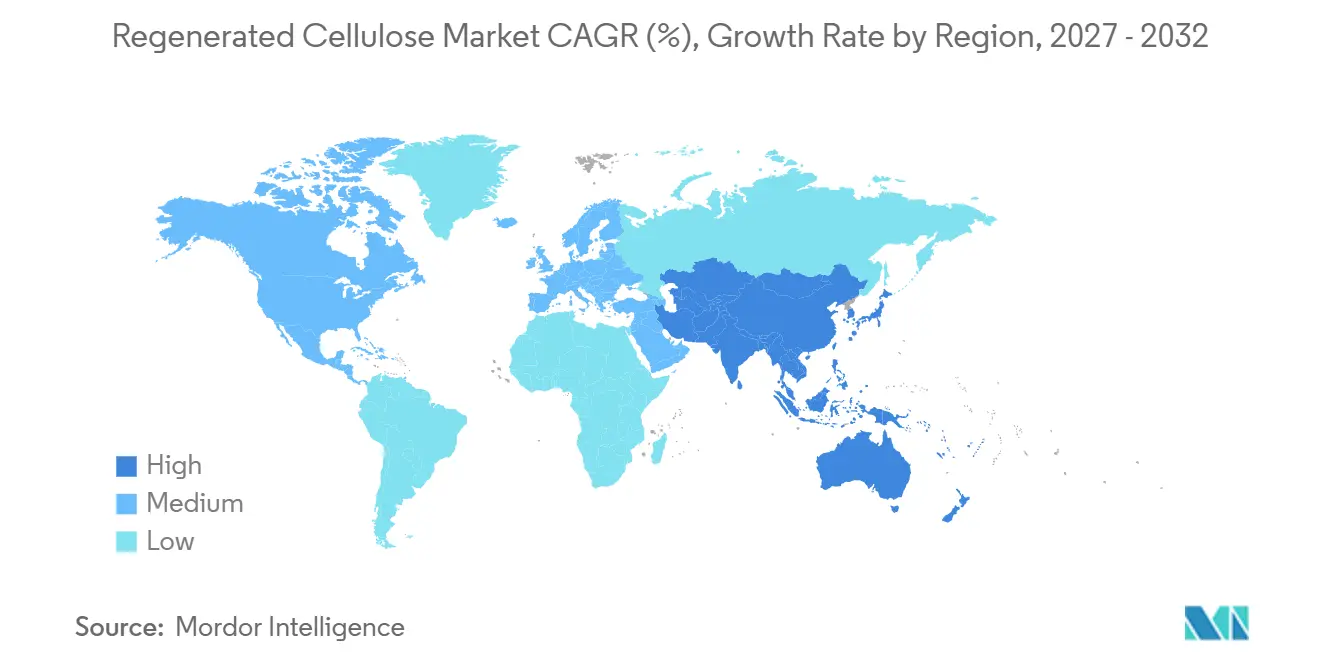
Asia-Pacific held 40.72% of the regenerated cellulose market in 2026 and is projected to advance at a 9.08% CAGR through 2032. China has a large viscose staple fiber production base, and Sateri reported 600,000 metric tons of lyocell capacity across 4 sites by mid-2026. India is becoming an additional supply center because Grasim Industries Limited has 824,000 metric tons per year of viscose staple fiber capacity and expects to commission its 55,000-metric-ton first-phase lyocell project at Harihar by mid-2027. Japan retains a premium position through Asahi Kasei Corporation’s cupro operations and traceable cotton-linter sourcing, while South Korea’s premium apparel exports support higher-value lyocell demand. Production density, textile conversion capacity, and rising consumer interest in premium materials support the region’s leadership.
North America
North America is a downstream consumer and regulatory pace-setter, although it also has important upstream pulp assets. The Textile Fiber Products Identification Act requires accurate generic fiber naming for textile products sold in the United States, which gives an advantage to suppliers that can document fiber composition and origin. Georgia-Pacific’s USD 800 million Alabama River Cellulose investment is expected to add 100,000 metric tons of softwood dissolving pulp capacity through 2027. Eastman Chemical Company has extended its Naia portfolio into bedding fill, activewear, and denim, indicating continued work with brands and textile converters in higher-value categories. Mexico and Canada add textile finishing and consumption activity, while brand sourcing requirements and pulp investment shape the region’s role.
Europe and Other Regions
Europe is a center for regulatory influence and specialty demand. The European Union Deforestation Regulation requires large operators to demonstrate deforestation-free supply chains for relevant wood-derived products from December 30, 2026, raising the importance of Forest Stewardship Council and Programme for the Endorsement of Forest Certification documentation. Lenzing AG’s Austrian program, including a Viscostar expansion, supports a strategy focused on performance, traceability, and hygiene applications. South America is expanding its dissolving wood pulp supply role, while a planned Circ recycled-pulp plant in France and hygiene manufacturing in Gulf Cooperation Council countries may broaden circular and downstream demand.
Competitive Landscape
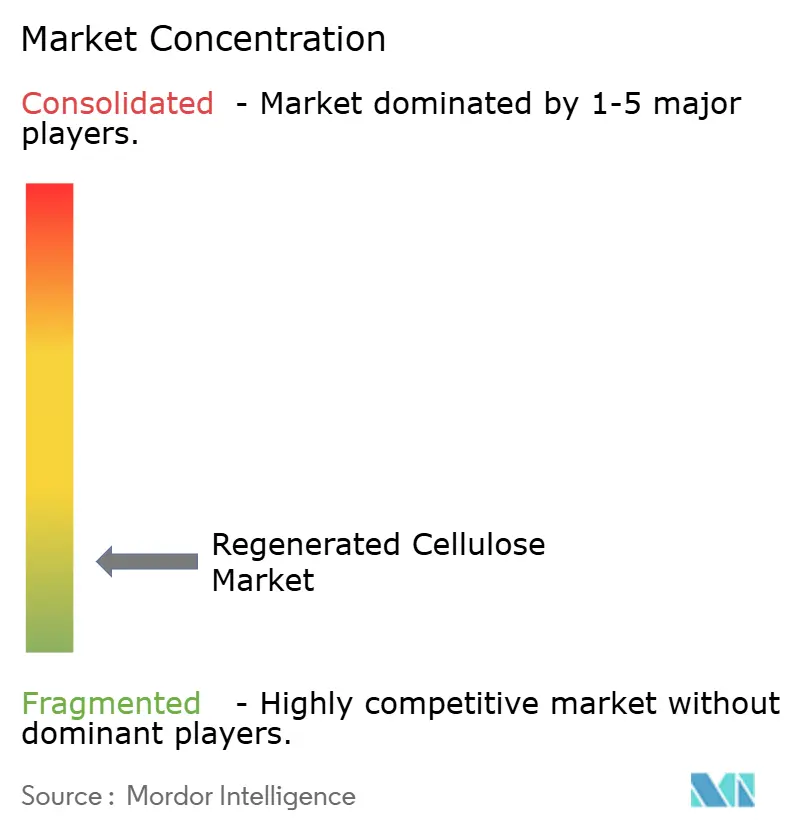
The regenerated cellulose market is highly fragmented, with the top five players including Sateri, Lenzing AG, Grasim Industries Limited, Tangshan Sanyou Xingda Chemical Fiber CO., Ltd., and Eastman Chemical Company. Chinese producers focus on scale and cost control in standard viscose and commodity lyocell, while European and Japanese suppliers target hygiene, luxury textiles, technical products, and applications requiring certification. These strategies reflect differences in feedstock access, technology, operating costs, and customer relationships. The competitive structure is divided between volume supply and higher-margin differentiation. Large suppliers have purchasing scale and broad customer reach, but competition remains active across products and regions.
Lenzing AG is strengthening its specialty nonwoven position through its Viscostar investment in Austria. Sateri expanded its lyocell position through Changzhou and Yutai projects and launched The Lyocell Company in September 2025. Eastman Chemical Company partnered with Huafon Chemical to establish local cellulose acetate filament yarn manufacturing in China. Kelheim Fibres GmbH was acquired by LEO III Fund after its insolvency proceedings, and the new owner plans investments in German production infrastructure and efficiency. These actions show investment in both proximity to textile manufacturing and specialty application development.
Textile-to-textile recycling, agricultural-residue pulp, and ionic liquid spinning remain areas where producers can establish differentiation. The Henan ionic liquid facility and Yibin Grace Group Co., Ltd.’s recycled dissolving pulp project show that Chinese suppliers are pursuing next-generation feedstocks as well as capacity growth. Directive (EU) 2025/1892 and the European Union Deforestation Regulation favor producers that can provide verified recycled content and traceable wood inputs. Eastman Chemical Company’s Naia Renew uses 60% sustainably sourced wood pulp and 40% Global Recycled Standard-certified recycled waste through mass balance accounting, while ISO 14001-aligned environmental practices can influence brand procurement.
Regenerated Cellulose Industry Leaders
-
Sateri
-
Lenzing AG
-
Grasim Industries Limited
-
Tangshan Sanyou Xingda Chemical Fiber CO.,Ltd
-
Eastman Chemical Company
- *Disclaimer: Major Players sorted in no particular order
Regenerated Cellulose Market Companies Covered in this Report
- Asahi Kasei Corporation
- Celanese Corporation
- Daicel Corporation
- Eastman Chemical Company
- GP Cellulose GmbH
- Grasim Industries Limited
- Jilin Chemical Fiber Co., Ltd.
- Kelheim Fibres GmbH
- Lenzing AG
- Sappi Limited
- Sateri
- Tangshan Sanyou Xingda Chemical Fiber CO.,Ltd
- Xinxiang Chemical Fiber Co., Ltd.
- Yibin Grace Group Co., Ltd.
- Zhejiang Fulida Fibre Co., Ltd.
Recent Industry Developments in Regenerated Cellulose Market
- June 2026: Grasim Industries Limited announced an investment of INR 3,094 crore (approximately USD 360.5 million) to establish an additional 110,000 metric tons per annum of lyocell fiber capacity at its Harihar facility in Karnataka, India. The expansion will comprise two production lines of 55,000 metric tons per annum each, with commissioning scheduled for 2028 and 2030, respectively, supporting the regenerated cellulose market through increased domestic production of sustainable cellulosic fibers.
- March 2026: Lenzing AG commenced production of nonwoven-grade lyocell fibers at its Prachinburi facility in Thailand under its VEOCEL brand, marking the first production of this fiber category in Asia. The development expands regional supply capabilities for biodegradable wood-based lyocell fibers used in hygiene and nonwoven applications, supporting the regenerated cellulose market through increased availability of specialty fibers.
Global Regenerated Cellulose Market Report Scope
Regenerated cellulose is a fiber material produced by dissolving natural cellulose from plant-based sources and converting it into fibers through chemical or physical processing. It combines the renewable origin of cellulose with properties such as softness, moisture absorption, and versatility across textile and industrial applications.
The Regenerated Cellulose Market is segmented by product type, fiber form, source, application, and geography. By product type, the market is segmented into viscose, lyocell, modal, cupro, and other product types. By fiber form, the market is segmented into staple fiber, filament fiber, yarn, nonwoven fiber, and other fiber forms. By source, the market is segmented into wood pulp, cotton linters, bamboo pulp, agricultural-residue pulp, and other sources. By application, the market is segmented into apparel, textiles, medical and hygiene products, packaging, automotive, and other applications. The report also covers the market size and forecasts for regenerated cellulose across 15 countries. For each segment, the market sizing and forecasts have been done on the basis of value (USD).
Segmentation Overview
| Viscose |
| Lyocell |
| Modal |
| Cupro |
| Other Product Types |
| Staple Fiber |
| Filament Fiber |
| Yarn |
| Nonwoven Fiber |
| Other Fiber Forms |
| Wood Pulp |
| Cotton Linters |
| Bamboo Pulp |
| Agricultural-Residue Pulp |
| Other Sources |
| Apparel |
| Textiles |
| Medical and Hygiene Products |
| Packaging |
| Automotive |
| Other Applications |
| Asia-Pacific | China |
| India | |
| Japan | |
| South Korea | |
| Rest of Asia-Pacific | |
| North America | United States |
| Canada | |
| Mexico | |
| Europe | Germany |
| United Kingdom | |
| France | |
| Italy | |
| Rest of Europe | |
| South America | Brazil |
| Argentina | |
| Rest of South America | |
| Middle East and Africa | Saudi Arabia |
| South Africa | |
| Rest of Middle East and Africa |
| By Product Type | Viscose | |
| Lyocell | ||
| Modal | ||
| Cupro | ||
| Other Product Types | ||
| By Fiber Form | Staple Fiber | |
| Filament Fiber | ||
| Yarn | ||
| Nonwoven Fiber | ||
| Other Fiber Forms | ||
| By Source | Wood Pulp | |
| Cotton Linters | ||
| Bamboo Pulp | ||
| Agricultural-Residue Pulp | ||
| Other Sources | ||
| By Application | Apparel | |
| Textiles | ||
| Medical and Hygiene Products | ||
| Packaging | ||
| Automotive | ||
| Other Applications | ||
| By Geography | Asia-Pacific | China |
| India | ||
| Japan | ||
| South Korea | ||
| Rest of Asia-Pacific | ||
| North America | United States | |
| Canada | ||
| Mexico | ||
| Europe | Germany | |
| United Kingdom | ||
| France | ||
| Italy | ||
| Rest of Europe | ||
| South America | Brazil | |
| Argentina | ||
| Rest of South America | ||
| Middle East and Africa | Saudi Arabia | |
| South Africa | ||
| Rest of Middle East and Africa | ||
Key Questions Answered in the Report
What is the size of the regenerated cellulose market?
The regenerated cellulose market size was valued at USD 16.88 billion in 2026 and is estimated to grow from USD 18.21 billion in 2027 to reach USD 26.91 billion by 2032, at a CAGR of 8.12% during the forecast period (2027-2032).
Which product type held the largest share in 2026?
Viscose held a 58.21% share in 2026.
Why is lyocell growing faster than other regenerated cellulose fibers?
Capacity additions, closed-loop production, and use in apparel, denim, filling materials, and nonwovens support lyocell growth.
Which application is projected to grow the fastest through 2032?
Medical and hygiene products are projected to advance at a 9.15% CAGR through 2032, supported by wipes, feminine hygiene, baby care, and adult incontinence demand.