
Red Wine Market Size and Share
Market Overview
| Study Period | 2022 - 2032 |
|---|---|
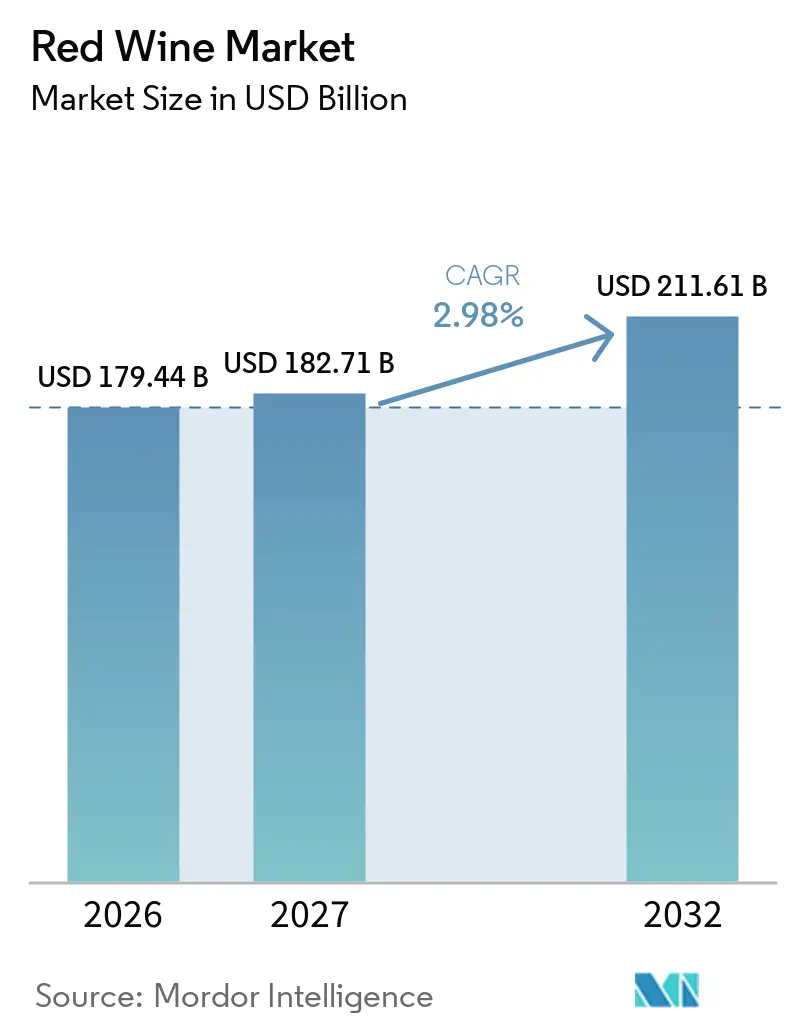
| Market Size (2027) | USD 182.71 Billion |
| Market Size (2032) | USD 211.61 Billion |
| Growth Rate (2027 - 2032) | 2.98 % |
| Fastest Growing Market | Asia-Pacific |
| Largest Market | Europe |
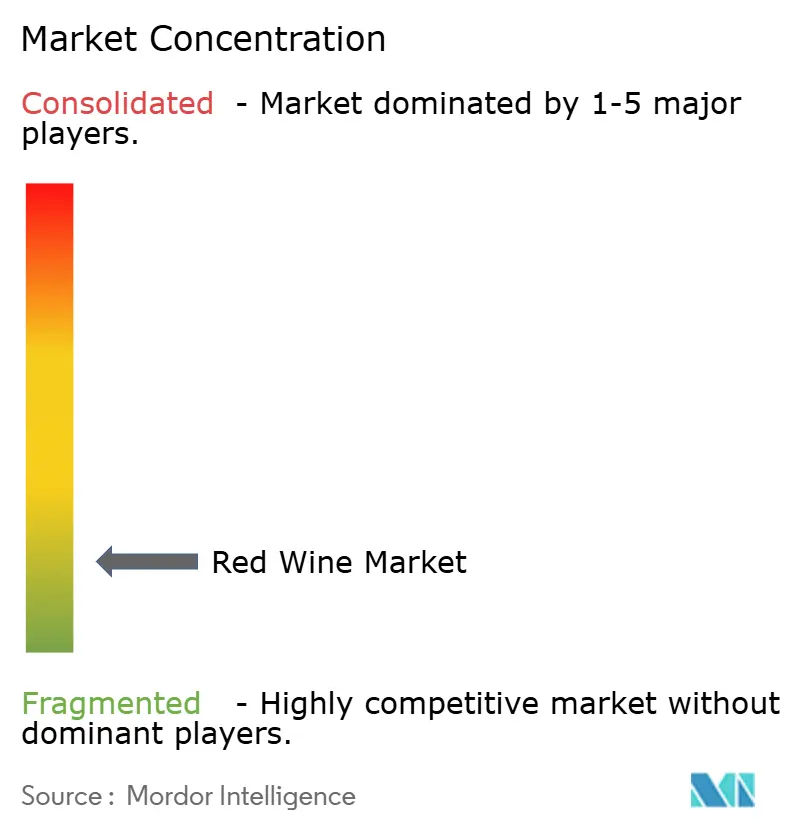
| Market Concentration | Low |
Major Players *Disclaimer: Major Players sorted in no particular order Image © Mordor Intelligence. Reuse requires attribution under CC BY 4.0. | |
Red Wine Market Analysis by Mordor Intelligence
The Red Wine Market size is valued at USD 179.44 billion in 2026, is estimated at USD 182.71 billion in 2027, and is forecast to reach USD 211.61 billion by 2032, at a CAGR of 2.98% from 2027 to 2032. The red wine market is gaining value through premium purchases even where case volumes are under pressure, as wines priced above USD 30 increased 9.4% in value in the United States during 2025. Producers are increasingly using organic certification, direct sales, tourism, and hospitality to protect margins and strengthen customer relationships. Health warnings and changing drinking habits create a more difficult operating setting, particularly for producers that do not offer lighter or lower-alcohol choices. Large wine groups are responding through portfolio sales, supply-chain changes, and tighter attention to premium labels and selected channels. These conditions leave room for estates that can show clear origin, credible sustainability practices, and a direct connection with buyers.
Key Report Takeaways
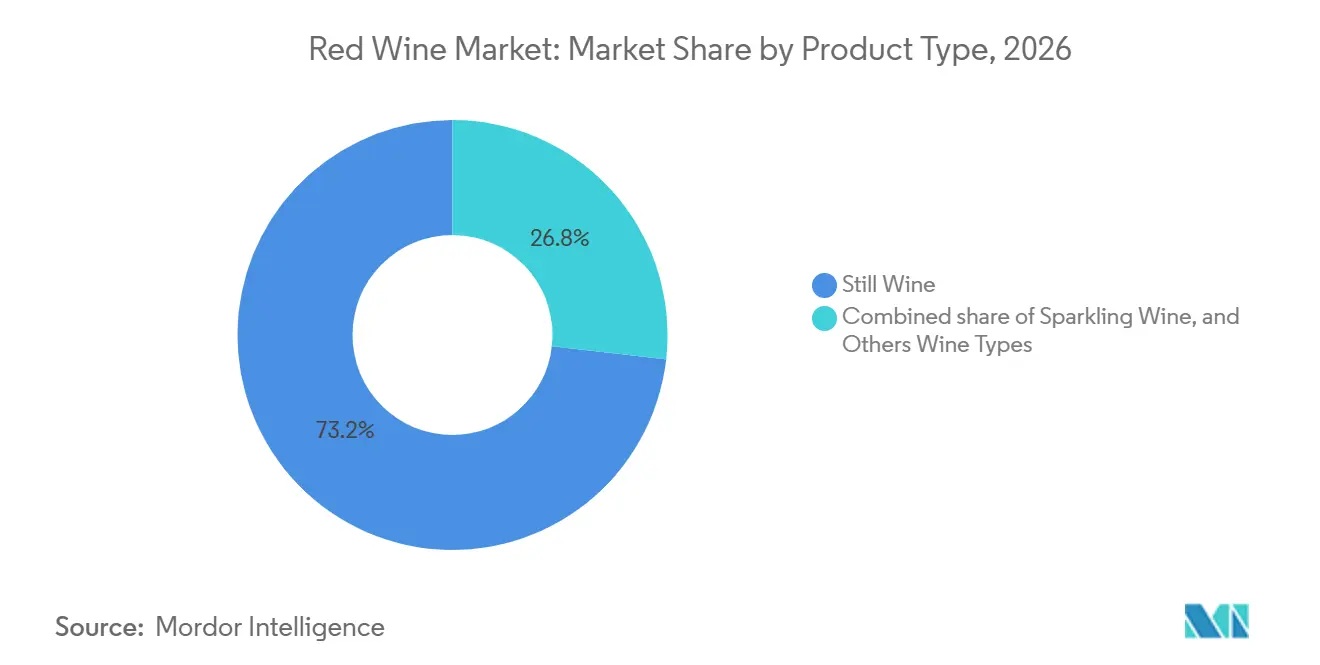
- By product type, still wine held 73.2% of the red wine market share in 2026, while sparkling wine is projected to grow at a 4.9% CAGR through 2032.
- By price range, mass wine accounted for 58.7% of the red wine market share in 2026, while premium wine is projected to grow at a 5.2% CAGR through 2032.
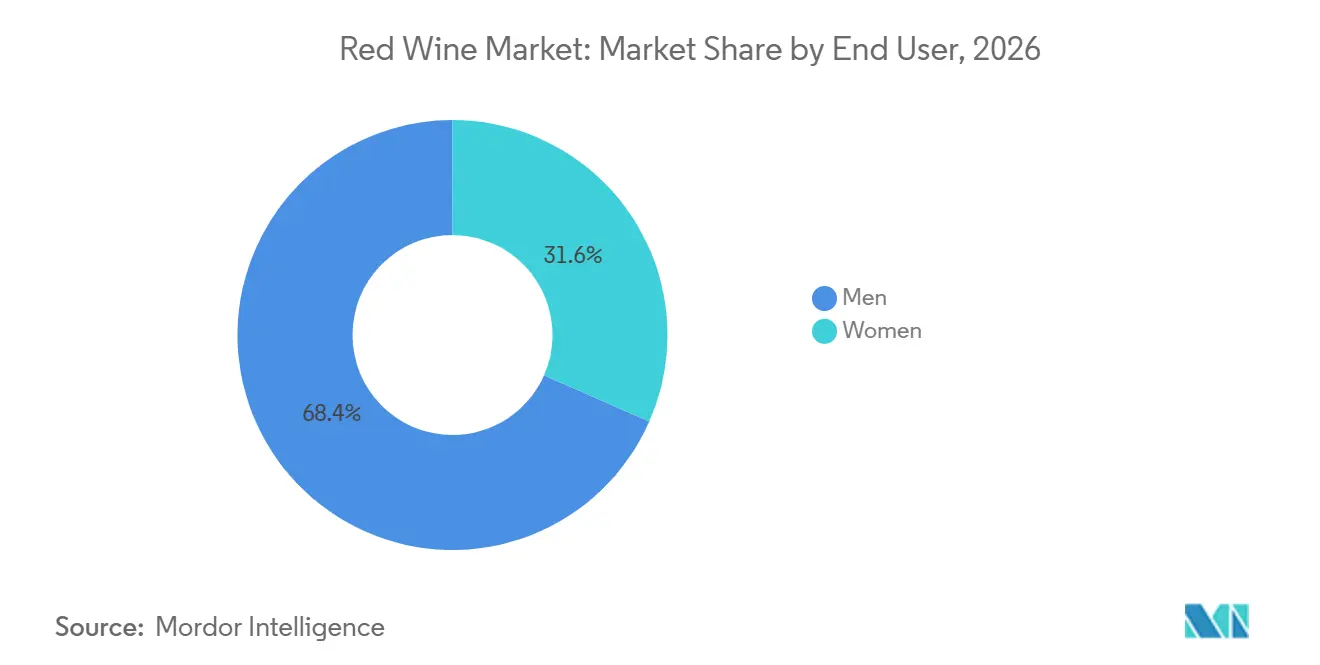
- By end user, men represented 68.4% of the red wine market share in 2026, while women are projected to grow at a 4.5% CAGR through 2032.
- By distribution channel, off-trade channels accounted for 67.4% of the red wine market share in 2026, while on-trade channels are projected to grow at a 5.5% CAGR through 2032.
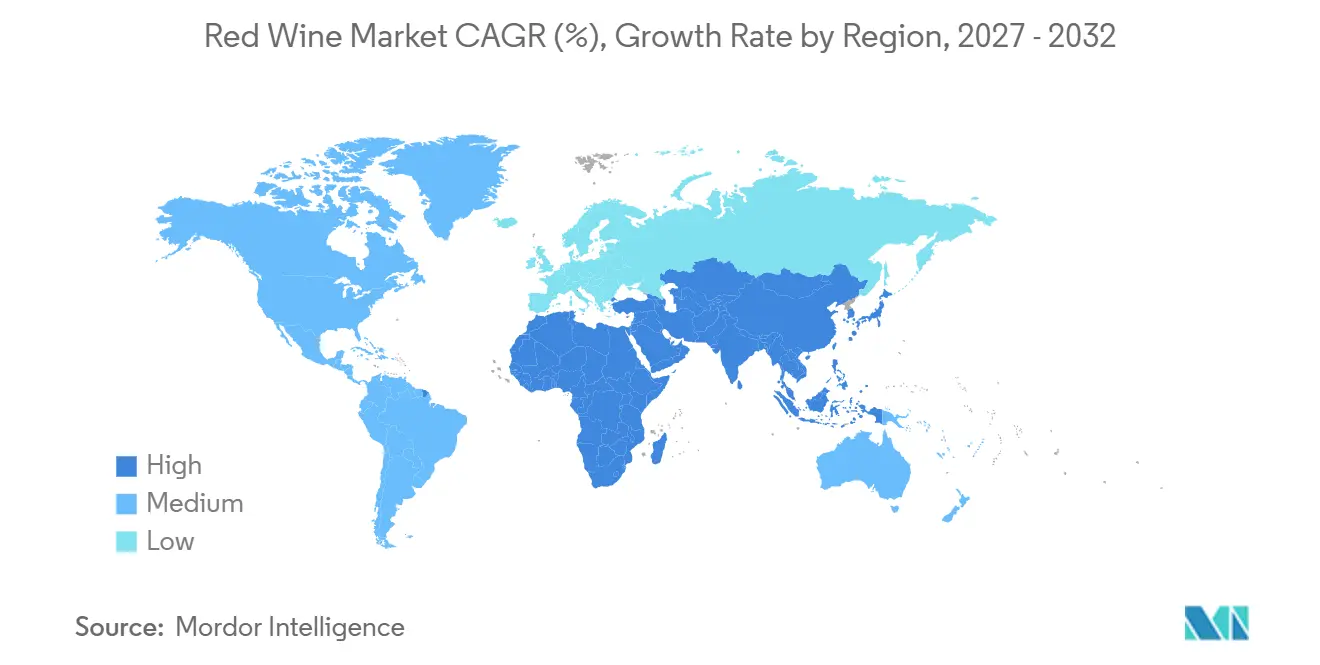
- By geography, Europe held 38.7% of the red wine market share in 2026, while Asia-Pacific is projected to grow at a 5.1% CAGR through 2032.
Note: Market numbers in this report are based on Mordor Intelligence's proprietary estimation framework, which combines nine months of actuals with Q4 projections for base year 2026.
Market Trends and Insights
Drivers Impact Analysis of Red Wine Market*
| Driver | (~) % Impact on CAGR Forecast | Geographic Relevance | Impact Timeline |
|---|---|---|---|
| Rising Interest in Organic and Sustainable Viticulture | +0.7% | Europe, Australia, and South America | Medium term (2-4 years) |
| Expansion of E-Commerce and Direct-to-Consumer Sales | +0.5% | North America and Asia-Pacific | Medium term (2-4 years) |
| Strong Cultural and Social Drinking Traditions | +0.7% | Europe and South America | Long term (≥ 4 years) |
| Growth of Wine Tourism and Hospitality | +0.4% | Europe and South America, including Mendoza, Santiago, and Valparaíso | Long term (≥ 4 years) |
| Gifting Culture and Special Occasions | +0.3% | Asia-Pacific, with spillover to the Middle East and Africa | Medium term (2-4 years) |
| Product Innovation and Variety | +0.4% | Global | Short term (≤ 2 years) |
| Source: Mordor Intelligence | |||
Rising Interest in Organic and Sustainable Viticulture
Organic production is increasingly shaping the pricing and sales of premium red wine. A 2025 academic study found that EU-approved organic certification can generate a 20.5% consumer price premium compared with conventional wines. The study also found that pesticide-free production can account for up to 74% of this premium, indicating that consumers place significant value on lower-chemical and environmentally responsible wine production. The OIV 2025–2030 Strategic Plan also identifies sustainability as a key priority for viticulture policy and communication. As retailers, hospitality businesses, and consumers place greater emphasis on sustainable sourcing, verified organic and environmental practices can help producers strengthen their access to premium sales channels. By combining organic certification with consistent quality, clear regional origin, and strong brand positioning, producers can develop higher-value red wine offerings and differentiate themselves in the premium market.
Expansion of E-Commerce and Direct-to-Consumer Sales
Direct sales allow wineries to maintain greater control over pricing, customer data, and brand presentation while building stronger relationships with consumers. In the United States, the average direct-to-consumer bottle price reached USD 52.7 in the first half of 2025, up 8% from the previous year, despite a 12% decline in shipment volume. Wines priced above USD 100 also recorded a 5% increase in total direct-to-consumer channel value, highlighting continued demand for premium offerings. These trends indicate that direct selling helps premium wineries protect margins and increase revenue per bottle rather than focus only on shipment volumes. It also allows smaller wineries to reach consumers and compete more effectively without developing the extensive physical distribution networks used by larger wine groups. For the red wine market, integrating winery visits, online purchases, and membership programs into a unified customer relationship strategy can support customer loyalty, repeat purchases, and premium product sales.
Strong Cultural and Social Drinking Traditions
Red wine continues to play an important role in meals, gifting, and formal social occasions across major producing and consuming regions. Wine represented the majority of gifting and dinner-pairing occasions in 2025–2026, highlighting its strong association with celebrations, hospitality, and shared dining experiences. In Mendoza, the number of winery establishments serving wine tourists increased by 57.5% between 2018 and 2024, reflecting growing consumer interest in wine tourism and regional wine experiences. These habits continue to support red wine demand for selected occasions, even as some consumers drink alcohol less frequently. Consumers also increasingly prefer distinctive bottles that reflect origin, quality, and suitability for sharing. The red wine market benefits when producers connect their brands with local food culture, regional heritage, and trusted wine traditions.
Growth of Wine Tourism and Hospitality
Wine tourism has evolved from a secondary cellar-door activity into an important source of revenue for wineries. A 2025 global study of 1,310 wineries across 47 countries found that 88% offered wine tourism activities, such as tastings, guided tours, and visitor experiences. On average, these activities generated 25% of winery revenue, while non-European producers derived an even higher share of 32%. Winery visits create opportunities for direct sales and allow customers to learn about a winery’s wines, heritage, and production process. They also help wineries reduce their reliance on distributors and retail promotions by building direct relationships with consumers. In the red wine market, a well-managed visitor experience can strengthen the value of a wine’s origin and encourage customers to make repeat purchases.
Restraints Impact Analysis of Red Wine Market*
| Restraint | (~) % Impact on CAGR Forecast | Geographic Relevance | Impact Timeline |
|---|---|---|---|
| Health Risks Associated with Alcohol Consumption | -0.8% | Global | Long term (≥ 4 years) |
| Stringent Regulatory and Labeling Requirements | -0.4% | Europe, North America, and Australia | Medium term (2-4 years) |
| Competition from Alternative Beverages | -0.6% | North America and Europe | Short term (≤ 2 years) |
| Supply Chain and Logistics Bottlenecks | -0.3% | Global, with concentration in South America and Europe | Medium term (2-4 years) |
| Source: Mordor Intelligence | |||
Health Risks Associated with Alcohol Consumption
Health evidence is creating lasting pressure on alcohol consumption, including red wine. The U.S. Surgeon General’s 2025 advisory states that alcohol consumption is causally linked to at least 7 cancer types. The American Heart Association stated in 2025 that a cause-and-effect relationship between moderate alcohol use and improved heart health has not been established[1]. The OIV has also included responsible communication on consumption in its current work. These positions make health-related labeling and careful marketing more important across the red wine market. Younger consumers who are reducing alcohol frequency may be especially difficult to reach through traditional category messages.
Competition From Alternative Beverages
Alternative beverages increasingly compete with red wine during meal occasions, social gatherings, and wellness-focused consumption. In the United States, non-alcoholic wine sales grew by 22% in 2025 and exceed 1 million cases, reflecting rising consumer interest in healthier and lower-alcohol beverage options. In December 2025, Decoy launched Featherweight Cabernet Sauvignon, made with premium California fruit and containing 80 calories per serving and 9% ABV. This product launch highlights how established wine brands are adapting to consumer demand for lower-alcohol choices without compromising quality. Producers that do not address changing wellness preferences may lose consumption occasions to no- and low-alcohol beverages, spirits, and other alternatives. As a result, the red wine market faces increasing pressure to offer a wider range of products while maintaining its premium image.
*Our forecasts treat driver/restraint impacts as directional, not additive. The impact forecasts reflect baseline growth, mix effects, and variable interactions.
Red Wine Market Segment Analysis
By Product Type:
Still Wine Leads, Sparkling Wine Gains GroundStill wine accounted for 73.2% of the red wine market share in 2026. Its position reflects the importance of established red wine styles from Bordeaux, Burgundy, Rioja, Barolo, and comparable New World regions. Still wine has the widest presence in retail, restaurants, and specialist wine lists, which gives producers a reliable platform for both familiar labels and regional discovery. It also has the most familiar place in the vocabulary used by consumers and sommeliers. This makes still wine a common starting point for new red wine buyers in Asia-Pacific and other developing consumption markets.
Premiumization continues to reinforce the position of still red wine. Premium-plus wines represented 34.4% of U.S. table wine volume in 2025, compared with 12.4% at the turn of the century. Cabernet Sauvignon, Pinot Noir, and Malbec remain central to this higher-value group because they are readily understood by consumers and widely used in restaurant wine lists. Sparkling wine is forecast to post a 4.9% CAGR through 2032 in the red wine market. Its occasion-led appeal can benefit from the wider demand for celebratory, food-friendly, and lower-alcohol formats.

By Price Range:
Mass Wine Leads Revenue While Premium Wine Advances FasterMass wine held 58.7% of the red wine market share in 2026. It remains accessible through grocery stores and other off-trade outlets, where availability and clear pricing simplify everyday purchase decisions. The segment is important for regular occasions in Europe and South America, where wine is often part of household shopping. Broad label awareness and competitive bottle prices also support its reach across established consumer groups. However, this tier faces the clearest effect from consumers who are drinking less often and choosing better bottles when they do drink.
Premium wine is forecast to expand at a 5.2% CAGR through 2032.U.S. wines priced above USD 30 increased 9.4% in value in 2025. This movement reflects trade-up behavior in mature markets and aspirational purchases in emerging markets, where a recognized appellation can reduce uncertainty for less experienced buyers. Organic certification and sustainability credentials can support a premium price when they are independently verified. The red wine industry is balancing volume access in mass wine with stronger value creation in premium labels.
By End User:
Men Form the Largest Customer Group While Women Expand FasterMen represented 68.4% of red wine market revenue in 2026. This pattern reflects established consumption norms in Southern Europe and North America, as well as enduring interest in structured and collectible red wines. Male consumers are strongly associated with premium and collectible labels, direct purchases, and fine-dining occasions. Beer and whiskey remain significant alternatives for men aged 25-44, making occasion-based placement important for wine producers. Producers are responding by strengthening placement in wine bars and restaurants where discovery, food pairing, and staff guidance can shape a purchase.
Women are forecast to grow at a 4.5% CAGR through 2032. In Brazil, women made up 53% of wine consumers in 2024, up 6 percentage points from 2019. Women are entering the category through social retail, e-commerce, and wine tourism as well as fine dining. These channels can favor organic offerings and lighter styles over heavier classical formats, particularly when information on origin and production is easy to access. Brands that frame red wine around social occasions, provenance, and informed choice have a clearer way to meet this demand.
By Distribution Channel:
Off-Trade Leads Sales While On-Trade RecoversOff-trade channels accounted for 67.4% of the red wine market share in 2026. Grocery retailers, specialty liquor stores, and digital storefronts provide the broadest consumer access and allow shoppers to choose from familiar and exploratory options. Specialty stores remain particularly useful for premium labels because staff can explain style, producer, and origin. The channel also supports purchases for home dining, gifting, and informal occasions. Packaging changes can widen this use, as shown by Bota Box’s 2026 launch of a 1.5-liter Napa Valley Cabernet Sauvignon in bag-in-box format at USD 20 suggested retail price.
On-trade channels are forecast to grow at a 5.5% CAGR through 2032. U.S. on-premise value velocity rose 5% year over year in April 2026, while ticket count increased 7%. Going out gives consumers more opportunity to try unfamiliar wines and trade up to restaurant selections with less risk than an unfamiliar retail purchase. Restaurants also connect wine with food pairing, which is an enduring strength for red wine. The red wine market can use this channel to build brand familiarity before repeat off-trade purchase.
Geography Analysis
Europe Red Wine Market
Europe held 38.7% of the red wine market share in 2026. France, Italy, Spain, Portugal, and Germany provide a dense base of appellation-led production and consumption, with established local demand and international recognition. Producers in the region are defending value through place-based premium labels and wine tourism that brings consumers closer to vineyards and wineries. Northern and Eastern European countries, including the Netherlands, Poland, Belgium, and Sweden, provide growth corridors as urban consumers broaden their wine purchases and environmental requirements become more important for premium retail and hospitality access.
APAC Red Wine Market
Asia-Pacific is forecast to grow at a 5.1% CAGR through 2032. India’s wine imports increased by more than 50% in the first half of 2025. Australia-India ECTA duty reductions made premium imports more accessible in a market that had faced 150% tariff barriers, supporting restaurant and retail availability. China remains the largest Asia-Pacific market by value and continues to favor premium positioning despite a more selective consumption environment. Thailand, Indonesia, and Vietnam are supporting trial through urban hospitality and tourism, while Japan and South Korea remain stable value markets for premium French and Italian wines.
The Americas and MEA Red Wine Market
North America remained the largest single-country wine market by value at USD 74.3 billion in 2025, although volume declined 2% that year. Napa represented 50% of the value of the U.S. direct-to-consumer channel in 2025, showing the resilience of a premium geographic identity. South America combines major production in Argentina and Chile with growing demand in Brazil, where women represented 53% of wine consumers in 2024. The Middle East and Africa remain smaller but positive markets, with South Africa serving as a production and consumption hub and the United Arab Emirates and Saudi Arabia emerging as premium import markets. Tourism, hospitality investment, and rising urban discretionary spending support this direction.
Competitive Landscape
The red wine market is fragmented, with key players including Treasury Wine Estates Limited, E. & J. Gallo Winery, Constellation Brands, and Pernod Ricard Winemakers. Independent and family-owned estates hold a strong position in the premium and ultra-premium segments, as their brands are tied to specific vineyards, regions, or family histories. Large groups, by contrast, focus resources on labels and channels with stronger margins. In June 2025, The Wine Group acquired six premium and ultra-premium brands from Constellation Brands, along with three California production facilities, 6,600 vineyard acres, and 500 employees.
Competitive advantage increasingly depends on provenance, direct buyer access, and a clear price-tier position. Digital tools such as provenance verification, personalized outreach, and wine clubs help premium producers maintain customer relationships and identify what drives repeat sales. Smaller producers can compete in areas such as organic-certified reds, lower-alcohol variants, and alternative formats without matching the distribution scale of large groups. In May 2025, Familia Torres shifted European freight to rail from the Spain-France border, working with distributors in Germany and the Netherlands, expecting a 30-40% reduction in distribution-related greenhouse gas emissions.
Supply and portfolio discipline are critical as consumer preferences shift faster than production plans can adjust. Treasury Wine Estates Limited recorded a USD 394 million post-tax charge in August 2026 to write down bulk wine inventory and rebalance its US supply chain, highlighting the financial risk of holding inventory that no longer aligns with demand. Independent producers can respond more quickly through terroir-led labels, organic practices, and direct cellar-door sales. Companies that align production, packaging, and distribution with specific consumer occasions are better positioned to grow in this market.
Red Wine Industry Leaders
-
E. & J. Gallo Winery
-
Treasury Wine Estates Limited
-
Castel Frères
-
The Wine Group LLC
-
Trinchero Family Estates
- *Disclaimer: Major Players sorted in no particular order
Red Wine Market Companies Covered in this Report
- Accolade Wines
- Bacardi Limited
- Bodegas Torres
- Bronco Wine Company
- Caviro S.C.A.
- Castel Frères
- Compagnia Del Vino SRL
- Constellation Brands, Inc.
- E. & J. Gallo Winery
- Familia Torres
- Foley Family Wines
- Gruppo Campari
- Grupo Peñaflor S.A.
- Henkell Freixenet
- Jackson Family Wines
- Moët Hennessy
- Opus One Winery
- Pernod Ricard Winemakers
- Treasury Wine Estates Limited
- The Wine Group LLC
Recent Industry Developments in Red Wine Market
- August 2026: Bota Box launched a Limited Reserve Napa Valley Cabernet Sauvignon in bag-in-box format at USD 20 SRP for 1.5 liters, signaling the format's credibility for premium red wine beyond commodity positioning.
- March 2026: Mercer Wine Estates acquired four Washington State wine brands, Matthews, Tenor, Jaine, and Single Barrel, from Avallé, deepening its Columbia Valley portfolio and formalizing a multi-year vineyard supply relationship.
- February 2026: Crimson Wine Group acquired the Raeburn wine brand from Purple Brands, adding approximately 250,000 annual cases of premium Sonoma County Pinot Noir and Chardonnay from the Russian River Valley and expanding Crimson's annual production above 400,000 cases.
- June 2025: The Wine Group completed its acquisition of 6 premium and ultra-premium brands from Constellation Brands, Cook's, J. Rogét, Meiomi, Robert Mondavi Private Selection, SIMI, and Woodbridge, together with 3 California production facilities and approximately 6,600 vineyard acres, integrating approximately 500 employees.
Global Red Wine Market Report Scope
The Red Wine Market refers to the market for red wine, an alcoholic beverage produced through the fermentation of red or black grape varieties, typically with grape skins retained during fermentation to develop its characteristic color, tannins, and flavor profile. By product type, the market is segmented into still wine, sparkling wine, and other wine types. By price range, the market is divided into mass and premium categories. By end-user, the market is segmented into men and women. By distribution channel, the market is divided into on-trade and off-trade, with off-trade further segmented into specialty/liquor stores and other off-trade channels. Geographically, the market covers North America, Europe, Asia-Pacific, South America, and the Middle East and Africa, with country-level coverage across major markets, including the United States, Canada, Mexico, Germany, the United Kingdom, Italy, France, Spain, the Netherlands, Poland, Belgium, Sweden, China, India, Japan, Australia, Indonesia, South Korea, Thailand, Singapore, Brazil, Argentina, Colombia, Chile, Peru, South Africa, Saudi Arabia, the United Arab Emirates, Nigeria, Egypt, Morocco, and Turkey, along with the respective regional rest-of-country categories. Market forecasts are presented in terms of value (USD) and Volume (Litres).
Segmentation Overview
| Still Wine |
| Sparkling Wine |
| Others Wine Types |
| Mass |
| Premium |
| Men |
| Women |
| On-Trade | |
| Off-Trade | Specialty/ Liquor Stores |
| Other Off-Trade Channels |
| North America | United States |
| Canada | |
| Mexico | |
| Rest of North America | |
| Europe | Germany |
| United Kingdom | |
| Italy | |
| France | |
| Spain | |
| Netherlands | |
| Poland | |
| Belgium | |
| Sweden | |
| Rest of Europe | |
| Asia-Pacific | China |
| India | |
| Japan | |
| Australia | |
| Indonesia | |
| South Korea | |
| Thailand | |
| Singapore | |
| Rest of Asia-Pacific | |
| South America | Brazil |
| Argentina | |
| Colombia | |
| Chile | |
| Peru | |
| Rest of South America | |
| Middle East and Africa | South Africa |
| Saudi Arabia | |
| United Arab Emirates | |
| Nigeria | |
| Egypt | |
| Morocco | |
| Turkey | |
| Rest of Middle East and Africa |
| By Product Type | Still Wine | |
| Sparkling Wine | ||
| Others Wine Types | ||
| By Price Range | Mass | |
| Premium | ||
| By End User | Men | |
| Women | ||
| By Distribution Channel | On-Trade | |
| Off-Trade | Specialty/ Liquor Stores | |
| Other Off-Trade Channels | ||
| By Geography | North America | United States |
| Canada | ||
| Mexico | ||
| Rest of North America | ||
| Europe | Germany | |
| United Kingdom | ||
| Italy | ||
| France | ||
| Spain | ||
| Netherlands | ||
| Poland | ||
| Belgium | ||
| Sweden | ||
| Rest of Europe | ||
| Asia-Pacific | China | |
| India | ||
| Japan | ||
| Australia | ||
| Indonesia | ||
| South Korea | ||
| Thailand | ||
| Singapore | ||
| Rest of Asia-Pacific | ||
| South America | Brazil | |
| Argentina | ||
| Colombia | ||
| Chile | ||
| Peru | ||
| Rest of South America | ||
| Middle East and Africa | South Africa | |
| Saudi Arabia | ||
| United Arab Emirates | ||
| Nigeria | ||
| Egypt | ||
| Morocco | ||
| Turkey | ||
| Rest of Middle East and Africa | ||
Key Questions Answered in the Report
What is the value of the red wine market in 2026?
The market is valued at USD 179.44 billion in 2026 and is forecast to reach USD 211.61 billion by 2032.
What growth rate is forecast for red wine through 2032?
The forecast CAGR is 2.98% from 2027 to 2032.
Which red wine product type leads global sales?
Still wine leads with 73.2% share in 2026, while sparkling wine is expected to grow at a 4.9% CAGR through 2032.
Which region is forecast to grow fastest?
Asia-Pacific is forecast to grow at a 5.1% CAGR through 2032, supported by India’s import growth and premium demand in China.