
Real Estate Valuation Services Market Size and Share
Market Overview
| Study Period | 2021 - 2032 |
|---|---|
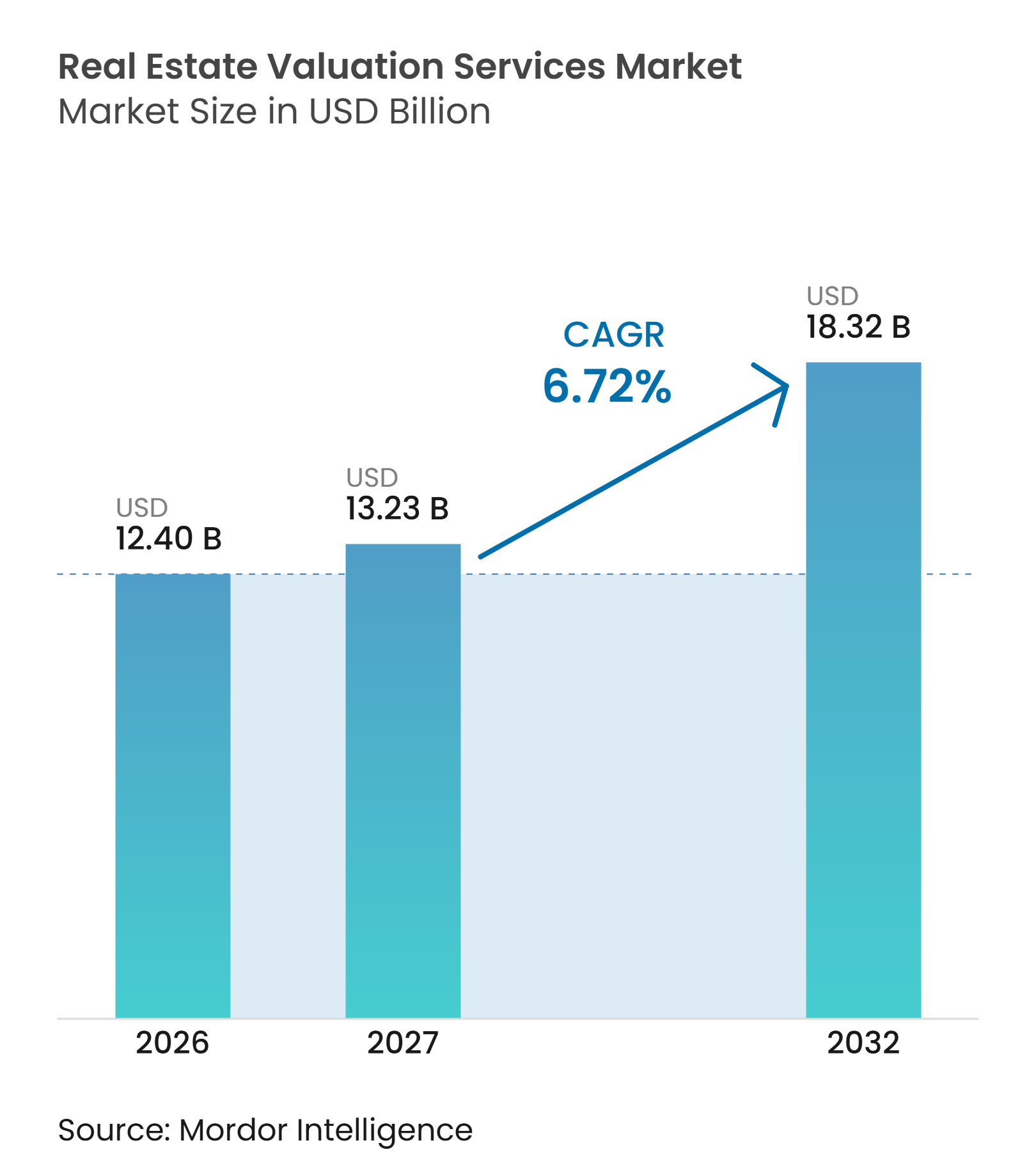
| Market Size (2027) | USD 13.23 Billion |
| Market Size (2032) | USD 18.32 Billion |
| Growth Rate (2027 - 2032) | 6.72 % |
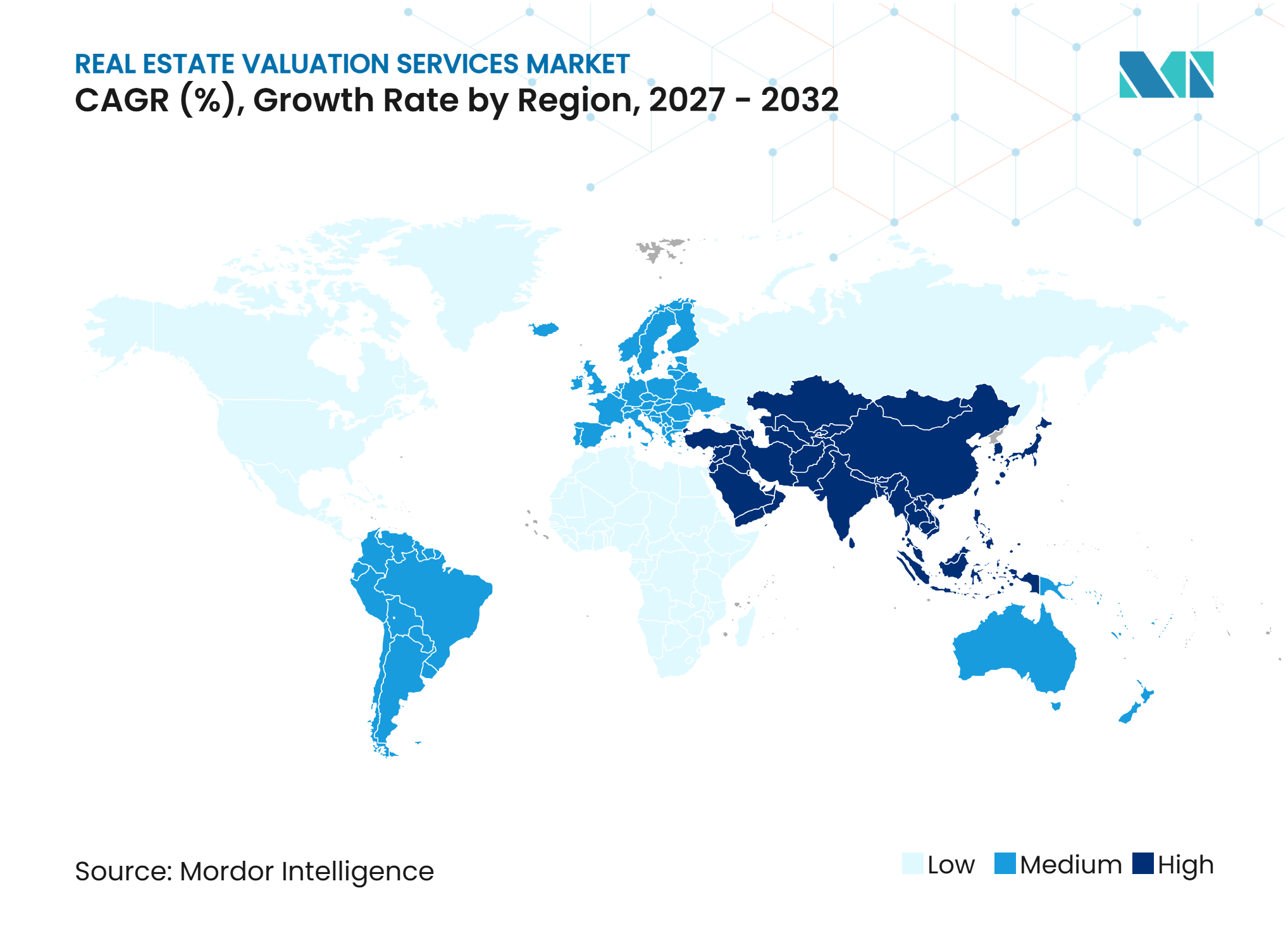
| Fastest Growing Market | Asia-Pacific |
| Largest Market | North America and Europe |
| Market Concentration | Medium |
Major Players *Disclaimer: Major Players sorted in no particular order Image © Mordor Intelligence. Reuse requires attribution under CC BY 4.0. | |
Real Estate Valuation Services Market Analysis by Mordor Intelligence
The Real Estate Valuation Services Market size is projected to expand from USD 12.40 billion in 2026 and USD 13.23 billion in 2027 to USD 18.32 billion by 2032, registering a CAGR of 6.72% between 2027 and 2032.
The real estate valuation services market is benefiting from reporting requirements, cross-border capital activity, and the need for specialist appraisal work across more complex property types. Standardized, audit-ready workflows are raising the service threshold for mortgage and institutional assignments. This favors providers that combine credentialed professionals, documented processes, and reliable data systems. Demand is also becoming less dependent on property transactions because portfolio monitoring, financial reporting, insurance, tax, and litigation work require valuations at regular intervals. Capacity shortages and fee pressure in standardized residential work remain material constraints, but compliance-led and specialized assignments support the outlook for the real estate valuation services market.
Key Report Takeaways
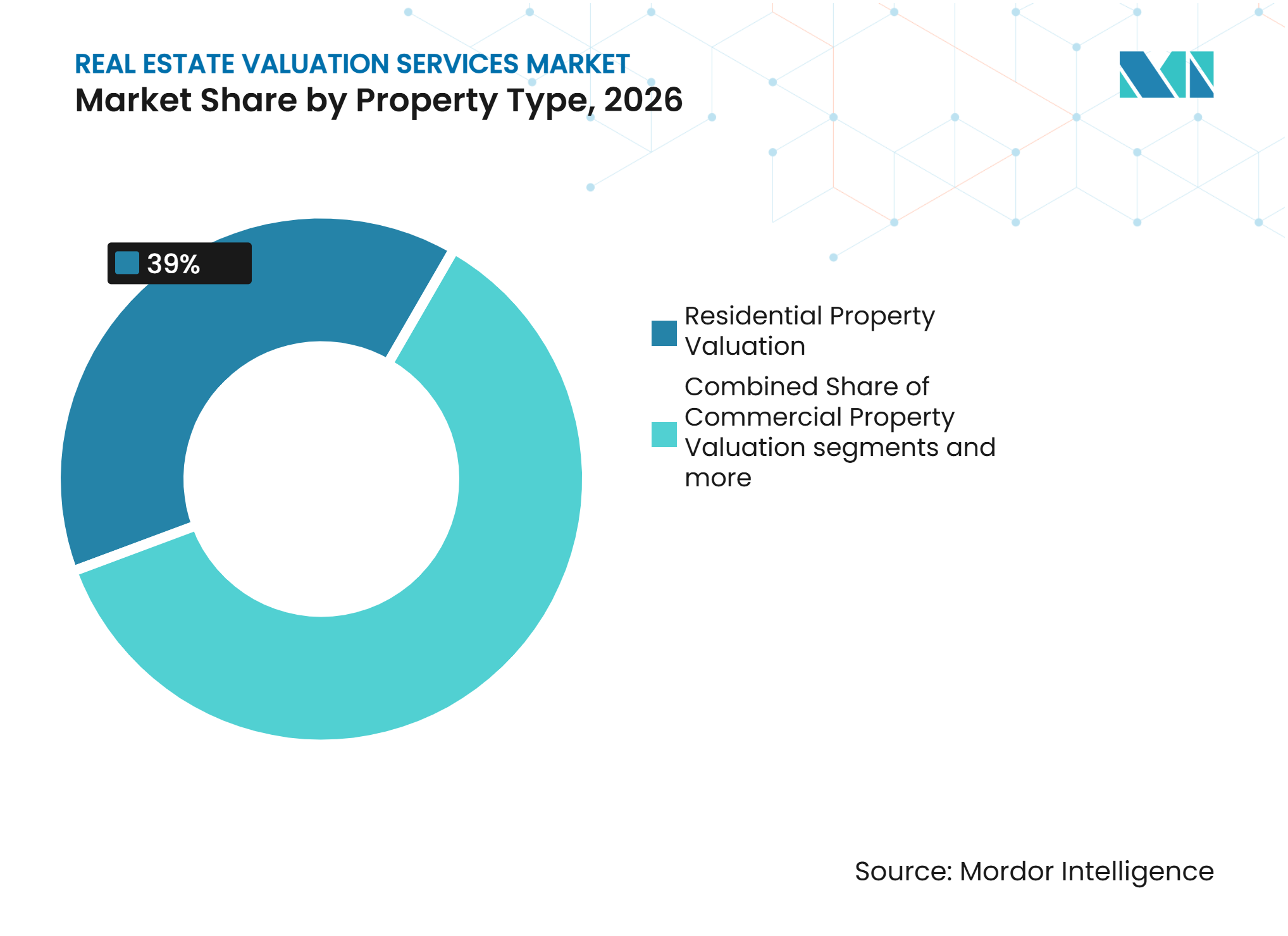
• By property type, residential property valuation held 39% of the real estate valuation services market share in 2026, while commercial property valuation is forecast to grow at a 7.6% CAGR through 2032.
• By application, the Others category accounted for 44% of the real estate valuation services market size in 2026 and is projected to expand at a 7.64% CAGR through 2032.
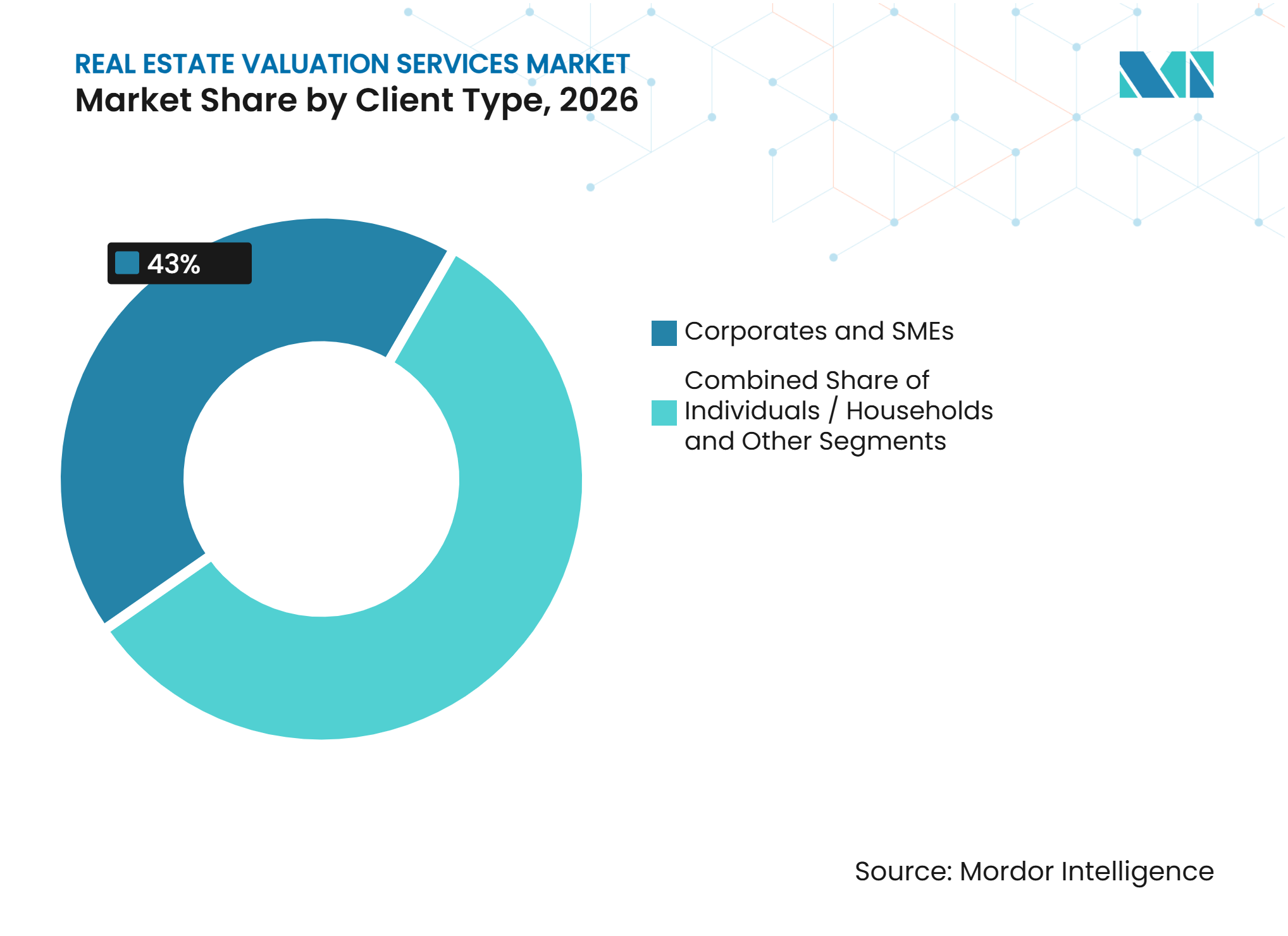
• By client type, corporates and small and medium-sized enterprises held 43% of real estate valuation services market revenue in 2026 and are forecast to grow at a 7.28% CAGR through 2032.
• By geography, North America held 34.5% of real estate valuation services market revenue in 2026, while Asia-Pacific is forecast to grow at an 8.29% CAGR through 2032.
Note: Market numbers in this report are based on Mordor Intelligence's proprietary estimation framework, which combines nine months of actuals with Q4 projections for base year 2026.
Market Trends and Insights
Drivers Impact Analysis of Real Estate Valuation Services Market*
| Drivers | (~) % Impact on CAGR Forecast | Geographic Relevance | Impact Timeline |
|---|---|---|---|
| Mortgage And Lending Compliance | +2.0% | North America, with spillover to Europe | Short term (≤ 2 years) |
| Institutional Portfolio Reporting | +1.5% | Global | Medium term (2-4 years) |
| Transaction And Refinancing Activity | +1.3% | North America and Asia-Pacific | Short term (≤ 2 years) |
| Specialized Asset Classes | +1.1% | North America, Asia-Pacific, and Europe | Medium term (2-4 years) |
| Transparent Valuation Regulation | +0.7% | Global | Long term (≥ 4 years) |
| Climate And Transition-Risk Pricing | +0.5% | Europe, Australia, and global markets | Long term (≥ 4 years) |
| Source: Mordor Intelligence | |||
Mortgage And Lending Compliance Sustains Structural Appraisal Demand
The November 2, 2026, UAD 3.6 requirement for government-sponsored enterprise loan submissions has changed the operating requirements for United States residential appraisal work. The mandate requires more structured property data, digital workflows, and documented audit trails for lenders, appraisal management companies, and appraisers. In an August 2026 survey, 49.7% of appraisers reported that they were fully ready, and 25.3% were actively preparing for the new format[1]. Traditional appraisals still represented 85.7% of Fannie Mae purchase loan originations and 77.6% of Freddie Mac purchase loan originations in February 2026. The Mortgage Industry Standards Maintenance Organization updated its property and valuation data specification for UAD 3.6, extending the change across lender systems and vendor processes. The real estate valuation services market therefore directs a larger share of compliance-sensitive work toward firms that can operate consistently within these standards.
Institutional Portfolio Reporting Builds Recurring Revenue
Perpetual-life funds, net asset value vehicles, and private wealth structures need regular and transparent assessments of commercial property holdings. These assignments create revenue that is less tied to individual acquisitions, disposals, or refinancing decisions. The institutional use case includes formal reporting, audit support, ongoing benchmarking, and workflow records that investors and auditors can review. Kroll introduced its Real Estate Valuation Solution in March 2026 to combine portfolio workflow management, standardized benchmarking, and audit-ready documentation. The move reflects demand for continuing portfolio oversight rather than a valuation ordered only when a property changes hands. This work supports a more recurring revenue base within the real estate valuation services market and raises the importance of consistent documentation.
Transaction And Refinancing Activity Shapes Assignment Volumes
Property investment and refinancing activity still influence the timing of appraisal orders, especially in North America and major Asia-Pacific investment centers. Cash-out refinancing retained high full-appraisal completion rates in February 2026, reaching 70.8% at Freddie Mac and 73.4% at Fannie Mae. That activity continues to provide a dependable source of assignments even when appraisal waivers are used more widely for no-cash-out refinances. Cross-border acquisitions and development funding also require formal reports during underwriting, acquisition, and periodic portfolio review. The link between transactions and revenue is now less direct because institutional monitoring and reporting work continues across changing rate conditions. The real estate valuation services market consequently treats transaction activity as an important volume driver rather than the only source of demand.
Specialized Asset Classes Raise Engagement Complexity
Data centers, infrastructure facilities, and life sciences properties require information that is rarely captured by standard comparable-sales analysis. Their valuation may depend on power availability, water access, rack density, scalability, connectivity, operating performance, and tenant covenants. Kroll identified these considerations as key elements in the valuation of artificial intelligence data center facilities during 2026. JLL reported that its Datasense tool reduced turnaround times for certain commercial lending assignments from 15 days to as little as 5 hours. The Royal Institution of Chartered Surveyors also issued a global standard on artificial intelligence use in surveying, which requires the technology to support rather than replace professional judgment[2]. These requirements create room for higher-value assignments in the real estate valuation services market, particularly for firms with property-specific and operational expertise.
Restraints Impact Analysis of Real Estate Valuation Services Market*
| Restraints | (~) % Impact on CAGR Forecast | Geographic Relevance | Impact Timeline |
|---|---|---|---|
| Cyclicality Of Transaction Volumes | -0.9% | North America and Europe | Short term (≤ 2 years) |
| Shortage Of Credentialed Valuers | -0.7% | North America, with global spillover | Medium term (2-4 years) |
| Data Gaps in Thinly Traded Assets | -0.5% | Asia-Pacific and the Middle East and Africa | Long term (≥ 4 years) |
| Fee Pressure from Standardized Assignments | -0.3% | Global | Long term (≥ 4 years) |
| Source: Mordor Intelligence | |||
Cyclicality Of Transaction Volumes Introduces Revenue Volatility
Valuation orders are exposed to changes in lending activity and property transactions, even though recurring institutional work provides some protection. During periods of tighter borrowing conditions, lenders apply stricter underwriting, and property transactions can slow. Appraisal waivers accounted for 47.6% of Freddie Mac and 47.4% of Fannie Mae no-cash-out refinances in February 2026. A refinancing recovery therefore does not translate directly into the same level of traditional appraisal revenue. Providers with institutional reporting, compliance work, and specialist asset capabilities have a broader set of assignments when transaction activity weakens. Firms concentrated in residential mortgage work remain more exposed to short-term volume changes in the real estate valuation services market.
Shortage Of Credentialed Valuers Limits Capacity
A shrinking workforce can lengthen turn times and limit the ability of providers to accept incremental work. The number of active United States appraisers producing government-sponsored enterprise loans fell by 26% between 2021 and 2026, leaving 29,400 active practitioners in 2026[3]. The Appraisal Institute and the Appraisal Foundation indicated that 23% to 25% of field appraisers may retire rather than adopt the UAD 3.6 format. Commercial appraisal turn times averaged 13 to 14 business days during lower-volume conditions in 2026. A stronger volume cycle could make this shortage more visible in lender and investor timelines. The Appraisal Qualifications Board remains important because its licensing and entry standards influence the future professional pipeline.
*Our forecasts treat driver/restraint impacts as directional, not additive. The impact forecasts reflect baseline growth, mix effects, and variable interactions.
Real Estate Valuation Services Market Segment Analysis
By Property Type:
Residential Work Provides Scale While Commercial Work Grows FasterResidential property valuation held 39% of revenue in 2026, making it the largest property category. It provides a large assignment base because mortgage originations in North America and Europe require lenders to verify collateral before lending. Standard full appraisals remained the main verification method for a substantial share of government-sponsored enterprise purchase loans in 2026. The real estate valuation services market relies on this volume even though residential fees are generally lower than those for complex commercial assignments. UAD 3.6 raises expectations for consistent property data, documented reporting, and lender-ready delivery. These conditions place greater value on dependable workflows and on providers that can maintain quality at scale.
Commercial property valuation is forecast to expand at a 7.6% CAGR through 2032, the fastest rate among property types. The real estate valuation services market size for commercial work is supported by investment in logistics, office, and alternative assets that require specialist methods and regular reporting. Commercial appraisals may need to consider sustainability information and physical climate risks when these factors affect the assignment. Industrial assets are gaining demand through manufacturing diversification and data center development, while urban expansion and development pipelines in higher-growth Asia-Pacific markets support land assignments. Hospitality, healthcare, and infrastructure holdings also require advisors able to evaluate complex operating assumptions. This shift brings more work toward technically demanding engagements that command higher revenue per assignment and reduce dependence on residential mortgage volumes.



By Application:
Reporting and Monitoring Work Leads RevenueThe Others application category held 44% of revenue in 2026 and was the largest application group. It includes institutional net asset value monitoring, financial reporting, insurance, tax assessment, estate settlement, and litigation-related valuations. This broad activity makes revenue in the real estate valuation services market less dependent on the timing of individual property sales. Investors, auditors, insurers, courts, and tax authorities need documented values for different decisions, which creates repeatable work. Mortgage and lending applications remain an important source of orders in North America because lender requirements demand complete and consistent reports. Property sales work remains relevant in active investment locations, but it does not define the full demand base.
The Others category is also forecast to grow at a 7.64% CAGR through 2032. Perpetual-life funds and net asset value vehicles require quarterly or more frequent reviews, supporting a recurring schedule of formal and portfolio-level assignments. International Financial Reporting Standards fair value requirements support independent, audit-ready assessments for organizations that carry real estate on their balance sheets. Insurance work is becoming more complex as owners and insurers consider climate exposure alongside replacement and market value factors. In a 2026 survey, 40% of real estate investors identified climate risk as one of the largest threats to asset values. The real estate valuation services market consequently treats these non-transactional uses as a continuing governance requirement rather than an occasional cost.
By Client Type:
Corporates And Small and Medium-Sized Enterprises Drive DemandCorporates and small and medium-sized enterprises generated 43% of revenue in 2026, the largest client share. They commission reports for treasury management, portfolio administration, merger and acquisition due diligence, lending support, and financial audits. Organizations holding real estate collateral or material owned and leased assets need assessments that can be documented for lenders, boards, and auditors. This supports regular demand that does not depend only on residential transactions. The real estate valuation services industry serves these clients through asset-level reports, portfolio reviews, and advisory work that aligns with financial reporting requirements. Multisite portfolios also increase the value of consistent delivery across several locations.
Corporates and small and medium-sized enterprises are forecast to grow at a 7.28% CAGR through 2032, making them the fastest-growing client category. Expanding corporate property portfolios and financial reporting needs support the projected growth. Asset-heavy businesses need credible values when they use property as collateral or present property positions to investors and auditors. Individual and household clients remain important through mortgages and estate-related work, but their orders change more directly with borrowing conditions. Public bodies, insurers, courts, and sovereign wealth funds form the Others group and commission specialist work with demanding documentation requirements. The real estate valuation services market benefits from this broader corporate and institutional mix because its revenue is more contractual, recurring, and resilient to standardized fee pressure.

Geography Analysis
North America
North America held 34.5% of revenue in 2026, the largest regional share. Its mortgage ecosystem and mature compliance infrastructure make valuation a required part of many lending processes. UAD 3.6 became mandatory for government-sponsored enterprise appraisal submissions on November 2, 2026, requiring structured data and more consistent digital reporting. MISMO updated its property and valuation services specification for these workflows, while 75% of appraisers were fully ready or preparing for the transition in August 2026. Waiver use in no-cash-out refinancing is shifting providers toward specialized commercial, infrastructure, and technology-supported work, while proposed interstate licensing changes could help with capacity constraints.
Asia-Pacific
Asia-Pacific is forecast to grow at an 8.29% CAGR through 2032. Institutional activity in Singapore, Australia, India, Japan, and China is supporting acquisition-related, development-stage, and periodic portfolio valuations. India’s listed real estate investment trust activity and China’s infrastructure real estate investment trust structures require ongoing asset and portfolio reporting, including filings to the China Securities Regulatory Commission. Australia’s mature institutional base and Japan’s established real estate investment trust sector reinforce the need for periodic reviews. The real estate valuation services market size in the region also depends on credible local data, specialist knowledge, and reporting that can support cross-border investment decisions.
Europe, The Middle East and Africa, and South America
Europe benefits from institutional demand in the United Kingdom and Germany. At the same time, the Royal Institution of Chartered Surveyors’ sustainability standard requires regulated firms to address relevant environmental, social, governance, climate-risk, and capital expenditure information. Newmark’s August 2026 acquisition of L+P Immobilienbewertungs GmbH reflects the value of wider European coverage for institutional assignments. Dubai is attracting institutions and investors seeking standards-compliant reports, and Glasgow Valuation & Advisory Services entered the city in 2026 to serve this demand. In South America, urban expansion and logistics investment support formalized work in Brazil, Argentina, and Chile, though currency volatility and infrastructure constraints limit institutional-scale capacity.
Competitive Landscape
Market Concentration
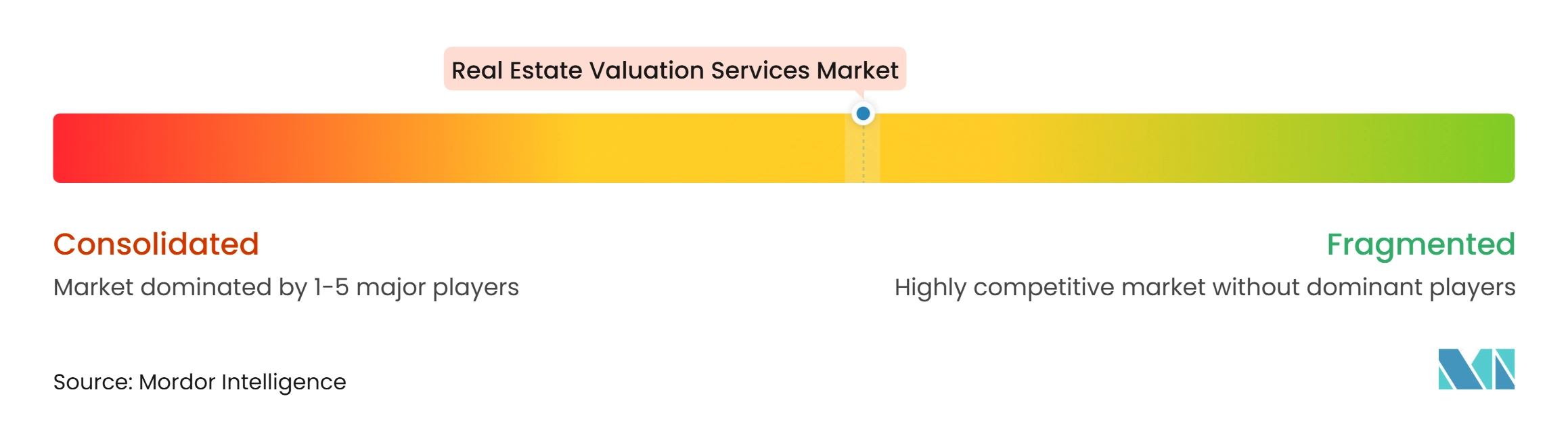
The real estate valuation services market is moderately concentrated, with diversified commercial real estate platforms competing alongside appraisal management companies, boutique advisory firms, and independent practitioners. Large providers differentiate through geographic coverage, data assets, specialist expertise, and consistent workflows for institutional clients. Local specialists retain valuable market knowledge and close client relationships, but they may face a greater burden when clients require standardized data, audit records, and delivery across several markets. Technology has greater value when it improves collection, review, analysis, and reporting while keeping qualified professional judgment in control. RICS guidance on artificial intelligence confirms that professional oversight remains essential in surveying and valuation work.
Kroll launched its Real Estate Valuation Solution in March 2026, using workflow management, benchmarking, and audit-ready records to serve complex commercial portfolios. JLL used Datasense for commercial lending assignments and reported faster turnaround for selected office, retail, and industrial properties. Cushman & Wakefield adopted ARGUS Intelligence for global valuation and performance workflows in January 2026. These examples show why process transparency and data consistency are becoming part of the real estate valuation services market offer alongside traditional appraisal quality. They also raise the investment requirement for firms pursuing large institutional mandates.
Acquisitions are extending geographic reach and specialist capacity. Newmark completed 4 valuation acquisitions in 2026, including L+P Immobilienbewertungs GmbH in Germany, to expand coverage for institutional investors, banks, and fund managers. RINA Prime acquired Gloval in Spain in July 2026 and combined it with Prime Yield to expand its European platform. Southeast Asia, Gulf Cooperation Council markets, data centers, infrastructure, and healthcare property remain areas where specialist operational knowledge can create opportunities. At the same time, Dealpath’s partnership with Cushman & Wakefield illustrates the growing importance of data-sharing platforms.
Real Estate Valuation Services Industry Leaders
-
CBRE Group, Inc.
-
Jones Lang LaSalle Incorporated
-
Cushman & Wakefield plc
-
Colliers International Group Inc.
-
Savills plc
- *Disclaimer: Major Players sorted in no particular order
Real Estate Valuation Services Market Companies Covered in this Report
- CBRE Group, Inc.
- Jones Lang LaSalle Incorporated
- Cushman & Wakefield plc
- Colliers International Group Inc.
- Savills plc
- Knight Frank LLP
- Newmark Group, Inc.
- Avison Young Inc.
- Integra Realty Resources, Inc.
- Kroll, LLC
- Deloitte Touche Tohmatsu Limited
- PricewaterhouseCoopers International Limited
- Ernst & Young Global Limited
- BDO USA, P.A.
- Grant Thornton International Ltd
- Valbridge Property Advisors, Inc.
- Anarock Property Consultants Private Limited
- Stout Risius Ross, LLC
- Opteon Solutions
Recent Industry Developments in Real Estate Valuation Services Market
- August 2026: Newmark Group, Inc. acquired L+P Immobilienbewertungs GmbH, a German full-service real estate valuation firm with more than 40 professionals serving institutional investors, banks, and fund managers across Europe. The deal was Newmark’s 4th valuation acquisition in 2026, following Catella Valuation Advisory in France, the Altus Group Canadian Appraisals business, and einwert in Germany.
- July 2026: RINA Prime completed the acquisition of Gloval, a Spanish real estate valuation operator. Gloval and Prime Yield, a Gloval Group subsidiary operating in Portugal, were integrated into the combined RINA Prime platform. The transaction expanded a data-led European valuation platform and brought the value of assets monitored and valued by the combined platform to more than USD 27.5 billion in the supplied source material.
- May 2026: Cushman & Wakefield was appointed as valuer of SEGRO's UK portfolio under a five-year contract. The portfolio covered more than 27.7 million sq. ft. of modern warehousing, industrial properties, data centres and development land, including Slough Trading Estate, Europe's largest trading estate in single ownership. The first biannual valuation was scheduled for June 2026 and subsequently reflected in SEGRO's half-year valuation reporting. The mandate demonstrated the scale, long duration, and broad asset coverage associated with institutional portfolio valuation assignments.
Global Real Estate Valuation Services Market Report Scope
Segmentation Overview
| Residential Property Valuation |
| Commercial Property Valuation |
| Industrial Property Valuation |
| Land Valuation |
| Other Valuation Services |
| Property Sales |
| Mortgage and Lending |
| Others |
| Individuals / Households |
| Corporates & SMEs |
| Others |
| North America | United States |
| Canada | |
| Mexico | |
| South America | Brazil |
| Argentina | |
| Chile | |
| Rest of South America | |
| Europe | United Kingdom |
| Germany | |
| France | |
| Italy | |
| Spain | |
| Russia | |
| Rest of Europe | |
| Asia - Pacific | China |
| India | |
| Japan | |
| South Korea | |
| Australia | |
| Rest of Asia - Pacific | |
| Middle East and Africa | United Arab Emirates |
| Saudi Arabia | |
| South Africa | |
| Nigeria | |
| Rest of Middle East & Africa |
| By Property Type | Residential Property Valuation | |
| Commercial Property Valuation | ||
| Industrial Property Valuation | ||
| Land Valuation | ||
| Other Valuation Services | ||
| By Application | Property Sales | |
| Mortgage and Lending | ||
| Others | ||
| By Client Type | Individuals / Households | |
| Corporates & SMEs | ||
| Others | ||
| By Geography | North America | United States |
| Canada | ||
| Mexico | ||
| South America | Brazil | |
| Argentina | ||
| Chile | ||
| Rest of South America | ||
| Europe | United Kingdom | |
| Germany | ||
| France | ||
| Italy | ||
| Spain | ||
| Russia | ||
| Rest of Europe | ||
| Asia - Pacific | China | |
| India | ||
| Japan | ||
| South Korea | ||
| Australia | ||
| Rest of Asia - Pacific | ||
| Middle East and Africa | United Arab Emirates | |
| Saudi Arabia | ||
| South Africa | ||
| Nigeria | ||
| Rest of Middle East & Africa | ||
Key Questions Answered in the Report
What is the projected size of the real estate valuation services market in 2032?
The sector is projected to reach USD 18.3 billion by 2032, expanding at a 6.72% CAGR from 2027 to 2032.
Which property type leads valuation demand?
Residential property valuation leads, with 39% of revenue in 2026. Commercial property valuation is the fastest-growing property category at a 7.6% CAGR through 2032
Why are institutional clients increasing their use of valuation services?
Portfolio reporting, net asset value monitoring, audit support, and financial reporting require recurring and documented property assessments. These needs continue even when transaction activity slows.
What is changing in U.S. mortgage appraisal work?
UAD 3.6 became mandatory for government-sponsored enterprise appraisal submissions on November 2, 2026. The requirement increases the need for structured property data, digital workflows, and documented review trails.
Which region is expected to grow fastest?
Asia-Pacific is forecast to grow at an 8.29% CAGR through 2032, supported by institutional investment and ongoing reporting needs. Investment structures in India and China also support regular asset and portfolio valuations.
What is the main operational constraint for valuation providers?
A shortage of credentialed valuers can lengthen turnaround times and limit capacity, especially when lending and transaction volumes rise. This raises the value of efficient technology-supported workflows and professional supervision.