
Rapid Infuser Market Size and Share
Market Overview
| Study Period | 2021 - 2032 |
|---|---|
| Market Size (2027) | USD 1.29 Billion |
| Market Size (2032) | USD 1.78 Billion |
| Growth Rate (2027 - 2032) | 6.72 % |
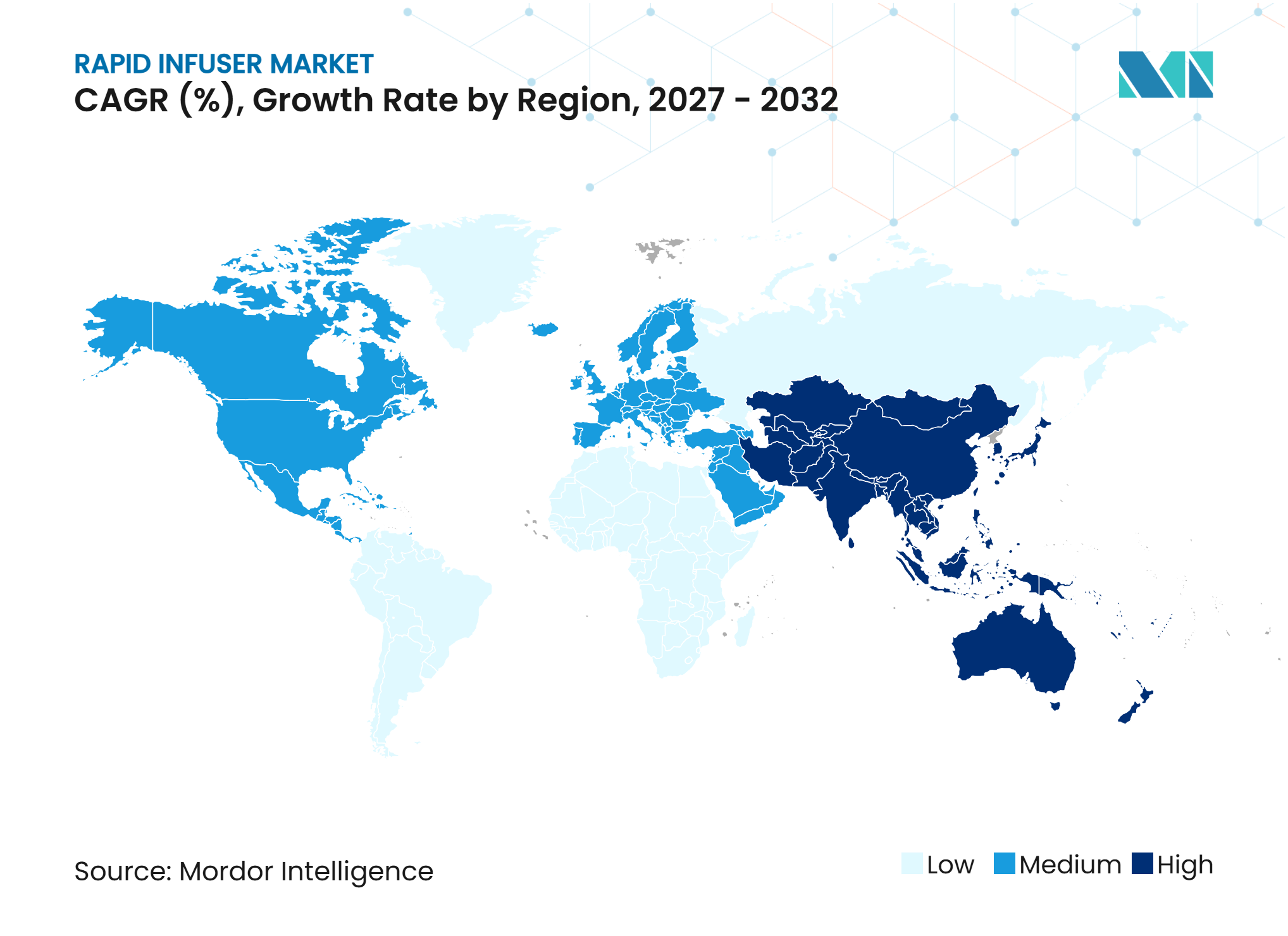
| Fastest Growing Market | Asia-Pacific |
| Largest Market | North America |
| Market Concentration | Medium |
Major Players *Disclaimer: Major Players sorted in no particular order Image © Mordor Intelligence. Reuse requires attribution under CC BY 4.0. | |
Rapid Infuser Market Analysis by Mordor Intelligence
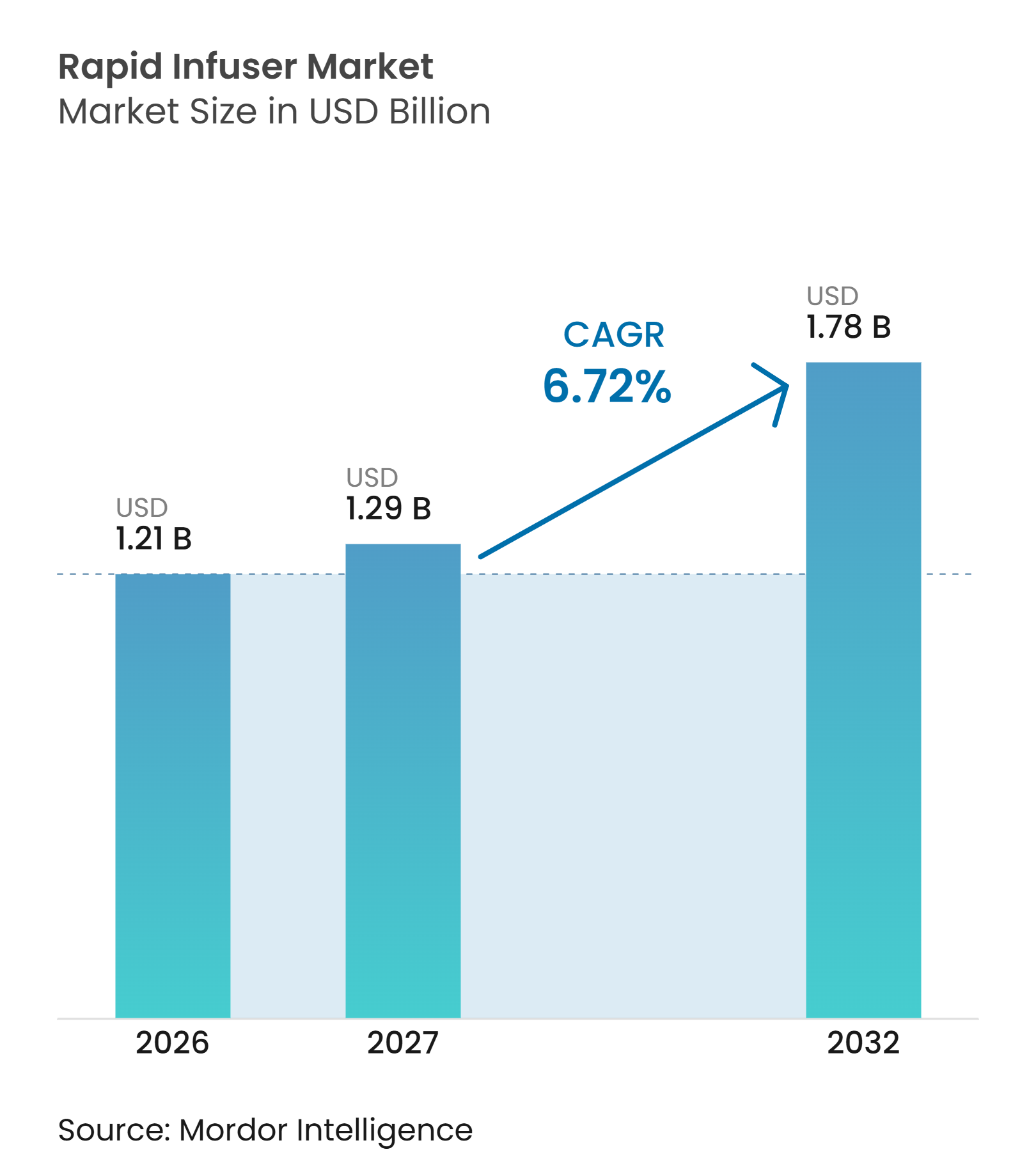
The Rapid Infuser Market size is expected to grow from USD 1.21 billion in 2026 to USD 1.29 billion in 2027 and is forecast to reach USD 1.78 billion by 2032 at 6.72% CAGR over 2027-2032.
The rapid infuser market is supported by the need to replace blood and fluids quickly during trauma care, complex surgery, and obstetric emergencies. Clinical protocols increasingly link high-volume fluid administration with active warming and air management, which favors systems that combine delivery speed with patient safety features. Patient blood management programs are also making fluid and blood delivery a more formal part of care pathways, widening the addressable base across hospitals and surgical facilities. Procurement is moving in two directions, with hospitals retaining demand for high-capacity trolley systems while emergency medical services, military users, and ambulatory centers seek compact equipment. The rapid infuser market also faces a practical constraint because equipment, servicing, and proprietary disposable sets can create a high lifetime cost for facilities with limited budgets.
Key Report Takeaways
- By product type, trolley-mounted systems held 72.58% of the rapid infuser market share in 2026, while handheld systems are projected to grow at a 7.24% CAGR through 2032.
- By component, rapid infuser systems held 60.35% of the rapid infuser market share in 2026, while disposable sets and accessories are projected to grow at a 7.69% CAGR through 2032.
- By application, trauma and emergency care held 32.47% of the rapid infuser market size in 2026, while labor and delivery is projected to grow at an 8.21% CAGR through 2032.
- By end user, hospitals held 46.38% of the rapid infuser market size in 2026, while ambulatory surgical centers are projected to grow at an 8.58% CAGR through 2032.
- By geography, North America held 37.48% of the rapid infuser market share in 2026, while Asia-Pacific is projected to grow at a 9.43% CAGR through 2032.
Note: Market numbers in this report are based on Mordor Intelligence's proprietary estimation framework, which combines nine months of actuals with Q4 projections for base year 2026.
Market Trends and Insights
Drivers Impact Analysis of Rapid Infuser Market of Rapid Infuser Market*
| Driver | (~) % Impact on CAGR Forecast | Geographic Relevance | Impact Timeline |
|---|---|---|---|
| Rising Trauma and Emergency Cases | +1.5% | Global, with intensity in North America, Europe, and Asia-Pacific | Short term (≤ 2 years) |
| Growing Complex Surgical Procedures | +1.3% | Global, particularly North America and Asia-Pacific | Medium term (2-4 years) |
| Prevention of Perioperative Hypothermia | +1.1% | Global | Medium term (2-4 years) |
| Patient Blood Management Protocols | +0.9% | North America and Europe, with spillover to Asia-Pacific and Middle East and Africa | Medium term (2-4 years) |
| Continuum of Care From Point of Injury to Operating Room | +0.7% | North America, Europe, and conflict-affected Middle East and Africa | Short term (≤ 2 years) |
| Preference for Aluminum-Free Fluid Paths | +0.5% | Global, with early gains in Europe and North America | Long term (≥ 4 years) |
| Source: Mordor Intelligence | |||
Rising Volume of Trauma and Emergency Cases
Injury-related emergency demand is a durable driver for the rapid infuser market because hemorrhage and shock require rapid, controlled volume replacement. ImageTrend recorded 2,317,428 injury-related emergency medical service responses in the United States during 2025, equal to 18.6% of activations, compared with 17.9% in 2023. The changing mix of patients also matters because older trauma patients can require careful temperature control while receiving blood and fluids. In California, emergency department visits at trauma centers increased 114% from 2003 to 2023, with substantial growth at Level III and Level IV facilities. This wider use of trauma facilities can extend demand beyond the largest academic centers into regional hospitals. The rapid infuser market therefore benefits from both a higher case volume and a broader distribution of high-acuity care.
Growing Number of Complex Surgical Procedures
Complex procedures are moving into ambulatory surgical centers, which changes where the rapid infuser market can compete rather than reducing clinical demand. U.S. spinal surgery volumes in ambulatory surgical centers grew nearly 8% annually between 2021 and 2024, based on data presented by the American Academy of Orthopedic Surgeons. The American Society of Plastic Surgeons reported that cosmetic procedures rose 7% in 2025 and reconstructive procedures increased 6%. Greater procedural complexity raises the need for equipment that can manage rapid fluid delivery and warming when blood loss risks arise. Facilities with smaller capital budgets are more likely to assess handheld or space-efficient trolley units than large systems designed for major operating rooms. This creates an opening for suppliers that adjust pricing, training, and service packages to the ambulatory setting.
Focus on Prevention of Perioperative Hypothermia
Active warming during large-volume fluid administration is becoming a more defined clinical requirement in the rapid infuser market. AORN guidance places continuous temperature management across the perioperative period within core nursing practice.[1] A 2025 British Journal of Anesthesia study found that warming fluids to at least 37°C at high flow rates was important to reduce hypothermia-related risks.[2] TSC Life received FDA 510(k) clearance in 2025 for its Fluido AirGuard System, which offers up to 800 mL per minute and automatic air detection. These specifications show why temperature performance and air management have become important points of product differentiation. Hospitals can use this clinical focus to standardize equipment selection across operating rooms, trauma bays, and labor and delivery units.
Adoption of Patient Blood Management Protocols
Patient blood management is expanding the clinical role of rapid infusion equipment across preoperative, intraoperative, and postoperative care. An AABB survey of 274 facilities across 5 World Health Organization regions found that 50.2% of North American respondents had formal patient blood management programs, compared with 37.8% in 2013. The same survey found that 61.7% of respondents provided patient blood management training.[3] World Health Organization guidance provides a three-phase approach for implementing patient blood management across different resource settings.[4] Formal protocols can make requirements for blood, fluids, warming, and monitoring more visible during procurement. The rapid infuser market can benefit when hospitals translate these protocols into standardized equipment pathways.
Restraints Impact Analysis of Rapid Infuser Market of Rapid Infuser Market*
| Restraint | (~) % Impact on CAGR Forecast | Geographic Relevance | Impact Timeline |
|---|---|---|---|
| High Equipment Acquisition and Maintenance Costs | -1.0% | Global, with highest pressure in Asia-Pacific and South America | Short term (≤ 2 years) |
| Limited Adoption in Smaller Healthcare Facilities | -0.7% | Global, particularly South America, Middle East and Africa, and rural Asia-Pacific | Long term (≥ 4 years) |
| Legacy Device Safety and Material Compatibility Scrutiny | -0.5% | Global, with intensity in North America and Europe | Medium term (2-4 years) |
| Disposable-Set Lock-In and Cross-Platform Incompatibility | -0.4% | Global | Medium term (2-4 years) |
| Source: Mordor Intelligence | |||
High Equipment Acquisition and Maintenance Costs
Capital cost is a material barrier to faster adoption in the rapid infuser market, especially for smaller providers and price-sensitive health systems. A UK government procurement notice listed a Belmont rapid blood and fluid infuser at GBP 46,663, equivalent to USD 58,700 in the source draft. The initial purchase is only part of the commitment because facilities also need training, maintenance, and compatible disposable sets. These costs can be difficult to absorb when reimbursement is constrained, or case volumes do not justify a dedicated device. Procurement teams also face limited flexibility after selecting a platform, because disposable sets and accessories may not work across competing systems. The rapid infuser market will need financing options, lower-footprint systems, and transparent service terms to improve access in these settings.
Limited Adoption in Smaller Healthcare Facilities
Rapid infuser use remains concentrated in large trauma centers, teaching hospitals, and urban surgical facilities. A 2025 Annals of Surgery analysis cited in the source draft found that the lowest-quintile Level I trauma centers averaged fewer than 2 hemorrhage control procedures per month. Low procedure density can make a dedicated system difficult to justify even when clinical need is present. Portable systems may reduce infrastructure requirements because they can support faster prehospital fluid administration without fixed power. The World Health Organization provides patient blood management guidance for different resource settings, but it does not prescribe capital equipment or purchasing models. This leaves a policy and procurement gap that can slow adoption in rural and secondary care facilities.
*Our forecasts treat driver/restraint impacts as directional, not additive. The impact forecasts reflect baseline growth, mix effects, and variable interactions.
Rapid Infuser Market Segment Analysis
By Product Type:
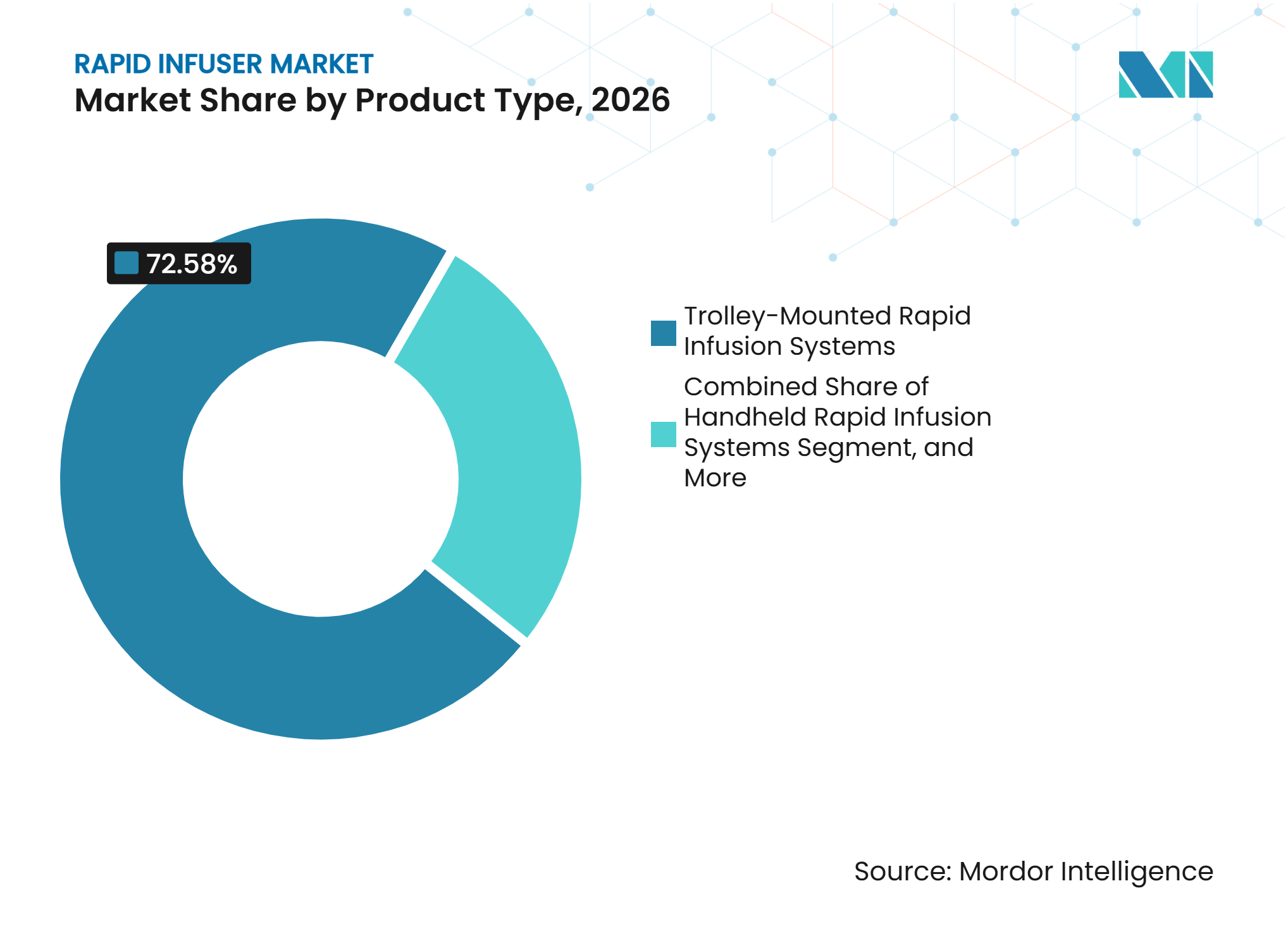
Handheld Systems Gaining Ground on Dominant Trolley PlatformsTrolley-mounted systems held 72.58% of the rapid infuser market share in 2026, reflecting their established role in operating rooms, surgical suites, and trauma bays. Their position depends on high sustained flow capacity, integrated warming, and safety functions that suit fixed clinical infrastructure. TSC Life states that the Fluido AirGuard System can deliver up to 800 mL per minute and uses automatic air detection. Accessories retain demand because they are linked to the installed system base and related service agreements. This structure supports recurring demand for suppliers that retain long-term hospital accounts.
Handheld systems are projected to expand at a 7.24% CAGR through 2032, making them the faster-moving product category. Their relevance is strongest in prehospital care, military medicine, and remote settings where fixed power and large trolley systems are less practical. The U.S. Army reported a 2025 exercise in which the 173rd Airborne Brigade used drones to reduce risk in blood resupply missions. The civilian value proposition follows the same direction because emergency teams need reliable fluid delivery before patients reach the operating room. Trolley and handheld platforms therefore serve different care settings rather than representing a direct replacement cycle.


By Component:
Disposable Sets Building a Recurring Demand BaseRapid infuser systems held 60.35% of the component segment in 2026, showing that capital equipment remains central to installed-base growth. The equipment sale often establishes later demand for compatible disposable sets, service, and accessories. Manchester University NHS Foundation Trust awarded a 2025 contract for rapid infuser consumables valued at GBP 126,642, equivalent to USD 159,000 in the source draft. The contract illustrates why suppliers value the consumable tail that follows placement of a system. It also explains why procurement teams examine lifetime cost rather than only the device purchase price.
Disposable sets and accessories are projected to grow at a 7.69% CAGR through 2032. Single-use fluid paths can support infection control, validated performance, and predictable set-up during urgent procedures. QinFlow identifies a stainless-steel coil and aluminum-free fluid path as a feature of its Warrior platform. Material compatibility and biocompatibility testing under ISO 10993 can raise the entry threshold for generic alternatives. EU Medical Device Regulation and FDA 510(k) requirements add to this technical burden for suppliers entering regulated markets. The resulting platform dependence supports OEM revenue but also drives hospital interest in interoperability.
By Application:
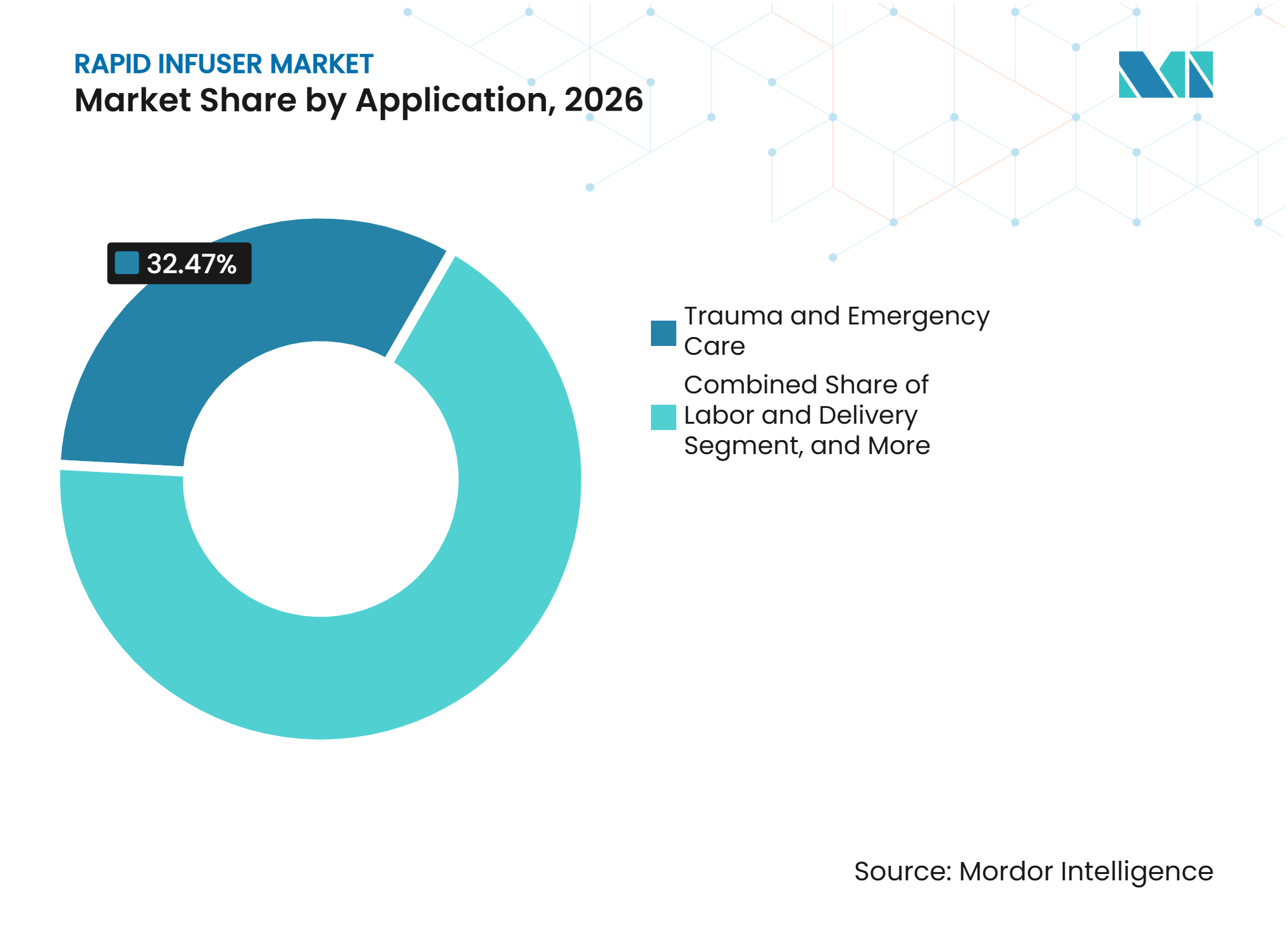
Labor and Delivery Growing From a High Trauma BaseTrauma and emergency care accounted for 32.47% of the rapid infuser market size in 2026. Hemorrhagic shock creates an immediate need for high-flow resuscitation, particularly when blood loss and hypothermia risks occur together. The need for warming at high flow rates is supported by the 2025 in vitro analysis in the British Journal of Anesthesia. Anesthesia and surgical care remain established uses, while intensive care demand can rise as patient blood management protocols become more formal. Other specialty and recovery applications contribute incremental volume as more facilities standardize emergency fluid-delivery practices.
Labor and delivery is projected to grow at an 8.21% CAGR through 2032. The World Health Organization published consolidated postpartum hemorrhage guidelines in 2025, and the source draft identifies rapid IV fluid delivery within 15 minutes as part of the MOTIVE treatment bundle. A 2025 Lancet Global Health publication reported that early bundle application reduced adverse postpartum hemorrhage outcomes by 60%. Obstetric care requires both rapid volume replacement and temperature management because hypothermia can worsen coagulopathy. This gives suppliers an incentive to support obstetric-specific education and performance evidence.

By End User:
Ambulatory Surgical Centers Emerging as the Fastest-Growing Facility SegmentHospitals held 46.38% of the rapid infuser market size in 2026. The concentration of trauma centers, complex surgical programs, intensive care capacity, and labor and delivery services supports their position. Hospital purchasing can support higher-capacity equipment because these sites manage frequent high-acuity cases. Large facilities are also better positioned to maintain biomedical engineering support and disposable inventory. This makes hospitals the core installed-base channel for established rapid infusion manufacturers.
Ambulatory surgical centers are projected to grow at an 8.58% CAGR through 2032. Medicare-certified ambulatory surgical centers totaled 6,299 in 2023, up 13% from 2017, while Medicare payments reached USD 6.8 billion in the source data. Greater use of outpatient spinal, cardiovascular, and orthopedic procedures raises demand for equipment that can address fluid management risks in a compact setting. The rapid infuser industry has an opportunity to tailor product design, operator training, and pricing to these facilities. Systems with a smaller footprint and simple workflows may be better aligned with ambulatory use than large platforms built for hospital operating rooms.
Geography Analysis
North America
North America accounted for 37.48% of the rapid infuser market share in 2026. The region benefits from a dense trauma network, broad patient blood management adoption, and reimbursement structures that support critical-care device procurement. Trauma-center emergency department volumes in California rose 114% between 2003 and 2023, with growth extending to Level III and IV centers. This supports demand beyond the largest Level I institutions. Ground-based blood transfusions increased from 5% to 10% of emergency medical service activations between 2023 and 2025. The FDA 510(k) pathway continues to influence product iteration and market access. Belmont Medical Technologies appointed Brian Larkin as chief executive officer in February 2026, reflecting an active period of commercial and product strategy development. The region therefore combines established hospital demand with growing prehospital use of portable platforms.
Asia-Pacific
Asia-Pacific is projected to grow at a 9.43% CAGR through 2032, the fastest regional pace in the rapid infuser market. Healthcare modernization, aging populations, and higher surgical volumes support demand across major economies. Shandong University Qilu Hospital issued a 2025 procurement notice with a CNY 13.5 million budget for a pressurized blood and fluid warming infusion system, equivalent to USD 1.86 million in the source draft. National Medical Products Administration requirements influence China’s device environment, while India’s Central Drugs Standard Control Organization shapes local compliance expectations. These requirements can favor manufacturers with established documentation and traceability capabilities. The region also has a wide range of hospital capabilities, which increases the relevance of both high-capacity and portable products. Suppliers must balance premium tertiary hospital demand with affordability requirements in secondary facilities.
Europe, Middle East and Africa, South America, and Australia
Europe remains a major buyer base because hospitals have established surgical capacity and formal procurement systems. EU Medical Device Regulation compliance remains an important factor for device and consumable suppliers, particularly where CE marking and technical documentation affect market access. In the United Kingdom, government procurement notices show continuing purchases of rapid infusion equipment and consumables. Gulf Cooperation Council markets can support premium equipment purchases through healthcare investment programs, while many sub-Saharan facilities depend on imported, lower-cost devices. Public procurement budgets constrain South American demand, although private hospital growth and postpartum hemorrhage protocols can support selective uptake. Australia’s government and Baxter Healthcare Australia announced an AUD 40 million investment in local IV fluid manufacturing in 2025, equal to USD 25.3 million in the source draft. This strengthens the local IV fluid supply ecosystem that supports rapid infusion procedures. These varied conditions require suppliers to adapt distribution, servicing, and pricing by healthcare system.
Competitive Landscape
Market Concentration

The rapid infuser market is moderately consolidated around specialized manufacturers and diversified medical device suppliers. Belmont Medical Technologies, QinFlow, and The Surgical Company International B.V. compete through established clinical use, product performance, and service relationships. Belmont’s RI-2 platform uses electromagnetic induction heating and has a meaningful installed base in hospital procurement networks. UK public notices also show ongoing procurement of Belmont systems and related consumables. Long-term service and disposable agreements create recurring revenue for suppliers with installed systems. This dynamic can limit the ability of a new supplier to displace an incumbent based only on equipment price.
Product differentiation centers on air management, fluid-path materials, warming performance, and high-flow precision. TSC Life received FDA 510(k) clearance for the Fluido AirGuard System in 2025, adding a high-flow warming system with automatic air detection to the U.S. market. QinFlow promotes an aluminum-free fluid path in its Warrior platform, responding to material compatibility concerns. ICU Medical received FDA 510(k) clearance for Plum Solo and Plum Duo precision IV pumps in April 2025, with EHR interoperability through its LifeShield platform. These adjacent infusion systems illustrate demand for connected critical-care workflows. Suppliers that combine clinical performance with data connectivity may gain a stronger position in large health systems.
Defense and prehospital channels are becoming more relevant to competition in the rapid infuser market. The U.S. Army’s 2025 drone-assisted blood resupply exercise shows the operational importance of rapid blood delivery closer to the point of injury. This supports the value of compact platforms that can function across military and civilian emergency environments. Manufacturers must also respond to hospital concerns about proprietary disposable sets and cross-platform incompatibility. Strong regulatory portfolios under FDA and EU Medical Device Regulation frameworks can protect incumbents while raising expectations for new entrants. The competitive picture remains balanced because no supplier in the draft is shown to control every product format, clinical setting, and regional channel.
Rapid Infuser Industry Leaders
-
410 Medical Inc.
-
Barkey GmbH & Co. KG
-
Biegler GmbH
-
ICU Medical Inc.
-
QinFlow Ltd
- *Disclaimer: Major Players sorted in no particular order
Rapid Infuser Market Companies Covered in this Report
- 3M
- 410 Medical, Inc.
- Barkey
- Belmont Medical Technologies
- Biegler
- Enthermics Medical Systems
- Foshan Keewell Medical Technology Co. Ltd
- Geratherm Medical
- ICU Medical
- Life Warmer Inc.
- MEQU A/S
- Piramal Critical Care
- QinFlow Ltd
- Quality in Flow Ltd
- Sebel Medical Electronics Co. Ltd
- Sino Medical-Device Technology
- Stryker
- The Surgical Company International BV
- ThermoSens Medical
- Vyaire Medical
Recent Industry Developments in Rapid Infuser Market
- October 2026: Fresenius Kabi joined Vizient's Reserve Program to expand supply assurance for critical IV fluids, providing U.S. healthcare organizations with dedicated, U.S.-based inventory covering 13 critical IV fluid products. This partnership reinforces the market's attention to supply-chain resilience for fluid delivery systems following the Hurricane Helene disruptions of late 2024.
- September 2025: TSC Life received U.S. FDA 510(k) clearance for the Fluido AirGuard System, a moderate-to-high-flow blood and IV fluid warmer capable of delivering up to 800 mL/min, or 48 L/hr. The system features automatic air detection and IV-line clamping to prevent outgassing-related air embolism.
- September 2025: ICU Medical received new FDA 510(k) clearance for the Clave portfolio of needlefree IV connectors, with a new labeling claim citing a 19% lower relative risk of central line-associated bloodstream infection in acute care hospitals with high Clave utilization, unifying MicroClave, NanoClave, and Clave Neutron under a single regulatory submission.
Global Rapid Infuser Market Report Scope
As per the report scope, a rapid infuser is a specialized medical device designed to rapidly deliver large volumes of blood, blood products, and intravenous fluids to patients experiencing severe blood loss, shock, or critical illness. These systems often incorporate fluid-warming technology to prevent hypothermia during transfusions and emergency resuscitation. Rapid infusers are commonly used in trauma centers, operating rooms, intensive care units, and obstetric emergencies to support timely hemodynamic stabilization.
The rapid infuser market is segmented by product type, component, application, end user, and geography. By product type, the market is segmented into trolley-mounted rapid infusion systems, handheld rapid infusion systems, and accessories. By component, the market is segmented into rapid infuser systems and disposable sets and accessories. By application, the market is segmented into trauma and emergency care, anesthesia, surgical care, labor and delivery, intensive care, and others. By end user, the market is segmented into hospitals, ambulatory surgical centers, specialty clinics, and others. By geography, the market is segmented into North America, Europe, Asia-Pacific, the Middle East and Africa, and South America. The market report also covers estimated market sizes and market trends for 17 countries across major regions worldwide. The report offers market value (in USD) for the above segments.
Segmentation Overview
| Trolley-Mounted Rapid Infusion Systems |
| Handheld Rapid Infusion Systems |
| Accessories |
| Rapid Infuser Systems |
| Disposable Sets and Accessories |
| Trauma and Emergency Care |
| Anesthesia |
| Surgical Care |
| Labor and Delivery |
| Intensive Care |
| Others |
| Hospitals |
| Ambulatory Surgical Centers (ASCs) |
| Specialty Clinics |
| Others |
| North America | United States |
| Canada | |
| Mexico | |
| Europe | Germany |
| United Kingdom | |
| France | |
| Italy | |
| Spain | |
| Rest of Europe | |
| Asia-Pacific | China |
| India | |
| Japan | |
| Australia | |
| South Korea | |
| Rest of Asia-Pacific | |
| Middle East and Africa | GCC |
| South Africa | |
| Rest of Middle East and Africa | |
| South America | Brazil |
| Argentina | |
| Rest of South America |
| By Product Type | Trolley-Mounted Rapid Infusion Systems | |
| Handheld Rapid Infusion Systems | ||
| Accessories | ||
| By Component | Rapid Infuser Systems | |
| Disposable Sets and Accessories | ||
| By Application | Trauma and Emergency Care | |
| Anesthesia | ||
| Surgical Care | ||
| Labor and Delivery | ||
| Intensive Care | ||
| Others | ||
| By End User | Hospitals | |
| Ambulatory Surgical Centers (ASCs) | ||
| Specialty Clinics | ||
| Others | ||
| By Geography | North America | United States |
| Canada | ||
| Mexico | ||
| Europe | Germany | |
| United Kingdom | ||
| France | ||
| Italy | ||
| Spain | ||
| Rest of Europe | ||
| Asia-Pacific | China | |
| India | ||
| Japan | ||
| Australia | ||
| South Korea | ||
| Rest of Asia-Pacific | ||
| Middle East and Africa | GCC | |
| South Africa | ||
| Rest of Middle East and Africa | ||
| South America | Brazil | |
| Argentina | ||
| Rest of South America | ||
Key Questions Answered in the Report
What is the projected value of the rapid infuser sector by 2032?
The rapid infuser market is projected to reach USD 1.78 billion by 2032, rising at a 6.72% CAGR from 2027.
Which rapid infuser product format has the largest share?
Trolley-mounted systems hold the largest product share at 72.58% in 2026 because they are widely used in operating rooms and trauma bays.
Which application is expected to grow fastest for rapid infusion devices?
Labor and delivery is projected to grow at an 8.21% CAGR through 2032, supported by postpartum hemorrhage protocols and rapid fluid delivery needs.
Why are ambulatory surgical centers relevant to rapid infusion suppliers?
Ambulatory surgical centers are projected to grow at an 8.58% CAGR through 2032 as more complex outpatient procedures create demand for compact fluid-management equipment.
Which region is expected to grow fastest for rapid infusion equipment?
Asia-Pacific is expected to grow at a 9.43% CAGR through 2032, supported by healthcare modernization, surgical demand, and aging populations.
What limits wider adoption of rapid infuser systems?
High equipment and maintenance costs, lower procedure volumes in smaller facilities, and proprietary disposable-set requirements can limit adoption.