
Ransomware Recovery Services Market Size and Share
Market Overview
| Study Period | 2020 - 2031 |
|---|---|
| Market Size (2026) | USD 10.27 Billion |
| Market Size (2031) | USD 19.98 Billion |
| Growth Rate (2026 - 2031) | 14.24 % |
| Fastest Growing Market | Asia-Pacific |
| Largest Market | North America |
| Market Concentration | Medium |
Major Players *Disclaimer: Major Players sorted in no particular order Image © Mordor Intelligence. Reuse requires attribution under CC BY 4.0. | |
Ransomware Recovery Services Market Analysis by Mordor Intelligence
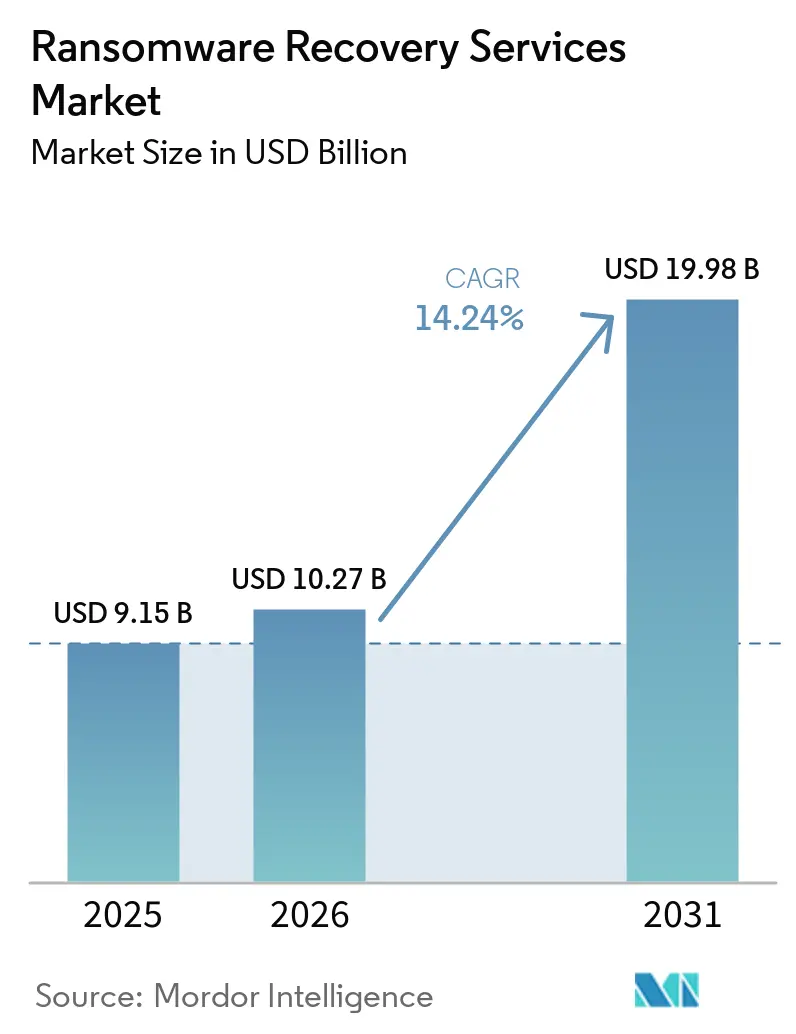
The ransomware recovery services market size was valued at USD 9.15 billion in 2025 and estimated to grow from USD 10.27 billion in 2026 to reach USD 19.98 billion by 2031, at a CAGR of 14.24% during the forecast period (2026-2031). Ransomware attacks increasingly combine encryption, data theft, service disruption, and direct contact with stakeholders, which increases the operational and legal burden on affected organizations. The ransomware recovery services market is supported by attacks on backup environments, including volume shadow copies, backup data stores, and administrator accounts, because these actions restrict self-managed restoration. Lower reliance on backups for actual recovery also leaves more organizations dependent on specialist support after an incident. Tighter cyber-insurance conditions are making immutable backups, recovery testing, and readiness programs more common procurement requirements. Platform vendors, backup specialists, and forensic firms are responding through acquisitions, partnerships, and integrated recovery workflows, while the ransomware recovery services market widens among smaller organizations that need more accessible managed services.
Key Report Takeaways
- By service type, decryption and specialist data recovery held 36.71% of the ransomware recovery services market share in 2025, while ransomware recovery readiness, testing, and exercises is projected to expand at an 18.39% CAGR through 2031.
- By delivery model, remote held 58.64% of revenue in 2025, while hybrid is projected to expand at a 19.27% CAGR through 2031.
- By organization size, large enterprises accounted for 67.31% of ransomware recovery services market revenue in 2025, while SMEs are projected to expand at a 21.83% CAGR through 2031.
- By industry vertical, BFSI held 27.34% of revenue in the ransomware recovery services market in 2025, while the healthcare and life sciences industry is projected to expand at a 22.51% CAGR through 2031.
- By geography, North America accounted for 37.48% of revenue in 2025, while Asia-Pacific is projected to expand at a 19.79% CAGR through 2031 in the ransomware recovery services market.
Note: Market size and forecast figures in this report are generated using Mordor Intelligence’s proprietary estimation framework, updated with the latest available data and insights as of January 2026.
Global Ransomware Recovery Services Market Trends and Insights
Drivers Impact Analysis*
| DRIVER | (~) % IMPACT ON CAGR FORECAST | GEOGRAPHIC RELEVANCE | IMPACT TIMELINE |
|---|---|---|---|
| Escalation of Double- and Triple-Extortion Attacks | +3.5% | Global | Short term (≤ 2 years) |
| Expansion of Ransomware-as-a-Service and Access-Broker Ecosystems | +2.8% | Global | Short term (≤ 2 years) |
| Regulatory Pressure for Tested Cyber Recovery | +2.5% | North America and EU, spill-over to APAC | Medium term (2-4 years) |
| Cloud and Multicloud Workload Expansion | +2% | Global | Medium term (2-4 years) |
| Backup Targeting Creates Demand for Immutable Recovery | +1.5% | Global | Short term (≤ 2 years) |
| Cyber-Insurance Requirements for Demonstrable Recovery Readiness | +1.2% | North America and EU | Medium term (2-4 years) |
| Source: Mordor Intelligence | |||
Escalation of Double- and Triple-Extortion Attacks
Advanced ransomware groups now combine encryption with data exfiltration, distributed denial-of-service attacks, and direct outreach to stakeholders in a single campaign. This approach shortens the time available for a victim to respond and broadens the consequences beyond system availability. Chainalysis recorded a 50% year-over-year increase in leak-site-claimed victims during 2025, even as on-chain ransomware payments fell to USD 820 million.[1]Chainalysis, “Crypto Ransomware: 2026 Crypto Crime Report,” Chainalysis, chainalysis.com. Sophos found that 56% of attacks encrypted data in 2026, compared with 50% in 2025. Mandiant documented deletion of volume shadow copies, encryption of ESXi data stores, and compromise of backup-administration accounts as pre-encryption steps, which can remove the option of routine restoration. The share of ransoms paid fell to 28%, increasing the need for technical recovery, forensic work, and decryption support as organizations seek payment alternatives.
Expansion of Ransomware-as-a-Service and Access-Broker Ecosystems
Ransomware-as-a-Service and access-broker models spread incident activity across a larger group of operators and affiliates. The closure of LockBit and RansomHub in 2025 was followed by gains for Akira, Qilin, Inc, Safepay, and DragonForce, showing that disruption of one group can shift activity rather than remove it. Initial Access Brokers received at least USD 14 million in on-chain payments during 2025 and enabled ransomware proceeds that were 58 times larger. Average access prices declined from USD 1,427 in Q1 2023 to USD 439 in Q1 2026 as automation, AI-assisted tools, and a greater supply of infostealer logs reduced barriers for affiliates. Lower attack-entry costs can expand the pool of targeted organizations faster than many defensive programs can improve. The ransomware recovery services market, therefore, depends on broad incident demand rather than the continued presence of any single operator brand. This ransomware recovery services market condition keeps recovery capacity relevant when criminal groups change names, tools, or affiliate networks.
Regulatory Pressure for Tested Cyber Recovery
Regulatory requirements are increasingly creating direct demand for recovery readiness services in regulated sectors. The EU Digital Operational Resilience Act has been applied since January 17, 2025, and requires financial entities to maintain tested continuity and backup restoration procedures under Articles 11 and 12.[2]National Institute of Standards and Technology, “Ransomware Risk Management: A Cybersecurity Framework 2.0 Community Profile,” National Institute of Standards and Technology, nist.gov. Supervisory reviews are intensifying in 2026 and will continue into 2027, which makes evidence of tested recovery capability more important for financial entities. The U.S. Cyber Incident Reporting for Critical Infrastructure Act requires reporting of significant cyber incidents within 72 hours and ransomware payments within 24 hours. NIST Interagency Report 8374r1 recommends documented and regularly exercised recovery plans with defined roles. These obligations move recovery readiness from a discretionary technology expense toward a documented requirement that can support recurring service relationships.
Cloud and Multicloud Workload Expansion
Cloud and multicloud adoption have created recovery requirements that differ from traditional on-site restoration. Mandiant found that voice phishing accounted for 23% of initial access vectors in cloud-specific incidents, compared with 11% across all incident types. Recovery teams must address cloud identities, configurations, object-versioning controls, and shared administrative credentials, rather than only file systems and local infrastructure. These conditions require specialized skills and tools that many conventional recovery providers lack. In June 2026, Rubrik introduced Autonomous Business Recovery for Cloud Applications, which discovers application stacks, maps dependencies, and rebuilds minimum viable business environments. The ransomware recovery services market is affected by this productization because some manual cloud recovery work can be shortened, while demand grows for specialists who can manage complex hybrid environments and validate clean restoration. The ransomware recovery services market also needs providers who can coordinate cloud recovery with dependencies across identity, data, and applications.
Restraints Impact Analysis*
| RESTRAINT | (~) % IMPACT ON CAGR FORECAST | GEOGRAPHIC RELEVANCE | IMPACT TIMELINE |
|---|---|---|---|
| Shortage of Recovery Engineers and Forensic Specialists | -1.8% | Global | Long term (≥ 4 years) |
| High Cost and Uncertain Economics of Complex Recovery Engagements | -1.5% | Global | Medium term (2-4 years) |
| Encrypted or Destructive Payloads Can Make Recovery Technically Impossible | -1% | Global | Short term (≤ 2 years) |
| Data-Sovereignty, Chain-of-Custody, and Cross-Border Access Constraints | -0.7% | APAC core, spill-over to EU | Medium term (2-4 years) |
| Source: Mordor Intelligence | |||
Shortage of Recovery Engineers and Forensic Specialists
The shortage of experienced digital forensics and incident response professionals limits service capacity and increases delivery costs. Magnet Forensics found that nearly three-quarters of 368 private-sector DFIR respondents faced recruitment and retention challenges, with 39.4% describing the issue as large or extreme.[3]Magnet Forensics, “State of Enterprise DFIR Report 2026,” Magnet Forensics, magnetforensics.com. SANS reported that 60% of organizations identified skills gaps as their main workforce challenge, compared with 40% that cited headcount shortages. Expert roles requiring 15 or more years of experience took 6 months or longer to fill in 55% of cases. Incumbent providers with established forensic teams can protect service quality, but higher staffing costs can delay purchases among budget-sensitive SMEs. This constraint also makes scalable methods, structured retainers, and recovery automation more important for providers seeking to serve a larger client base. The ransomware recovery services market benefits when scarce expert time is directed to the most complex recovery decisions.
High Cost and Uncertain Economics of Complex Recovery Engagements
Complex ransomware incidents can have uncertain outcomes when data is fully encrypted, backup chains are destroyed, or destructive payloads prevent restoration. Elastio found that 38% of organizations paying more than the initial ransom demand experienced backup failures or malfunctions. Sophos found that 48% of organizations with encrypted data paid ransoms despite having backup-based recovery options. Organizations with 100 to 250 employees stopped attacks before encryption or extortion in 34% of cases, compared with 46% for organizations with 3,001 to 5,000 employees. A resource-intensive engagement without a viable restoration outcome can affect a provider's reputation and make buyers cautious about approving work. The risk is greater for smaller organizations because a failed engagement can create a larger financial disruption relative to their available budgets. The ransomware recovery services market must therefore address buyer concerns about scope, timing, and the practical limits of restoration.
*Our forecasts treat driver/restraint impacts as directional, not additive. The impact forecasts reflect baseline growth, mix effects, and variable interactions.
Segment Analysis
By Service Type: Decryption Leads While Readiness Testing Gains Ground
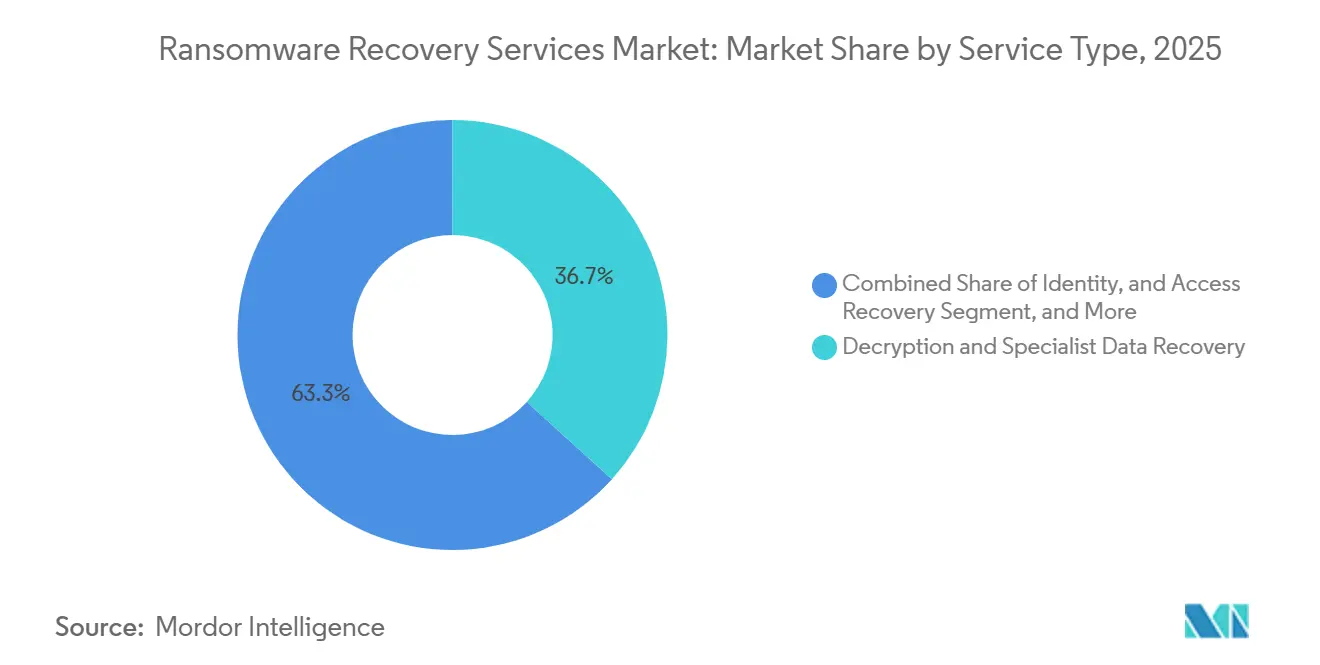
Decryption and specialist data recovery held 36.71% of revenue in 2025. This position reflected continuing demand for expert intervention when encrypted systems could not be restored through self-service methods. Sophos reported that 56% of attacks encrypted data in 2026, sustaining the need for post-incident specialist work.[4]Sophos, “The State of Ransomware in Financial Services 2025,” Sophos, sophos.com. Historically, many organizations purchased recovery support only after an incident had already affected production data and systems. This pattern favors providers that can combine technical analysis with clear recovery priorities for business teams. Emergency Assessment, Triage, Containment, and Eradication often start the engagement by identifying the scope of compromise and limiting further damage. Digital Forensics and Evidence Preservation supports investigation requirements where an organization needs a defensible record of events. Infrastructure, System, Application, and Cloud Restoration remains labor-intensive because restoration can span hybrid systems and continue for several weeks.
The ransomware recovery services market size for ransomware recovery readiness, Testing, and exercises is projected to grow at an 18.39% CAGR between 2026 and 2031. This service is gaining attention as insurers, boards, and regulators request evidence that recovery processes work under realistic conditions. The ransomware recovery services market is responding by offering exercises that make recovery readiness easier for nontechnical decision-makers to evaluate. Tested recovery is becoming a management issue because downtime, contractual commitments, and disclosure obligations can have consequences beyond technology teams. Recovery validation and secure return to operations are increasingly sold after restoration to confirm that systems can resume normal use. Identity, directory, and access recovery are also becoming more important because 79% of attacks began through identity-based approaches. Sophos also found that 67% of victims considered the ransomware incident their most significant identity attack. The September 2026 integration between Rubrik and CrowdStrike reduced identity infrastructure recovery times from days to hours, demonstrating how technology providers are working to improve recovery speed.



By Delivery Model: Remote Delivery Remains Largest as Hybrid Work Expands
Remote held 58.64% of revenue in 2025. It provides a practical model for early triage, endpoint forensics, decryption analysis, threat hunting, identity investigations, and cloud workload restoration. Providers can deploy specialist tools quickly without waiting for staff to travel to the affected location. Remote teams can also manage several engagements at the same time, which supports service capacity during periods of high incident volume. This delivery method remains suitable where secure network access is available and the recovery task does not require physical evidence collection. Its scale and speed mean it is expected to retain a majority position through 2031. The ransomware recovery services market continues to rely on remote access for rapid specialist deployment across dispersed customer locations. Remote response also gives customers an entry point to specialist expertise before deciding whether on-site support is needed.
Hybrid is projected to grow at a 19.27% CAGR between 2026 and 2031, the fastest rate among delivery models. Complex rebuilds can require on-site work for network-attached storage, RAID, SAN arrays, hardware-level forensics, and chain-of-custody-sensitive evidence. Backup use for actual recovery fell to 54% in 2025, a 6-year low, which means more incidents may need deeper intervention after compromised backup chains are discovered. Hybrid delivery combines the speed of remote investigation with physical support when infrastructure conditions require it. On-Site delivery remains necessary in regulated settings where data sovereignty rules restrict transmission of evidence over public networks. It is also relevant to operational technology environments where network access is limited or unsafe. Providers that can move smoothly from remote action to site-based recovery within one workflow can differentiate their service. Smaller specialists may find it difficult to build this coverage at scale, while larger platforms can include it in retainer programs and tiered response models.
By Organization Size: Large Enterprises Lead Revenue While SMEs Expand
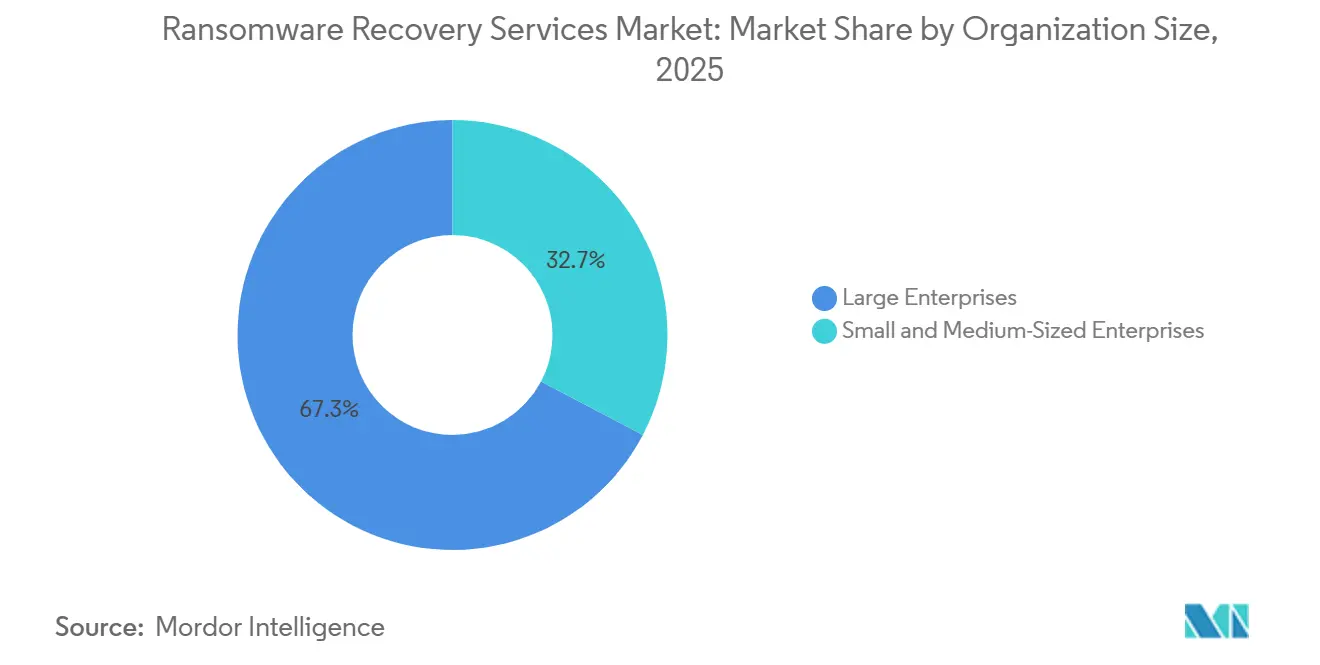
Large Enterprises held 67.31% of revenue in 2025. Their larger share reflects high average contract values and multi-year retainers formed after serious incidents. Enterprise recovery can cover cloud environments, on-premises systems, identity services, and operational technology at the same time. Recovery time objectives are often written into contracts, which creates pressure for providers to maintain trained teams and clear delivery processes. Large organizations also face regulatory, reputational, and operational consequences when critical services are disrupted. These conditions favor broader engagements that include readiness assessment, incident response, restoration, validation, and post-incident improvements. The ransomware recovery services industry, therefore, retains a strong enterprise revenue base even as demand broadens among smaller buyers.
SMEs are projected to grow at a 21.83% CAGR between 2026 and 2031. Accessible subscription pricing, managed recovery products, greater attack exposure, and cyber-insurance requirements are widening the addressable customer base below the enterprise tier. Small organizations with 100 to 250 employees stopped attacks before encryption or extortion in 34% of cases. The 46% result for organizations with 3,001 to 5,000 employees shows the relative difficulty that smaller teams can face in preventing attack completion. This can translate into frequent demand for practical recovery assistance, even where each individual budget is constrained. Providers need productized channels that maintain forensic quality without relying only on traditional day-rate consulting. Subscription-priced services can support this model when they combine preparation, tested recovery plans, and access to specialist support during an event. The ransomware recovery services market can reach more SMEs when these services reduce uncertainty before an incident occurs.
By Industry Vertical: BFSI Provides the Largest Base While Healthcare Grows Fastest
BFSI held 27.34% of revenue in 2025. Financial institutions manage high-value data and face substantial regulatory, operational, and reputational exposure when services are unavailable. Direct ransomware attacks on financial institutions increased from 156 in 2024 to 202 in 2025, while Q1 2026 recorded 65 finance-sector incidents. The Q1 2026 figure was 76% higher than the Q1 2025 level. Sophos found that 57% of financial organizations fully recovered within 1 week during 2025. Professional recovery support and mature backup infrastructure can help explain the need for fast, documented restoration in this vertical. Government and Public Administration, IT and Telecommunication, and Industrial Manufacturing also account for substantial demand. The ransomware recovery services market gains further support where service outages affect public functions, customer access, and connected production systems.
The healthcare and life sciences industry is projected to grow at a 22.51% CAGR between 2026 and 2031. Patient-care dependencies make prolonged system disruption especially difficult, which raises the importance of rapid recovery and clean system validation. The FBI identified healthcare as the most targeted sector in 2025, with 460 ransomware attacks, while a tracker recorded 410 healthcare ransomware attacks in H1 2026. IBM placed the average total healthcare breach cost at USD 7.42 million per incident in 2025.[5]IBM Security, “Cost of a Data Breach Report 2025,” IBM, ibm.com. Manufacturing also remains exposed, with JIPDEC reporting a 57.1% ransomware infection rate among Japanese manufacturers. Cyble identified manufacturing as the most-attacked sector in APAC in H1 2026, with more than 49 confirmed incidents. Education and Research Institutions remain underinvested in cyber recovery relative to their exposure, while Energy and Utilities, Oil and Gas, Retail and E-Commerce, Transportation and Logistics, and Media and Entertainment contribute to the vertical demand base.
Geography Analysis
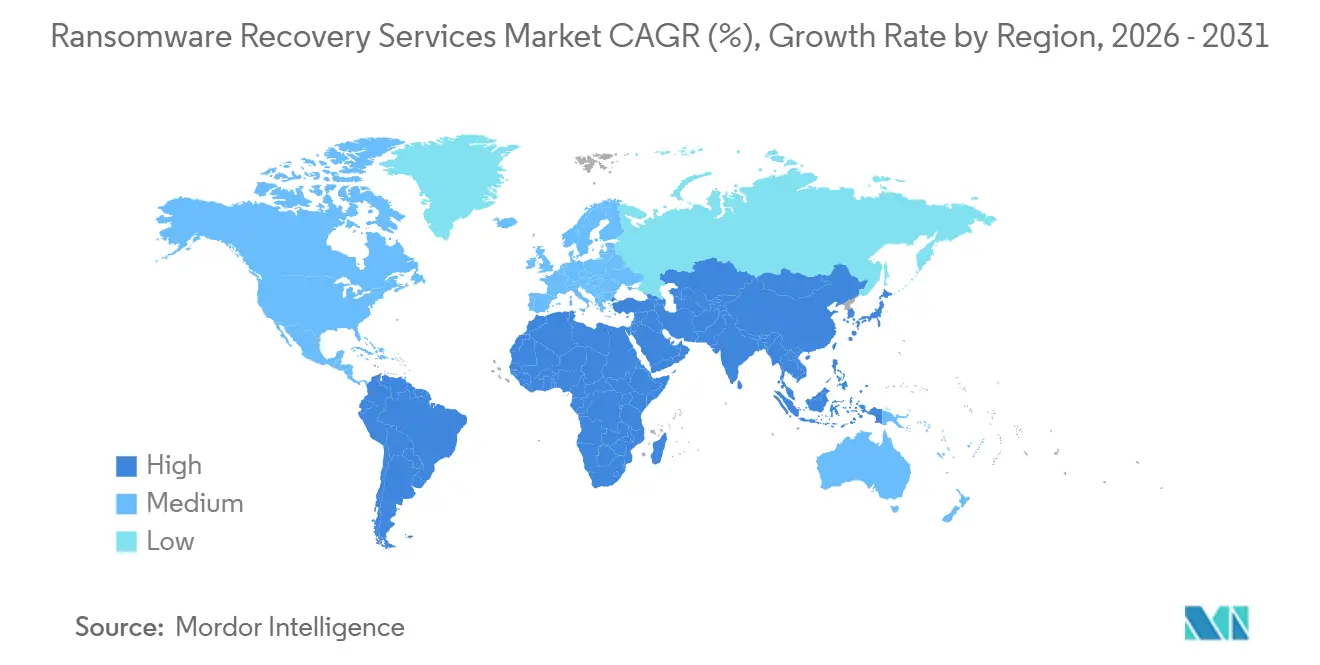
North America held 37.48% of the ransomware recovery services market share in 2025. The region has a high concentration of valuable corporate targets, a mature cyber-insurance ecosystem, and substantial incident-response capacity. U.S. SEC disclosure rules and the forthcoming CIRCIA framework support systematic investment in professionally documented recovery programs. Canadian SMBs faced all-in ransomware incident costs of CAD 135,000 (USD 97,594.15) to CAD 250,000 (USD 180,729.90) per engagement during 2026. This cost range supports demand for subscription-based recovery products below the enterprise tier. The ransomware recovery services market can use recurring service models to spread preparedness and response costs across a longer period.
Europe is shaped by regulatory requirements that make tested restoration more visible to regulated buyers. DORA has been effective since January 17, 2025, and requires tested ICT continuity and backup restoration for EU financial entities. Supervisory review is intensifying through 2026, and thematic reviews of third-party ICT risk concentration are planned through 2027. Germany, the United Kingdom, France, and Italy provide significant demand through concentrated financial and industrial activity. The United Kingdom recorded the highest median ransom demand globally in 2026, at USD 2.5 million.
Asia-Pacific is projected to expand at a 19.79% CAGR between 2026 and 2031, making it the fastest-growing regional area. India recorded 77 confirmed ransomware incidents in H1 2026, second in APAC behind Thailand, which recorded 82 incidents. India’s 6-hour CERT-In breach notification requirement strengthens demand for documented response and recovery support. Japan reported that 45.8% of companies experienced ransomware infection in 2026, and its recovery success rate was 44.2%, down from 46% in 2025.[6] Japan Information Processing Development Corporation, “Enterprise IT Utilization Trend Survey 2026,” JIPDEC, jipdec.or.jp. China issued an August 2026 warning regarding the Sorry ransomware variant, which targeted Linux servers and data-rich SMEs. South America’s BFSI and energy activity, together with Gulf digital infrastructure programs and expanding digital economies in Nigeria and South Africa, support future demand as regional attack surfaces develop.

Competitive Landscape
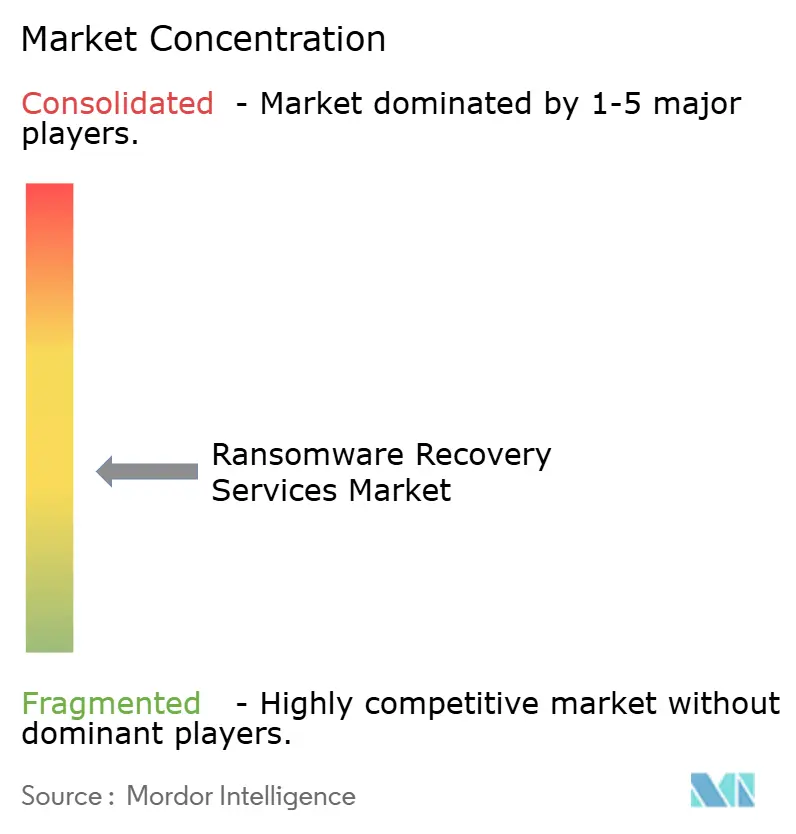
The ransomware recovery services market is moderately fragmented across security platforms, data-resilience vendors, and specialized forensic and incident-response firms. CrowdStrike Holdings, Inc., Palo Alto Networks, Inc., and SentinelOne, Inc. compete through integrated detection-to-recovery workflows in broader security operations platforms. Veeam Software Group GmbH, Rubrik, Inc., Cohesity, Inc., Commvault Systems, Inc., Druva Inc., and Acronis International GmbH compete through recovery technology, air-gapped vaults, and contractual recovery commitments. Kroll, LLC, Arete Advisors, Inc., NCC Group plc, Coveware, Inc., and Proven Data Recovery, LLC compete through investigative expertise, negotiation support, and evidence handling. These groups increasingly target the same enterprise buyer as customers seek a coordinated response from detection through recovery.
The ransomware recovery services market is increasingly shaped by platform convergence in 2025 and 2026. Veeam completed its USD 1.725 billion acquisition of Securiti AI in December 2025 to bring data resilience, security posture management, privacy governance, and AI trust capabilities together. Rubrik introduced Autonomous Business Recovery for Cloud Applications in June 2026, using a Preemptive Recovery Engine to reconstruct minimum viable business environments. Commvault integrated cyber recovery actions into CrowdStrike Charlotte Agentic SOAR workflows in August 2026, making recovery actions available within security operations workflows. These moves reduce manual coordination and narrow the space between specialized recovery services and wider security platforms.
The ransomware recovery services market continues to include smaller firms where cases require physical forensics, NAS and RAID reconstruction, or evidence handling with strict chain-of-custody requirements. WithSecure Corporation, Bitdefender SRL, and Sophos Limited compete across detection, response, and recovery, especially in the European mid-market. SME-accessible managed recovery, operational technology validation, and cross-cloud recovery without vendor lock-in remain important needs. Competition rests on response depth, recovery speed, global delivery capacity, and the ability to validate clean and usable systems. The ransomware recovery services market favors firms that can connect these capabilities without fragmenting responsibility during an active incident, while preserving specialist accountability and documented recovery decisions throughout the engagement.
Ransomware Recovery Services Industry Leaders
Veeam Software Group GmbH
Rubrik, Inc.
Cohesity, Inc.
Druva Inc.
Proven Data Recovery, LLC
- *Disclaimer: Major Players sorted in no particular order

Recent Industry Developments
- September 2026: Rubrik, Inc. and CrowdStrike Holdings, Inc. announced an agentic identity resilience workflow integration at Fal.Con 2026, combining CrowdStrike Falcon Next-Gen Identity Security with Rubrik Identity Resilience orchestrated by Charlotte Agentic SOAR. The integration delivers a complete closed-loop workflow spanning detection, containment, investigation, and recovery of compromised identity environments, reducing RTOs from days to hours for joint customers.
- August 2026: Commvault Systems, Inc. integrated its cyber recovery actions into CrowdStrike's Charlotte Agentic SOAR platform, making recovery steps natively available within security operations center workflows and reducing manual handoffs between security and IT recovery teams. The integration is generally available for joint Commvault and CrowdStrike customers via the CrowdStrike Marketplace.
- July 2026: Veeam Software Group GmbH released Veeam Data Platform v13.1 at VeeamON Sydney, expanding malware scanning to NAS environments, enhancing cloud threat detection for Microsoft Azure, adding Active Directory Forest Recovery for identity-focused cyber incidents, and incorporating post-quantum cryptography aligned with NIST standards. The platform simultaneously introduced hybrid FIPS support for regulated enterprise deployments.
- June 2026: Rubrik, Inc. unveiled Autonomous Business Recovery for Cloud Applications at Rubrik FORWARD in Las Vegas, an agentic cyber resilience solution that automatically discovers full application stacks, performs dependency mapping across data, configurations, and code, and rebuilds a minimum viable business environment at machine speed. The product entered private preview following the announcement.


Global Ransomware Recovery Services Market Report Scope
Ransomware recovery services market comprises specialized cybersecurity and business continuity services that help organizations prepare for, respond to, and recover from ransomware attacks by providing pre-incident readiness assessments, backup infrastructure validation, incident response planning, forensic investigation, data restoration, system rebuilding, and post-incident security hardening. These services include ransomware-specific backup testing (immutable backups, air-gapped recovery environments), tabletop exercises, playbooks for negotiation and decryption key validation, clean room environments for malware analysis, data integrity verification, and coordinated recovery orchestration across IT, security, legal, and business teams to minimize downtime, data loss, and ransom payments while ensuring compliant recovery processes that meet regulatory requirements and cyber insurance policy conditions across enterprise, critical infrastructure, healthcare, financial services, and government sectors facing escalating ransomware threats.
The Ransomware Recovery Services Market Report is Segmented by Service Type (Emergency Assessment, Triage, Containment, and Eradication, Digital Forensics and Evidence Preservation, Decryption and Specialist Data Recovery, Infrastructure, System, Application, and Cloud Restoration, Identity, Directory, and Access Recovery, Recovery Validation and Secure Return to Operations, and Ransomware Recovery Readiness, Testing, and Exercises), Delivery Model (Remote, On-Site, and Hybrid), Organization Size (Large Enterprises, and Small and Medium-Sized Enterprises), Industry Vertical (Government and Public Administration, Industrial Manufacturing, Retail and E-Commerce, Transportation and Logistics, Energy and Utilities, Oil and Gas, IT and Telecommunication, Media and Entertainment, Education and Research Institutions, Healthcare and Life Sciences, Banking, Financial Services, and Insurance (BFSI), and Other Industry Verticals), and Geography (North America, South America, Europe, Asia-Pacific, and Middle East and Africa). The Market Forecasts are Provided in Terms of Value (USD).
| Emergency Assessment, Triage, Containment, and Eradication |
| Digital Forensics and Evidence Preservation |
| Decryption and Specialist Data Recovery |
| Infrastructure, System, Application, and Cloud Restoration |
| Identity, Directory, and Access Recovery |
| Recovery Validation and Secure Return to Operations |
| Ransomware Recovery Readiness, Testing, and Exercises |
| Remote |
| On-Site |
| Hybrid |
| Large Enterprises |
| Small and Medium-Sized Enterprises |
| Government and Public Administration |
| Retail and E-Commerce |
| Transportation and Logistics |
| IT and Telecommunication |
| Media and Entertainment |
| Healthcare and Life Sciences |
| Banking, Financial Services, and Insurance (BFSI) |
| Other Industry Verticals |
| North America | United States | |
| Canada | ||
| Mexico | ||
| South America | Brazil | |
| Argentina | ||
| Rest of South America | ||
| Europe | Germany | |
| United Kingdom | ||
| France | ||
| Italy | ||
| BENELUX | ||
| Rest of Europe | ||
| Asia-Pacific | China | |
| Japan | ||
| India | ||
| South Korea | ||
| Australia | ||
| Rest of Asia-Pacific | ||
| Middle East and Africa | Middle East | United Arab Emirates |
| Saudi Arabia | ||
| Rest of Middle East | ||
| Africa | South Africa | |
| Nigeria | ||
| Egypt | ||
| Rest of Africa | ||
| By Service Type | Emergency Assessment, Triage, Containment, and Eradication | ||
| Digital Forensics and Evidence Preservation | |||
| Decryption and Specialist Data Recovery | |||
| Infrastructure, System, Application, and Cloud Restoration | |||
| Identity, Directory, and Access Recovery | |||
| Recovery Validation and Secure Return to Operations | |||
| Ransomware Recovery Readiness, Testing, and Exercises | |||
| By Delivery Model | Remote | ||
| On-Site | |||
| Hybrid | |||
| By Organization Size | Large Enterprises | ||
| Small and Medium-Sized Enterprises | |||
| By Industry Vertical | Government and Public Administration | ||
| Retail and E-Commerce | |||
| Transportation and Logistics | |||
| IT and Telecommunication | |||
| Media and Entertainment | |||
| Healthcare and Life Sciences | |||
| Banking, Financial Services, and Insurance (BFSI) | |||
| Other Industry Verticals | |||
| By Geography | North America | United States | |
| Canada | |||
| Mexico | |||
| South America | Brazil | ||
| Argentina | |||
| Rest of South America | |||
| Europe | Germany | ||
| United Kingdom | |||
| France | |||
| Italy | |||
| BENELUX | |||
| Rest of Europe | |||
| Asia-Pacific | China | ||
| Japan | |||
| India | |||
| South Korea | |||
| Australia | |||
| Rest of Asia-Pacific | |||
| Middle East and Africa | Middle East | United Arab Emirates | |
| Saudi Arabia | |||
| Rest of Middle East | |||
| Africa | South Africa | ||
| Nigeria | |||
| Egypt | |||
| Rest of Africa | |||


Key Questions Answered in the Report
What is the ransomware recovery services market size?
The ransomware recovery services market size was valued at USD 9.15 billion in 2025 and estimated to grow from USD 10.27 billion in 2026 to reach USD 19.98 billion by 2031, at a CAGR of 14.24% during the forecast period (2026-2031).
Which service type leads ransomware recovery services?
Decryption and Specialist Data Recovery led with a 36.71% share in 2025, reflecting ongoing demand for specialist support after encryption.
What is driving demand for ransomware recovery services?
Double- and triple-extortion attacks, cloud complexity, tested recovery requirements, and cyber-insurance conditions are increasing demand for recovery support.
Which customer group is growing fastest for ransomware recovery services?
SMEs are projected to grow at a 21.83% CAGR through 2031 as accessible managed recovery services and subscription models widen adoption.
Which end-use sector is growing fastest?
Healthcare and Life Sciences is projected to grow at a 22.51% CAGR through 2031 because patient-care operations require fast recovery from cyber incidents.
Which region is growing fastest for ransomware recovery services?
Asia-Pacific is projected to grow at a 19.79% CAGR through 2031, supported by expanding digital systems and stricter recovery documentation needs.
Page last updated on:


 Your data is secure and never sold or shared.


