
RAN Planning and Optimization Software Market Size and Share
Market Overview
| Study Period | 2020 - 2031 |
|---|---|
| Market Size (2026) | USD 3.35 Billion |
| Market Size (2031) | USD 7.65 Billion |
| Growth Rate (2026 - 2031) | 17.96 % |
| Fastest Growing Market | Africa |
| Largest Market | North America |
| Market Concentration | Medium |
Major Players *Disclaimer: Major Players sorted in no particular order Image © Mordor Intelligence. Reuse requires attribution under CC BY 4.0. | |
RAN Planning and Optimization Software Market Analysis by Mordor Intelligence
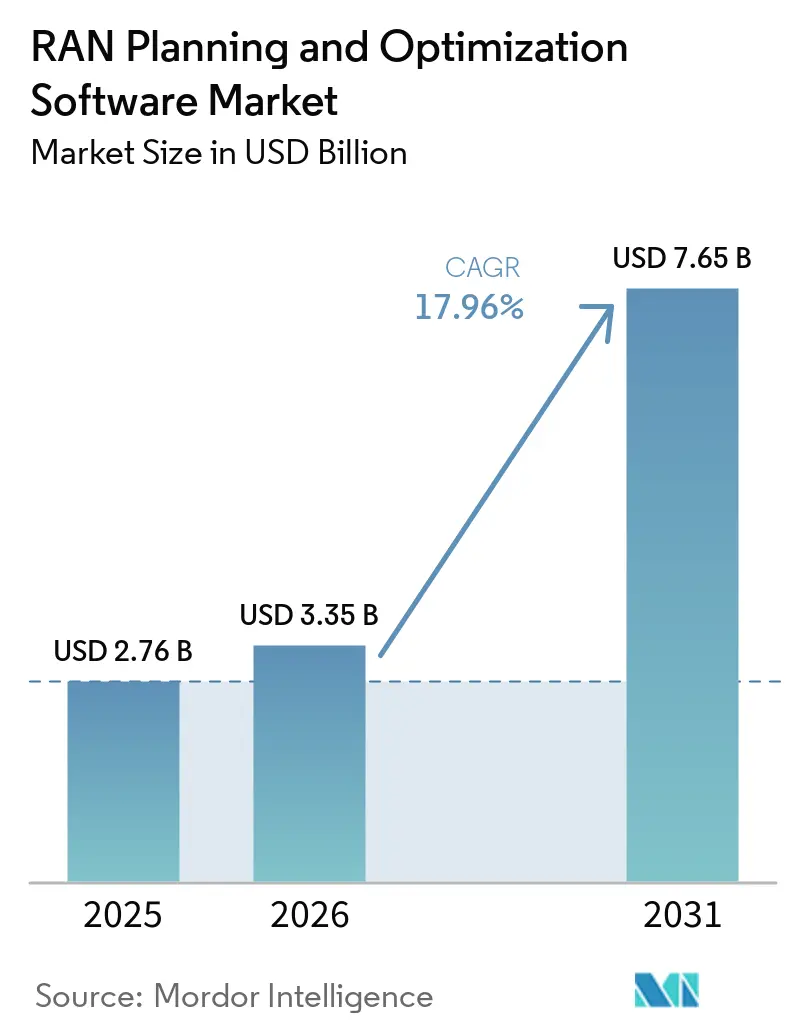
The RAN Planning And Optimization Software Market size was valued at USD 2.76 billion in 2025 and is estimated to grow from USD 3.35 billion in 2026 to reach USD 7.65 billion by 2031, at a CAGR of 17.96% during the forecast period (2026-2031).
The RAN Planning and Optimization Software market is growing as 5G standalone networks make radio engineering a continuous operating task rather than an occasional planning exercise. Operators need tools that process live network data, run large propagation models, and provide recommendations quickly enough to support changing radio conditions. Cloud-based software is becoming more relevant because it can handle computing workloads that are difficult to sustain in local deployments. Open RAN creates demand for neutral tools and increases the need for cross-supplier validation. The RAN Planning and Optimization Software market also faces longer buying cycles, in which operator consolidation and cautious change-control processes affect purchasing decisions.
Key Report Takeaways
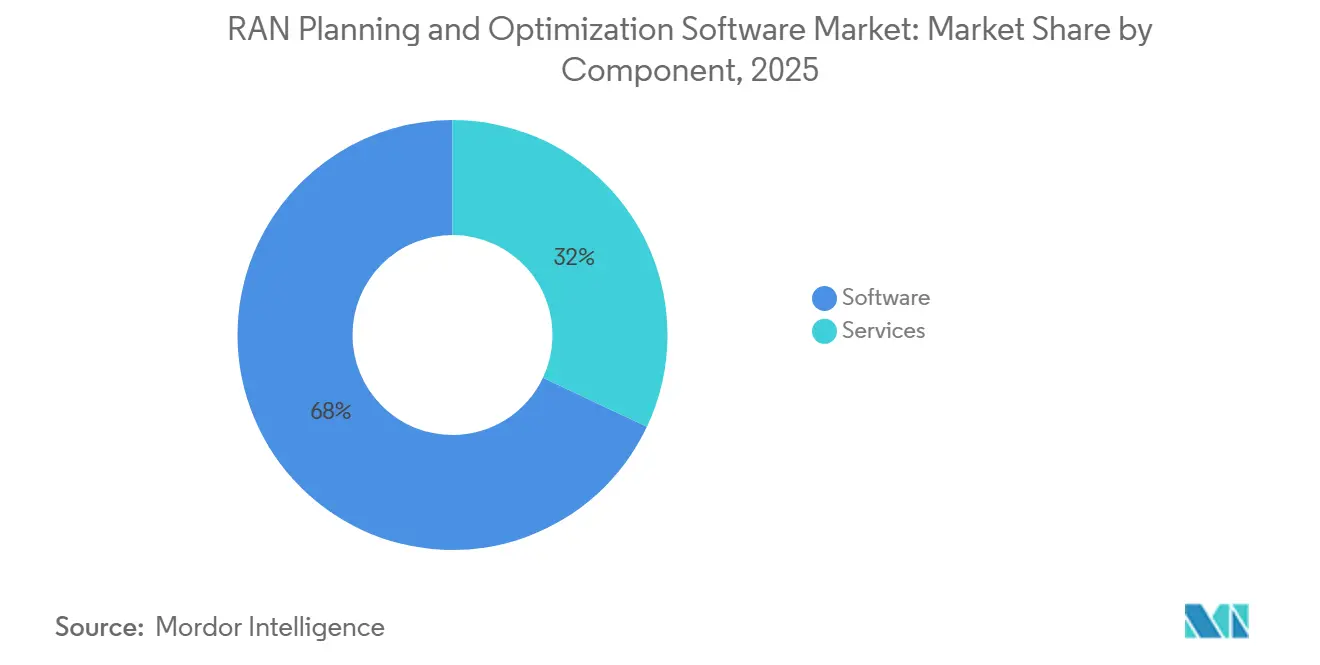
- By component, software held 67.98% of the RAN Planning and Optimization Software market share in 2025, while software is forecast to grow at an 18.71% CAGR through 2031.
- By deployment mode, on-premises deployment accounted for 42.15% of the RAN Planning and Optimization Software market size in 2025, while cloud-based deployment is forecast to grow at a 19.52% CAGR through 2031.
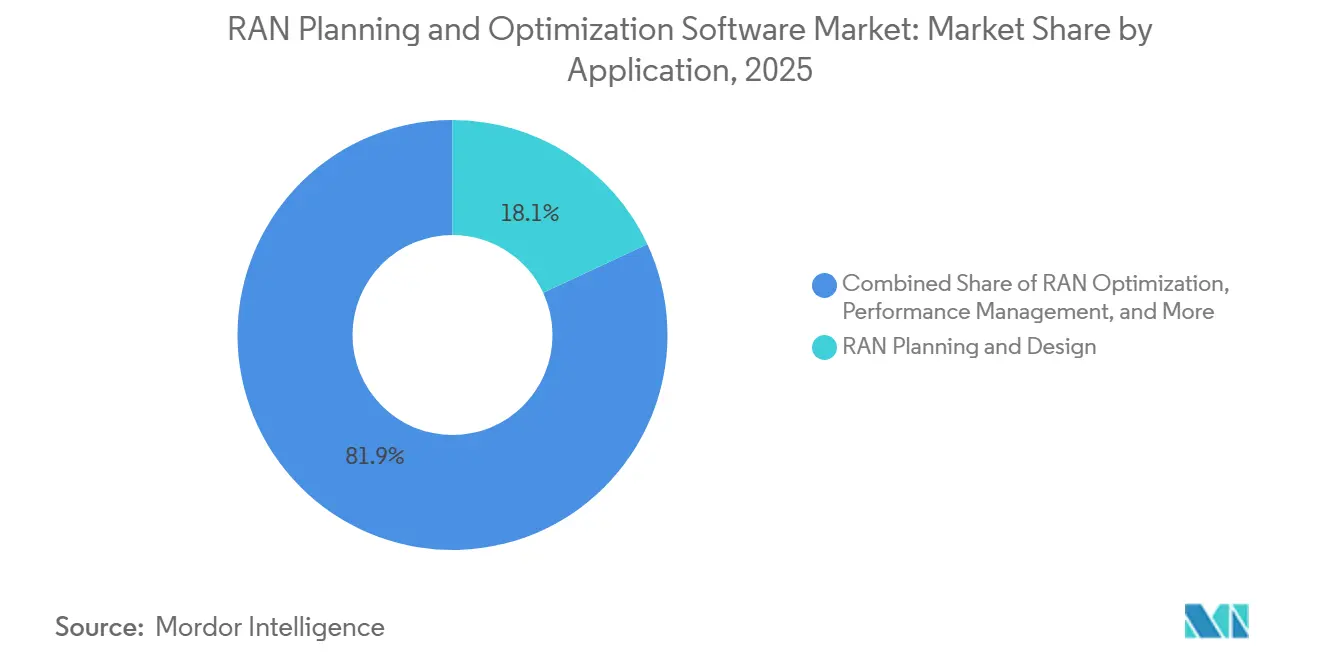
- By application, RAN Optimization accounted for 18.06% of the RAN Planning and Optimization Software market size in 2025 and is forecast to grow at a 20.01% CAGR through 2031.
- By end user, mobile network operators held 64.07% of the RAN Planning and Optimization Software market share in 2025, while neutral host and private network operators are forecast to grow at an 18.34% CAGR through 2031.
- By geography, North America held 31.61% of the RAN Planning and Optimization Software market share in 2025, while Africa are forecast to grow at an 19.87% CAGR through 2031.
Note: Market size and forecast figures in this report are generated using Mordor Intelligence’s proprietary estimation framework, updated with the latest available data and insights as of January 2026.
Market Trends and Insights
Drivers Impact Analysis of RAN Planning and Optimization Software Market*
| Driver | (~) % Impact on CAGR Forecast | Geographic Relevance | Impact Timeline |
|---|---|---|---|
| 5G Network Densification and Multi-Technology Complexity | +4.5% | Global, concentrated in North America, Asia-Pacific, and Europe | Medium term (2-4 years) |
| Cloud-Native and AI-Enabled Autonomous RAN Operations | +4% | North America, Europe, and Asia-Pacific core markets | Medium term (2-4 years) |
| Open RAN and Multi-Vendor Interoperability Requirements | +2.8% | Global, with early concentration in the United States, Japan, and Europe | Medium term (2-4 years) |
| Spectrum Scarcity and Higher Spectral Efficiency Demand | +2.2% | Global, with Asia-Pacific and North America leading | Long term (≥ 4 years) |
| Closed-Loop Optimization for Energy and Capacity Efficiency | +1.6% | Global, with European Union and Asia-Pacific regulatory influence | Long term (≥ 4 years) |
| Agentic AI for Governed Radio Engineering Workflows | +1% | North America and Europe, extending to Asia-Pacific | Short term (≤ 2 years) |
| Source: Mordor Intelligence | |||
5G Network Densification and Multi-Technology Complexity
5G networks are moving from broad macro coverage toward denser small-cell grids. Operators also continue to manage 2G, 3G, 4G, and 5G layers at the same time. Each site activation can alter cell-edge interference patterns and require further engineering work. The RAN Planning and Optimization Software market benefits when teams need continuous re-optimization instead of periodic network reviews. Forsk's Naos supports automated 5G site selection and country-scale path-loss calculations through service-based architecture.[1]Forsk, “Naos Overview,” Forsk, forsk.com These capabilities are becoming important in operator requests for proposals as radio configurations become more complex.
Cloud-Native and AI-Enabled Autonomous RAN Operations
Cloud-native architecture is shifting planning tools from desktop licenses toward subscription services and application programming interfaces. This change allows software providers to update planning logic without waiting for a hardware refresh. Ericsson launched its AI in RAN software subscription in 2026 with scheduler, beamforming, positioning, and observability functions. The company stated that the package is designed to place AI functions closer to radio operations. The RAN Planning and Optimization Software market gains recurring revenue opportunities when optimization moves from batch analysis into regular network management. This model also links planning decisions more closely to operational capacity and service quality.
Open RAN and Multi-Vendor Interoperability Requirements
Open RAN deployments can combine radio, distributed-unit, and software components from different suppliers. That arrangement makes interference coordination and parameter optimization more difficult than in a uniform radio network. The O-RAN Alliance completed Release 5 in November 2025 with 157 specification titles and added security and AI or machine learning controls. The RAN Planning and Optimization Software market therefore needs tools that can operate across open R1, E2, and A1 interfaces. Testing by the National Telecommunications and Information Administration found that standards-compliant components can still encounter integration problems from version differences and message handling. Neutral planning platforms can address that need, but validation requirements can add cost and slow implementation.
Spectrum Scarcity and Demand for Higher Spectral Efficiency
Demand for radio frequencies continues to exceed available supply, especially in dense urban locations. The International Telecommunication Union stated in 2025 that spectrum scarcity rises when demand exceeds available supply. Operators respond through carrier aggregation, interference management, frequency reuse, and more detailed coverage modeling. The RAN Planning and Optimization Software market supports these activities when each new spectrum layer requires another planning cycle. GSMA estimated that operators need an average of 2 GHz of mid-band spectrum across 36 cities to meet IMT-2020 needs at reliable 100 Mbps speeds.[2]GSMA, “Vision 2030: Insights for Mid-Band Spectrum Needs,” GSMA, gsma.com TELUS acquired 3800 MHz licenses in 2025 for CAD 317.6 million, equivalent to USD 230 million, creating a new basis for 5G coverage design and interference planning.
Restraints Impact Analysis of RAN Planning and Optimization Software Market*
| Restraint | (~) % Impact on CAGR Forecast | Geographic Relevance | Impact Timeline |
|---|---|---|---|
| Operator Consolidation and Concentrated Software Buying | -3.2% | Europe and North America | Medium term (2-4 years) |
| Legacy OSS and Proprietary Tool Lock-In | -2.6% | Global, concentrated in developing markets | Long term (≥ 4 years) |
| Explainability and Change-Control Risks in Autonomous Optimization | -1.8% | Global | Medium term (2-4 years) |
| Scarcity of Calibrated Geodata and RF Engineering Talent | -1.2% | Africa, the Middle East, and South America | Long term (≥ 4 years) |
| Source: Mordor Intelligence | |||
Operator Consolidation and Concentrated Software Buying
Operator consolidation reduces the number of organizations making independent software purchases. Merged operators can seek multi-year agreements, volume discounts, and bundled planning and optimization contracts. These requirements can reduce unit revenue for suppliers in the RAN Planning and Optimization Software market. Network tool selections may also be delayed while merged engineering teams align their technical architecture. Such evaluations can extend request-for-proposal cycles by 12 to 24 months. Suppliers with integrations across both operators' operating support systems can be better positioned when network rationalization plans are approved.
Legacy OSS and Proprietary Tool Lock-In
Many large operators still use centralized operating support systems designed for static, hardware-focused networks. These environments can struggle to ingest telemetry at the pace needed for AI-supported optimization. Replacing an operating support system is costly because operators must maintain service during a multi-year transition. Samsung found that configuration and management data-model differences can prevent simple compatibility in multi-vendor Open RAN environments. The RAN Planning and Optimization Software market can therefore face a gap between a tool's contracted features and the data available to use them. This limitation can slow renewals and reduce the number of reference deployments.
*Our forecasts treat driver/restraint impacts as directional, not additive. The impact forecasts reflect baseline growth, mix effects, and variable interactions.
RAN Planning and Optimization Software Market Segment Analysis
By Component:
Software Subscriptions Lead AI-Driven DemandSoftware accounted for 67.98% of 2025 value and is forecast to grow at an 18.71% CAGR through 2031. The segment reflects operator demand for updated planning logic and AI functions without hardware replacement cycles. Subscription models enable suppliers to deliver new features through recurring commercial arrangements. Nokia introduced an AI-native RAN platform in 2026 that uses a software subscription model for feature delivery. This approach supports ongoing improvements to planning, radio operations, and optimization functions. It also reduces dependence on fixed-vintage tool releases that can lag network changes. The software segment of the RAN Planning and Optimization Software industry is strengthened by the need for vendor-neutral functions in mixed radio estates.
Services cover implementation, system integration, and managed operating support. They help operators configure tools when internal radio engineering resources are limited. Integration work becomes more relevant as operators add spectrum bands, technology generations, and Open RAN components. Operators in Africa and South America may need external support to integrate newer tools with existing operational support systems. Services revenue can therefore grow beside license revenue even when software remains the leading component. Providers that combine software with long-term managed services can develop more durable customer relationships. This model differs from perpetual licenses with optional support. The RAN Planning and Optimization Software market remains dependent on service expertise when software capability must be translated into routine operating practices.


By Deployment Mode:
Cloud-Based Computing Gains GroundOn-premises deployment accounted for 42.15% of 2025 value. It remains relevant where operators prioritize data sovereignty, close operating support system integration, and local control. Cloud-based deployment is forecast to grow at 19.52% through 2031, the fastest pace among deployment modes. Massive MIMO modeling, 3D ray tracing, AI training, and country-scale path-loss calculations need flexible computing capacity. Infovista's VistaPlan Go is designed to provide optimized network designs using pre-calibrated propagation models and traffic distributions.[3]Infovista, “Design Your Network in Minutes, Not Days,” Infovista, infovista.com The RAN Planning and Optimization Software market can gain from faster design cycles when such computing resources are available. Cloud delivery also reduces the need for local software deployment and manual geodata preparation.
Hybrid deployment is a transition option for operators that cannot move all data and processes at once. Sensitive geographic information may remain on premises while computationally intensive simulations move to cloud resources. Private 5G and government deployments can continue to use this structure where data residency requirements apply. A hybrid model allows a gradual migration and reduces change-management risk. It can also maintain continuity with familiar workflows while operators evaluate cloud performance. The RAN Planning and Optimization Software industry can use hybrid arrangements to preserve current customer relationships during migration. On-premises installations can remain substantial in absolute terms even as their share declines. The overall deployment mix is moving toward cloud-based computing rather than an immediate replacement of local tools.
By Application:
RAN Optimization Combines Scale and GrowthRAN Optimization represented 18.06% of 2025 application value and is forecast to grow at a 20.01% CAGR through 2031. It is both the largest and fastest-growing application category in the supplied estimates. Operators increasingly use AI-supported optimization as a continuous control activity instead of a corrective task after deployment. Ericsson's 2026 AI in RAN subscription includes functions for scheduler adaptation, multi-layer coordination, and observability ERICSSON.COM. RAN Planning and Design remains essential, although automated cell planning is becoming part of optimization platforms. Performance Management and Capacity Planning continue to support investment decisions through detailed monitoring of key performance indicators. The RAN Planning and Optimization Software market is being shaped by a closer integration of planning and operations. This shift makes RAN Planning and Optimization Software relevant to the market throughout the network life cycle.
Coverage and Propagation Analysis is being used for cases beyond conventional mobile coverage design. Infovista added support for the Google Cloud Propagation API, improved vegetation height modeling, and fixed wireless access key performance indicator analysis in Planet 26 during 2026. These functions improve the accuracy of propagation simulation and broaden fixed wireless planning needs. Interference Management is becoming more important where multi-band carrier aggregation and Open RAN deployments create difficult adjacent-carrier conditions. The Others category includes non-terrestrial network planning, Citizens Broadband Radio Service coordination, and private 5G design. These applications are growing from smaller bases as enterprise and government deployments expand. The RAN Planning and Optimization Software market needs specialized tools for indoor, shared-spectrum, and mixed-vendor environments. Application boundaries may become less distinct as planning and optimization functions are increasingly delivered together.

By End User:
Mobile Network Operators Set Capability RequirementsMobile network operators held 64.07% of 2025 end-user spending. Their national footprints require multi-technology coverage, carrier aggregation modeling, massive MIMO beamforming, and detailed network performance analysis. These requirements create the highest product capability threshold across buyer groups. Suppliers that satisfy mobile network operator needs can use the same underlying capabilities with other customers. Ongoing 5G spectrum deployment keeps software licenses, engineering services, and optimization upgrades relevant. The RAN Planning and Optimization Software market is therefore strongly influenced by carrier procurement standards. Large operators also shape product road maps because their networks produce the most demanding operating conditions. Their technical requirements become a reference point for many smaller buyers.
Neutral host and private network operators are forecast to grow at an 18.34% CAGR through 2031. Federated Wireless introduced CBRS Active DAS support in January 2026 to help mobile operators add indoor 5G capacity with shared CBRS spectrum.[4]Federated Wireless, “Federated Wireless Launches CBRS Active DAS Support to Expand Indoor 5G Without Consuming Licensed Spectrum,” Federated Wireless, federatedwireless.ai Manufacturing, logistics, and campus networks require indoor planning, 3D building models, and multi-floor propagation analysis. Ranplan and iBwave have established positions in these planning requirements. Government and public safety organizations remain smaller but important buyers for dedicated communications networks. Network equipment vendors and system integrators also use these tools internally and within managed service offerings. The RAN Planning and Optimization Software market has a wider end-user base as private and shared-spectrum deployments grow.
Geography Analysis
The Americas RAN Planning and Optimization Software Market
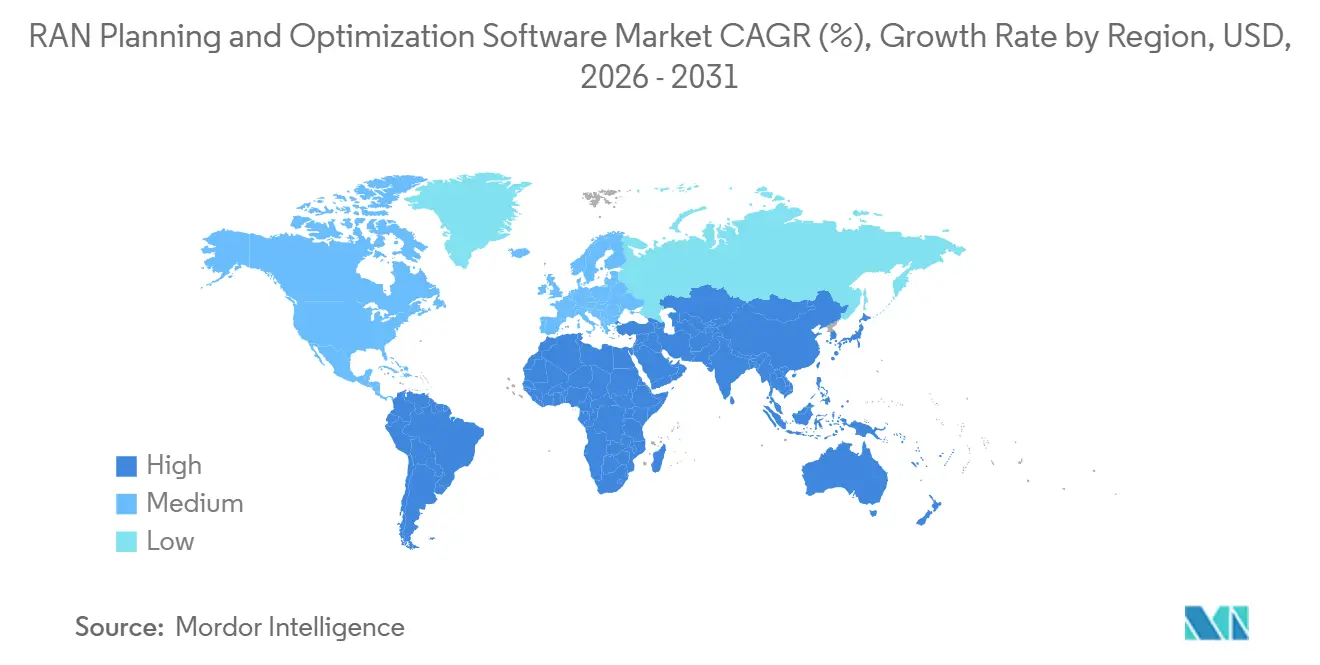
North America held 31.61% of 2025 value in the supplied estimates. The region's position reflects a mature 5G base and continued investment in spectrum. AT&T completed its acquisition of EchoStar's spectrum license in July 2026 for USD 23 billion. The acquisition added 50 MHz of low-band and mid-band spectrum across nearly all U.S. markets. New spectrum layers require coverage, interference, and parameter planning across many sites. Twelve North American operators had launched at least 1 commercial 5G standalone network by March 2026. Canada also continued a planning cycle following the 3800 MHz spectrum licenses acquired in 2025. Mexico contributes smaller modernization opportunities linked to competition and digital inclusion programs. South America is emerging as operators in Brazil and Chile adapt LTE estates for 5G migration.
Europe and APAC RAN Planning and Optimization Software Market
Europe has a mature mobile network operator base and an active Open RAN policy setting. Spectrum harmonization and connectivity targets support continuing network upgrades. Ericsson extended its partnership with Virgin Media O2 in March 2026 for 5 years. [5]Source: Ericsson, “Ericsson to Become Virgin Media O2’s Primary RAN Partner,” Ericsson, ericsson.com The agreement covers most of the operator's nationwide radio network and includes AI and machine learning software. Germany, France, and the United Kingdom are major regional demand centers. Asia-Pacific combines high network scale with early work on AI-native and Open RAN planning. China requires tools that can address very large network configurations. Japan, South Korea, and India add demand through advanced technology adoption and continuing 5G expansion.
MEA RAN Planning and Optimization Software Market
Africa is forecast to grow at a 19.87% CAGR through 2031, the fastest geographic rate in the supplied estimates. GSMA projected fewer than 100 million 5G connections in Africa by the end of 2026 and more than 380 million by 2030. This expansion requires planning capabilities as operators add 5G sites and spectrum layers. The RAN Planning and Optimization Software market has room to grow where legacy technologies remain in service during 5G rollout. Ghana removed exclusive 5G wholesale rights from one operator in July 2026, supporting a more competitive planning environment. The Middle East is smaller but high value, led by Saudi Arabia and the United Arab Emirates. Smart-city programs and dense urban deployments require detailed coverage modeling for complex built environments.

Competitive Landscape
The RAN Planning and Optimization Software market includes large equipment vendors and specialized software providers. Equipment vendors can bundle planning and optimization functions with radio hardware and operating support systems. Specialized providers compete through vendor neutrality and multi-radio access technology coverage. Large suppliers benefit from installed customer bases, certified integrations, and radio-specific data resources. Ericsson's 2026 Virgin Media O2 agreement illustrates the ability of incumbent vendors to extend radio relationships through software and AI functions. This can limit opportunities for independent suppliers in major operator accounts. Competition also centers on AI functions for beamforming, cell parameter adjustment, and digital-twin calibration. These capabilities are increasingly treated as proprietary product features rather than standard service functions.
Private 5G and neutral-host planning remain less fully served by tools designed for wide-area macro networks. Ranplan and iBwave are positioned in planning requirements that include indoor coverage and building-level design. This area may draw interest from larger suppliers seeking faster entry into private network applications. Energy-aware optimization is another area where providers can connect software functions with operator efficiency needs. Ericsson's AI in RAN offering includes AI-managed beamforming and other functions within a software subscription. Vendors that can document energy outcomes may strengthen their commercial position. The RAN Planning and Optimization Software industry is also moving toward tools that combine planning data with operating decisions.
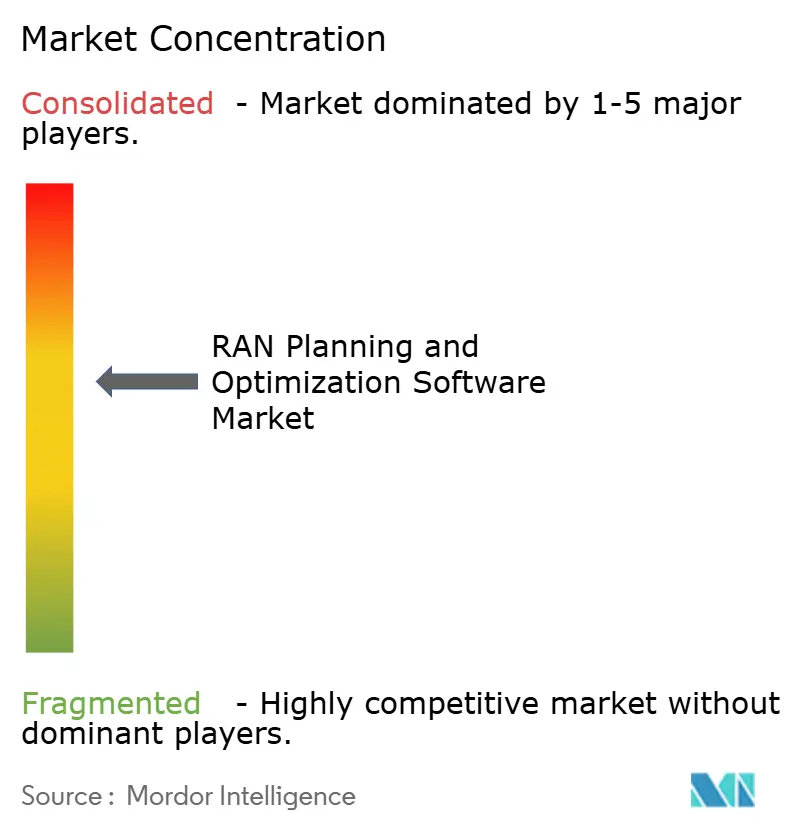
Governed agentic AI is an emerging area for radio engineering workflows. TEOCO Aircom launched raNora in March 2026 for data investigation, coverage analysis, site planning, and data validation.[6]TEOCO Aircom, “raNora: Agentic AI for Autonomous Radio Planning,” TEOCO Aircom, teocoaircom.com The platform uses a language-model reasoning engine and a telecommunications-trained multi-agent architecture. Mavenir launched an Agentic Service Assurance Framework in June 2026 for automated network operations across domains. These initiatives show how suppliers are extending AI functions into controlled operational workflows. The International Telecommunication Union provides the technical basis for evaluating spectrum-use efficiency claims. Market concentration cannot be quantified from the supplied material because it provides no combined market share for leading suppliers.
RAN Planning and Optimization Software Industry Leaders
Telefonaktiebolaget LM Ericsson
Nokia Corporation
Huawei Technologies Co., Ltd.
ZTE Corporation
Infovista SAS
- *Disclaimer: Major Players sorted in no particular order
RAN Planning and Optimization Software Market Companies Covered in this Report
- Telefonaktiebolaget LM Ericsson
- Nokia Corporation
- Huawei Technologies Co., Ltd.
- ZTE Corporation
- Infovista SAS
- TEOCO Corporation
- Forsk SAS
- Keysight Technologies, Inc.
- VIAVI Solutions Inc.
- Amdocs Limited
- Comarch S.A.
- Anritsu Corporation
- Ranplan Wireless Network Design Ltd.
- iBwave Solutions Inc.
- Rohde & Schwarz GmbH & Co. KG
- Samsung Electronics Co., Ltd.
- Mavenir Systems, Inc.
- RADCOM Ltd.
- Siradel SAS
- ATDI S.A.S.
- Accuver Co., Ltd.
- Ascom Holding AG
- CommScope, Inc.

Recent Industry Developments in RAN Planning and Optimization Software Market
- July 2026: Infovista unveiled new versions of VistaPlan Go and Planet 26, adding Google Cloud Propagation API support, improved vegetation modeling, and FWA KPI analysis for enhanced RAN planning and optimization.
- March 2026: Ericsson extended its partnership with Virgin Media O2 for five years, covering the majority of the operator’s UK RAN and deploying AI/ML software for real-time network performance optimization.
- March 2026: Aircom, a TEOCO company, launched raNora, an agentic AI platform for radio planning and engineering workflows, including network-data investigation, coverage analysis, and site planning.
- February 2026: Aircom, a TEOCO company, released Mentor v2025.2 with enhanced CogniSense capabilities for continuous network performance monitoring, early issue detection, and automated site performance certification.


Global RAN Planning and Optimization Software Market Report Scope
The RAN Planning and Optimization Software Market includes software and related services used for RAN planning, design, optimization, performance management, capacity planning, coverage analysis, and interference management across 4G, 5G, and emerging networks. Market revenue includes software licenses, subscriptions, SaaS, maintenance, implementation, integration, consulting, and support services directly attributable to these solutions. Revenue is estimated using vendor disclosures, product portfolios, customer deployments, contracts, and primary and secondary research, with broader telecom platform revenues allocated only to the RAN planning and optimization component; RAN hardware, construction, generic OSS/BSS, and unrelated IT services are excluded.
The RAN Planning and Optimization Software Market Report is Segmented by Component (Software, and Services), Deployment Mode (On-Premises, Cloud-Based, and More), Application (RAN Planning and Design, Optimization, Performance Management, Capacity Planning, Coverage and Propagation Analysis, Interference Management, and Other Applications), End User (Mobile Network Operators, Neutral Host and Private Network Operators, Enterprises, Government and Public Safety Organizations, and Network Equipment Vendors and System Integrators), and Geography. The Market Forecasts are Provided in Terms of Value (USD).
| Software |
| Services |
| On-Premises |
| Cloud-Based |
| Hybrid |
| RAN Planning and Design |
| RAN Optimization |
| Performance Management |
| Capacity Planning |
| Coverage and Propagation Analysis |
| Interference Management |
| Other Applications |
| Mobile Network Operators |
| Neutral Host and Private Network Operators |
| Enterprises |
| Government and Public Safety Organizations |
| Network Equipment Vendors and System Integrators |
| North America | United States |
| Canada | |
| Mexico | |
| South America | Brazil |
| Argentina | |
| Chile | |
| Rest of South America | |
| Europe | Germany |
| United Kingdom | |
| France | |
| Italy | |
| Spain | |
| Russia | |
| Rest of Europe | |
| Asia-Pacific | China |
| Japan | |
| India | |
| South Korea | |
| Australia | |
| Rest of Asia-Pacific | |
| Middle East | Saudi Arabia |
| United Arab Emirates | |
| Türkiye | |
| Israel | |
| Rest of Middle East | |
| Africa | South Africa |
| Nigeria | |
| Egypt | |
| Rest of Africa |
| By Component | Software | |
| Services | ||
| By Deployment Mode | On-Premises | |
| Cloud-Based | ||
| Hybrid | ||
| By Application | RAN Planning and Design | |
| RAN Optimization | ||
| Performance Management | ||
| Capacity Planning | ||
| Coverage and Propagation Analysis | ||
| Interference Management | ||
| Other Applications | ||
| By End User | Mobile Network Operators | |
| Neutral Host and Private Network Operators | ||
| Enterprises | ||
| Government and Public Safety Organizations | ||
| Network Equipment Vendors and System Integrators | ||
| By Geography | North America | United States |
| Canada | ||
| Mexico | ||
| South America | Brazil | |
| Argentina | ||
| Chile | ||
| Rest of South America | ||
| Europe | Germany | |
| United Kingdom | ||
| France | ||
| Italy | ||
| Spain | ||
| Russia | ||
| Rest of Europe | ||
| Asia-Pacific | China | |
| Japan | ||
| India | ||
| South Korea | ||
| Australia | ||
| Rest of Asia-Pacific | ||
| Middle East | Saudi Arabia | |
| United Arab Emirates | ||
| Türkiye | ||
| Israel | ||
| Rest of Middle East | ||
| Africa | South Africa | |
| Nigeria | ||
| Egypt | ||
| Rest of Africa | ||


Key Questions Answered in the Report
What is the projected value of the RAN planning and optimization market?
Forecasts indicate expansion to USD 7.65 billion by 2031 on a 17.96% CAGR.
What is driving demand for RAN planning and optimization software?
5G densification, multi-technology networks, spectrum constraints, cloud computing, and Open RAN deployments are increasing planning and optimization needs.
Which deployment mode is growing fastest?
Cloud-based deployment is forecast to grow at a 19.52% CAGR through 2031 because large modeling workloads require flexible computing capacity.
Which application has the highest growth outlook?
RAN Optimization is forecast to grow at a 20.01% CAGR through 2031 and represented 18.06% of application value in 2025.
Who are the leading end users of these tools?
Mobile network operators held 64.07% of 2025 end-user spending, while neutral host and private network operators have the fastest growth outlook.
Which region has the strongest growth outlook?
Africa is forecast to grow at a 19.87% CAGR through 2031 as 5G connections and deployments increase across the continent.
Page last updated on:





