
Qatar Takaful Market Size and Share
Market Overview
| Study Period | 2021 - 2032 |
|---|---|
| Forecast Data Period | 2027 - 2032 |
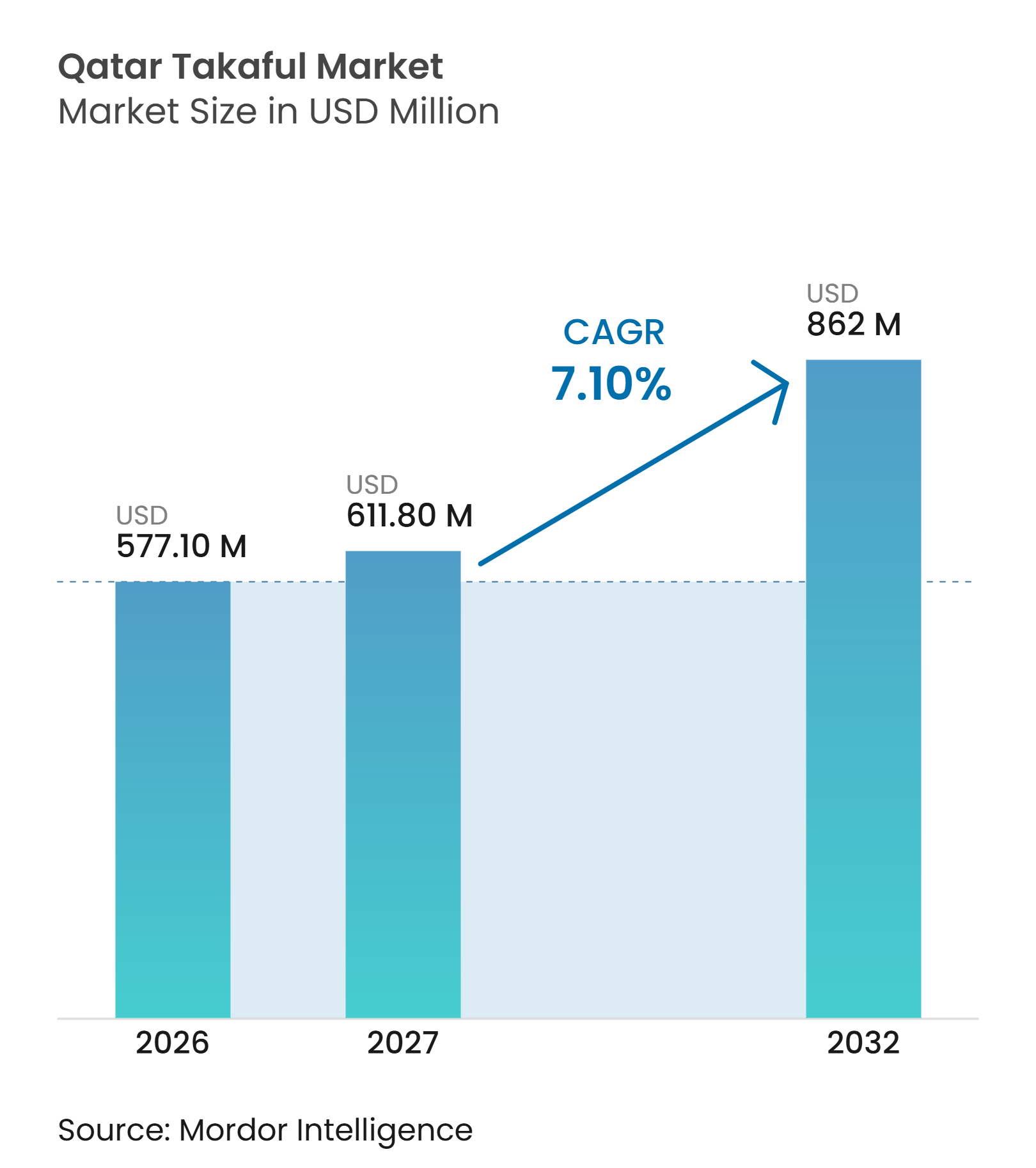
| Base Year Market Size (2026) | USD 577.10 Million |
| Market Size (2027) | USD 611.80 Million |
| Market Size (2032) | USD 862 Million |
| Growth Rate (2027 - 2032) | 7.10 % |
| Market Concentration | High |
Major Players *Disclaimer: Major Players sorted in no particular order Image © Mordor Intelligence. Reuse requires attribution under CC BY 4.0. | |
Qatar Takaful Market Analysis by Mordor Intelligence
The Qatar Takaful Market size is expected to increase from USD 577.10 million in 2026 to USD 611.80 million in 2027 and reach USD 862 million by 2032, growing at a CAGR of 7.10% over 2027-2032.
Growth is moving into a more established phase, with mandatory health insurance enrollment supporting faster expansion between 2020 and 2024. The Health Care Services Law No. 22 of 2021 has made private health insurance compulsory for non-Qatari residents and visitors, expanding the customer base for eligible insurers. Qatar’s expatriate workforce, healthcare network, and continuing growth in small business insurance needs support recurring demand. Digital distribution is also becoming more relevant as insurers use partnerships and installment-payment options to reduce upfront payment barriers, improve the renewal experience, and offer services through online and branch channels that reflect how retail customers increasingly manage financial transactions, particularly for straightforward medical, motor, travel, and personal protection products where customers expect clear pricing, quick payment confirmation, and accessible claims support.
Key Report Takeaways
- By takaful type, medical and health takaful captured 34.8% of the Qatar Takaful market share in 2026, while family protection and life takaful are projected to grow at an 8.5% CAGR through 2032.
- By distribution channel, agents and brokers held a 45.3% share of the Qatar Takaful market in 2026, while embedded, affinity, and other non-bank partnerships are projected to grow at a 10.5% CAGR through 2032.
- By customer type, individual and retail participants accounted for 44.8% of the Qatar Takaful market share in 2026, while small and medium enterprises are projected to grow at an 8.2% CAGR through 2032.
Note: Market numbers in this report are based on Mordor Intelligence's proprietary estimation framework, which combines nine months of actuals with Q4 projections for base year 2026.
Market Trends and Insights
Drivers Impact Analysis of Qatar Takaful Market*
| Driver | (~) % Impact on CAGR Forecast | Geographic Relevance | Impact Timeline |
|---|---|---|---|
| Mandatory Health Insurance for Expatriates and Visitors | +1.8% | National, concentrated in Doha, Lusail, and northern industrial zones | Short term (≤ 2 years) |
| Demand for Sharia-Compliant Insurance Solutions | +1.5% | National, strongest in high-income residential and financial district areas | Medium term (2-4 years) |
| Expansion of Family and Health Takaful | +1.2% | National | Medium term (2-4 years) |
| Expatriate-Led Population and Employment Base | +0.8% | National, with concentration in Doha, Al Wakra, and Lusail | Short term (≤ 2 years) |
| Digital Insurance Distribution and Product Innovation | +0.7% | National, with the Qatar Financial Centre as an innovation hub | Medium term (2-4 years) |
| Qatar Central Bank Regulation and Islamic Finance Ecosystem | +0.6% | National | Long term (≥ 4 years) |
| Source: Mordor Intelligence | |||
Mandatory Health Insurance for Expatriates and Visitors
In the Qatar Takaful market, Health Care Services Law No. 22 of 2021 made private health insurance mandatory for non-Qatari residents and visitors. The law shifted health coverage from a discretionary purchase to a required element of residency and visitor access, which brought a large population with annual coverage needs into the formal insurance system. The expected additional gross written premium from the program was QAR 1.7 billion (USD 467 million) to QAR 2.2 billion (USD 605 million)[1]. Detailed regulations for long-term resident expatriates had not been finalized, leaving further enrollment potential as implementation develops and leaving insurers to prepare capacity before the remaining group enters the system. Participating insurers must hold a Qatar Central Bank license, renew it annually, and store patient information within Qatar under the Ministry of Public Health registration requirements. These requirements favor operators with established healthcare panels, claims processes, and local data-management capabilities.
Sharia-Compliant Insurance and Family Takaful Expansion
The expansion of mandatory health insurance has supported demand for health takaful products in Qatar, while increasing awareness of Shariah-compliant financial protection provides opportunities for operators to develop broader family takaful offerings. Family and health coverage represent an important component of Qatar's takaful industry, reflecting the role of personal protection products alongside motor and general insurance. The mutual risk-sharing model also differentiates takaful from conventional insurance by allowing participants to contribute to a common fund for covering eligible claims. Under Wakala and Mudarabah arrangements, operators can manage participant funds through agency-based and profit-sharing structures, respectively. Qatar Financial Centre regulations also require takaful operators to establish policies governing the treatment and distribution of fund surpluses, strengthening transparency around participant entitlements. These features provide operators with opportunities to broaden their family takaful portfolios through protection and savings-linked products while increasing awareness of Shariah-compliant insurance structures.
Expatriate Employment and Small Business Insurance Demand
The Qatar Takaful market is supported by Qatar’s expatriate-led employment base, which drives recurring health, motor, and personal protection insurance requirements. The customer base is concentrated in Doha, Al Wakra, Lusail, and industrial areas, where employers need group health and employee protection arrangements that can be placed and renewed for a large workforce under a single employer relationship. Small and medium enterprises are expanding their use of business continuity and key-person protection as risk awareness improves. QNB and QLM agreed in March 2025 to offer tailored insurance packages for small businesses through QNB’s SME banking network[2]. The agreement covers key-person protection and group employee protection, linking insurance access to existing banking relationships. This model can make insurance more accessible to businesses that do not use traditional brokers, especially when banking staff can introduce coverage at the same point where a firm arranges accounts, payments, or credit facilities.
Digital Distribution and Regulatory Framework
Digital distribution is changing how insurers acquire customers and service policies in the Qatar Takaful market. Beema partnered with PayLater in August 2025 to offer Sharia-compliant installment payments for insurance premiums across online and branch channels[3]. The partnership reduces the effect of a single upfront premium payment and can help insurers limit policy lapses at renewal, particularly for customers who are willing to retain cover but prefer to manage cash flow in installments. Qatar Central Bank digital insurer rules require a licensed insurer to operate the digital value chain, including underwriting, issuance, and claims management. The rules also set paid-up capital at QAR 100 million (USD 27.5 million), which raises entry requirements for new digital operators and makes a well-funded operating model more important than a simple online sales interface. Qatar Insurance Group expanded its technology position in February 2025 through investments in Jaguar Transit, MIC Global, and Digital Petroleum
Restraints Impact Analysis of Qatar Takaful Market*
| Restraint | (~) % Impact on CAGR Forecast | Geographic Relevance | Impact Timeline |
|---|---|---|---|
| Conventional Insurers’ Scale and Product Breadth | -0.8% | National | Medium term (2-4 years) |
| Niche Customer Base and Lower Takaful Penetration | -0.7% | National | Long term (≥ 4 years) |
| Concentration Among a Small Number of Takaful Operators | -0.5% | National | Medium term (2-4 years) |
| Limited Scale in Family and Life Takaful | -0.4% | National | Short term (≤ 2 years) |
| Source: Mordor Intelligence | |||
Conventional Insurers’ Scale and Product Breadth
In the Qatar Takaful market, conventional insurers accounted for 93% of Qatar’s total insurance premium in early 2025, leaving takaful operators to build scale from a smaller base. Established conventional insurers have deeper corporate relationships, wider reinsurance access, and larger marketing budgets, giving them a practical advantage when customers require broad international capacity or established broker support. These strengths are especially relevant for energy, infrastructure, aviation, and major commercial accounts that use international broker networks. Foreign branches within the Qatar Financial Centre also compete in corporate medical and engineering coverage. Qatar Chamber discussed health insurance pricing, mandatory motor commission structures, and competition with Qatar Financial Centre-licensed insurers during its 2025 Insurance Committee session. The review shows that pricing discipline will remain important in health and motor lines where takaful operators have significant exposure.
Penetration Constraints and Concentration Risk
A large share of lower-income expatriate workers remain highly price-sensitive and may select the lowest-cost mandatory policy. This limits an insurer’s ability to raise premium per policy through additional benefits alone, because customers who purchase only to meet a mandatory requirement may place greater weight on price than on added product features. Life and family takaful represented 5% of Qatar’s total insurance business in early 2025, showing that long-term savings and investment products remain less developed. Transient expatriate employment patterns can also limit demand for longer-duration financial protection products, as households may be uncertain about how long they will remain in Qatar or where they will need benefits in the future. The Qatar Takaful market is concentrated among a small number of operators, so a disruption at a leading provider could affect sector performance. Competition between Qatar Central Bank-licensed and Qatar Financial Centre Regulatory Authority-licensed insurers also complicates efforts to develop consistent product depth across the domestic market.
*Our forecasts treat driver/restraint impacts as directional, not additive. The impact forecasts reflect baseline growth, mix effects, and variable interactions.
Qatar Takaful Market Segment Analysis
By Takaful Type:
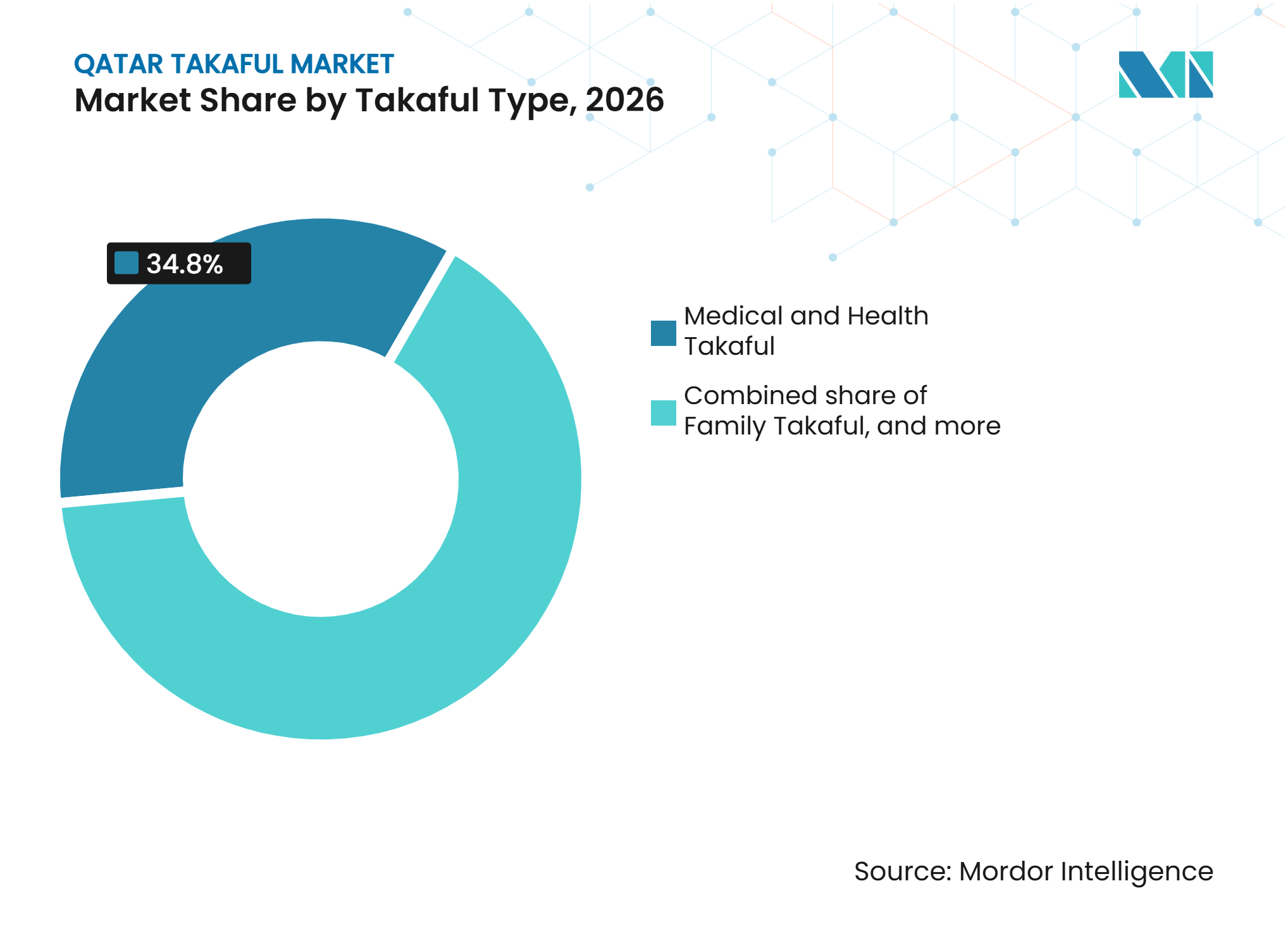
Health Coverage Supports Scale While Family Protection ExpandsWithin the Qatar Takaful market, medical and health takaful held a 34.8% share in 2026, supported by compulsory coverage for non-Qatari residents and visitors. The segment benefits from recurring policy renewals, employer-sponsored group plans, and a customer base that is renewed through established healthcare provider networks. Healthcare network costs, claims administration, and medical inflation remain central to underwriting performance because they directly affect the margin earned on high-volume medical policies. Health policies also give insurers a direct customer relationship that can support measured cross-selling of personal accident, travel, and family protection products without relying solely on new customer acquisition. The Ministry of Public Health requires participants in the mandatory system to follow licensing, renewal, and local patient-data requirements.
Family protection and life takaful is projected to grow at an 8.5% CAGR from 2027 to 2032. The Qatar Takaful market size for this segment is supported by education, savings, and income-protection needs among households without employer-sponsored retirement coverage, particularly where customers seek to align long-term planning with Sharia-compliant arrangements. Savings and investment-linked products can address longer-term financial planning needs, although adoption depends on policyholders seeing value despite their varied length of residence in Qatar. Distribution costs can be lower when an insurer uses existing health-policy relationships and digital channels to offer family coverage, rather than building a separate acquisition process. General takaful continues to include motor, property and fire, marine and aviation, engineering and construction, liability, travel and personal accident, and credit coverage. Motor takaful remains relevant because of Qatar’s high vehicle ownership and mandatory coverage requirements.


By Distribution Channel:
Broker Relationships Lead While Embedded Distribution Gains GroundWithin the Qatar Takaful market, agents and brokers accounted for a 45.3% share in 2026. Their position reflects their role in corporate relationships and in advising clients with engineering, marine cargo, and other specialized risk needs that often require careful policy placement. Brokers also remain useful when customers require support across renewals, claims coordination, and the selection of cover that fits a company’s contractual risk profile. Their role may be most durable in large commercial lines where policy terms, risk information, and reinsurance arrangements are more complex. The Qatar Takaful industry continues to use these networks to reach companies that seek direct advice before choosing coverage.
Embedded, affinity, and other non-bank partnerships are projected to grow at a 10.5% CAGR through 2032. Beema’s PayLater partnership shows how installment payments can be incorporated into online and branch insurance sales. Bancatakaful provides access to small-business customers through existing lending and transaction relationships, which may reduce the effort required for an insurer to identify suitable prospects. QNB’s agreement with QLM is an example of distributing key-person and group employee protection through SME banking services. Direct distribution can reduce the need for human intervention in policy issuance, premium payments, and claims filing, while digital insurer requirements set expectations for end-to-end service delivery.
By Customer Type:
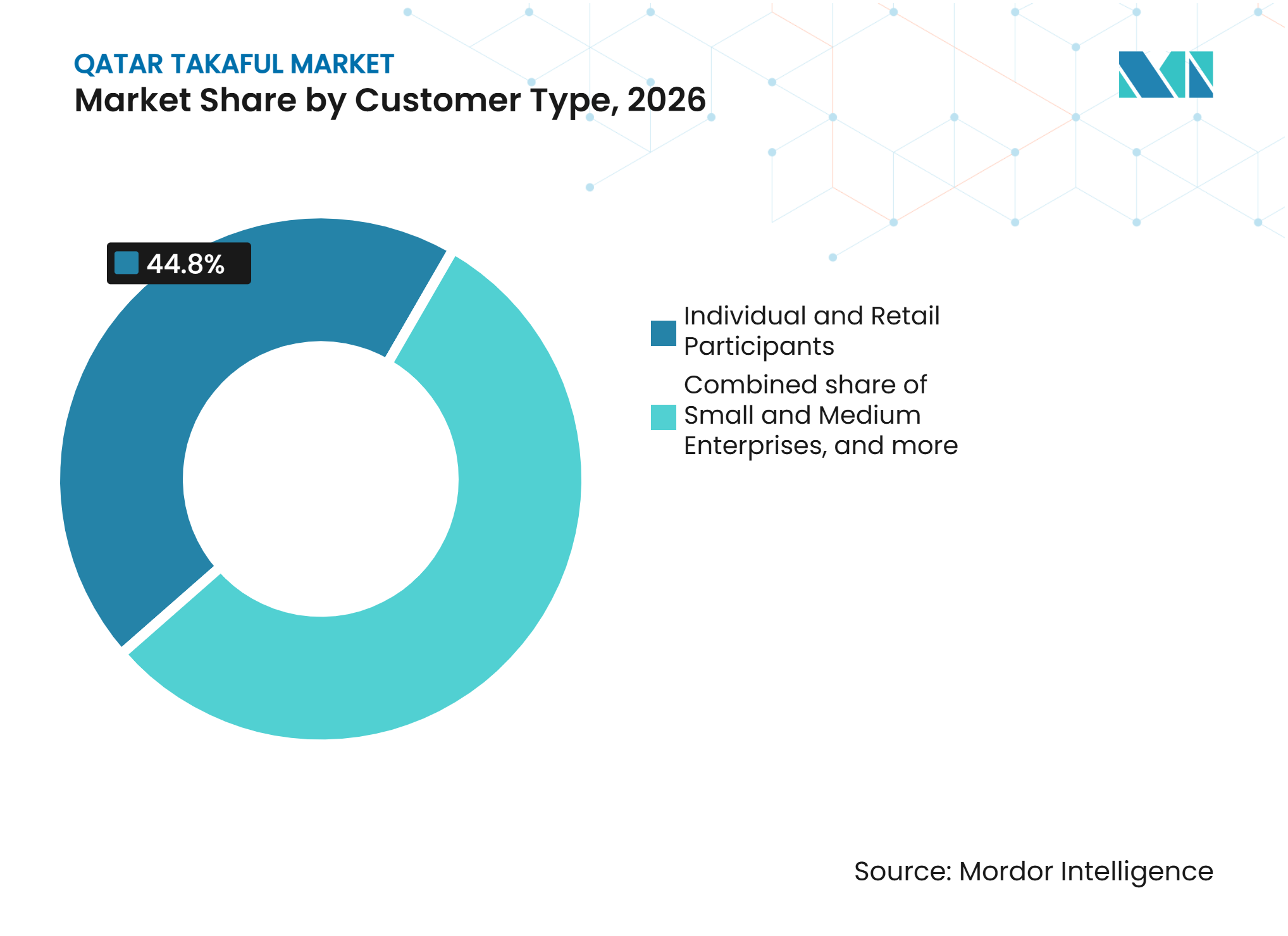
Retail Participation Provides Breadth While SMEs Grow FasterWithin the Qatar Takaful market, individual and retail participants accounted for a 44.8% share in 2026. Mandatory health and motor renewals provide the largest source of recurring demand within this customer group and give operators a stable basis for serving a wide range of income levels. The segment is broad, but it remains sensitive to premium affordability, payment flexibility, and the simplicity of the renewal process. Digital channels can improve access by simplifying enrollment, payment, claims notification, and policy servicing for customers who may otherwise rely on branch or broker support. Individual customers may also become more receptive to family and savings products after they are familiar with medical takaful coverage.
Small and medium enterprises are forecast to grow at an 8.2% CAGR from 2027 to 2032. The Qatar Takaful market size for SME coverage is supported by rising demand for business continuity, key-person protection, and group employee benefits as firms formalize their risk-management practices. QNB and QLM’s 2025 agreement illustrates how banks can package protection products with SME banking services. Large corporates and government institutions generally command higher average premiums in engineering, property, and aviation coverage, but demand can depend on the timing and scale of major infrastructure projects. This creates a more episodic pattern than the recurring policy renewals seen in retail and small-business coverage.

Geography Analysis
Doha
Doha is the main origination center for retail and corporate takaful because it hosts domestically licensed operators, the insurance supervision function, and a large share of the expatriate workforce. The city’s healthcare infrastructure supports employer-sponsored medical plans and private health insurance demand. Takaful contributions rose 4.1% to nearly QR 2 billion (USD 549.5 million) in 2025, while Doha-based Beema reported 28.3% contribution growth and Al Khaleej Takaful reported 19.7% growth. Qatar’s Islamic finance fintech transaction volume reached nearly QR 10 billion (USD 2.7 billion) in 2024 and was projected to grow at a 10% CAGR through 2028. The Qatar Takaful market benefits from Doha’s concentration of financial services, employers, hospitals, and digital payment activity.
Qatar Financial Centre
The Qatar Financial Centre hosts foreign takaful branches that bring specialized corporate medical and engineering capacity to the country. Its separate regulatory framework creates competition with insurers licensed by the Qatar Central Bank, encouraging domestic providers to strengthen underwriting, product range, and digital capabilities. Qatar Chamber identified competition between Qatar Financial Centre-licensed firms and domestic operators as a subject for industry discussion in 2025. The Qatar Financial Centre’s Digital Asset Lab has explored blockchain and tokenization applications for insurance contract settlement, which could support parametric product design. Qatar Central Bank’s digital insurer requirements raise the operating standard for new entrants and favor operators that have capital and established compliance systems.
Gulf Cooperation Council, United States, United Kingdom, and Asia-Pacific Links
The Qatar Takaful market is influenced by consolidation, reinsurance pricing, and talent flows across the Gulf Cooperation Council. Qatar Financial Centre reporting identified merger and acquisition activity in the Gulf Cooperation Council as an opportunity for Qatari takaful operators seeking regional scale. Kuwait-based GIG takaful signed a memorandum of understanding with YASH Technologies in October 2025 for artificial intelligence-led digital transformation. QIC’s insurtech investments included plans spanning Gulf Cooperation Council markets, Singapore, India, and Africa, showing links with the Asia-Pacific region. The United States and the United Kingdom remain reference points for global reinsurance capacity, technology partnerships, and financial reporting practices, although the available information provides no country-specific Qatar Takaful figures for either country.
Competitive Landscape
Market Concentration
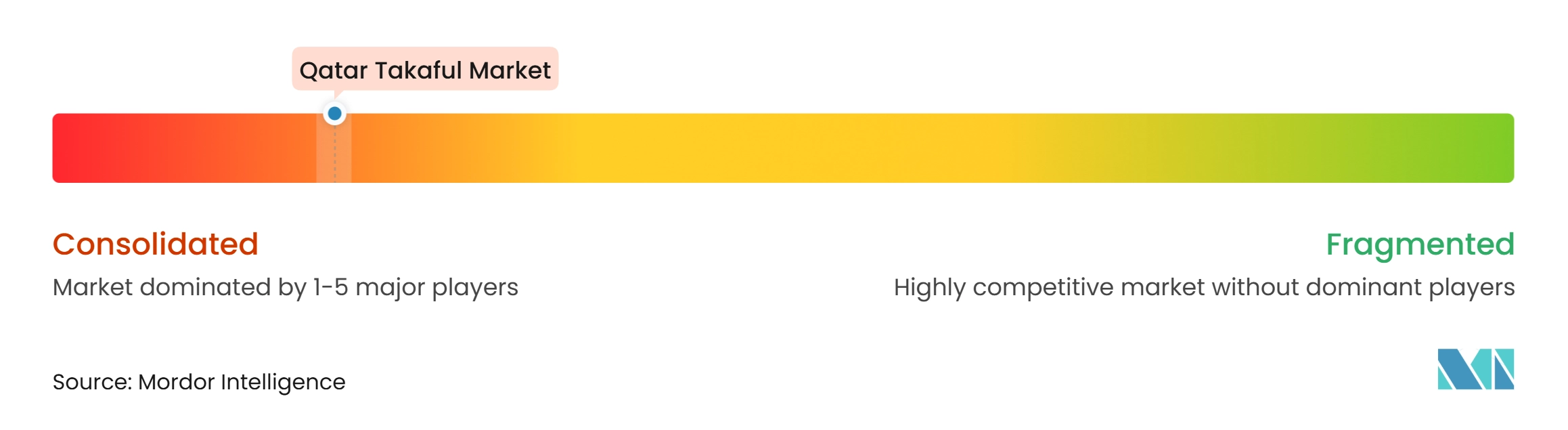
Qatar Takaful market has a concentrated competitive structure with QIIG, Beema, and Al Khaleej Takaful as leading players. QIIG operates a hybrid Wakala-Mudarabah model. Scale matters because large operators can negotiate healthcare network terms, invest in claims technology, and access reinsurance on more competitive terms. The concentration also increases the importance of underwriting discipline and investment management at the leading operators, since their pricing decisions and provider-network practices can have a visible effect on the wider sector’s performance. Smaller companies must differentiate through targeted channels, specialist products, or partnerships rather than compete solely on scale.
Competitive activity increasingly centers on digital distribution, small-business product development, and embedded premium financing. Beema’s August 2025 PayLater agreement introduced interest-free, 4-installment premium payments for the full takaful product range. QNB and QLM’s March 2025 collaboration created a route to offer key-person and group employee protection to small businesses through banking relationships. QIC also invested in Jaguar Transit, MIC Global, and Digital Petroleum to expand its insurtech partnerships. These moves show that established insurers are using partnerships to broaden their technology and distribution capabilities.
QIC launched Qatar’s first personal lines cyber insurance in the second quarter of 2025, covering financial losses associated with cyberattacks, phishing, identity theft, and credit card fraud. The product was not a takaful policy, but it demonstrated demand for personal cyber coverage and the potential for new insurance formats. Qatar Central Bank digital insurer rules require QAR 100 million (USD 27.5 million) in paid-up capital, creating a material barrier for greenfield digital entrants. Doha Insurance Group changed the name of its wholly owned takaful subsidiary from Doha Takaful Company to Doha Islamic Insurance, Shamel, in May 2025.
Qatar Takaful Industry Leaders
-
Qatar Islamic Insurance Group Q.P.S.C.
-
Al Khaleej Takaful Insurance Company Q.P.S.C.
-
General Takaful Company
-
Damaan Islamic Insurance Company Q.P.S.C. (Beema)
-
Doha Islamic Insurance – Shamel
- *Disclaimer: Major Players sorted in no particular order
Qatar Takaful Market Companies Covered in this Report
- Qatar Islamic Insurance Group Q.P.S.C. (QIIC)
- Al Khaleej Takaful Insurance Company Q.P.S.C.
- Damaan Islamic Insurance Company Q.P.S.C. (Beema)
- General Takaful Company
- Doha Islamic Insurance – Shamel
- MedGulf Takaful – QFC Branch
- Takaful International Company
- T'azur Company
- SEIB Insurance & Reinsurance
- GIG Takaful
Recent Industry Developments in Qatar Takaful Market
- August 2025: Beema, Damaan Islamic Insurance Company, signed a strategic partnership with PayLater, Qatar’s first Qatar Central Bank-licensed Sharia-compliant buy-now-pay-later provider, introducing interest-free 4-installment premium payments for the full takaful product range. The service is available online and at branches.
- May 2025: Doha Insurance Group obtained Qatar Central Bank and Ministry of Commerce and Industry approvals to rename its wholly owned takaful subsidiary from Doha Takaful Company to Doha Islamic Insurance, Shamel.
- March 2025: QNB signed a strategic master agreement with QLM Life and Medical Insurance to deliver tailored SME insurance packages covering key-person protection and group employee protection through QNB’s SME banking network.
- February 2025: QIC Group announced strategic equity investments in Jaguar Transit, MIC Global, and Digital Petroleum, with expansion plans across Gulf Cooperation Council markets, Singapore, India, and Africa.
Qatar Takaful Market Report Scope
Segmentation Overview
| Family Takaful | Family Protection / Life Takaful |
| Savings and Investment-Linked Takaful | |
| Medical and Health Takaful | |
| General Takaful | Motor Takaful |
| Property and Fire Takaful | |
| Marine and Aviation Takaful | |
| Engineering and Construction Takaful | |
| Liability Takaful | |
| Travel and Personal Accident Takaful | |
| Credit and Other General Takaful |
| Agents and Brokers |
| Bancatakaful |
| Direct Distribution |
| Embedded, Affinity and Other Non-Bank Partnerships |
| Individual and Retail Participants |
| Small and Medium Enterprises |
| Large Corporates |
| Government and Institutional Participants |
| By Takaful Type | Family Takaful | Family Protection / Life Takaful |
| Savings and Investment-Linked Takaful | ||
| Medical and Health Takaful | ||
| General Takaful | Motor Takaful | |
| Property and Fire Takaful | ||
| Marine and Aviation Takaful | ||
| Engineering and Construction Takaful | ||
| Liability Takaful | ||
| Travel and Personal Accident Takaful | ||
| Credit and Other General Takaful | ||
| By Distribution Channel | Agents and Brokers | |
| Bancatakaful | ||
| Direct Distribution | ||
| Embedded, Affinity and Other Non-Bank Partnerships | ||
| By Customer Type | Individual and Retail Participants | |
| Small and Medium Enterprises | ||
| Large Corporates | ||
| Government and Institutional Participants | ||
Key Questions Answered in the Report
What is the forecast growth rate for Qatar takaful through 2032?
The sector is forecast to grow at a 7.1% CAGR from 2027 to 2032, reaching USD 862.0 million by 2032.
Which takaful type has the largest share in Qatar?
Medical and Health Takaful leads with 34.8% share in 2026, supported by mandatory private health insurance requirements for non-Qatari residents and visitors.
What is the fastest-growing Qatar takaful segment?
Family Protection and Life Takaful is projected to record an 8.5% CAGR through 2032.
Which distribution channel is expected to grow fastest?
Embedded, Affinity, and Other Non-Bank Partnerships are forecast to expand at a 10.5% CAGR through 2032.
Why are SMEs important for takaful providers in Qatar?
SMEs are forecast to grow at an 8.2% CAGR, with demand supported by key-person protection, group employee benefits, and business continuity coverage.
Which companies lead Qatar’s takaful sector?
QIIG, Beema, and Al Khaleej Takaful collectively held 81% of gross written contributions in 2024.