
Qatar Real Estate Market Size and Share
Market Overview
| Study Period | 2020 - 2031 |
|---|---|
| Forecast Data Period | 2026 - 2031 |
| Base Year Market Size (2025) | USD 14.58 Billion |
| Market Size (2026) | USD 15.32 Billion |
| Market Size (2031) | USD 19.64 Billion |
| Growth Rate (2026 - 2031) | 5.09 % |
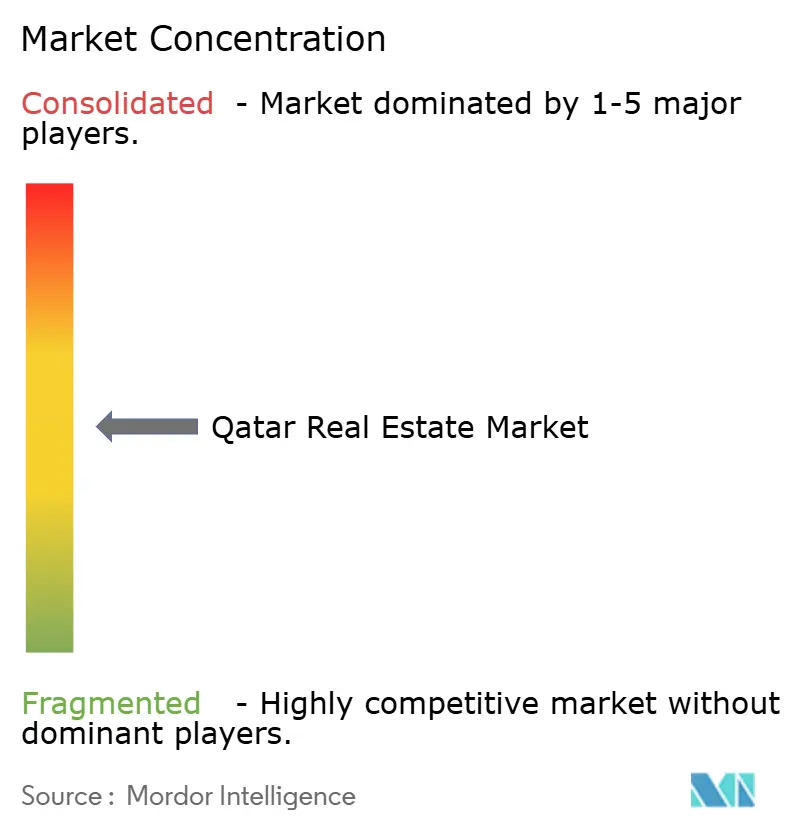
| Market Concentration | Medium |
Major Players *Disclaimer: Major Players sorted in no particular order Image © Mordor Intelligence. Reuse requires attribution under CC BY 4.0. | |
Qatar Real Estate Market Analysis by Mordor Intelligence
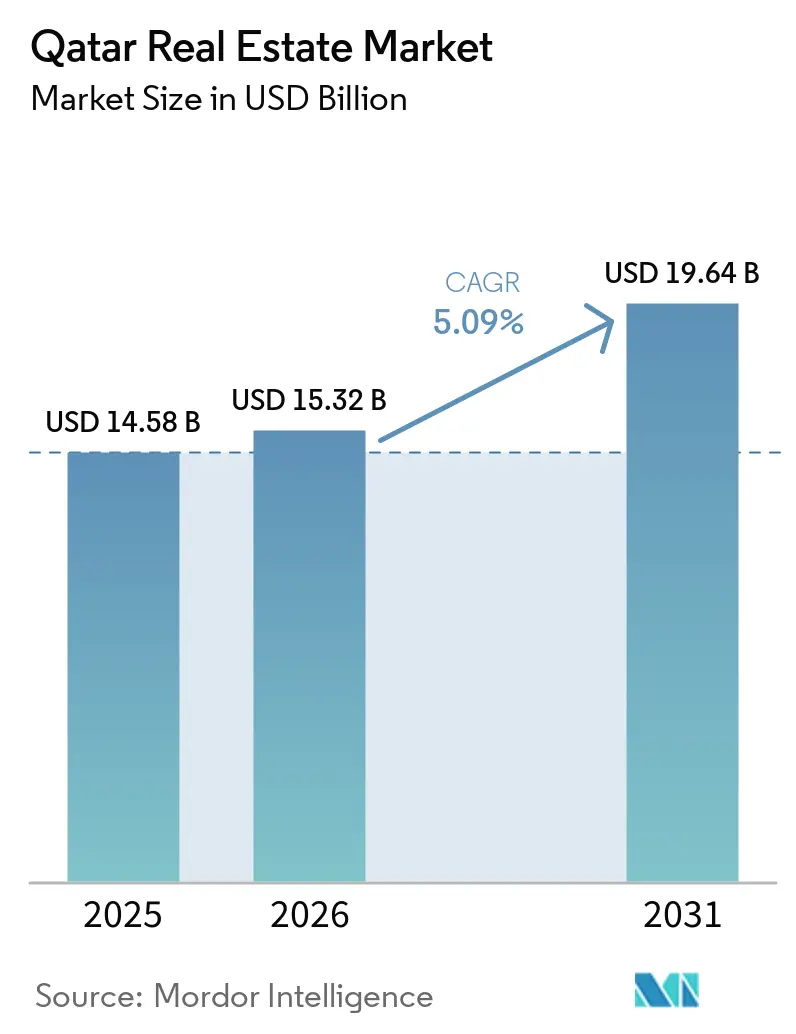
The Qatar Real Estate Market size is expected to grow from USD 14.58 billion in 2025 to USD 15.32 billion in 2026 and is forecast to reach USD 19.64 billion by 2031 at 5.09% CAGR over 2026-2031.
The Qatar real estate market is moving beyond the supply adjustment that followed the 2022 FIFA World Cup, with demand increasingly tied to economic diversification, population growth, and wider access for international buyers. Qatar National Vision 2030 continues to support investment in business districts, tourism facilities, transport connections, and mixed-use communities. Developers are responding with payment plans, fee waivers, and projects that combine housing, retail, offices, and hospitality uses. Prime districts can sustain stronger demand because they offer established services and transport access, while newer outer locations face more competition from available stock. The Qatar real estate market, therefore, offers growth opportunities in connected communities and higher-quality commercial space, although supply conditions and regional uncertainty remain important constraints.
Key Report Takeaways
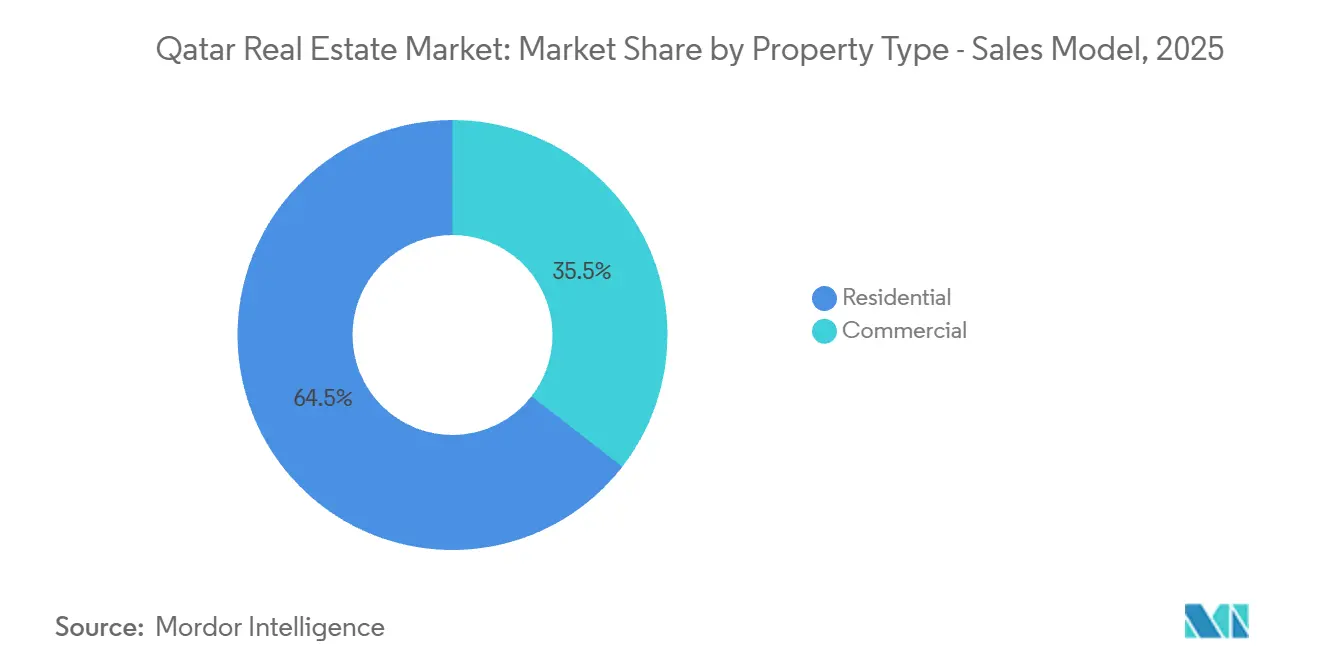
- By property type in the sales model, residential property held 64.5% of the Qatar real estate market share in 2025, while residential property was also the fastest-growing segment at a 5.71% CAGR through 2031.
- By key cities in the sales model, Doha held 42.5% of the Qatar real estate market share in 2025, while Al Wakrah recorded the highest forecast CAGR at 5.97% through 2031.
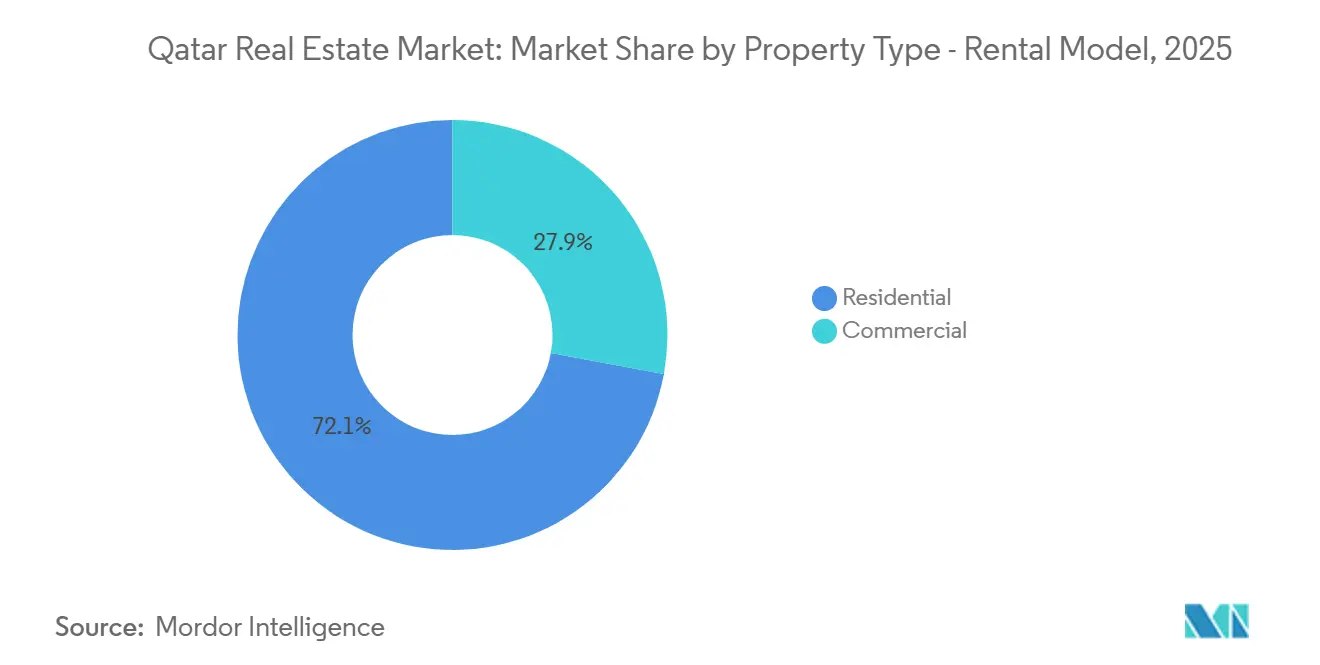
- By property type in the rental model, residential property accounted for 72.1% of the Qatar real estate market size in 2025, while commercial property was forecast to grow at a 6.03% CAGR through 2031.
- By key cities in the rental model, Doha accounted for 53.4% of the Qatar real estate market size in 2025, while Al Wakrah was forecast to expand at a 6.21% CAGR through 2031.
Note: Market size and forecast figures in this report are generated using Mordor Intelligence’s proprietary estimation framework, updated with the latest available data and insights as of January 2026.
Qatar Real Estate Market Trends and Insights
Drivers Impact Analysis*
| Drivers | (~) % Impact on CAGR Forecast | Geographic Relevance | Impact Timeline |
|---|---|---|---|
| Wider Foreign Ownership Access | +1.2% | Qatar-wide, with activity concentrated in Doha, Lusail, The Pearl, and coastal zones | Medium term (2-4 years) |
| Population And Expatriate Workforce Growth | +1.0% | Qatar-wide, with stronger absorption in Doha, Al Rayyan, and emerging suburban corridors | Long term (≥ 4 years) |
| Mixed-Use Development Pipeline | +0.8% | Lusail and Doha, with spillover into Al Wakrah and coastal zones | Medium term (2-4 years) |
| Tourism Diversification | +0.7% | Doha, Lusail, and the Simaisma coastal corridor | Long term (≥ 4 years) |
| Grade A Office Demand | +0.5% | West Bay, Lusail Marina District, and Msheireb Downtown | Short term (≤ 2 years) |
| Transport-Led Development | +0.4% | Lusail, Al Wakrah, Al Rayyan, and suburban areas near metro and orbital road networks | Long term (≥ 4 years) |
| Source: Mordor Intelligence | |||
Expanding Foreign Ownership Regulations Broaden Buyer Composition
Qatar’s property access framework has changed the pool of potential buyers in the Qatar real estate market. Foreign nationals can acquire freehold property in 9 designated areas and hold usufruct rights for up to 99 years in 16 additional areas under the stated legal framework. An investment of USD 200,000 can qualify a buyer for a renewable 5-year residency permit, while USD 1 million can qualify the buyer for permanent residency benefits. These rules link ownership with longer-term residence and can attract professionals, entrepreneurs, and households that may also use the rental sector. Cabinet Decision No. 21 of 2026 added the Simaisma Resort and Beach Project to the permitted ownership areas, extending access to a coastal tourism development[1].
Population and Expatriate Workforce Growth Sustains Residential Absorption
Population and workforce growth support the underlying housing need across the Qatar real estate market. The supplied research identified stronger demand in established communities that have transport access, services, and employment connections. This pattern favors completed areas in Doha and Al Rayyan over locations where new homes are still being absorbed. Residential sales transactions reached 7,846 in 2025, reflecting the combined effect of demand growth and wider ownership access[2]. The resulting demand is not uniform because homes in less-connected locations can take longer to lease or sell.
Lusail and Mixed-Use Developments Underpin the Development Pipeline
Lusail remains the largest concentrated development pipeline in the Qatar real estate market. The city covers 38 square kilometers, includes 19 districts and 4 islands, and combines offices, homes, retail, hospitality, and public infrastructure. Its mixed-use format gives residents and employers an alternative to older central districts. In July 2026, Parsons received a 3-year program management, construction management, and construction supervision contract for the Lusail City Infrastructure Program[3]. The Qatar Financial Centre relocation to Lusail Boulevard in 2025 also strengthened the city’s position as a business location.
Tourism Diversification Supports Hospitality and Leisure Investment
Tourism diversification gives the Qatar real estate market another source of demand beyond housing and offices. Tourist arrivals reached 5.09 million in 2025, compared with 4.91 million in 2024, according to the supplied research. This activity supports hotels, resorts, retail, and mixed-use locations that serve visitors and residents. Qatari Diar and Dar Global signed an agreement in April 2025 to develop the Trump International Golf Club and Trump-branded villas within the Simaisma master plan. Hotel activity in Lusail and Simaisma can also support demand for nearby residential and leisure assets.
Restraints Impact Analysis*
| Restraints | (~) % Impact on CAGR Forecast | Geographic Relevance | Impact Timeline |
|---|---|---|---|
| Residential Supply Pressure | -0.8% | Lusail, Al Waab, and The Pearl, with less pressure in prime Doha and Al Wakrah | Short term (≤ 2 years) |
| Rental Incentives and Landlord Competition | -0.6% | Mid-tier suburban rental corridors in Doha and outer Al Rayyan | Short term (≤ 2 years) |
| Regional Geopolitical Uncertainty | -0.5% | Qatar-wide, with greater exposure in discretionary investment-led housing | Short term (≤ 2 years) |
| Secondary Office Demand Weakness | -0.4% | C/D Ring Road, the older West Bay fringe, and secondary Doha office clusters | Medium term (2-4 years) |
| Source: Mordor Intelligence | |||
Residential Completions Create Localized Supply Imbalance
High delivery volumes in specific districts are placing pressure on rents and lease-up periods in the Qatar real estate market. Residential stock reached 404,612 units at the end of 2025, and the supplied research placed much of the later 2025 pipeline in Lusail, Al Waab, and The Pearl. This concentration means that the available supply can exceed immediate demand in selected locations. Developers have used longer payment plans and registration-fee waivers to maintain transaction activity. These measures can help buyers complete purchases, but they can also reduce rental yields for owners in supply-heavy submarkets.
Landlord Incentives and Rental Concessions Compress Net Effective Yields
Rental incentives are limiting the increase in effective income for some owners in the Qatar real estate market. The supplied research reported rent-free periods and fit-out contributions in suburban Doha and outer Al Rayyan. These concessions help landlords retain tenants when nearby buildings offer similar space. They also widen the difference between headline rents and the income actually received by the owner. Secondary office demand adds to this issue because older buildings must compete with newer Grade A stock in Lusail and central business districts.
*Our forecasts treat driver/restraint impacts as directional, not additive. The impact forecasts reflect baseline growth, mix effects, and variable interactions.
Segment Analysis
By Property Type In the Sales Model: Residential Property Leads Transaction Activity
Residential property held 64.5% of the sales model in 2025, making it the largest part of the Qatar real estate market. It is forecast to grow at a 5.71% CAGR through 2031, supported by population growth, ownership eligibility, and buyer incentives. Apartment transactions rose 74% between 2023 and 2025 in the supplied research. Villa and landed house sales also increased over the same period. These changes show continued buyer interest across different residential formats. More buyers are purchasing homes in communities that offer completed services and easier access to employment centers. Payment plans and fee waivers help bring first-time and upgrade buyers into the sales process. The Qatar real estate industry still depends on whether new supply is absorbed at a pace that protects pricing and owner returns.
Commercial property is smaller than residential property within the sales model. Still, it remains important to the Qatar real estate market because it includes offices, retail space, logistics assets, and hospitality-linked real estate. Premium destinations can achieve stronger rents where they combine tenant traffic, transport access, and established amenities. Lusail Boulevard is one example of a location that benefits from this pattern. Logistics property near Hamad Port also serves demand linked to e-commerce distribution and last-mile delivery. The shift of the Qatar Financial Centre to Lusail Boulevard in 2025 reinforced the area’s office and retail appeal. Commercial investors must still distinguish between well-located Grade A stock and older secondary space. That difference is increasingly important as tenants assess building quality, efficiency, and proximity to services. This segment remains tied to business expansion, tourism activity, and the pace of occupancy in new mixed-use districts.
By Key Cities In the Sales Model: Doha Retains Scale While Al Wakrah Grows Faster
Doha accounted for 42.5% of sales model activity in 2025 and remained the largest city in the Qatar real estate market. Its role reflects its concentration of premium homes, Grade A office space, established communities, and dense transport links. Doha recorded 564 residential sales transactions valued at QAR 2.4 billion in the fourth quarter of 2025, according to the supplied research. The city attracts buyers seeking liquidity, central locations, and established services. Premium areas such as The Pearl, Al Dafna, and West Bay continue to anchor higher-value activity. Doha also benefits from mortgage lending and participation by end users and higher-net-worth buyers. These strengths make the city a central reference point for pricing and demand. Competition from Lusail, however, means that older office buildings face a need to maintain quality and tenant appeal.
Al Wakrah is forecast to be the fastest-growing sales city, with a 5.97% CAGR through 2031. Sales transactions rose from 317 in 2024 to 1,090 in 2025, according to the supplied research. Competitive land pricing, developer incentives, and proximity to Al Janoub Stadium support the city’s appeal. Ezdan Holding Group opened freehold sales at Hayat Al Wakra 2 and Al Nokhba Villas in October 2025 for citizens, residents, and foreign investors. Al Rayyan continues to attract households seeking villas and larger homes. Lusail draws investment through major state-linked development activity. The rest of Qatar, including Al Khor, offers more affordable land and benefits from continuing infrastructure extensions. These cities provide alternatives for buyers whose needs are not fully met in central Doha.
By Property Type In the Rental Model: Residential Scale Coexists with Faster Commercial Growth
Residential property held 72.1% of the rental model in 2025, reflecting the importance of rented accommodation for many expatriate households. Total rental contracts reached 89,341 during the first 9 months of 2025, according to the supplied research. Residential contracts represented 76% of that total. This scale makes homes the main source of activity in the rental model. Demand ranges from affordable suburban units to premium waterfront residences. Household income, family size, and workplace location shape the choice of community. This creates different conditions for landlords in prime and mid-tier districts. The Qatar real estate industry must therefore serve a broad range of occupier budgets and housing needs.
Commercial property is forecast to grow at a 6.03% CAGR through 2031, faster than the residential rental segment. Demand for Grade A offices is concentrated in Lusail and West Bay, where larger tenants seek modern buildings. Government-related occupancy and corporate relocations help support newer, higher-specification stock. Demand from information and communications technology, data, and e-governance tenants is also expected to favor efficient offices. Older buildings face a different environment because tenants have more alternatives. The performance gap between Grade A and secondary offices can widen when new supply enters the market. Retail, logistics, and hospitality spaces add diversity to commercial rental demand. The commercial segment can therefore grow even while individual office submarkets experience differing vacancy and rent conditions.
Geography Analysis
Doha held 42.5% of sales activity and 53.4% of rental activity in 2025, making it the largest geography in the Qatar real estate market. The city anchors premium residential and office demand through locations such as The Pearl, Al Dafna, and West Bay. Its established communities appeal to households that place value on services, employment access, and centrality. Doha also remains important for mortgage-backed purchases and higher-value transactions. Major tenants are shifting some office demand toward newer space in Lusail. This movement can strengthen rents in high-quality Lusail buildings while increasing competition for older West Bay properties.
Al Wakrah had the highest forecast growth in both models, at 5.97% in sales and 6.21% in rentals through 2031. Its transaction count rose to 1,090 in 2025, supported by competitive prices, development activity, and improving connections. The city provides a lower-cost option for buyers and tenants who still need access to Doha. Ezdan’s 2025 freehold launches demonstrate developer interest in this location. Al Rayyan continues to draw demand for villas and higher-value family housing. Together, Al Wakrah and Al Rayyan widen the geography of demand beyond central Doha.
Lusail is moving from a construction-led phase toward a more active occupancy market in the Qatar real estate market. Its mixed-use design connects residential, office, retail, and hospitality activity in one urban area. The city’s infrastructure program continues through the 2026 Parsons contract. New offices and transport connections support its role as an emerging business district. The rest of Qatar, including Al Khor, remains relevant for affordable housing and projects linked to infrastructure extensions. The approved Saudi Arabia-Qatar rail connection could support mobility and demand along the northern corridor, although its effect will depend on implementation.
Competitive Landscape
The Qatar real estate market is moderately concentrated because state-linked developers control major land banks and premium mixed-use pipelines. Qatari Diar Real Estate Investment Company, Barwa Real Estate, Msheireb Properties, and United Development Company are major participants. Their roles extend beyond construction because they can act as master planners, asset owners, and long-term operators. This creates an advantage in large projects that need patient capital and coordinated infrastructure. Private developers and brokers remain active in mid-market and retail segments. Their position is more fragmented and often depends on local project execution and sales networks.
Competition is increasingly shaped by the ability to deliver projects that meet buyer, tenant, and regulatory requirements. Law No. 6 of 2014 requires escrow arrangements and licensed developer registration, which supports established operators with the resources to meet compliance obligations. Msheireb Properties is expanding its urban development model through a decarbonization partnership with Cundall and an artificial intelligence-enabled city operations platform developed with Ooredoo Qatar and Honeywell. Qatar Investment Authority acquired a 49% stake in Msheireb Properties in June 2025, while Qatar Foundation retained 51%. These actions show how leading participants are combining capital support, building operations, and technology in major urban districts.
New forms of investment may also broaden competition in the Qatar real estate market. HMK Capital registered the Salwa Real Estate Investment Trust Fund with the Qatar Financial Centre Regulatory Authority in May 2026, described in the supplied research as Qatar’s first real estate investment trust. The fund subsequently assembled an initial portfolio through property acquisitions in Mseimeer, Al Rayyan, Al Dafna, and West Bay. Affordable homes for middle-income expatriates and logistics assets near Hamad Port remain areas with room for further development. Qatari Diar’s Simaisma agreement with Dar Global provides another example of a large developer using a branded leisure project to attract investment. The competitive structure favors firms that can combine land, financing, compliance, and long-term asset management.
Qatar Real Estate Industry Leaders
-
Barwa Real Estate
-
Ezdan Holding Group
-
United Development Company
-
Qatari Diar Real Estate Investment Company
-
Msheireb Properties
- *Disclaimer: Major Players sorted in no particular order
Recent Industry Developments
- September 2026: Qatar's Prime Minister, at the Qatar Economic Forum powered by Bloomberg, announced the launch of the "Doha Investment" platform, forecasting USD 38.5 billion in new infrastructure projects and USD 22.5 billion in private real estate and hospitality investment over the next 5 years, with immediate tendering processes commencing for public-private partnership projects.
- June 2026: Parsons Corporation was awarded a 3-year program management, construction management, and construction supervision contract by Lusail Real Estate Development Company for the Lusail City Infrastructure Program, continuing a partnership with Qatari Diar across 19 mixed-use districts spanning 38 square kilometers.
Qatar Real Estate Market Report Scope
| Residential | Apartments and Condominiums |
| Villas and Landed Houses | |
| Commercial | Office |
| Retail | |
| Logistics | |
| Other Commercial Property, Including Industrial and Hospitality |
| Doha |
| Al Rayyan |
| Al Wakrah |
| Lusail |
| Rest of Qatar |
| By Property Type | Residential | Apartments and Condominiums |
| Villas and Landed Houses | ||
| Commercial | Office | |
| Retail | ||
| Logistics | ||
| Other Commercial Property, Including Industrial and Hospitality | ||
| By Key Cities | Doha | |
| Al Rayyan | ||
| Al Wakrah | ||
| Lusail | ||
| Rest of Qatar | ||
Key Questions Answered in the Report
What is the forecast growth rate for Qatar's real estate through 2031?
The Qatar real estate market is forecast to grow at a 5.09% CAGR from 2026 to 2031, reaching USD 19.6 billion.
Which property type has the largest sales base in Qatar?
Residential property led the sales model with 64.5% share in 2025 and is forecast to grow at a 5.71% CAGR through 2031.
Which city is expected to grow fastest in property sales?
Al Wakrah is forecast to record the highest sales CAGR at 6.03% through 2031.
What is driving commercial rental demand in Qatar?
Demand is concentrating on Grade A office locations, especially Lusail and West Bay, as tenants seek modern and well-connected space.
Can foreign investors buy property in Qatar?
Foreign buyers can access freehold and usufruct rights in designated areas under Qatar’s ownership framework.
Which companies are significant participants in Qatar's real estate?
Major state-linked participants include Qatari Diar, Barwa Real Estate, Msheireb Properties, and United Development Company.