Qatar Passenger Vehicles Lubricants Market Analysis by Mordor Intelligence
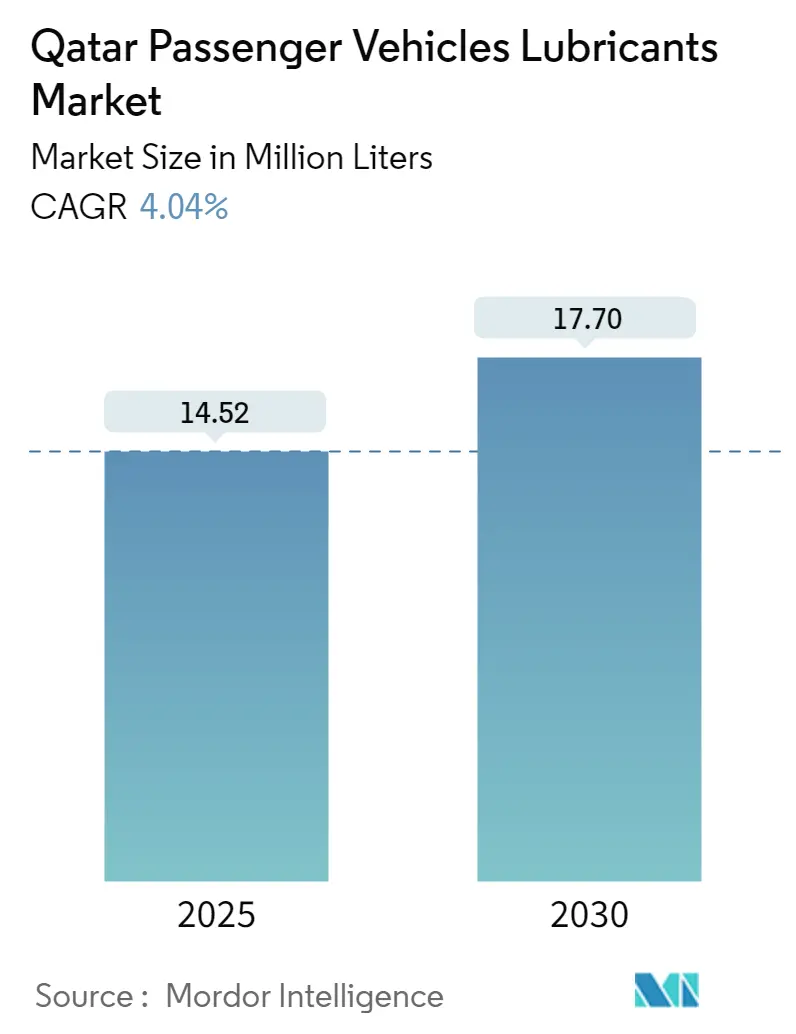
The Qatar Passenger Vehicles Lubricants Market size is estimated at 14.52 million liters in 2025, and is expected to reach 17.70 million liters by 2030, at a CAGR of 4.04% during the forecast period (2025-2030).
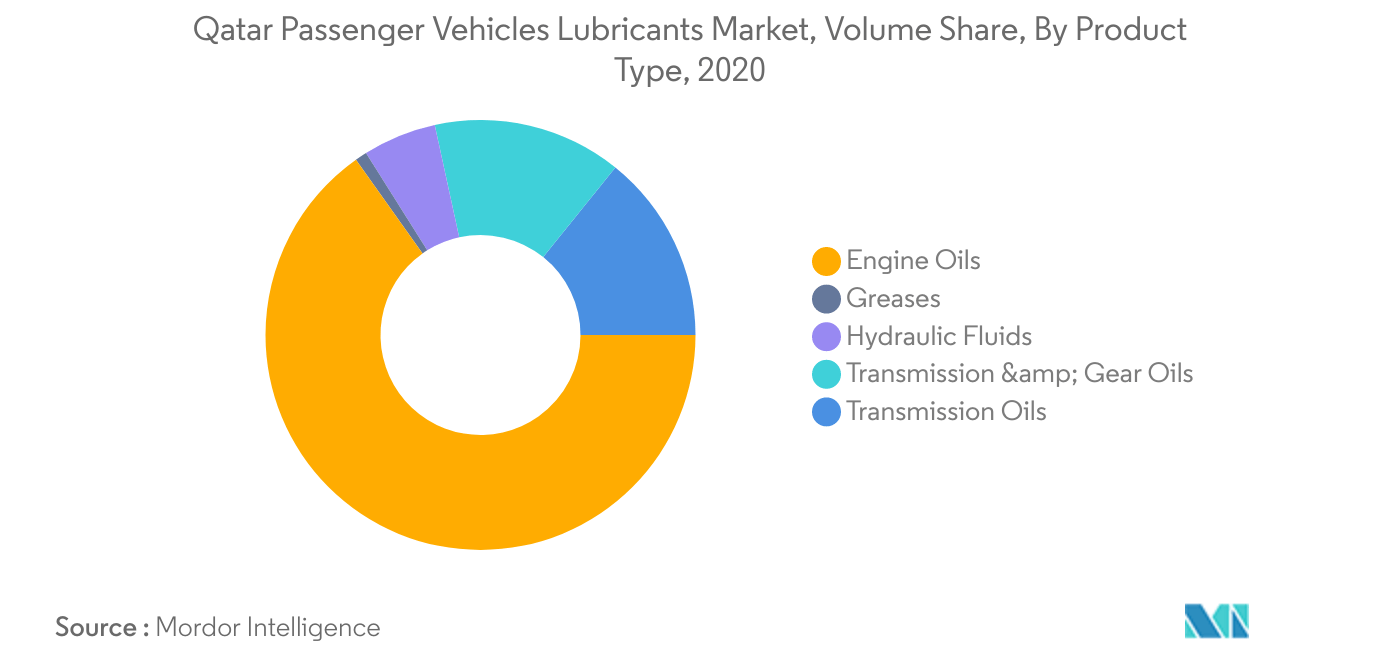
Largest Segment by Product Type - Engine Oils : Engine oil is the leading product type due to its high volume requirements and shorter drain intervals, as it is used in high-temperature and high-pressure applications.
Fastest Segment by Product Type - Greases : Recovery in the sales of new vehicles along with expected growth in the usage and sales of used imported vehicles are likely to augment the grease consumption in near future.
Qatar Passenger Vehicles Lubricants Market Trends and Insights
Largest Segment By Product Type : Engine Oils
In Qatar, passenger vehicles (PVs) is the second-largest vehicle type in terms of automotive lubricant consumption. During 2015-2019, the PV lubricant consumption grew with a CAGR of 4.18% primarily owing to the surge in the car popualtion of the country.
In 2020, PVs accounted for about 39.62% of the total automotive lubricant consumption in the country. Engine oil accounted for the largest share in the PV lubricant consumption, with a share of around 76% during the year. During 2020, PV lubricants consumption declined by 8.33% due to the lower usage of the vehicle fleet post COVID-19 outbreak.
During 2021-2026, the grease segment is likely to be the fastest-growing lubricant type at a CAGR of 5.49%. This growth is likely to be driven by rise in sales of passenger cars and recovery in average distance travelled in the country.
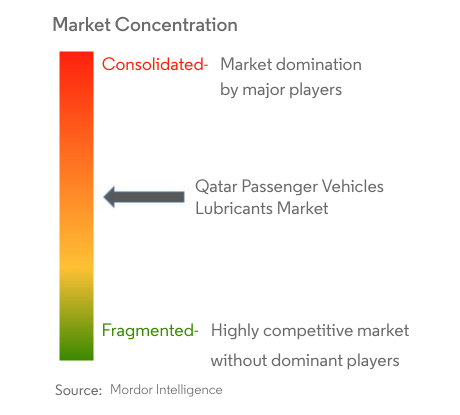
The Qatar Passenger Vehicles Lubricants Market is moderately consolidated, with the top five companies occupying 54.65%. The major players in this market are ExxonMobil Corporation, Qatar Lubricants Company (QALCO), Royal Dutch Shell PLC, TotalEnergies and Valvoline Inc. (sorted alphabetically).
Qatar Passenger Vehicles Lubricants Industry Leaders
ExxonMobil Corporation
Qatar Lubricants Company (QALCO)
Royal Dutch Shell PLC
TotalEnergies
Valvoline Inc.
*Disclaimer: Major Players sorted in no particular order
March 2021: Castrol announced the launch of Castrol ON (a Castrol e-fluid range that includes e-gear oils, e-coolants, and e-greases) to its product portfolio. This range is specially designed for electric vehicles.
March 2021: Hyundai Motor Company and Royal Dutch Shell PLC announced a five-year global business cooperation agreement, with a new focus on clean energy and carbon reduction, to help Hyundai continue its transformation as a Smart Mobility Solution Provider.
February 2021: Royal Dutch Shell PLC introduced a global portfolio of carbon-neutral lubricants for a wide range of automotive and industrial applications to control carbon emissions.
Table of Contents for Qatar Passenger Vehicles Lubricants Industry Report
1. Executive Summary & Key Findings
2. Introduction
2.1 Study Assumptions & Market Definition
2.2 Scope of the Study
2.3 Research Methodology
3. Key Industry Trends
3.1 Automotive Industry Trends
3.2 Regulatory Framework
3.3 Value Chain & Distribution Channel Analysis
4. Market Segmentation
4.1 By Product Type
4.1.1 Engine Oils
4.1.2 Greases
4.1.3 Hydraulic Fluids
4.1.4 Transmission & Gear Oils
5. Competitive Landscape
5.1 Key Strategic Moves
5.2 Market Share Analysis
5.3 Company Profiles
5.3.1 BP PLC (Castrol)
5.3.2 Dana Lubricants Factory LLC
5.3.3 ENEOS Corporation
5.3.4 ExxonMobil Corporation
5.3.5 Gulf Continental Oil and Grease Factory (GulfCon)
How big is the Qatar Passenger Vehicles Lubricants Market?
The Qatar Passenger Vehicles Lubricants Market size is expected to reach 14.52 million Liters in 2025 and grow at a CAGR of 4.04% to reach 17.70 million Liters by 2030.
What is the current Qatar Passenger Vehicles Lubricants Market size?
In 2025, the Qatar Passenger Vehicles Lubricants Market size is expected to reach 14.52 million Liters.
Who are the key players in Qatar Passenger Vehicles Lubricants Market?
ExxonMobil Corporation, Qatar Lubricants Company (QALCO), Royal Dutch Shell PLC, TotalEnergies and Valvoline Inc. are the major companies operating in the Qatar Passenger Vehicles Lubricants Market.
What years does this Qatar Passenger Vehicles Lubricants Market cover, and what was the market size in 2024?
In 2024, the Qatar Passenger Vehicles Lubricants Market size was estimated at 13.93 million Liters. The report covers the Qatar Passenger Vehicles Lubricants Market historical market size for years: 2019, 2020, 2021, 2022, 2023 and 2024. The report also forecasts the Qatar Passenger Vehicles Lubricants Market size for years: 2025, 2026, 2027, 2028, 2029 and 2030.
Statistics for the 2025 Qatar Passenger Vehicles Lubricants market share, size and revenue growth rate, created by Mordor Intelligence™ Industry Reports. Qatar Passenger Vehicles Lubricants analysis includes a market forecast outlook for 2025 to 2030) and historical overview. Get a sample of this industry analysis as a free report PDF download.