Qatar Commercial Vehicles Lubricants Market Analysis by Mordor Intelligence
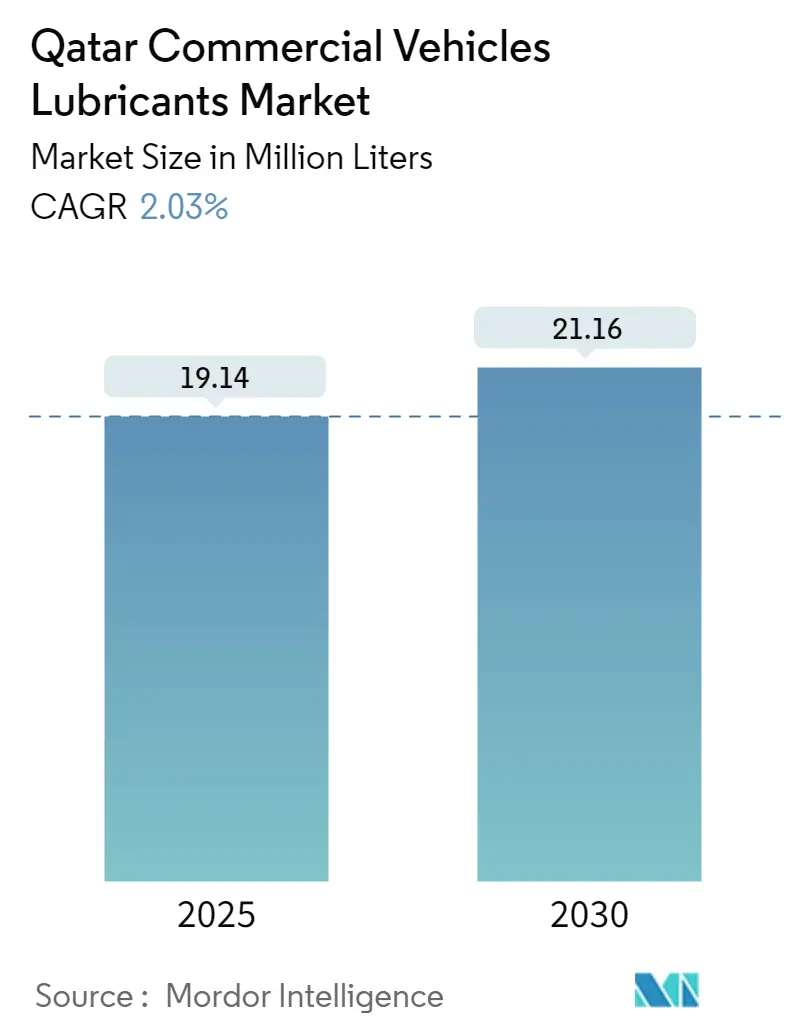
The Qatar Commercial Vehicles Lubricants Market size is estimated at 19.14 million liters in 2025, and is expected to reach 21.16 million liters by 2030, at a CAGR of 2.03% during the forecast period (2025-2030).
Largest Segment by Product Type - Engine Oils : Engine oil is the leading product type due to its high volume requirements and shorter drain intervals, as it is used in high-temperature and high-pressure applications.
Fastest Segment by Product Type - Greases : In Qatar, the predicted rebound in commercial vehicle imports and sales beginning in 2021 is expected to increase the consumption of greases during the next few years.
Qatar Commercial Vehicles Lubricants Market Trends and Insights
Largest Segment By Product Type : Engine Oils
In Qatar, commercial vehicles (CVs) forms the second-largest vehicle type in terms of automotive lubricant consumption. During 2015-2019, lubricant consumption in the CV sector has been fluctuating. This can be attributed to the growing vehicle fleet along with expanding service intervals for engine oils and transmission oils.
The commercial vehicle lubricant consumption declined by almost 8.3% as COVID-19 affected the freight transportation in 2020. The engine oil segment accounted for around 78% share in CV lubricant consumption in 2020. A major decline of 9.5% was observed in the consumption of greases in CV segment during the year.
The grease segment is likely to be the fastest-growing segment with a CAGR of 5.19% during 2021-2026. The recovery in production and sales of commercial vehicles is likely to drive the consumption of greases in the short term.
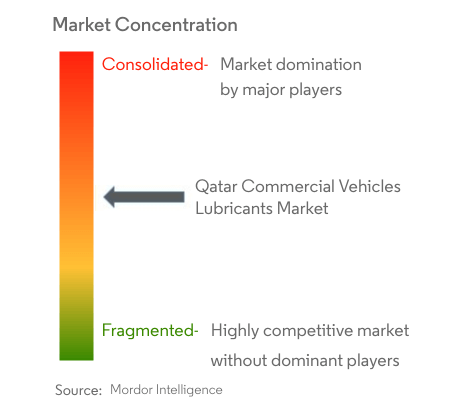
The Qatar Commercial Vehicles Lubricants Market is moderately consolidated, with the top five companies occupying 47.14%. The major players in this market are ExxonMobil Corporation, Qatar Lubricants Company (QALCO), Royal Dutch Shell PLC, TotalEnergies and Valvoline Inc. (sorted alphabetically).
Qatar Commercial Vehicles Lubricants Industry Leaders
ExxonMobil Corporation
Qatar Lubricants Company (QALCO)
Royal Dutch Shell PLC
TotalEnergies
Valvoline Inc.
*Disclaimer: Major Players sorted in no particular order
January 2022: Effective April 1, ExxonMobil Corporation was organized along three business lines - ExxonMobil Upstream Company, ExxonMobil Product Solutions and ExxonMobil Low Carbon Solutions.
October 2021: Valvoline and Cummins extended their long-standing marketing and technology collaboration agreement for another five years. Cummins will endorse and promote Valvoline's Premium Blue engine oil for its heavy-duty diesel engines and generators and will distribute Valvoline products through its global distribution networks.
March 2021: Castrol announced the launch of Castrol ON (a Castrol e-fluid range that includes e-gear oils, e-coolants, and e-greases) to its product portfolio. This range is specially designed for electric vehicles.
Table of Contents for Qatar Commercial Vehicles Lubricants Industry Report
1. Executive Summary & Key Findings
2. Introduction
2.1 Study Assumptions & Market Definition
2.2 Scope of the Study
2.3 Research Methodology
3. Key Industry Trends
3.1 Automotive Industry Trends
3.2 Regulatory Framework
3.3 Value Chain & Distribution Channel Analysis
4. Market Segmentation
4.1 By Product Type
4.1.1 Engine Oils
4.1.2 Greases
4.1.3 Hydraulic Fluids
4.1.4 Transmission & Gear Oils
5. Competitive Landscape
5.1 Key Strategic Moves
5.2 Market Share Analysis
5.3 Company Profiles
5.3.1 BP PLC (Castrol)
5.3.2 Chevron Corporation
5.3.3 ENEOS Corporation
5.3.4 ExxonMobil Corporation
5.3.5 Gulf Continental Oil and Grease Factory (GulfCon)
How big is the Qatar Commercial Vehicles Lubricants Market?
The Qatar Commercial Vehicles Lubricants Market size is expected to reach 19.14 million Liters in 2025 and grow at a CAGR of 2.03% to reach 21.16 million Liters by 2030.
What is the current Qatar Commercial Vehicles Lubricants Market size?
In 2025, the Qatar Commercial Vehicles Lubricants Market size is expected to reach 19.14 million Liters.
Who are the key players in Qatar Commercial Vehicles Lubricants Market?
ExxonMobil Corporation, Qatar Lubricants Company (QALCO), Royal Dutch Shell PLC, TotalEnergies and Valvoline Inc. are the major companies operating in the Qatar Commercial Vehicles Lubricants Market.
What years does this Qatar Commercial Vehicles Lubricants Market cover, and what was the market size in 2024?
In 2024, the Qatar Commercial Vehicles Lubricants Market size was estimated at 18.75 million Liters. The report covers the Qatar Commercial Vehicles Lubricants Market historical market size for years: 2019, 2020, 2021, 2022, 2023 and 2024. The report also forecasts the Qatar Commercial Vehicles Lubricants Market size for years: 2025, 2026, 2027, 2028, 2029 and 2030.
Statistics for the 2025 Qatar Commercial Vehicles Lubricants market share, size and revenue growth rate, created by Mordor Intelligence™ Industry Reports. Qatar Commercial Vehicles Lubricants analysis includes a market forecast outlook for 2025 to 2030) and historical overview. Get a sample of this industry analysis as a free report PDF download.
Please copy & paste this embed code onto your site:
Images must be attributed to Mordor Intelligence. Learn more
About The Embed Code X
Mordor Intelligence's images may only be used with attribution back to Mordor Intelligence. Using the Mordor Intelligence's embed code renders the image with an attribution line that satisfies this requirement.
In addition, by using the embed code, you reduce the load on your web server, because the image will be hosted on the same worldwide content delivery network Mordor Intelligence uses instead of your web server.










 Your data is secure and never sold or shared.


