
Market Overview
| Study Period | 2020 - 2031 |
|---|---|
| Forecast Data Period | 2026 - 2031 |
| Base Year Market Size (2025) | USD 532.22 Million |
| Market Size (2026) | USD 564.94 Million |
| Market Size (2031) | USD 761.18 Million |
| Growth Rate (2026 - 2031) | 6.15 % |
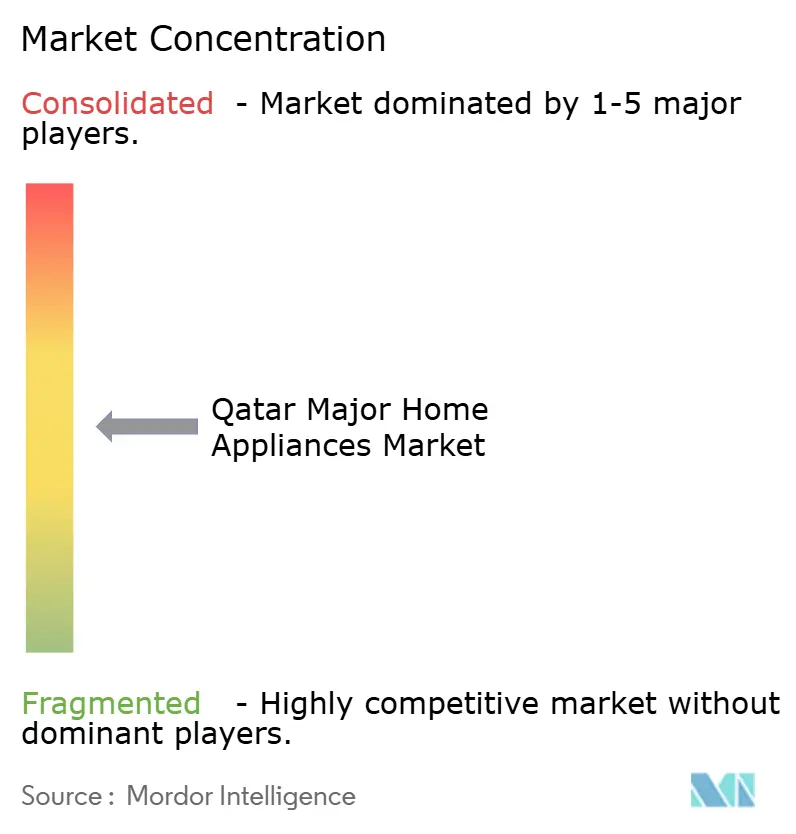
| Market Concentration | Medium |
Major Players *Disclaimer: Major Players sorted in no particular order Image © Mordor Intelligence. Reuse requires attribution under CC BY 4.0. | |
Qatar Major Home Appliances Market Analysis by Mordor Intelligence
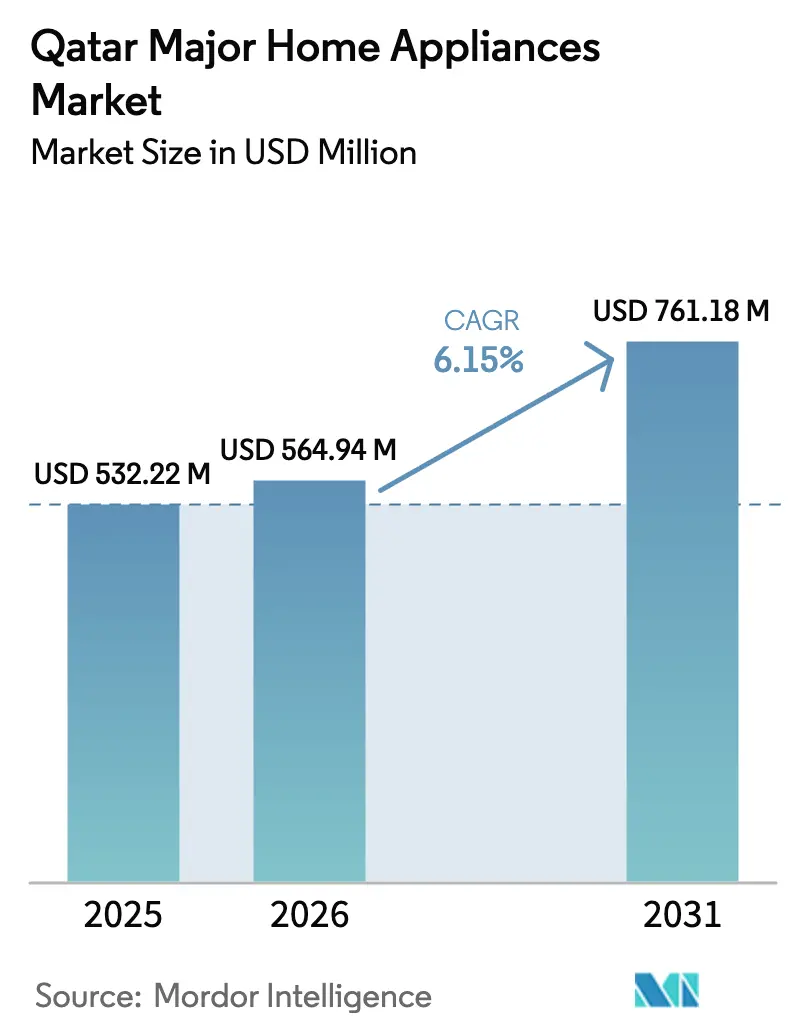
The Qatar Major Home Appliances market size was valued at USD 532.22 million in 2025 and estimated to grow from USD 564.94 million in 2026 to reach USD 761.18 million by 2031, at a CAGR of 6.15% during the forecast period (2026-2031). The current expansion of the Qatar Major Home Appliances market reflects a post-FIFA World Cup economy that continues to leverage immigration-driven household formation, government housing loans, and accelerating digital retail growth. Air conditioners retain primacy within the Qatar Major Home Appliances market because extreme heat pushes cooling devices from discretionary to essential status. Dishwashers are gaining ground as Western lifestyle habits diffuse through the expatriate workforce, while energy-efficiency subsidies under Qatar National Vision 2030 redirect consumer attention from upfront price to lifetime operating cost. E-commerce now builds on 5G rollout, high mobile penetration, and one-hour delivery pilots to rewrite brand visibility rules across the Qatar Major Home Appliances market, even as multi-brand stores remain critical for large-ticket items that require in-store demonstration and post-sale servicing.
Key Report Takeaways
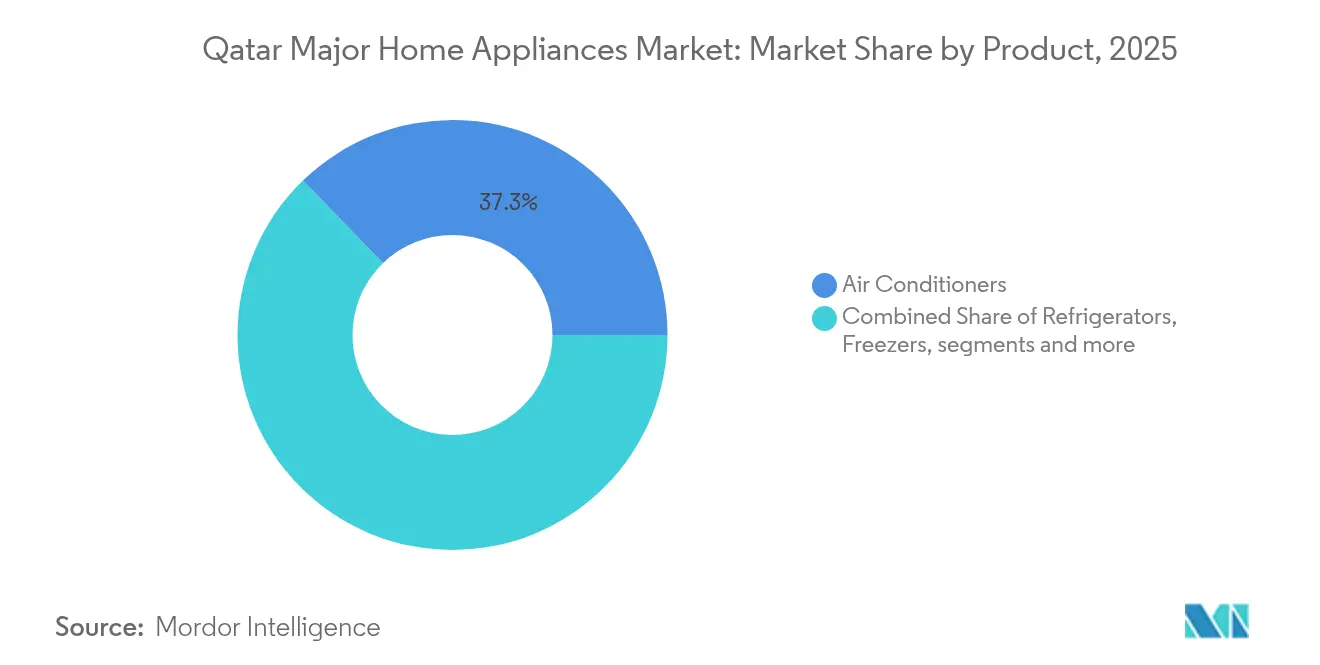
- By product category, air conditioners led with 37.25% revenue share in 2025, while dishwashers are projected to expand at a 6.85% CAGR through 2031.
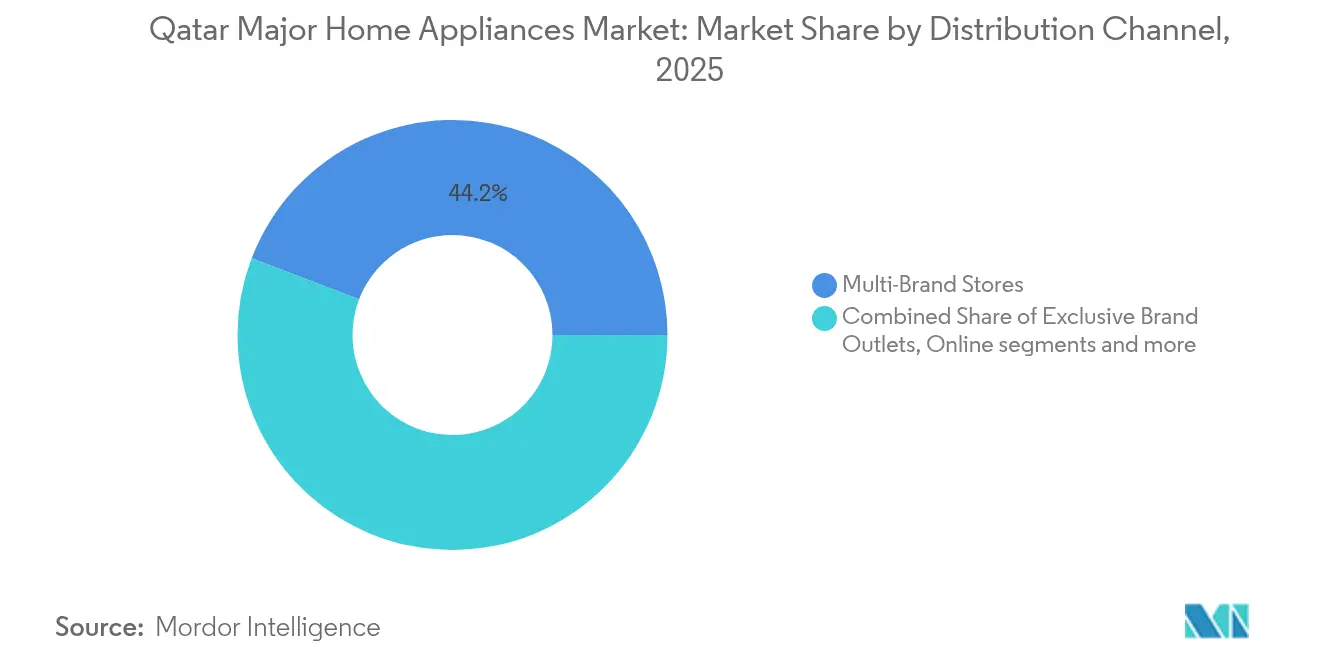
- By distribution channel, multi-brand stores held 44.20% of the Qatar Major Home Appliances market share in 2025, whereas online channels are advancing at a 7.45% CAGR to 2031.
- By geography, Doha accounted for 59.30% share of the Qatar Major Home Appliances market size in 2025, and Al Wakrah is projected to expand at a 7.08% CAGR through 2031.
Note: Market size and forecast figures in this report are generated using Mordor Intelligence’s proprietary estimation framework, updated with the latest available data and insights as of 2026.
Qatar Major Home Appliances Market Trends and Insights
Drivers Impact Analysis*
| Driver | (~) % Impact on CAGR Forecast | Geographic Relevance | Impact Timeline |
|---|---|---|---|
| Rising disposable income & expatriate population growth | +1.8% | National, concentrated in Doha and Al Rayyan | Medium term (2-4 years) |
| Government housing initiatives & infrastructure development | +1.2% | National, early gains in Al Wakrah, Umm Salal | Long term (≥ 4 years) |
| High penetration of smart home technology | +0.9% | Urban centers, mainly Doha and Al Rayyan | Short term (≤ 2 years) |
| FIFA World Cup legacy boosts rental turnover | +0.7% | National, peak in Doha | Short term (≤ 2 years) |
| Energy-efficiency subsidies (QNV 2030) | +0.6% | National | Long term (≥ 4 years) |
| Source: Mordor Intelligence | |||
Rising Disposable Income & Expat Population Growth
Qatar’s expatriates constitute roughly three-quarters of residents, and their combined purchasing power underpins frequent appliance replacement. Rental agreements for furnished units commonly run 24–36 months, a term that accelerates demand for mid-range refrigerators and dishwashers. Employers competing for skilled talent offer housing allowances that push buyers toward premium brands touting quieter compressors and lower electricity use. Whirlpool supplied more than 50,000 units to local project developers, signaling a vibrant business-to-business pipeline. Wage growth tied to the Third National Development Strategy keeps household budgets resilient even as headline inflation cooled to 1% in 2024[1].
Government Housing Initiatives & Infrastructure Development
Interest-free loans and free land plots for Qatari nationals stimulate construction in suburban municipalities, creating entire housing clusters that require full appliance suites. The extension of 23,400 electricity substations by 2026 removes grid bottlenecks and permits higher-capacity cooling systems across the Qatar major home appliances market[2]. Developers phase procurement near handover, producing concentrated order cycles that favor suppliers able to guarantee short-lead deliveries. Sustainable-building codes mandate inverter compressors, R32 refrigerants, and water-saving washing machines, elevating specification over price comparisons. Ongoing petrochemical and port projects in Ras Laffan and Mesaieed draw contractor camps that also generate residential appliance demand for workers.
High Penetration of Smart Home Technology
Qatar’s National Digital Agenda earmarks USD 11 billion for ICT contribution to non-hydrocarbon GDP, spurring 5G coverage that now blankets major municipalities. Samsung integrates SmartThings hubs into premium AC models, enabling mobile scheduling and predictive maintenance alerts, while LG embeds AI agents into refrigerators that monitor door-open frequency. Expatriates accustomed to connected living in Europe and North America accelerate adoption curves in the Qatar major home appliances market. Energy-use dashboards allow users to visualize cost savings, an attribute that dovetails with power-tariff reforms planned for 2027. Retailers position Wi-Fi-ready models as the default rather than an upgrade, shifting price sensitivities toward software support and over-the-air update longevity.
FIFA World Cup Legacy Boosting Rental Turnover
Stadium-adjacent districts converted to mixed-use zones now host serviced apartments that refresh interiors every leasing season. Property managers favor durable yet mid-priced appliances capable of rapid swap-outs when occupancy switches. Hospitality venues built for the tournament purchased commercial-grade laundry and refrigeration units that still fall within the statistical scope of the Qatar major home appliances market, blurring category boundaries. Tourism arrivals have remained above pre-event levels, elongating this turnover impulse beyond the typical mega-event halo. Landlords cite sustainability expectations established during the World Cup bid, prioritizing high Energy Star-style ratings when selecting replacement stock.
Restraints Impact Analysis*
| Restraint | (~) % Impact on CAGR Forecast | Geographic Relevance | Impact Timeline |
|---|---|---|---|
| Supply-Chain Disruptions & Import Dependency | -1.4% | National, affecting all distribution channels | Short term (≤ 2 years) |
| Rising Inflation & Currency Fluctuation | -0.8% | National, with a higher impact on imported premium brands | Short term (≤ 2 years) |
| Influx of Low-Cost Asian Brands Compressing Margins | -0.6% | National, concentrated in multi-brand stores and online channels | Medium term (2-4 years) |
| Water-Scarcity Regulations Limiting Appliance Specs | -0.4% | National, with stricter enforcement in water-stressed municipalities | Long term (≥ 4 years) |
| Source: Mordor Intelligence | |||
Supply-Chain Disruptions & Import Dependency
Nearly all large appliances arrive through Hamad Port, exposing retailers to freight-rate spikes and customs documentation backlogs. The new 12-digit GCC tariff code temporarily slowed clearance in early 2025, forcing safety-stock expansions that tie up working capital. Certificate-of-origin notarization adds an administrative burden for smaller importers, widening scale advantages for regional distributors. Qatar’s 5% external duty is modest yet still compounds when currency fluctuations elevate supplier quotations[3]. Although China lifted appliance export quotas in 2024, Red Sea shipping route tensions raise insurance premiums that pass through to shelf prices.
Influx of Low-Cost Asian Brands Compressing Margins
TCL, Hisense, and Haier push aggressively into the Qatar Major Home Appliances market by bundling warranties and financing dealer showrooms. Their chassis-level cost advantages allow refrigerator prices below European incumbents, pressuring profit pools across multi-brand retail. Online marketplaces further sharpen comparisons, letting shoppers sort dishwashers by lowest price within seconds. Premium names respond with feature escalation—door-in-door storage, UV-sterilization cycles, and voice control—to justify differentials. Retailers welcome higher footfall yet concede narrower per-unit margins as incentives shift toward volume rebates rather than headline percentages.
*Our forecasts treat driver/restraint impacts as directional, not additive. The impact forecasts reflect baseline growth, mix effects, and variable interactions.
Segment Analysis
By Product: Cooling Dominance Amid Kitchen Evolution
Air conditioners commanded 37.25% revenue in 2025, anchoring the Qatar major home appliances market around climate-driven necessity. The segment draws strength from household energy statistics showing cooling appliances account for half of electricity usage in GCC homes ScienceDirect. Refrigerators maintain steady upgrades as buyers prefer larger capacities compatible with bulk grocery habits adopted during the pandemic. Dishwashers grew fastest and benefit from BSH’s strong regional advertising around hygienic wash temperatures, reflecting lifestyle convergence among expatriates. Washing machines incorporate water-efficiency features that align with forthcoming grey-water recycling regulations.
The Qatar major home appliances market size for dishwashers is forecast to climb at 6.85% CAGR, supported by rising dual-income households that trade time savings for utility costs. Ovens, particularly convection-microwave hybrids, gain traction in apartments where kitchen footprints are constrained. LG’s antimicrobial evaporator coatings resonate with hospitality buyers seeking health certifications for post-stay sanitation audits. Specialty cooking devices, including smart air fryers, sit within the “Others” category yet foreshadow adjacent expansion into countertop appliances. Across every sub-category, energy labels and IoT readiness shape brand consideration more than color or handle style, signaling maturity in consumer evaluation criteria.

By Distribution Channel: Digital Transformation Accelerates
Multi-brand stores held a 44.20% share of the Qatar major home appliances market in 2025 because consumers still rely on hands-on comparison for bulky items. Retailers cluster along Salwa Road in Doha, where one-stop appliance districts simplify weekend shopping itineraries. Floor staff use augmented-reality tablets to superimpose refrigerator door swings onto apartment floor plans, bridging online research with physical inspection. Exclusive brand outlets target the premium tier with experiential showrooms; Bosch and Siemens operate design centers featuring live cooking demos that reinforce aspirational positioning.
The Qatar major home appliances market size for online channels is projected to advance at 7.45% CAGR to 2031, driven by fintech-enabled installment plans and real-time inventory visibility. Marketplace platforms partner with logistics providers, offering doorstep installation within 48 hours across all municipalities. Price transparency is reshaping promotion cycles: brands now synchronize flash sales with pay-day calendars common to expatriate salaried workers. “Click-and-collect” models leverage existing storefronts, reducing last-mile costs while preserving service touchpoints. Independent installers register on digital ecosystems to capture after-sale revenue, illustrating how e-commerce growth permeates broader value-chain economics.
Geography Analysis
Doha retained 59.30% share of the Qatar Major Home Appliances market size in 2025, as its skyline of high-rise apartments compresses thousands of households into a narrow radius. Vertical living favors stackable washer-dryer combos and built-in dishwashers. Retail density allows same-day delivery for breakdown replacements, reinforcing purchase confidence. Al Rayyan follows as a complementary hub where larger homes translate into multi-unit cooling systems and side-by-side refrigerators. Umm Salal’s emergent housing for government staff sustains demand for mid-priced models that balance feature depth with affordability.
Al Wakrah leads in growth at 7.08% CAGR, catalyzed by coastal master plans that integrate marinas, schools, and healthcare facilities. Family-sized villas in the municipality typically feature dual kitchens—one indoor, one outdoor—doubling appliance count per property.
Al Khor’s industrial zone erects dormitories for petrochemical workers, generating bulk purchases of durable washing machines with simplified user interfaces. Northern districts such as Al Daayen invest in road connectivity first, but retail feasibility studies already earmark plots for future appliance megastores. This geographic diffusion ensures that Qatar's major home appliances market evolves from a Doha-centric profile into a multi-nodal landscape.
Regulatory Landscape
Market access for major home appliances in Qatar is shaped by the Ministry of Commerce and Industry (MOCI) and the Qatar General Organization for Standardization (QS), with mandatory conformity controls applied at import clearance. Electrical appliances covered under the Product Conformity Assessment (PCA) program require a Certificate of Conformity (CoC) prior to customs release, and products must comply with local electrical requirements (220-240V, 50Hz) and GCC-aligned safety frameworks such as the Gulf Technical Regulation for Low Voltage Electrical Appliances and Equipment, including the Gulf Conformity Tracking System (GCTS) QR-linked marking used for traceability.
Energy and resource performance regulation increasingly influences purchase and specification decisions, particularly for air conditioners and water-consuming appliances. In-market standards and labeling requirements referenced include QS air-conditioner performance requirements (for example, QS 2663) alongside Kahramaa-led conservation and energy-efficiency work on appliance specifications, while industry bodies such as the Qatar Chamber have discussed the review of draft energy performance specifications (notably in 2024) for categories such as air conditioners, refrigerators, washing machines, and water heaters. Separately, GCC Green Label and GCTS registration requirements for water-consumption products were set to become mandatory from 24 February 2026, tightening compliance obligations for importers and brand owners.
Value Chain Analysis
Qatar's major home appliances value chain is import-led, with global OEMs (for example, LG, Samsung, Whirlpool, BSH, and Haier) supplying finished units largely manufactured outside Qatar. These are routed through local importers that handle PCA documentation, GCTS-related marking readiness where applicable, and customs clearance under the GCC tariff framework.
Downstream, distribution is concentrated among large local partners that combine retail showrooms, B2B project supply, and after-sales installation and servicing networks. Players such as Video Home & Electronic Centre (Jumbo Electronics), Mannai, Al Emadi Group, and Almana & Partners act as key conduits for brand reach, often operating multi-brand retail, managing exclusive distribution for selected international brands, and coordinating MEP-linked installation for air conditioning and built-in kitchen packages. The service layer (installation, maintenance, spare parts, and warranty administration) remains a key value capture point in Qatar because the installed base drives ongoing demand for air conditioners, and rental and hospitality stock replacements require rapid turnaround.
Competitive Landscape
The Qatar major home appliances market features more than 20 active international brands, producing a moderate concentration scenario with vigorous feature competition but limited pricing power. European incumbents, chiefly BSH and Whirlpool, protect premium margins via advanced inverter compressors, hygienic steam cycles, and extensive after-sales service contracts. Samsung and LG pivot on connectivity, bundling appliances with smart-home hubs and cloud-based diagnostics that appeal to tech-savvy expatriates. Chinese players such as TCL, Haier, and Hisense enter through aggressive distributor incentives, lowering retail prices, and squeezing gross margins across the board.
Strategic moves in 2024-2025 illustrate dual playbooks. LG broke ground on a USD 600 million India plant intended to backfill Middle East shipments and mitigate freight risk, KED Global. Arçelik acquired Whirlpool’s MENA operations to gain scale and region-specific product knowledge, signaling consolidation intent. Arçelik Retailers align with whichever supplier offers the fastest replenishment: shortages in split-AC outdoor units during summer 2024 prompted some dealers to reorder container loads directly from Shenzhen factories. Smart-appliance ecosystems form a second competitive axis; Samsung’s SmartThings counts 360 million users, while LG’s Home 8 voice assistant allows refrigerator firmware updates over 5 G. Value-tier challengers copy premium functions within months, eroding differentiation and shortening product refresh intervals.
White-space opportunities persist in project sales. Government affordable-housing schemes create volume bids where the total cost of ownership overrides badge prestige. As efficiency mandates tighten, compressor suppliers become critical bottlenecks, and vertically integrated brands hold an edge. Overall, rivalry centers on who can synchronize global manufacturing, local compliance, and omnichannel engagement faster than peers.
Qatar Major Home Appliances Industry Leaders
-
Whirlpool Corporation
-
LG Electronics Inc.
-
Samsung Electronics Co. Ltd
-
Haier Smart Home Co. Ltd.
-
BSH Home Appliances
- *Disclaimer: Major Players sorted in no particular order
Market Opportunities and Future Outlook
Regulation-led specification upgrades create a clear whitespace for suppliers that can deliver compliant, high-efficiency portfolios at scale while maintaining short lead times. The mandatory GCC Green Label and GCTS registration for water-consumption products from 24 February 2026 lifts the bar for washing machines and other water-related categories, favoring brands and distributors with established conformity workflows and documentation discipline. At the same time, the public review of draft energy performance specifications via the Qatar Chamber and QS-linked processes points to a continuing pipeline of tightening requirements across core categories, pushing product roadmaps toward inverter-based systems, improved insulation and compressors, and stronger water-use metrics.
Omnichannel expansion and distributor-led market entry remain practical opportunity vectors in Qatar, where large local distributors shape availability, financing, installation capacity, and after-sales experience. Active market movement includes exclusive distribution activity for major brands, such as Westinghouse being showcased through a local exclusive distributor arrangement, and continued high visibility of connected features in new launches, for example, LG ThinQ-enabled refrigerators introduced in-country. For brands targeting project sales, alignment with Kahramaa conservation priorities and municipal enforcement practices supports differentiated bids built around lifetime energy and water performance rather than only upfront price.
Recent Industry Developments
- April 2026: Grand Home Appliances expanded its exclusive distribution agreement with Westinghouse across Qatar's major urban markets. The expansion broadens brand reach in large-format retail and strengthens after-sales coverage for major appliances.
- March 2025: LG Electronics launched new multi-door refrigerator models in Qatar (including GR-B34FFCDB and GR-X34FFCAB) with ThinQ app-based remote monitoring features. The launch reinforced connectivity as a differentiation lever in premium refrigeration and supported retailers pushing higher-value models through feature-led merchandising.
- December 2024: KBN Group Holding and Whirlpool highlighted an expanded partnership in Qatar that included a shift from B2B project focus toward B2C retail through dedicated brand shops. This widened Whirlpool's route-to-market options and increased competitive intensity in organized retail, where brand-controlled presentation and service promises influence conversion for large-ticket appliances.
Research Methodology Framework and Report Scope
Market Definition and Coverage
This market covers the value of new major home appliances sold in Qatar for household use, counted at the point of sale across key product groups like cooling, laundry, cooking, dishwashing, and room air conditioning.
Scope exclusions: We exclude small countertop and personal appliances, such as kettles, mixers, and grooming devices.
Segmentation Overview
- By Product
- Refrigerators
- Freezers
- Washing Machines
- Dishwashers
- Ovens (Incl. Combi & Microwave)
- Air Conditioners
- Other Major Appliances
- By Distribution Channel
- Multi-Brand Stores
- Exclusive Brand Outlets
- Online
- Other Distribution Channels
- By Geography
- Doha
- Al Rayyan
- Al Wakrah
- Umm Salal
- Al Khor
- Others (Al Daayen, Al Shahaniya, Al Shamal)
Data Sources, Market Sizing, and Validation
Desk Research
Desk work was used to set realistic boundaries, build the first demand picture, and pressure-test assumptions before calling experts. For Qatar, we relied on public sources such as Qatar Planning and Statistics Authority releases, UN Comtrade trade statistics, IMF and World Bank macro indicators, and housing and construction publications linked to official agencies. We also reviewed energy-efficiency and product standards references where available, since appliance replacement cycles and specifications can be affected by these rules.
To translate those signals into a sizing model, we complemented public data with general secondary sources like retailer announcements, company annual reports and investor decks, and reputable business press coverage on Qatar retail and housing. Where a number could not be validated publicly, we used paid subscriptions for company financials and news intelligence, and, when needed, shipment-level import data to sanity-check volume direction. These examples are not exhaustive, and other sources were also used for data collection, validation, and clarifying open questions.
Primary Interviews and Surveys
Primary work focused on validating what actually sells in Qatar, and how pricing and promotions move across channels, which then tightened the market totals. We spoke with a mix of distributors, multi-brand retailers, brand-side managers, and service ecosystem contacts, and we also tested assumptions with people closer to end-buyer demand in Doha and the other large municipalities.
Distribution of primary research fieldwork respondents
| Company type | Respondent position |
|---|---|
| Top tier: 32% | CXOs: 13% |
| Mid tier: 53% | Functional/Unit leaders: 39% |
| Smaller Players: 15% | Managers: 48% |
Market-Sizing & Forecasting
Market sizing was built using top-down and bottom-up checks so the totals stay explainable and repeatable. On the top-down side, we reconstructed addressable spend by linking household formation and housing handovers to major-appliance penetration and replacement cycles, and then mapping this to category-level demand in value terms. After that, we corroborated the result with selective bottom-up approximations, such as sampled price bands from retail listings, channel mix splits discussed in interviews, and distributor-side volume direction checks, which were then used to adjust outliers.
A few Qatar-specific inputs were treated as core levers because they move the market more than small parameter changes. These include the pace of new residences being occupied, replacement timing for room air conditioners in a high-usage climate, the share of built-in versus freestanding cooking products in newer housing stock, promotional seasonality around key retail periods, and import-linked pricing pressure because many units are sourced from outside the country. Forecasting used scenario analysis anchored on expected housing occupancy and the consumer spending outlook, and then refined with expert feedback on likely ASP movement and channel shifts (especially online versus store-led sales). Where gaps existed in category splits, we filled them using a conservative range from interviews and then rebalanced totals to match the overall demand pool.
Data Validation & Update Cycle
Before finalizing, outputs were checked against independent signals, such as import direction, retail expansion news, and housing activity, so any mismatch could be investigated quickly. If a category showed an unusual jump, we re-checked the driver variables, revisited currency conversion timing, and, when needed, re-contacted sources to confirm whether a one-off promotion or project delivery had distorted the pattern. The model and the narrative are reviewed in steps by other analysts, and only then is the final set of numbers signed off.
The report is refreshed annually, and interim updates are added when a material event changes pricing, availability, or demand expectations. Right before delivery, we run a fresh review pass so clients receive the latest view available at that time.
Mordor Intelligence's Qatar Major Home Appliances Market Size Compared Against Other Published Estimates
Published market sizes for major home appliances in Qatar often vary because different studies do not count the same products, channels, and buyer types, and they also choose different base years. Currency timing and whether values are reported at retail selling price or closer to shipment value can also create visible gaps.
The table shows a spread that is mainly explained by what is included around cooling and cooking products, and how quickly average selling prices are assumed to rise. Under Mordor Intelligence's scope, the value is counted for new major appliances sold to residential end-users, and small countertop and personal appliances are kept out even if they sit next to major products in retail reporting.
Benchmark comparison
| Source | Market Size | Gaps in Research Methodology |
|---|---|---|
| Mordor Intelligence | USD 532.22 M (2025) | |
| Industry Publisher A | USD 487.30 M (2026) | Uses a different year reference and appears to mix in a narrower product set, which can undercount categories like room air conditioners that carry high value in Qatar, and it is not always clear if values are retail or import-linked. |
| Market Commentary B | USD 1.00 B (2024) | Likely reflects a broader home-appliances basket that can include small appliances and adjacent electronics, and it also reads like a rounded headline figure without transparent category splits, price logic, or a consistent base-year definition. |
Taken together, the comparison suggests that the biggest differences come from scope boundaries and from how pricing is carried forward year to year. By tying the estimate to clear demand drivers like household additions, replacement cycles for high-usage appliances, and channel-level price checks, our output stays traceable and easier to re-create when assumptions change.
Key Questions Answered in the Report
What is the current value of the Qatar Major Home Appliances market?
The market is valued at USD 564.94 million in 2026.
How fast is the Qatar Major Home Appliances market expected to grow?
It is projected to post a 6.15% CAGR and reach USD 761.18 million by 2031.
Which product dominates the Qatar Major Home Appliances market?
Air conditioners lead with a 37.25% revenue share in 2025.
Which distribution channel is gaining momentum?
Online channels are growing at a 7.45% CAGR as e-commerce infrastructure and digital payments improve.
Which municipality shows the fastest growth?
Al Wakrah records the highest geographic CAGR of 7.08% through 2031 due to post-World Cup suburban development.
What policy is driving energy-efficient appliance demand?
Rebates under Qatar National Vision 2030 energy-efficiency programs incentivize consumers to select high-performance models.