
Qatar Islamic Finance Market Size and Share
Market Overview
| Study Period | 2021 - 2032 |
|---|---|
| Forecast Data Period | 2027 - 2032 |
| Base Year Market Size (2026) | USD 193.20 Billion |
| Market Size (2027) | USD 203.30 Billion |
| Market Size (2032) | USD 266.90 Billion |
| Growth Rate (2027 - 2032) | 5.60 % |
| Market Concentration | Low |
Major Players *Disclaimer: Major Players sorted in no particular order Image © Mordor Intelligence. Reuse requires attribution under CC BY 4.0. | |
Qatar Islamic Finance Market Analysis by Mordor Intelligence
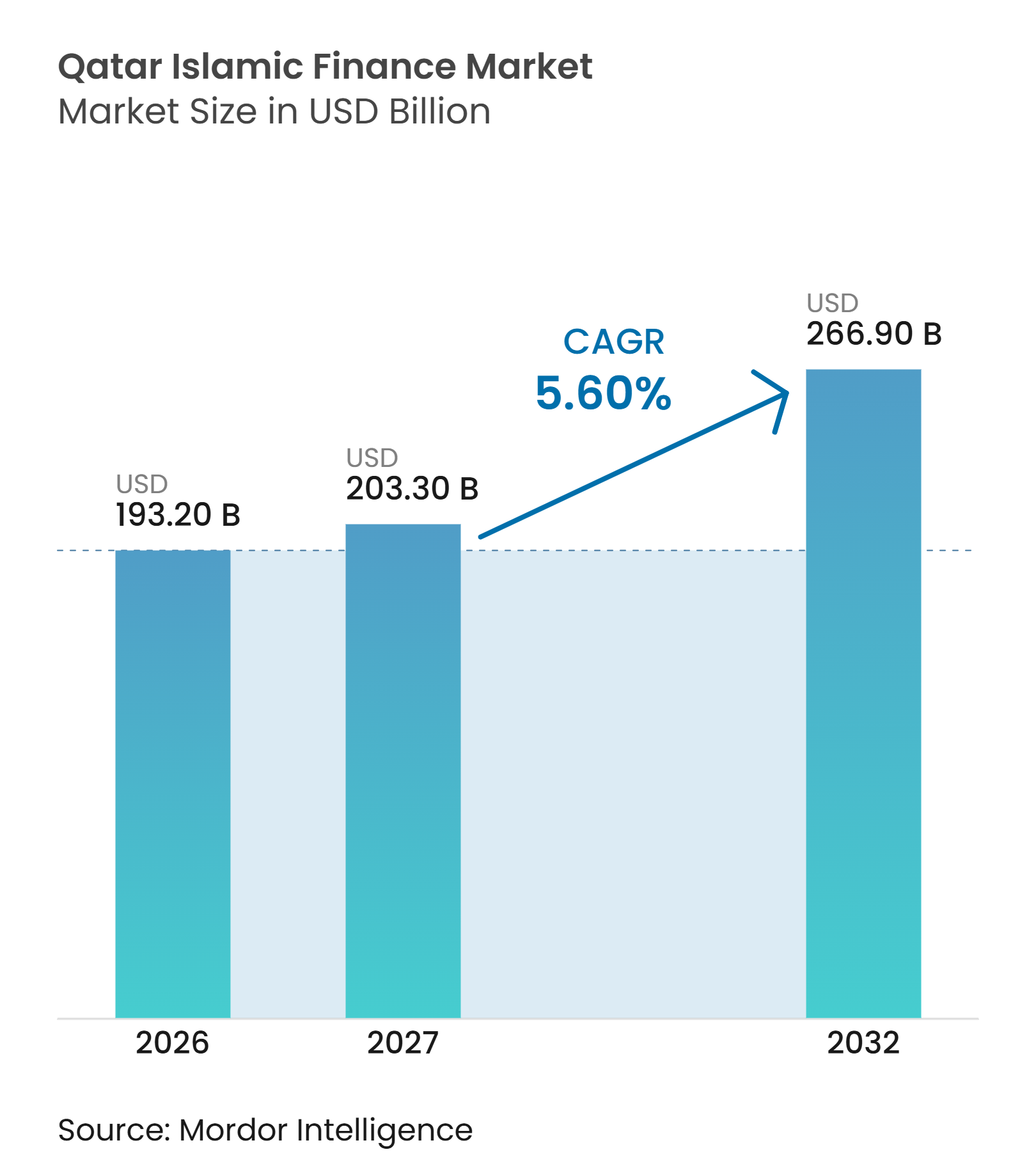
The Qatar Islamic Finance Market size is projected to be USD 193.20 billion in 2026, USD 203.30 billion in 2027, and reach USD 266.90 billion by 2032, growing at a CAGR of 5.60% from 2027 to 2032.
The Qatar Islamic finance market is moving into a steadier growth phase after the infrastructure credit demand associated with the FIFA World Cup cycle. Sovereign sukuk, family takaful, and state-supported Islamic lending to small businesses are expected to support this phase. Digital banking and sustainable finance are also becoming more important to product development and customer access. The Qatar Islamic finance market benefits from its place in the Third Financial Sector Strategic Plan, which applies Islamic finance across banking, insurance, digital finance, and capital markets. The market also faces practical limits from concentrated real estate financing, high compliance requirements, and limited trading liquidity for local sukuk.
Key Report Takeaways
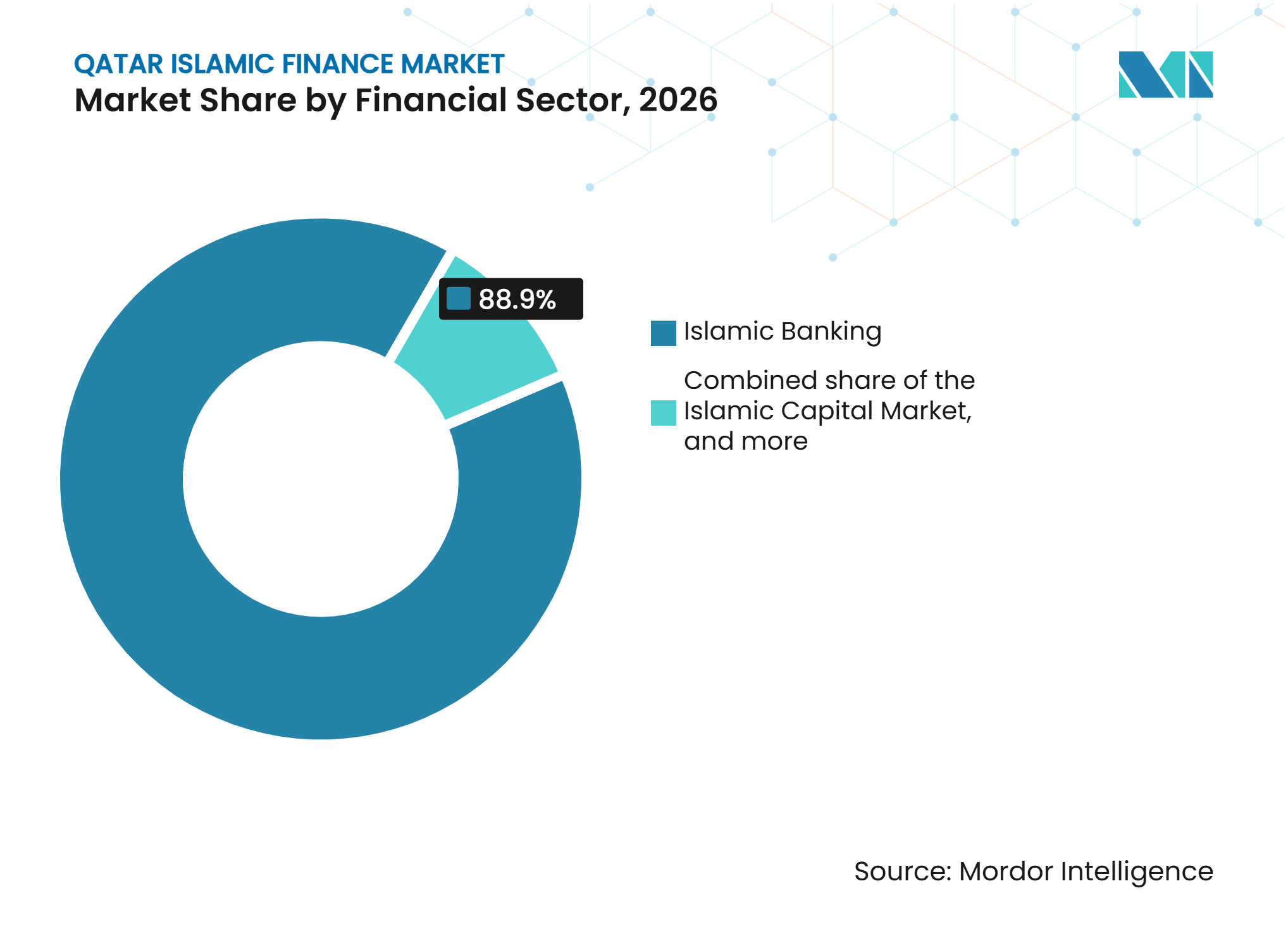
- By financial sector, Islamic banking captured 88.9% of the Qatar Islamic finance market share in 2026, while the Islamic capital market is projected to grow at 7.8% CAGR through 2032.
- By customer type, government and government-related entities captured 34.7% of the Qatar Islamic finance market in 2026, while MSMEs are projected to grow at 6.9% CAGR through 2032.
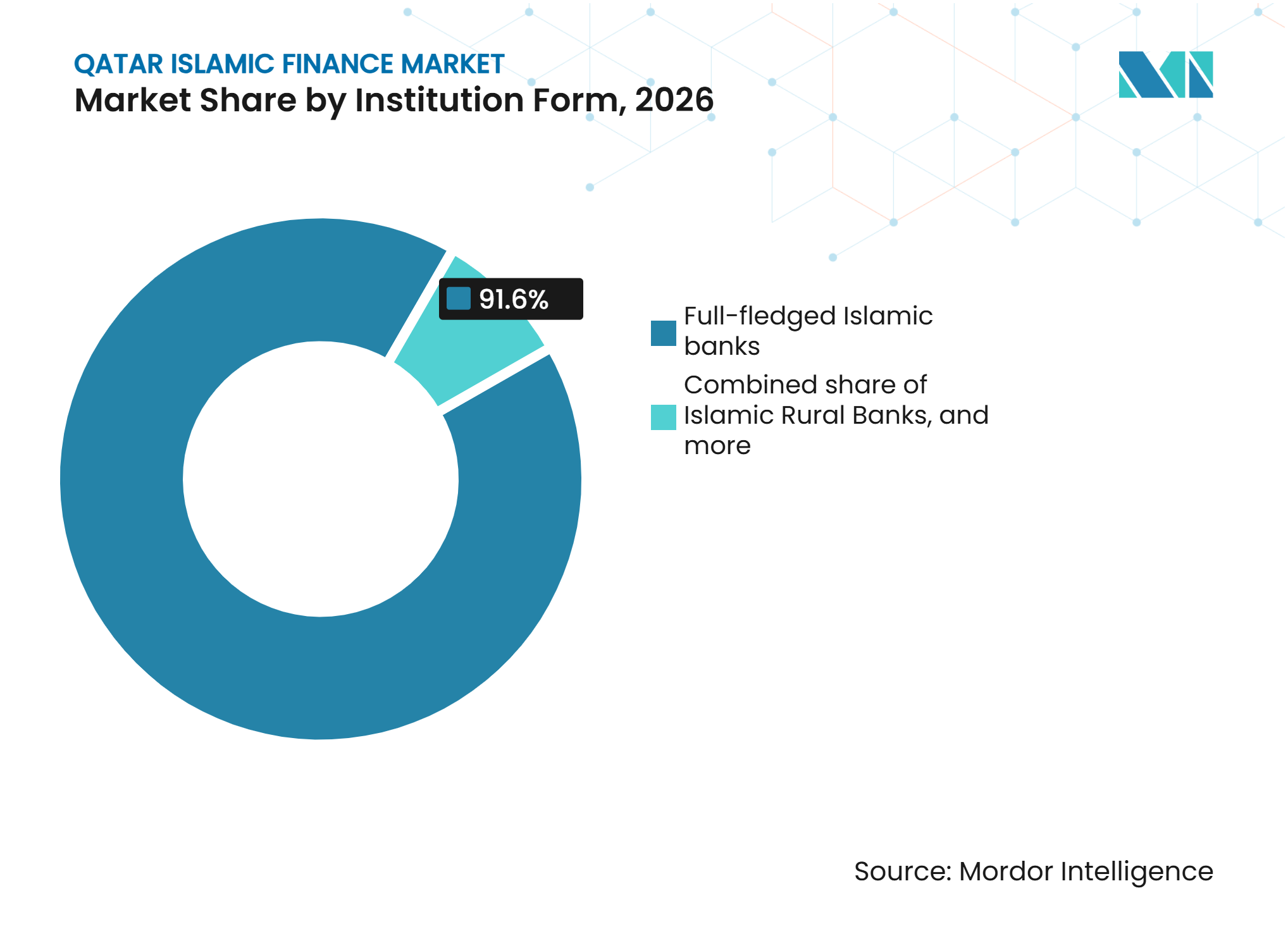
- By institution form, full-fledged Islamic banks captured 91.6% of the Qatar Islamic finance market in 2026, while licensed Islamic non-bank institutions are projected to grow at 6.2% CAGR through 2032.
Note: Market numbers in this report are based on Mordor Intelligence's proprietary estimation framework, which combines nine months of actuals with Q4 projections for base year 2026.
Market Trends and Insights
Drivers Impact Analysis of Qatar Islamic Finance Market*
| Driver | (~) % Impact on CAGR Forecast | Geographic Relevance | Impact Timeline |
|---|---|---|---|
| Qatar National Vision 2030 and Financial Sector Development Initiatives | +1.3% | Qatar-wide, with stronger relevance in Qatar Financial Centre and Qatar Stock Exchange-listed entities, plus market adjacency | Long term (≥ 4 years) |
| Rising Demand for Sharia-Compliant Retail and Corporate Products | +1.0% | National, with concentration in Doha, Al Wakra, and Al Rayyan municipalities | Medium term (2-4 years) |
| Sovereign and Corporate Sukuk Re-issuance | +0.7% | National, with international investor spillover to the Gulf Cooperation Council and Southeast Asia | Medium term (2-4 years) |
| Mandatory Health Coverage and Family Takaful Expansion | +0.4% | National, with early outperformance in family and health takaful lines | Short term (≤ 2 years) |
| Digital Islamic Banking and Islamic Fintech Adoption | +0.8% | National, with the Qatar Financial Centre digital assets ecosystem and cross-border digital payments | Medium term (2-4 years) |
| ESG Sukuk and Sustainable Infrastructure Funding | +0.5% | National, cross-border Gulf Cooperation Council markets, and United Kingdom listings | Long term (≥ 4 years) |
| Source: Mordor Intelligence | |||
Qatar National Vision 2030 and Financial Sector Development Initiatives
Qatar's National Vision 2030 and Third National Development Strategy 2024–2030 support economic diversification through the development of financial services and private-sector participation. The Third Financial Sector Strategic Plan incorporates Islamic finance across four strategic pillars: banking, insurance, digital finance, and capital markets. Qatar Development Bank reported QAR 2 billion (approximately USD 549.5 million) in direct capital disbursements in 2025, up 30% year over year, while financing commitments reached more than 630 companies[1]. These initiatives strengthen demand for Sharia-compliant financing among businesses and private-sector enterprises while supporting the development of Islamic financial services. Continued implementation of Qatar's financial sector strategy is expected to reinforce the role of Islamic banking, takaful, and capital market instruments in the country's economic diversification.
Sovereign and Corporate Sukuk Re-issuance
Qatar's government Ijarah Sukuk program is strengthening domestic Islamic capital-market activity through regular sovereign issuance. QCB's government bond and Sukuk issuance reached QAR 23.3 billion (USD 6.40 billion) in 2025[2]. Qatar Islamic Bank issued a USD 750 million senior unsecured Sukuk in March 2026 at 80 basis points over United States Treasuries, with the USD 1.7 billion order book reaching 2.3 times the issue size. Estithmar Holding's QAR 500 million (USD 137.36 million) corporate Sukuk further demonstrated the development of local-currency corporate issuance. Together, sovereign and corporate Sukuk activity is expanding financing channels beyond bank lending and supporting deeper Islamic capital markets.
Digital Islamic Banking and Islamic Fintech Adoption
Digital channels are expanding access to Sharia-compliant financial services in Qatar. The Qatar Financial Centre projects Islamic FinTech transaction volumes to reach QAR 16.1 billion (USD 4.4 billion) by 2028, representing a 10% CAGR from 2024. Qatar Islamic Bank introduced biometric Click to Pay in May 2025 and partnered with PayLater to launch Sharia-compliant BNPL solutions in July 2025[3]. QIB's growing digital adoption, including increased mobile banking usage and digital financing capabilities, demonstrates how Islamic banks can expand customer access without equivalent branch-led expansion. These developments can improve transaction efficiency, broaden access for retail and SME customers, and support scalable delivery of Sharia-compliant financial products.
ESG Sukuk and Sustainable Infrastructure Funding
Sustainable Sukuk are gaining importance in Qatar's Islamic capital markets. AlRayan Bank issued a QAR 500 million (USD 137.4 million), three-year Green Sukuk in February 2026 at a 4.25% profit rate, which became the first green Sukuk listed on the Qatar Stock Exchange. QIIB had allocated QAR 2.85 billion (USD 784 million) of Sustainable Sukuk proceeds across seven eligible green and social sectors by June 2026. These developments expand Sharia-compliant sustainable investment instruments and strengthen Qatar's ability to channel Islamic capital toward environmental and social projects.
Restraints Impact Analysis of Qatar Islamic Finance Market*
| Restraint | (~) % Impact on CAGR Forecast | Geographic Relevance | Impact Timeline |
|---|---|---|---|
| Limited Secondary-Market Liquidity for Islamic Instruments | -0.4% | National, with Doha as the primary market and no Clearstream to Qatar Stock Exchange settlement bridge | Medium term (2-4 years) |
| Shariah Standardization and Product-Approval Complexity | -0.3% | National, with a stronger effect on Qatar Financial Centre registered entities operating under dual frameworks | Long term (≥ 4 years) |
| High Compliance and Technology Investment Costs | -0.3% | National, with a greater effect on non-bank institutions and smaller takaful operators | Medium term (2-4 years) |
| Real Estate and Household Credit Concentration | -0.2% | National, with concentration in Doha, Lusail, and Al Wakra real estate corridors | Medium term (2-4 years) |
| Source: Mordor Intelligence | |||
Limited Secondary-Market Liquidity for Islamic Instruments
Secondary-market depth remains a constraint on Qatar's Islamic capital markets. The IILM identifies buy-and-hold behavior, limited availability of short-term Sharia-compliant instruments, and the need for deeper Islamic repo markets as barriers to more effective secondary-market liquidity. Qatar Central Bank has continued developing its primary-dealer and government Sukuk framework, including regular 2026 Ijarah Sukuk issuance. However, limited trading activity can constrain price discovery and make Sukuk portfolios less effective for short-term liquidity management. This keeps Qatar's Islamic finance market relatively dependent on bank balance sheets and central-bank liquidity mechanisms.
Shariah Standardization and Product-Approval Complexity
Qatar's Islamic finance institutions face multiple Shariah governance requirements under the Qatar Central Bank, AAOIFI, and Islamic Financial Services Board frameworks. QCB's 2024 instructions include additional governance requirements for Islamic banks, while AAOIFI issued five Shariah governance standards in 2024 and subsequently issued GS 23 for Islamic finance windows. AAOIFI Standard 62 on Sukuk also remains under development, creating potential future changes to Sukuk structures and compliance processes. These evolving requirements increase governance, product review, documentation, and compliance costs, which can weigh more heavily on smaller Islamic financial institutions and takaful operators.
*Our forecasts treat driver/restraint impacts as directional, not additive. The impact forecasts reflect baseline growth, mix effects, and variable interactions.
Qatar Islamic Finance Market Segment Analysis
By Financial Sector:
Sukuk Capital Market Activity Accelerates Beyond the Dominant Banking BaseIslamic banking held 88.9% of the Qatar Islamic finance market size in 2026. Islamic banking holds 88.9% of the Qatar Islamic finance market in 2026. Islamic bank assets reached QAR 616.5 billion (USD 169.4 billion) in 2025, growing 5.3% against 5% for conventional commercial banks, and equal to nearly 28% of Qatari banking assets. Financing by Islamic banks rose 4.2% to QAR 418.3 billion (USD 114.9 billion), about 29% of total banking sector financing. About 96% of that financing was directed to the domestic market.
The Islamic capital market is projected to grow at 7.8% CAGR through 2032, the fastest pace among financial sector segments. Qatar Islamic Bank issued a USD 750 million five-year senior sukuk at 4.4%, the first sukuk from a Qatari financial institution in 2026. The pricing was 80 basis points over US Treasuries and the lowest profit rate for a GCC bank five-year senior sukuk in the prior twelve months. Dukhan Bank followed in June 2026 with a USD 500 million perpetual Additional Tier 1 sukuk at 6%, the tightest AT1 sukuk yield in the region that year. Dukhan Bank is rated A2 by Moody’s and A by Fitch, and a group of regional and international banks acted as joint lead managers. Qatar Central Bank (QCB) continues to update standards on sustainable finance, ESG disclosures, governance, insurance, and takaful.


By Customer Type:
Government Anchor Gives Way to an MSME Growth WaveGovernment and government-related entities held 34.7% of the Qatar Islamic finance market in 2026, reflecting the significant role of public-sector and state-linked financing demand. Qatar Development Bank's financing commitments increased 5% in 2025 to more than QAR 7.3 billion (USD 2 billion) across over 630 companies, while direct capital disbursements reached QAR 2 billion (USD 549.5 million), up 30% year over year. MSMEs are projected to grow at a 6.9% CAGR from 2027 to 2032, supported by expanding public-sector programs and private-sector financing initiatives. QDB also launched the National Funding Gate in 2025 to simplify access to financing and connect Qatar-based businesses with participating financial institutions. Qatar International Islamic Bank's Mazaya product further supports SME demand by providing collateral-free financing of up to QAR 500,000 (USD 137,362.6) based on cash-flow assessment.
Retail and individual customers represent a broad customer base for Islamic banks, supported by expanding digital onboarding, mobile banking, and Sharia-compliant consumer finance products. Large corporates and financial institutions continue to generate high-value financing and transaction volumes, while SMEs are becoming an increasingly important target segment as Qatar promotes private-sector development. Qatar Islamic Bank was named Best SME Bank in the Middle East and Qatar by Global Finance in March 2026, highlighting the growing focus on SME banking within the Islamic finance sector. QIB also reported continued support for corporates, government-related entities, SMEs, and retail customers through tailored financing and digital banking solutions. This diversified customer base reduces reliance on government-linked demand and supports broader expansion of Qatar's Islamic finance market.
By Institution Form:
Full-Fledged Banks Dominate but Non-Banks Gain Structural TractionFull-fledged Islamic banks accounted for 91.6% of Qatar's Islamic finance market in 2026, with four licensed institutions: Qatar Islamic Bank, AlRayan Bank, Dukhan Bank, and Qatar International Islamic Bank. The segment is supported by strong balance sheets, with QIB reporting QAR 221.1 billion (USD 60.7 billion) in assets in 2025, up 10.1%, while QIIB reported QAR 62.6 billion (USD 17.2 billion), up 4.4%. Dukhan Bank reported approximately QAR 123.8 billion (USD 34 billion) in assets, while AlRayan Bank remained another major full-fledged Islamic banking institution. QCB-based sector data shows Islamic banks collectively held QAR 616.5 billion (USD 169.4 billion) in assets in 2025, representing 85.8% of total Islamic finance assets and nearly 28% of Qatar's banking-sector assets.
Licensed Islamic non-bank institutions are projected to grow at a 6.2% CAGR through 2032, supported by expansion in takaful, Islamic finance companies, investment companies, and funds. Qatar's takaful sector recorded QAR 335 million (USD 92 million) in shareholder profits in 2025, up 2.7%, while total assets increased 5.9% to QAR 4.7 billion (USD 1.3 billion) and contributions rose 4.1% to approximately QAR 2 billion (USD 549.5 million). AAOIFI Shariah standards are adopted as mandatory regulatory requirements in Qatar, providing a standardized Shariah framework across Islamic financial institutions, although the scope and application can vary by institution and activity. The combination of continued Islamic banking dominance and growth in takaful and other non-bank activities supports gradual diversification of Qatar's Islamic finance market beyond full-fledged banks.

Geography Analysis
Qatar is a single-jurisdiction Qatar Islamic finance market, and Islamic instruments represented 27% of national financial assets in 2024. The market operates through Qatar Central Bank-regulated mainland institutions and Qatar Financial Centre-regulated entities, including Lesha Bank and QInvest. Qatar Financial Centre entities can access international capital market standards more flexibly, while mainland institutions have central bank liquidity access. Islamic finance recorded a 6.4% CAGR from 2020 to 2024, exceeding the 5.3% CAGR for the overall financial sector. In February 2026, the Qatar Stock Exchange listed 33 government sukuk, 34 government bonds, the first corporate riyal sukuk, and the first green sukuk.
Qatar’s Islamic finance sector both competes and collaborates with centers in the Gulf Cooperation Council, the United Arab Emirates, Saudi Arabia, Malaysia, and the Asia-Pacific region. Its advantages include a strong sovereign credit environment, the Qatar Financial Centre framework, and support through the Third Financial Sector Strategic Plan. The domestic sukuk curve now covers 2-year, 3-year, 5-year, and 10-year maturities after successive Ijarah auctions. This provides corporate issuers with benchmark pricing that was not available 5 years earlier. Qatar also works with the International Islamic Liquidity Management Corporation, whose sukuk program increased from USD 4 billion to USD 6 billion in 2024.
Qatar’s development strategy identifies opportunities in SME working capital, digital takaful for expatriate and gig-economy workers, cross-border Islamic wealth platforms, and local-currency sukuk liquidity. Digital takaful demand is concentrated in industrial and logistics corridors with underserved informal workers. AlRayan Bank and QInvest are developing wealth services through the United Kingdom and the Gulf Cooperation Council capital markets. The primary dealer framework has reduced friction in domestic secondary-market trading. These geographic links support the Qatar Islamic finance market while retaining its domestic regulatory base.
Competitive Landscape
Market Concentration
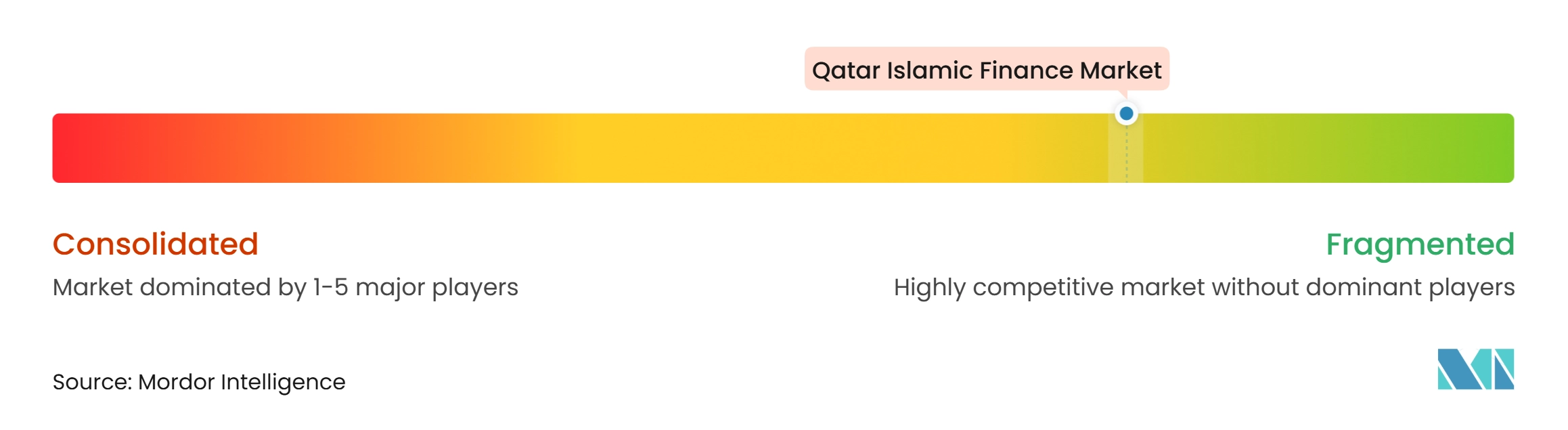
The Qatar Islamic finance market is fragmented, with competition distributed across full-fledged Islamic banks, takaful operators, Islamic finance companies, investment companies, and capital-market institutions. The four full-fledged Islamic banks, Qatar Islamic Bank, AlRayan Bank, Dukhan Bank, and Qatar International Islamic Bank, form the core banking segment. At the same time, specialized institutions such as Lesha Bank and QInvest compete in investment and capital-market services. Islamic banking accounted for 87.8% of total Islamic finance assets in 2025, while Sukuk and takaful accounted for 11% and 0.7%, respectively, demonstrating the presence of multiple market segments beyond banking.
Competition is increasingly differentiated by digital banking, sustainable finance, wealth management, and capital-market capabilities. Qatar Islamic Bank expanded its digital offering through Click to Pay and Sharia-compliant buy now, pay later services, while AlRayan Bank issued Qatar's first green Sukuk in February 2026. Qatar International Islamic Bank also expanded its capital-market activities, including the listing of its first Sukuk on the Qatar Stock Exchange by the end of 2025. These developments allow institutions to compete through specialized products and capabilities rather than solely through traditional lending.
The non-bank segment further reinforces the fragmented structure, with five independent takaful companies and additional takaful operators authorized through the Qatar Financial Centre. QIIC, Beema, and AlKhaleej Takaful accounted for around 81% of takaful gross written contributions in 2024, while Islamic finance companies held approximately QAR 2.6 billion (USD 714.3 million) of assets in 2025, and Islamic investment companies held QAR 552.5 million (USD 151.8 million). Overall, the market combines a large Islamic banking base with multiple specialized non-bank providers, supporting a fragmented competitive structure across products, customer segments, and financial services.
Qatar Islamic Finance Industry Leaders
-
Qatar Islamic Bank Q.P.S.C.
-
Dukhan Bank Q.P.S.C.
-
Masraf AlRayan Q.P.S.C. (AlRayan Bank)
-
Qatar International Islamic Bank Q.P.S.C.
-
Lesha Bank LLC
- *Disclaimer: Major Players sorted in no particular order
Qatar Islamic Finance Market Companies Covered in this Report
- Qatar Islamic Bank Q.P.S.C.
- Masraf AlRayan Q.P.S.C. (AlRayan Bank)
- Dukhan Bank Q.P.S.C.
- Qatar International Islamic Bank Q.P.S.C.
- Lesha Bank LLC (Public)
- QInvest LLC
- Qatar Development Bank
- Al Jazeera Finance Company
- Qatar Finance House Company
- Qatar Islamic Insurance Group Q.P.S.C. (QIIG)
- Al Khaleej Takaful Insurance Company Q.P.S.C.
- Damaan Islamic Insurance Company (Beema)
- Qatar General Insurance & Reinsurance Company Q.P.S.C.
- Doha Insurance Group Q.P.S.C.
- Qatar Insurance Company Q.S.P.C. (QIC)
- Abu Dhabi Islamic Bank – Qatar Financial Centre Branch
- Qatar National Bank Q.P.S.C.
- The Commercial Bank P.S.Q.C.
- Ahlibank Q.P.S.C.
- Qatar Exchange / Qatar Financial Markets ecosystem participant: QNB Financial Services
Recent Industry Developments in Qatar Islamic Finance Market
- August 2026: Qatar Central Bank issued QAR 5 billion (USD 1.4 billion) in Government Ijarah Sukuk across January 2029 and August 2030 maturities, bringing 2026 Ijarah sukuk issuance to QAR 23.3 billion (USD 6.4 billion) across 6 auctions.
- June 2026: Qatar International Islamic Bank received a post-issuance review confirming that QAR 2,852.4 million (USD 784 million) in sustainable sukuk proceeds had been fully allocated to eligible green and social assets across 7 sectors in Qatar.
- May 2026: Qatar Central Bank issued Government Ijarah Sukuk worth QAR 6.5 billion (USD 1.8 billion) across September 2028 and August 2030 maturities at a 4.45% yield, with QAR 14.5 billion (USD 4 billion) in bids.
- March 2026: Qatar Islamic Bank was named Best SME Bank in the Middle East and Qatar, recognizing its Sharia-compliant MSME digital onboarding, Murabaha and Ijarah products, and payment services.
Qatar Islamic Finance Market Report Scope
Segmentation Overview
| Islamic Banking | |
| Islamic Capital Market | Sukuk |
| Islamic Funds | |
| Islamic Non-Bank Financial Institutions | Takaful / Islamic Insurance |
| Others (Pension, Financing Companies, etc.) |
| Retail / Individual Customers |
| MSMEs |
| Large Corporates |
| Government & Government-Related Entities |
| Financial Institutions |
| Other Customer Types |
| Full-Fledged Islamic Banks |
| Islamic Windows of Conventional Banks |
| Licensed Islamic Non-Bank Institutions (Takaful, Fund Managers, and Other Licensed Non-Banks) |
| By Financial Sector | Islamic Banking | |
| Islamic Capital Market | Sukuk | |
| Islamic Funds | ||
| Islamic Non-Bank Financial Institutions | Takaful / Islamic Insurance | |
| Others (Pension, Financing Companies, etc.) | ||
| By Customer Type | Retail / Individual Customers | |
| MSMEs | ||
| Large Corporates | ||
| Government & Government-Related Entities | ||
| Financial Institutions | ||
| Other Customer Types | ||
| By Institution Form | Full-Fledged Islamic Banks | |
| Islamic Windows of Conventional Banks | ||
| Licensed Islamic Non-Bank Institutions (Takaful, Fund Managers, and Other Licensed Non-Banks) | ||
Key Questions Answered in the Report
What is the forecast growth rate for Qatar Islamic finance through 2032?
The Qatar Islamic finance market is forecast to grow at a 5.6% CAGR from 2027 to 2032, rising from USD 203.3 billion in 2027 to USD 266.9 billion by 2032.
Which financial sector leads Islamic finance activity in Qatar?
Islamic banking led with an 88.9% share in 2026, supported by QAR 616.5 billion (USD 169.4 billion) in assets across 4 full-fledged Islamic banks.
Which customer group is expected to grow fastest in Qatar?
MSMEs are projected to grow at 6.9% CAGR through 2032, supported by state-backed lending and banks’ digital and collateral-light financing products.
Why are sukuk important to financial services in Qatar?
The Islamic capital market is projected to grow at 7.8% CAGR through 2032, and Qatar Central Bank raised QAR 23.3 billion (USD 6.4 billion) through 6 Ijarah sukuk auctions in 2026.
Which institutions dominate Islamic financial services in Qatar?
Full-fledged Islamic banks held 91.6% of the institutional base in 2026, although licensed Islamic non-bank institutions are forecast to grow at 6.2% CAGR through 2032.
What is the main constraint on Qatar’s sukuk market?
Limited secondary-market liquidity remains a key constraint because it reduces price discovery and makes it more difficult for banks and investors to trade local Islamic instruments.