
PVC Pipes and Fittings Market Size and Share
Market Overview
| Study Period | 2021 - 2031 |
|---|---|
| Market Size (2026) | USD 49.40 Billion |
| Market Size (2031) | USD 69.54 Billion |
| Growth Rate (2026 - 2031) | 7.08 % |
| Fastest Growing Market | Asia-Pacific |
| Largest Market | Asia-Pacific |
| Market Concentration | Low |
Major Players *Disclaimer: Major Players sorted in no particular order Image © Mordor Intelligence. Reuse requires attribution under CC BY 4.0. | |
PVC Pipes and Fittings Market Analysis by Mordor Intelligence
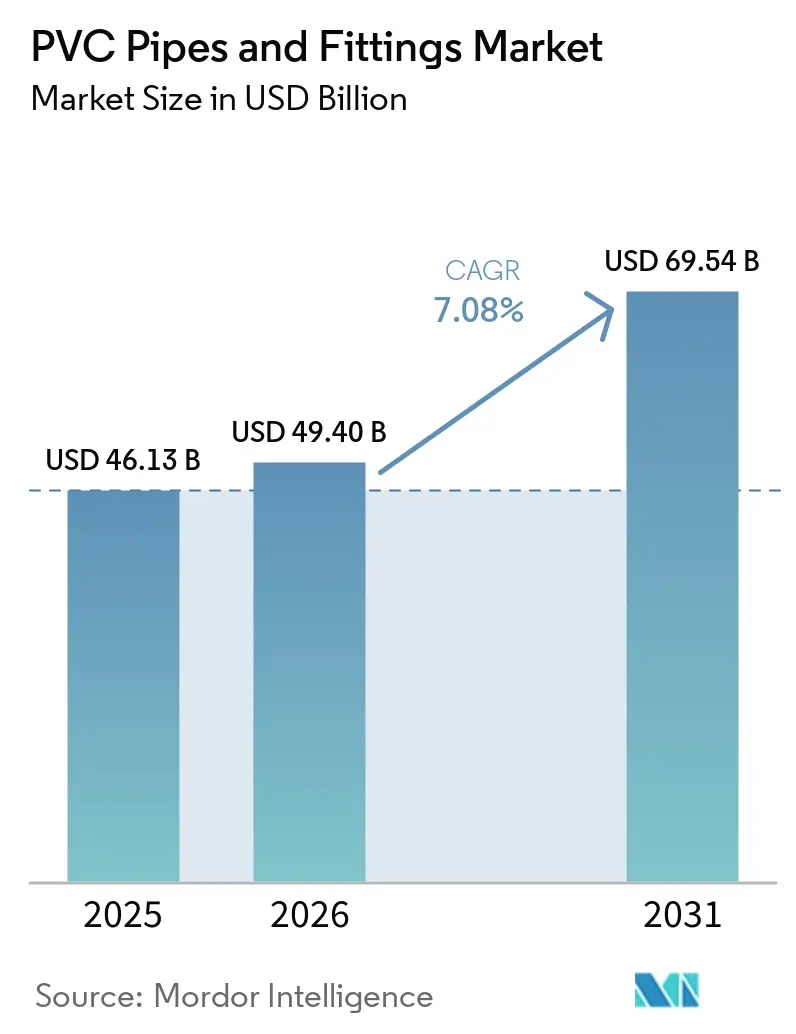
The PVC Pipes and Fittings Market size was valued at USD 46.13 billion in 2025 and is estimated to grow from USD 49.40 billion in 2026 to reach USD 69.54 billion by 2031, at a CAGR of 7.08% during the forecast period (2026-2031). The PVC pipes and fittings market benefits from continuing investment in water networks, sanitation systems, housing, and irrigation. Demand is also moving toward systems that require more complex connections and higher-performance materials. Commercial construction supports this shift because fire protection, hot-water plumbing, and heating, ventilation, and air-conditioning installations have defined performance requirements. Material costs and regulatory obligations remain important limits for producers, especially where resin prices change quickly. The PVC pipes and fittings market, therefore, offers growth opportunities in municipal replacement work, pressurized irrigation, and commercial building systems.
Key Report Takeaways
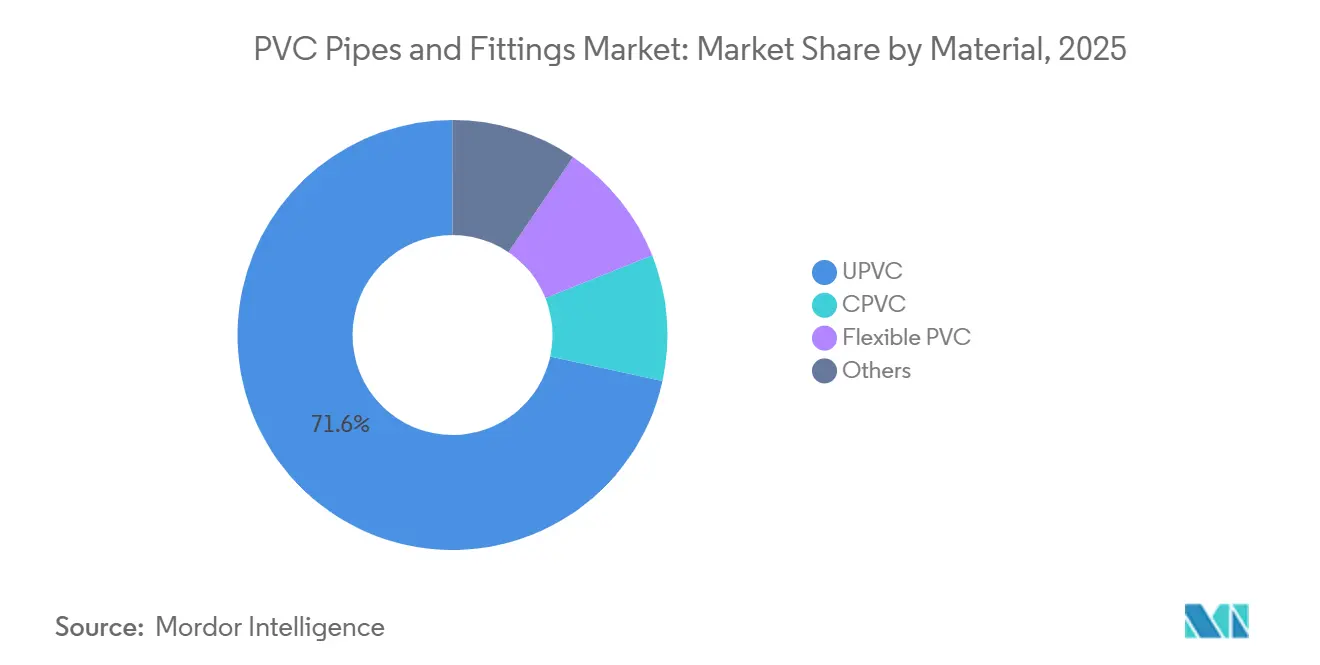
- By material, UPVC held 71.56% of the PVC pipes and fittings market share in 2025, while CPVC is projected to advance at a 7.34% CAGR through 2031.
- By product type, pipes held 74.12% of the PVC pipes and fittings market share in 2025, while fittings are projected to advance at a 7.83% CAGR through 2031.
- By application, water supply and distribution held 39.31% of the PVC pipes and fittings market share in 2025, while irrigation and agriculture are projected to advance at an 8.18% CAGR through 2031.
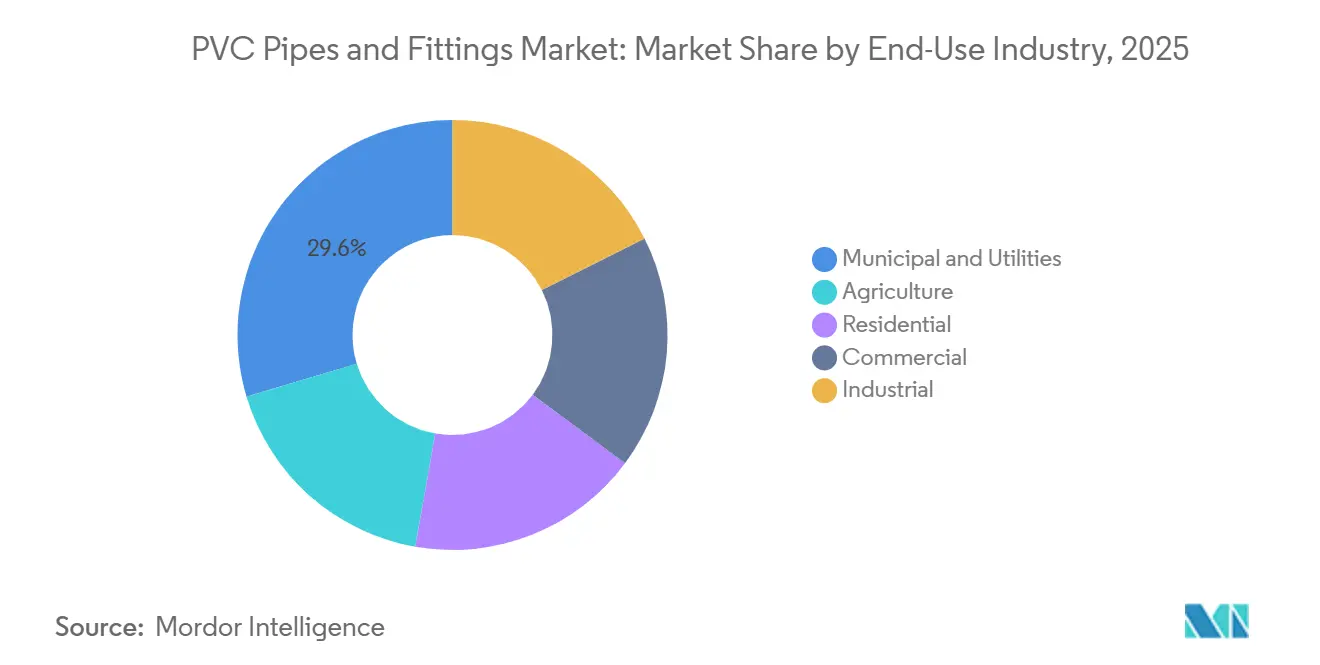
- By end-use industry, municipal and utilities held 29.63% of the PVC pipes and fittings market share in 2025, while commercial is projected to advance at an 8.45% CAGR through 2031.
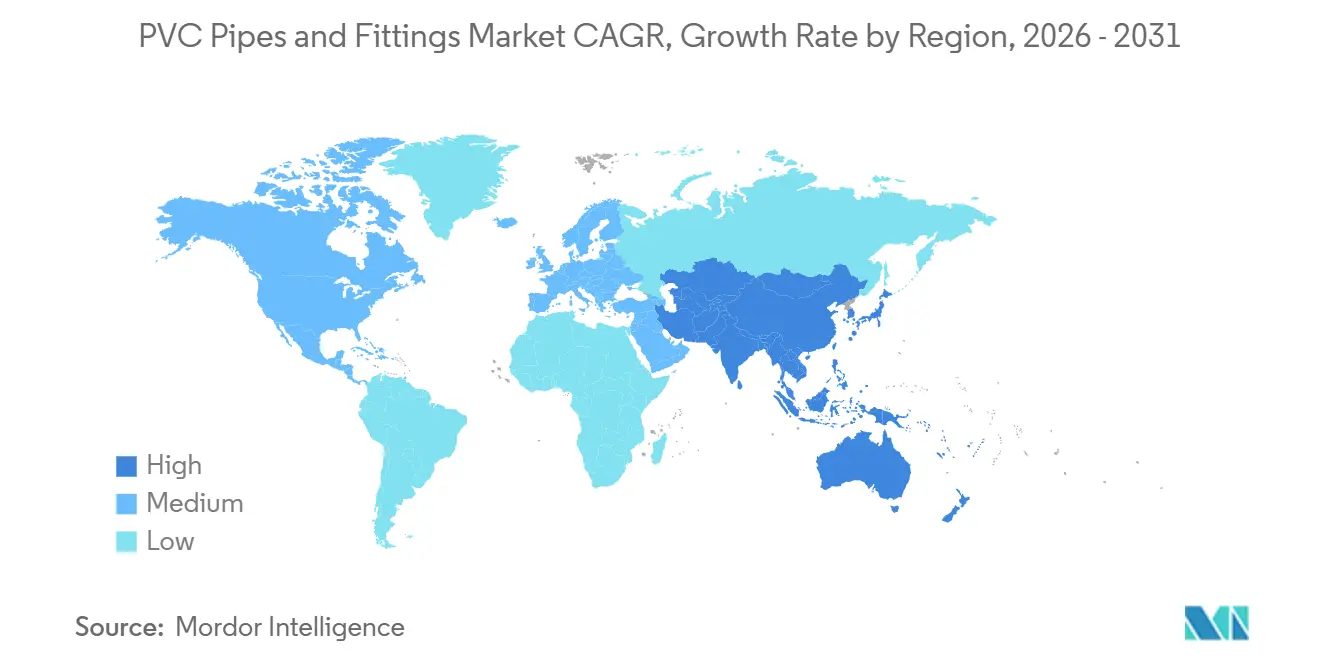
- By geography, Asia-Pacific held 42.45% of the PVC pipes and fittings market share in 2025 and is projected to advance at an 8.22% CAGR through 2031.
Note: Market size and forecast figures in this report are generated using Mordor Intelligence’s proprietary estimation framework, updated with the latest available data and insights as of January 2026.
Global PVC Pipes and Fittings Market Trends and Insights
Drivers Impact Analysis*
| Driver | (~) % Impact on CAGR Forecast | Geographic Relevance | Impact Timeline |
|---|---|---|---|
| Global Water and Wastewater Infrastructure Renewal | +2.1% | Global, highest concentration in North America, MENA, and APAC core | Long term (≥ 4 years) |
| Urban Housing and Sanitation Expansion in Emerging Economies | +1.8% | APAC core (India, ASEAN), spillover to sub-Saharan Africa and South America | Medium term (2-4 years) |
| PVC Cost and Installation Advantage Versus Metal and Concrete | +1.4% | Global | Short term (≤ 2 years) |
| Irrigation Modernization and Water-Efficiency Investment | +1.0% | South Asia, Middle East, South America, Southern Europe | Medium term (2-4 years) |
| CPVC Adoption in Hot-Water, Fire-Sprinkler, and Industrial Systems | +0.8% | North America and APAC core, spillover to MEA | Medium term (2-4 years) |
| Source: Mordor Intelligence | |||
Global Water and Wastewater Infrastructure Renewal
Water and wastewater replacement programs create a durable source of demand for the PVC pipes and fittings market. The American Water Works Association identified aging infrastructure as the leading operational concern among water utilities in its 2026 industry assessment[1]American Water Works Association, “2026 State of the Water Industry Report,” American Water Works Association, awwa.org. The United States Environmental Protection Agency has documented substantial long-term infrastructure needs for drinking water and clean water systems. These programs need distribution pipes, sewer pipes, fittings, valves, and related components across collection, treatment, storage, and delivery networks. PVC pipes remain relevant where corrosion resistance, low weight, and straightforward installation support project delivery. This replacement cycle supports demand beyond short-term construction conditions because utilities must maintain service regardless of changes in private building activity, and because deferred replacement can increase leakage, operating costs, and service disruptions for municipal operators.
Urban Housing and Sanitation Expansion in Emerging Economies
Urban housing and sanitation expansion provides a broad installation base for the PVC pipes and fittings market. By August 2026, India had completed and delivered more than 1 crore (10 million) houses to beneficiaries under the Pradhan Mantri Awas Yojana – Urban (PMAY-U) and PMAY-U 2.0. Each new home requires water supply, drainage, and sanitation connections. The Atal Mission for Rejuvenation and Urban Transformation 2.0 program also supports water and sewerage works in urban areas. Formal development in peri-urban areas moves installations toward specified systems and standardized pipe quality. This development strengthens demand for UPVC and CPVC products through residential and public sanitation projects, while distribution networks also require repeat purchases of connectors and drainage components as neighborhoods transition from individual systems to coordinated service networks.
PVC Cost and Installation Advantage Versus Metal and Concrete
PVC Cost and Installation Advantage Versus Metal and Concrete supports material selection in many projects. Westlake Pipe and Fittings stated that PVC is lighter than ductile iron and does not require cathodic protection in relevant applications. Lower handling requirements can reduce installation effort on municipal, agricultural, and building sites. PVC also resists corrosion, which reduces maintenance concerns in water and drainage uses. These characteristics help contractors meet project budgets and installation schedules. The PVC pipes and fittings market retains this advantage when procurement focuses on lifecycle performance, maintenance needs, transport requirements, and installation time rather than the purchase price alone, particularly where project managers must limit disruption in dense urban areas.
Irrigation Modernization and Water-Efficiency Investment
Irrigation Modernization and Water-Efficiency Investment expands demand for pressurized pipe networks. India approved the Modernization of Command Area Development and Water Management sub-scheme for 2025 and 2026 with an outlay of INR 1,600 crore (approximately USD 192 million) for piped irrigation to the farm gate. The World Bank documented the Türkiye Second Irrigation Modernization and Water Efficiency Project, which covers the rehabilitation of 72,778 hectares across 6 schemes. Pressurized systems use pipes, connectors, manifolds, and valves rather than open channels. This raises the number of fittings required within each system because controlled irrigation layouts use branches, valves, connectors, and changes in pipe direction. The PVC pipes and fittings market benefits as farms pursue controlled water use, dependable distribution, and systems that can be adapted as field layouts or crop needs change, which supports recurring demand for repair components and system extensions.
Restraints Impact Analysis*
| Restraint | (~) % Impact on CAGR Forecast | Geographic Relevance | Impact Timeline |
|---|---|---|---|
| PVC Resin and Energy-Cost Volatility | -0.9% | Global, most acute in South Asia and Southeast Asia import-dependent markets | Short term (≤ 2 years) |
| Environmental, Additive, and Vinyl-Chloride Compliance Burden | -0.6% | North America and EU, with spillover obligations for export-oriented global manufacturers | Long term (≥ 4 years) |
| Substitution by HDPE, PEX, Ductile Iron, Copper, and Composite Systems | -0.5% | North America and Europe | Medium term (2-4 years) |
| Source: Mordor Intelligence | |||
PVC Resin and Energy-Cost Volatility
PVC Resin and Energy-Cost Volatility can weaken demand when manufacturers pass cost increases through the distribution chain. Resin cost changes can increase the cost of pipe production and cause distributors to reduce inventories. Price instability can delay contractor purchases and limit working capital for smaller producers. Integrated suppliers have more capacity to manage these periods than companies that rely on spot resin purchases. The PVC pipes and fittings market faces added consolidation pressure when volatility continues because smaller producers have limited capacity to absorb cost movements, finance inventory, or adjust pricing quickly, while larger integrated companies can coordinate resin procurement, manufacturing output, and inventory planning across more sites.
Environmental, Additive, and Vinyl-Chloride Compliance Burden
Environmental, Additive, and Vinyl-Chloride Compliance Burden increases product qualification and documentation needs. The US Environmental Protection Agency began a high-priority risk evaluation for vinyl chloride under the Toxic Substances Control Act in 2025[2]United States Environmental Protection Agency, “Draft Scope of the Risk Evaluation for Vinyl Chloride,” United States Environmental Protection Agency, epa.gov. The Occupational Safety and Health Administration reopened the record for its vinyl chloride rulemaking in April 2026. Producers must manage emissions, worker protection, formulation records, and material testing. European requirements for stabilizers and plasticizers also add reformulation work for manufacturers selling into regulated markets. Substitution by HDPE, Cross-linked polyethylene (PEX), ductile iron, copper, and composite systems is most relevant where buyers value temperature performance, established installer preferences, premium residential plumbing specifications, or existing supply relationships, and suppliers must demonstrate clear operating benefits to retain these applications.
*Our forecasts treat driver/restraint impacts as directional, not additive. The impact forecasts reflect baseline growth, mix effects, and variable interactions.
Segment Analysis
By Material: UPVC Leads Revenue While CPVC Supports Higher-Performance Uses
UPVC held 71.56% of the PVC pipes and fittings market share in 2025. Its position reflects mechanical strength, corrosion resistance, and established use in pressure water distribution, drainage, and sewerage systems. The Plastics Pipe Institute stated that correctly specified CPVC systems can provide a service life of more than 50 years. UPVC remains widely used because many municipal and building applications need a proven, economical solution. It supports great demand across basic water and sanitation installations, including projects where contractors require familiar products with established joining methods and broad local availability. The PVC pipes and fittings market, therefore, relies on UPVC for its broad installed base and familiar handling practices.
CPVC is projected to advance at a 7.34% CAGR through 2031. It serves hot-water plumbing, industrial fluid handling, and fire-sprinkler applications where temperature and chemical resistance matter. The Plastic Pipe and Fittings Association describes CPVC as a material used in residential and commercial fire sprinkler systems. Commercial retrofit activity can increase CPVC demand because pipe replacement must meet building codes and operating conditions. SEKISUI CHEMICAL CO., LTD. has a position in both PVC piping and CPVC compounds, which supports its material offering. Flexible PVC remains useful in applications such as conduit and irrigation hose, where flexibility supports installation needs and gives manufacturers a way to serve narrower requirements without changing their core material platform.



By Product Type: Pipes Lead Revenue, While Fittings Accelerate
Pipes accounted for 74.12% of the PVC pipes and fittings market share in 2025. They form the main distribution length in water mains, sewer networks, buildings, and agricultural systems. Straight pipe demand rises with network construction and replacement activity. This makes pipes central to the PVC pipes and fittings market across most applications. Their scale also makes resin availability and manufacturing capacity important to supply.
Fittings are projected to advance at a 7.83% CAGR through 2031. Pressurized irrigation, commercial plumbing, heating, ventilation, and air-conditioning systems, and fire protection systems require more junctions and connection points than simple networks. Aliaxis Holdings SA filed a 2025 patent application for a mechanical fitting compatible with CPVC, PVC, and UPVC systems. Mechanical and push-fit designs can reduce installation time and widen the contractor base. Faster fittings growth can improve the sales mix because connection components generally involve greater system complexity, product choice, and technical support than the sale of standard straight pipe lengths.
By Application: Water Supply and Distribution Maintain Scale While Irrigation and Agriculture Expand
Water supply and distribution held 39.31% of the PVC pipes and fittings market share in 2025. Municipal replacement programs and new network construction support this application. Water projects require pressure-rated pipes, bends, couplings, and distribution components. Sanitation expansion also links water access to connected drainage infrastructure. The category remains important in developed markets that replace aging assets and in emerging markets that expand first-time connections. These conditions anchor the PVC pipes and fittings market in essential infrastructure spending, where water access, public health, network reliability, and replacement needs remain central public policy concerns.
Irrigation and agriculture are projected to advance at an 8.18% CAGR through 2031. Water scarcity and farm productivity goals encourage irrigation systems that control water delivery. Sewerage and drainage maintain a stable role as cities add household connections. Chemical and industrial fluid handling remains a higher-specification use for CPVC and selected UPVC grades. Heating, ventilation, and air-conditioning, plumbing, telecommunications conduit, and power cable ducting provide additional application demand, allowing suppliers to balance exposure across infrastructure, construction, industrial, and agricultural buying cycles.
By End-Use Industry: Commercial Demand Advances Through Building Requirements
Municipal and utilities held 29.63% of the PVC pipes and fittings market share in 2025. Public water and wastewater projects support this position through replacement and network expansion work. Utilities value corrosion resistance and long service performance in appropriate installations. Their procurement decisions can create large orders for pipes and related fittings. Development lenders and public programs also support water and sanitation investment across emerging regions. Municipal work consequently remains a core outlet for the PVC pipes and fittings market, especially where procurement programs specify long service life, corrosion resistance, and installation efficiency.
Commercial is projected to advance at an 8.45% CAGR through 2031. Offices, schools, healthcare facilities, and other commercial buildings need plumbing, heating, ventilation, air-conditioning, and fire protection systems. The Plastic Pipe and Fittings Association identifies light-hazard commercial occupancies as an application for listed CPVC fire sprinkler systems. Residential construction remains a large demand source, particularly in India and Southeast Asia. Agriculture benefits from modern irrigation systems, while industrial users require chemical resistance and dependable fluid handling. These requirements support commercial demand even when lower-value construction activity is more price sensitive, because building safety, operating reliability, and compliance needs can limit substitution in specified projects.
Geography Analysis
Asia-Pacific held 42.45% of the PVC pipes and fittings market share in 2025 and is projected to advance at an 8.22% CAGR through 2031. China and India combine infrastructure investment, housing construction, sanitation programs, and irrigation work, creating broad demand for pipes and fittings. CHINA LESSO has production bases across Indonesia, Thailand, Malaysia, Cambodia, Vietnam, the Philippines, Tanzania, Angola, Uzbekistan, and the United States. This footprint supports regional supply, wider distribution coverage, and access to export markets. Indian manufacturers are expanding capacity to meet demand from housing, agricultural, and water infrastructure projects.
Japan and South Korea are mature markets where infrastructure rehabilitation and higher-performance products support sales. North America is supported by drinking water and wastewater replacement activities. The US Environmental Protection Agency’s infrastructure needs assessments demonstrate substantial long-term requirements for drinking water and clean water systems. Municipal and industrial systems remain important opportunities, while PEX competes in selected residential plumbing applications. Europe combines replacement work in Western markets with new construction in Central and Eastern Europe.
Regulatory requirements for additives and product safety can raise costs in Europe but favor capable, established suppliers. The Middle East and Africa benefit from water distribution, desalination, sanitation, and irrigation investments. South America is supported by water and sanitation expansion, with Brazil serving as a major regional market. The PVC pipes and fittings market has opportunities where public authorities extend reliable water access and modernize agricultural infrastructure.

Competitive Landscape
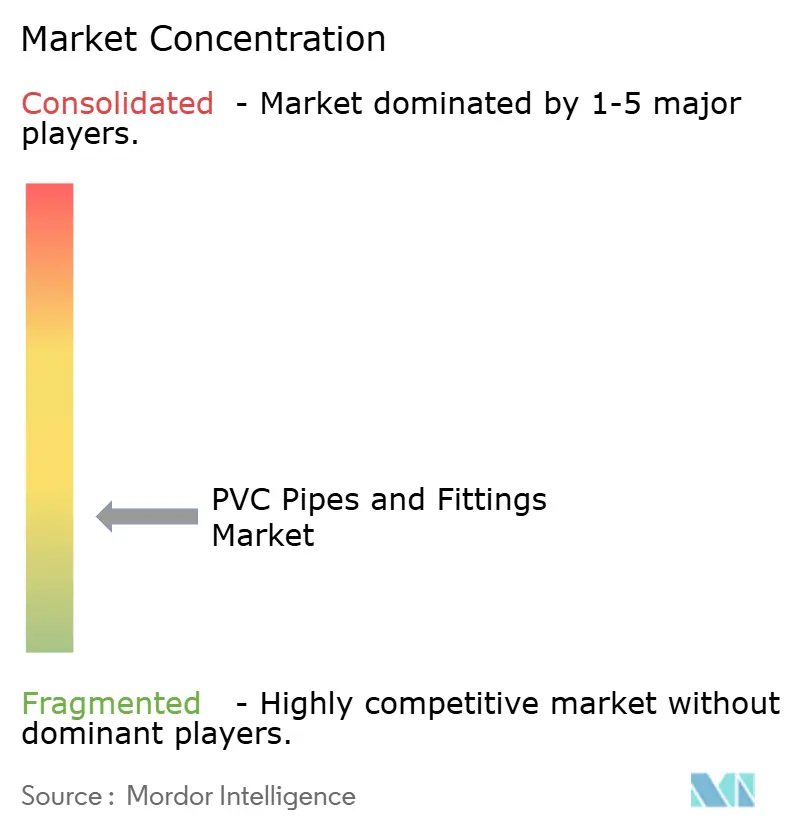
The PVC pipes and fittings market is highly fragmented, with the top five players including JM EAGLE, INC., CHINA LESSO, Orbia, Aliaxis Holdings SA, and SEKISUI CHEMICAL CO., LTD. ASTRAL PIPES, The Supreme Industries Limited, Finolex Industries Limited, and Prince Pipes and Fittings Ltd. compete through distribution coverage, local brands, contractor relationships, and CPVC portfolios. Major suppliers also seek closer control of resin, compounds, and manufacturing capacity to protect supply availability. Product certification and reliable delivery remain important when contractors select complete piping systems.
Westlake Corporation completed the acquisition of the Wilhelmshaven PVC and vinyl chloride monomer site in Germany in June 2026 for USD 109 million. The facility added 380,000 metric tons of annual PVC capacity and 882 million pounds of vinyl chloride monomer capacity, strengthening its European chlorovinyls supply position. Aliaxis Holdings SA, through IPEX Inc., acquired Johnson Controls’ CPVC pipe and fittings business for residential and light commercial fire-sprinkler systems in October 2024. That acquisition expanded access to a code-driven commercial application and added a manufacturing base in Huntsville, Alabama. CHINA LESSO is expanding production and overseas sales across Asia, Africa, and other markets.
Technology and product design increasingly differentiate leading suppliers. Aliaxis Research and Technology’s mechanical fitting patent filing addresses installation compatibility across CPVC, PVC, and UPVC systems. PIPELIFE INTERNATIONAL GmbH promotes systems designed for long service life, which is relevant for public infrastructure procurement. Smaller manufacturers face pressure from resin price changes, technical approvals, and investment in production upgrades.
PVC Pipes and Fittings Industry Leaders
JM EAGLE, INC.
CHINA LESSO
Orbia
Aliaxis Holdings SA
SEKISUI CHEMICAL CO., LTD.
- *Disclaimer: Major Players sorted in no particular order

Recent Industry Developments
- September 2026: Aliaxis Holdings SA, through IPEX Inc., continued supporting recovery efforts following Hurricane Helene, including initiatives to remove PVC pipe debris from the French Broad River and strengthen mitigation measures at its Asheville facility. The recovery activity highlights the role of PVC piping manufacturers in post-disaster infrastructure restoration and environmental management.
- June 2026: Westlake Corporation, through Westlake Vinnolit GmbH & Co. KG, completed the acquisition of the Wilhelmshaven PVC production site in Germany for approximately USD 109 million, adding 380,000 metric tons per year of PVC capacity. The additional PVC production capacity strengthens resin availability for downstream applications, including PVC pipes and fittings.


Global PVC Pipes and Fittings Market Report Scope
PVC pipes and fittings are polymer-based components used to convey fluids and connect piping systems across various infrastructure and building applications. They offer corrosion resistance, durability, lightweight handling, and ease of installation for fluid transportation systems.
The PVC Pipes and Fittings Market is segmented by material, product type, application, end-use industry, and geography. By material, the market is segmented into UPVC, CPVC, flexible PVC, and others. By product type, the market is segmented into pipes and fittings. By application, the market is segmented into water supply and distribution, sewerage and drainage systems, irrigation and agriculture, chemical and industrial fluid handling, HVAC and plumbing systems, and others. By end-use industry, the market is segmented into municipal and utilities, residential, commercial, agriculture, and industrial. The report also covers the market size and forecasts for PVC pipes and fittings in 15 countries across major regions. For each segment, the market sizing and forecasts have been done on the basis of value (USD).
| UPVC |
| CPVC |
| Flexible PVC |
| Others |
| Pipes |
| Fittings |
| Water Supply and Distribution |
| Sewerage and Drainage Systems |
| Irrigation and Agriculture |
| Chemical and Industrial Fluid Handling |
| HVAC and Plumbing Systems |
| Others |
| Municipal and Utilities |
| Residential |
| Commercial |
| Agriculture |
| Industrial |
| Asia-Pacific | China |
| India | |
| Japan | |
| South Korea | |
| ASEAN Countries | |
| Rest of Asia-Pacific | |
| North America | United States |
| Canada | |
| Mexico | |
| Europe | Germany |
| United Kingdom | |
| France | |
| Italy | |
| NORDIC Countries | |
| Rest of Europe | |
| South America | Brazil |
| Argentina | |
| Rest of South America | |
| Middle East and Africa | Saudi Arabia |
| South Africa | |
| Rest of Middle East and Africa |
| By Material | UPVC | |
| CPVC | ||
| Flexible PVC | ||
| Others | ||
| By Product Type | Pipes | |
| Fittings | ||
| By Application | Water Supply and Distribution | |
| Sewerage and Drainage Systems | ||
| Irrigation and Agriculture | ||
| Chemical and Industrial Fluid Handling | ||
| HVAC and Plumbing Systems | ||
| Others | ||
| By End-Use Industry | Municipal and Utilities | |
| Residential | ||
| Commercial | ||
| Agriculture | ||
| Industrial | ||
| By Geography | Asia-Pacific | China |
| India | ||
| Japan | ||
| South Korea | ||
| ASEAN Countries | ||
| Rest of Asia-Pacific | ||
| North America | United States | |
| Canada | ||
| Mexico | ||
| Europe | Germany | |
| United Kingdom | ||
| France | ||
| Italy | ||
| NORDIC Countries | ||
| Rest of Europe | ||
| South America | Brazil | |
| Argentina | ||
| Rest of South America | ||
| Middle East and Africa | Saudi Arabia | |
| South Africa | ||
| Rest of Middle East and Africa | ||


Key Questions Answered in the Report
What is the size of the PVC pipes and fittings market?
The PVC pipes and fittings market stands at USD 49.40 billion in 2026 and is projected to reach USD 69.54 billion by 2031.
Which material held the largest share in 2025?
UPVC held 71.56% of the market share in 2025, supported by its broad use in water distribution, drainage, and sewerage systems.
Which product type is projected to advance fastest through 2031?
Fittings are projected to advance at a 7.83% CAGR through 2031 as irrigation and commercial systems use more complex connections.
Which application is expected to grow fastest through 2031?
Irrigation and agriculture are projected to advance at an 8.18% CAGR through 2031, supported by pressurized irrigation investment.
Page last updated on:


 Your data is secure and never sold or shared.


