
Pultrusion Products Market Size and Share
Market Overview
| Study Period | 2022 - 2032 |
|---|---|
| Market Size (2027) | USD 3.07 Billion |
| Market Size (2032) | USD 3.99 Billion |
| Growth Rate (2027 - 2032) | 5.35 % |
| Fastest Growing Market | Asia-Pacific |
| Largest Market | Asia-Pacific |
| Market Concentration | Low |
Major Players *Disclaimer: Major Players sorted in no particular order Image © Mordor Intelligence. Reuse requires attribution under CC BY 4.0. | |
Pultrusion Products Market Analysis by Mordor Intelligence
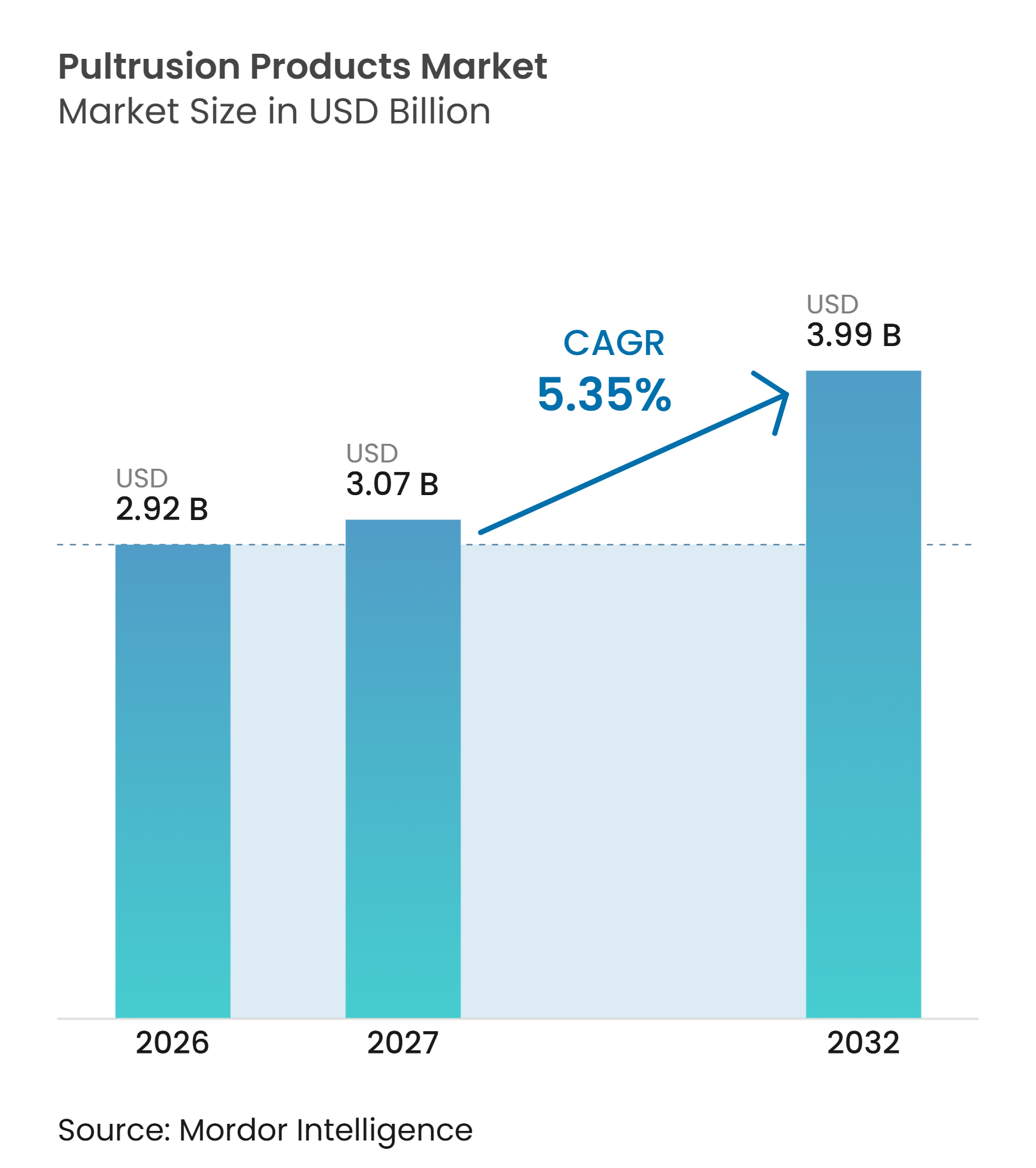
The Pultrusion Products Market size was valued at USD 2.92 billion in 2026 and is estimated to grow from USD 3.07 billion in 2027 to reach USD 3.99 billion by 2032, at a CAGR of 5.35% during the forecast period (2027-2032). The pultrusion products market benefits from replacement work on aging infrastructure, especially where corrosion increases maintenance needs. Grid investment also expands demand for non-conductive structural components in substations, cable systems, and transmission projects. Wind energy supports demand for carbon fiber pultruded parts, particularly spar caps and conductor cores. These applications have different purchasing cycles, which gives the pultrusion products market a broader base than a single construction end use. Producers are also moving toward higher-value profiles, recycled carbon fiber content, and local supply capacity near large project markets.
Key Report Takeaways
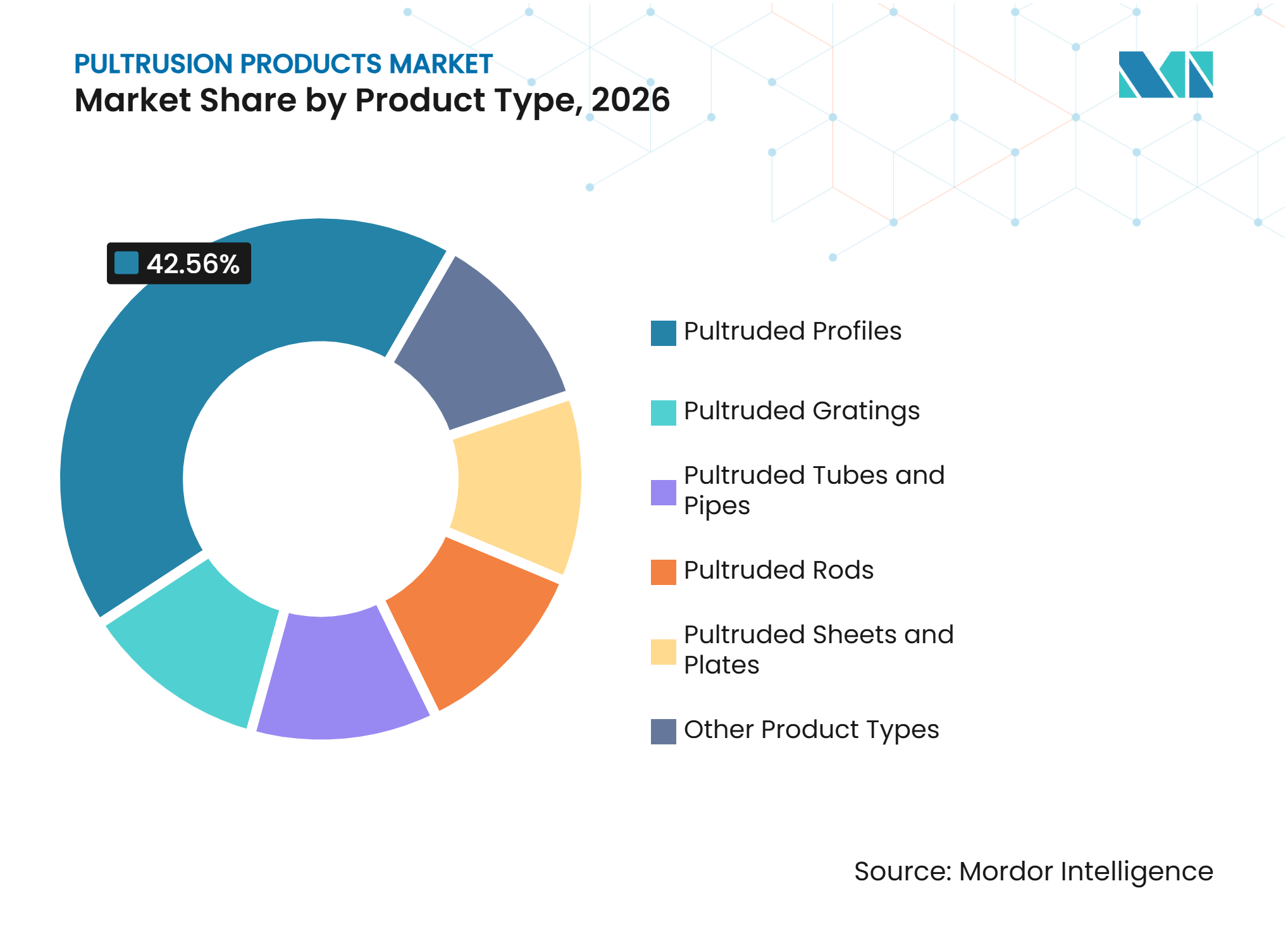
- By product type, pultruded profiles held 42.56% of the pultrusion products market share in 2026, while pultruded gratings are projected to advance at a 5.95% CAGR through 2032.
- By fiber type, glass fiber-reinforced polymer held 82.13% of the pultrusion products market share in 2026, while carbon fiber-reinforced polymer is projected to advance at a 6.21% CAGR through 2032.
- By resin type, polyester held 46.32% of the pultrusion products market share in 2026, while epoxy is projected to advance at a 6.19% CAGR through 2032.
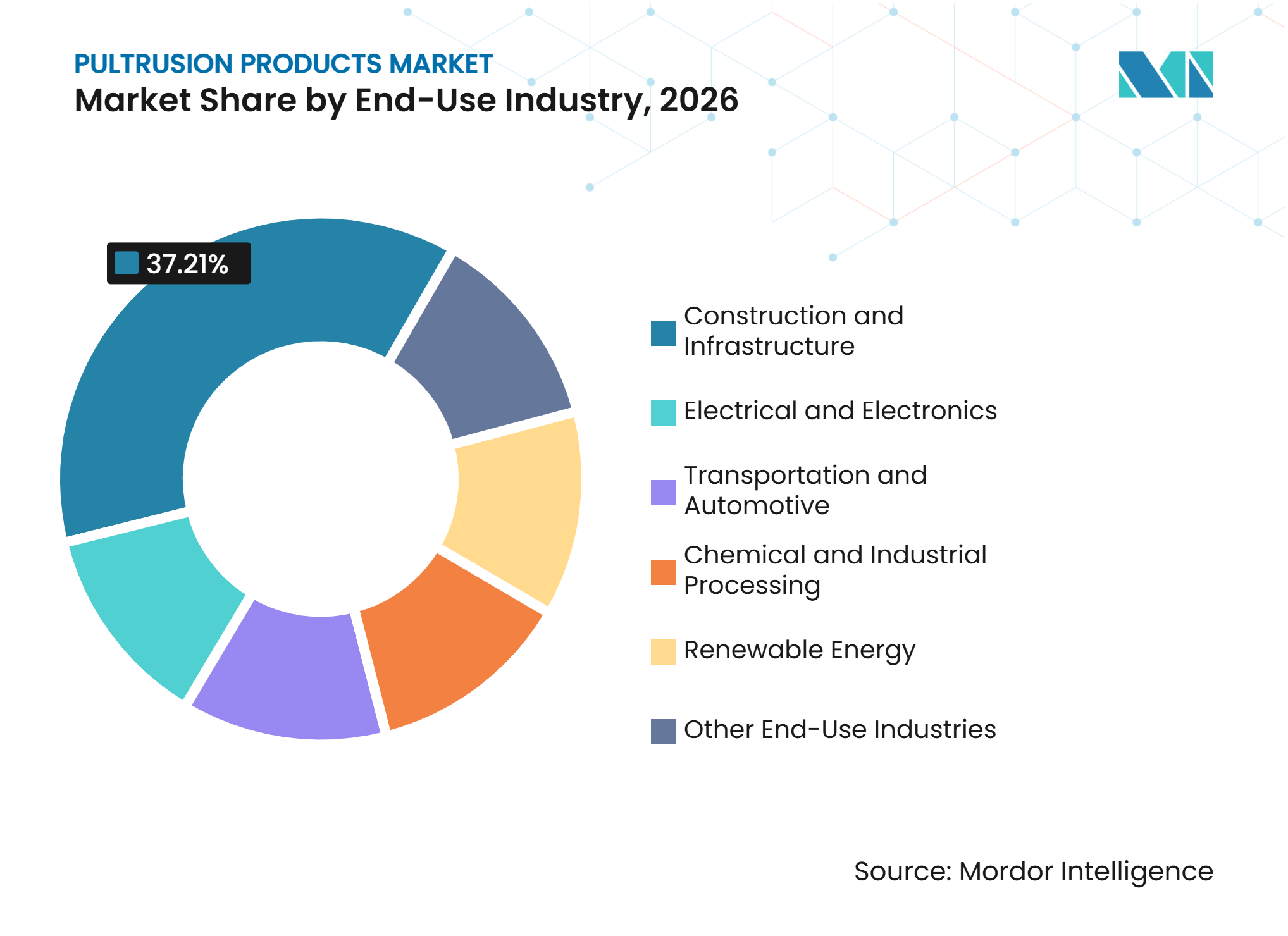
- By end-use industry, construction and infrastructure held 37.21% of the pultrusion products market share in 2026, while transportation and automotive are projected to advance at a 6.52% CAGR through 2032.
- By geography, Asia-Pacific held 38.44% of the pultrusion products market share in 2026 and is projected to advance at a 6.48% CAGR through 2032.
Note: Market numbers in this report are based on Mordor Intelligence's proprietary estimation framework, which combines nine months of actuals with Q4 projections for base year 2026.
Market Trends and Insights
Drivers Impact Analysis of Pultrusion Products Market*
| Driver | (~) % Impact on CAGR Forecast | Geographic Relevance | Impact Timeline |
|---|---|---|---|
| Corrosion-Resistant Infrastructure Replacement | +1.4% | Global; highest in North America and Europe where bridge stock is aging; spillover into APAC coastal and wastewater infrastructure | Long term (≥ 4 years) |
| Grid Modernization and Non-Conductive Utility Structures | +1.2% | Global; North America and Europe grid investment programs; APAC transmission expansion | Medium term (2–4 years) |
| Wind Energy and Lightweight Composite Components | +1.1% | APAC dominant, particularly China and India; European offshore wind expansion | Medium term (2–4 years) |
| Lifecycle-Cost Advantage Over Steel, Aluminum, and Wood | +0.9% | Global; early gains in North America and Europe where lifecycle accounting is institutionalized | Long term (≥ 4 years) |
| Pultruded FRP Rebar Adoption in Aggressive Environments | +0.7% | North America (Buy America mandates), APAC coastal and marine, Europe bridge deck rehabilitation | Short term (≤ 2 years) |
| Source: Mordor Intelligence | |||
Corrosion-Resistant Infrastructure Replacement
Aging infrastructure is moving toward pultruded fiber-reinforced polymer (FRP) from a specialist material into more routine structural specifications. A 2026 study found that glass fiber-reinforced polymer (GFRP) alternatives for offshore platforms reduced structural self-weight by 25% and lowered lifecycle costs by as much as 26% over 50 years when compared with steel. The savings were tied to fewer corrosion maintenance cycles, which matter in marine, wastewater, and chemical settings. American Society of Civil Engineers/Structural Engineering Institute (ASCE/SEI) 74-23 provides a U.S. design route for pultruded FRP structures, while European Committee for Standardization (CEN)/TS 19101:2022 provides a European technical reference. Pultron Composites used its Mateenbar GFRP rebar in the Tauranga Bridge Marina breakwater project during 2024 and 2025, where each concrete panel was reduced by 2 metric tons, and the design life exceeded 100 years.
Grid Modernization and Non-Conductive Utility Structures
Grid modernization creates demand for pultruded sections in utility poles, cable trays, switchgear enclosures, and substation structures. These parts are valued because they are non-conductive, corrosion-resistant, and lighter than many conventional alternatives. Exel Composites signed a four-year agreement with De Angeli Prodotti in November 2025, followed by an agreement with Tratos in December 2025. Both agreements cover carbon fiber composite conductor cores for high-voltage applications. The projects show that the pultrusion products market is becoming more connected to long-term utility investment plans.
Wind Energy and Lightweight Composite Components
Wind energy raises demand for high-stiffness pultruded carbon fiber parts used in spar caps and related blade structures. The Global Wind Energy Council reported 117 gigawatts of global wind installations in 2024 and projected an 8.8% CAGR for the wind sector through 2030[1]. Larger turbines require longer blades, which increases the value of materials with high stiffness and fatigue resistance. China commissioned 130 gigawatts of turbines in 2025, with an average unit size of 7.16 megawatts. That deployment gives Asia-Pacific a large concentration of potential carbon fiber demand.
Lifecycle-Cost Advantage Over Steel, Aluminum, and Wood
The lifecycle-cost case is strongest where structures operate in corrosive, wet, or electrically sensitive conditions. A 2025 study of hybrid FRP-steel reinforcement systems found up to 20% higher durability over a 50-year period than steel-only systems. Better durability can reduce replacement frequency and help project owners manage maintenance budgets. Chemical plants are replacing corroded steel grating with pultruded alternatives where repainting and shutdown costs are high. This replacement cycle is particularly relevant in industrial flooring, walkways, and access systems.
Restraints Impact Analysis of Pultrusion Products Market*
| Restraint | (~) % Impact on CAGR Forecast | Geographic Relevance | Impact Timeline |
|---|---|---|---|
| Higher Upfront Cost Than Conventional Materials | -0.8% | Global; most acute in price-sensitive APAC and South American markets | Short term (≤ 2 years) |
| Limited Composite Design-Code Coverage | -0.6% | North America and Europe (mandatory code compliance); limited adoption in emerging markets lacking local standards | Medium term (2–4 years) |
| Constant-Cross-Section Design Limitation | -0.5% | Global; most constraining in architectural and specialty structural applications in Western markets | Long term (≥ 4 years) |
| Source: Mordor Intelligence | |||
Higher Upfront Cost Than Conventional Materials
Pultruded FRP still carries a higher initial price than steel in many standard applications, especially when bids prioritize the lowest upfront cost. This is a material issue in price-sensitive construction markets in Southeast Asia and South America. A project designed for steel may also need redesigned connections, embedments, and load paths before FRP can be used. That engineering work adds cost and slows substitutions even when lifecycle results favor composites. Larger production facilities can reduce unit costs over time, but price normalization will remain gradual.
Limited Composite Design-Code Coverage
Design-code coverage remains uneven, which makes structural engineers cautious when they consider unfamiliar materials. ASCE/SEI 72-23 provides load and resistance factor design provisions for pultruded structures, but its scope is limited to glass fiber reinforcement. Carbon and aramid fiber pultruded structures do not have the same established U.S. code route. CEN/TS 19101:2022 is a technical specification rather than a complete Eurocode[2]. These limits can cause designers to retain steel specifications even when a composite profile has suitable technical performance.
*Our forecasts treat driver/restraint impacts as directional, not additive. The impact forecasts reflect baseline growth, mix effects, and variable interactions.
Pultrusion Products Market Segment Analysis
By Product Type:
Pultruded Profiles Lead, While Pultruded Gratings AdvancePultruded profiles held 42.56% of the pultrusion products market share in 2026. Their large installed base reflects long-standing use in beams, channels, angles, and I-sections across construction, industrial facilities, and utility projects. The pultrusion products market size for profiles is supported by applications that need corrosion resistance, electrical insulation, and predictable structural dimensions. Pultruded gratings are projected to advance at a 5.95% CAGR through 2032. Their adoption is most visible in chemical plants, offshore assets, and water treatment facilities, where steel gratings can require repeated maintenance. Tubes and pipes, rods, sheets, and plates serve marine, telecommunications, and construction formwork applications.
Fibrolux GmbH completed its largest civil engineering project in May 2026 when it supplied more than 16 kilometers of custom pultruded fiberglass deck beams for the Marshal Jozef Pilsudski Bridge rehabilitation in Torun, Poland. The project used composite walkway slabs and drainage support sections for cycling and pedestrian infrastructure. Fibrolux GmbH also filed a patent in February 2026 for a monolithic casting process to make a lightweight glass-reinforced plastic (GRP) grating with optimized material use. The development shows that product differentiation increasingly depends on handling efficiency, material use, and load capacity. As profiles become more standardized, specialized gratings and civil components can help producers protect margins. The product mix will continue to favor suppliers that can offer both standard shapes and project-specific designs.



By Fiber Type:
GFRP Supports Revenue, While CFRP ExpandsGlass fiber-reinforced polymer held 82.13% of the pultrusion products market share in 2026. GFRP remains the standard material where corrosion resistance and electrical neutrality matter more than maximum stiffness. Its lower material cost makes it suitable for broad uses in building profiles, gratings, rebar, and utility structures. Carbon Fiber-Reinforced Polymer (CFRP) is projected to advance at a 6.21% CAGR through 2032. Its growth is tied to wind turbine spar caps and electrical conductor cores, where stiffness, thermal stability, and fatigue resistance are central. Aramid fiber-reinforced polymer remains relevant in ballistic, marine, and pressure vessel uses, while basalt-fiber hybrids offer intermediate performance in selected applications.
The pultrusion products market also benefits from GFRP’s established supply base and its fit with standard profile applications. Epsilon Composite and Nova Carbon demonstrated a pultruded CFRP machine beam in March 2026 that incorporated more than 30% recycled carbon fiber. The project used 1.8 metric tons of production scrap and avoided 29 metric tons of carbon dioxide equivalent. Recycled carbon fiber can improve the material case for industrial and construction applications, although commercial supply and qualification standards remain important. CFRP will continue to be concentrated in applications where its performance advantage is necessary.
By Resin Type:
Polyester Supports Standard Revenue, While Epoxy ExpandsPolyester held 46.32% of the pultrusion products market share in 2026. It is widely used because of its lower raw material cost and fit with standard GFRP pultrusion processes. Vinyl ester is used in chemical processing and marine settings where stronger hydrolysis resistance justifies a higher material cost. Epoxy is projected to advance at a 6.19% CAGR through 2032. It is selected for wind energy, transportation, and electrical infrastructure because it can provide stronger fiber-to-matrix adhesion, heat resistance, and fatigue performance. Phenolic resin remains important where fire performance is critical, while polyurethane supports selected high-throughput automotive components.
Electric vehicle battery tray producers use epoxy-pultruded parts to meet flame resistance and dimensional stability requirements under United Nations Economic Commission for Europe Regulation No. 100 and Underwriters Laboratories 2580 frameworks. This requirement can raise the value of resin selection in the pultrusion products market, especially where safety certification is part of supplier approval. Exel Composites adopted a bio-based unsaturated polyester resin with Polynt that includes 20% bio-based content and has a 20% lower carbon footprint than conventional unsaturated polyester resin. The change provides a lower-carbon option without requiring a full shift away from polyester. European producers may lead adoption because carbon accounting has a larger role in customer requirements. Resin suppliers that can combine performance, processability, and documented environmental data will be better positioned.
By End-Use Industry:
Construction and Infrastructure Support Scale, While Transportation and Automotive AdvanceConstruction and infrastructure held 37.21% of the pultrusion products market share in 2026. It remains the commercial foundation for pultruded components because it includes recurring bridge, wastewater, industrial, and utility replacement work. Transportation and automotive are projected to advance at a 6.52% CAGR through 2032. The segment is supported by electric vehicle lightweighting programs and commercial vehicle payload targets. Electrical and electronics, chemical and industrial processing, and renewable energy add demand through cable systems, corrosion-resistant access structures, and wind components. The broad end-use mix limits the pultrusion products market’s dependence on a single project category.
Carbon Truck & Trailer GmbH used a pultruded CFRP chassis on a Fiat Ducato retail vehicle for Borco Höhns and achieved a 185-kilogram weight reduction with a 36% payload increase compared with the steel baseline. This example shows why pultruded composites are becoming more relevant to ground transportation. Qualification programs are increasing as vehicle manufacturers seek lighter structural parts without giving up stiffness. American Composites Manufacturers Association (ACMA) has also highlighted composite conductor cores to increase transmission capacity and grid resilience. Demand therefore links transportation, utility, and energy projects through the same set of advanced profile technologies. Suppliers with flexible materials capability can serve several end uses with related process knowledge.

Geography Analysis
Asia-Pacific: Large Demand Base and Faster Expansion
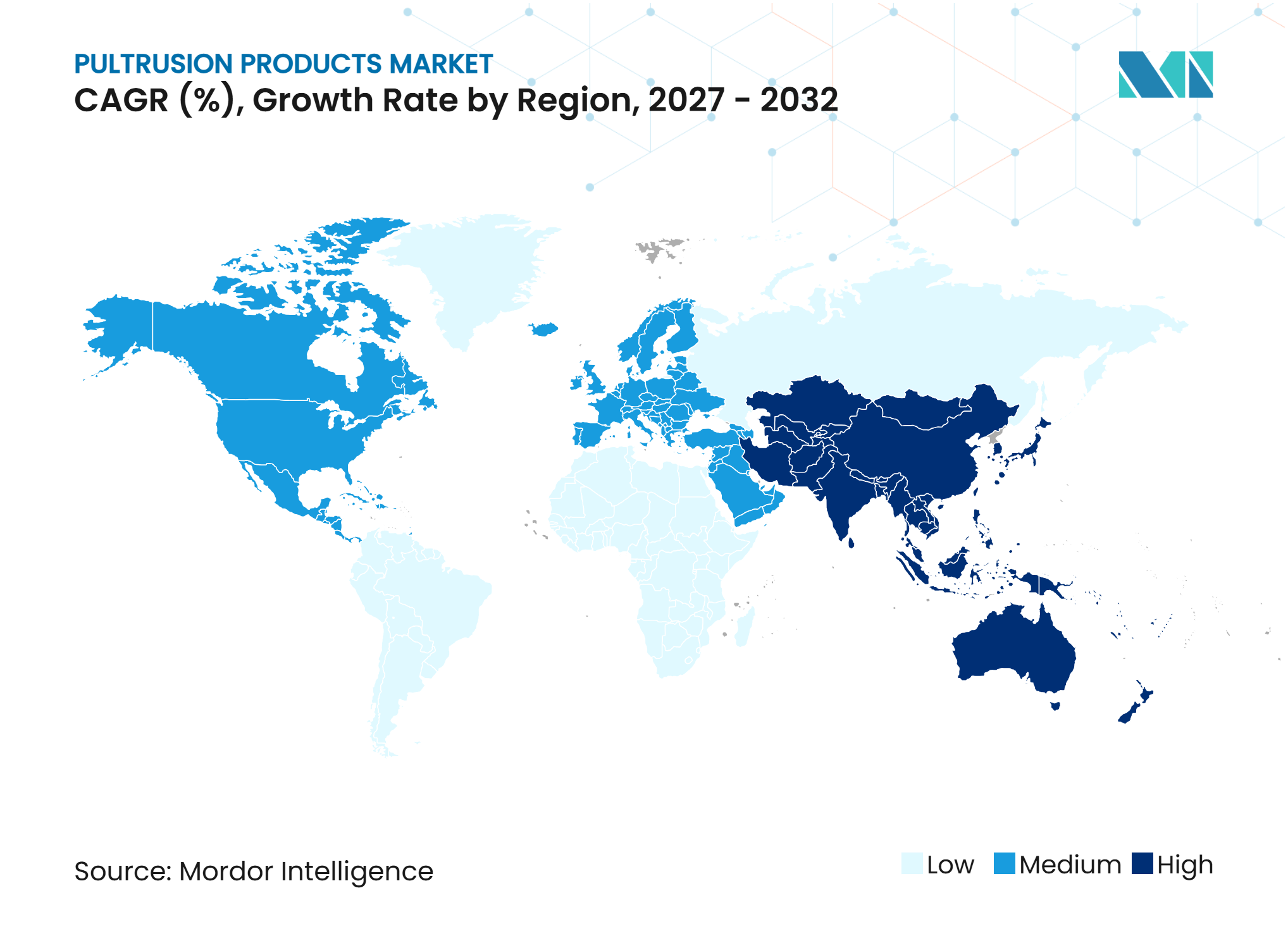
Asia-Pacific held 38.44% of the pultrusion products market share in 2026 and is projected to advance at a 6.48% CAGR through 2032. China drives regional demand through wind energy expansion and continued infrastructure activity. The China Wind Energy Association reported 130 gigawatts of new turbine installations in 2025, with an average unit size of 7.16 megawatts. Larger turbines need high-performance spar cap materials, which supports CFRP pultrusion. India also supports demand through rail, highways, airports, and metro projects. Japan focuses more on high-specification transport and electrical rehabilitation work, while South Korea’s electric vehicle programs add CFRP demand. Southeast Asian markets are at an earlier substitution stage, with coastal and industrial processing projects encouraging GFRP profile adoption.
North America: Rebar and Grid Programs Support Adoption
North America’s pultrusion products market is supported by infrastructure procurement rules and grid modernization. PULTRALL opened a 127,000-square-foot production facility in Edon, Ohio, in March 2026 to expand V-ROD fiberglass rebar output and create more than 60 jobs. The investment responds to demand linked to Build America, Buy America requirements. ACMA’s utility pole standard revision also supports clearer technical expectations for composite poles. STRONGWELL CORPORATION appointed Module Solutions & Systems AS as a distributor for parts of Europe in June 2025, extending the company’s reach without a new local plant. University of Maine’s work on field-bendable thermoplastic FRP rebar with state Departments of Transportation could support a new set of transportation applications.
Europe, South America, the Middle East, Africa, and Oceania: Different Adoption Paths
Western Europe uses more high-performance epoxy and carbon fiber profiles in wind, rail, and rehabilitation work, while Central and Eastern Europe have wider standard GFRP infrastructure applications. Fibrolux GmbH’s bridge project in Poland demonstrates demand for long composite deck beam systems in rehabilitation work. Europe’s evolving design framework under CEN/TS 19101:2022 remains an important compliance factor for structural applications. The pultrusion products market can expand in this group of regions as local technical support makes composite specifications easier to adopt. Brazil and Argentina have demand for FRP gratings in petrochemical processing, although cost sensitivity and limited local manufacturing slow broader use. Saudi Arabian petrochemical and marine infrastructure support GFRP profiles and gratings, while South African water utilities are expanding composite specifications. Pultron Composites opened a warehouse in North Brisbane in August 2026, giving Queensland projects local access to Mateenbar GFRP rebar. Its Australian expansion shows how local stock and technical support can build demand where corrosion-free reinforcement is still developing.
Competitive Landscape
Market Concentration
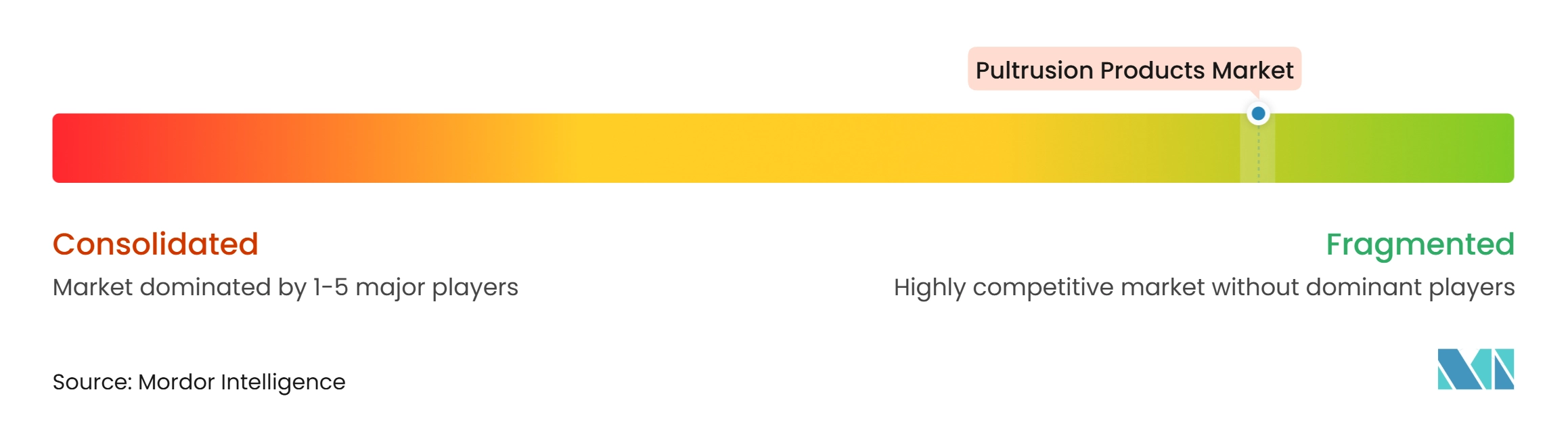
The pultrusion products market is highly fragmented, with top players including STRONGWELL CORPORATION, Röchling SE & Co. KG, Jiuding New Material Co., Ltd., Exel Composites, and Fibergrate. They compete through profile breadth, materials capability, manufacturing scale, technical support, and local project delivery. Regional manufacturers remain important in customized orders and local infrastructure work.
Bedford Reinforced Plastics joined GEOTEK and STRONGWELL CORPORATION under the STRONGTEK holding company in June 2026 after the May 15 partnership close. The combined business has more than 1,500 employees, 4 plants, and over 65 pultrusion lines. This combination gives the group added scale across safety, industrial, and infrastructure applications. Exel Composites’ combined frame agreements with De Angeli Prodotti and Tratos show a separate strategy centered on high-voltage conductor cores. Epsilon Composite’s plans for an India subsidiary and a Chennai factory with Sumitomo as a capital partner show the importance of proximity to Asian energy and infrastructure customers.
Product development is another area of competition. Epsilon Composite and Nova Carbon used more than 30% recycled carbon fiber in a commercially qualified pultruded machine beam, linking product performance with circular material use. Fibrolux GmbH’s patented lightweight GRP grating process seeks to improve material use and installation handling. Bedford Reinforced Plastics introduced PRODeck LV for pedestrian bridges in November 2025. ACMA P01-202X and the transition to ISO 9001:2026 could raise compliance demands for smaller suppliers. Companies that can combine tested products, delivery reliability, and application engineering will have an advantage in new specifications.
Pultrusion Products Industry Leaders
-
STRONGWELL CORPORATION
-
Röchling SE & Co. KG
-
Jiuding New Material Co., Ltd
-
Exel Composites
-
Fibergrate
- *Disclaimer: Major Players sorted in no particular order
Pultrusion Products Market Companies Covered in this Report
- Bedford Reinforced Plastics
- Creative Composites Group
- Epsilon Composite
- Exel Composites
- Fibergrate
- Fibrolux GmbH
- Jiuding New Material Co., Ltd
- PULTRALL
- Pultron Composites
- Röchling SE & Co. KG
- Shakespeare Composite Structures
- STRONGWELL CORPORATION
- Tencom
- TOP GLASS Industries
Recent Industry Developments in Pultrusion Products Market
- September 2026: Liberty Pultrusions announced an investment of nearly USD 700,000 to expand manufacturing capacity at its Pittsburgh, Pennsylvania facility. The project includes a new pultrusion production line and upgrades to existing equipment, adding approximately 800,000 pounds of annual capacity to support demand from electrical insulation, power distribution, construction, and industrial applications.
- October 2025: Exel Composites reported that its Indian joint venture, Kineco Exel Composites India, had reached volume production at its Banda facility, with dedicated manufacturing lines for carbon-fiber components used in wind turbine blades. The facility's volume shipments strengthened India's domestic supply of pultruded carbon-fiber flats, spar-cap reinforcements, and other wind-energy components.
Global Pultrusion Products Market Report Scope
Pultrusion products are fiber-reinforced polymer (FRP) composites manufactured through a continuous process in which reinforcing fibers are impregnated with resin and pulled through a heated die to form products with uniform cross-sections. These products offer high strength-to-weight ratios, corrosion resistance, electrical insulation, and dimensional stability. They are widely used in construction, infrastructure, electrical equipment, transportation, chemical processing, and renewable energy applications.
The Pultrusion Products Market is segmented by product type, fiber type, resin type, end-use industry, and geography. By product type, the market is segmented into pultruded profiles, pultruded gratings, pultruded tubes and pipes, pultruded rods, pultruded sheets and plates, and other product types. By fiber type, the market is segmented into glass fiber-reinforced polymer, carbon fiber-reinforced polymer, aramid fiber-reinforced polymer, and other fiber types. By resin type, the market is segmented into polyester, vinyl ester, epoxy, phenolic, polyurethane, and other resin types. By end-use industry, the market is segmented into construction and infrastructure, electrical and electronics, transportation and automotive, chemical and industrial processing, renewable energy, and other end-use industries. The report also covers the market size and forecasts for pultrusion products in 15 countries across major regions. For each segment, the market sizing and forecasts have been done on the basis of value (USD).
Segmentation Overview
| Pultruded Profiles |
| Pultruded Gratings |
| Pultruded Tubes and Pipes |
| Pultruded Rods |
| Pultruded Sheets and Plates |
| Other Product Types |
| Glass Fiber-Reinforced Polymer |
| Carbon Fiber-Reinforced Polymer |
| Aramid Fiber-Reinforced Polymer |
| Other Fiber Types |
| Polyester |
| Vinyl Ester |
| Epoxy |
| Phenolic |
| Polyurethane |
| Other Resin Types |
| Construction and Infrastructure |
| Electrical and Electronics |
| Transportation and Automotive |
| Chemical and Industrial Processing |
| Renewable Energy |
| Other End-Use Industries |
| Asia-Pacific | China |
| India | |
| Japan | |
| South Korea | |
| ASEAN Countries | |
| Rest of Asia-Pacific | |
| North America | United States |
| Canada | |
| Mexico | |
| Europe | Germany |
| United Kingdom | |
| France | |
| Italy | |
| NORDIC Countries | |
| Rest of Europe | |
| South America | Brazil |
| Argentina | |
| Rest of South America | |
| Middle East and Africa | Saudi Arabia |
| South Africa | |
| Rest of Middle East and Africa |
| By Product Type | Pultruded Profiles | |
| Pultruded Gratings | ||
| Pultruded Tubes and Pipes | ||
| Pultruded Rods | ||
| Pultruded Sheets and Plates | ||
| Other Product Types | ||
| By Fiber Type | Glass Fiber-Reinforced Polymer | |
| Carbon Fiber-Reinforced Polymer | ||
| Aramid Fiber-Reinforced Polymer | ||
| Other Fiber Types | ||
| By Resin Type | Polyester | |
| Vinyl Ester | ||
| Epoxy | ||
| Phenolic | ||
| Polyurethane | ||
| Other Resin Types | ||
| By End-Use Industry | Construction and Infrastructure | |
| Electrical and Electronics | ||
| Transportation and Automotive | ||
| Chemical and Industrial Processing | ||
| Renewable Energy | ||
| Other End-Use Industries | ||
| By Geography | Asia-Pacific | China |
| India | ||
| Japan | ||
| South Korea | ||
| ASEAN Countries | ||
| Rest of Asia-Pacific | ||
| North America | United States | |
| Canada | ||
| Mexico | ||
| Europe | Germany | |
| United Kingdom | ||
| France | ||
| Italy | ||
| NORDIC Countries | ||
| Rest of Europe | ||
| South America | Brazil | |
| Argentina | ||
| Rest of South America | ||
| Middle East and Africa | Saudi Arabia | |
| South Africa | ||
| Rest of Middle East and Africa | ||
Key Questions Answered in the Report
What is the size of the pultrusion products market?
The pultrusion products market size was valued at USD 2.92 billion in 2026 and is estimated to grow from USD 3.07 billion in 2027 to reach USD 3.99 billion by 2032, at a CAGR of 5.35% during the forecast period (2027-2032).
What is driving demand for pultruded products?
Infrastructure replacement, grid modernization, wind energy, and lifecycle-cost benefits support demand for pultruded products.
Which product type held the largest share in 2026?
Pultruded profiles held a 42.56% share in 2026.
Which fiber type held the largest share in 2026?
Glass fiber-reinforced polymer held an 82.13% share in 2026 because it offers corrosion resistance and electrical insulation at a lower cost than carbon fiber.