
Protective and Defense Technical Textile Market Size and Share
Market Overview
| Study Period | 2021 - 2032 |
|---|---|
| Market Size (2026) | USD 21.38 Billion |
| Market Size (2032) | USD 29.98 Billion |
| Growth Rate (2027 - 2032) | 7.00 % |
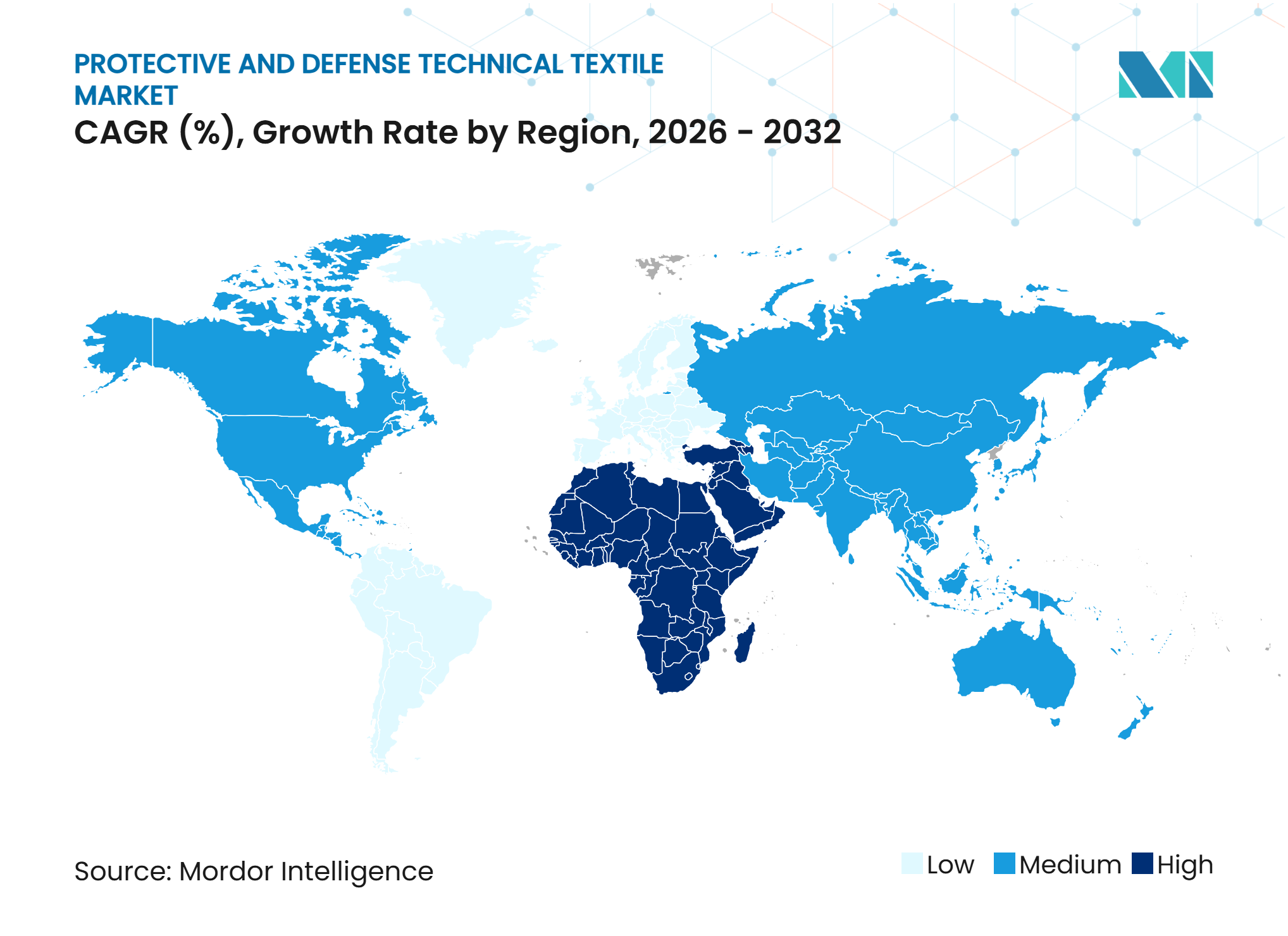
| Fastest Growing Market | Middle East and Africa |
| Largest Market | North America |
| Market Concentration | Medium |
Major Players *Disclaimer: Major Players sorted in no particular order Image © Mordor Intelligence. Reuse requires attribution under CC BY 4.0. | |
Protective and Defense Technical Textile Market Analysis by Mordor Intelligence
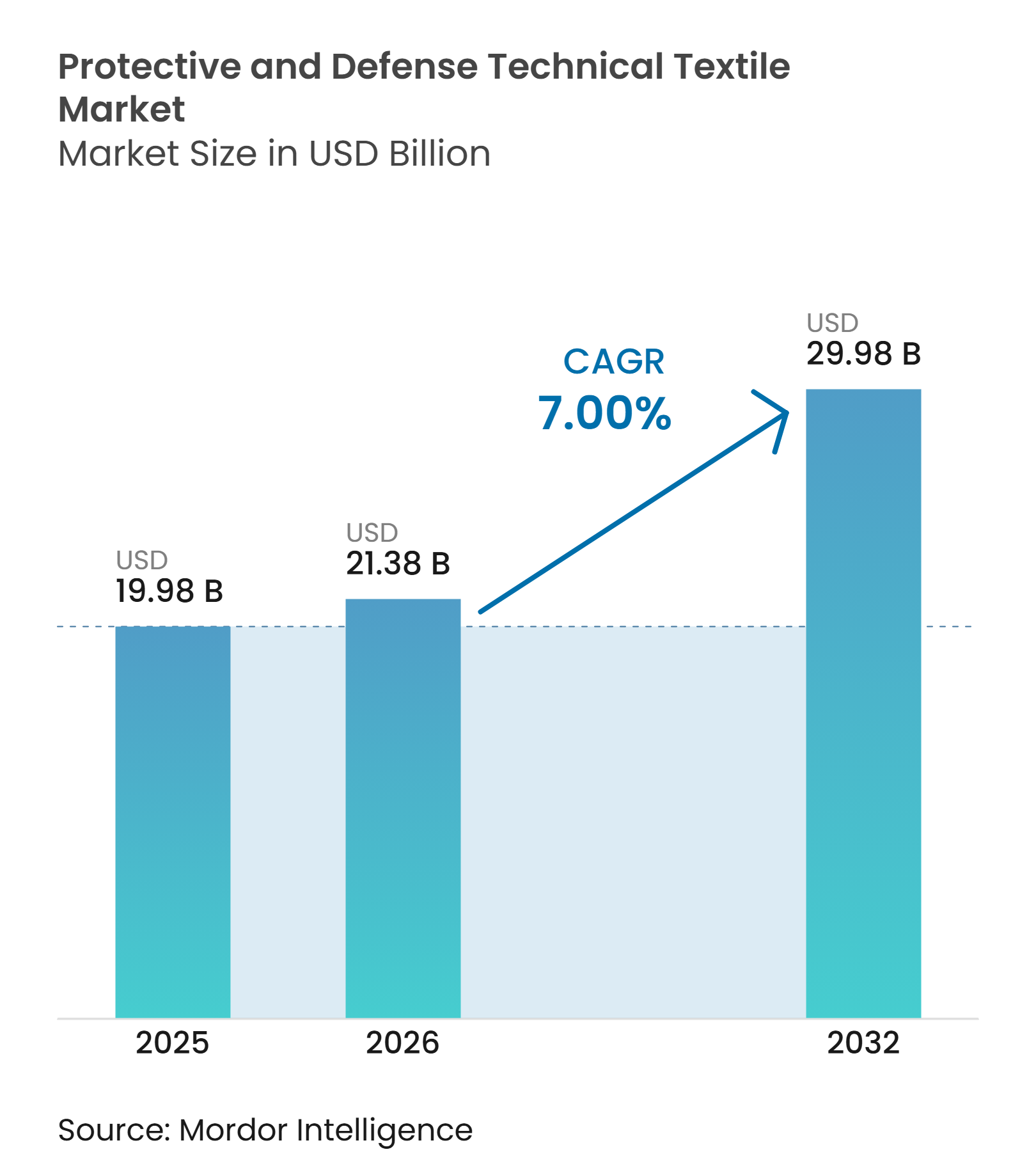
The Protective And Defense Technical Textile Market size is projected to expand from USD 19.98 billion in 2025 and USD 21.38 billion in 2026 to USD 29.98 billion by 2032, registering a CAGR of 7% between 2026 and 2032.
Rising defense budgets are supporting demand for integrated technical textile systems that combine ballistic, thermal, chemical, and flame-resistant protection. Global military expenditure reached USD 2,887 billion in 2025, extending an 11-year sequence of annual increases in real terms. This sustained investment is encouraging defense agencies to upgrade soldier protection equipment, including ballistic vests, combat uniforms, helmets, protective covers, and lightweight armor systems. Increasing emphasis on soldier mobility and operational efficiency is also driving the adoption of high-strength, lightweight fibers and advanced composite materials that provide improved protection without adding excessive weight. Tighter workplace safety regulations are further increasing replacement demand for fitted and certified protective garments. OSHA’s 2025 construction rule requires personal protective equipment to fit each worker properly, including coveralls, vests, harnesses, and full-body suits.
Key Report Takeaways
- By product type, flame, heat, and arc protective textiles held 28.5% of the protective and defense technical textile market share in 2026, while ballistic, fragmentation, and penetration-resistant textiles are projected to grow at an 8.8% CAGR through 2032.
- By material type, aramid fibers held 29% of the market in 2026, while UHMWPE is forecast to expand at a 9.2% CAGR through 2032.
- By end-use application, defense and armed forces accounted for 29.5% of the protective and defense technical textile market size in 2026 and is projected to advance at an 8.5% CAGR through 2032.
-
By geography, North America held 33% of the market in 2026, while the Middle East and Africa is forecast to grow at an 8.6% CAGR through 2032.
Note: Market numbers in this report are based on Mordor Intelligence's proprietary estimation framework, which combines nine months of actuals with Q4 projections for base year 2026.
Market Trends and Insights
Drivers Impact Analysis of Protective and Defense Technical Textile Market*
| Driver | (~) % Impact on CAGR Forecast | Geographic Relevance | Impact Timeline |
|---|---|---|---|
| Defense Modernization and Soldier Protection Investments | +2.0% | Global, with concentrated spending in North America, Europe, and Asia-Pacific | Long term (≥ 4 years) |
| Occupational Safety Regulation and PPE Compliance Requirements | +1.5% | North America and Europe, with growing enforcement in Asia-Pacific and the Middle East and Africa | Short term (≤ 2 years) to Medium term (2-4 years) |
| Ballistic and Fragmentation Protection Requirements | +1.2% | Global, with highest intensity in NATO nations, India, South Korea, and Israel | Long term (≥ 4 years) |
| Flame-Resistant and Arc-Rated Workwear Adoption | +1.0% | North America and Europe, with emerging demand in the Middle East and industrial Asia-Pacific | Medium term (2-4 years) |
| Firefighting and Emergency Response Equipment Replacement | +0.8% | North America and Europe, with increasing demand in Asia-Pacific and the Middle East and Africa | Short term (≤ 2 years) to Medium term (2-4 years) |
| Industrial Chemical Handling and Hazardous Environment Protection | +0.5% | Global, centered on Asia-Pacific petrochemical corridors and extending to the Middle East and Africa | Medium term (2-4 years) |
| Source: Mordor Intelligence | |||
Defense Modernization and Soldier Protection Investments
NATO members agreed in June 2025 to raise the defense spending target to 5% of GDP by 2035, replacing the former 2% benchmark. The agreement supports a longer planning horizon for soldier protection equipment across the protective and defense technical textile market. European military spending rose 14% to USD 864 billion in 2025, while spending in Asia and Oceania rose 8.1% to USD 681 billion.[1] India also approved USD 4.6 billion in emergency procurement funds after the May 2025 conflict with Pakistan. These programs increase demand for lighter protective ensembles that combine ballistic, thermal, and chemical layers. Suppliers with completed defense qualifications are better placed because new systems can require two to five years of testing and procurement review.
Occupational Safety Regulation and PPE Compliance Requirements
OSHA’s final rule under 29 CFR 1926.95(c), which took effect on January 13, 2025, requires construction employers to provide personal protective equipment (PPE) that appropriately fits workers according to their body size and shape.[2] The requirement covers protective garments and equipment, including coveralls, vests, harnesses, and full-body suits, and applies to small businesses as well as large contractors. This regulatory change is encouraging employers to reassess existing PPE inventories and prioritize properly fitted products during procurement and replacement. It is also increasing demand for customized sizing, ergonomic garment designs, and certified protective materials that maintain safety performance without restricting worker mobility. Consequently, manufacturers are focusing on flexible sizing options, improved fabric construction, and multi-hazard protection capabilities, strengthening the role of product design and compliance in the protective and defense technical textile market.
Ballistic and Fragmentation Protection Requirements
Ukraine’s Ministry of Defense began its first procurement of modular body armor in an extended full-body configuration in July 2025.[3] The move indicates a shift from point protection toward systems that cover a larger area of the body. Such designs require more technical textile material per unit. The United Kingdom Ministry of Defense also published a Personal Hard Armour framework in October 2025 with a potential whole-life value of up to GBP 250 million (USD 337.3 million). UHMWPE is gaining attention for soft armor because its low density can reduce system weight at comparable protection levels. This strengthens material demand within the protective and defense technical textile market as military buyers focus on mobility and endurance.
Flame-Resistant and Arc-Rated Workwear Adoption
NFPA 70E establishes requirements for arc-rated protective clothing for workers exposed to electrical hazards, with arc-rated garments required where incident energy exposure reaches or exceeds 1.2 cal/cm². This requirement affects utility, electrical, and industrial employees working near energized equipment, strengthening demand for specialized protective workwear. ASTM F1506-25, published in October 2025, further establishes performance specifications for flame-resistant and electric arc-rated clothing, supporting product standardization and compliance across industrial applications. OSHA’s 2025 guidance discourages the use of flammable everyday clothing during electrical work and reinforces employer-provided arc-rated garments as an essential workplace safety measure. Additionally, OSHA’s General Duty Clause can create employer liability when recognized workplace hazards are not adequately addressed. These regulatory and safety requirements are encouraging employers to replace non-compliant garments with certified arc-rated clothing, while supporting demand for flame-resistant fibers, multilayer protective fabrics, and durable workwear across the protective and defense technical textile market.
Restraints Impact Analysis of Protective and Defense Technical Textile Market*
| Restraint | (~) % Impact on CAGR Forecast | Geographic Relevance | Impact Timeline |
|---|---|---|---|
| High Costs of Aramid, UHMWPE, and Specialty Protective Fibers | -1.5% | Global, with the strongest effects in price-sensitive markets across South Asia, Southeast Asia, and Africa | Long term (≥ 4 years) |
| Long Military Qualification and Procurement Cycles | -1.0% | Global, concentrated in NATO nations and Asia-Pacific defense procurement agencies | Long term (≥ 4 years) |
| Product Testing, Certification, and Compliance Costs | -0.8% | North America and Europe, with growing compliance pressure in Asia-Pacific | Medium term (2-4 years) |
| Supply Concentration in High-Performance Materials | -0.6% | Global, with the strongest effects on manufacturers dependent on aramid and UHMWPE | Long term (≥ 4 years) |
| Source: Mordor Intelligence | |||
High Costs of Aramid, UHMWPE, and Specialty Protective Fibers
Ballistic-grade UHMWPE fiber is priced at USD 40 to USD 60 per kilogram. Manufacturers have limited ability to reduce fiber use because armor must meet NIJ 0101.06 or equivalent protection requirements. Higher fiber prices can therefore pass quickly into finished armor prices. This limits purchasing capacity in price-sensitive government markets across Africa, Southeast Asia, and parts of South America. Chile’s navy tendered for 500 IIIA-rated ballistic helmets and 50 bulletproof vests in 2025, illustrating the smaller procurement volumes available to some defense buyers. The protective and defense technical textile market remains exposed to upstream price pressure, where only a small group of suppliers can provide high-performance fibers.
Long Military Qualification and Procurement Cycles
Military protective textile systems can require two to five years of testing, certification, and procurement work before field deployment. This creates a gap between materials development and commercial revenue. The Defense Logistics Agency uses first-article testing samples as a guaranteed minimum delivery quantity under its Modular Scalable Vest contracts. The approach aims to reduce onboarding delays, but technical review remains necessary across engineering, contracting, and product-management functions. Newer technologies, including MOF-integrated CBRN fabrics and multispectral camouflage systems, face additional adoption barriers when established qualification pathways are unavailable. Smaller innovators are most affected because they must fund long development periods before winning defense revenue in the protective and defense technical textile market.
*Our forecasts treat driver/restraint impacts as directional, not additive. The impact forecasts reflect baseline growth, mix effects, and variable interactions.
Protective and Defense Technical Textile Market Segment Analysis
By Product Type:
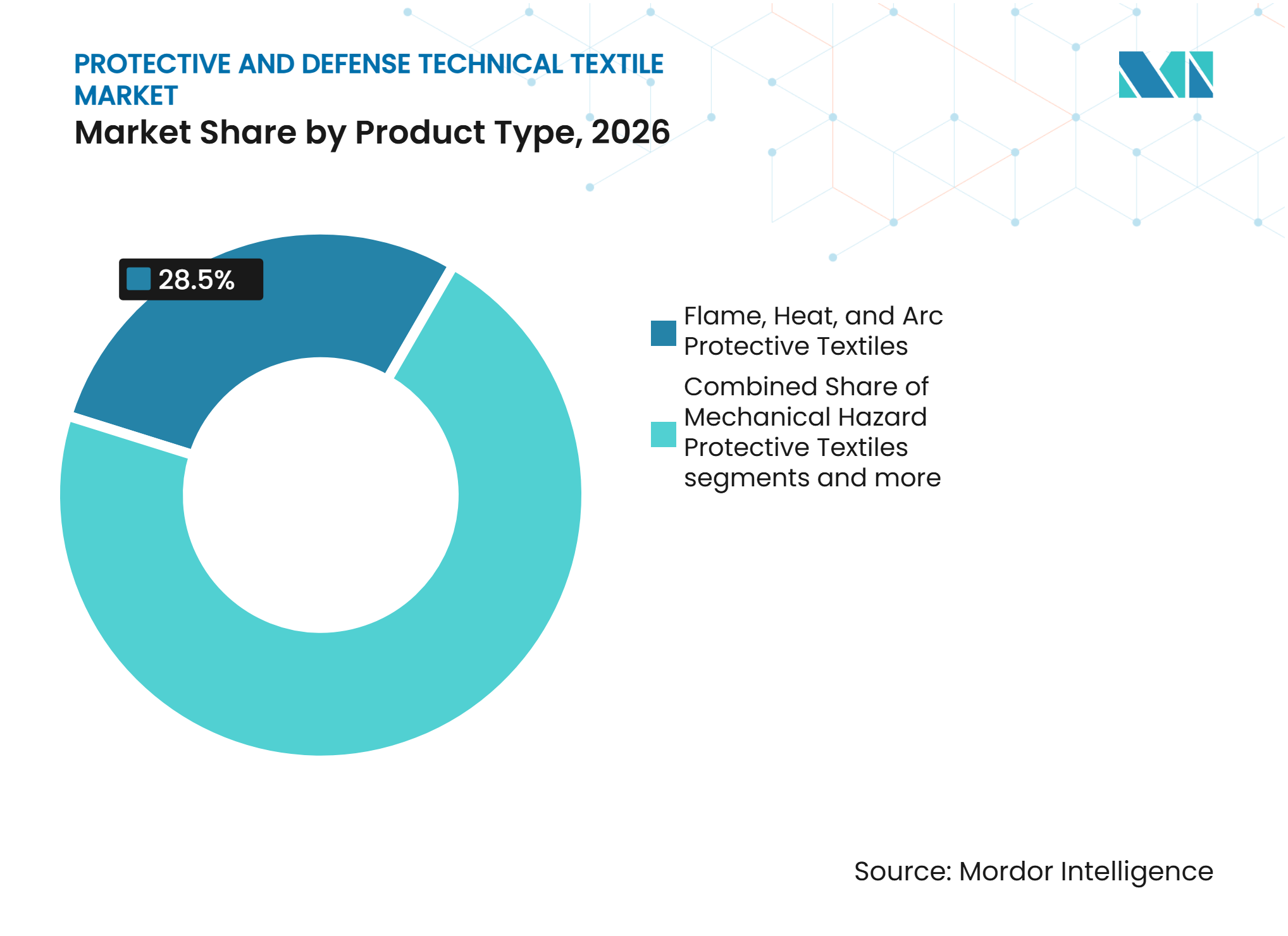
Flame Protection Leads While Ballistics ExpandsFlame, heat, and arc protective textiles held 28.5% of the protective and defense technical textile market share in 2026. Their position reflects demand from electrical utilities, oil and gas operations, industrial facilities, and firefighting services. NFPA 70E, NFPA 2112, and NFPA 1970 shape purchase requirements across these end uses. The 2025 edition of NFPA 1970 requires structural firefighting hoods to achieve 90% filtration efficiency for particles from 0.1 to 1.0 microns.
Ballistic, fragmentation, and penetration-resistant textiles are forecast to grow at an 8.8% CAGR through 2032. Demand comes from European and Asia-Pacific defense agencies that are expanding protection requirements for soldiers. The category benefits from orders for modular full-body armor and updated hard armor systems. Extreme-cold and adverse-weather protective textiles serve Arctic and high-altitude military operations. Defense signature management and specialized survivability textiles include multispectral camouflage and electromagnetic shielding applications. Chemical, biological, and CBRN protective textiles are also evolving through active decontamination materials. Milliken and Numat announced in November 2025 that they would integrate Sentinel MOF technology into protective fabrics for defense, first-responder, and industrial users.



By Material Type:
Aramid Provides Established Performance While UHMWPE Gains UseAramid fibers held 29% of the market in 2026. Meta-aramid supports flame protection, while para-aramid supports ballistic applications. Aramid has established acceptance across NFPA, ISO 11612, and military qualification frameworks. The European Defence Agency selected the REGEN project in April 2025 to develop solvent-based recycling of soft aramid layers from end-of-life body armor into new ballistic fibers. The project addresses material recovery and potential dependence on primary fiber supply. Its progress may create a circular supply route for European manufacturers in the protective and defense technical textile market.
UHMWPE is forecast to grow at a 9.2% CAGR through 2032. Its lower density compared with para-aramid supports lighter armor designs for dismounted personnel. Taiwan’s Armament Bureau allocated TWD 2.35 billion (USD 75 million) in 2025 to procure UHMWPE fiber from Honeywell and DSM brands for helmets and ballistic plates. Cotton and natural cellulosic fibers remain relevant in cost-sensitive industrial flame-protection products. Regenerated cellulosic and flame-resistant viscose support multi-hazard workwear, while polyester and polyamide support high-visibility and mechanical-protection garments. Glass, carbon, inorganic fibers, PBI, and PBO serve specialized thermal and ballistic applications.
By End-Use Application:
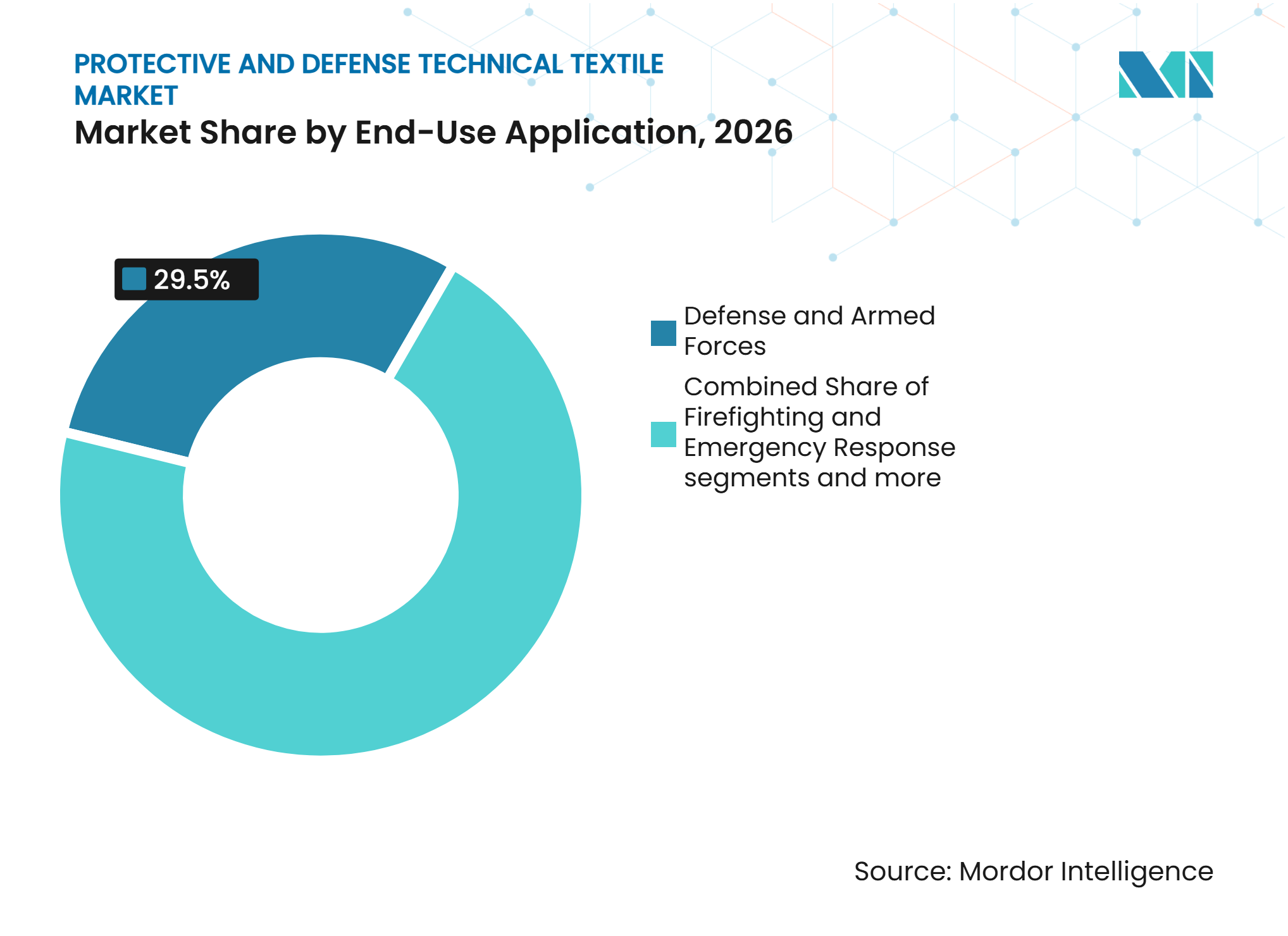
Defense Holds Both Scale and GrowthDefense and Armed Forces accounted for 29.5% of the protective and defense technical textile market size in 2026. It is also projected to expand at an 8.5% CAGR through 2032. The segment is shifting from standard uniform fabrics toward integrated soldier protection systems. India’s emergency procurement activity accelerated purchases of soldier equipment after the May 2025 conflict with Pakistan. SMPP Limited has contracts for 11,700 advanced ballistic helmets and 27,700 bulletproof jackets. These procurements show the direct link between defense readiness programs and technical textile volume demand.
Law enforcement and security services continue to require replacement ballistic vests and high-visibility workwear. Firefighting and emergency response demand is shaped by NFPA 1970-2025 particulate-blocking hood requirements and the move toward PFAS-free moisture barriers. Oil, gas, petrochemicals, chemical processing, utilities, and electrical services are core buyers of flame-resistant and arc-rated workwear. Manufacturing and industrial processing require mechanical and chemical protection as standards and employer safety programs evolve. OSHA’s proper-fit requirement supports construction, mining, and infrastructure demand. Transportation, warehousing, and logistics use high-visibility and impact-resistant protective textiles.

Geography Analysis
North America
North America held 33% of the protective and defense technical textile market size in 2026. The North American protective and defense technical textile market combines a large defense procurement base with strict workplace safety requirements. The United States Defense Logistics Agency awarded three Modular Scalable Vest contracts with combined ordering capacity of USD 450 million over three years, with first deliveries arriving in October 2025. The United StatesArmy’s 596th Transportation Brigade completed a transition to PFAS-free structural firefighting bunker gear in 2025. This adoption provides a procurement signal for municipal and military fire services. OSHA’s revised construction PPE standard is also driving replacement demand for coveralls and mechanical-protection garments. Canada’s NATO commitments and Mexico’s automotive and petrochemical industries provide additional regional demand. Regulatory influence from OSHA and NFPA remains central to supplier qualification and product selection.
Asia-Pacific
Asia-Pacific demand is supported by defense modernization and industrial safety regulation formalization. India’s military expenditure reached USD 92.1 billion in 2025, up 8.9% from the prior year. India also approved USD 4.6 billion in emergency procurement funds after the May 2025 conflict with Pakistan. Arvind’s Advanced Materials division presented domestic ballistic textile capability at Milipol India 2025, supporting the Make in India defense manufacturing program. China’s military expenditure was estimated at USD 336 billion in 2025, with spending up 7.4% year-on-year. South Korea and Japan are also expanding procurement under updated defense postures. Domestic production capability and industrial safety formalization support the protective and defense technical textile market across the region.
Europe, Middle East and Africa, and South America
The Middle East and Africa is forecast to grow at an 8.6% CAGR from 2027 to 2032, making it the fastest-growing regional segment. Europe’s military spending rose 14% to USD 864 billion in 2025. Germany, Poland, and Nordic states are accelerating ballistic and soldier-protection procurement under NATO planning. France’s 2025 National Strategic Review set a goal of an economy prepared for war by 2030, and equipment spending rose 11% to USD 21.1 billion in the supplied research. Spain allocated USD 11.8 billion to military procurement through its Industrial and Technological Plan for Security and Defence. Ireland’s Integrated Modular Body Armour Systems contract was opened to other European Union member states under the SAFE Regulation in 2025. In the Middle East and Africa, defense modernization and the oil and gas sector support military and industrial protective clothing demand. South America is supported by industrial safety compliance and law-enforcement garment programs. Chile’s 2025 tender for ballistic helmets and vests illustrates ongoing force-protection procurement within the protective and defense technical textile market.
Competitive Landscape
Market Concentration
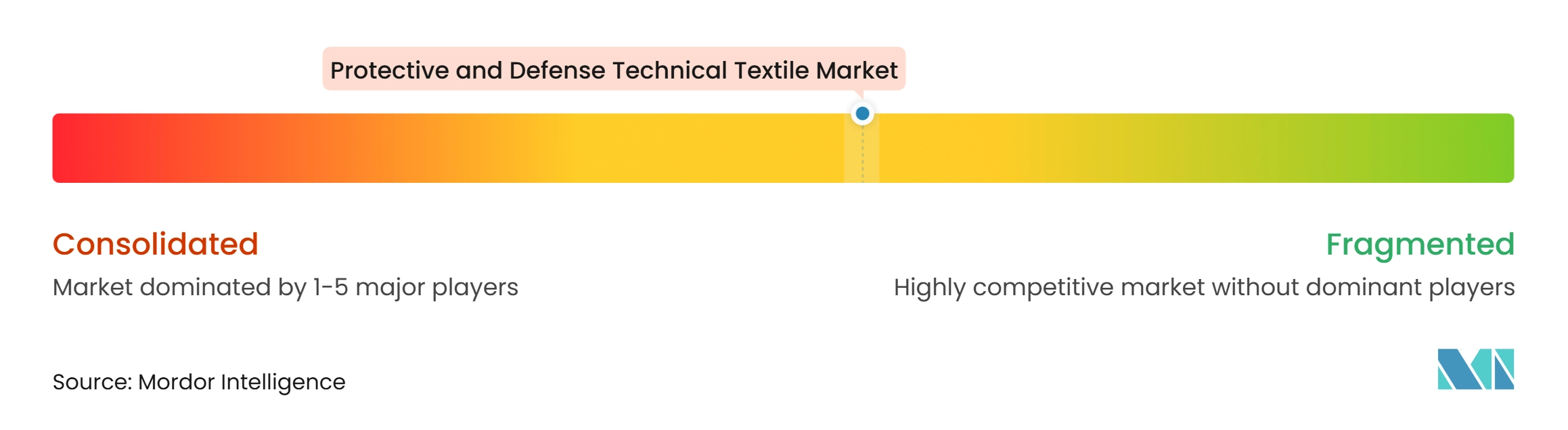
The protective and defense technical textile market exhibits a medium level of market concentration. Integrated producers compete through fiber specification, functional finishing, garment construction, and certification coverage. NFPA, EN, and NATO-related qualifications create switching costs for procurement agencies that have validated a supply chain against particular product standards. This favors suppliers that can provide consistent performance across several protective functions. It also limits price-only competition in high-risk applications. The protective and defense technical textile market therefore rewards validated products and reliable qualification support.
Milliken and Numat announced a November 2025 supply relationship to integrate MOF technology into protective fabrics manufactured in the United States. The partnership targets CBRN protection for defense, first-response, and industrial customers. DuPont launched Tyvek APX in November 2025, combining higher breathability with chemical barrier performance. The product was supported by an independent physiological study from Empa and trials involving nearly 300 participants. W. L. Gore’s GORE-TEX CROSSTECH Innovate moisture barrier was certified to the 2025 edition of NFPA 1970. These developments reflect the importance of comfort, non-PFAS formulations, and active protection functions.
The European Defence Agency’s REGEN project may change materials competition by developing recycled aramid fibers from end-of-life body armor. The United Kingdom Personal Hard Armour framework also identifies complex-curvature, covert, and buoyant ballistic plate formats as part of future requirements. These requirements create opportunities for suppliers with advanced composites and tested armor designs. Specialty certification remains particularly important for companies serving military, firefighting, and chemical-protection applications. The protective and defense technical textile industry also has scope for suppliers that can meet emerging PFAS-free specifications without reducing performance. New entrants in the protective and defense technical textile market face capital needs, material sourcing constraints, and lengthy qualification processes.
Protective and Defense Technical Textile Industry Leaders
-
Milliken & Company
-
TenCate Protective Fabrics
-
Sioen Industries NV
-
Carrington Textiles (RTS Textiles Group)
-
Klopman International
- *Disclaimer: Major Players sorted in no particular order
Protective and Defense Technical Textile Market Companies Covered in this Report
- Milliken & Company
- TenCate Protective Fabrics
- Sioen Industries NV
- Carrington Textiles (RTS Textiles Group)
- Klopman International
- IBENA Textilwerke GmbH
- Concordia Textiles NV
- Kermel SAS
- Safety Components Fabric Technologies Inc.
- W. L. Gore & Associates Inc.
- 3M Company
- The Haartz Corporation
- Barrday Inc.
- Avient Corporation (Dyneema)
- Warwick Mills
- Kusumgar Limited
- Cooneen Group
- Lakeland Industries Inc. (Lakeland Fire + Safety)
- National Safety Apparel
- Kappler Inc.
- Protective Industrial Products Inc.
- Ansell Limited
- SHOWA Group
- Superior Glove Works Ltd.
- Point Blank Enterprises Inc.
- The Safariland Group
- MKU Limited
- Mehler Systems
Recent Industry Developments in Protective and Defense Technical Textile Market
- February 2026: Avient's Dyneema® collaborated with Spanish body armor manufacturer FEDUR to supply materials for 24,000 soft ballistic vests for Spain's National Police under a four-year contract. The vests use third-generation Dyneema® SB301 unidirectional material, combining ballistic protection with reduced weight and improved wearer mobility. The material enables armor designs up to 20% lighter than alternative protective solutions.
- February 2026: Avon Protection launched the EXOSKIN-S2 high-performance CBRN protective suit for military personnel, first responders, and special forces. The suit incorporates an activated carbon fabric inner layer to protect against aerosol, vapor, liquid, and particulate chemical warfare agents. It is designed for operations lasting up to 24 hours and integrates with respirators, protective boots, gloves, and body armor.
- November 2025: Milliken & Company and Numat Technologies announced a strategic supply relationship to integrate Numat's Sentinel® MOF technology platform into Milliken's protective fabrics for defense, first-responder, and industrial customers, targeting CBRN professionals seeking non-PFAS alternatives to legacy chemical protection technologies.
- November 2025: DuPont unveiled Tyvek APX at A+A 2025 in Düsseldorf, the most advanced form of its Tyvek chemical-garment fabric, delivering enhanced breathability alongside chemical barrier performance, validated by an independent physiological study from Empa and customer trials involving nearly 300 participants.
Global Protective and Defense Technical Textile Market Report Scope
The Protective and Defense Technical Textile Market is Segmented by Product Type (Flame, Heat, and Arc Protective Textiles, Ballistic, Fragmentation, and Penetration-Resistant Textiles, and More), by Material Type (Aramid Fibers, Polyester, and More), by End-Use Application (Firefighting and Emergency Response, and More), and by Geography (North America, Europe, and More). The Market Forecasts are Provided in Terms of Value (USD).
Segmentation Overview
| Flame, Heat, and Arc Protective Textiles | Flame-Resistant and Flash Fire Protective Textiles |
| Firefighter Protective Textiles | |
| Arc-Rated Protective Textiles | |
| Welding and Molten Metal Protective Textiles | |
| Textile Fire Blankets, Welding Curtains, and Thermal Safety Barriers | |
| Ballistic, Fragmentation, and Penetration-Resistant Textiles | Ballistic Protection Fabrics and Laminates |
| Textile-Based Soft Body Armor Components and Panels | |
| Others (Textile Reinforcement for Ballistic Helmets/ Hard Armor Systems, Blast-Related Protective Textile Components, etc.) | |
| Chemical, Biological, and CBRN Protective Textiles | Chemical Protective Fabrics and Clothing |
| Biological and Particulate Barrier Protective Textiles | |
| CBRN Protective Textiles and Clothing | |
| Mechanical Hazard Protective Textiles | Cut- and Slash-Resistant Textiles |
| Puncture- and Needle-Resistant Textiles | |
| Abrasion- and Impact-Resistant Textile Components | |
| Other Mechanical Hazard Protective Textiles | |
| High-Visibility and Reflective Protective Textiles | Fluorescent High-Visibility Fabrics and Apparel |
| Retroreflective Textile Materials | |
| Combined High-Visibility Protective Textile Products | |
| Extreme-Cold and Adverse-Weather Protective Textiles | |
| Defense Signature-Management and Specialized Survivability Textiles | |
| Other Protective Technical Textiles (Antistatic and Electrostatic-Dissipative, Electromagnetic Shielding Protective, etc.) |
| Aramid Fibers |
| Ultra-High-Molecular-Weight Polyethylene |
| Cotton and Other Natural Cellulosic Fibers |
| Regenerated Cellulosic and Flame-Resistant Viscose Fibers |
| Modacrylic and Other Flame-Resistant Acrylic Fibers |
| Polyester |
| Polyamide |
| Glass, Carbon, and Other Inorganic Fibers |
| Other High-Performance Synthetic Fibers (PBI, PBO, Heat-Resistant Fibers, etc.) |
| Defense and Armed Forces | |
| Law Enforcement and Security Services | |
| Firefighting and Emergency Response | Firefighting Services |
| Hazmat and Disaster Response Services | |
| Oil, Gas, Petrochemicals, and Chemical Processing | |
| Utilities and Electrical Services | |
| Manufacturing and Industrial Processing | Metalworking, Fabrication, and Heavy Manufacturing |
| Automotive and General Manufacturing | |
| Other Industrial Processing | |
| Construction, Mining, and Infrastructure | |
| Transportation, Warehousing, and Logistics Operations | |
| Other Occupational and Institutional End Users |
| North America | United States |
| Canada | |
| Mexico | |
| Europe | Germany |
| United Kingdom | |
| France | |
| Italy | |
| Spain | |
| Belgium | |
| Netherlands | |
| Poland | |
| Sweden | |
| Türkiye | |
| Rest of Europe | |
| Asia-Pacific | China |
| India | |
| Japan | |
| South Korea | |
| Taiwan | |
| Australia | |
| Indonesia | |
| Middle East and Africa | Saudi Arabia |
| United Arab Emirates | |
| Israel | |
| South Africa | |
| Egypt | |
| Rest of Middle East and Africa | |
| South America | Brazil |
| Argentina | |
| Chile | |
| Rest of South and Central America |
| By Product Type | Flame, Heat, and Arc Protective Textiles | Flame-Resistant and Flash Fire Protective Textiles |
| Firefighter Protective Textiles | ||
| Arc-Rated Protective Textiles | ||
| Welding and Molten Metal Protective Textiles | ||
| Textile Fire Blankets, Welding Curtains, and Thermal Safety Barriers | ||
| Ballistic, Fragmentation, and Penetration-Resistant Textiles | Ballistic Protection Fabrics and Laminates | |
| Textile-Based Soft Body Armor Components and Panels | ||
| Others (Textile Reinforcement for Ballistic Helmets/ Hard Armor Systems, Blast-Related Protective Textile Components, etc.) | ||
| Chemical, Biological, and CBRN Protective Textiles | Chemical Protective Fabrics and Clothing | |
| Biological and Particulate Barrier Protective Textiles | ||
| CBRN Protective Textiles and Clothing | ||
| Mechanical Hazard Protective Textiles | Cut- and Slash-Resistant Textiles | |
| Puncture- and Needle-Resistant Textiles | ||
| Abrasion- and Impact-Resistant Textile Components | ||
| Other Mechanical Hazard Protective Textiles | ||
| High-Visibility and Reflective Protective Textiles | Fluorescent High-Visibility Fabrics and Apparel | |
| Retroreflective Textile Materials | ||
| Combined High-Visibility Protective Textile Products | ||
| Extreme-Cold and Adverse-Weather Protective Textiles | ||
| Defense Signature-Management and Specialized Survivability Textiles | ||
| Other Protective Technical Textiles (Antistatic and Electrostatic-Dissipative, Electromagnetic Shielding Protective, etc.) | ||
| By Material Type | Aramid Fibers | |
| Ultra-High-Molecular-Weight Polyethylene | ||
| Cotton and Other Natural Cellulosic Fibers | ||
| Regenerated Cellulosic and Flame-Resistant Viscose Fibers | ||
| Modacrylic and Other Flame-Resistant Acrylic Fibers | ||
| Polyester | ||
| Polyamide | ||
| Glass, Carbon, and Other Inorganic Fibers | ||
| Other High-Performance Synthetic Fibers (PBI, PBO, Heat-Resistant Fibers, etc.) | ||
| By End-Use Application | Defense and Armed Forces | |
| Law Enforcement and Security Services | ||
| Firefighting and Emergency Response | Firefighting Services | |
| Hazmat and Disaster Response Services | ||
| Oil, Gas, Petrochemicals, and Chemical Processing | ||
| Utilities and Electrical Services | ||
| Manufacturing and Industrial Processing | Metalworking, Fabrication, and Heavy Manufacturing | |
| Automotive and General Manufacturing | ||
| Other Industrial Processing | ||
| Construction, Mining, and Infrastructure | ||
| Transportation, Warehousing, and Logistics Operations | ||
| Other Occupational and Institutional End Users | ||
| By Geography | North America | United States |
| Canada | ||
| Mexico | ||
| Europe | Germany | |
| United Kingdom | ||
| France | ||
| Italy | ||
| Spain | ||
| Belgium | ||
| Netherlands | ||
| Poland | ||
| Sweden | ||
| Türkiye | ||
| Rest of Europe | ||
| Asia-Pacific | China | |
| India | ||
| Japan | ||
| South Korea | ||
| Taiwan | ||
| Australia | ||
| Indonesia | ||
| Middle East and Africa | Saudi Arabia | |
| United Arab Emirates | ||
| Israel | ||
| South Africa | ||
| Egypt | ||
| Rest of Middle East and Africa | ||
| South America | Brazil | |
| Argentina | ||
| Chile | ||
| Rest of South and Central America | ||
Key Questions Answered in the Report
What is the forecast for the protective and defense technical textile market?
The sector is projected to rise from USD 19.98 billion in 2026 to USD 29.98 billion by 2032, at a 7.00% CAGR from 2027 to 2032.
Which product category holds the largest share?
Flame, heat, and arc protective textiles held 28.5% in 2026, supported by workplace, utility, and firefighting protection requirements.
Which material is expected to grow fastest?
UHMWPE is projected to grow at a 9.2% CAGR through 2032 as defense buyers seek lighter ballistic protection systems.
What end use is growing fastest?
Defense and armed forces is expected to grow at an 8.5% CAGR through 2032 and held 29.5% in 2026.
Which region is expanding fastest?
Middle East and Africa is forecast to grow at an 8.4% CAGR through 2032, supported by military modernization and domestic defense manufacturing.
What factors limit adoption of advanced protective textiles?
High-performance fiber costs, testing and certification expenses, concentrated material supply, and lengthy military qualification cycles can delay purchasing and product adoption.