
Private CA As A Service Market Size and Share
Market Overview
| Study Period | 2020 - 2031 |
|---|---|
| Market Size (2026) | USD 1.21 Billion |
| Market Size (2031) | USD 3.07 Billion |
| Growth Rate (2026 - 2031) | 20.47 % |
| Fastest Growing Market | Asia-Pacific |
| Largest Market | North America |
| Market Concentration | Medium |
Major Players *Disclaimer: Major Players sorted in no particular order Image © Mordor Intelligence. Reuse requires attribution under CC BY 4.0. | |
Private CA As A Service Market Analysis by Mordor Intelligence
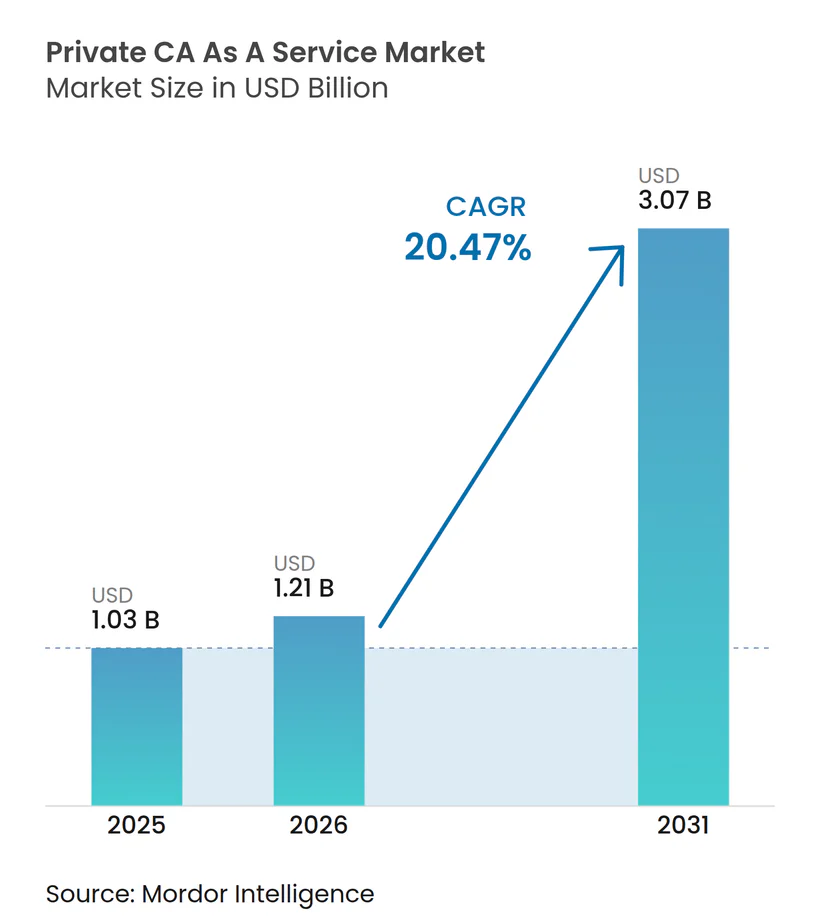
The private CA as a service market size was valued at USD 1.03 billion in 2025 and estimated to grow from USD 1.21 billion in 2026 to reach USD 3.07 billion by 2031, at a CAGR of 20.47% during the forecast period (2026-2031). Shorter public TLS certificate lifecycles are shifting certificate renewal from an occasional operational task to a continuous requirement, thereby increasing the value of automation. The private CA as a service market is also shaped by the spread of cloud workloads, service meshes, connected devices, and AI agents that need authenticated identities. Regulatory activity around post-quantum cryptography, digital identity, and cryptographic controls is increasing the importance of providers capable of operating across standards and jurisdictions. Competition is moving beyond certificate pricing toward lifecycle automation, private certificate authority operations, key management, cryptographic discovery, and integration with existing security environments. These conditions create room for providers that can combine technical depth with practical deployment support for enterprises and smaller organizations.
Key Report Takeaways
- By service offering, managed private CA and core PKI services held 47.82% of revenue in the private CA as a service market in 2025, while certificate lifecycle automation and management services are projected to expand at a 24.79% CAGR through 2031.
- By certificate and identity type, server and network infrastructure certificates accounted for 29.77% of revenue in 2025, while workload, application, and service identity certificates are projected to grow at a 23.64% CAGR through 2031.
- By organization size, large enterprises held 67.56% of the private CA as a service market revenue in 2025, while small and medium-sized enterprises is projected to record a 23.84% CAGR through 2031.
- By end user, banking, financial services, and insurance (BFSI) accounted for 32.89% of revenue in 2025, while the healthcare and life sciences industry is projected to grow at a 24.76% CAGR through 2031.
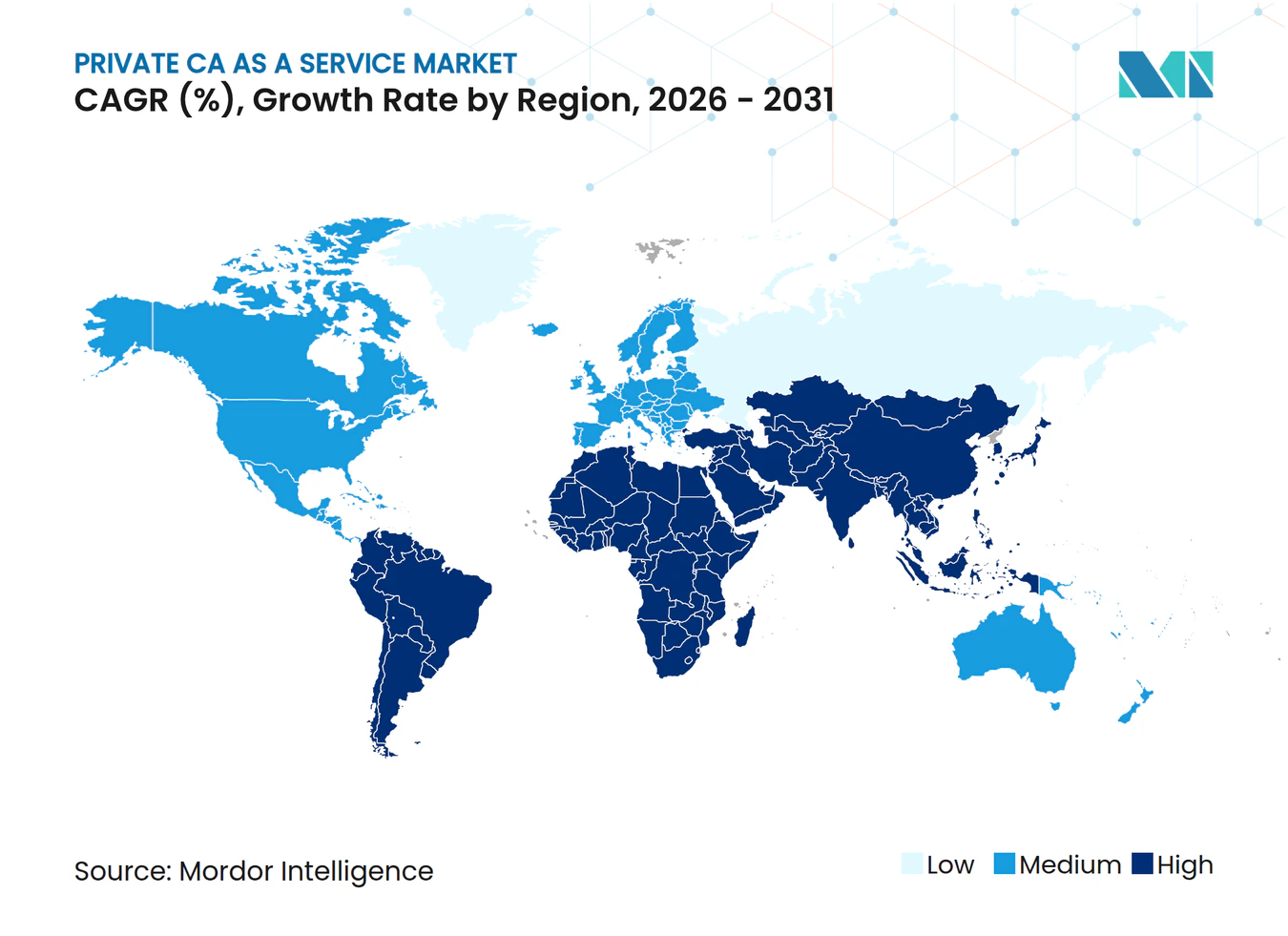
- By geography, North America held 34.78% of revenue in the private CA as a service market in 2025, while Asia-Pacific is projected to expand at a 26.51% CAGR through 2031.
Note: Market size and forecast figures in this report are generated using Mordor Intelligence’s proprietary estimation framework, updated with the latest available data and insights as of January 2026.
Market Trends and Insights
Drivers Impact Analysis of Private CA As A Service Market*
| Driver | (~) % Impact on CAGR Forecast | Geographic Relevance | Impact Timeline |
|---|---|---|---|
| Expansion of Machine and Workload Identities | +6.5% | Global, most acute in North America and Europe | Short term (≤ 2 years) |
| Zero Trust and Mutual TLS Adoption | +4.8% | North America and Europe, accelerating across Asia-Pacific | Medium term (2-4 years) |
| Cloud, Hybrid Cloud, and Kubernetes Adoption | +4.2% | Global, concentrated in North America and Asia-Pacific | Short term (≤ 2 years) |
| Regulatory Requirements for Cryptographic Governance | +3.6% | North America and Europe, with spillover to Middle East and Africa | Medium term (2-4 years) |
| Shorter Certificate Lifecycles and Continuous Renewal | +3.1% | Global | Short term (≤ 2 years) |
| Connected Product and Industrial Device Identity | +2.4% | Europe and Asia-Pacific core, with spillover to Middle East and Africa | Long term (≥ 4 years) |
| Source: Mordor Intelligence | |||
Expansion of Machine and Workload Identities
Machine identities now cover cloud workloads, containerized microservices, Kubernetes pods, IoT sensors, and AI agents. Their volumes are increasing faster than earlier certificate categories because each distributed service requires an authenticated identity and a defined process for certificate renewal, revocation, and policy validation. AI agents create a distinct challenge because they can appear across distributed environments and need short-lived credentials and policy controls. Keyfactor announced its intention to acquire Cofide in July 2026 to add verified identity capabilities for AI agents and cloud workloads. The private CA as a service market, therefore, increasingly requires governance that addresses machine identity at scale rather than focusing solely on certificate inventory.
Zero Trust and Mutual TLS Adoption
Zero-trust architectures require cryptographic proof for connections among users, services, and devices. Mutual TLS supports this model by validating both ends of a connection, which makes certificate issuance and renewal a continuous operational responsibility. HID Global reported in March 2026 that 61% of surveyed IT leaders planned to invest in PKI automation within 24 months, while 45% identified regulatory compliance as a primary business goal for PKI investment.[1] The change is important because east-west communications that once relied on network trust now require validated, time-bound credentials across applications, services, and device connections. Federal zero-trust requirements have also created procurement patterns relevant to both regulated organizations and contractors. The private CA as a service market benefits when organizations need service-mesh-scale issuance capacity but do not operate internal CA infrastructure at that scale.
Cloud, Hybrid Cloud, and Kubernetes Adoption
Cloud-native environments create certificate management demands that traditional on-premises deployments were not designed to manage. Containers can start and stop faster than conventional certificate renewal cycles, while multi-cloud environments can introduce separate CA trust anchors. HID Global found that 76% of organizations had incorporated cloud components into PKI infrastructure, although only 23% operated fully cloud-based deployments. Larger organizations often retain hybrid architectures to combine cloud flexibility with on-premises cryptographic control, local key custody, and continuity for established applications. Kubernetes workloads need frequent short-lived certificates from internal issuing authorities, which supports demand for managed private CA services. Keyfactor introduced enhanced cryptographic discovery and lifecycle automation features for multi-cloud certificate volumes in March 2026.
Regulatory Requirements for Cryptographic Governance
Post-quantum mandates, certificate validity rules, and digital identity regulation are creating a layered compliance environment. Executive Order 14412 directed federal agencies to appoint post-quantum cryptography migration leads and set December 2030 and December 2031 milestones for key establishment and digital signature systems. The order identifies NIST FIPS 203, 204, and 205 as the relevant standards for the transition. In Europe, eIDAS 2.0 requires each member state to make at least 1 European Digital Identity Wallet available by December 2026.[2] Organizations serving both jurisdictions must consider FIPS-related requirements and ETSI EN 319 expectations while aligning policies, validation practices, key operations, and audit records. The private CA as a service market favors providers capable of operating CA hierarchies and key management processes across these standards.
Restraints Impact Analysis of Private CA As A Service Market*
| Restraint | (~) % Impact on CAGR Forecast | Geographic Relevance | Impact Timeline |
|---|---|---|---|
| Shortage of PKI and Cryptographic Operations Expertise | -2.8% | Global, most acute in Asia-Pacific and Middle East and Africa | Short term (≤ 2 years) |
| Key Custody and Data Sovereignty Requirements | -1.9% | Europe and North America, with national compliance requirements in Asia-Pacific | Medium term (2-4 years) |
| Fragmented Ownership of Ephemeral Workload Identities | -1.4% | Global, concentrated in multi-cloud environments | Medium term (2-4 years) |
| CA Policy Portability and Vendor Lock-In Risk | -1% | Global | Long term (≥ 4 years) |
| Source: Mordor Intelligence | |||
Shortage of PKI and Cryptographic Operations Expertise
PKI and cryptographic operations require specialist knowledge that cannot be quickly created through general security hiring. The 2025 ISC2 Cybersecurity Workforce Study found that 59% of security professionals reported critical or significant skills needs within their teams, compared with 44% in 2024.[3] The shortage slows adoption when organizations lack staff to evaluate providers, migrate certificate authorities, define policies, manage the transition, and maintain controls post-implementation. It can also encourage larger enterprises to outsource, because they can fund managed arrangements. Smaller organizations may delay adoption if the first migration seems difficult or costly. The private CA as a service market must therefore pair technical platforms with onboarding and operational support that reduces the burden on internal teams.
Key Custody and Data Sovereignty Requirements
Root CA private key custody remains one of the most sensitive choices in a PKI design. Organizations subject to data residency, national security, and sector requirements may need keys retained in nationally compliant hardware security module infrastructure. This can conflict with shared HSM pools used in global cloud-hosted services. DigiCert reported operating 30 service instances across 5 continents in March 2026, reflecting the need to address local data residency and audit expectations. These requirements do not prevent managed services, but they direct demand toward qualified providers with local infrastructure, validated operating controls, regional support, and documented key custody processes. For classified workloads and certain national security users, managed services may remain limited to issuing CA operations rather than management of the root trust.
*Our forecasts treat driver/restraint impacts as directional, not additive. The impact forecasts reflect baseline growth, mix effects, and variable interactions.
Private CA As A Service Market Segment Analysis
By Service Offering:
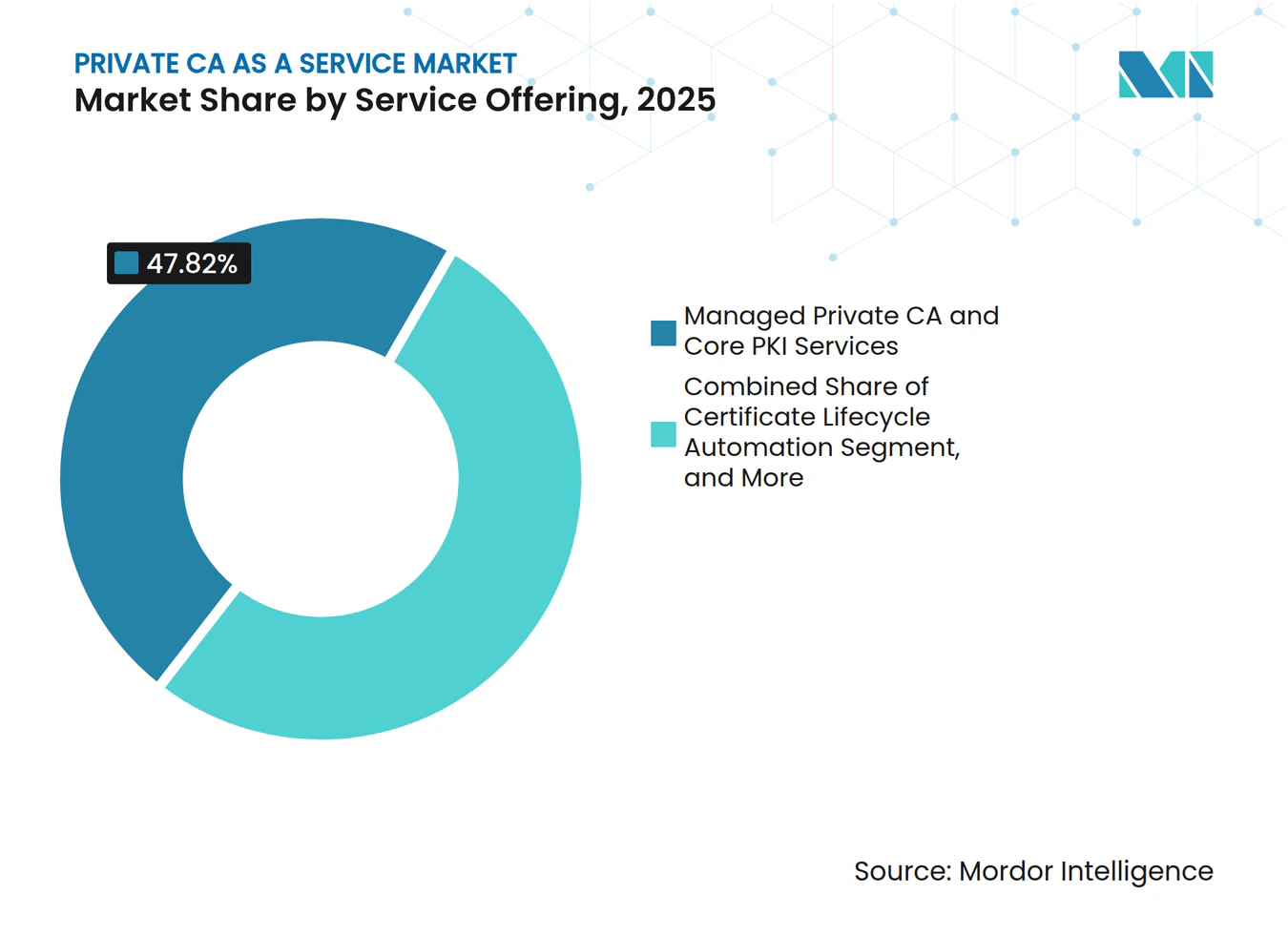
Automation Increases Demand for Integrated PKI OperationsManaged private CA and core PKI Services held 47.82% of the private CA as a service market share in 2025. The segment leads because enterprises need private certificate hierarchies without shouldering the operational burden of on-premises HSMs, CA software, continuous auditing, policy maintenance, and specialist administration. Financial services, healthcare, and government organizations need documented CA policies, dual-control key ceremonies, and audit trails. Certificate Lifecycle Automation and Management Services is projected to grow at a 24.79% CAGR through 2031. The validity reduction schedule makes manual renewal processes increasingly difficult because the maximum public TLS validity period moves to 47 days by March 2029.
Managed cryptographic Key and HSM Services gain importance as organizations prepare for post-quantum migration and new key generation under NIST FIPS 203, 204, and 205. Professional, Migration, and Integration Services also become relevant when legacy CA environments require a redesign rather than an incremental update. Microsoft states that its Active Directory Certificate Services post-quantum functionality is available in Windows Server 2025 and that planning is required for changes to certificate templates, certification authorities, and client support.[4] Enterprises are moving from separate procurement of managed CA, CLM, and HSM services toward more integrated subscriptions. This approach gives Private CA as a service market customers a common operational model for discovery, issuance, renewal, key protection, and policy control.



By Certificate and Identity Type:
Workload Certificates Change Certificate VolumesServer and network infrastructure certificates accounted for 29.77% of the private CA as a service market revenue in 2025. These certificates support web server authentication, API gateway security, load balancer termination, internal microservice communications, and trusted service access across enterprise infrastructure. Workload, Application, and Service Identity Certificates are projected to grow at a 23.64% CAGR through 2031. The expansion reflects Kubernetes service meshes, serverless functions, and AI agent environments that assign an identity to each computing unit. These private CA as a service market environments are increasing the need for automated issuance and mutual authentication.
Workload certificates differ from conventional TLS certificates because their useful life can be measured in minutes or hours. They need programmatic issuance through workflows such as SPIFFE, SPIRE, or ACME, rather than manual procurement and deployment. Enterprise Device and Endpoint Certificates continue to support device enrollment programs, while IoT and OT Device Certificates develop as a compliance-related category. The EU Cyber Resilience Act is relevant to connected product manufacturers supplying the European market from 2027, strengthening the need for formalized device identity practices. Code, Software, and Document Signing Certificates also need stronger lifecycle controls following the CA/Browser Forum's planned reduction in code signing certificate validity to 460 days, effective March 2026.[5]
By Organization Size:
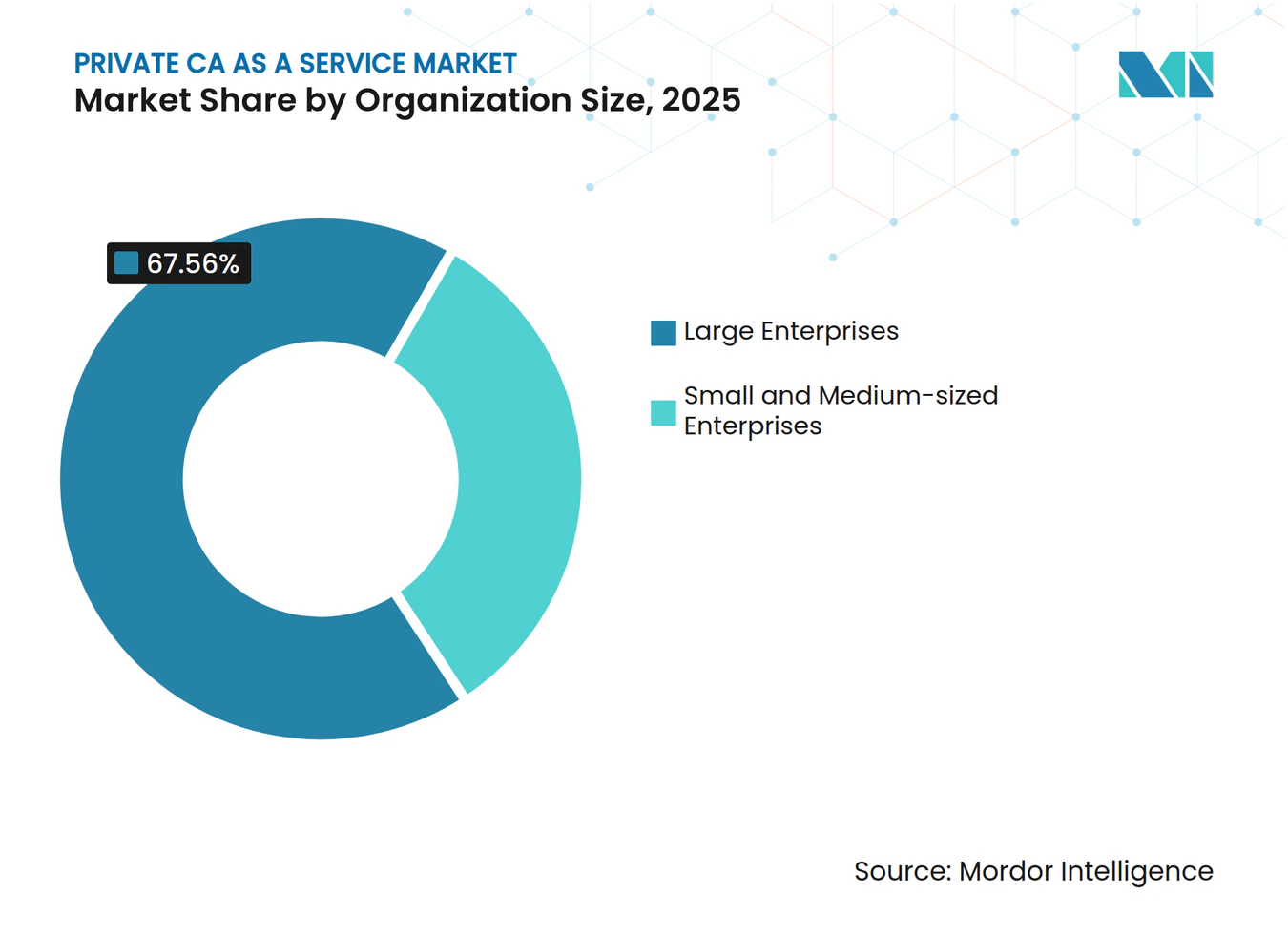
SME Adoption Broadens the Customer BaseLarge enterprises commanded 67.56% of the private CA as a service market share in 2025. Their scale of multi-cloud use, compliance budgets, and machine identity volumes makes internal management difficult without dedicated specialist teams, defined ownership, and reliable lifecycle processes. These organizations purchased CA hierarchies, HSM-backed key management, post-quantum migration planning, and professional services. Small and Medium-Sized Enterprises is projected to expand at a 23.84% CAGR through 2031. Higher renewal frequency, supply chain security requirements, and digital service obligations extend the need for certificate governance to this customer group.
GMO globalSign expanded TLS Connect to small and medium-sized enterprises in Asia-Pacific and the Middle East in August 2026, following its Western market launch in April 2026. The offering automates the deployment and renewal of public trust TLS certificates for organizations that lack deep in-house PKI expertise. OmniTrust launched an annual USD 99,000 offering for PKI and unlimited certificate management in March 2026, with complimentary CA migration services for early customers. ISO 27001, PCI DSS, HIPAA, and sector requirements can prompt small and medium-sized enterprises to seek external support when certification controls receive greater scrutiny. Private CA as a service market providers that simplify onboarding and policy setup can serve this expanding group without weakening security governance.

By End User:
BFSI Provides Scale While Healthcare Grows FasterBanking, financial services, and insurance (BFSI) accounted for 32.89% of private CA service market revenue in 2025. The segment needs strong certificate controls because payment systems, digital transactions, and cross-border compliance activities depend on continuous, authenticated services, clear trust relationships, and documented operating controls. The X9 Financial PKI production root CA signing ceremony took place in June 2025 after 7 years of planning. The development enabled DigiCert to generate PKI products for interoperability of financial services certificates under the Accredited Standards Committee X9's governance. This formal trust infrastructure supports procurement by institutions that need a qualified approach to financial services applications.
The healthcare and life sciences industry is projected to grow at a 24.76% CAGR through 2031. Electronic health record digitization, telemedicine expansion, and connected medical devices increase the number of systems requiring protected access and encrypted communication. PDS Health expanded its CyberArk deployment in May 2025 to add Zero Touch PKI and Certificate Manager across its operations, which included more than 1,000 dental and primary care practices in the United States. Government and Public Administration also adopt managed PKI services through national digital identity and zero-trust programs. Information Technology and Telecommunications uses it for API security and software supply chain integrity, while manufacturing, retail, and logistics are emerging users as certificate expectations move through supply chains.
Geography Analysis
United States Private CA As a Service Market
North America held 34.78% of the private CA as a service market share in 2025. The private CA as a service market in the United States supports demand through regulated enterprises, financial services, and federal policies on zero trust and post-quantum cryptography. Executive Order 14412 set December 2030 and December 2031 transition milestones for high-impact federal systems, with implications for covered contractors. This environment supports qualified provider selection across defense, healthcare, and critical infrastructure, where transition planning must fit existing systems, contractor relationships, and formal security requirements.
The Americas and Europe Private CA As a Service Market
North America is shifting from initial PKI deployment toward post-quantum planning, which supports higher-value professional services alongside managed CA subscriptions. Europe held the second-largest regional revenue share in 2025. eIDAS 2.0 requires member states to provide at least 1 European Digital Identity Wallet by December 2026, thereby increasing the need for PKI infrastructure that is compatible with ETSI EN 319 standards. Germany supports demand for industrial device certificates through automotive and manufacturing supply chains, while France and the United Kingdom contribute through financial services and defense procurement. South America remains at an earlier stage, with Brazil's ICP-Brasil framework and Mexico's fintech activity providing a base for financial services and government adoption.
APAC and MEA Private CA As a Service Market
Asia-Pacific is projected to grow at a 26.51% CAGR through 2031. India, China, Japan, South Korea, and Singapore each contribute through digital identity, payment, industrial IoT, smart-city, and cross-border payment programs. GMO GlobalSign's expansion of TLS Connect to small and medium-sized enterprises in the Asia-Pacific region in August 2026 reflects growing interest in accessible certificate lifecycle automation. The Middle East and Africa remain the smallest regional segments, but digital government initiatives in Saudi Arabia and the UAE support certificate-based e-government authentication. South Africa contributes to demand through financial services compliance and banking digitization.
Competitive Landscape
Market Concentration
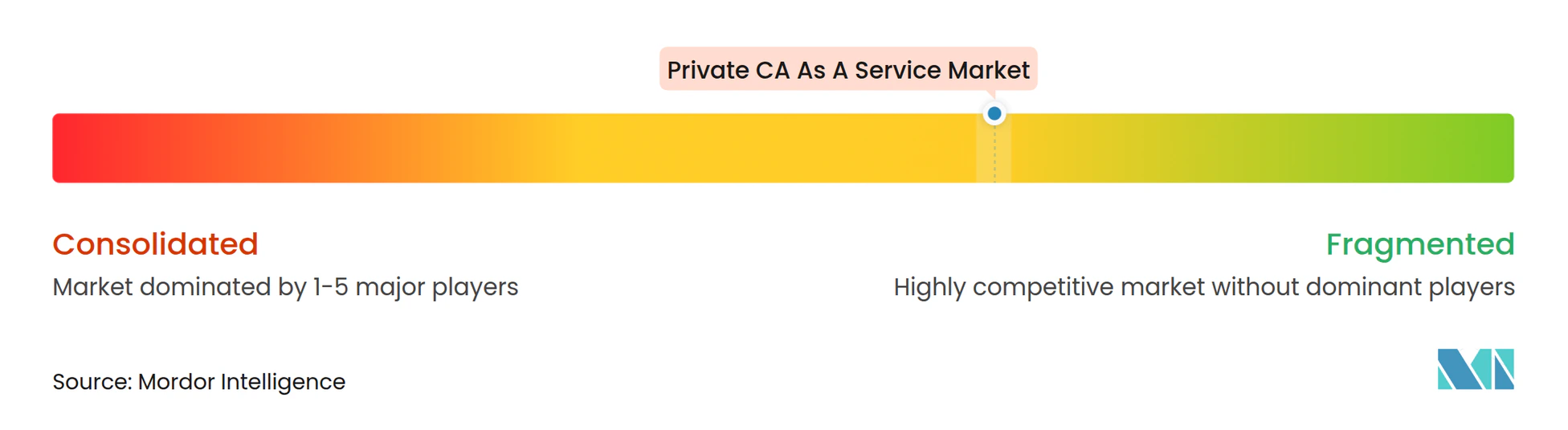
The private CA as a service market is moderately fragmented, with established providers competing through deployment flexibility, certificate lifecycle capabilities, integrations, and cryptographic management breadth. Competition is moving toward broader control planes that combine certificate lifecycle management, private CA, key management, cryptographic discovery, and post-quantum readiness. Keyfactor acquired InfoSec Global and CipherInsights in May 2025 to extend its capabilities in cryptographic posture management and discovery.[6] It received a USD 1 billion-plus strategic growth investment led by Summit Partners in July 2026 to fund product innovation, expansion, and acquisitions.
Providers are following 2 broad approaches. Others concentrate on industry-specific requirements, including financial services interoperability or industrial device identity. DigiCert's financial services work is linked to the X9 Financial PKI initiative, while Keyfactor's EJBCA platform is used in industrial IoT environments. DigiCert stated that its 2026 annual recurring revenue reached a record level across 30 service instances on 5 continents. Private CA as a service market global deployment can matter when buyers require data residency, local audit support, and consistent operating standards. WebTrust audits, ISO 27001 accreditation, and FIPS 140-2 or FIPS 140-3 HSM requirements remain practical barriers for new providers.
AI agent identity governance, post-quantum migration support, and subscription tools for smaller organizations remain key areas of competition. AppViewX launched Agent Identity Security in June 2026 to discover, govern, secure, and monitor AI agents across enterprise environments. Keyfactor launched its Trust Control Plane in June 2026 to bring machine identity management, lifecycle automation, private CA operations, and post-quantum governance into 1 model. These moves show that providers compete on non-human identity controls and changing cryptographic requirements.
Private CA As A Service Industry Leaders
-
Keyfactor, Inc.
-
DigiCert, Inc.
-
Entrust Corporation
-
Sectigo Limited
-
GMO GlobalSign Holdings K.K.
- *Disclaimer: Major Players sorted in no particular order
Private CA As A Service Market Companies Covered in this Report
- Keyfactor, Inc.
- DigiCert, Inc.
- Entrust Corporation
- Sectigo Limited
- GMO GlobalSign Holdings K.K.
- Amazon Web Services, Inc.
- Google LLC
- Microsoft Corporation
- Ascertia Limited
- AppViewX, Inc.
- Smallstep Labs, Inc.
- SSL.com, Inc.
- HID Global Corporation
- Encryption Consulting, LLC
- SecureSME Limited
- CyberArk Software Ltd.
- EverTrust SAS
- Garantir Technologies SAS
- eMudhra Limited
- WISeKey International Group AG
- SwissSign AG
- Trustwave Holdings, Inc.
- T-Systems International GmbH
- SECOM Trust Systems Co., Ltd.
- Actalis S.p.A.
Recent Industry Developments in Private CA As A Service Market
- September 2026: Newfold Digital, serving approximately 6 million customers globally across Network Solutions Group and Bluehost Group brands, selected DigiCert to modernize its SSL/TLS certificate infrastructure. The partnership was driven by the challenge of managing certificates at compressed validity periods and preparing for the long-term transition to post-quantum cryptography, representing managed PKI adoption reaching digital commerce platforms at significant customer scale.
- September 2026: Securosys and OmniTrust announced a jointly validated integration of OmniTrust PKI with Securosys Primus CyberVault HSMs and CloudHSM via the PKCS#11 interface, combining cloud-native PKI platform operations with hardware-backed key protection. The partnership directly addresses the key custody challenge that is a primary restraint on cloud-hosted managed PKI adoption in regulated industries.
- August 2026: GMO GlobalSign expanded its TLS Connect CLM automation tool to Asia-Pacific and Middle Eastern SME markets, following its April 2026 Western-market launch. The tool automates public trust TLS certificate deployment and renewal for organizations lacking in-house PKI expertise, responding to the doubled renewal volumes resulting from the March 2026 validity reduction to 200 days under CA/Browser Forum SC-081v3.
- July 2026: Keyfactor announced a USD 1 billion+ strategic growth investment led by Summit Partners, with existing investors Insight Partners and Sixth Street Growth retaining significant ownership. The investment is directed toward product innovation, geographic expansion, and strategic acquisitions in AI agent identity and post-quantum cryptographic security.
Global Private CA As A Service Market Report Scope
The private CA as a service market comprises cloud‑based and managed offerings that allow organizations to deploy and operate their own private certificate authorities (CAs) without building on-premises PKI infrastructure. Providers host and manage the CA hierarchy, HSM‑backed key storage, and signing operations, while customers define policies, certificate templates, and issuance workflows for internal use cases such as device identity, service‑to‑service TLS, and zero‑trust access.
The Private CA As A Service Market Report is Segmented by Service Offering (Managed Private CA and Core PKI Services, Certificate Lifecycle Automation and Management Services, Managed Cryptographic Key and HSM Services, and Professional, Migration and Integration Services), Certificate and Identity Type (Server and Network Infrastructure Certificates, Workload, Application and Service Identity Certificates, Enterprise Device and Endpoint Certificates, IoT and OT Device Certificates, User and Secure Email Certificates, and Code, Software and Document Signing Certificates), Organization Size (Large Enterprises, and Small and Medium-sized Enterprises), End User (Banking, Financial Services, and Insurance (BFSI), Government and Public Administration, Information Technology and Telecommunications, Healthcare and Life Sciences, and Other End Users), and Geography (North America, South America, Europe, Asia-Pacific, and Middle East and Africa). The Market Forecasts are Provided in Terms of Value (USD).
Segmentation Overview
| Managed Private CA and Core PKI Services |
| Certificate Lifecycle Automation and Management Services |
| Managed Cryptographic Key and HSM Services |
| Professional, Migration and Integration Services |
| Server and Network Infrastructure Certificates |
| Workload, Application and Service Identity Certificates |
| Enterprise Device and Endpoint Certificates |
| IoT and OT Device Certificates |
| User and Secure Email Certificates |
| Code, Software and Document Signing Certificates |
| Large Enterprises |
| Small and Medium-sized Enterprises |
| Banking, Financial Services, and Insurance (BFSI) |
| Government and Public Administration |
| Information Technology and Telecommunications |
| Healthcare and Life Sciences |
| Other End Users |
| North America | United States | |
| Canada | ||
| South America | Brazil | |
| Mexico | ||
| Rest of South America | ||
| Europe | Germany | |
| United Kingdom | ||
| France | ||
| Rest of Europe | ||
| Asia-Pacific | China | |
| Japan | ||
| India | ||
| Rest of Asia-Pacific | ||
| Middle East and Africa | Middle East | Saudi Arabia |
| United Arab Emirates | ||
| Rest of Middle East | ||
| Africa | South Africa | |
| Rest of Africa | ||
| By Service Offering | Managed Private CA and Core PKI Services | ||
| Certificate Lifecycle Automation and Management Services | |||
| Managed Cryptographic Key and HSM Services | |||
| Professional, Migration and Integration Services | |||
| By Certificate and Identity Type | Server and Network Infrastructure Certificates | ||
| Workload, Application and Service Identity Certificates | |||
| Enterprise Device and Endpoint Certificates | |||
| IoT and OT Device Certificates | |||
| User and Secure Email Certificates | |||
| Code, Software and Document Signing Certificates | |||
| By Organization Size | Large Enterprises | ||
| Small and Medium-sized Enterprises | |||
| By End User | Banking, Financial Services, and Insurance (BFSI) | ||
| Government and Public Administration | |||
| Information Technology and Telecommunications | |||
| Healthcare and Life Sciences | |||
| Other End Users | |||
| By Geography | North America | United States | |
| Canada | |||
| South America | Brazil | ||
| Mexico | |||
| Rest of South America | |||
| Europe | Germany | ||
| United Kingdom | |||
| France | |||
| Rest of Europe | |||
| Asia-Pacific | China | ||
| Japan | |||
| India | |||
| Rest of Asia-Pacific | |||
| Middle East and Africa | Middle East | Saudi Arabia | |
| United Arab Emirates | |||
| Rest of Middle East | |||
| Africa | South Africa | ||
| Rest of Africa | |||
Key Questions Answered in the Report
What is the private CA as a service market size?
The private CA as a service market size was valued at USD 1.03 billion in 2025 and estimated to grow from USD 1.21 billion in 2026 to reach USD 3.07 billion by 2031, at a CAGR of 20.47% during the forecast period (2026-2031).
What is driving demand for private CA as a services?
Shorter TLS certificate validity periods, expanding machine identities, zero trust adoption, cloud use, and post-quantum requirements are driving demand.
Which service offering leads private CA as a services?
Managed Private CA and Core PKI Services led with 47.82% of revenue in 2025.
Which end-user sector is growing fastest?
The healthcare and life sciences industry is projected to grow at a 24.76% CAGR through 2031, supported by digital health systems and connected devices.
Which region is expanding fastest?
Asia-Pacific is projected to grow at a 26.51% CAGR through 2031, supported by digital infrastructure and identity programs.
Why is certificate lifecycle automation important?
Public TLS certificate validity moved to 200 days in March 2026 and is scheduled to fall to 47 days by March 2029, making manual renewal less workable.