
Private Banking Market Size and Share
Market Overview
| Study Period | 2021 - 2032 |
|---|---|
| Market Size (2027) | USD 226.10 Billion |
| Market Size (2032) | USD 299.70 Billion |
| Growth Rate (2027 - 2032) | 5.80 % |
| Fastest Growing Market | Asia-Pacific |
| Largest Market | North America |
| Market Concentration | Low |
Major Players *Disclaimer: Major Players sorted in no particular order Image © Mordor Intelligence. Reuse requires attribution under CC BY 4.0. | |
Private Banking Market Analysis by Mordor Intelligence
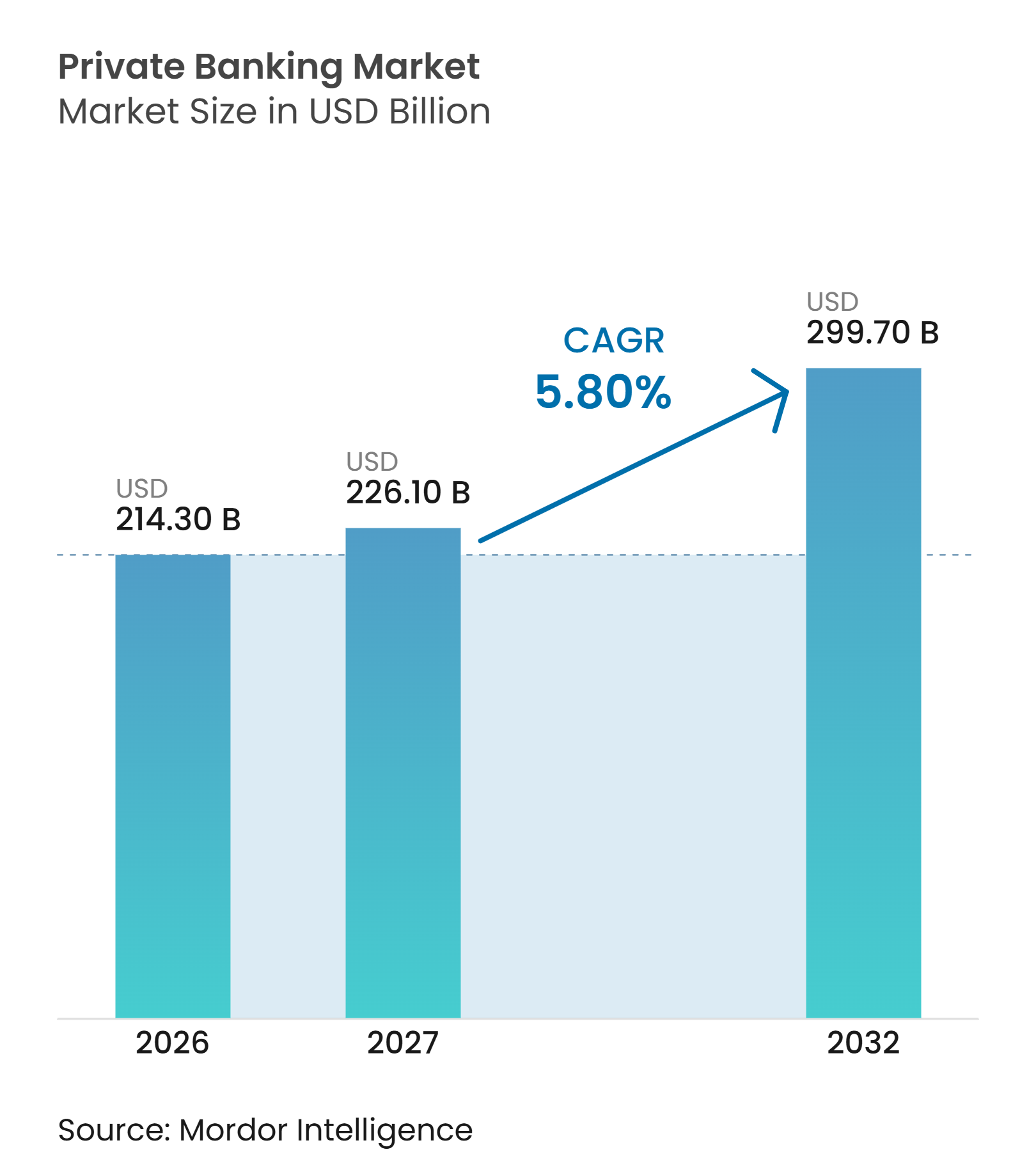
The Private Banking Market size was valued at USD 214.30 billion in 2026 and is estimated to grow from USD 226.10 billion in 2027 to reach USD 299.70 billion by 2032, at a CAGR of 5.80% during the forecast period (2027-2032).
Growth is supported by higher wealth among affluent households, wider use of tailored advisory services, and demand for lending, investment, and estate-planning support within one relationship. Clients with complex finances are increasingly seeking providers that can coordinate investment decisions, credit, fiduciary services, and family governance. This favors institutions with broad product capabilities, specialist advisory teams, and systems that support cross-border service. The private banking market also faces pressure from asset-price movements, fee sensitivity, and the rising cost of regulatory compliance.
Key Report Takeaways
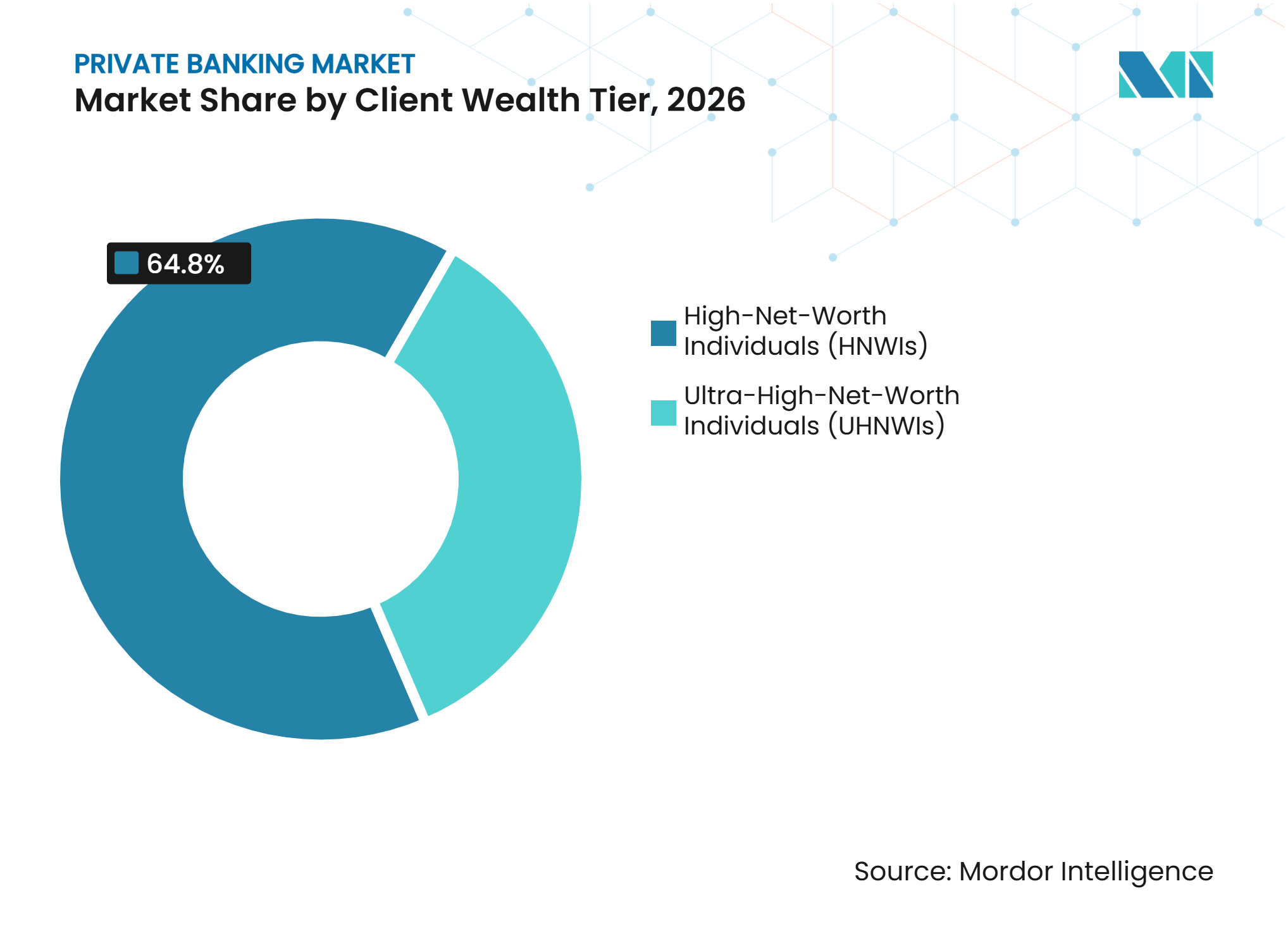
- By client wealth tier, high-net-worth individuals captured 64.8% of the private banking market share in 2026, while ultra-high-net-worth individuals are projected to grow at a 6.7% CAGR through 2032.
- By provider and institutional model, universal and commercial banks with private-banking divisions captured 45.2% of the private banking market share in 2026, while boutique and specialist private banks are projected to grow at a 6.8% CAGR through 2032.
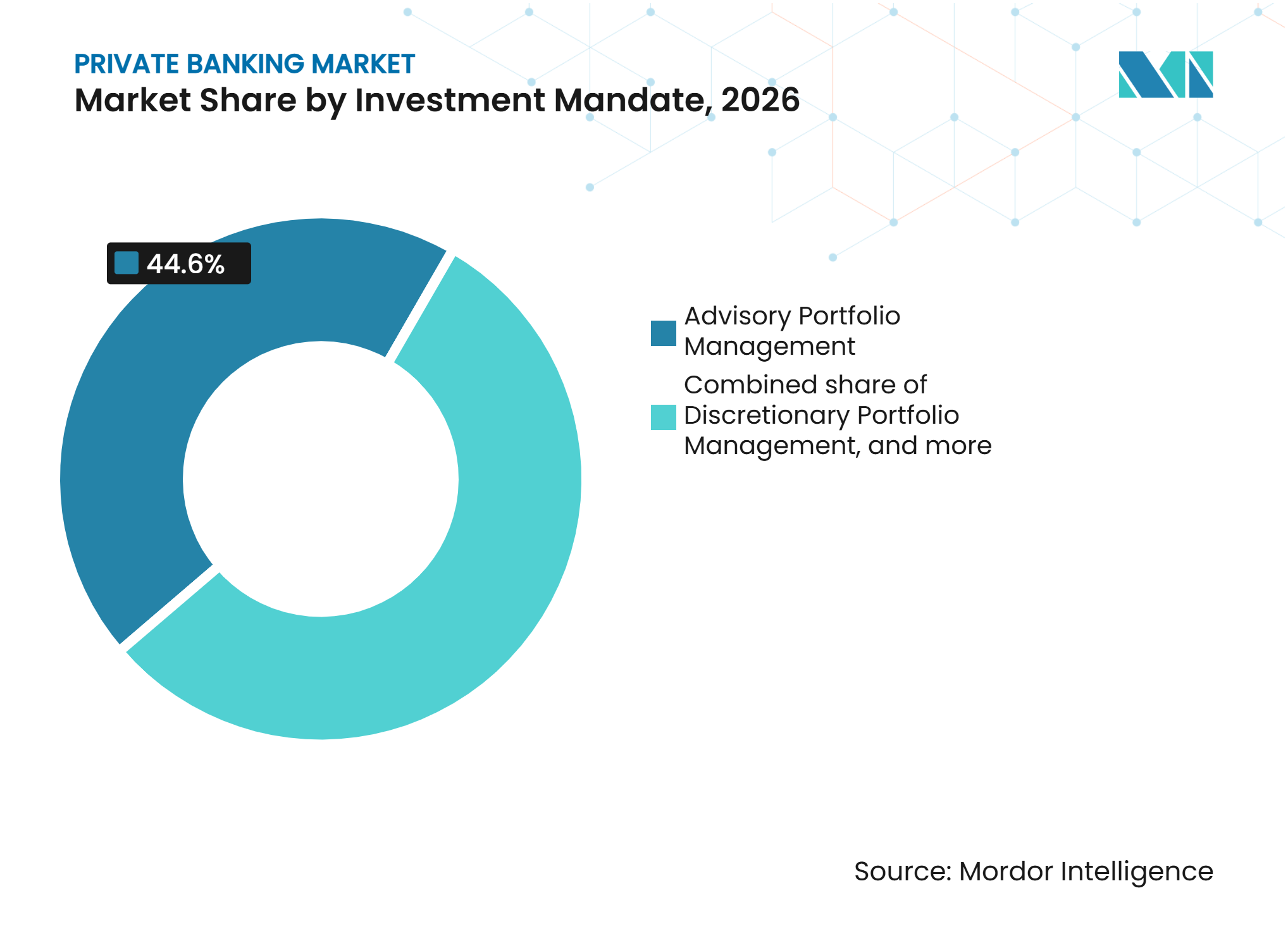
- By investment mandate, advisory portfolio management captured 44.6% of the private banking market share in 2026, while discretionary portfolio management is projected to grow at 6.5% CAGR through 2032.
- By geography, North America captured 36.1% of the private banking market share in 2026, while Asia-Pacific is projected to grow at a 7.3% CAGR through 2032.
Note: Market numbers in this report are based on Mordor Intelligence's proprietary estimation framework, which combines nine months of actuals with Q4 projections for base year 2026.
Market Trends and Insights
Drivers Impact Analysis of Private Banking Market*
| Driver | (~) % Impact on CAGR Forecast | Geographic Relevance | Impact Timeline |
|---|---|---|---|
| Growth in Global HNWI and UHNWI Population | +1.5% | Global | Short term (≤ 2 years) |
| Intergenerational Wealth Transfer and Succession Planning | +1.0% | Global, with emphasis on North America and Asia-Pacific | Medium term (2-4 years) |
| Demand for Alternative and Private-Market Investments | +0.9% | Global, strongest in Asia-Pacific and North America | Medium term (2-4 years) |
| Integrated Wealth Planning and Private Banking Services | +0.7% | North America, Europe | Medium term (2-4 years) |
| Cross-Border Private Banking and International Wealth Management | +0.8% | Asia-Pacific, including Hong Kong and Singapore, and the Middle East | Long term (≥ 4 years) |
| Lending and Bespoke Banking Solutions | +0.6% | Global, strongest in Europe and Asia-Pacific | Short term (≤ 2 years) |
| Source: Mordor Intelligence | |||
Growth in the Global HNWI and UHNWI Population
The expanding population of high-net-worth and ultra-high-net-worth clients remains a direct driver of the private banking market. Global high-net-worth wealth rose 8.7% to USD 98.3 trillion in 2025, while the millionaire population increased by nearly 2 million to 25.3 million people. Ultra-high-net-worth wealth increased 9.7% in 2025, outpacing the broader high-net-worth client group for a second consecutive year[1]. Wealth concentration also shapes revenue because a limited number of larger relationships generate a substantial part of advisory, financing, and fiduciary income. In the United States, 736,000 new millionaires were added in 2025, strengthening the client base for established advisory platforms. The private banking market benefits when providers can convert this broader wealth creation into long-term relationships rather than isolated investment transactions.
Intergenerational Wealth Transfer and Succession Planning
Wealth transfer is expanding the scope of client relationships because families need support before, during, and after assets move between generations. USD 83.5 trillion is projected to change hands by 2048, and USD 124 trillion is expected to transfer from Baby Boomers and the Silent Generation to heirs in the United States[2]. Lombard Odier reported that fewer than 1 in 4 wealthy families had a structured long-term wealth-transfer plan in place, leaving a clear advisory need. Bank of America found that 79% of ultra-high-net-worth individuals involve advisers in estate-planning discussions with heirs, while 61% are concerned about wealth affecting heirs’ motivation. Programs for next-generation education, governance, and family-office coordination can help banks retain relationships beyond the first generation. Bank of Singapore strengthened its Family Office and Wealth Advisory leadership in April 2026 to support ultra-high-net-worth clients with succession and structuring needs.
Rising Demand for Alternative and Private-Market Investments
Demand for private-market access is creating a larger role for private banks in product selection, due diligence, and portfolio construction. Barclays found that 72% of wealthy investors globally invest in private markets in 2026, compared with 50% in 2025, and 60% plan to increase allocations. Infrastructure allocations among surveyed investors rose from 22% to 27%, while 42% of current investors increased secondaries positions[3]. Hamilton Lane reported that 86% of wealth professionals planned to increase private-market allocations in 2026, citing client demand and market volatility. Curated co-investments and proprietary funds can make a provider’s offering more distinctive for clients who seek opportunities not available through open platforms. The private banking market therefore rewards firms that can combine access with careful suitability assessment and clear reporting. Fees from structuring, distribution, and alternative-investment administration are becoming more important within ultra-high-net-worth relationships.
Expansion of Cross-Border Private Banking and International Wealth Management
Cross-border activity is changing the competitive position of major booking centers and increasing the value of strong onboarding and reporting processes. Hong Kong managed USD 2.9 trillion in cross-border assets in 2025, an increase of 10.7% that was supported by mainland China inflows, initial public offerings, and equity-market gains[4]. Hong Kong and Singapore are expected to see cross-border wealth grow 12% annually over the next 5 years, compared with a 10% global rate. The Hong Kong Securities and Futures Commission reported that private banking and private wealth assets under management in Hong Kong rose 24% to HKD 12,945 billion (USD 1.66 trillion) in 2025, while net inflows grew 79% year over year. Providers need reliable know-your-customer, booking, tax-reporting, and client-service capabilities across locations to serve internationally mobile families. These operational requirements raise the value of a dual-hub model for institutions competing for ultra-high-net-worth mandates. They also make cross-border infrastructure a durable consideration in the private banking market.
Restraints Impact Analysis of Private Banking Market*
| Restraint | (~) % Impact on CAGR Forecast | Geographic Relevance | Impact Timeline |
|---|---|---|---|
| AML, KYC, Tax Transparency, and Regulatory Compliance Costs | -0.7% | Global, with the European Union and Asia-Pacific as core areas | Medium term (2-4 years) |
| Market Volatility and Asset-Price Sensitivity of Fee Income | -0.5% | Global | Short term (≤ 2 years) |
| Shortage and Rising Cost of Experienced Private Bankers | -0.3% | Asia-Pacific, Middle East | Medium term (2-4 years) |
| Complex Cross-Border Client Onboarding and Source-of-Wealth Verification | -0.2% | Europe, Asia-Pacific | Long-term (≥ 4 years) |
| Source: Mordor Intelligence | |||
Rising AML, KYC, Tax-Transparency, and Regulatory Compliance Costs
Compliance requirements are raising fixed operating costs for banks that serve wealthy clients across jurisdictions. The European Union Anti-Money Laundering Authority assumed responsibilities in January 2026 and finalized 3 regulatory technical standards in October 2026 covering customer due diligence, politically exposed person screening, and group-wide governance. Italy’s private banking association identified more than 20 active European regulatory dossiers affecting private banking in 2025 across anti-money-laundering rules, environmental, social, and governance requirements, taxation, and digital governance. Swiss Bankers Association research found that 86% of Swiss banks had fully implemented environmental, social, and governance guidelines in wealth management by March 2026. Larger organizations can spread these costs across broader revenue bases and established control systems. Smaller firms may need partnerships, technology investment, or a narrower service model to absorb the administrative burden. This cost gap can favor scale in the private banking market while preserving room for specialists with clearly differentiated expertise.
Market Volatility and Asset-Price Sensitivity of Fee Income
A significant portion of private-bank income is linked to assets under management, making advisory and management fees sensitive to market valuations. Higher equity values can lift fees without a proportional rise in the cost of serving clients, but the reverse occurs during prolonged market declines. State Street reported that only 7% of asset owners planned to reduce private-market allocations during the next 2 years, although interest-rate uncertainty and geopolitical conflict can complicate valuations and distributions for illiquid assets. This creates particular risk for providers that depend heavily on co-investment fees and carried-interest arrangements. Lending, fiduciary services, and fixed advisory retainers can provide more stable revenue when market-linked income weakens. Revenue diversification is therefore relevant to the resilience of the private banking market, not only to its growth prospects.
*Our forecasts treat driver/restraint impacts as directional, not additive. The impact forecasts reflect baseline growth, mix effects, and variable interactions.
Private Banking Market Segment Analysis
By Client Wealth Tier:
Ultra-High-Net-Worth Demand Is Reshaping Relationship EconomicsHigh-net-worth individuals held 64.8% of private banking market share in 2026, making this the largest client segment by revenue contribution. Ultra-high-net-worth individuals are projected to grow at a 6.7% CAGR through 2032, supported by faster wealth growth among the highest asset holders. This group requires more extensive coordination across investment management, lending, family governance, estate planning, and direct-investment access. Its needs are often closer to those of a family office than those of a standard advisory customer. The private banking market size for this tier is supported by relationship structures that generate higher revenue per client.
Ultra-high-net-worth clients increasingly seek consolidated reporting, private credit, co-investment opportunities, and services linked to business ownership or liquidity events. J.P. Morgan’s family-office research identifies a large wealth transfer that makes these services more relevant to families planning across generations. The Millionaires Next Door group, defined as clients with USD 1 million to USD 5 million, remains important because it represents 89.7% of the high-net-worth population. This group faces more digital competition because basic investment services can be delivered through lower-cost platforms. Providers must therefore distinguish highly tailored ultra-high-net-worth service from scalable high-net-worth advisory offerings. This separation is influencing product design, staffing, and technology spending across the private banking industry.


By Provider and Institutional Model:
Boutiques Compete on Specialization and IndependenceUniversal and commercial banks with private-banking divisions held 45.2% of the private banking market size in 2026. Their scale provides broad product access, balance-sheet lending capacity, and referrals from corporate and retail banking activities. These advantages are particularly important for entrepreneurs whose business, financing, and household needs are closely connected. HSBC Private Banking Asia is targeting entrepreneurs at several stages of their business and wealth journey, reflecting the value of integrated coverage. The model can combine investment banking, corporate finance, and private banking around a single client relationship.
Boutique and specialist private banks are projected to grow at 6.8% CAGR through 2032. Their positioning centers on independent advice, bespoke mandates, and close senior-level relationships. The Swiss Bankers Association found that 86% of Swiss banks had fully implemented environmental, social, and governance guidelines in wealth management, showing how specialized advice can become a service differentiator. Quintet Private Bank reported EUR 553 million (USD 597 million) in 2025 income and CHF 105 billion (USD 119 billion) in total client assets. Dedicated private banks focus on wealth preservation and multi-generational needs, while investment banks can use capital-markets access to support deal flow for wealthy clients. This mix of institutional models keeps the private banking market competitive even where large banks retain scale advantages.
By Investment Mandate:
Discretionary Management Gains GroundAdvisory portfolio management captured 44.6% of private banking market share in 2026, reflecting clients’ continued desire to retain final authority over investment decisions. Discretionary portfolio management is projected to grow at a 6.5% CAGR through 2032 as clients delegate asset allocation during periods of economic and market uncertainty. Delegated mandates can give relationship teams a clearer basis for managing risk, rebalancing portfolios, and coordinating complex holdings. This format is especially relevant when clients hold private assets, concentrated equity positions, or cross-border portfolios. It also allows advisers to focus discussions on objectives rather than individual transactions.
Digital tools are changing discretionary mandates by giving clients more visibility into portfolios, risk settings, and investment scenarios. Such tools can reduce the perceived trade-off between delegating decisions and maintaining oversight. The smallest mandate category, execution-only investment services, remains relevant for financially sophisticated clients who require limited advisory support. It faces direct competition from digital brokerage platforms and is not a primary growth focus for established private banks. Goal-based frameworks can differentiate discretionary offerings by connecting investment decisions to succession, philanthropy, or a planned business exit. This makes discretionary portfolio management an important source of growth within the private banking market.

Geography Analysis
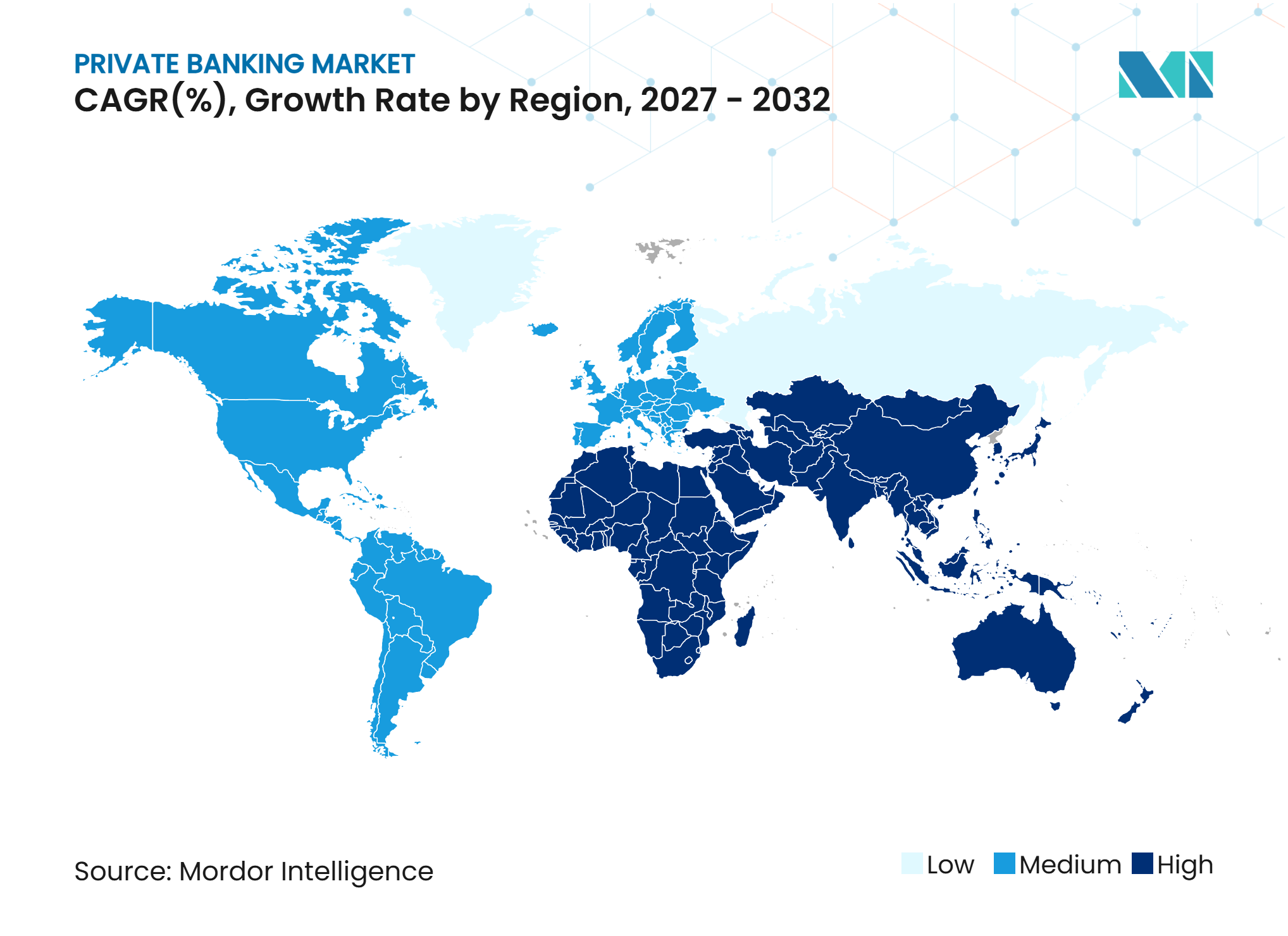
North America held 36.1% of the private banking market share in 2026. The United States benefits from deep capital markets, a mature advisory system, and a large base of affluent households. Major platforms are expanding their wealth and investment-management capabilities through scale, broad product access, and regional consolidation. PNC Financial Services announced a USD 4.1 billion acquisition of FirstBank Holding in 2025, while Fifth Third Bancorp announced a USD 10.9 billion all-stock acquisition of Comerica in the same year. These transactions illustrate how firms are seeking greater geographic reach and client-asset scale. North American assets under management are expected to reach USD 111 trillion by 2030 at a CAGR of 6.2%, with private markets expected to account for more than half of asset and wealth management revenue.
Asia-Pacific is projected to grow at a 7.3% CAGR through 2032, the fastest geographic rate in the private banking market. The region’s high-net-worth wealth increased 10.5% in 2025, supported by semiconductor-linked equity gains. Hong Kong managed USD 2.9 trillion in cross-border assets in 2025, while cross-border wealth in Hong Kong and Singapore is projected to grow 12% annually over the next 5 years. Hong Kong private banking and private wealth assets under management reached HKD 12,945 billion (USD 1.66 trillion) in 2025. Southeast Asia adds further demand through first-generation entrepreneurial wealth and new family-office formation in Indonesia, Thailand, Vietnam, and Malaysia. The United Kingdom remains relevant to internationally mobile clients through its established wealth-management and advisory ecosystem.
Europe has a substantial revenue base because of Switzerland’s historical role in cross-border private banking and the region’s established booking infrastructure. European high-net-worth wealth increased 6.5% in 2025 after declining in 2024, supported by stabilizing equity markets and easing inflation. Luxembourg’s high-net-worth population grew 13.5% in 2025, and Germany added 11.1% more millionaires. The Middle East and Africa remain smaller in size, although the United Arab Emirates recorded 11.1% cross-border wealth growth in 2025. South America is a smaller but developing opportunity, with Mexico recording 5.4% high-net-worth wealth growth in 2025. Currency and political risk in Brazil and Argentina can constrain cross-border mandate conversion.
Competitive Landscape
Market Concentration
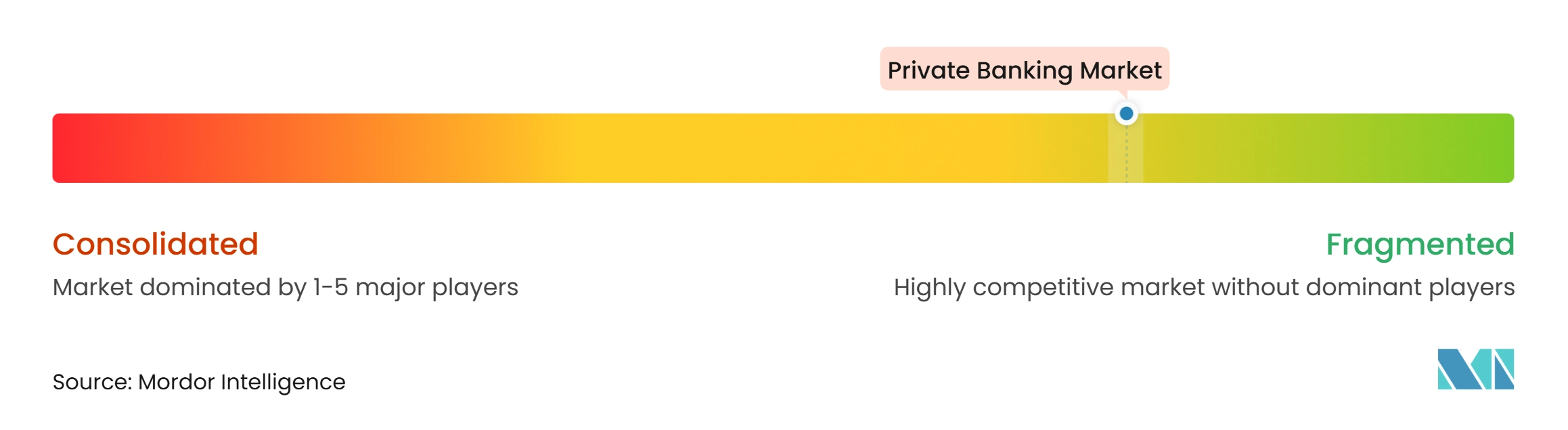
The private banking market is fragmented across boutique banks, independent asset managers, and family-office specialists. UBS, J.P. Morgan, Morgan Stanley, Bank of America, Goldman Sachs, and Citi are major franchises with broad global coverage. UBS Global Wealth Management had USD 4.5 trillion in assets under management as of the second quarter of 2025. Its Credit Suisse integration expanded its scale and supported a larger ultra-high-net-worth client base. Large institutions compete through lending capacity, capital-markets access, international booking centers, and integrated advisory models. Boutique players compete through specialization, independence, and direct access to senior advisers.
Private-market access has become a central competitive feature for the largest providers. Goldman Sachs introduced more than 40 alternative-investment fund structures in 2025, while J.P. Morgan Private Bank launched a secondary platform for clients to buy and sell positions in alternative funds. Deutsche Bank Private Bank deployed an agentic artificial intelligence solution for source-of-wealth know-your-customer processes in October 2026 to reduce administrative work and support faster onboarding. EFG International completed its acquisition of Quilvest Switzerland in July 2026, expanding its footprint in Latin America and the Middle East. These moves show how firms are combining product capability, technology, and targeted acquisitions to deepen relationships. They also show why smaller providers need a distinct client proposition rather than broad scale alone.
Regulatory investment is a further competitive consideration because large platforms can spread control costs over wider operations. The European Union Anti-Money Laundering Authority’s October 2026 standards cover customer due diligence, group-wide governance, and politically exposed person screening. Banks with established cross-border compliance infrastructure may be better positioned to absorb these requirements. Smaller institutions can respond through partnerships, technology, or concentration on selected client niches. The competitive field will therefore continue to include both large integrated platforms and focused specialists. Product quality, relationship continuity, and the ability to manage complex client needs remain central across the global private banking market.
Private Banking Industry Leaders
-
UBS Group AG
-
JPMorgan Chase & Co.
-
The Goldman Sachs Group, Inc.
-
The Bank of New York Mellon Corporation
-
BNP Paribas SA
- *Disclaimer: Major Players sorted in no particular order
Private Banking Market Companies Covered in this Report
- UBS Global Wealth Management
- The Bank of New York Mellon Corporation (BNY)
- J.P. Morgan Private Bank
- Morgan Stanley Private Wealth Management
- Goldman Sachs Private Wealth Management
- Citi Private Bank
- HSBC Global Private Banking
- Bank of America Private Bank
- BNP Paribas Wealth Management
- Julius Baer
- Deutsche Bank International Private Bank
- Pictet Wealth Management
- Lombard Odier
- Rothschild & Co Wealth Management
- LGT Private Banking
- Barclays Private Bank
- Santander Private Banking
- Société Générale Private Banking
- Indosuez Wealth Management
- EFG International
Recent Industry Developments in Private Banking Market
- October 2026: AMLA finalized 3 sets of regulatory technical standards for the private sector, covering customer due diligence thresholds, group-wide AML/CFT governance, and PEP screening. Once adopted and published in the EU Official Journal, the standards will apply 6 months after entry into force, reshaping compliance obligations for all EU-supervised private banking entities.
- October 2026: Deutsche Bank Private Bank launched an agentic artificial intelligence solution integrated into its digital know-your-customer platform to support source-of-wealth assessments, reducing administrative burden and enabling relationship managers to redirect time toward advisory activities.
- July 2026: EFG International completed the acquisition of Quilvest Switzerland, bringing total assets under management above CHF 200 billion (USD 250 billion). The transaction deepens EFG’s footprint in Latin America and the Middle East while adding CHF 3.9 billion (USD 4.9 billion) in assets under management and CHF 1.4 billion (USD 1.8 billion) in custody assets previously serving ultra-high-net-worth clients of the Bemberg family.
- February 2026: NatWest Group announced the acquisition of Evelyn Partners from funds advised by Permira and Warburg Pincus for GBP 2.7 billion (USD 3.7 billion) in enterprise value. The transaction expands NatWest’s private banking and investment-management capabilities in the United Kingdom
Global Private Banking Market Report Scope
Segmentation Overview
| High-Net-Worth Individuals (HNWIs) |
| Ultra-High-Net-Worth Individuals (UHNWIs) |
| Universal and Commercial Banks with Private-Banking Divisions |
| Dedicated / Pure-Play Private Banks |
| Investment Banks with Dedicated Private-Wealth Businesses |
| Boutique and Specialist Private Banks |
| Discretionary Portfolio Management |
| Advisory Portfolio Management |
| Execution-Only Investment Services |
| North America | United States |
| Canada | |
| Mexico | |
| South America | Brazil |
| Argentina | |
| Rest of South America | |
| Europe | United Kingdom |
| Germany | |
| France | |
| Italy | |
| Spain | |
| Rest of Europe | |
| Asia-Pacific | China |
| Japan | |
| India | |
| South Korea | |
| Australia | |
| Indonesia | |
| Thailand | |
| Malaysia | |
| Singapore | |
| Vietnam | |
| Rest of Asia-Pacific | |
| Middle East and Africa | Saudi Arabia |
| United Arab Emirates | |
| Turkey | |
| South Africa | |
| Egypt | |
| Rest of Middle East and Africa |
| By Client Wealth Tier | High-Net-Worth Individuals (HNWIs) | |
| Ultra-High-Net-Worth Individuals (UHNWIs) | ||
| By Provider / Institutional Model | Universal and Commercial Banks with Private-Banking Divisions | |
| Dedicated / Pure-Play Private Banks | ||
| Investment Banks with Dedicated Private-Wealth Businesses | ||
| Boutique and Specialist Private Banks | ||
| By Investment Mandate | Discretionary Portfolio Management | |
| Advisory Portfolio Management | ||
| Execution-Only Investment Services | ||
| By Geography | North America | United States |
| Canada | ||
| Mexico | ||
| South America | Brazil | |
| Argentina | ||
| Rest of South America | ||
| Europe | United Kingdom | |
| Germany | ||
| France | ||
| Italy | ||
| Spain | ||
| Rest of Europe | ||
| Asia-Pacific | China | |
| Japan | ||
| India | ||
| South Korea | ||
| Australia | ||
| Indonesia | ||
| Thailand | ||
| Malaysia | ||
| Singapore | ||
| Vietnam | ||
| Rest of Asia-Pacific | ||
| Middle East and Africa | Saudi Arabia | |
| United Arab Emirates | ||
| Turkey | ||
| South Africa | ||
| Egypt | ||
| Rest of Middle East and Africa | ||
Key Questions Answered in the Report
What is the projected growth rate for private banking through 2032?
The private banking market is projected to grow at a CAGR of 5.8% between 2027 and 2032, rising from USD 214.3 billion in 2026 to USD 299.7 billion by 2032.
Which client group leads private banking revenue?
High-Net-Worth Individuals held 64.8% share in 2026, while Ultra-High-Net-Worth Individuals are projected to grow at 6.7% CAGR through 2032.
Why are private-market investments important to private banks?
Wealthy clients are increasing allocations to private markets, creating demand for curated access, due diligence, portfolio construction, and ongoing reporting.
Which provider model is growing most quickly?
Boutique and Specialist Private Banks are projected to grow at 6.8% CAGR through 2032, supported by demand for bespoke mandates and independent advice.
Which region has the strongest projected growth?
Asia-Pacific is projected to grow at 7.3% CAGR through 2032, supported by expanding wealth, cross-border activity, and family-office formation.
What are the main operational challenges for private banks?
The main challenges are regulatory compliance costs, know-your-customer and source-of-wealth requirements, asset-price sensitivity of fee income, and competition for experienced bankers.