
Prepaid Card Market Size and Share
Market Overview
| Study Period | 2021 - 2032 |
|---|---|
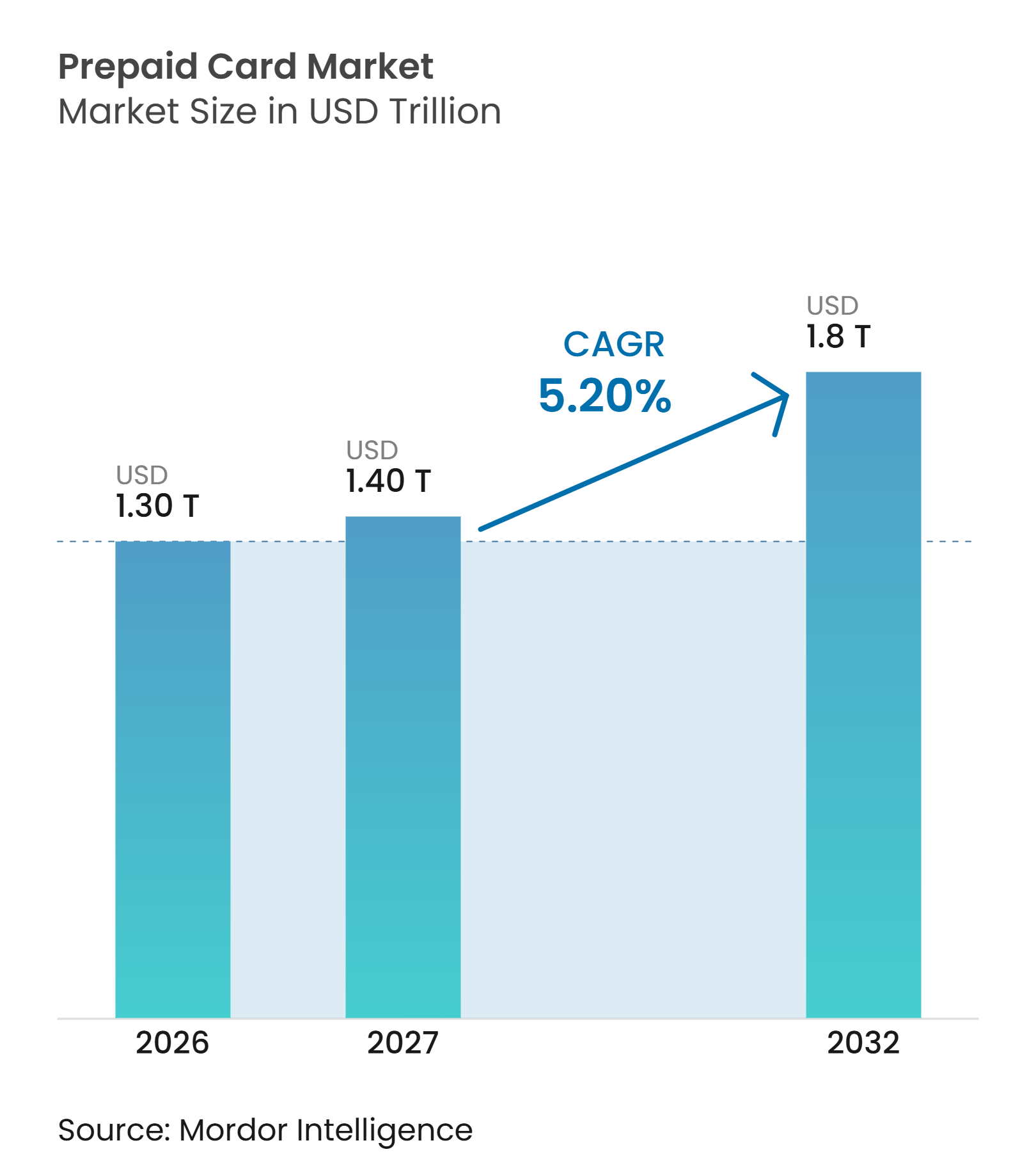
| Market Size (2027) | USD 1.40 Trillion |
| Market Size (2032) | USD 1.8 Trillion |
| Growth Rate (2027 - 2032) | 5.20 % |
| Fastest Growing Market | Asia-Pacific |
| Largest Market | North America |
| Market Concentration | Low |
Major Players *Disclaimer: Major Players sorted in no particular order Image © Mordor Intelligence. Reuse requires attribution under CC BY 4.0. | |
Prepaid Card Market Analysis by Mordor Intelligence
The Prepaid Card Market size is expected to increase from USD 1.30 trillion in 2026 to USD 1.40 trillion in 2027 and reach USD 1.8 trillion by 2032, growing at a CAGR of 5.20% over 2027-2032.
The prepaid card market is supported by the move from cash and paper-based payments toward digital credentials that can be issued and funded quickly. Government benefit programs, payroll use, and digital wallet access broaden the role of prepaid products beyond retail gift cards. Corporate programs are also using virtual cards for employee expenses, supplier payments, incentives, and reimbursements. The United States Department of the Treasury ended paper checks for most federal payments on September 30, 2025, directing people without bank accounts toward Direct Express and other electronic options. The prepaid card market faces pressure from fraud, compliance costs, and real-time account-to-account payment systems, while financial inclusion and card-as-a-service platforms continue to create opportunities.
Key Report Takeaways
- By card type, open-loop prepaid cards captured 69.8% of the prepaid card market share in 2026 and are projected to grow at a 5.8% CAGR through 2032.
- By card format, physical cards accounted for 75.6% of the prepaid card market share in 2026, while virtual cards are projected to grow at 13.5% CAGR through 2032.
- By reloadability, reloadable cards captured 68.3% of the prepaid card market share in 2026, while non-reloadable cards are projected to grow at 6.5% CAGR through 2032.
- By usage, general-purpose cards accounted for 32.5% of the prepaid card market share in 2026, while travel and foreign currency cards are projected to grow at 8.5% CAGR through 2032.
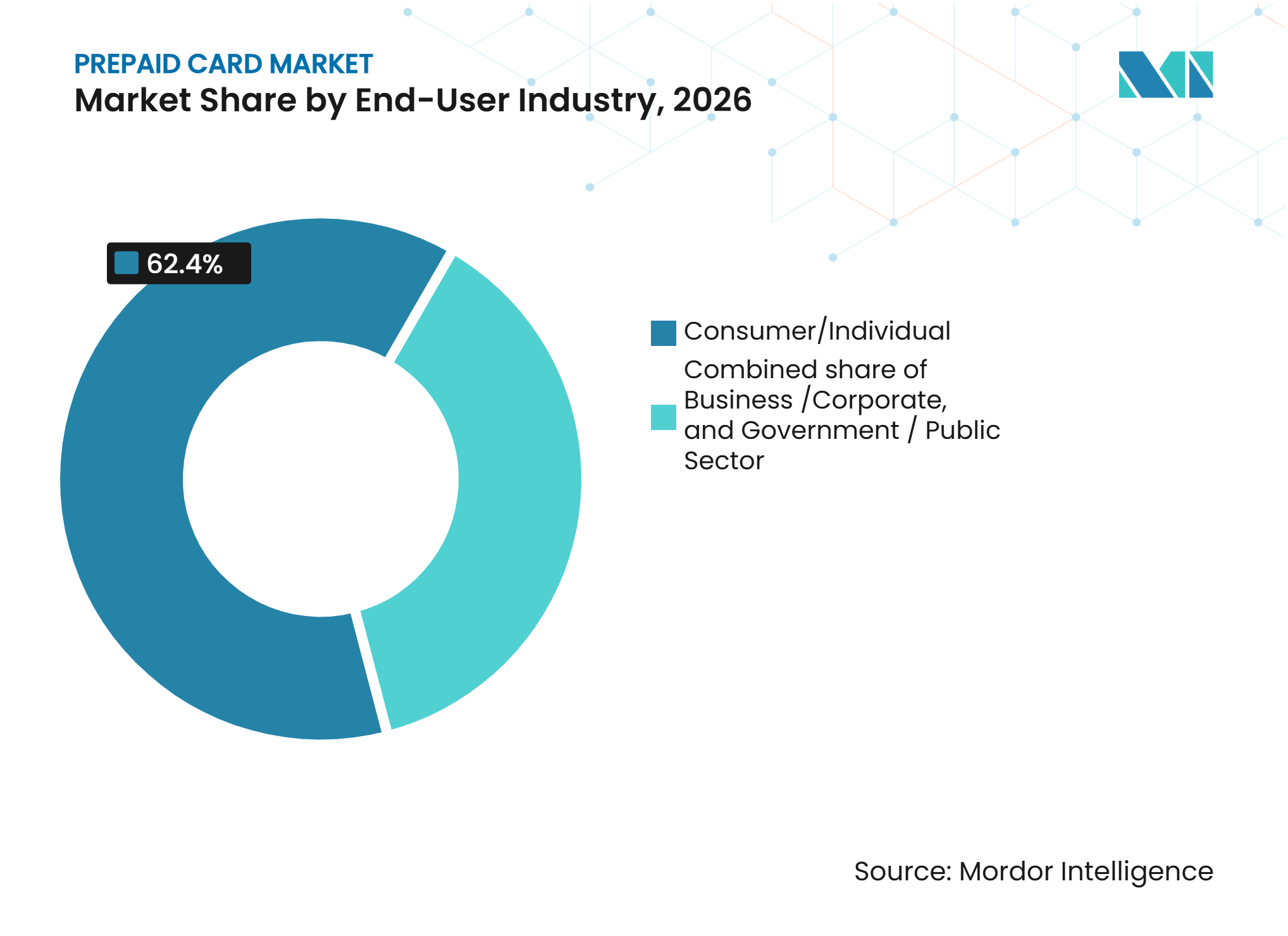
- By customer type, consumer and individual cardholders held 62.4% of the prepaid card market share in 2026, while business and corporate customers are projected to grow at 7.8% CAGR through 2032.
- By distribution channel, banks and financial institutions held 42.4% of the prepaid card market share in 2026, while online and mobile application channels are projected to grow at 11.8% CAGR through 2032.
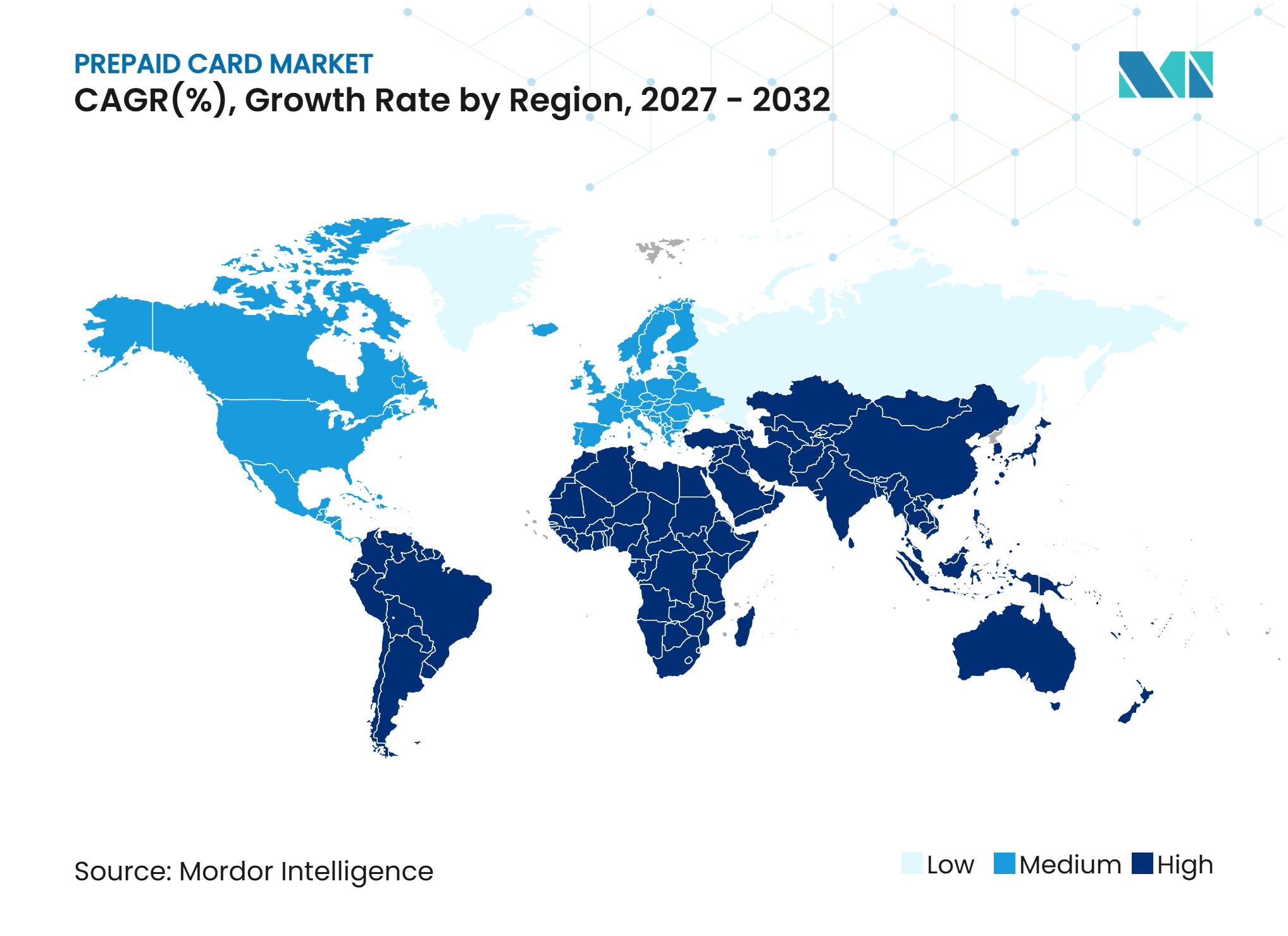
- By geography, North America captured 36.6% of the prepaid card market share in 2026, while Asia-Pacific is projected to grow at an 8.3% CAGR through 2032.
Note: Market numbers in this report are based on Mordor Intelligence's proprietary estimation framework, which combines nine months of actuals with Q4 projections for base year 2026.
Market Trends and Insights
Drivers Impact Analysis of Prepaid Card Market*
| Driver | (~) % Impact on CAGR Forecast | Geographic Relevance | Impact Timeline |
|---|---|---|---|
| Expansion of Cashless Payments and Digital Commerce | +1.2% | Global | Short term (≤ 2 years) |
| Growth of Virtual Prepaid Cards and Mobile Wallet Integration | +1.1% | North America, Europe, Asia-Pacific | Short term (≤ 2 years) |
| Rising Adoption of Payroll Cards and Government Benefit Disbursements | +0.8% | North America, Asia-Pacific, Middle East and Africa, South America | Medium term (2-4 years) |
| Increasing Corporate Spending Digitization and Expense Management | +0.7% | North America, Europe | Medium term (2-4 years) |
| Financial Inclusion and Access to Payments for Underbanked Consumers | +0.5% | Middle East and Africa, Asia-Pacific, South America | Long term (≥ 4 years) |
| Embedded Finance and Card-as-a-Service Adoption | +0.4% | North America, Europe, Asia-Pacific | Medium term (2-4 years) |
| Source: Mordor Intelligence | |||
Expansion of Cashless Payments and Digital Commerce
The prepaid card market benefits as consumers and businesses use digital payment credentials for a wider range of purchases. Prepaid cards let users separate spending purposes and manage funds without a conventional bank account or credit approval. Wallet providers have made it easier to retain several cards within one device, which supports purpose-specific products for travel, benefits, incentives, and daily spending. In the United States, the continued use of card-based payment options gives issuers a large installed base for linking prepaid products with mobile wallets. This environment supports products that combine a digital credential with a physical card for users who still need in-store cash access. It also allows issuers to connect a single payment program with retail, online, and mobile wallet acceptance. The prepaid card market also benefits when merchants and public agencies replace manual payment methods with electronic disbursement.
Growth of Virtual Prepaid Cards and Mobile Wallet Integration
Virtual card programs are becoming a central part of the prepaid card market because cards can be provisioned without printing or mailing a physical product. Onbe expanded its Send to Wallet service to the United Kingdom and European markets in May 2025, allowing recipients to add virtual cards to Google Pay and Samsung Pay in one step[1]. Edenred Payment Solutions introduced web push provisioning that enables a cardholder to add a virtual card to Apple Pay or Google Pay through a web link[2]. Faster activation gives issuers more time to capture early spending that may otherwise be lost before a physical card arrives. This also reduces the delivery dependency that can delay access to funds in time-sensitive payout programs. Mobile wallet integration also supports cards used for contractor payments, rebates, insurance settlements, and employee benefits. The prepaid card market therefore gives software platforms a way to offer payments without building a full banking product.
Rising Adoption of Payroll Cards and Government Benefit Disbursements
Payroll and government benefit programs support recurring prepaid card usage by loading wages or benefit payments directly onto eligible payment cards. In the United States, the Department of the Treasury announced that paper checks would be phased out for most federal payments effective September 30, 2025, while retaining electronic alternatives, including Direct Express for recipients without bank accounts[3]. In September 2025, Fifth Third Bank was appointed financial agent for the five-year Direct Express program, which served approximately 3.4 million Americans receiving monthly federal benefits. The program provides a recurring source of prepaid debit card transactions and offers opportunities to expand digital access, digital wallet integration, cardless ATM access, and bill payment services. These developments support prepaid card adoption by improving access to electronically disbursed funds, particularly among recipients who do not use traditional bank accounts.
Increasing Corporate Spending Digitization and Expense Management
The digitization of corporate payments is expanding demand for card-based tools that help businesses control spending, manage employee expenses, and reconcile transactions. Marqeta reported total processing volume of USD 383 billion in 2025, an increase of 31% from 2024, reflecting growth across the card programs supported by its platform[4]. Virtual cards can help finance teams establish transaction limits, restrict spending by merchant or use case, and integrate payment records into expense-management and accounting workflows. These capabilities can support supplier payments, employee purchases, contractor payouts, and other controlled business expenditures. However, virtual cards may be funded through credit, debit, or other commercial payment arrangements and are not necessarily prepaid products. Consequently, corporate spending digitization is a relevant market driver, but its contribution to prepaid card growth depends on the extent to which businesses adopt prepaid-funded cards and accounts rather than other card types.
Restraints Impact Analysis of Prepaid Card Market*
| Restraint | (~) % Impact on CAGR Forecast | Geographic Relevance | Impact Timeline |
|---|---|---|---|
| Regulatory Compliance Costs and AML/KYC Requirements | -0.8% | Global, with acute pressure in Europe, India, Australia, China | Short term (≤ 2 years) |
| Payment Fraud, Account Takeover and Unauthorized Transactions | -0.7% | Global | Short term (≤ 2 years) |
| Dependence on Sponsor Banks, Card Networks and Issuing Infrastructure | -0.5% | North America, Europe | Medium term (2-4 years) |
| Fee Sensitivity and Competition from Account-to-Account Payments | -0.4% | South America, India, Europe | Long term (≥ 4 years) |
| Source: Mordor Intelligence | |||
Regulatory Compliance Costs and AML/KYC Requirements
Compliance costs can limit the ability of smaller providers to enter the prepaid card market. General-purpose reloadable cards require identity checks, transaction monitoring, and suspicious-activity reporting, while low-value and single-purpose products may face less extensive obligations. The Reserve Bank of India updated its directions for prepaid payment instrument issuers in November 2025 to align Know Your Customer requirements with its 2025 Commercial Banks KYC Directions. Australia also introduced anti-money-laundering requirements for gift card issuers that require documented risk controls and domestic-use measures. A provider operating in the United States, Europe, and India must manage different regulatory requirements and operating processes. Larger issuers can spread compliance investment across more cardholders, while smaller program managers may face higher costs per card.
Payment Fraud, Account Takeover and Unauthorized Transactions
Fraud creates a material operational risk for the prepaid card market, especially when cards are issued and added to a wallet in a short period. Cifas recorded more than 78,000 account-takeover cases in the United Kingdom during 2025, 6% above 2024, and reported more than 106,000 misuse-of-facility cases. BioCatch reported a 55% increase in fraud linked to remote-access tools in the first half of 2025, with digital card features among the areas exposed to account takeover. Issuers need transaction monitoring, device checks, and authentication measures that match the speed of virtual provisioning. These safeguards can raise operating costs and make onboarding less convenient for users. Providers that contain fraud effectively can strengthen their position with banks, corporate clients, and public agencies.
*Our forecasts treat driver/restraint impacts as directional, not additive. The impact forecasts reflect baseline growth, mix effects, and variable interactions.
Prepaid Card Market Segment Analysis
By Card Type:
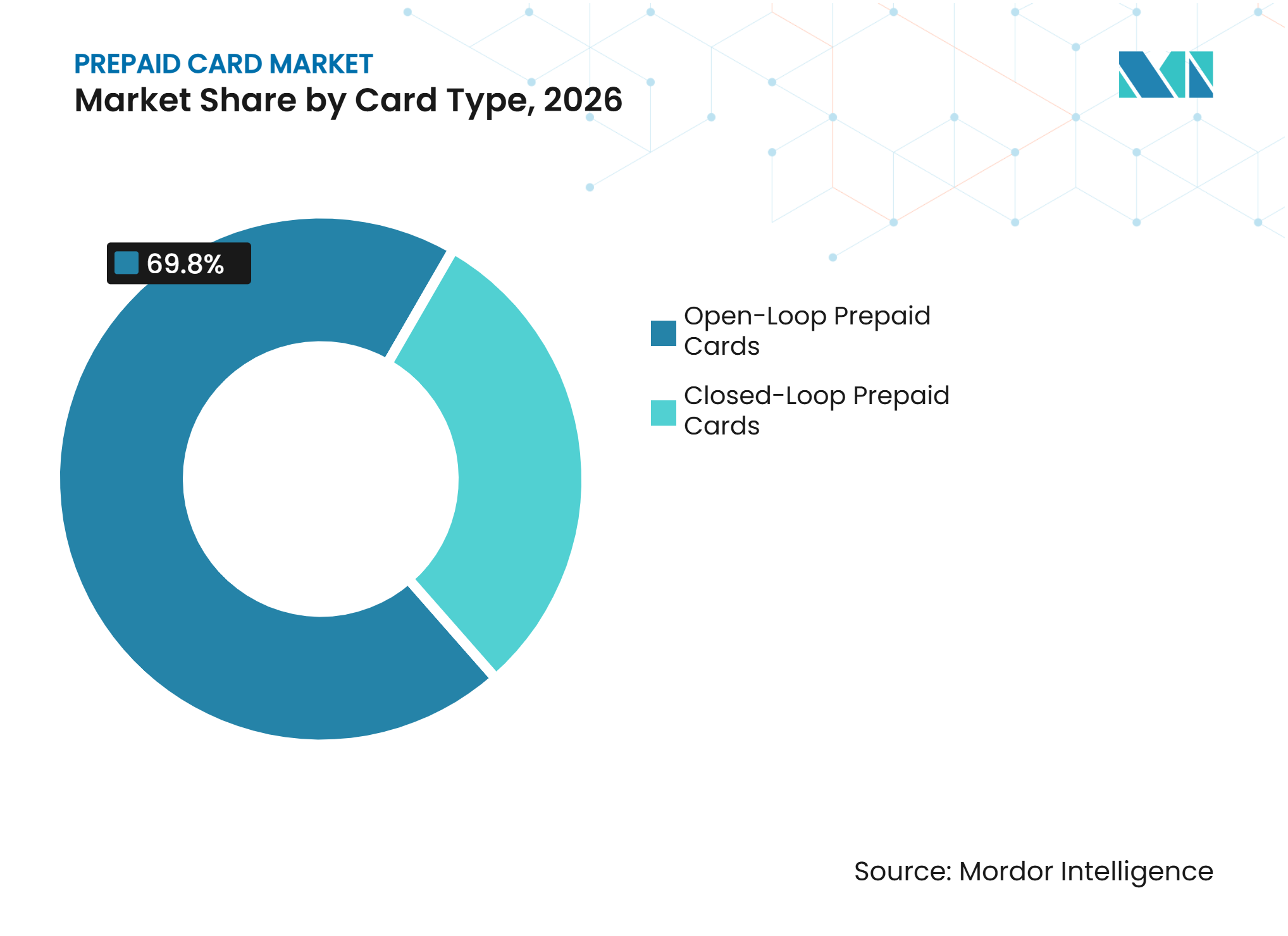
Open-Loop Networks Hold the Broadest AcceptanceOpen-loop cards accounted for 69.8% of the prepaid card market share in 2026 and are projected to grow at a 5.8% CAGR through 2032. Its leading position reflects acceptance across Visa and Mastercard networks, enabling cardholders to use them at a broad range of merchants. Payroll providers and public benefit programs favor open-loop products because recipients need to use funds for essential purchases across multiple locations. The prepaid card industry uses these payment rails to support both government benefit credentials and virtual cards for controlled business purchases. Closed-loop cards remain relevant for retail gift programs, transit systems, and high-control environments where issuers need to restrict where cardholders can spend balances. However, their limited merchant acceptance constrains their addressable use cases compared with open-loop products.
Tokenized credentials that can be added to mobile wallets also support open-loop card growth. A virtual card number for a business transaction can operate on the same network infrastructure as a card issued for a public benefit program. Consumer protection requirements in the United States and Europe can increase costs for open-loop programs; however, established issuers have integrated these obligations into their operating models. In January 2026, Blackhawk Network introduced Drive and Grocery prepaid Mastercard products through Sunrise Banks, combining category-specific spending controls with open-network acceptance. This approach demonstrates how a program can maintain defined spending purposes while providing a broader payment experience. The prepaid card market offers scope for both network-wide acceptance and products designed around specific merchant categories.


By Card Format:
Physical Cards Lead While Virtual Cards Grow FasterPhysical cards held 75.6% of the prepaid card market share in 2026, while virtual cards are projected to grow at a CAGR of 13.5% from 2027 to 2032. Physical cards remain important for benefit payments, retail gift card displays, and users with limited smartphone access. They also provide cardholders with a familiar method to access balances at ATMs or retail locations. The prepaid card market for virtual cards is projected to expand as issuers can rapidly create credentials and make them available through mobile wallets. Virtual issuance eliminates printing and delivery steps and supports immediate payments. Businesses also use virtual card numbers for single-use supplier payments and contractor disbursements.
The market is increasingly differentiating between virtual-first programs for digital commerce and business payments and combined physical and virtual programs for payroll and public benefits. This structure recognizes that many users still require physical access even as they adopt digital payment tools. Digital wallets and cardless cash features can reduce dependence on physical cards for certain transactions. At the same time, providers can position physical issuance as an optional service rather than the default for every account. This approach helps providers manage issuance costs while maintaining accessibility for users who prefer tangible cards. The prepaid card market will continue to require both formats, as access to smartphones and payment infrastructure varies significantly across users and regions.
By Reloadability:
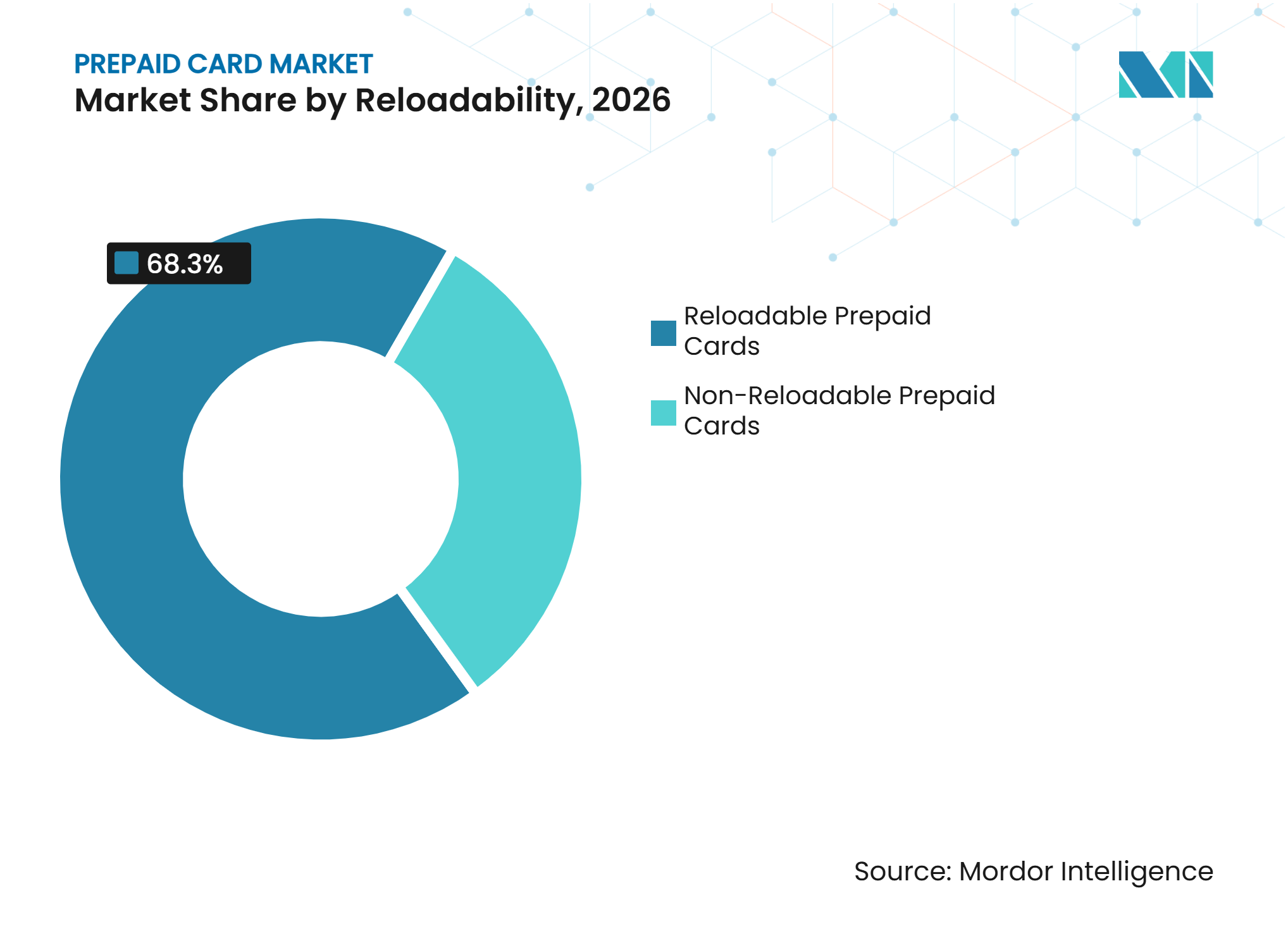
Recurring Loads Support Reloadable CardsReloadable prepaid cards accounted for a 68.3% share of the prepaid card market in 2026, supported by their suitability for recurring disbursements, ongoing expense management, and repeated consumer spending. Employers, government agencies, financial institutions, and benefit program administrators drive adoption by requiring mechanisms to distribute funds at regular intervals without issuing new cards for each payment cycle. Payroll disbursements, social benefits, pension payments, healthcare allowances, and corporate expense programs generate sustained demand for cards that support multiple funding transactions. Reloadable products also enable cardholders to retain the same payment instrument across successive funding cycles, supporting continuity in spending and account management. Additionally, the ability to adjust loaded balances according to changing payment requirements makes these cards suitable for both individual users and institutional payment programs.
Non-reloadable prepaid cards are projected to grow at a CAGR of 6.5% during 2027-2032, driven by demand for controlled-value payments, promotional incentives, corporate rewards, gift cards, and one-time disbursements. Businesses increasingly use these products for employee recognition, customer acquisition campaigns, loyalty rewards, and promotional reimbursements, where a predefined payment amount is preferable to maintaining an ongoing funding facility. Their limited funding functionality also helps organizations establish spending limits and manage the financial exposure associated with individual payout programs. These characteristics support adoption among businesses seeking simplified payment distribution and controlled disbursement mechanisms. Consequently, reloadable cards retain an advantage in recurring payment applications, while non-reloadable cards address targeted spending and predefined payout requirements.

By Usage:
General-Purpose Cards Lead While Travel Cards AdvanceGeneral-purpose cards held a 32.5% share in 2026, making them the largest usage category. They serve underbanked consumers, public benefit recipients, and individuals seeking a separate tool to manage everyday spending. Their broad utility stems from their acceptance for common purchases across the card network. However, instant payment systems, such as India’s Unified Payments Interface (UPI) and Brazil’s Pix, compete with prepaid cards in this use case by offering lower-cost account-to-account payments for small transactions. Government benefit and payroll cards remain more resilient, as their usage is linked to payment program structures rather than consumer payment preferences.
Travel and foreign currency cards are projected to grow at a CAGR of 8.5% through 2032. These products enable travelers to load and spend funds in multiple currencies while managing currency conversion costs. In January 2026, Commercial Bank Qatar introduced the CB Multi Mastercard Platinum Prepaid Card, a digital multicurrency product compatible with Apple Pay, Samsung Pay, and Google Pay. Payroll and corporate disbursement cards generate steady demand from employers, while gift and incentive cards remain integral to retail and corporate reward programs. The prepaid card market supports each use case through distinct funding, acceptance, and spending-control rules. This range of applications enables providers to serve both individual users and institutional clients.
By Customer Type:
Consumers Lead While Businesses Expand FasterConsumer and individual cardholders held a 62.4% share in 2026. Payroll cards, public benefits, and gift programs reach large numbers of people because the card is often the method by which they receive funds. The Federal Reserve Bank of Cleveland reported that more than 18% of United States households were unbanked or underbanked in 2026. Prepaid cards can provide a formal payment option to these households without a credit check or a minimum account balance. The leading consumer position reflects the continuing importance of accessible payment products. Public agencies in the Philippines also used prepaid cards for social payments during 2025.
Business and corporate customers are projected to grow at a 7.8% CAGR from 2027 to 2032. Small and medium-sized enterprises are adopting expense cards and virtual payment tools within treasury and accounting workflows. BoxCommerce and Mastercard introduced a prepaid card program for South African small and medium-sized enterprises in January 2026 that lets merchants access sales proceeds through physical or virtual cards. Corporate customers use controls such as merchant limits and transaction rules to manage business spending. Expense-management platforms also extend these capabilities to companies that previously relied on employees’ personal cards. The prepaid card market supports this transition by giving software-led business services a regulated payment instrument.
By Distribution Channel of Issuance:
Digital Channels Change the Bank-Led ModelBanks and financial institutions are projected to account for a 42.4% share of issuance distribution in 2026. Its position is supported by established regulatory relationships, bank identification number sponsorship, compliance capabilities, and consumer trust. Sponsor banks increasingly provide the regulated infrastructure for programs marketed by fintech firms, rather than competing directly for every cardholder. This arrangement enables digital providers to focus on user experience and program features. Retail stores and kiosks remain important access points for consumers without reliable internet access or smartphones. The prepaid card market continues to rely on physical retail locations as an entry point for converting cash into digital payments.
Online and mobile application channels are projected to grow at a CAGR of 11.8% through 2032. Card-as-a-service platforms reduce the technical complexity for nonfinancial applications seeking to offer card programs. Highnote launched Instant Payments in July 2025, supporting rapid payouts to eligible debit and prepaid cards through Mastercard Move and Visa Direct. Digital issuance can reduce the time between a payment instruction and the availability of funds in the recipient’s account. It also enables providers to integrate cards into existing payroll, benefits, commerce, or expense management applications. Consequently, the prepaid card market is shifting toward a model in which banks provide regulated infrastructure, while digital channels manage distribution and customer interactions.
Geography Analysis
North America accounted for 36.6% of the prepaid card market size in 2026. The United States maintains this position through established open-loop payroll card programs, benefit cards, and extensive retail gift card networks. The Treasury’s electronic payment policy provides individuals without bank accounts with an alternative to paper checks, supporting continued demand for prepaid options. Fifth Third Bank’s Direct Express agreement serves 3.4 million Americans receiving monthly federal benefits and includes virtual card, cardless ATM, and digital wallet capabilities. Canada contributes through employer-led payroll card programs, while Mexico generates demand for remittance-funded products. The United States also remains a major hub for issuers, sponsor banks, and payment processors.
Asia-Pacific is forecast to grow at a CAGR of 8.3% from 2027 to 2032. India represents a core growth market, as prepaid payment instrument circulation reached 470.1 million in the third quarter of 2025. Corporate, transit, and wallet-linked use cases support transaction activity. Japan’s prepaid transit solutions introduce consumers to card-based payments, while the country’s cashless payment ratio reached 58% in 2025. China presents a different environment, with mobile wallets dominating payments and regulatory oversight of clearing infrastructure increasing. Southeast Asia and India continue to offer long-term opportunities as smartphone penetration and financial inclusion programs expand access to more users. In Asia-Pacific, the prepaid card market must compete with instant payment tools while serving consumers who still require a formal card-based payment method.
Europe and South America exhibit distinct demand patterns. The United Kingdom’s regulated e-money environment supports prepaid fintech products, including allpay’s DOSH Mastercard offering for adults without access to conventional banking services. Germany, France, and the Netherlands support the adoption of virtual cards for business use, while Southern European markets generate demand for travel-related multicurrency cards. In Brazil, the Pix system competes with general-purpose cards for low-value consumer payments; however, payroll and public transfer programs continue to sustain prepaid card usage. In the Middle East and Africa, First Abu Dhabi Bank and Mastercard introduced a virtual corporate card number solution in 2025 for enterprise and government users. Financial inclusion remains a key factor in Sub-Saharan Africa, where issuers are expanding card access in Nigeria, Ethiopia, and South Africa.
Competitive Landscape
Market Concentration
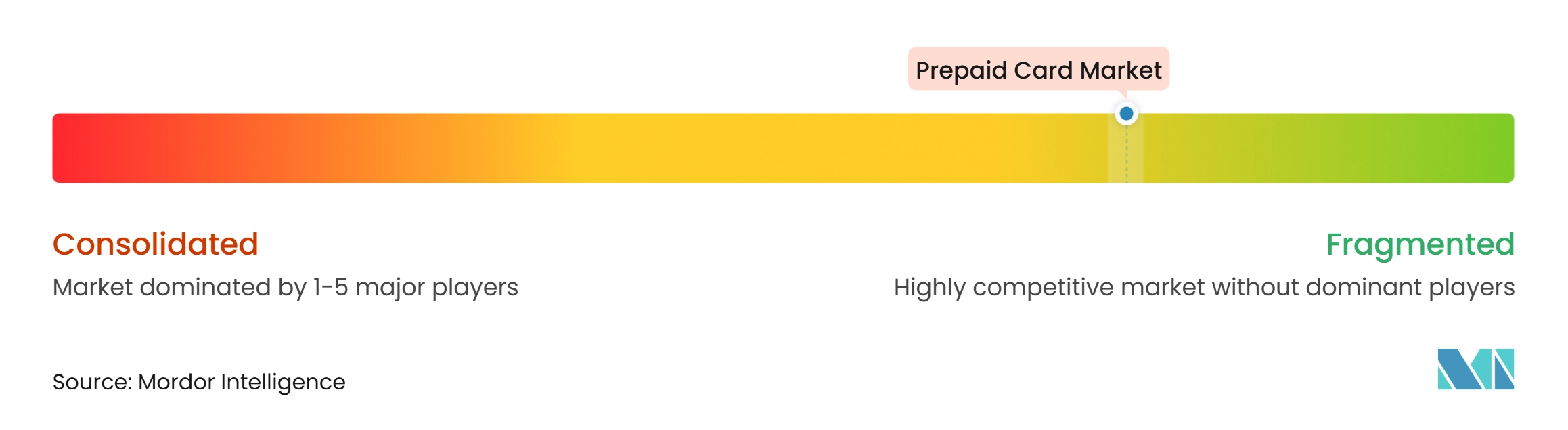
The United States prepaid card market is fragmented at the issuer, program-management, and distribution levels, with banks, fintech companies, payment processors, and specialist providers serving different customer segments and use cases. Visa and Mastercard provide widely used payment network infrastructure, while sponsor banks such as The Bancorp Bank, Pathward, and Fifth Third Bank support issuing arrangements and regulated banking services. Marqeta reported total processing volume of USD 382.5 billion in 2025, an increase of 31% from USD 291.1 billion in 2024, demonstrating the scale of its card-processing platform, although this volume spans supported card programs and does not represent prepaid card market share. Competition varies by customer segment, funding model, distribution channel, and program requirements, allowing specialized providers to compete through technology, customer experience, fraud prevention, and tailored card features.
Strategic expansion and product innovation continue to shape competition. Marqeta completed its acquisition of TransactPay in August 2025, adding licensed electronic-money and BIN-sponsorship capabilities in the United Kingdom and European Economic Area to strengthen card program management and cross-border expansion. In July 2026, Mastercard expanded its In Control virtual card platform with enhanced issuer and transaction-clearing controls, a single API connection, and broader embedded-payment capabilities. Its collaboration with HSBC in the United Arab Emirates also supports tokenized virtual commercial cards in digital wallets, although these commercial products are not necessarily prepaid cards. Blackhawk Network introduced its Drive Prepaid Card and Grocery Prepaid Card in January 2026, offering category-restricted rewards for fuel, electric vehicle charging, and grocery purchases through physical and digital cards. These developments illustrate how providers differentiate through program-management capabilities, transaction controls, specialized spending applications, and distribution partnerships.
Potential opportunities remain in low-cost products for underbanked users, interoperable public disbursement programs, and expense cards with real-time controls for small and medium-sized businesses. Card-as-a-service providers are helping clients enter these areas by offering program management as a managed capability. This can reduce the operational burden for companies that want to launch a card but do not have direct issuing expertise. The prepaid card market is not dominated by a single issuer or processor at the program-management level. Its competitive position is shaped by the balance between network-scale infrastructure and specialized providers serving specific customer groups. This structure allows product specialization to coexist with shared network and issuing infrastructure. It also means issuer choice can vary by customer type, use case, and distribution model. Competition remains active.
Prepaid Card Industry Leaders
-
Visa Inc.
-
Mastercard Incorporated
-
Green Dot Corporation
-
Blackhawk Network Holdings, Inc.
-
American Express Company
- *Disclaimer: Major Players sorted in no particular order
Prepaid Card Market Companies Covered in this Report
- Visa Inc.
- Mastercard Incorporated
- Green Dot Corporation
- American Express Company
- Blackhawk Network Holdings, Inc.
- InComm Payments
- PayPal Holdings, Inc.
- The Bancorp, Inc.
- Pathward Financial, Inc.
- Fifth Third Bancorp
- Ouro Global, Inc. (Netspend)
- Paysafe Limited
- Edenred SE
- Pluxee
- Euronet Worldwide, Inc.
- Western Union Company
- Fiserv, Inc.
- Marqeta, Inc.
- Nium Pte. Ltd.
- CPI Card Group Inc.
- Walmart Inc.
Recent Industry Developments in Prepaid Card Market
- July 2026: Mastercard expanded its virtual card platform with enhanced security features, deepening a partnership with HSBC to deploy tokenized virtual corporate card numbers in the United Arab Emirates, enabling enterprise and government entities to issue and manage virtual corporate cards through a mobile-first interface.
- February 2026: Runa launched Runa Prepaid Cards, a fully white-labelled embedded payout solution available as both a single-use Reward variant and a reloadable Reload variant. Cards are provisioned instantly via a secure URL, are compatible with digital wallets, and are accepted on the Visa network globally.
- January 2026: BoxCommerce and Mastercard launched a prepaid card program for South African small and medium-sized enterprises, granting merchants instant access to sales proceeds via physical and virtual prepaid cards fully integrated into the BoxCommerce merchant dashboard.
- January 2026: Blackhawk Network launched the Drive Prepaid Card and Grocery Prepaid Card with Mastercard. Both products target corporate reward and recognition programs, are issued by Sunrise Banks, are available in physical and virtual formats, and work with Apple Pay, Google Wallet, and Samsung Wallet.
Global Prepaid Card Market Report Scope
Segmentation Overview
| Open-Loop Prepaid Cards |
| Closed-Loop Prepaid Cards |
| Physical Prepaid Cards |
| Virtual Prepaid Cards |
| Reloadable Prepaid Cards |
| Non-Reloadable Prepaid Cards |
| General-Purpose Prepaid Cards |
| Gift and Incentive Cards |
| Government Benefit and Payroll Cards |
| Travel and Foreign Currency Cards |
| Payroll and Corporate Disbursement Cards |
| Other Purpose-Specific Prepaid Cards |
| Consumer / Individual |
| Business / Corporate |
| Government / Public Sector |
| Banks and Financial Institutions |
| Online and Mobile Applications |
| Retail Stores and Kiosks |
| Agents and Other Distribution Partners |
| North America | United States |
| Canada | |
| Mexico | |
| South America | Brazil |
| Argentina | |
| Rest of South America | |
| Europe | United Kingdom |
| Germany | |
| France | |
| Italy | |
| Spain | |
| Rest of Europe | |
| Asia-Pacific | China |
| India | |
| Japan | |
| Australia | |
| Rest of Asia-Pacific | |
| Middle East & Africa | United Arab Emirates |
| Saudi Arabia | |
| South Africa | |
| Rest of Middle East & Africa |
| By Card Type | Open-Loop Prepaid Cards | |
| Closed-Loop Prepaid Cards | ||
| By Card Format | Physical Prepaid Cards | |
| Virtual Prepaid Cards | ||
| By Reloadability | Reloadable Prepaid Cards | |
| Non-Reloadable Prepaid Cards | ||
| By Usage | General-Purpose Prepaid Cards | |
| Gift and Incentive Cards | ||
| Government Benefit and Payroll Cards | ||
| Travel and Foreign Currency Cards | ||
| Payroll and Corporate Disbursement Cards | ||
| Other Purpose-Specific Prepaid Cards | ||
| By Customer Type | Consumer / Individual | |
| Business / Corporate | ||
| Government / Public Sector | ||
| By Distribution Channel of Issuance | Banks and Financial Institutions | |
| Online and Mobile Applications | ||
| Retail Stores and Kiosks | ||
| Agents and Other Distribution Partners | ||
| By Geography | North America | United States |
| Canada | ||
| Mexico | ||
| South America | Brazil | |
| Argentina | ||
| Rest of South America | ||
| Europe | United Kingdom | |
| Germany | ||
| France | ||
| Italy | ||
| Spain | ||
| Rest of Europe | ||
| Asia-Pacific | China | |
| India | ||
| Japan | ||
| Australia | ||
| Rest of Asia-Pacific | ||
| Middle East & Africa | United Arab Emirates | |
| Saudi Arabia | ||
| South Africa | ||
| Rest of Middle East & Africa | ||
Key Questions Answered in the Report
What is the projected value of the prepaid card market by 2032?
The prepaid card market is forecast to reach USD 1.8 trillion by 2032, growing at a 5.2% CAGR from 2027 to 2032.
Which prepaid card type has the largest share?
Open-loop cards hold 69.8% share in 2026 because Visa and Mastercard network acceptance supports broad merchant use.
Why are virtual prepaid cards growing quickly?
Virtual cards are projected to grow at 13.5% CAGR through 2032 because they can be provisioned quickly and added to mobile wallets.
Which region is growing fastest for prepaid cards?
Asia-Pacific is forecast to grow at 8.3% CAGR through 2032, supported by financial inclusion, transit, corporate, and wallet-linked use cases.
How do prepaid cards support public benefit payments?
Public agencies can load recurring benefits onto prepaid cards, offering an electronic alternative to paper checks for people without bank accounts. The model supports payments through cards, wallets, and ATMs.
What are the main risks facing prepaid card providers?
Key risks include compliance costs, account takeover fraud, dependence on issuing infrastructure, and competition from instant account-to-account payments. These risks can raise costs and affect user adoption.