
Power Plant Boiler Market Size and Share
Market Overview
| Study Period | 2022 - 2032 |
|---|---|
| Market Size (2027) | USD 26.28 Billion |
| Market Size (2032) | USD 33.89 Billion |
| Growth Rate (2027 - 2032) | 5.22 % |
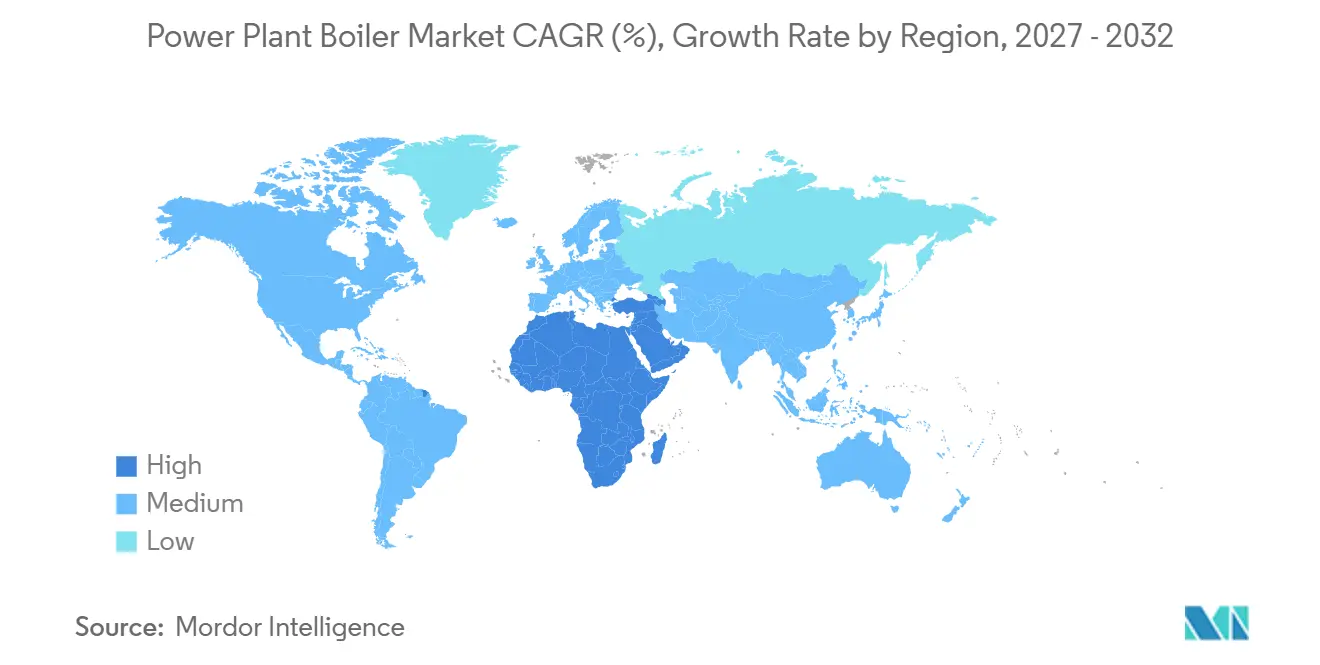
| Fastest Growing Market | Middle East and Africa |
| Largest Market | Asia-Pacific |
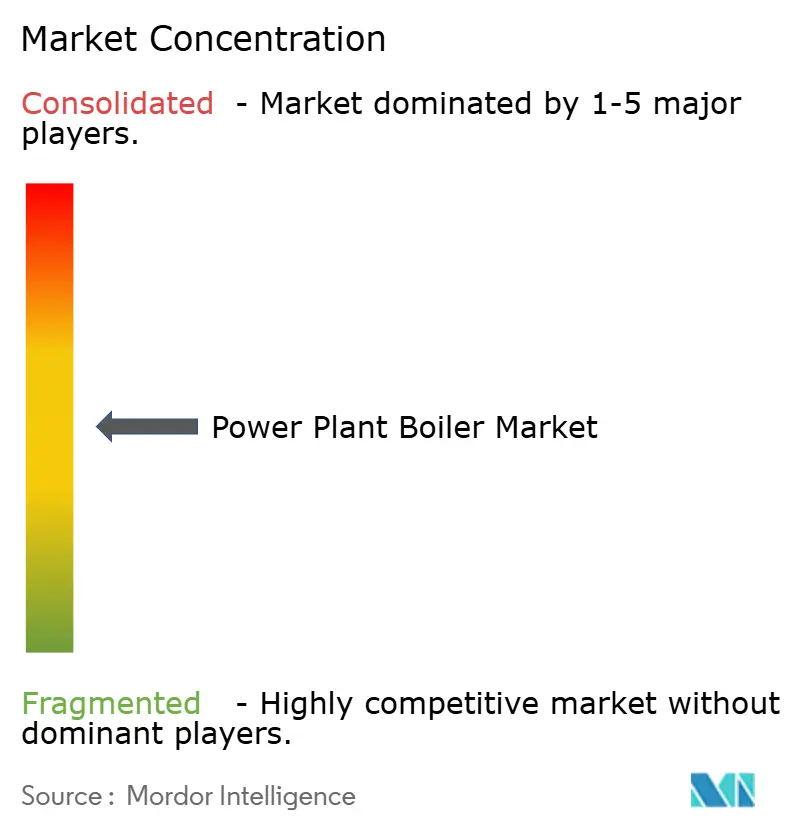
| Market Concentration | Medium |
Major Players *Disclaimer: Major Players sorted in no particular order Image © Mordor Intelligence. Reuse requires attribution under CC BY 4.0. | |
Power Plant Boiler Market Analysis by Mordor Intelligence
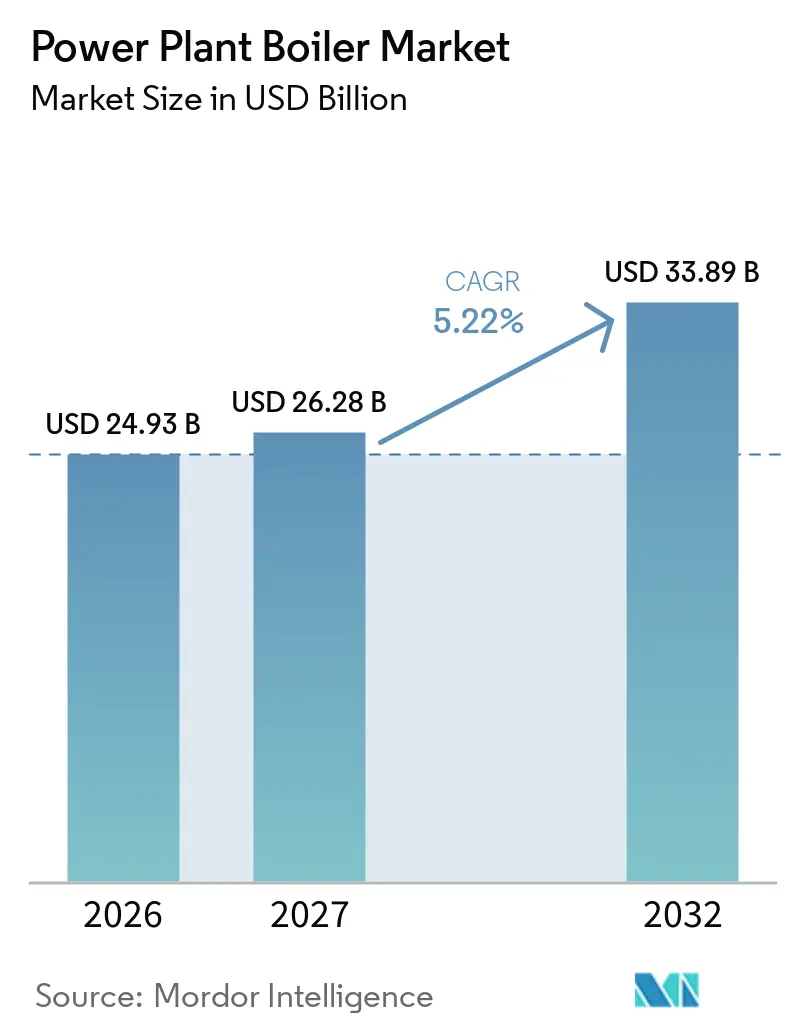
The Power Plant Boiler Market size is expected to increase from USD 24.93 billion in 2026 to USD 26.28 billion in 2027 and reach USD 33.89 billion by 2032, growing at a CAGR of 5.22% over 2027-2032. The power plant boiler market follows investment in steam-cycle generation because boilers remain central to thermal generation assets. Electricity demand from data centers, industrial activity, and urban growth is increasing the need for dependable capacity in several large economies. The International Energy Agency reported that data center electricity use rose 17% in 2025, which strengthens the case for dispatchable generation where grid connections and renewable capacity are constrained.[1] The power plant boiler market is also shaped by replacement work, fuel conversion, and emission-control upgrades at existing plants. Equipment suppliers are therefore serving both new-build projects and life-extension programs, while fuel-flexible designs create opportunities in biomass, waste, gas, and co-firing applications.
Key Report Takeaways
- By boiler type, Pulverized Fuel boilers held 46.7% of the power plant boiler market share in 2026, while Heat Recovery Steam Generators are forecast to expand at a 5.9% CAGR through 2032.
- By technology, Subcritical boilers accounted for 54.6% of the power plant boiler market share in 2026, while Ultra-Supercritical technology is projected to grow at a 6.7% CAGR through 2032.
- By application, Utility-Scale Power Generation held 67.3% of the power plant boiler market size in 2026, while Combined Heat and Power is forecast to grow at a 5.4% CAGR through 2032.
- By component, Water-Tube and Steam Generation Systems accounted for 32.2% of the power plant boiler market size in 2026, while Emission Control and Auxiliary Systems are forecast to expand at a 5.6% CAGR through 2032.
- By geography, Asia-Pacific held 69.3% of global value in 2026, while the Middle East and Africa are projected to grow at a 5.8% CAGR through 2032.
Note: Market numbers in this report are based on Mordor Intelligence's proprietary estimation framework, which combines nine months of actuals with Q4 projections for base year 2026.
Market Trends and Insights
Drivers Impact Analysis of Power Plant Boiler Market*
| Driver | (~) % Impact on CAGR Forecast | Geographic Relevance | Impact Timeline |
|---|---|---|---|
| Rising Electricity Demand From Industrialization, Urbanization, and Data-Center Loads | +1.5% | Global, with concentrated effect in North America, China, India, and Southeast Asia | Short term (≤ 2 years) |
| Aging Boiler Fleet Replacement and Life-Extension Programs | +1.2% | North America, Europe, China, India | Medium term (2-4 years) |
| Efficiency Gains From Supercritical and Ultra-Supercritical Technologies | +0.9% | China, India, Southeast Asia, and spillover to the Middle East and Africa | Long term (≥ 4 years) |
| Fuel Flexibility for Low-Grade Coal, Biomass, Waste, and Co-Firing | +0.8% | Europe, Southeast Asia, India | Medium term (2-4 years) |
| Retrofit Demand for Flexible Dispatch and Renewable-Energy Balancing | +0.6% | Europe, North America, South Korea, Japan | Medium term (2-4 years) |
| Ultra-Supercritical CFB Scaling for Low-Calorific-Value Fuels | +0.4% | China, India, Southeast Asia | Long term (≥ 4 years) |
| Source: Mordor Intelligence | |||
Rising Electricity Demand from Industrialization, Urbanization, and Data-Center Loads
The power plant boiler market benefits from higher electricity use in industrial, urban, and data-center locations. The International Energy Agency (IEA) recorded a 17% increase in data center electricity use in 2025, while its assessment identified tighter bottlenecks and a scramble for power solutions.[2] U.S. electricity consumption is forecast to reach a record 4,283 billion kWh in 2026, and data-center demand is contributing to higher use of fossil-fuel generation while grid connections lag. Demand clusters are growing in Northern Virginia, Singapore, and northern India, where round-the-clock supply remains important for large facilities. This pattern links data-center investment to orders for coal and gas boiler systems where dispatchable capacity is needed. It also encourages utilities to keep reliable steam-cycle assets available while new grid and generation projects are built.
Aging Boiler Fleet Replacement and Life-Extension Programs
The power plant boiler market receives demand from steam units commissioned in the 1980s and 1990s that are reaching the end of their 30-35-year economic life. In February 2026, the U.S. Department of Energy committed USD 175 million to 6 coal-plant modernization projects, including work at Mountaineer, Cardinal, and Fort Martin, within a broader USD 525 million program.[3] These projects support life extension and a more stable supply for rural communities. Adani Power placed advanced orders for 11.2 GW of ultra-supercritical boilers, turbines, and generators as it expanded from 17.55 GW to a planned 30.67 GW by 2030. Higher orders for boilers and turbines in India can limit production slots at major manufacturers, increasing the importance of delivery scheduling and pressure-part supply. This environment supports refurbishment work as well as demand for modular components.
Efficiency Gains from Supercritical and Ultra-Supercritical Technologies
The power plant boiler market is moving toward designs that reduce fuel use and emissions per megawatt-hour. Ultra-supercritical technology provides a net thermal-efficiency advantage of 10 percentage points over subcritical designs in the supplied evidence. Dongfang Electric Corporation delivered equipment in December 2025 for the 630°C ultra-supercritical double-reheat demonstration project at Yuncheng in Shandong Province, where 2 units of 1,000 MW are scheduled for commissioning in 2026.[4] The units are expected to generate 10 billion kWh annually, save 350,000 tons of standard coal, and reduce carbon dioxide emissions by 945,000 tons each year. China’s 2025-2027 coal power upgrade plan set a design target of no more than 270 g/kWh for supply coal consumption in ultra-supercritical double-reheat units. Higher efficiency standards are raising boiler specifications in China, India, and Southeast Asia.
Fuel Flexibility for Low-Grade Coal, Biomass, Waste, and Co-Firing
Fuel flexibility widens the addressable work for the power plant boiler market because operators can adapt boilers to locally available fuels and change compliance conditions. Circulating fluidized bed boilers can use high-moisture and low-calorific-value fuels and can co-fire biomass. A 2025 peer-reviewed study found that biomass pellets blended at up to 20 wt% in a 620 t/h industrial circulating fluidized bed boiler produced stable combustion without a significant thermal-efficiency loss and reduced annual carbon dioxide emissions by 130,000 tons. Valmet received a contract in 2024 to convert 2 coal-fired circulating fluidized bed boilers at ŠKO-ENERGO’s Mladá Boleslav plant to 100% biomass and supply a new bubbling fluidized bed boiler. The project is expected to reduce annual carbon dioxide emissions by 290,000 tons and supports Škoda Auto’s 2030 carbon-neutral manufacturing objective. These systems can help operators manage exposure to coal prices and carbon-compliance requirements.
Restraints Impact Analysis of Power Plant Boiler Market*
| Restraint | (~) % Impact on CAGR Forecast | Geographic Relevance | Impact Timeline |
|---|---|---|---|
| High Capital Costs and Long Project Payback Periods | -1.4% | Global, most acute in South America, the Middle East and Africa, and Southeast Asia | Short term (≤ 2 years) |
| Stricter Emissions Rules and Carbon-Compliance Costs | -0.9% | Europe, North America, China, India | Medium term (2-4 years) |
| Long Lead Times for Pressure Parts, High-Temperature Alloys, and OEM Slots | -0.7% | Global, concentrated in India and Southeast Asia | Short term (≤ 2 years) |
| Coal-Plant Permitting Risk and Asset-Stranding Exposure | -0.8% | Europe, North America, Japan, South Korea | Long term (≥ 4 years) |
| Source: Mordor Intelligence | |||
High Capital Costs and Long Project Payback Periods
High capital costs limit the power plant boiler market in locations where project finance remains constrained. Supercritical and ultra-supercritical projects carry a 10-25% cost premium over equivalent subcritical designs in the supplied evidence. A standard 2,000 MW ultra-supercritical plant requires multi-billion-dollar commitments and has a 15-25-year payback period. In India, coal-fired tariffs of INR 5.5-5.8 per unit and a fixed-charge recovery ratio of 60-65% leave limited room for cost overruns or fuel-price shocks. International development-finance institutions have largely withdrawn from coal financing since 2022, narrowing the lender base in Southeast Asia. Developers therefore rely more heavily on domestic banks, export-credit agencies, and government-backed purchase agreements.
Stricter Emissions Rules and Carbon-Compliance Costs
Stricter emissions requirements raise the installed cost of conventional boiler projects while creating retrofit work. China requires limits of 30 mg/Nm³ for particulates, 35 mg/Nm³ for sulfur dioxide, and 50 mg/Nm³ for nitrogen oxides across coal-fired units. These requirements lead operators to invest in emission control and auxiliary systems that add 8-12% to installed plant cost. In Europe, the EU Emissions Trading System favors a move from coal toward gas-fired combined-cycle generation. Biomass circulating fluidized bed and waste-to-energy systems are therefore taking on a larger share of European capital expenditure. The result is lower demand for conventional coal boilers in Organization for Economic Co-operation and Development (OECD) countries, alongside stronger demand for fuel-flexible and emission-ready systems.
*Our forecasts treat driver/restraint impacts as directional, not additive. The impact forecasts reflect baseline growth, mix effects, and variable interactions.
Power Plant Boiler Market Segment Analysis
By Boiler Type:
Pulverized Fuel Holds the Largest Position While HRSGs Grow FastestPulverized Fuel boilers held 46.7% of the power plant boiler market value in 2026. Their position is supported by the installed base and active construction pipelines in China, India, and Indonesia. L&T Energy received an award from National Thermal Power Corporation (NTPC) in July 2026 for 2 ultra-supercritical 800 MW units at Lara Stage-III in Chhattisgarh. L&T classified the project as a mega order of INR 5,000-10,000 crore, equivalent to USD 600 million-USD 1.2 billion.
Heat Recovery Steam Generators are projected to grow at a 5.9% CAGR through 2032, making them the fastest-growing boiler type. Their demand is linked to combined-cycle gas turbine orders and power needs from data centers and industrial co-generation. GE Vernova has an installed base of more than 1,300 HRSGs globally. In April 2025, it delivered 3 HRSG Supermodules for the 2.3 GW Ha Goi Thermal Power Station in Japan, each weighing 2,500 metric tons. Circulating fluidized bed, bubbling fluidized bed, and other designs serve fuel-flexible, district-heating, industrial captive, and waste-to-energy projects.
By Technology:
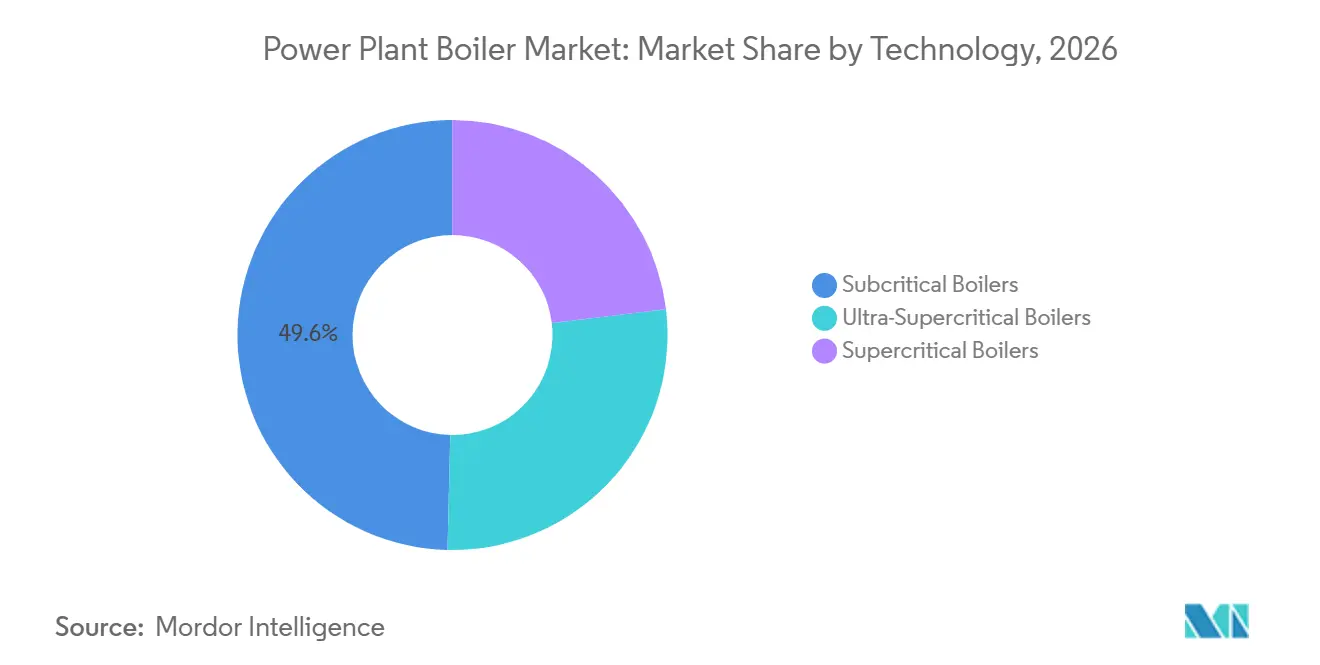
Subcritical Boilers Retain a Large Base While Ultra-Supercritical Units AccelerateSubcritical boilers held 54.6% of the power plant boiler market value in 2026. The large installed base in developing economies and the economics of brownfield refurbishment support this position. Their use also reflects fuel conditions in lignite-heavy areas of Eastern Europe, low-rank coal regions in Indonesia, and sub-bituminous coal locations in India. The fleet creates ongoing demand for service, replacement parts, and targeted upgrades.
Ultra-supercritical technology is forecast to grow at a 6.7% CAGR through 2032. Dongfang Boiler’s 700 MW ultra-supercritical circulating fluidized bed unit at Yuneng Honghe Power Plant completed its 168-hour trial in April 2025 with 46.34% full-plant thermal efficiency. The project met China’s ultra-low emission standards and used high-moisture, low-calorific-value lignite. Supercritical systems remain an intermediate option for markets that cannot justify the capital premium of ultra-supercritical technology. Advanced double-reheat units are becoming the preferred benchmark for new Asian baseload projects.
By Application:
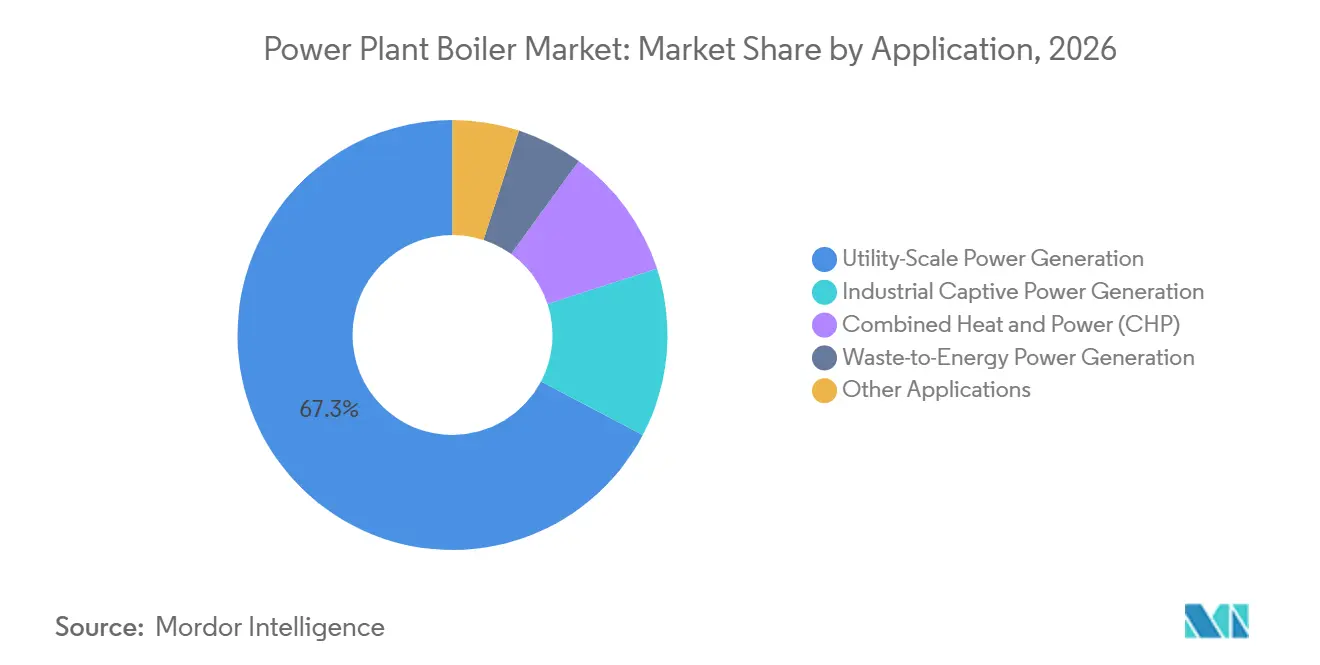
Utility-Scale Generation Leads While CHP Builds DemandUtility-Scale Power Generation held 67.3% of the power plant boiler market value in 2026. Large baseload additions in Asia and the U.S. retrofit pipeline support the segment. The U.S. Energy Information Administration projects 145 GW of coal-fired capacity at the end of 2028 after planned retirements. This fleet sustains demand for boiler parts, upgrades, and emissions-control equipment.
Combined Heat and Power are forecast to grow at a 5.4% CAGR through 2032. It is driven by industrial users seeking lower grid dependence and municipalities updating district-heating networks. Enercity commissioned Germany’s first waste-wood combustion plant with a large-scale heat pump using flue-gas condensation at its Stöcken biomass CHP plant in Hannover in October 2025. The project involved EUR 195 million, equivalent to USD 211 million. Waste-to-Energy Power Generation and Industrial Captive Power Generation further support demand in Asia.
By Component:
Water-Tube Systems Lead While Emission Controls ExpandWater-Tube and Steam Generation Systems held 32.2% of the power plant boiler market value in 2026. These systems are the highest-cost single component in a boiler assembly. Supercritical designs require specialized nickel-based superalloys that can operate above 25 MPa and 600°C. Their technical requirements make material quality and fabrication capability central to supplier selection.
Emission Control and Auxiliary Systems are forecast to grow at a 5.6% CAGR through 2032. China’s retrofit mandate and India’s tighter sulfur dioxide and nitrogen oxide limits create required spending at operating plants. Dongfang Boiler used a C630R high-temperature rotor alloy in the 630°C demonstration project, co-developed with China Iron & Steel Research Institute. Economizers and air preheaters support efficiency improvements in retrofit programs. Feedwater and circulation systems remain linked to boiler service contracts.
Geography Analysis
APAC Power Plant Boiler Market
Asia-Pacific held 69.3% of the power plant boiler market in 2026. The region combines new coal-fired capacity additions with replacement of older designs by ultra-supercritical equipment. China approved nearly 100 GW of new coal-fired plants in 2024. India and China accounted for 87% of new global coal-power proposals in 2025. National Thermal Power Corporation (NTPC) aims to add 30 GW of new thermal capacity by 2032.
North America and Europe Power Plant Boiler Market
North America and Europe represent a technically demanding part of the power plant boiler market. U.S. demand is directed toward life extension, fuel conversion, and emissions upgrades rather than new coal-fired projects. Only 2.6 GW of planned 8.5 GW of U.S. coal retirements occurred in 2025 after Department of Energy emergency orders. The Department of Energy’s February 2026 funding program also targets efficiency upgrades and coal-to-gas conversion readiness. European demand is moving toward biomass, waste-to-energy, and Combined heat and power (CHP) equipment, as reflected in Valmet’s 2025 order for a 75 MWth and 25 MWe biomass CHP plant in Sweden.
MEA and South America Power Plant Boiler Market
The Middle East and Africa is forecast to grow at a 5.8% CAGR through 2032. Growth is tied to gas-fired combined-cycle additions in the Gulf and thermal projects in Nigeria, Egypt, and South Africa. The International Energy Agency (IEA) expects Middle East and North Africa power capacity to increase by more than 300 GW over the next decade. Natural gas is expected to meet half of incremental electricity demand to 2035, which favors HRSG orders, while South America’s Brazil-led demand relies on gas peaking capacity and smaller industrial boilers, with Colombia and Argentina offering industrial captive and waste-heat recovery opportunities.
Competitive Landscape
The power plant boiler market is moderately consolidated. The supplied evidence identifies 6-8 original equipment manufacturers (OEMs) capable of utility-scale supercritical or ultra-supercritical engineering, procurement, and construction (EPC) projects, alongside more than 30 regional participants in industrial, waste-to-energy, and service work. Dongfang Electric, Harbin Electric, and Shanghai Electric supply much of China’s new-build boiler demand. They are also becoming more competitive in Southeast Asia and Africa through financing packages.
Japanese and Korean manufacturers include Mitsubishi Heavy Industries through Mitsubishi Power, IHI Corporation, Kawasaki Heavy Industries, and Doosan Enerbility. These companies target hydrogen and ammonia co-firing and high-efficiency HRSG systems. In March 2025, Downer Group signed an alliance with Mitsubishi Power and Mitsubishi Heavy Industries Power IDS to act as exclusive reseller and service provider in Australia and New Zealand. The agreement covers maintenance, forced-outage services, and spare-parts supply. Western suppliers, including GE Vernova, Siemens Energy, ANDRITZ, and Babcock & Wilcox, focus on biomass, waste-to-energy, and high-margin service work in Europe and North America.
Technical differentiation remains important for high-specification projects. The C630R rotor alloy used in Dongfang’s 630°C project represents a high-temperature materials development for advanced boiler systems. GE Power India approved a plan in September 2025 to demerge its Durgapur boiler manufacturing business to JSW Energy. Modular Heat Recovery Steam Generator (HRSG) systems, ammonia co-firing retrofit packages, and emissions-control integration remain relevant areas of supplier activity.
Power Plant Boiler Industry Leaders
-
GE Vernova, Inc.
-
Mitsubishi Heavy Industries, Ltd.
-
Doosan Enerbility Co., Ltd.
-
Dongfang Electric Corporation Limited
-
Babcock & Wilcox Enterprises, Inc.
- *Disclaimer: Major Players sorted in no particular order
Power Plant Boiler Market Companies Covered in this Report
- ANDRITZ AG
- Ansaldo Energia S.p.A.
- Babcock & Wilcox Enterprises, Inc.
- Bharat Heavy Electricals Limited
- Cleaver-Brooks, Inc.
- Dongfang Electric Corporation Limited
- Doosan Enerbility Co., Ltd.
- Foster Wheeler AG
- GE Vernova, Inc.
- Harbin Electric Corporation
- Hitachi Zosen Corporation
- IHI Corporation
- John Wood Group PLC
- Kawasaki Heavy Industries, Ltd.
- Mitsubishi Heavy Industries, Ltd.
- Shanghai Electric Group Company Limited
- Siemens Energy AG
- Sofinter S.p.A.
- Sumitomo Heavy Industries, Ltd.
- Thermax Limited
- Valmet Oyj
Recent Industry Developments in Power Plant Boiler Market
- July 2026: L&T Energy CarbonLite Solutions received a Limited Notice to Proceed from NTPC for the Lara Stage-III thermal power project in Chhattisgarh, covering two 800 MW ultra-supercritical units with 1,600 MW total capacity. L&T classified the order as Mega, valued at INR 5,000-10,000 crore, equivalent to USD 600 million-USD 1.2 billion.
- February 2026: The U.S. Department of Energy announced USD 175 million for 6 coal-plant modernization projects under a broader USD 525 million program to extend coal-fleet life and support grid reliability.
- November 2025: Dongfang Electric Corporation delivered boilers, turbines, and generators for the Yuncheng project in Shandong Province, the first 630°C ultra-supercritical double-reheat national demonstration plant. Its two 1,000 MW units are scheduled for commissioning in 2026 and are expected to supply 10 billion kWh annually.
- November 2025: Mitsubishi Power announced a contract to convert the 660 MW O Mon 1 Thermal Power Plant in Vietnam from oil to natural gas. The company will supply gas burners for the existing boiler and install a Selective Catalytic Reduction (SCR) denitrification system.
Global Power Plant Boiler Market Report Scope
A boiler in a power plant is a closed, heavy-duty vessel that converts water into high-pressure, high-temperature steam by burning fuel or utilizing heat energy. This pressurized steam is then used to drive a steam turbine, which powers an electrical generator to produce electricity.
The global power plant boiler market is segmented by boiler type, technology, application, component, and geography. By boiler type, the market is segmented into pulverized fuel (PF) boilers, circulating fluidized bed (CFB) boilers, bubbling fluidized bed (BFB) boilers, heat recovery steam generators (HRSGs), and other power plant boiler types. By technology, the market is segmented into subcritical, supercritical, and ultra-supercritical boilers. By application, the market is segmented into utility-scale power generation, industrial captive power generation, combined heat and power (CHP), waste-to-energy power generation, and other applications. By component, the market is segmented into boiler furnaces and combustion systems, water-tube and steam generation systems, superheaters and reheaters, economizers, air preheaters, feedwater and circulation systems, and emission control and auxiliary systems. The report also covers the market size and forecasts for the global power plant boiler market across 27 countries in key regions. For each segment, the market sizing and forecasts have been provided on the basis of value (USD).
Segmentation Overview
| Pulverized Fuel Boilers |
| Circulating Fluidized Bed (CFB) Boilers |
| Bubbling Fluidized Bed Boilers |
| Heat Recovery Steam Generators (HRSGs) |
| Other Power Plant Boiler Types |
| Subcritical Boilers |
| Supercritical Boilers |
| Ultra-Supercritical Boilers |
| Utility-Scale Power Generation |
| Industrial Captive Power Generation |
| Combined Heat and Power (CHP) |
| Waste-to-Energy Power Generation |
| Other Applications |
| Boiler Furnace and Combustion Systems |
| Water-Tube and Steam Generation Systems |
| Superheaters and Reheaters |
| Economizers |
| Air Preheaters |
| Feedwater and Circulation Systems |
| Emission Control and Auxiliary Systems |
| North America | United States |
| Canada | |
| Mexico | |
| Europe | Germany |
| France | |
| Italy | |
| Spain | |
| United Kingdom | |
| Russia | |
| Rest of Europe | |
| Asia-Pacific | China |
| India | |
| Japan | |
| South Korea | |
| Australia | |
| Indonesia | |
| Malaysia | |
| Thailand | |
| Rest of Asia-Pacific | |
| South America | Brazil |
| Argentina | |
| Colombia | |
| Rest of South America | |
| Middle East and Africa | Saudi Arabia |
| United Arab Emirates | |
| Qatar | |
| Kuwait | |
| Oman | |
| Egypt | |
| Nigeria | |
| Rest of Middle East and Africa |
| By Boiler Type | Pulverized Fuel Boilers | |
| Circulating Fluidized Bed (CFB) Boilers | ||
| Bubbling Fluidized Bed Boilers | ||
| Heat Recovery Steam Generators (HRSGs) | ||
| Other Power Plant Boiler Types | ||
| By Technology | Subcritical Boilers | |
| Supercritical Boilers | ||
| Ultra-Supercritical Boilers | ||
| By Application | Utility-Scale Power Generation | |
| Industrial Captive Power Generation | ||
| Combined Heat and Power (CHP) | ||
| Waste-to-Energy Power Generation | ||
| Other Applications | ||
| By Component | Boiler Furnace and Combustion Systems | |
| Water-Tube and Steam Generation Systems | ||
| Superheaters and Reheaters | ||
| Economizers | ||
| Air Preheaters | ||
| Feedwater and Circulation Systems | ||
| Emission Control and Auxiliary Systems | ||
| By Geography | North America | United States |
| Canada | ||
| Mexico | ||
| Europe | Germany | |
| France | ||
| Italy | ||
| Spain | ||
| United Kingdom | ||
| Russia | ||
| Rest of Europe | ||
| Asia-Pacific | China | |
| India | ||
| Japan | ||
| South Korea | ||
| Australia | ||
| Indonesia | ||
| Malaysia | ||
| Thailand | ||
| Rest of Asia-Pacific | ||
| South America | Brazil | |
| Argentina | ||
| Colombia | ||
| Rest of South America | ||
| Middle East and Africa | Saudi Arabia | |
| United Arab Emirates | ||
| Qatar | ||
| Kuwait | ||
| Oman | ||
| Egypt | ||
| Nigeria | ||
| Rest of Middle East and Africa | ||
Key Questions Answered in the Report
What is the projected value of the power plant boiler market by 2032?
The sector is projected to reach USD 33.89 billion by 2032, growing at a 5.22% CAGR from 2027.
Which boiler type has the largest position?
Pulverized Fuel boilers held 46.7% of value in 2026, supported by installations and new capacity projects in Asia.
Why are Heat Recovery Steam Generators growing quickly?
HRSGs are forecast to grow at 5.9% CAGR as gas-fired combined-cycle projects, industrial co-generation, and data-center demand expand, while installed gas turbine capacity supports associated steam-generation equipment.
Which region has the largest role in boiler demand?
Asia-Pacific held 69.3% of global value in 2026 because China, India, and Southeast Asia continue to build and upgrade thermal capacity.
What technology is growing fastest?
Ultra-supercritical technology is forecast to grow at 6.7% CAGR through 2032 because it improves efficiency and reduces emissions per megawatt-hour.
How are emissions requirements changing equipment demand?
Tighter requirements increase demand for emission-control systems, biomass conversion, waste-to-energy equipment, and fuel-flexible boiler designs.