
Polyvinyl Amine Paper Dry Strength Agent Market Size and Share
Market Overview
| Study Period | 2022 - 2032 |
|---|---|
| Market Size (2027) | USD 317.76 Million |
| Market Size (2032) | USD 428.04 Million |
| Growth Rate (2027 - 2032) | 6.14 % |
| Fastest Growing Market | Asia-Pacific |
| Largest Market | Asia-Pacific |
| Market Concentration | Medium |
Major Players *Disclaimer: Major Players sorted in no particular order Image © Mordor Intelligence. Reuse requires attribution under CC BY 4.0. | |
Polyvinyl Amine Paper Dry Strength Agent Market Analysis by Mordor Intelligence
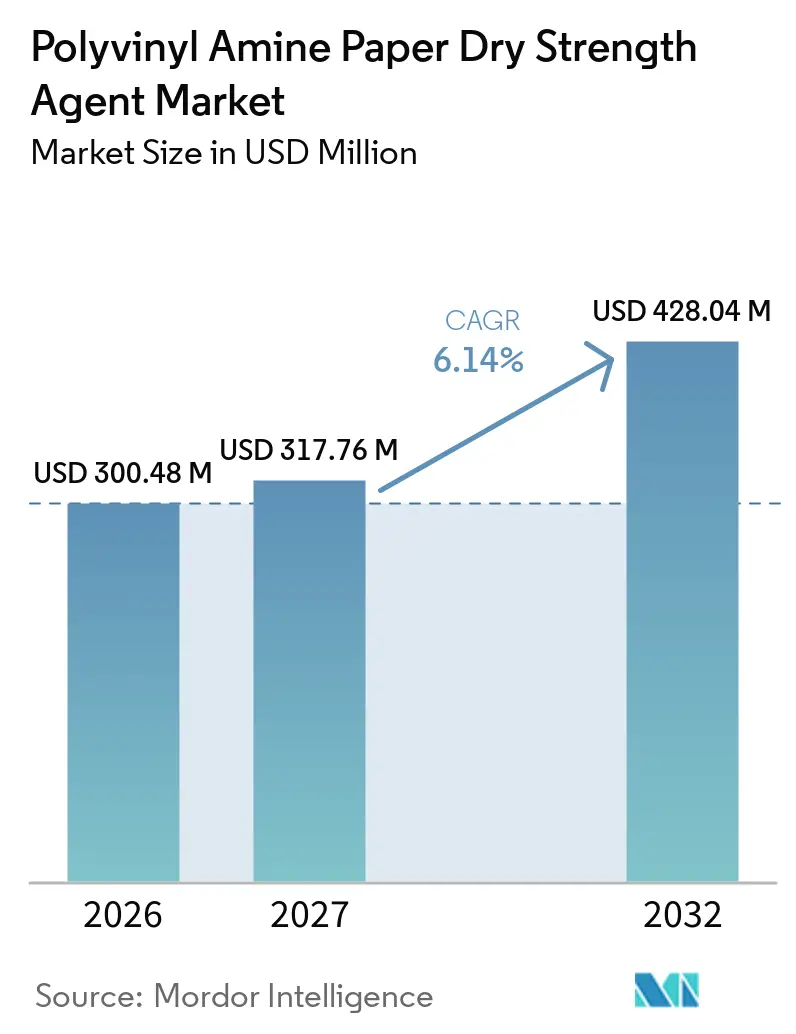
The Polyvinyl Amine Paper Dry Strength Agent Market size was valued at USD 300.48 million in 2026 and is estimated to grow from USD 317.76 million in 2027 to reach USD 428.04 million by 2032, at a CAGR of 6.14% during the forecast period (2027-2032). The polyvinyl amine paper dry strength agent market is supported by demand for stronger fiber-based packaging, particularly where producers reduce basis weight and raise recycled-fiber use. Polyvinyl amine binds with cellulose through electrostatic and hydrogen-bonding interactions, which can improve dry tensile strength, drainage, and retention within the wet end. This combination gives suppliers an opportunity to position one chemistry against separate retention, drainage, and strength programs. Packaging specifications, circularity requirements, and water management practices are raising the technical requirements placed on paper furnish. The polyvinyl amine paper dry strength agent market also faces tighter competition from modified starch and polyacrylamide products where mills prioritize initial cost over broader operating performance.
Key Report Takeaways
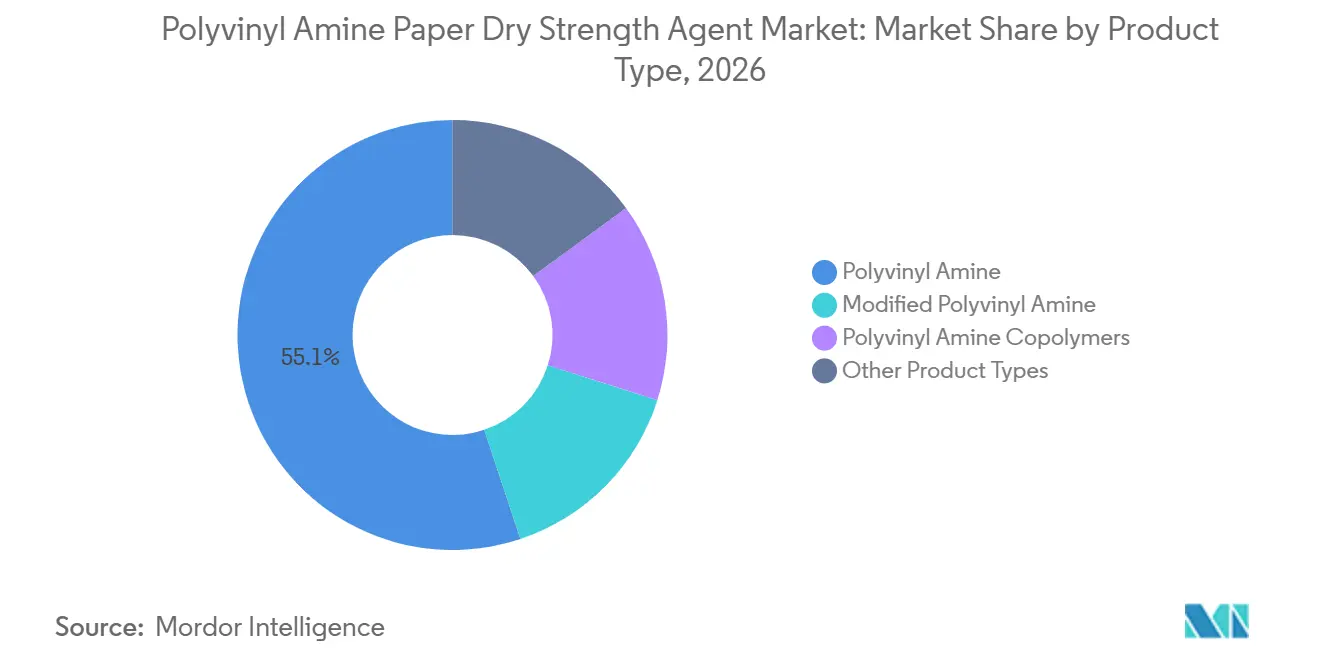
- By product type, polyvinyl amine held 55.13% of the polyvinyl amine paper dry strength agent market share in 2026, while modified polyvinyl amine is forecast to advance at a 7.06% CAGR through 2032.
- By form, liquid held 70.64% of the polyvinyl amine paper dry strength agent market share in 2026 and is forecast to advance at a 7.17% CAGR through 2032.
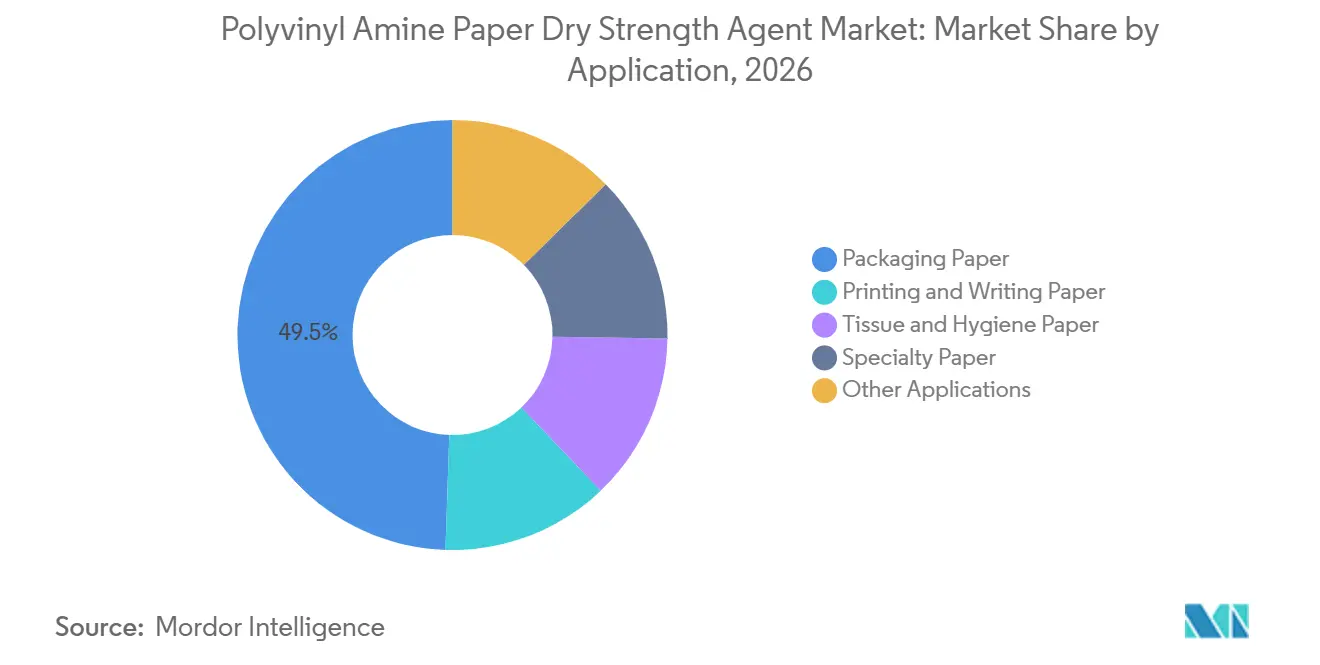
- By application, packaging paper held 49.48% of the polyvinyl amine paper dry strength agent market share in 2026, while specialty paper is forecast to advance at a 7.41% CAGR through 2032.
- By geography, Asia-Pacific held 42.92% of the polyvinyl amine paper dry strength agent market share in 2026 and is forecast to advance at a 7.38% CAGR through 2032.
Note: Market numbers in this report are based on Mordor Intelligence's proprietary estimation framework, which combines nine months of actuals with Q4 projections for base year 2026.
Global Polyvinyl Amine Paper Dry Strength Agent Market Trends and Insights
Drivers Impact Analysis*
| Driver | (~) % Impact on CAGR Forecast | Geographic Relevance | Impact Timeline |
|---|---|---|---|
| Growth of Fiber-Based Packaging and E-Commerce Fulfillment | +2.0% | Global, led by Asia-Pacific and North America | Short term (≤ 2 years) |
| Rising Recycled-Fiber Utilization and Fiber-Strength Compensation | +1.5% | Global, strongest in Europe and North America | Short term (≤ 2 years) |
| Lightweighting of Paper and Paperboard Grades | +0.9% | Global, early adoption in Northern Europe and Japan | Medium term (2–4 years) |
| Expansion of High-Performance Specialty Paper Applications | +0.7% | Europe, North America, APAC core | Medium term (2–4 years) |
| Closed-Loop Water and High-Filler Papermaking Requiring Higher-Performance Polymers | +0.4% | Asia-Pacific, Europe | Long term (≥ 4 years) |
| Source: Mordor Intelligence | |||
Growth of Fiber-Based Packaging and E-Commerce Fulfillment
E-commerce parcel demand continues to reshape requirements for corrugated board and kraft paper. Converting mailers and shelf-ready packs to lighter corrugated formats shifts more of the performance requirement toward wet-end chemistry. The polyvinyl amine paper dry strength agent market benefits when mills need to retain strength without increasing basis weight. Polyvinyl amine can support strength, drainage, and retention in the same program, which can reduce the need for separate additive lines. Amazon uses its Package Decision Engine to reduce corrugated material while preserving package performance, reflecting a broader preference for lower material use.
Rising Recycled-Fiber Utilization and Fiber-Strength Compensation
Recovered fiber represented 44.4% of total fiber inputs at United States mills in 2024, compared with 36.6% in 2005[1]. Recycled fibers become shorter and lose bonding potential through repeated processing. This makes dry-strength performance more important in packaging furnishes with higher recycled content. Polyvinyl amine can attach to cellulose surface sites in shorter and more contaminated fiber mixtures. A 2025 study found that cationic polyelectrolytes can improve retention, drainage, and sheet properties in recycled-fiber furnishes, while dosage control remains important. The polyvinyl amine paper dry strength agent market can therefore gain demand as mills increase mixed recovered-fiber use and require greater strength compensation.
Lightweighting of Paper and Paperboard Grades
Paper and paperboard lightweighting is increasing the need to maintain strength at lower grammage. Packaging converters use lighter formats to reduce fiber use and transport weight. This approach increases the importance of tensile performance, burst resistance, and sheet consistency. The polyvinyl amine paper dry strength agent market is positioned to benefit because dry-strength additives help compensate for lower fiber mass. Producers must demonstrate that chemical treatment can preserve operational performance on fast paper machines. The demand is particularly relevant where paper grades must meet exact performance limits without increasing raw-material consumption.
Expansion of High-Performance Specialty Paper Applications
Specialty paper applications require consistent tensile performance, surface quality, and formation. Release liners, filtration media, and pressure-sensitive substrates often operate at lower grammage and tighter quality thresholds. The polyvinyl amine paper dry strength agent market benefits when paper producers use chemistry instead of adding fiber mass. Kraft grades account for a material part of specialty paper demand because industrial sacks, carrier bags, and e-commerce mailers need reliable strength. The European Union Packaging and Packaging Waste Regulation is supporting the transition from plastic-laminate structures to barrier-coated paper formats. This shift raises the performance requirements placed on the paper substrate and supports demand for high-performance strength agents.
Restraints Impact Analysis*
| Restraint | (~) % Impact on CAGR Forecast | Geographic Relevance | Impact Timeline |
|---|---|---|---|
| Volatility in Vinylamine Precursors, Energy, and Specialty-Polymer Costs | -1.2% | Global; concentration risk in Western Europe and East Asia | Short term (≤ 2 years) |
| Competition from Modified Starch, Polyacrylamide, and Other Strength Additives | -0.9% | Global; most intense in price-sensitive APAC and Latin America | Medium term (2–4 years) |
| Charge-Demand Variability in Recycled and Contaminated Furnishes | -0.5% | Asia-Pacific, North America | Medium term (2–4 years) |
| Source: Mordor Intelligence | |||
Volatility in Vinylamine Precursors, Energy, and Specialty-Polymer Costs
N-vinylformamide is the direct precursor used to produce polyvinyl amine. Its manufacture uses acetylene and formamide, which expose suppliers to feedstock and energy-cost movements. The calcium carbide route to acetylene is energy intensive, which can make polymer economics sensitive to electricity and natural gas prices. Post-polymerization hydrolysis, quality assurance, and liquid-form logistics add further costs for suppliers. SNF Group started full operations at its N-vinylformamide facility in Dunkirk, France, in December 2024, and the facility completed ramp-up by the second quarter of 2025. The project diversifies European supply, but concentrated upstream production still exposes buyers to supply interruptions and cost transmission.
Competition from Modified Starch, Polyacrylamide, and Other Strength Additives
Starch-based dry-strength products retain an established position because of their cost, availability, and long use within paper mills. High-amylopectin, enzyme-modified, and cationic starch products have improved performance in mid-range applications. Glyoxalated polyacrylamide is also used in recycled-board production to support dewatering and dry strength. A 2025 study reported the highest density and tensile strength in recycled packaging fluting from a combination of 5% cellulose nanofibers and 0.2% cationic polyacrylamide. Commodity containerboard mills with short procurement contracts remain more exposed to these substitutes. Producers in the polyvinyl amine paper dry strength agent market must therefore differentiate through performance consistency in specialty, tissue, and value-added packaging grades.
*Our forecasts treat driver/restraint impacts as directional, not additive. The impact forecasts reflect baseline growth, mix effects, and variable interactions.
Segment Analysis
By Product Type: Polyvinyl Amine Supports Established Demand While Modified Polyvinyl Amine Expands
Polyvinyl amine held 55.13% of the polyvinyl amine paper dry strength agent market share in 2026. It is widely used in established containerboard and graphic paper furnishes where chemical compatibility is familiar to mill operators. Its primary amine groups can create electrostatic and hydrogen-bonding interactions with cellulose. This mechanism supports sheet strength at dosage levels that can be difficult for starch programs to match in high-speed machines. Standard grades remain relevant where mills value predictable performance and straightforward process control. Their installed position gives suppliers an opportunity to protect demand while mills continue to use conventional wet-end systems.
Modified polyvinyl amine is projected to advance at a 7.06% CAGR through 2032 within the polyvinyl amine paper dry strength agent market. These products are used when mixed, short-fiber, or contaminated furnishes reduce the performance of standard grades. Suppliers can adjust charge density or introduce hydrophobic groups to improve performance in difficult process conditions. This flexibility helps mills match the polymer program to the furnish condition instead of applying one standard chemistry across every paper grade. It also becomes more important when dissolved substances interfere with predictable fiber bonding. Copolymer products have a smaller role in high-filler specialty papers, where strength and sizing functions can be required together. Food-contact requirements also support product selection in food-service and fresh-produce packaging. Polyvinyl amine has a cleaner profile than acrylamide-containing alternatives under United States Food and Drug Administration 21 Code of Federal Regulations (CFR) and European Union food-contact material requirements. This can support adoption in food-adjacent paper applications where compliance reviews are part of the material selection process. The modified product range therefore gives suppliers a path to participate in more demanding applications without changing the basic wet-end function of the chemistry.

By Form: Liquid Form Leads Both Share and Growth
Liquid held 70.64% of the polyvinyl amine paper dry strength agent market share in 2026. Liquid products also are projected to advance at a 7.17% CAGR through 2032. Their position reflects the installed base of pump-and-dose wet-end systems in paper mills. Ready-to-use concentrates avoid dissolution steps and can provide consistent dosing across furnish changes. This is important on high-speed machines, where a chemistry interruption can cause sheet breaks and production losses. New paper capacity in Asia-Pacific continues to favor conventional liquid dosing systems.
Powder products are relevant for export and mid-size mill applications where freight costs make water-heavy liquid products less attractive. On-site preparation can reduce transport volume and make supply more practical for distant locations. This form can be useful when mills need to manage storage space and replenishment intervals more closely. It can also help suppliers serve sites where freight efficiency has a larger effect on delivered product cost. Granules serve narrower specialty-paper and tissue applications that need small-volume dosing and longer shelf stability. Their role remains limited where mills require continuous high-volume chemical delivery. Sustainability procurement criteria can also increase attention to shipping weight per unit of active polymer. The polyvinyl amine paper dry strength agent market may gradually see more powder adoption as logistics economics improve. The installed base remains an important constraint because liquid systems are already integrated into routine mill operations. Liquid products are likely to remain the primary format in the near term because most mills already have metered-pump infrastructure. This means form selection will continue to reflect operational convenience as well as transport and storage considerations.
By Application: Packaging Paper Provides Revenue Demand While Specialty Paper Builds Higher-Value Requirements
Packaging paper held 49.48% of the polyvinyl amine paper dry strength agent market share in 2026. Corrugated box, kraft liner, and fluting production form the main demand base for this application. United States packaging paper production grew 1.7% in 2025, while total paper output declined 3.7%. This difference shows that packaging demand can remain more resilient than broader paper demand. Recycled content requirements increase the need for additives that restore strength in containerboard furnishes. Printing and writing paper remains a smaller use area as digital substitution reduces consumption in developed economies.
Specialty paper is projected to advance at a 7.41% CAGR through 2032 in the polyvinyl amine paper dry strength agent market. Release liners, filtration media, and food-grade greaseproof papers need consistent tensile strength, surface smoothness, and formation. These products often cannot increase basis weight to solve performance problems. Dry-strength chemistry can help producers meet requirements while maintaining lower grammage. The resulting benefit is not limited to sheet strength because stable formation can also support downstream converting performance. Producers can therefore use additive selection to support demanding specifications without changing the core paper substrate. Tissue and hygiene paper also use polyvinyl amine to improve tensile strength and formation when mills use shorter hardwood fibers. Shorter fibers can reduce strength, which makes consistent wet-end treatment important for maintaining paper properties. Demand for tissue capacity in India, Vietnam, and Indonesia supports further use of dry-strength programs in these applications. Specialty and tissue requirements together broaden the application base beyond corrugated packaging. This mix helps suppliers balance high-volume packaging demand with applications that place greater value on consistent technical performance.
Geography Analysis
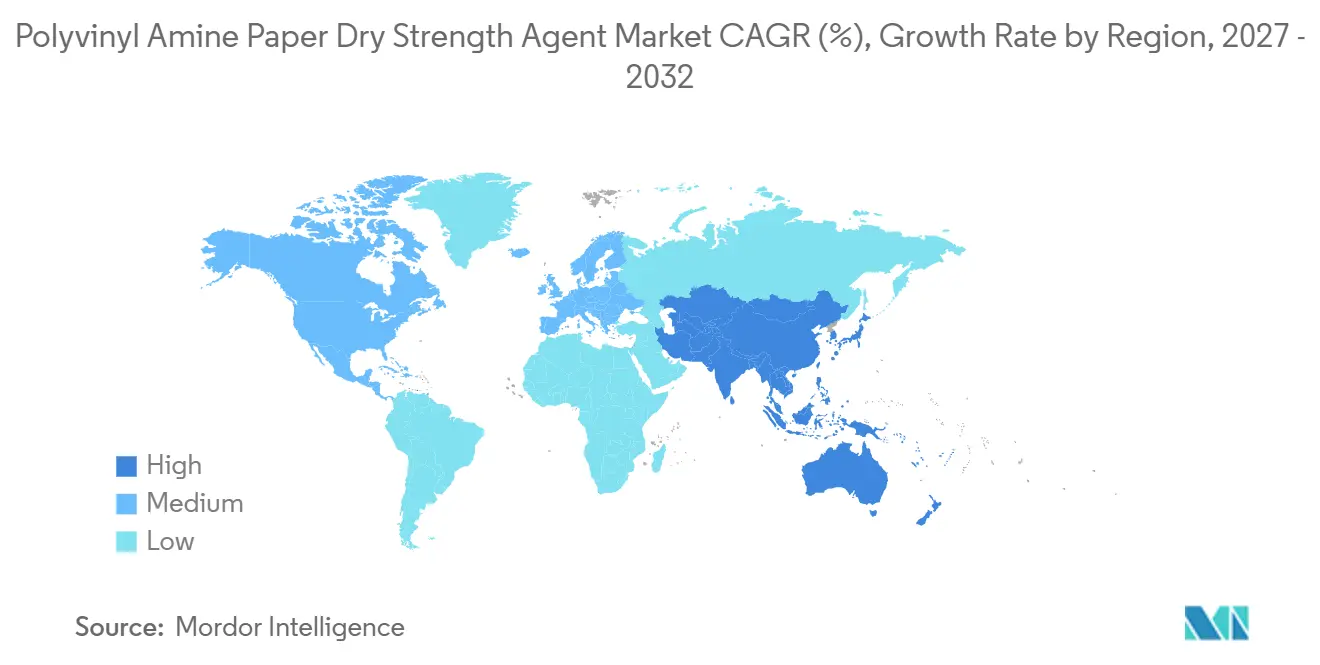
Asia-Pacific held 42.92% of the polyvinyl amine paper dry strength agent market share in 2026 and is projected to advance at a 7.38% CAGR through 2032. Packaging demand, paper-machine investment, and higher recycled-fiber use underpin regional consumption. China, India, and Southeast Asia are important because new mills commonly install conventional wet-end dosing equipment. Export-oriented Chinese mills face customer requirements for more consistent paper and board quality. Environmental standards in Indonesia and India also encourage more closed-loop water management. These conditions increase the value of additives that can perform in higher conductivity furnishes.
Kemira Oyj announced in March 2025 that it would expand strength-chemical capacity at Wellgrow, Thailand, to serve Southeast Asian and Indian customers[2]. The expanded site reached approximately 100,000 metric tons of total strength-chemical capacity in August 2026. North America remains an important area for the polyvinyl amine paper dry strength agent market because its paper mills use substantial recycled fiber. Packaging paper production grew in 2025 despite a decline in total United States paper output. Functional paper formats can gain importance as restrictions affect fluorochemical-coated papers. This favors paper substrates that need strength performance without relying on conventional barrier systems.
Europe remains a technically advanced region for polyvinyl amine chemistry, especially in Nordic and Central European paper mills. Circularity rules and the Packaging and Packaging Waste Regulation support greater recycled content in corrugated packaging. The polyvinyl amine paper dry strength agent market benefits when recycled content increases the need for dry-strength compensation. South America and the Middle East and Africa represent smaller demand areas with room for adoption. Brazil supports South American demand through its integrated pulp and paper sector and expanding packaging capacity. Saudi Arabia and South Africa support Middle East and Africa demand through converting investment for food, beverage, and retail use. These regions are at an earlier stage of adoption, but their packaging requirements are moving in a similar direction.
Competitive Landscape
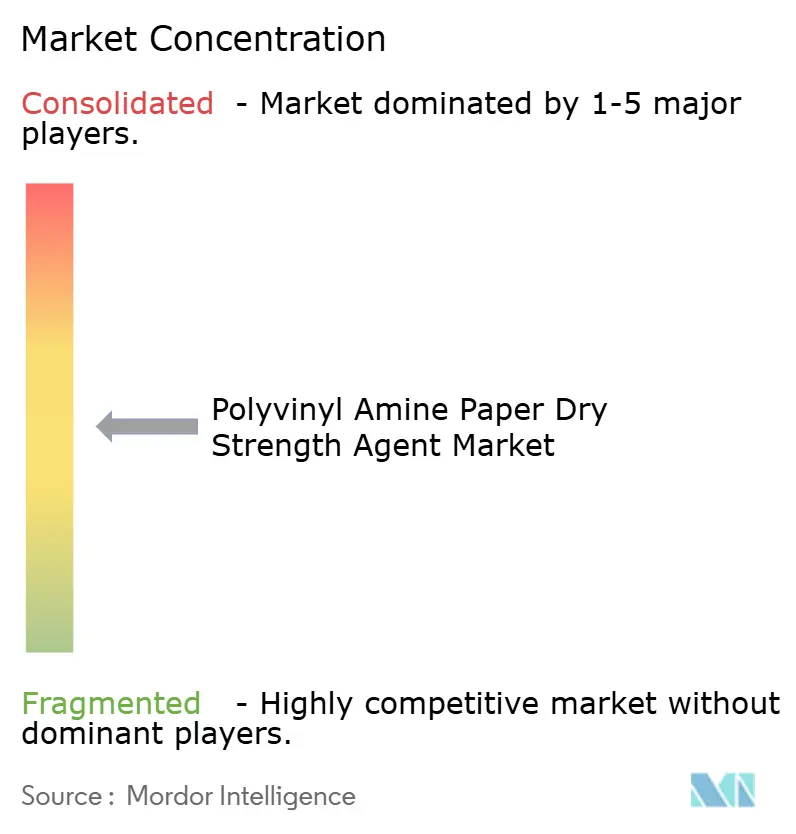
The polyvinyl amine paper dry strength agent market is moderately concentrated, with the top five players including BASF, Kemira Oyj, Solenis, SNF Group, and Harima Chemicals Group, Inc. Kemira Oyj, Solenis, and SNF Group influence product development through integrated N-vinylformamide-to-polyvinyl amine capabilities and digital dosing services. Solenis uses its Xelorex platform to link additive delivery with real-time dry-end strength information. This service model can make switching more difficult because the supplier relationship extends beyond the chemical itself. Kemira Oyj reorganized its business into 3 focused units in January 2025, including Packaging & Hygiene Solutions and Fiber Essentials. The change sharpened its commercial focus on paper and board strength chemistry.
SNF Group commissioned its Dunkirk facility in December 2024 under a licensing agreement with Mitsubishi Chemical Corporation. The project supports European access to N-vinylformamide-based polymers and related polyvinyl amine products. BASF launched paper coating dispersions in September 2026 with product carbon footprints 20%-45% lower than conventional grades, using the Together for Sustainability methodology. BASF and UPM also announced a collaboration in May 2026 that combines barrier papers with waterborne resins for recyclable fiber-based packaging. These actions show that suppliers are competing through lower-carbon paper chemistry and recyclable packaging applications as well as dry-strength performance.
Shandong Tiancheng Chemical Co., Ltd. and Wuxi Lansen Chemicals Co., Ltd. compete in standard liquid grades, particularly for commodity containerboard uses in China. Their movement into modified and copolymer products is limited by the need for tight hydrolysis control and more advanced analytical capability. Arakawa Chemical Industries, Ltd., Harima Chemicals Group, Inc., Nitto Boseki Co., Ltd., and Seiko PMC Corporation serve specialty paper requirements with products tailored to high-filler and neutral-pH furnishes. Applied Chemicals International Group, Buckman, KURARAY CO., LTD., Nouryon, and Solenis contribute to the wider paper-chemicals competitive field. SNF Group and BASF also have positions across adjacent polymer and process-chemistry categories. Supplier differentiation in the polyvinyl amine paper dry strength agent market depends on technical service, supply reliability, process knowledge, and the ability to support more demanding furnishes.
Polyvinyl Amine Paper Dry Strength Agent Industry Leaders
-
BASF
-
Kemira Oyj
-
Solenis
-
SNF Group
-
Harima Chemicals Group, Inc.
- *Disclaimer: Major Players sorted in no particular order
Recent Industry Developments
- April 2026: Solenis broke ground on a new 60,000-metric-ton production facility in Beihai, Guangxi, China, with an investment of RMB 250 million (approximately USD 35 million). Scheduled to begin operations in the second quarter of 2027, the facility will produce polymers, defoamers, silica, and process chemicals, strengthening regional supply of papermaking chemicals, including solutions used to improve paper strength.
- March 2026: Kemira Oyj expanded its Wellgrow, Thailand production site to approximately 100,000 metric tons per year of total strength-chemical capacity. The expansion strengthens the supply of paper and board strength agents for Southeast Asian and Indian markets, supporting demand for dry-strength additives in papermaking.
Global Polyvinyl Amine Paper Dry Strength Agent Market Report Scope
Polyvinyl amine paper dry strength agents are chemical additives used in papermaking to improve the strength and durability of paper under dry conditions. They enhance fiber-to-fiber bonding, helping paper products maintain their mechanical integrity during converting, handling, and end use.
The Polyvinyl Amine Paper Dry Strength Agent Market is segmented by product type, form, application, and geography. By product type, the market is segmented into polyvinyl amine, modified polyvinyl amine, polyvinyl amine copolymers, and other product types. By form, the market is segmented into liquid, powder, and granules. By application, the market is segmented into packaging paper, printing and writing paper, tissue and hygiene paper, specialty paper, and other applications. The report also covers the market size and forecasts for polyvinyl amine paper dry strength agents across 15 countries. For each segment, the market sizing and forecasts have been done on the basis of value (USD).
| Polyvinyl Amine |
| Modified Polyvinyl Amine |
| Polyvinyl Amine Copolymers |
| Other Product Types |
| Liquid |
| Powder |
| Granules |
| Packaging Paper |
| Printing and Writing Paper |
| Tissue and Hygiene Paper |
| Specialty Paper |
| Other Applications |
| Asia-Pacific | China |
| India | |
| Japan | |
| South Korea | |
| Rest of Asia-Pacific | |
| North America | United States |
| Canada | |
| Mexico | |
| Europe | Germany |
| United Kingdom | |
| France | |
| Italy | |
| Rest of Europe | |
| South America | Brazil |
| Argentina | |
| Rest of South America | |
| Middle East and Africa | Saudi Arabia |
| South Africa | |
| Rest of Middle East and Africa |
| By Product Type | Polyvinyl Amine | |
| Modified Polyvinyl Amine | ||
| Polyvinyl Amine Copolymers | ||
| Other Product Types | ||
| By Form | Liquid | |
| Powder | ||
| Granules | ||
| By Application | Packaging Paper | |
| Printing and Writing Paper | ||
| Tissue and Hygiene Paper | ||
| Specialty Paper | ||
| Other Applications | ||
| By Geography | Asia-Pacific | China |
| India | ||
| Japan | ||
| South Korea | ||
| Rest of Asia-Pacific | ||
| North America | United States | |
| Canada | ||
| Mexico | ||
| Europe | Germany | |
| United Kingdom | ||
| France | ||
| Italy | ||
| Rest of Europe | ||
| South America | Brazil | |
| Argentina | ||
| Rest of South America | ||
| Middle East and Africa | Saudi Arabia | |
| South Africa | ||
| Rest of Middle East and Africa | ||
Key Questions Answered in the Report
What is the size of the polyvinyl amine paper dry strength agent market?
The polyvinyl amine paper dry strength agent market size was valued at USD 300.48 million in 2026 and is estimated to grow from USD 317.76 million in 2027 to reach USD 428.04 million by 2032, at a CAGR of 6.14% during the forecast period (2027-2032).
What is driving demand for polyvinyl amine paper dry strength agents?
Packaging growth, recycled-fiber use, lightweighting, specialty paper demand, and closed-loop water systems support use of higher-performance dry-strength chemistry.
Which product type held the largest share in 2026?
Polyvinyl amine held 55.13% of the market share in 2026, supported by established use in containerboard and graphic paper furnishes.
Which application is projected to advance fastest through 2032?
Specialty paper is projected to advance at a 7.41% CAGR through 2032 because demanding paper grades need dependable strength and surface properties.