
Polyurethane Recycling Catalysts Market Size and Share
Market Overview
| Study Period | 2022 - 2032 |
|---|---|
| Market Size (2027) | USD 28.72 Million |
| Market Size (2032) | USD 39.79 Million |
| Growth Rate (2027 - 2032) | 6.74 % |
| Fastest Growing Market | Asia-Pacific |
| Largest Market | Asia-Pacific |
| Market Concentration | Medium |
Major Players *Disclaimer: Major Players sorted in no particular order Image © Mordor Intelligence. Reuse requires attribution under CC BY 4.0. | |
Polyurethane Recycling Catalysts Market Analysis by Mordor Intelligence
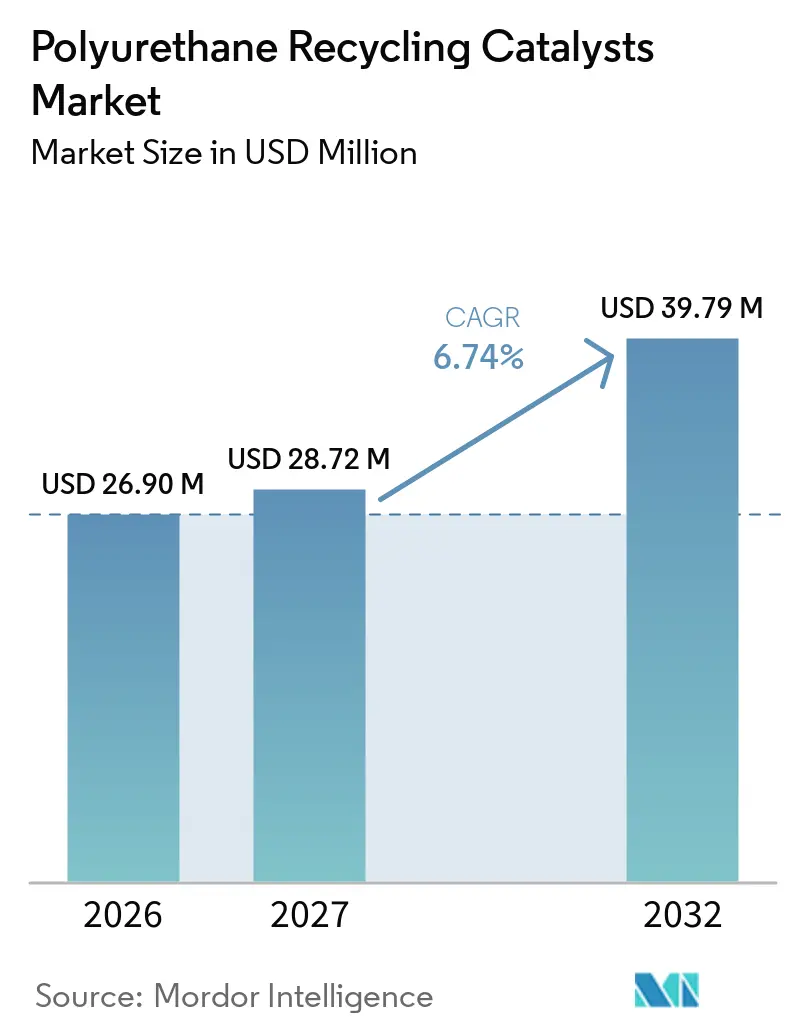
The Polyurethane Recycling Catalysts Market size was valued at USD 26.90 million in 2026 and is estimated to grow from USD 28.72 million in 2027 to reach USD 39.79 million by 2032, at a CAGR of 6.74% during the forecast period (2027-2032). Regulatory requirements are moving polyurethane recycling from voluntary activity toward documented supply-chain compliance, especially in Europe. The Packaging and Packaging Waste Regulation entered into force in February 2025, while the EU policy framework for end-of-life vehicles has strengthened the focus on recycled materials in vehicles. This change is encouraging foam producers, automotive suppliers, and recyclers to assess catalyst systems before detailed compliance requirements take effect. The polyurethane recycling catalysts market is also shaped by the ability to produce recovered polyols that meet formulation requirements, rather than merely achieving material recovery. Suppliers that combine catalyst expertise with polyol offtake and formulation support can reduce qualification risk for customers. In Asia-Pacific, expanded chemical recycling capacity and new approaches to mixed-waste processing support demand, while high energy use, feedstock contamination, and lengthy qualification cycles remain material constraints.
Key Report Takeaways
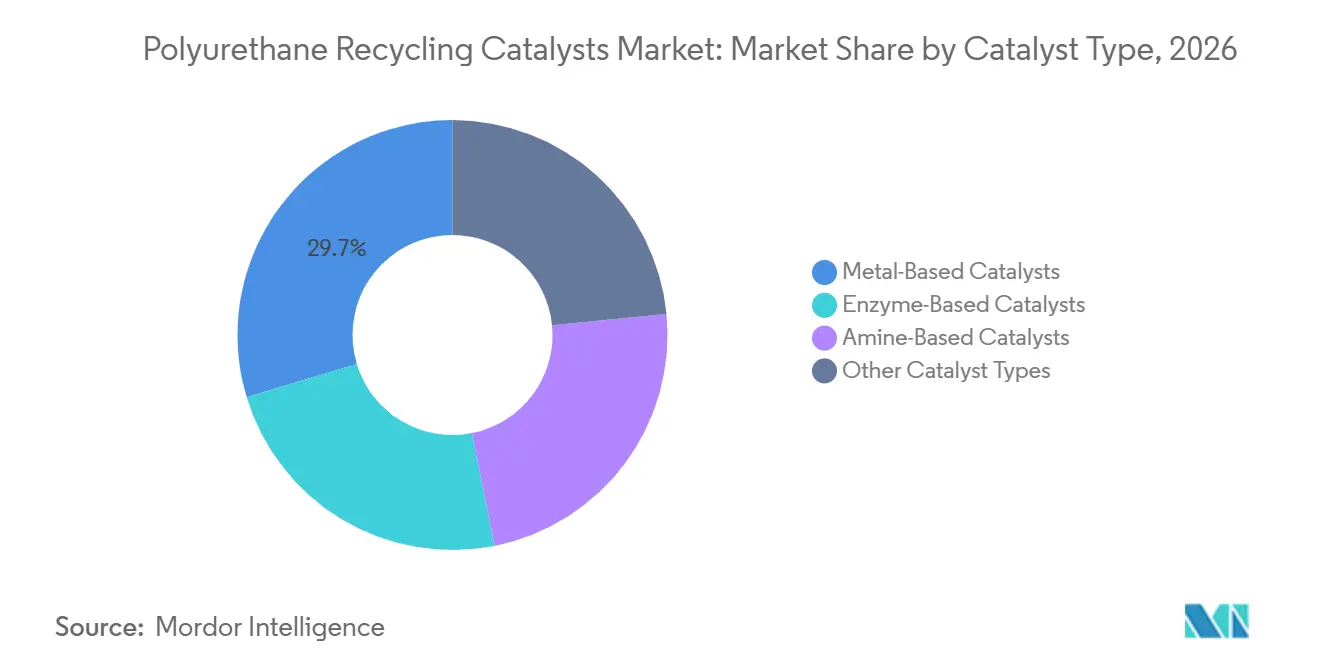
- By catalyst type, amine-based catalysts held 29.67% of the polyurethane recycling catalysts market share in 2026, while enzyme-based catalysts are projected to advance at an 8.13% CAGR through 2032.
- By recycling process, glycolysis held 31.53% of the polyurethane recycling catalysts market share in 2026, while aminolysis is projected to advance at a 7.67% CAGR through 2032.
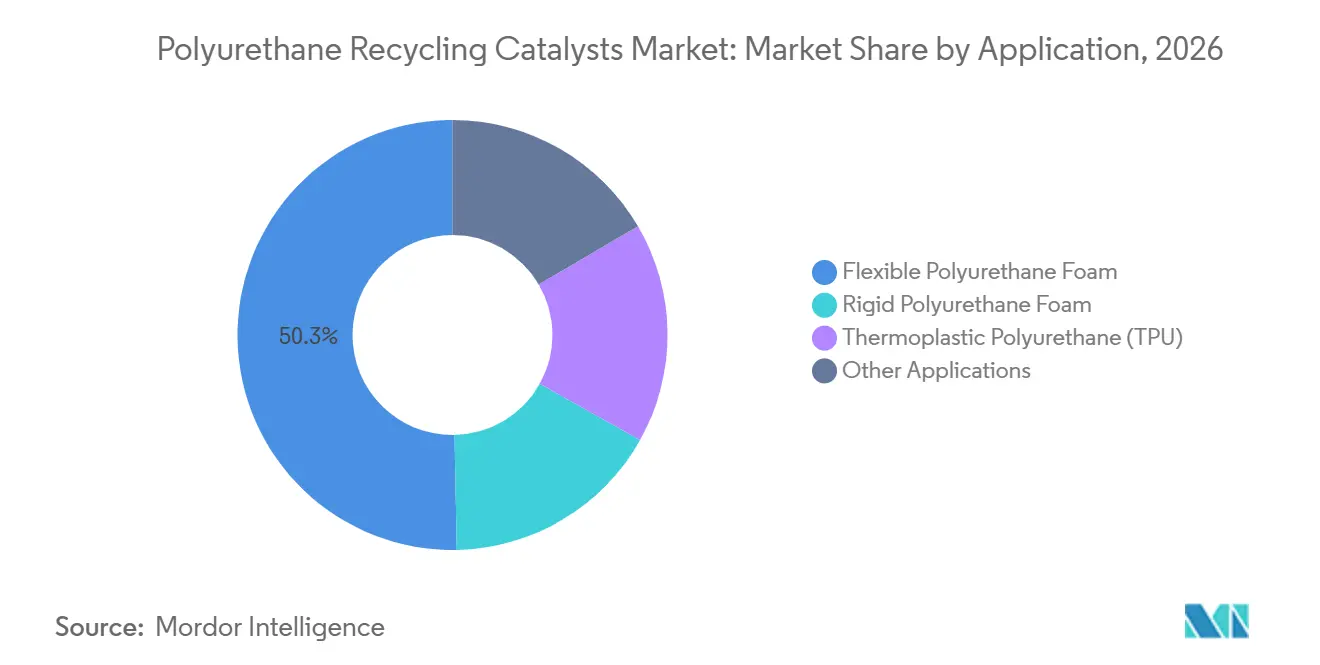
- By application, flexible polyurethane foam held 50.32% of the polyurethane recycling catalysts market share in 2026, while thermoplastic polyurethane is projected to advance at an 8.11% CAGR through 2032.
- By geography, Asia-Pacific held 40.25% of the polyurethane recycling catalysts market share in 2026, while Asia-Pacific is projected to advance at a 7.83% CAGR through 2032.
Note: Market numbers in this report are based on Mordor Intelligence's proprietary estimation framework, which combines nine months of actuals with Q4 projections for base year 2026.
Global Polyurethane Recycling Catalysts Market Trends and Insights
Drivers Impact Analysis*
| Driver | (~) % Impact on CAGR Forecast | Geographic Relevance | Impact Timeline |
|---|---|---|---|
| Regulatory Push for Recycled Content and End-of-Life PU Recovery | +1.8% | Global; EU as primary regulatory standard-setter with active spillover to APAC and North America | Medium term (2-4 years) |
| Demand for High-Quality Recycled Polyols and Chemical Feedstocks | +1.5% | Global; most pronounced in North America and Europe where foam formulator specifications are established | Medium term (2-4 years) |
| Automotive Closed-Loop Seating Programs | +1.2% | North America, Europe, and East Asia (OEM manufacturing hubs) | Short term (≤ 2 years) |
| Commercialization of Catalyst-Enabled Depolymerization | +0.9% | Global; early-mover gains in Europe and Asia-Pacific | Long term (≥ 4 years) |
| Lower-Temperature Catalytic Routes and Catalyst Recovery | +0.7% | Global; cost-sensitive scale-up concentrated in Asia-Pacific | Medium term (2-4 years) |
| Source: Mordor Intelligence | |||
Regulatory Push for Recycled Content and End-of-Life PU Recovery
The Packaging and Packaging Waste Regulation entered into force in February 2025 and increased the importance of verified recycled content in relevant product systems[1]. The EU framework for end-of-life vehicles also directs attention toward recycled plastic content in new vehicles. Automotive seating and insulation foam create sizable recoverable polyurethane streams, and chemical routes are important when foam-grade materials must be returned to production. The European Commission launched a consultation on the Circular Economy Act in August 2025, with the initiative intended to strengthen the market for secondary materials. These policy actions encourage original equipment manufacturers and foam formulators to begin catalyst qualification earlier. The polyurethane recycling catalysts market benefits when early partnerships position suppliers for contracts that extend beyond initial compliance dates.
Demand for High-Quality Recycled Polyols and Chemical Feedstocks
Recovered polyol quality remains central to the commercial case for chemical recycling. Glycolysis and aminolysis can produce material with properties more suitable for reformulation than mechanical recycling output. BASF presented circular footwear solutions at SIMAC 2025, including thermoplastic polyurethane grades with up to 100% recycled content. Researchers at the University of Tokyo and Kyushu University reported in July 2026 a catalyst that selectively depolymerized polyurethane in mixed plastic waste while leaving polyester and polyamide chains intact. This work addresses contamination that can limit the consistency of recovered polyols from mixed waste. Research published in 2025 also showed 40% virgin-polyol substitution at near-identical hydroxyl value and viscosity. The polyurethane recycling catalysts market gains when recovered feedstocks can meet the higher recycled-content thresholds sought by buyers.
Automotive Closed-Loop Seating Programs
Dow, JLR, and Adient began production-scale testing in early 2025 of closed-loop polyurethane seat foam containing 20% re-polyol from Dow’s RENUVA technology[2]. JLR planned to introduce the material in 2026 production vehicles, and the project reported a 50% carbon dioxide reduction per seat in its lifecycle assessment. Dow and Gruppo Fiori announced in September 2025 a process to recover polyurethane from end-of-life vehicles without disassembly. The process targets the 28 kg of polyurethane found in a typical vehicle. Automotive specifications create a higher-value use case because they require controlled aromatic amine residuals, color, and hydroxyl values. Validated automotive systems can also help suppliers demonstrate performance for appliance and construction foam applications.
Commercialization of Catalyst-Enabled Depolymerization
BASF launched its ChemCycling program polyurethane recycling program at CHINAPLAS in March 2025 for footwear, automotive, and synthetic leather applications. The program uses advanced liquefaction technology for post-industrial and post-consumer waste. Evonik Industries AG’s hydrolysis approach supports foam formulations with up to 100% recycled polyol and received recognition through the interzum Award 2025 and German Design Council Innovation Award 2026. These projects show that customers increasingly expect more than catalyst supply. They also need material offtake, formulation support, and reliable process data. BASF’s December 2025 patent application for glycolysis-based recycled-polyol production from polyisocyanurate foam shows that established suppliers are also extending intellectual property coverage across foam chemistries.
Restraints Impact Analysis*
| Restraint | (~) % Impact on CAGR Forecast | Geographic Relevance | Impact Timeline |
|---|---|---|---|
| High Energy, Reagent, and Purification Costs | -1.8% | Global; most acute in regions without subsidized industrial energy, including parts of Europe and North America | Short term (≤ 2 years) |
| Contamination and Inconsistent Feedstock Quality | -1.4% | Global; most severe in APAC and MEA where waste sorting infrastructure is still developing | Medium term (2-4 years) |
| Recovered-Polyol Quality and Qualification Risk | -1.0% | North America and Europe, where foam formulator specifications are most stringent | Long term (≥ 4 years) |
| Source: Mordor Intelligence | |||
High Energy, Reagent, and Purification Costs
Standard polyurethane foam glycolysis requires reaction temperatures of 180-250 °C and excess glycol reagent. Energy and reagent use therefore remain major cost variables for the polyurethane recycling catalysts market. Removing aromatic amine residuals, metal traces, and excess glycol can account for 30-50% of total depolymerization cost in complex feedstock cases. A 2025 Nature Communications assessment estimated total process cost at USD 0.59 per kg. A 2026 ACS Sustainable Chemistry & Engineering study reported 85% polyol recovery within 1 hour at 100 °C using low-temperature hydroalcoholytic depolymerization. Higher-volume, lower-margin applications may remain slower to adopt these routes until energy costs and catalyst recovery meet commercial requirements.
Contamination and Inconsistent Feedstock Quality
Post-consumer polyurethane waste often contains adhesives, flame retardants, fibrous facings, and different foam grades. These materials can poison catalysts or cause variations in recovered polyol quality. Sorting and pretreatment add cost and limit the accessible feedstock base for chemical recycling. A 2025 Journal of Materials Chemistry A study found that controlled aminolysis could separate polyurethane layers from textile substrates and recover oligomers for waterborne polyurethane emulsions with 50% virgin-polyol substitution. This pretreatment adds complexity that many collection systems do not yet support. In regions with variable collection quality, selective catalyst systems for mixed polymer waste can provide a mitigation path, but their commercial adoption will take time.
*Our forecasts treat driver/restraint impacts as directional, not additive. The impact forecasts reflect baseline growth, mix effects, and variable interactions.
Segment Analysis
By Catalyst Type: Amine-Based Catalysts Lead Revenue, While Enzyme-Based Catalysts Advance Growth
Amine-based catalysts held 29.67% of the polyurethane recycling catalysts market share in 2026. Their position reflects established use in glycolysis, where tertiary amines speed urethane-bond cleavage and work with conventional reactor systems. Metal-based catalysts include zinc acetate, potassium hydroxide, and bismuth systems. Concerns about metal residues in recovered polyols are encouraging developers to consider metal-ion-free alternatives.
Enzyme-based catalysts are projected to advance at an 8.13% CAGR through 2032, giving this group the strongest growth rate in the catalyst type analysis. A June 2025 ACS Catalysis paper reported that urethanase variant P367A/L381A had 2.8 times the hydrolytic activity of the wild type and produced 10.9 times more monomers from commercial toluene diisocyanate (TDI)-based polyurethane foam. A 2025 Science publication described AbPURase, identified through the GRASE framework, as enabling near-complete depolymerization of commercial polyurethane at kg scale within 8 hours. It reported activity 2 orders of magnitude higher than previously known urethanases under glycolysis conditions. Enzymatic systems can provide aromatic amine-free monomer streams, which can reduce purification needs for automotive and medical foam applications.

By Recycling Process: Glycolysis Leads While Aminolysis Expands
Glycolysis accounted for 31.53% of the polyurethane recycling catalysts market size in 2026. It has an established industrial base, broad substrate tolerance, and accumulated process knowledge. A key development is the replacement of alkali metal hydroxide catalysts, which can leave metal ions that lead to gel formation in recovered polyol. Metal-ion-free amine and ionic-liquid systems can address this issue. The 2025 Royal Society of Chemistry (RSC) Green Chemistry study achieved full foam depolymerization in 4–5 hours below 100 °C with a reused catalyst-medium system.
Aminolysis is projected to advance at a 7.67% CAGR through 2032. It can recover both polyol and aromatic amines, including toluene diamine and methylene diphenyl diamine, within one process step. This dual-stream output can improve economics when amine prices support recovery. The 2025 Journal of Materials Chemistry A work showed controlled aminolysis across multilayer polyurethane composites, including foam, elastane blends, and coated textiles. The resulting oligomers were used in waterborne polyurethane emulsions at 50% virgin-polyol substitution. Under recycled-content verification requirements, recovering 2 output streams can strengthen attributable recycling yield.
By Application: Flexible Polyurethane Foam Provides Revenue, While Thermoplastic Polyurethane Builds Faster Demand
Flexible polyurethane foam held 50.32% of the polyurethane recycling catalysts market share in 2026. This application benefits from large post-consumer streams from mattresses, furniture, and automotive seating. Collection programs already exist for several of these foam sources. Dow, JLR, and Adient tested closed-loop seat foam with 20% re-polyol at production scale during early 2025. Rigid polyurethane foam requires adapted approaches because of higher isocyanate indices and polyisocyanurate hard segments.
Thermoplastic polyurethane is projected to advance at an 8.11% CAGR through 2032. Repeated mechanical processing can lower molecular weight by up to 80%, creating a need for catalyst-supported upgrading of recycled material. BASF introduced Elastollan RC with up to 100% recycled content at SIMAC 2025. Covestro AG’s Leverkusen pilot supports chemical recycling of Vulkollan elastomers and targets circular solutions for thermoplastic polyurethane. Mono-material product designs for footwear, electric vehicle interiors, and wearable products increase the importance of feedstock purity.
Geography Analysis
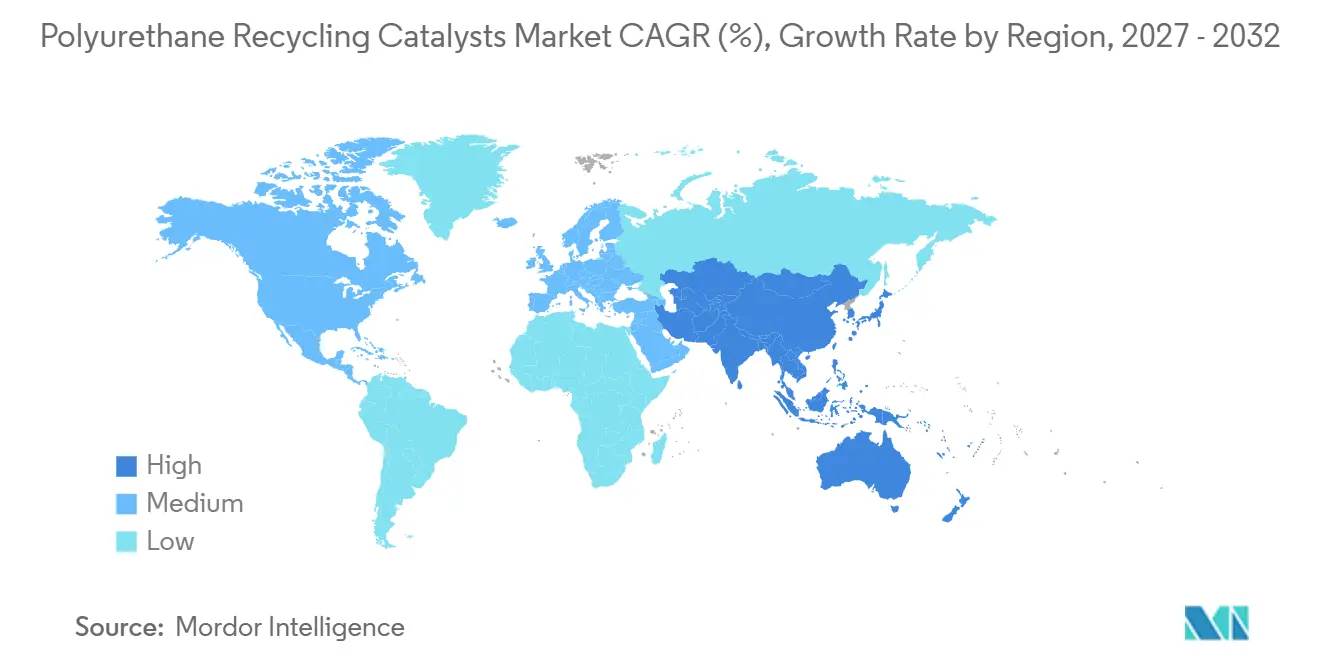
Asia-Pacific held 40.25% of the polyurethane recycling catalysts market size in 2026 and is projected to advance at a 7.83% CAGR through 2032. China combines a major polyurethane production base with large volumes of post-consumer polyurethane waste. China’s recycled-content requirements and expanded Extended Producer Responsibility programs for foam-containing goods support demand for depolymerization capacity. Japan is developing catalyst approaches for more selective processing of mixed waste. In July 2026, the University of Tokyo and Kyushu University reported a catalyst that processed polyurethane while retaining polyester and polyamide chains.
Europe and North America act as regulatory and commercial anchors for the polyurethane recycling catalysts market. European requirements include the Packaging and Packaging Waste Regulation, end-of-life vehicle policy, and work on the Circular Economy Act. Germany remains important for technology development, where BASF produces its Lupragen amine catalyst range in Ludwigshafen and introduced Lupragen N 208 in December 2025. Covestro AG’s facilities in Leverkusen and Krefeld support elastomer and rigid-foam development. Evonik Industries AG’s circular polyurethane platform also reinforces European activity. These actions connect regulatory requirements with suppliers that can provide material, process, and formulation support.
South America and the Middle East and Africa represent smaller shares, with different near-term conditions. Brazil and Argentina can benefit from automotive supply chains that respond to circular-content requirements from global original equipment manufacturers. Repsol’s chemical recycling investments could gain regional relevance as capacity expands. The Middle East and Africa face limited post-consumer polyurethane collection infrastructure. Saudi Arabia’s industrial diversification programs and South Africa’s manufacturing base remain focused demand centers. The region’s role in producing virgin methylene diphenyl diisocyanate and polyol precursors provides an incentive to develop domestic recovery capacity as recovered-polyol quality improves.
Competitive Landscape
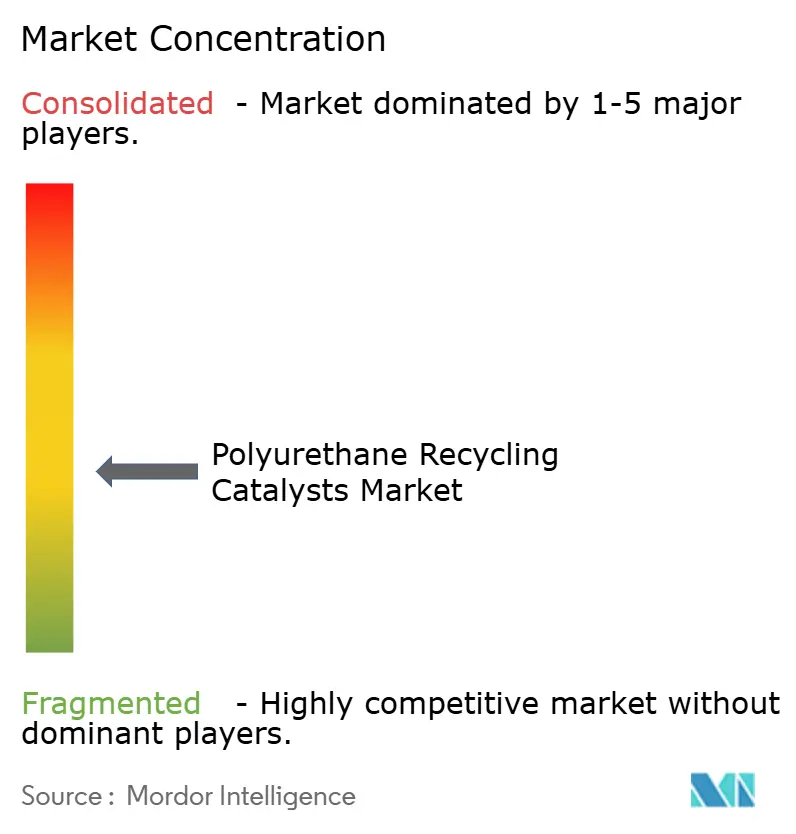
The polyurethane recycling catalysts market is moderately concentrated, with the top five players including BASF, Evonik Industries AG, Covestro AG, Huntsman International LLC, and RAMPF Holding GmbH & Co. KG. Suppliers seek to control catalyst technology, depolymerization intellectual property, recycled-polyol supply, and formulation support. BASF combines its ChemCycling program program with its Lupragen product line and recycled-polyol process development. This approach can make a formulator reliant on a single provider across several stages of the recycling chain.
BASF introduced Lupragen N 208 in December 2025 as a low-volatile organic compound reactive amine catalyst that becomes integrated into the polyurethane network during foaming. Covestro AG uses several routes, including Vulkollan chemolysis, smart pyrolysis, and enzymatic recycling. Covestro AG and Fraunhofer UMSICHT agreed in March 2026 to build a smart-pyrolysis pilot for rigid polyurethane and polyisocyanurate foam. Evonik Industries AG’s hydrolysis route supports formulations containing up to 100% recycled polyol. Broad technology coverage is important because one catalyst chemistry does not fit every foam substrate.
Opportunities remain in recoverable catalysts for continuous-flow reactors, industrial enzyme preparations, and systems validated for contaminated waste. Purtiso BV, RAMPF Holding GmbH & Co. KG, and H&S Anlagentechnik GmbH offer equipment and catalyst packages that can reduce implementation risk for newer recyclers. Umicore’s precious-metal catalyst platform places added attention on catalyst-recovery economics. The polyurethane recycling catalysts industry may see stronger competition from biocatalytic systems if performance shown for AbPURase is translated into industrial operation. These systems could challenge established amine catalysts in flexible foam and thermoplastic polyurethane applications within the forecast period. The polyurethane recycling catalysts market also requires solutions that continue to work with adhesive-laden construction foam and flame-retardant-treated automotive foam. A recoverable catalyst can improve economics when it can be reused without compromising output quality. Equipment suppliers can support early projects by integrating separation, reaction, and recovery needs into one process package. These capabilities matter because commercial recyclers must manage feedstock variability as well as catalyst performance.
Polyurethane Recycling Catalysts Industry Leaders
-
BASF
-
Evonik Industries AG
-
Covestro AG
-
Huntsman International LLC
-
RAMPF Holding GmbH & Co. KG
- *Disclaimer: Major Players sorted in no particular order
Recent Industry Developments
- March 2026: Covestro AG and Fraunhofer UMSICHT signed an agreement for a 2,000-ton-per-year smart pyrolysis pilot plant to recycle rigid polyurethane foam waste into high-purity aniline. The project supports the market by advancing catalyst-assisted chemical recycling technologies for recovering raw materials from PU insulation waste.
- September 2025: Dow and Gruppo Fiori advanced a joint process to recover polyurethane waste from end-of-life vehicles without disassembly, producing a stream suitable for chemical depolymerization. The process improves access to PU feedstock and supports the polyurethane recycling catalysts market by enabling more efficient chemical recycling of automotive polyurethane waste.
Global Polyurethane Recycling Catalysts Market Report Scope
Polyurethane recycling catalysts are chemical or biological catalysts used to facilitate the breakdown and recovery of polyurethane materials into reusable chemical components. They help improve reaction efficiency and enable the recovery of materials from polyurethane waste for use in new products.
The Polyurethane Recycling Catalysts Market is segmented by catalyst type, recycling process, application, and geography. By catalyst type, the market is segmented into metal-based catalysts, amine-based catalysts, enzyme-based catalysts, and other catalyst types. By recycling process, the market is segmented into glycolysis, hydrolysis, aminolysis, and other recycling processes. By application, the market is segmented into flexible polyurethane foam, rigid polyurethane foam, thermoplastic polyurethane (TPU), and other applications. The report also covers the market size and forecasts for polyurethane recycling catalysts across 15 countries. For each segment, the market sizing and forecasts have been done on the basis of value (USD).
| Metal-Based Catalysts |
| Amine-Based Catalysts |
| Enzyme-Based Catalysts |
| Other Catalyst Types |
| Glycolysis |
| Hydrolysis |
| Aminolysis |
| Other Recycling Processes |
| Flexible Polyurethane Foam |
| Rigid Polyurethane Foam |
| Thermoplastic Polyurethane (TPU) |
| Other Applications |
| Asia-Pacific | China |
| India | |
| Japan | |
| South Korea | |
| ASEAN Countries | |
| Rest of Asia-Pacific | |
| North America | United States |
| Canada | |
| Mexico | |
| Europe | Germany |
| United Kingdom | |
| France | |
| Italy | |
| NORDIC Countries | |
| Rest of Europe | |
| South America | Brazil |
| Argentina | |
| Rest of South America | |
| Middle East and Africa | Saudi Arabia |
| South Africa | |
| Rest of Middle East and Africa |
| By Catalyst Type | Metal-Based Catalysts | |
| Amine-Based Catalysts | ||
| Enzyme-Based Catalysts | ||
| Other Catalyst Types | ||
| By Recycling Process | Glycolysis | |
| Hydrolysis | ||
| Aminolysis | ||
| Other Recycling Processes | ||
| By Application | Flexible Polyurethane Foam | |
| Rigid Polyurethane Foam | ||
| Thermoplastic Polyurethane (TPU) | ||
| Other Applications | ||
| By Geography | Asia-Pacific | China |
| India | ||
| Japan | ||
| South Korea | ||
| ASEAN Countries | ||
| Rest of Asia-Pacific | ||
| North America | United States | |
| Canada | ||
| Mexico | ||
| Europe | Germany | |
| United Kingdom | ||
| France | ||
| Italy | ||
| NORDIC Countries | ||
| Rest of Europe | ||
| South America | Brazil | |
| Argentina | ||
| Rest of South America | ||
| Middle East and Africa | Saudi Arabia | |
| South Africa | ||
| Rest of Middle East and Africa | ||
Key Questions Answered in the Report
What is the size of the polyurethane recycling catalysts market?
The Polyurethane Recycling Catalysts Market size was valued at USD 26.90 million in 2026 and is estimated to grow from USD 28.72 million in 2027 to reach USD 39.79 million by 2032, at a CAGR of 6.74% during the forecast period (2027-2032).
What is driving demand for polyurethane recycling catalysts?
Recycled-content requirements, automotive closed-loop seating programs, and demand for high-quality recovered polyols are supporting adoption.
Which catalyst type is projected to advance fastest through 2032?
Enzyme-based catalysts are projected to advance at an 8.13% CAGR through 2032.
Which recycling process held the largest share in 2026?
Glycolysis held a 31.53% share in 2026 because of its industrial scale, substrate tolerance, and established process base.