
Poly (Butylene Adipate-Co-Terephthalate) Market Size and Share
Market Overview
| Study Period | 2021 - 2031 |
|---|---|
| Market Size (2026) | USD 2.01 Billion |
| Market Size (2031) | USD 3.02 Billion |
| Growth Rate (2026 - 2031) | 8.53 % |
| Fastest Growing Market | Asia-Pacific |
| Largest Market | Asia-Pacific |
| Market Concentration | Medium |
Major Players *Disclaimer: Major Players sorted in no particular order Image © Mordor Intelligence. Reuse requires attribution under CC BY 4.0. | |
Poly (Butylene Adipate-Co-Terephthalate) Market Analysis by Mordor Intelligence
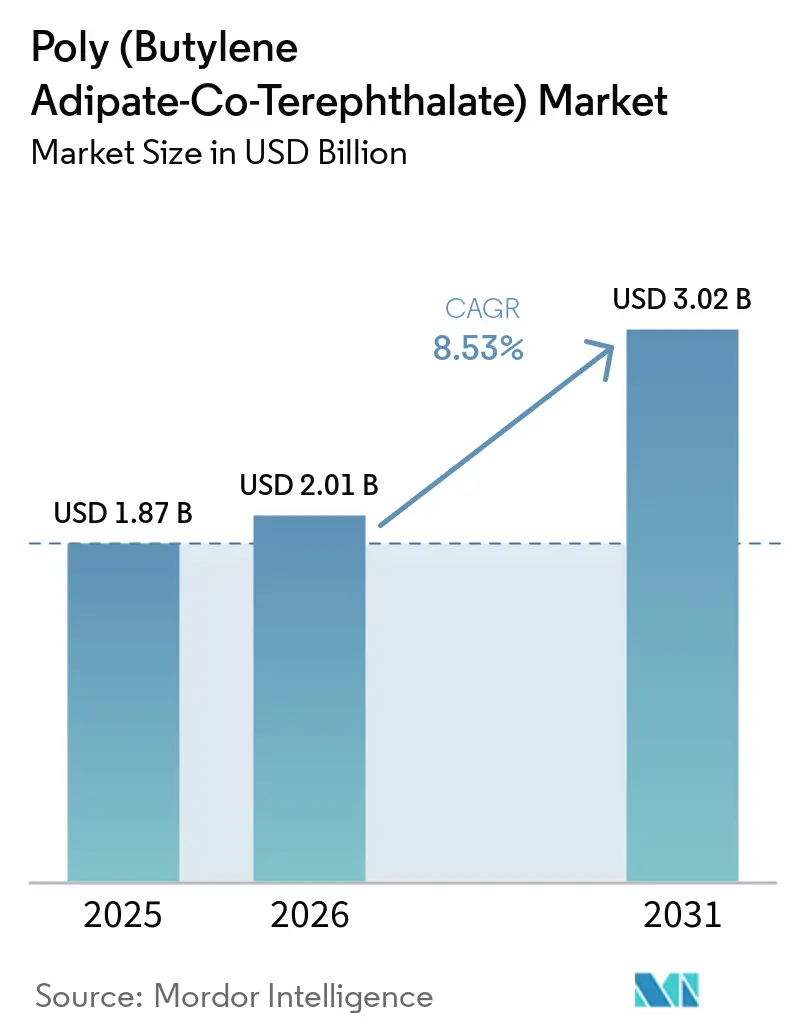
The poly (butylene adipate-co-terephthalate) (PBAT) market size was valued at USD 1.87 billion in 2025 and is projected to grow from USD 2.01 billion in 2026 to USD 3.02 billion by 2031, at a CAGR of 8.53% during the forecast period (2026-2031). Packaging regulations are influencing the poly (butylene adipate-co-terephthalate) (PBAT) market by making certified compostability a purchasing requirement for selected formats and a condition for access to regulated applications. Regulation (EU) 2025/40 establishes a pathway for compostable packaging. Its application date in February 2028 is prompting brands and converters to qualify materials in advance. China’s restrictions on certain non-degradable plastic products are also supporting substitution demand. However, excess supply is placing pressure on commodity-grade prices and limiting smaller producers’ ability to compete on price. Performance improvements in PBAT blends are expanding the range of flexible packaging, foodservice, and agricultural applications that meet operational requirements while retaining the mechanical properties converters require. The PBAT market benefits suppliers that offer certified grades, consistent processing performance, qualified supply arrangements, and material support throughout the customer qualification process.
Key Report Takeaways
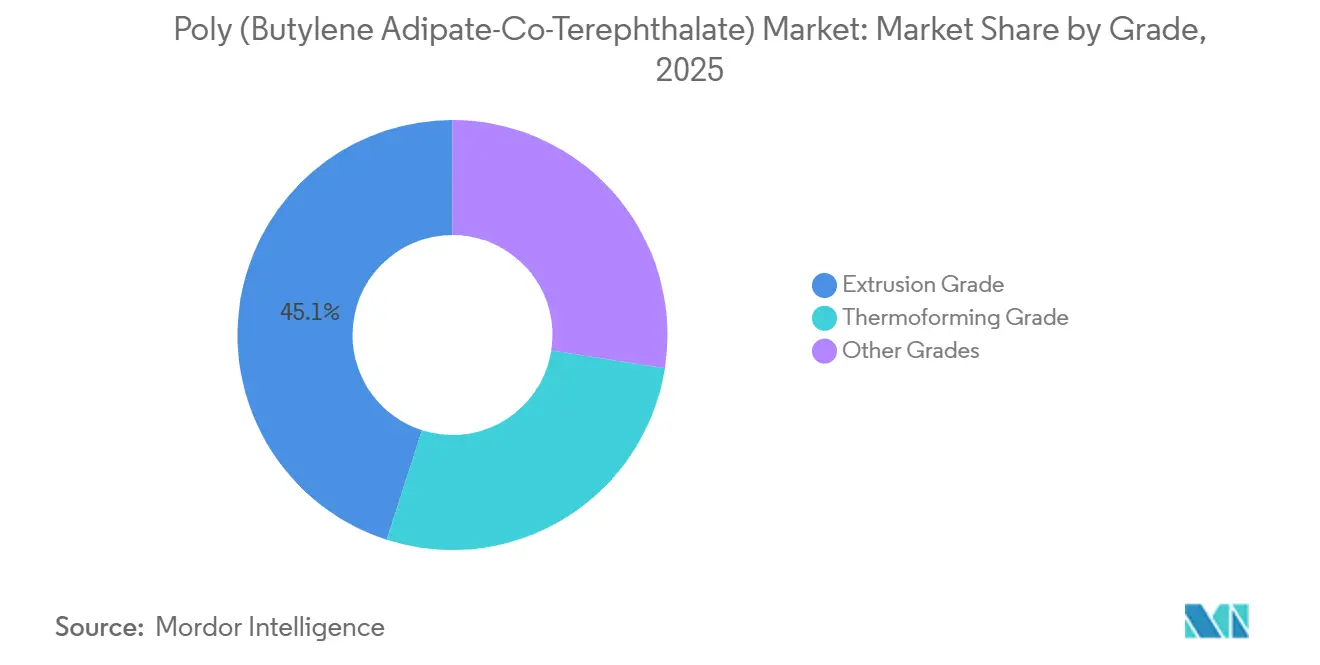
- By grade, extrusion grade held 45.06% of global demand in 2025, while thermoforming grade is forecast to grow at an 8.94% CAGR through 2031.
- By application, composite bags accounted for 27.35% of global demand in 2025, while mulch films are forecast to expand at a 9.14% CAGR through 2031.
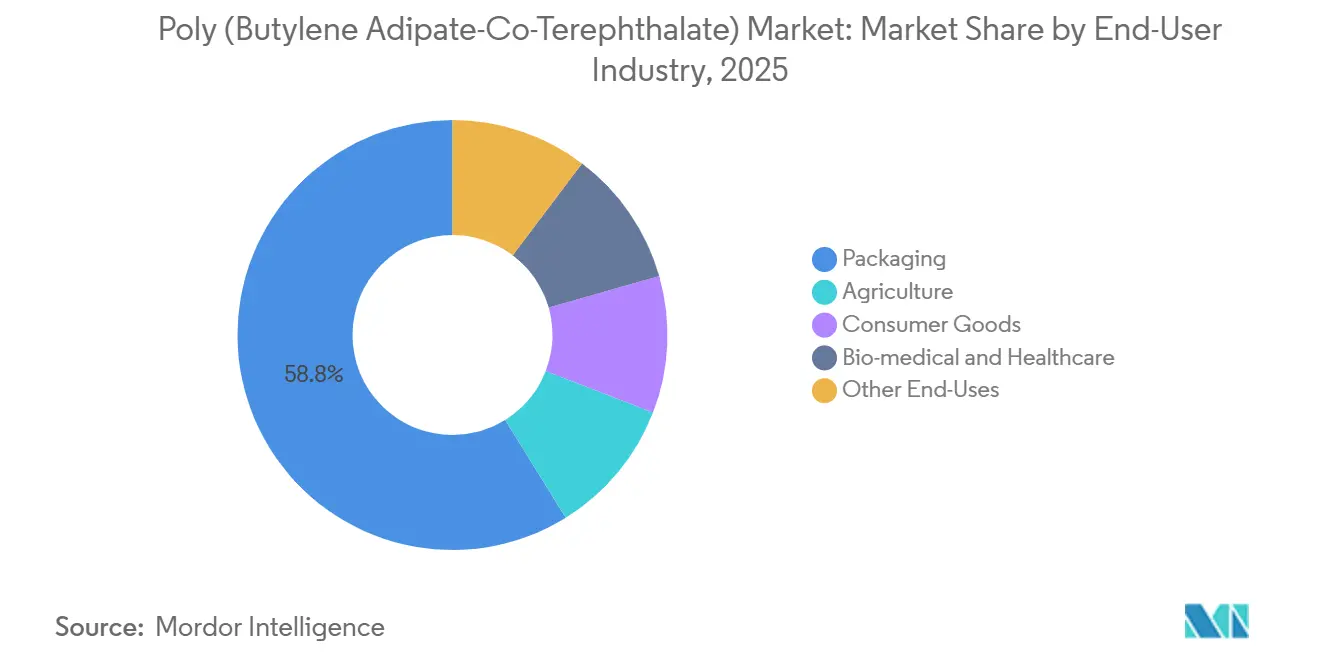
- By end-user industry, packaging held 58.83% of demand in 2025, while agriculture is projected to grow at a 9.73% CAGR through 2031.
- By geography, Asia-Pacific held 40.17% of global demand in 2025 and is projected to expand at a 9.47% CAGR through 2031.
Note: Market size and forecast figures in this report are generated using Mordor Intelligence’s proprietary estimation framework, updated with the latest available data and insights as of January 2026.
Global Poly (Butylene Adipate-Co-Terephthalate) Market Trends and Insights
Drivers Impact Analysis*
| Drivers | (~) % Impact on CAGR Forecast | Geographic Relevance | Impact Timeline |
|---|---|---|---|
| Packaging Regulation and Compostability Mandates | +2.0% | Global, including the EU, China, Asia-Pacific, and North America | Medium term (2-4 years) |
| Sustainable Flexible Packaging Adoption | +1.8% | North America and the EU, with spillover to the Asia-Pacific | Short term (≤ 2 years) |
| Biodegradable Agricultural Mulch Films | +1.5% | Asia-Pacific core, including China and India, with spillover to the EU | Short term (≤ 2 years) |
| PBAT Blend Optimization with Polylactic Acid (PLA) and Starch | +1.2% | Global | Long term (≥ 4 years) |
| Narrower Compostability Eligibility Creating Specification-Led Demand | +1.0% | EU and North America | Medium term (2-4 years) |
| Source: Mordor Intelligence | |||
Packaging Regulation and Compostability Mandates
The poly (butylene adipate-co-terephthalate) (PBAT) market is influenced by regulations that link specific packaging formats to compostability requirements, making material selection a compliance consideration. Regulation (EU) 2025/40 identifies formats such as tea bags, coffee pods, and produce labels that must meet EN 13432 compostability requirements from February 2028[1]European Parliament and Council, “Regulation (EU) 2025/40 on Packaging and Packaging Waste,” EUR-Lex, eur-lex.europa.eu.. Brands selling affected products in Europe will need certified material solutions or will need to reconsider these formats before the deadline. This requirement increases the relevance of certification and documentation. Member States may extend national compostability requirements to additional formats until August 12, 2026, creating varying demand conditions across countries before the broader implementation date. China’s plastic-pollution framework supports biodegradable alternatives for bags and thin films in major cities, reinforcing demand for materials that manufacturers can process into these formats. EN 13432 and ASTM D6400 remain key certification standards because they link material claims with purchasers’ compliance requirements and provide a common basis for converter and brand-owner evaluations.
Sustainable Flexible Packaging Adoption
Retailers and foodservice operators are increasingly adopting compostable flexible packaging beyond formats directly covered by legislation. Producer-responsibility obligations and corporate climate commitments drive these decisions, particularly in Europe and North America, where brands often review packaging specifications at the corporate level. Brand owners are also qualifying certified PBAT grades before 2028 to reduce the risk of supply disruptions and allow time for line trials, packaging testing, and supplier approvals. Early qualification can support predictable production levels even when short-term spot demand is subdued, as qualified materials are more likely to remain on approved purchasing lists. In May 2026, BASF expanded its Ecovio range for flexible barrier packaging, offering options designed for organic recycling or paper recycling pathways. The poly (butylene adipate-co-terephthalate) (PBAT) market depends on film performance and compostability, as converters require materials that operate reliably on high-throughput lines while maintaining the barrier properties required for the intended packaged product.
Biodegradable Agricultural Mulch Films
Agricultural mulch accounts for 13% of China’s domestic PBAT consumption and represents the fastest-growing end-use segment. Certified products can comply with soil-biodegradability standards, including EN 17033 and TÜV AUSTRIA OK Biodegradable SOIL, making certification relevant for agricultural purchasing and packaging applications. A 2025 field study found that PBAT films increased soil organic carbon by 0.16-0.48 g/kg and microbial biomass carbon by 5.5-33.8 mg/kg under the reported conditions. The study also reported that maize yields under PBAT black film were 2,550 kg/ha higher than those in non-film control plots. Separate research published in 2025 found that plants grown with a PBAT/PLA/soy composite film were 49% taller than those grown under conventional controls. These agricultural benefits support mulch-film purchasing decisions, as growers evaluate crop performance and soil conditions alongside the replacement of conventional plastics. Consequently, this application extends beyond compliance with plastic restrictions.
PBAT Blend Optimization with PLA and Starch
Manufacturers commonly compound commercial PBAT with polylactic acid (PLA), thermoplastic starch (TPS), or polybutylene succinate (PBS) to achieve application-specific mechanical, barrier, and degradation properties. A 2026 review reported that PBAT/PLA blends containing the Joncryl ADR-4468 chain extender achieved a tensile strength of 60.6 MPa and an elongation at break of 608.5% in the machine direction. A separate 2026 study reported that carboxylated liquid polyisoprene improved the stability of PBAT/TPS blends by reducing glycerol phase separation and starch recrystallization. These developments enable the production of grades for food-contact films, agricultural products, and other applications with demanding specifications, rather than relying on a single formulation across all uses. The poly (butylene adipate-co-terephthalate) (PBAT) market supports producers with compounding capabilities and proprietary formulations after customers complete qualification cycles, as converters may find it more difficult to switch qualified blends than to switch standard commodity resins.
Restraints Impact Analysis*
| Restraints | (~) % Impact on CAGR Forecast | Geographic Relevance | Impact Timeline |
|---|---|---|---|
| Higher Production Cost Than Conventional Plastics | -1.5% | Global | Short term (≤ 2 years) |
| Inadequate Industrial Composting Infrastructure | -1.2% | South America, the Middle East and Africa, and Asia-Pacific outside China | Medium term (2-4 years) |
| Recyclability-First Packaging Rules Limiting Broad Compostable Substitution | -0.8% | EU and North America | Medium term (2-4 years) |
| Source: Mordor Intelligence | |||
Higher Production Cost Than Conventional Plastics
PBAT typically costs two to three times more to produce than conventional LDPE because its key raw materials, BDO, adipic acid, and PTA, require multistep petrochemical synthesis. A 2024 Washington State University Extension analysis found that bio-based feedstocks cost two to 2.5 times more than their petroleum-based equivalents for biodegradable mulch applications. The analysis also found that fully bio-based materials were not expected to achieve price parity with PE mulch in the near term[2]Mauldin et al., “Soil-Biodegradable Plastic Mulch: Suitability for Sustainable and Organic Agriculture,” Washington State University Extension Publications, pubs.extension.wsu.edu.. Capacity additions in China have lowered spot prices for commodity extrusion-grade materials. In response, producers are targeting thermoforming grades, medical packaging films, and PBAT/PLA blends, where pricing pressure is lower and product performance supports differentiated positioning. Investment in bio-based BDO may improve PBAT's cost position over time; however, achieving commercial competitiveness at scale will require further cost reductions in the poly (butylene adipate-co-terephthalate) (PBAT) market.
Inadequate Industrial Composting Infrastructure
PBAT can obtain industrial compostability certification under EN 13432 and ASTM D6400; however, treatment capacity varies across regions where compostable packaging is sold. Much of South America, the Middle East, and Southeast Asia lacks facilities to process collected compostable packaging at scale or maintain separate organic waste streams. In these regions, packaging collected with organic waste may still be sent to landfills or incinerated, limiting end-of-life differentiation for compostable packaging. This constraint limits demand for compostable formats and complicates adoption across consumer goods and agricultural applications, where collection systems are often more difficult to manage than in defined industrial settings. Regulation (EU) 2025/40 requires adequate infrastructure for bio-waste collection and treatment to support broader compostability measures. The poly (butylene adipate-co-terephthalate) (PBAT) market is expected to remain constrained through 2029, as collection and processing systems do not adequately match product availability or the volume of compostable materials placed on the market.
*Our forecasts treat driver/restraint impacts as directional, not additive. The impact forecasts reflect baseline growth, mix effects, and variable interactions.
Segment Analysis
By Grade: Extrusion Grade Anchors Demand, Thermoforming Expands
Extrusion grade accounted for 45.06% of the poly (butylene adipate-co-terephthalate) (PBAT) market in 2025. Manufacturers use this grade in blown films for shopping bags, compostable mailers, courier liners, and food-wrap laminates, which represent established applications for the material. Its position reflects compatibility with flexible-film production lines calibrated for low-density polyethylene (LDPE)-like melt behavior and continuous operation. PBAT compounded with starch or polylactic acid (PLA) can operate within similar processing parameters, enabling converters to avoid investments in new machinery. This installed-base advantage supports adoption, as converters can introduce compostable film formulations while retaining familiar equipment, operating practices, and qualification processes. Consequently, adoption can occur through material substitution on established lines rather than complete equipment replacement, which is relevant for shopping bags, mailers, liners, and food wraps.
Thermoforming grade is forecast to grow at a CAGR of 8.94% from 2026 to 2031. It supports compostable food trays, clamshells, disposable cutlery, and lids that face sustainability requirements from foodservice buyers in Europe and North America. These applications require resins that balance stiffness, processability, and the end-of-life performance expected of compostable products. A 2025 study found that compatibilized PBAT/PBS compounds with 30%-40% talc loading produced thermoformed trays that did not break during the reported compression tests. China’s GB/T 32366-2025 standard took effect on October 1, 2025, tightening carboxyl-content specifications and introducing fish-eye count as a quality metric. The revised standard raises the technical requirements for grades used in applications such as thermoforming and provides compliant suppliers with a basis to serve these applications. Producers must manage resin consistency and visible-quality metrics alongside the mechanical performance required for trays, clamshells, lids, and other foodservice formats.



By Application: Composite Bags Lead Demand, Mulch Films Drive Growth
Composite bags accounted for 27.35% of the poly (butylene adipate-co-terephthalate) (PBAT) market in 2025. Manufacturers widely use PBAT/PLA and PBAT/starch laminates in retail and grocery bags in Europe and China because these formulations combine toughness with compostability. Italy’s compostable-bag requirements and the EU Single-Use Carrier-Bag Directive have helped establish manufacturing scale and consumer familiarity with these products. Bin bags use PBAT to achieve the tensile strength and elongation required to withstand municipal waste collection, with handling failures otherwise limiting adoption. Cling films benefit from PBAT’s elongation and low modulus for food-contact preservation, while stabilizers use PBAT as a toughening or compatibilizing component in brittle biopolymer blends. These applications include both finished flexible packaging products and PBAT used in broader blend formulations to improve material performance.
Mulch films are projected to grow at a CAGR of 9.14% through 2031. A 2025 study developed a multilayer film with PBAT outer layers and a thermoplastic starch core that achieved 64% mass loss after 365 days of laboratory composting, compared with 12% for a monolayer PBAT film. This performance addresses agricultural users’ concerns about film fragments remaining in the soil after the first growing season. Hengli Group’s integration into 1,4-butanediol (BDO) and purified terephthalic acid (PTA) supports the production of cost-competitive mulch-film grades in China and India, where farm-level price sensitivity remains high. Compostable nonwoven fabrics and PBAT-based expanded foam remain niche applications, each accounting for less than 2% of domestic demand in China. However, advances in processing methods are creating additional opportunities for these applications. Although their current scale is limited, they expand PBAT’s relevance beyond bags, films, trays, and mulch products as manufacturers refine related production techniques.
By End-User Industry: Packaging Commands Share as Agriculture Accelerates
Packaging is projected to account for 58.83% of the poly (butylene adipate-co-terephthalate) (PBAT) market in 2025. Flexible-film applications provide the segment with an established base, including shopping bags, courier mailers, food wraps, and related laminates. Brand owners, converters, and certifiers have spent years qualifying PBAT film formulations to meet food-contact and compostability requirements. This qualification process supports sustained packaging demand, as validated materials are difficult to replace quickly and conversion lines require reliable film performance. Consumer goods manufacturers also use related extrusion and lamination infrastructure for personal-care sachets, cleaning-product films, and household packaging inserts. This overlap allows converters to apply established PBAT film-processing expertise across multiple packaging applications rather than develop separate processing approaches for each consumer product.
Agriculture is forecast to grow at a CAGR of 9.73% through 2031. The segment combines demonstrated agronomic performance with an expanding certification framework for biodegradable mulch, making purchasing decisions dependent on both field performance and material compliance. Mulch films can support crop production while avoiding the persistent macro-fragments associated with conventional films after use. A review expected in 2026 will assess PBAT’s biocompatibility and low crystallinity as properties applicable to laboratory-scale wound dressings, surgical films, and controlled-release drug-delivery matrices.
Geography Analysis
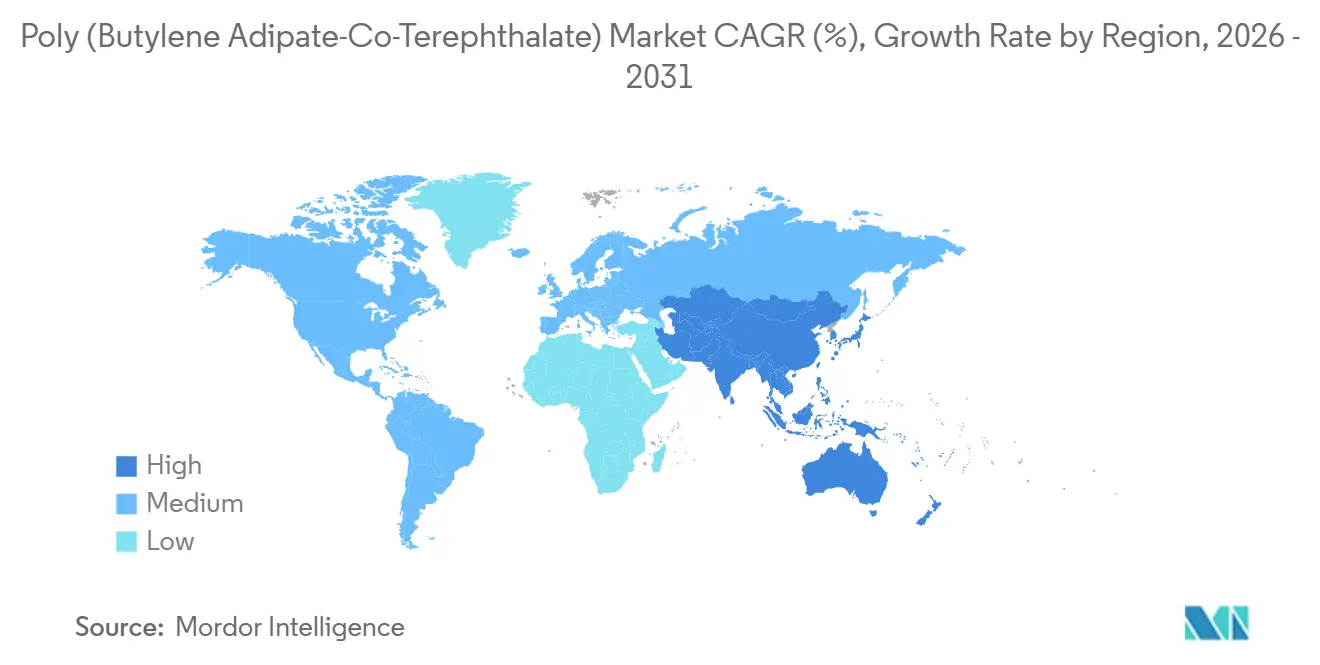
Asia-Pacific accounted for 40.17% of the poly (butylene adipate-co-terephthalate) (PBAT) market in 2025 and is forecast to grow at a CAGR of 9.47% through 2031. China is the region’s key supply base and demand center, supported by its manufacturing base, converter capacity, and policy support for biodegradable alternatives in bags and thin-film applications. Restrictions on single-use plastics in India support demand for compostable alternatives, while tightening restrictions across ASEAN markets create additional demand. SKC’s SK leaveo subsidiary operates a 70,000-tons-per-year reinforced PBAT facility in Haiphong, Vietnam. The facility received a USD 40 million investment from the International Finance Corporation (IFC) in August 2025. It supports the supply of PBAT materials for regional packaging and agricultural applications and shows we're expanding our investment beyond China.
Europe has a smaller production base but remains relevant due to explicit compostability requirements and established collection infrastructure. Germany, Italy, and France have bio-waste collection and treatment systems that support demand for certified materials and provide disposal routes for compostable packaging. Regulation (EU) 2025/40 will establish common requirements for selected packaging formats from February 2028. National authorities retained limited discretion to expand compostability requirements until August 2026. This policy environment requires European converters to maintain compliant material options, complete qualification activities before the common deadline, and evaluate multiple certified sources for required grades.
North America is led by the United States, where ASTM D6400-certified packaging is used across foodservice, restaurant, and retail channels. Corporate purchasing programs and state-level regulations, including California’s requirements for organic collection and foodservice products, influence demand more than a single federal framework does. This creates a state- and customer-specific adoption pattern. Suppliers and converters must align material choices with local collection requirements and the packaging specifications of major brand owners. South America remains at an earlier stage, although municipal programs in São Paulo and Rio de Janeiro establish policy frameworks in Brazil. PBAT penetration remains lower in the Middle East and Africa due to limited industrial composting capacity and cost competitiveness. However, public-sector green procurement for foodservice and agricultural applications in Gulf Cooperation Council countries could support demand for biodegradable polymers.

Competitive Landscape
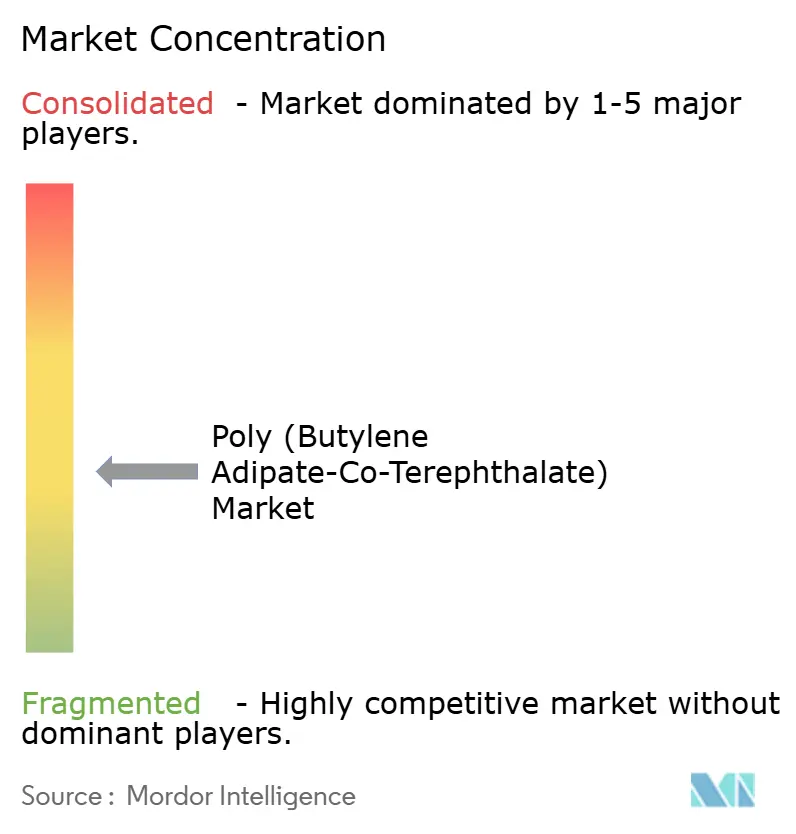
The poly (butylene adipate-co-terephthalate) (PBAT) market is moderately fragmented, with suppliers meeting buyer specifications across commodity and specialty grades. Commodity grades primarily compete on price, while certified and performance-focused grades differentiate through application, certification, and processing requirements. In June 2024, BASF launched ecoflex F Blend C1200 BMB, a PBAT material sourced from renewable feedstocks and verified by a certified mass-balance method. BASF stated that the product has a 60% lower product carbon footprint and holds REDcert2 and ISCC PLUS certifications. This strategy focuses on a lower-carbon grade and reflects buyer requirements for documentation, certification, and traceability.
Novamont reported 1,800 active patents and patent applications across 149 patent families in its 2025 report. Its patent portfolio supports differentiation in compound formulations, particularly once a converter has validated performance for a specific packaging or agricultural application. Bio-based BDO offers another option to differentiate PBAT products through lower carbon intensity and higher renewable content. SK leaveo developed nanocellulose-reinforced PBAT with the Korea Research Institute of Chemical Technology for nonwoven fabrics, agricultural covers, and packaging applications. This development targets higher tensile performance and supports applications beyond the conventional flexible-film market.
Medium-sized Asian producers are expanding through government-supported biodegradable-material programs and local compounding partnerships to serve regional converters with specific formulation requirements. The analysis identifies JinHui ZhaoLong and GO YEN Chemical as participants seeking customers in Southeast Asia and Eastern Europe, where certification requirements may differ from those in core EU markets. Mitsubishi Chemical and Chang Chun Group use polyester-processing expertise and food-contact compliance networks to serve specialty packaging niches. Therefore, the poly (butylene adipate-co-terephthalate) (PBAT) market competes at the commodity level, while certified and specialized applications involve qualification timelines and formulation expertise.
Poly (Butylene Adipate-Co-Terephthalate) Industry Leaders
BASF
Kingfa Sci. & Tech. Co., Ltd.
Novamont S.p.A.
JinHui ZhaoLong High Technology Co., Ltd.
Chang Chun Group
- *Disclaimer: Major Players sorted in no particular order

Recent Industry Developments
- June 2026: he European Union launched an anti-dumping investigation into Chinese-origin PBAT and PBSeT biodegradable polymers. The investigation may affect China-EU trade flows, European converter sourcing strategies, and pricing for export-oriented Chinese producers.
- April 2026: Kingfa Sci. & Tech. unveiled a bio-based, home-compostable PBS (polybutylene succinate) extrusion-coating material at CHINAPLAS 2026 in Shanghai. The product expanded Kingfa’s biodegradable polymer portfolio beyond PBAT for applications that comply with EU packaging and California composting frameworks.


Global Poly (Butylene Adipate-Co-Terephthalate) Market Report Scope
Polybutylene adipate terephthalate (PBAT) is a biodegradable random copolymer used in applications requiring flexible packaging materials. It serves as an alternative to conventional low-density polyethylene (LDPE) in products such as films, bags, and compostable packaging.
The poly (butylene adipate-co-terephthalate) market is segmented by grade, application, end-user industry, and geography. By grade, the market is segmented into extrusion grade, thermoforming grade, and other grades. By application, the market is segmented into composite bags, bin bags, mulch films, cling films, stabilizers, and other applications. By end-user industry, the market is segmented into packaging, agriculture, consumer goods, bio-medical and healthcare, and other end-uses. The report also covers market size and forecasts for poly (butylene adipate-co-terephthalate) across 15 countries in the major regions. The market sizes and forecasts are provided in terms of value (USD).
| Extrusion Grade |
| Thermoforming Grade |
| Other Grades |
| Composite Bags |
| Bin Bags |
| Mulch Films |
| Cling Films |
| Stabilizers |
| Other Applications |
| Packaging |
| Agriculture |
| Consumer Goods |
| Bio-medical and Healthcare |
| Other End-Uses |
| Asia-Pacific | China |
| India | |
| Japan | |
| South Korea | |
| ASEAN Countries | |
| Rest of Asia-Pacific | |
| North America | United States |
| Canada | |
| Mexico | |
| Europe | Germany |
| United Kingdom | |
| France | |
| Italy | |
| NORDIC Countries | |
| Rest of Europe | |
| South America | Brazil |
| Argentina | |
| Rest of South America | |
| Middle East and Africa | Saudi Arabia |
| South Africa | |
| Rest of Middle East and Africa |
| By Grade | Extrusion Grade | |
| Thermoforming Grade | ||
| Other Grades | ||
| By Application | Composite Bags | |
| Bin Bags | ||
| Mulch Films | ||
| Cling Films | ||
| Stabilizers | ||
| Other Applications | ||
| By End-User Industry | Packaging | |
| Agriculture | ||
| Consumer Goods | ||
| Bio-medical and Healthcare | ||
| Other End-Uses | ||
| By Geography | Asia-Pacific | China |
| India | ||
| Japan | ||
| South Korea | ||
| ASEAN Countries | ||
| Rest of Asia-Pacific | ||
| North America | United States | |
| Canada | ||
| Mexico | ||
| Europe | Germany | |
| United Kingdom | ||
| France | ||
| Italy | ||
| NORDIC Countries | ||
| Rest of Europe | ||
| South America | Brazil | |
| Argentina | ||
| Rest of South America | ||
| Middle East and Africa | Saudi Arabia | |
| South Africa | ||
| Rest of Middle East and Africa | ||


Key Questions Answered in the Report
What is current market size of Industrial Poly (Butylene Adipate-Co-Terephthalate) Market?
The poly (butylene adipate-co-terephthalate) (PBAT) market size was valued at USD 1.87 billion in 2025 and is projected to grow from USD 2.01 billion in 2026 to USD 3.02 billion by 2031, at a CAGR of 8.53% during the forecast period (2026-2031).
Which PBAT application is growing fastest?
Mulch films are projected to expand at a 9.14% CAGR through 2031, supported by research on soil and crop performance. The material is used where growers also seek to avoid persistent macro-fragments after film use.
Which end-user sector uses the most PBAT?
Packaging held 58.83% of demand in 2025 because flexible-film formats already have established qualification pathways. Brand owners, converters, and certifiers have supported these applications through years of food-contact and compostability validation.
Which region leads in global PBAT demand?
Asia-Pacific held 40.17% of global demand in 2025 and is forecast to grow at a 9.47% CAGR through 2031. China’s manufacturing base, India’s restrictions on selected single-use plastics, and regional investment support this position.
Page last updated on:





