
Plastic Straps Market Size and Share
Market Overview
| Study Period | 2022 - 2032 |
|---|---|
| Market Size (2027) | USD 4.14 Billion |
| Market Size (2032) | USD 5.75 Billion |
| Growth Rate (2027 - 2032) | 6.78 % |
| Fastest Growing Market | Asia-Pacific |
| Largest Market | Asia-Pacific |
| Market Concentration | Medium |
Major Players *Disclaimer: Major Players sorted in no particular order Image © Mordor Intelligence. Reuse requires attribution under CC BY 4.0. | |
Plastic Straps Market Analysis by Mordor Intelligence
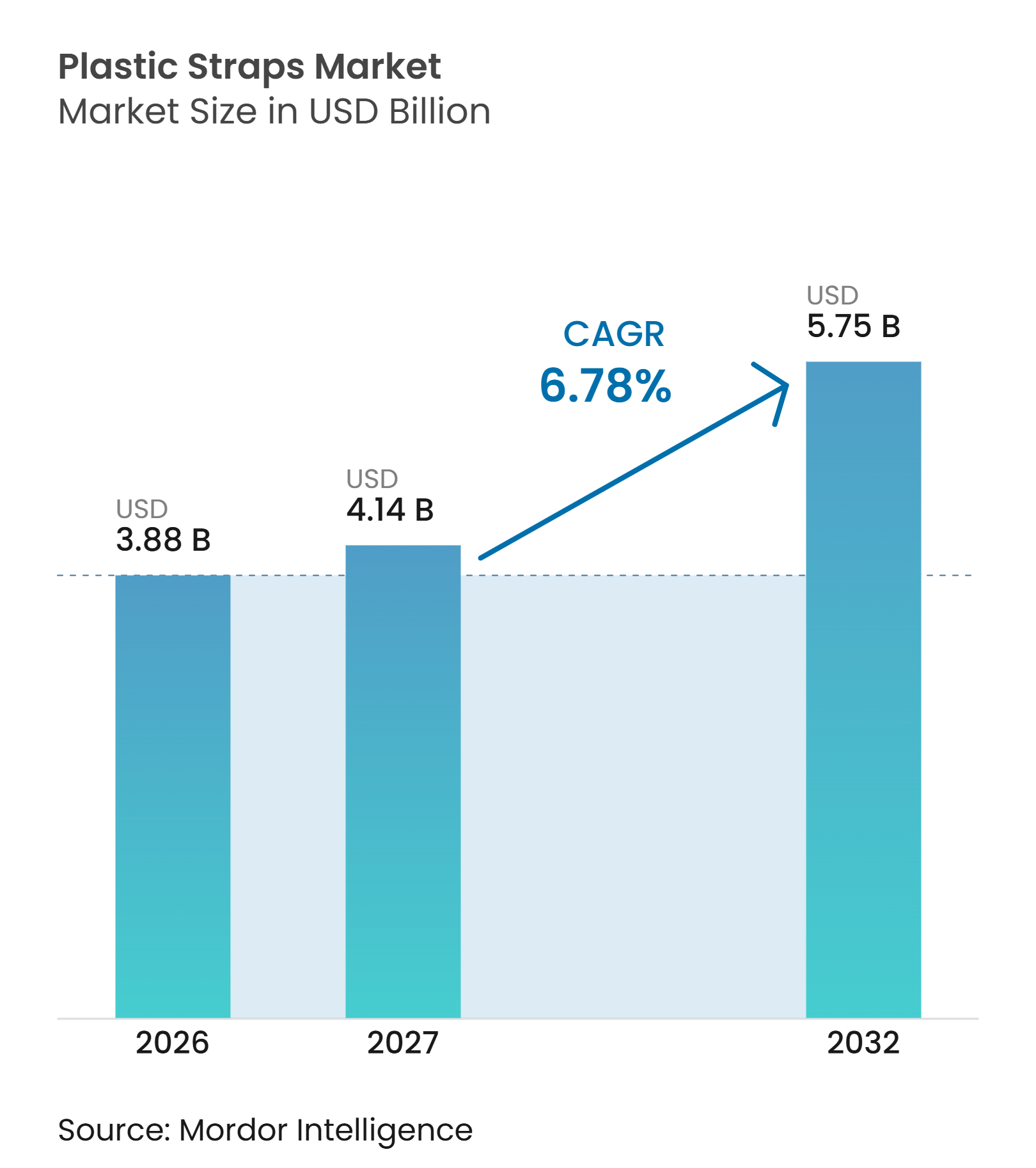
The plastic straps market size was valued at USD 3.88 billion in 2026 and is estimated to grow from USD 4.14 billion in 2027 to USD 5.75 billion by 2032, at a CAGR of 6.78% during the forecast period (2027-2032). The plastic straps market is supported by the expansion of e-commerce fulfillment networks and the need for reliable, automated pallet unitizing. Demand is also shifting from traditional industrial handling to food processing, construction, and specialized cargo securing. Polyethylene Terephthalate (PET) is gaining preference for applications that require retained tension, consistent dimensions, and compatibility with high-speed systems. This favors suppliers that can meet machine-grade quality requirements and provide documentation of recycled content. In Europe, recycled-content regulations and transport-packaging requirements are prompting purchasing teams to evaluate both material supply and compliance readiness.
Key Report Takeaways
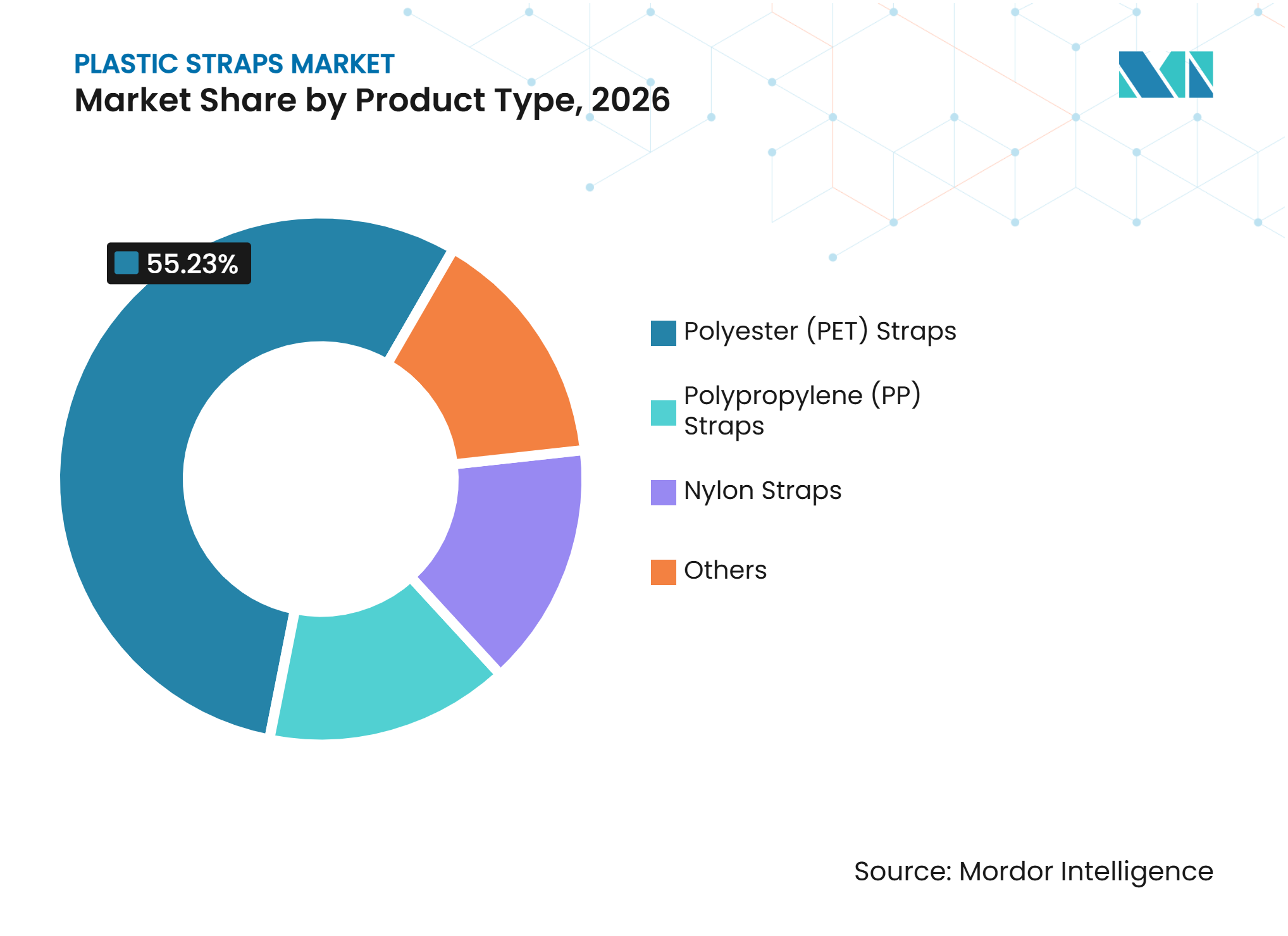
- By product type, PET straps held 55.23% of the plastic straps market share in 2026, while the same segment is projected to grow at a 7.45% CAGR through 2032.
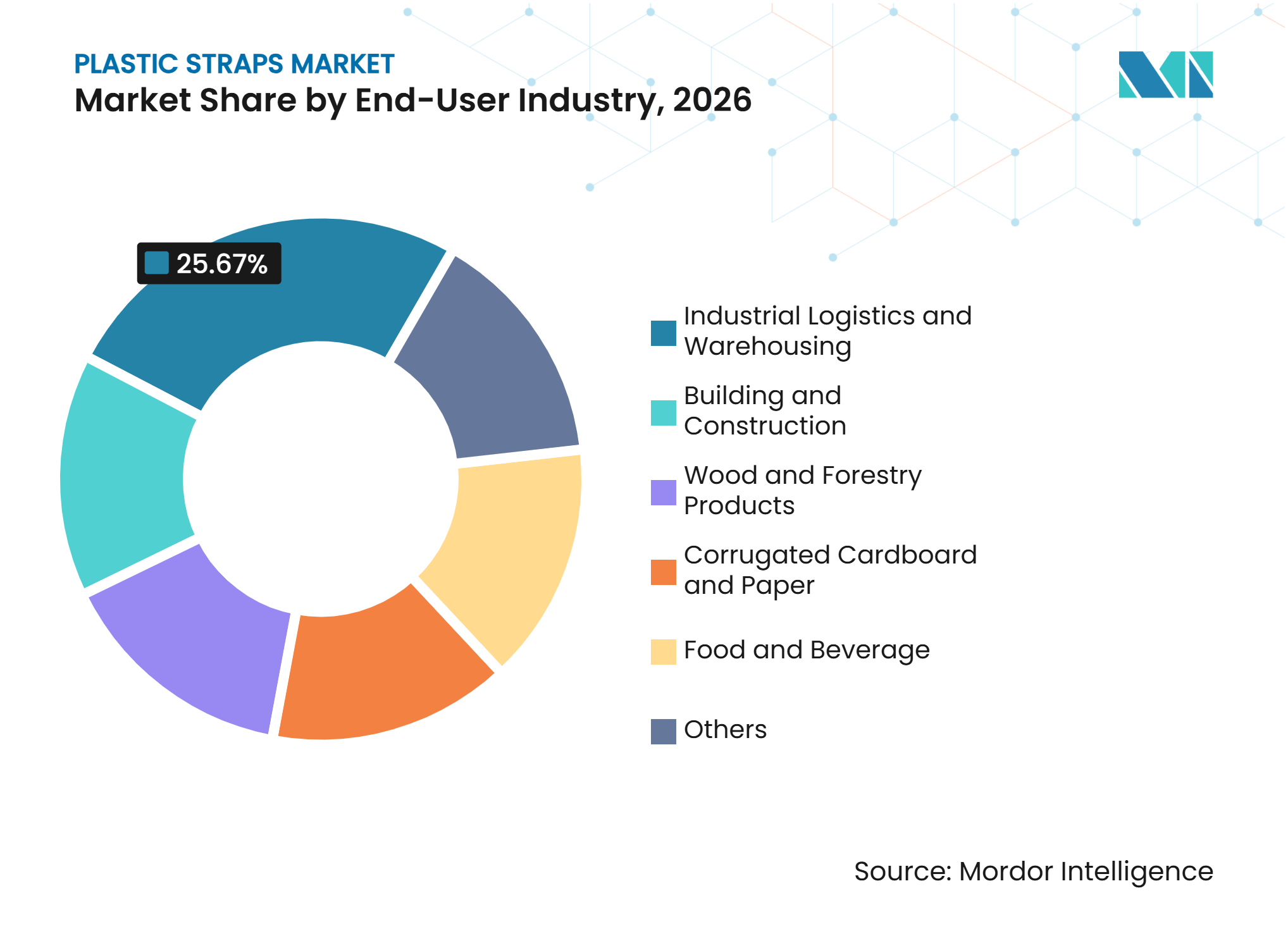
- By end-user industry, industrial logistics and warehousing accounted for 25.67% of the plastic straps market size in 2026, while food and beverage is forecast to expand at a 7.89% CAGR through 2032.
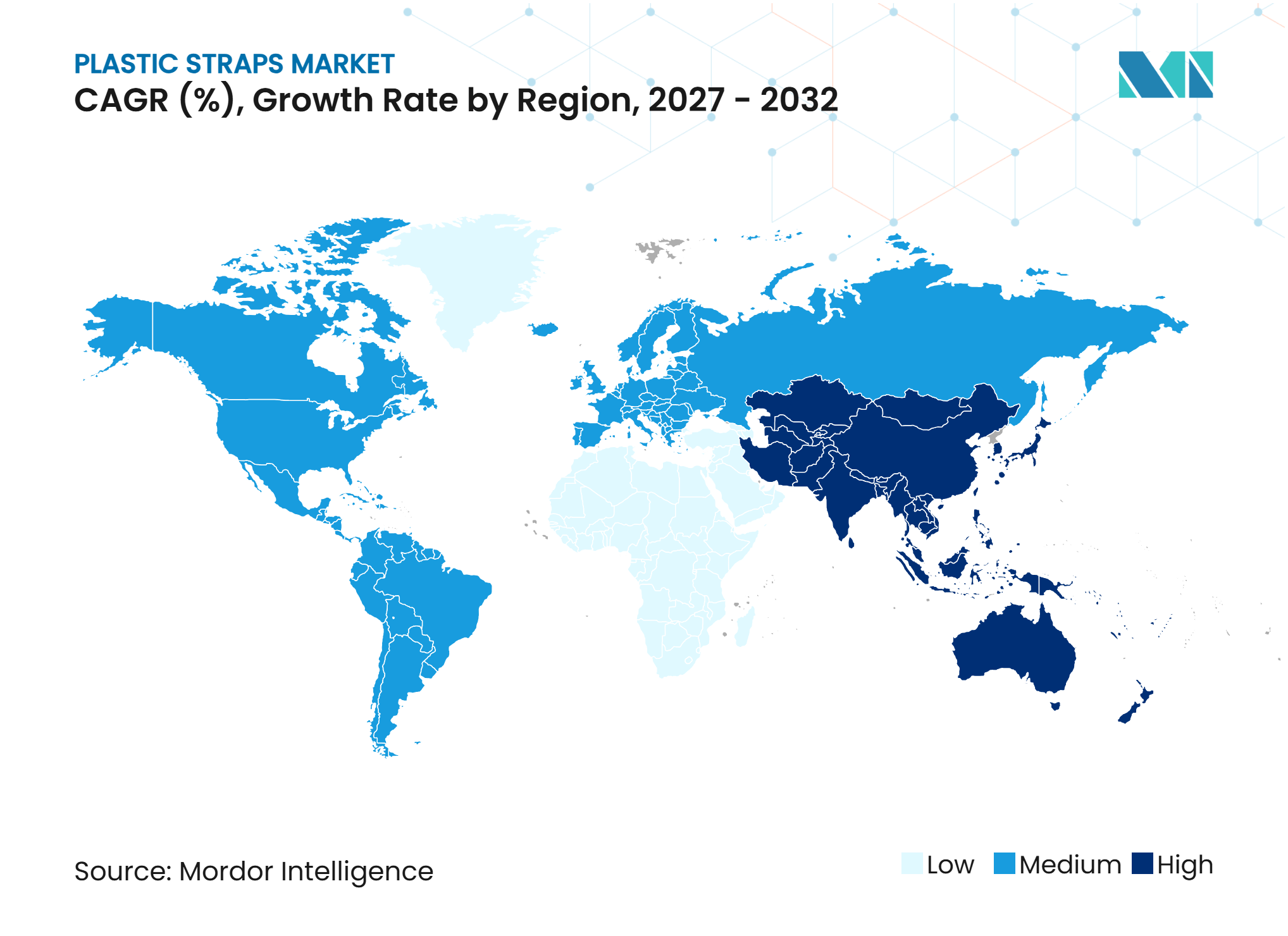
- By geography, Asia-Pacific captured 40.12% of the plastic straps market share in 2026 and is projected to advance at a 7.71% CAGR through 2032.
Note: Market numbers in this report are based on Mordor Intelligence's proprietary estimation framework, which combines nine months of actuals with Q4 projections for base year 2026.
Market Trends and Insights
Drivers Impact Analysis of Plastic Straps Market*
| Drivers | (~) % Impact on CAGR Forecast | Geographic Relevance | Impact Timeline |
|---|---|---|---|
| E-Commerce Fulfillment and Automated Unitizing | +1.8% | Global, with intensity in Asia-Pacific and North America | Medium term (2-4 years) |
| Steel-to-PET Substitution in Heavy Loads | +1.5% | North America and Europe, with spillover to Asia-Pacific | Medium term (2-4 years) |
| Recycled-Content Procurement and Circular Packaging Targets | +1.2% | EU-led, with early gains in Germany, Netherlands, and France | Long term (≥ 4 years) |
| Verified Recycled-Content Traceability as a Tender Requirement | +0.7% | EU and North America, emerging in Asia-Pacific | Long term (≥ 4 years) |
| Machine-Compatible Low-Variation Strap for High-Throughput Lines | +0.9% | Global, strongest in Asia-Pacific and North America | Short term (≤ 2 years) |
| Source: Mordor Intelligence | |||
E-Commerce Fulfillment and Automated Unitizing
E-commerce fulfillment is making automated strapping a practical requirement for distribution centers handling high-volume mixed Stock Keeping Unit (SKU) pallets. Global air cargo demand grew 3.4% in 2025, while Asia-Pacific cargo figures grew 8.4%, reflecting the ongoing strength of e-commerce cargo flows[1]. These flows increase the need for reliable unitizing across warehouse, air cargo, and delivery networks. Automated arch-strapping systems require consistent strap width and thickness, especially when equipment runs at high cycle rates. This requirement gives qualified PET suppliers a position with fulfillment operators that cannot accept frequent variation in consumables. China's amended Express Delivery Interim Regulations require express-delivery companies to reduce single-use plastics and meet relevant packaging requirements, which support the use of recyclable materials with documented compliance.
Steel-to-PET Substitution in Heavy Loads
PET strapping is being used more widely in heavy-load applications such as coil, lumber, and building-material handling. The change depends on PET products meeting the load retention and tensile requirements for each application. Recycled PET products are also being positioned for industrial load securement, including Greenbridge's AtlaStrap, which the company describes as a 100% post-consumer recycled PET solution. The shift gives buyers a lighter-material option where handling safety and corrosion concerns are important. It also broadens the range of addressable uses for plastic straps beyond standard pallet and carton applications. The plastic straps market benefits when distributors and end users qualify PET alternatives for applications previously served by steel.
Recycled-Content Procurement and Circular Packaging Targets
Recycled-content requirements are moving plastic strapping from a specialist sustainability purchase into a formal procurement consideration for larger shippers. Regulation (EU) 2025/40 sets recycled-content requirements for plastic packaging from 2030 and establishes a longer-term direction for 2040. The regulation makes secure recycled PET (rPET) supply and credible content accounting more important to suppliers serving European accounts. FROMM formed F+M Recycling GmbH with Mensing Group in February 2025 to develop a recycling operation for PET and Polypropylene (PP) strapping in Germany. That type of investment can reduce reliance on spot supply and help producers prepare for future tender requirements. Bottle-to-bottle recycling demand may also increase competition for recovered PET feedstock, raising the value of strap collection and recycling programs.
Verified Recycled-Content Traceability as a Tender Requirement
Purchasing teams increasingly need auditable evidence when buying packaging materials that contain recycled feedstock. ISO 22095-2:2026 and ISO 22095-3:2026 establish chain-of-custody approaches for mass balance and book-and-claim systems. These standards give suppliers and certification bodies a common structure for recording and communicating recycled-content claims. Documentation requirements can increase the cost of participation for smaller producers with limited compliance resources. These standards also encourage larger suppliers to link product data, certification records, and customer reporting requirements. In the plastic straps market, traceable recycled content can become a differentiator when tenders specify evidence rather than general environmental claims.
Restraints Impact Analysis of Plastic Straps Market*
| Restraints | (~) % Impact on CAGR Forecast | Geographic Relevance | Impact Timeline |
|---|---|---|---|
| Polymer Resin and Recycled Feedstock Price Volatility | -1.4% | Global, with highest exposure in energy-import-dependent regions in South and Southeast Asia and Europe | Short term (≤ 2 years) |
| Plastic-Waste Liability and Fragmented Collection Systems | -0.9% | EU, South and Southeast Asia, with spillover to North America | Long term (≥ 4 years) |
| Qualification Risk When Replacing Steel in Critical Loads | -0.7% | North America, Europe, and advanced industrial markets in Asia-Pacific | Medium term (2-4 years) |
| Substitution by Stretch Film, Adhesives, and Reusable Load Systems | -0.8% | EU and North America | Medium term (2-4 years) |
| Source: Mordor Intelligence | |||
Polymer Resin and Recycled Feedstock Price Volatility
PET and PP strapping producers remain exposed to fluctuations in resin and energy costs. Recycled feedstock supply is also under pressure, as multiple packaging applications compete for the same recovered material. These conditions can compress margins when suppliers are unable to fully pass higher input costs to customers. Teufelberger's 2025 communications referenced its participation in an industry alliance, reflecting the importance of coordinated approaches to material use and recycling. Producers without long-term rPET supply arrangements face exposure to both virgin-resin pricing and uncertainty around recycled feedstock availability. This is particularly relevant in markets where energy costs are high, and competition from lower-cost supply is strong.
Plastic-Waste Liability and Fragmented Collection Systems
Plastic waste responsibilities can increase the total strapping cost for both users and suppliers. The European Commission confirmed in February 2026 that pallet wrapping and straps are exempt from the Packaging and Packaging Waste Regulation (PPWR)'s 100% reuse requirement[2]. This provides clarity for transport-packaging users, though broader expectations for reuse and circularity continue to influence product design and purchasing decisions. Collection systems remain uneven outside mature recovery markets, making it difficult to build verified closed-loop supply at scale. This limits the reach of premium recycled-content offerings in markets with fragmented waste-collection infrastructure. Suppliers must therefore align their recycling claims with local collection capacity and customer reporting requirements.
*Our forecasts treat driver/restraint impacts as directional, not additive. The impact forecasts reflect baseline growth, mix effects, and variable interactions.
Plastic Straps Market Segment Analysis
By Product Type:
PET Straps Lead in Share and GrowthPET straps held 55.23% of the plastic straps market share in 2026 and are projected to expand at a 7.45% CAGR through 2032. The segment leads due to its tensile performance and ability to retain tension after elongation. It is also compatible with high-speed machines used in automated logistics and packaging lines. PET's dimensional consistency supports users who require repeatable cycle performance. Its thermal stability is useful in operations that combine speed, load integrity, and downstream material recovery. These characteristics make PET a preferred option when users transition from manual methods or older equipment to automated systems. PET also supports applications where a secured load must retain tension during storage, handling, and transportation. Suppliers that maintain consistent resin quality are better positioned to serve operations that cannot tolerate unplanned machine stoppages. The product's compatibility with automated equipment makes performance validation an important part of purchase decisions. This creates a distinction between basic strap supply and materials developed for demanding industrial lines.
PP straps continue to serve light- and medium-duty applications, including corrugated carton closure and agricultural bundling. Their flexibility and cost position suit applications with lower load requirements. Nylon is used in specialized applications that require extreme elongation, including heavy coil and pipe bundling. Composite cord and textile straps are used in container cargo securing, where handling safety and lower weight are important. In its FY2025 reporting, Scientex confirmed continued production of PP strapping bands, indicating that established PP suppliers maintain manufacturing bases in Asian markets. PPWR-related recycled-content requirements may further support PET in Europe, as its material structure can be more readily aligned with recycling and certification programs. PP remains relevant when users prioritize economical carton closure and ease of handling over higher tensile performance. Composite and textile alternatives are suited to cases where load securing requires a different balance of strength, flexibility, and operator safety. Product selection therefore remains closely linked to load weight, equipment type, and the user's recycling objectives. This gives established producers room to offer a portfolio rather than a single material solution.



By End-User Industry:
Logistics Provides Scale and Food and Beverage Adds GrowthIndustrial logistics and warehousing accounted for 25.67% of the plastic straps market size in 2026. Fulfillment-center investments in North America, Germany, and Japan support this position, as automated end-of-line systems replace manual strapping at high-volume sites. The segment requires materials that perform consistently on installed equipment and rewards suppliers that can deliver machine-grade straps at dependable quality. Large distribution centers create recurring demand for consumables once equipment and material specifications are established. This can create switching costs, as new products must be tested before receiving operational approval. Operators also value suppliers that can help resolve equipment issues without delaying distribution schedules. As fulfillment networks scale, consistent strapping becomes part of broader throughput planning. The segment's position is therefore supported by both new warehouse investment and routine replacement demand. In this context, material reliability can matter as much as initial purchase price.
Food and beverage is projected to grow at a 7.89% CAGR through 2032, supported by cold-chain development and organized retail expansion in developing economies. Refrigerated logistics requires materials that can tolerate temperature changes while supporting hygiene-focused packaging operations. ISO 22002-4 was restructured in September 2025 to provide guidance for food packaging and manufacturing environments. Corrugated cardboard and paper remain large, price-sensitive applications, but high-speed inline systems require tight material tolerances. Building and construction faces softer demand in parts of Europe, while the shift from steel toward PET provides a partial offset. Wood and forestry applications offer an additional opportunity as operators seek alternatives to corrosion-prone steel banding. Food processors also consider whether a strap can perform reliably across chilled storage, dispatch, and transport conditions. The need for consistent materials is reinforced when packaging lines operate continuously. Corrugated applications remain commercially important because minor material variation can affect a high-speed line. End-user demand is therefore split between large, established applications and faster-growing uses that require more specialized product specifications.

Geography Analysis
Asia-Pacific
Asia-Pacific held 40.12% of the plastic straps market share in 2026 and is forecast to grow at a 7.71% CAGR through 2032. China, India, South Korea, Japan, and ASEAN countries support demand across corrugated packaging, food processing, and industrial logistics. China's Express Delivery Interim Regulations, which took effect on June 1, 2025, require measures to reduce packaging waste and ensure compliance with national standards. This regulatory influence favors suppliers that can support consistent product quality and document compliance. Japan's automated manufacturing base and South Korea's petrochemical capacity support demand for higher-specification polyethylene terephthalate (PET) products. ASEAN manufacturing investment supports demand for mid-tier polypropylene (PP) straps in applications where price remains a key factor. The region combines high consumption with varied requirements across advanced manufacturing and developing logistics networks. This diversity allows PET, PP, and specialized straps to serve distinct applications. Suppliers with regional capacity can shorten lead times for customers operating across several countries. Compliance documentation is becoming increasingly relevant as packaging rules are being formalized in major markets. The plastic straps market benefits from this combination of manufacturing activity, logistics expansion, and evolving packaging requirements.
North America
North America is supported by e-commerce fulfillment investment and a shift toward plastic solutions in institutional and industrial securing applications. The United States Postal Service adopted revised standards effective July 1, 2025, requiring cross-strapped plastic bands for certain bundled mail. This rule reflects the broader need for dependable plastic load-securing materials. Greenbridge Companies, Inc. introduced its recycled PET AtlaStrap product in February 2025 for sustainable load securement applications. Installed automated strapping equipment supports recurring demand for compatible consumables. The region also requires suppliers to address qualification needs when users replace metal-based systems in demanding applications. Buyers assess product performance alongside the availability of technical support and local stock. Automated operations place a premium on consumables that perform consistently with installed machinery. Recycled-content products appeal to users with formal sustainability goals. These requirements give established suppliers opportunities to compete on service and product assurance rather than price alone. Demand is tied to both the scale of fulfillment activity and the pace of system upgrades.
Europe, South America, Middle East, and Africa
Europe's high-specification markets are shaped by compliance with the Packaging and Packaging Waste Regulation (PPWR), documentation of recycled content, and the need for a dependable supply of recycled polyethylene terephthalate (rPET). FROMM's German recycling investment reflects the value placed on local feedstock recovery and material processing ahead of future compliance thresholds. The European Commission's exemption for straps from the 100% reuse requirement provides operational clarity, while other transport-packaging rules continue to influence purchasing decisions. In South America, demand is driven by food processing, logistics, and agribusiness, particularly in Brazil. The Middle East and Africa present an emerging opportunity, where logistics, warehousing, and industrial development are increasing the need for automated unitizing. These regions require product offerings that balance local supply conditions, cost, and growing material recovery requirements. Western European customers place particular value on evidence of compliance and feedstock traceability. Other regions may place greater weight on product availability, import lead times, and operational cost. This creates different competitive conditions even where the underlying need for unitizing is similar. Suppliers that adapt product portfolios and service models to local requirements can address a broader set of customers. Circularity expectations are likely to remain most prominent in Europe, while logistics development supports demand across the broader regional group.
Competitive Landscape
Market Concentration
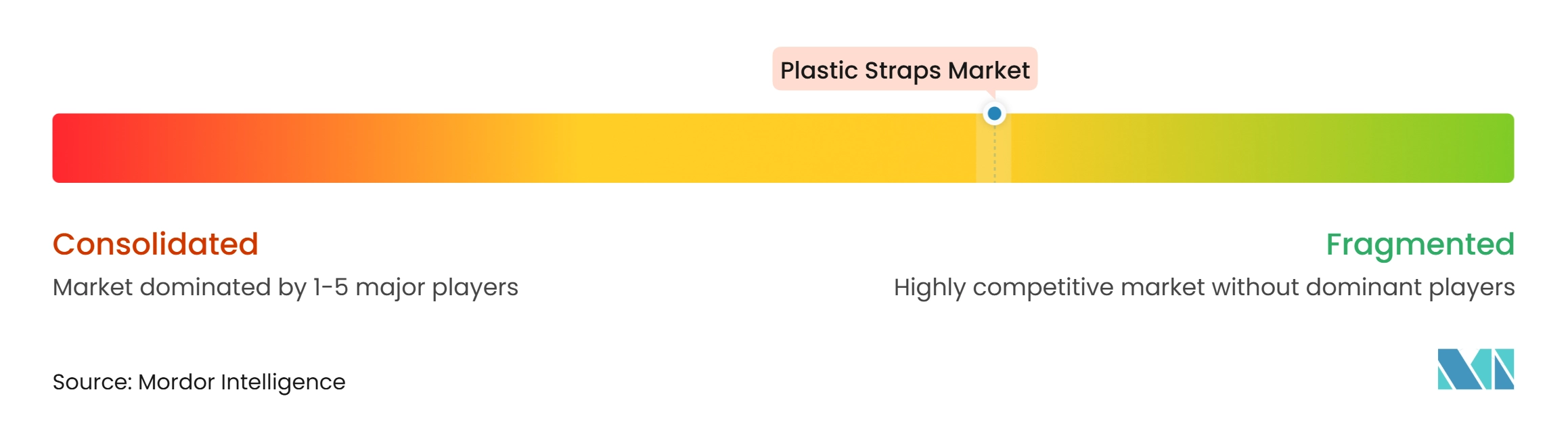
The plastic straps market is moderately fragmented. Larger suppliers compete through automation capability, system integration, recycled-content credentials, and broad product portfolios, while regional suppliers often compete on price and local delivery. FROMM's 2025 acquisition of Maillis Group strengthened its product range and geographic reach, while also reducing the pool of independent suppliers serving parts of Europe and the Middle East. Consolidation has made scale, access to materials, and technical service more important factors in customer purchasing decisions. Larger groups can spread product development and compliance costs across a wider customer base and are better positioned to support accounts operating across multiple regions. Smaller suppliers remain relevant where local delivery and price are the primary purchase criteria. The competitive balance therefore differs between standardized products and higher-specification, machine-compatible materials, with service capability being as important as the strap itself in the latter category.
Equipment integration remains a meaningful competitive factor, as installed machines create recurring demand for compatible consumables. Mosca opened its third Malaysian manufacturing facility in Johor in June 2025, according to the Malaysian Investment Development Authority, which reported it to be 103,458 ft², thereby improving local manufacturing capacity in a growth region. Mosca also introduced digitally connected strapping equipment for automated production settings. Greenbridge's launch of a 100% post-consumer-recycled PET product demonstrates how sustainability credentials are becoming part of the competitive landscape in load securement. A nearby production base can improve supply responsiveness and reduce the difficulty of serving growing packaging operations, while digital equipment features can make strapping data more accessible to customers who monitor operational performance. These developments indicate that companies are competing through capacity, connectivity, and material credentials rather than strap pricing alone, making the competitive environment more demanding for undifferentiated suppliers.
Recycling infrastructure and traceability are likely to differentiate suppliers serving premium European tenders from those focused on standard products. ISO 22095 chain-of-custody standards provide buyers with a common framework for evaluating mass-balance and book-and-claim claims, favoring producers that can manage certification, feedstock sourcing, and customer documentation. Product innovation is also relevant in specialized cargo securing, where performance requirements are less easily met by commodity straps. Teufelberger's participation in the Strapping Alliance reflects an industry focus on material use and recycling collaboration. Suppliers with installed equipment bases, recycling capability, and documented quality have clearer differentiation, and chain-of-custody standards make it easier for buyers to ask specific questions about recycled-content claims. This may favor companies that have already invested in recordkeeping and customer-facing documentation. Specialized cargo securing remains an area where application knowledge provides a barrier to entry, requiring producers to demonstrate both performance and material availability. Competitive advantage is therefore increasingly linked to the ability to combine a reliable product with technical, compliance, and recycling support.
Plastic Straps Industry Leaders
-
Signode Industrial Group LLC
-
FROMM Holding AG
-
Teufelberger
-
GreenBridge
-
Mosca GmbH
- *Disclaimer: Major Players sorted in no particular order
Plastic Straps Market Companies Covered in this Report
- Cordstrap
- Cyklop
- DuBose Strapping, Inc.
- FROMM Holding AG
- GreenBridge
- HANGZHOU YOUNGSUN INTELLIGENT EQUIPMENT CO., LTD
- LINDER GmbH
- MAILLIS GROUP
- Mosca GmbH
- PAC Strapping Products Inc.
- Samuel, Son & Co.
- Scientex Berhad
- Signode Industrial Group LLC
- Teufelberger
Recent Industry Developments in Plastic Straps Market
- November 2026: LINDER GmbH acquired AMB GmbH from Wuppertal, adding engineering, design, manufacturing, and commissioning capabilities to form the LINDER Group. The group debuted at Interpack 2026 under its new identity as a full-service provider of plastic strapping, load-securing, and packaging systems.
- October 2025: Mosca GmbH launched the SoniXs P7-Connect, a fully automated plastic strapping machine succeeding the MP-6. The machine offers expanded Internet of Things (IoT) integration and is designed for seamless incorporation into fully automated production lines, with applications in corrugated cardboard and logistics operations.
Global Plastic Straps Market Report Scope
Plastic straps, also known as plastic banding or poly strapping, are flexible, high-tensile-strength bands made from polymers such as polypropylene or polyester. They are designed to bind, close, or unitize items securely without causing damage.
The plastic straps market is segmented by product type, end-user industry, and geography. By product type, the market is segmented into polyester (PET) straps, polypropylene (PP) straps, nylon straps, and others. By end-user industry, the market is segmented into industrial logistics and warehousing, corrugated cardboard and paper, food and beverage, building and construction, wood and forestry products, and others. The report also covers market sizes and forecasts for plastic straps across 15 countries in major regions. The market sizes and forecasts are provided in terms of value (USD).
Segmentation Overview
| Polyester (PET) Straps |
| Polypropylene (PP) Straps |
| Nylon Straps |
| Others |
| Industrial Logistics and Warehousing |
| Corrugated Cardboard and Paper |
| Food and Beverage |
| Building and Construction |
| Wood and Forestry Products |
| Others |
| Asia-Pacific | China |
| India | |
| Japan | |
| South Korea | |
| ASEAN Countries | |
| Rest of Asia-Pacific | |
| North America | United States |
| Canada | |
| Mexico | |
| Europe | Germany |
| United Kingdom | |
| France | |
| Italy | |
| NORDIC Countries | |
| Rest of Europe | |
| South America | Brazil |
| Argentina | |
| Rest of South America | |
| Middle East and Africa | Saudi Arabia |
| South Africa | |
| Rest of Middle East and Africa |
| By Product Type | Polyester (PET) Straps | |
| Polypropylene (PP) Straps | ||
| Nylon Straps | ||
| Others | ||
| By End-User Industry | Industrial Logistics and Warehousing | |
| Corrugated Cardboard and Paper | ||
| Food and Beverage | ||
| Building and Construction | ||
| Wood and Forestry Products | ||
| Others | ||
| By Geography | Asia-Pacific | China |
| India | ||
| Japan | ||
| South Korea | ||
| ASEAN Countries | ||
| Rest of Asia-Pacific | ||
| North America | United States | |
| Canada | ||
| Mexico | ||
| Europe | Germany | |
| United Kingdom | ||
| France | ||
| Italy | ||
| NORDIC Countries | ||
| Rest of Europe | ||
| South America | Brazil | |
| Argentina | ||
| Rest of South America | ||
| Middle East and Africa | Saudi Arabia | |
| South Africa | ||
| Rest of Middle East and Africa | ||
Key Questions Answered in the Report
What is current market size of Plastic Straps Market?
The plastic straps market size was valued at USD 3.88 billion in 2026 and is estimated to grow from USD 4.14 billion in 2027 to USD 5.75 billion by 2032, at a CAGR of 6.78% during the forecast period (2027-2032).
Which end-user application is growing fastest for plastic straps?
Food and beverage is the fastest-growing end-user segment, with a projected 7.89% CAGR through 2032.
Why are automated fulfillment centers important for plastic straps?
Automated systems require consistent strap width, thickness, and retention of tension, which supports demand for machine-grade materials.
Which region has the largest plastic straps demand?
Asia-Pacific leads with a 40.12% share in 2026 and is projected to grow at a 7.71% CAGR through 2032.