
Plant-Based Waters Market Size and Share
Market Overview
| Study Period | 2021 - 2031 |
|---|---|
| Market Size (2026) | USD 6.73 Billion |
| Market Size (2031) | USD 10.86 Billion |
| Growth Rate (2026 - 2031) | 10.03 % |
| Fastest Growing Market | Asia-Pacific |
| Largest Market | North America |
| Market Concentration | Medium |
Major Players *Disclaimer: Major Players sorted in no particular order Image © Mordor Intelligence. Reuse requires attribution under CC BY 4.0. | |
Plant-Based Waters Market Analysis by Mordor Intelligence
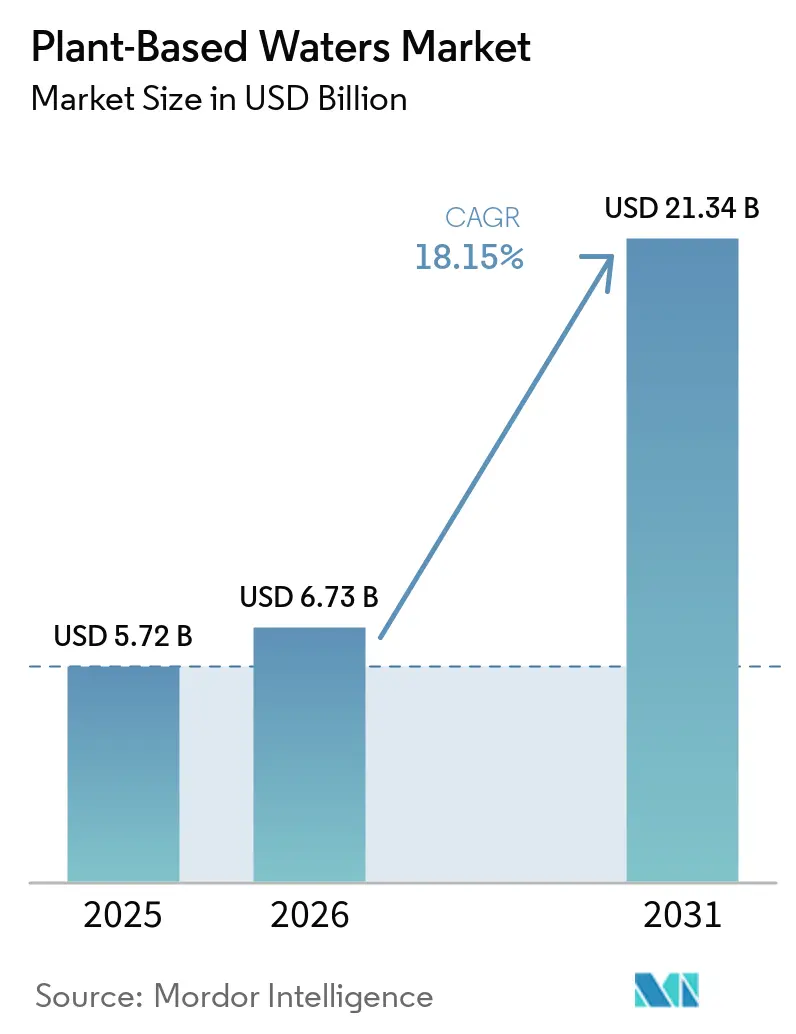
The plant-based water market size is projected to expand from USD 5.72 billion in 2025 and USD 6.73 billion in 2026 to USD 10.86 billion by 2031, registering a CAGR of 10.03% between 2026 to 2031. The plant-based water market is moving beyond its earlier wellness niche as consumers look for beverages with less sugar and recognizable ingredients. This shift favors products whose ingredient list and hydration proposition are simple to understand. Competitive priorities are also changing because reliable access to coconut supply is becoming as important as brand visibility. Larger brands can protect availability through supply agreements and ownership of processing assets, while smaller brands face more exposure to input shortages. The plant-based water market also has room for new sources, flavors, and formats, although claims, packaging choices, and retail access will determine whether these products achieve broader adoption.
Key Report Takeaways
- By product type, coconut water held 54.32% of the category share in 2025, while aloe vera water is forecast to grow at a 12.11% CAGR through 2031.
- By variant, standard and non-sparkling products accounted for 48.37% of the category share in 2025, while carbonated and sparkling products are forecast to grow at a 11.24% CAGR through 2031.
- By type, plain products held 74.32% of the category share in 2025, while flavored and functional products are forecast to grow at a 12.52% CAGR through 2031.
- By packaging type, bottles accounted for 53.28% of the category share in 2025, while cans are forecast to grow at a 11.62% CAGR through 2031.
- By distribution channel, supermarkets and hypermarkets held 41.28% of the category share in 2025, while online retail is forecast to grow at a 11.45% CAGR through 2031.
- By geography, North America held 41.28% of the category share in 2025, while Asia-Pacific is forecast to grow at a 12.82% CAGR through 2031.
Note: Market size and forecast figures in this report are generated using Mordor Intelligence’s proprietary estimation framework, updated with the latest available data and insights as of January 2026.
Market Trends and Insights
Drivers Impact Analysis of Plant-Based Waters Market*
| Driver | (~) % Impact on CAGR Forecasts | Geographic Relevance | Impact Timeline |
|---|---|---|---|
| Growing demand for natural and clean-label beverages | +3.2% | Global | Medium term (2-4 years) |
| Rising demand for electrolyte-rich and functional hydration | +2.8% | North America and Europe, with spillover to Asia-Pacific | Medium term (2-4 years) |
| Product innovation and new plant sources | +2.1% | Global | Long term (≥ 4 years) |
| Expansion of e-commerce and direct-to-consumer sales | +1.8% | Asia-Pacific, North America, and Europe | Short term (≤ 2 years) |
| Growing adoption among fitness and wellness-oriented consumers | +2.0% | North America, Europe, and Australia | Medium term (2-4 years) |
| Increasing marketing and branding from influencers and fitness enthusiasts | +1.4% | North America and Europe, with spillover to Middle East and Africa | Short term (≤ 2 years) |
| Source: Mordor Intelligence | |||
Growing Demand for Natural and Clean-Label Beverages
The plant-based water market benefits from formulations that can rely on a short and recognizable ingredient list. Single-ingredient coconut water gives brands a clean-label position without the reformulation challenges faced by drinks that depend on synthetic additives. Harmless Harvest introduced a shelf-stable line in May 2026 that contained 100% coconut water with no additives, extending that position from refrigerated cases into ambient aisles. This launch showed that shelf stability and a simple formula can coexist when the product and process are designed for wider retail distribution. The plant-based water market can therefore address consumers who want lower-sugar beverages without requiring them to adopt a specialized sports nutrition product. Growing fitness and wellness participation further supports this use case because hydration is increasingly part of routine consumption rather than a need limited to exercise occasions. Influencer and fitness-led marketing can improve trial, but a product still needs a clear ingredient proposition and repeat-purchase appeal to maintain sales after initial exposure.
Rising Demand for Electrolyte-Rich and Functional Hydration
The plant-based water market has a credible role in functional hydration because coconut water and related products can present their electrolyte content as plant-derived. This position distinguishes the category from many conventional sports drinks and gives it relevance for daily hydration as well as recovery occasions. Glanbia Nutritionals reported that hydration represented 25% of functional beverage consumption and that 78% of North American consumers recognized a link between hydration and overall health[1]. Coconut water powder also supports demand outside branded retail products because it is used in electrolyte blends and recovery beverages. That ingredient role provides another route to volume growth, although it does not necessarily strengthen a consumer-facing plant-based water brand.
Product Innovation and New Plant Sources
The plant-based water market is expanding its product base through aloe vera, cactus, maple, birch, and other plant sources. Cacto Drinks launched Prickly Pear Cactus Water in a 330 ml aluminum can at IFE 2026 in March 2026, bringing a new source and format to a major food and drink event[2]. Caliwater also introduced Dragon Fruit in 2026, using flavor to encourage product trial within cactus water. These launches show how brands are using differentiated sources and flavors to widen the category beyond conventional coconut water. Cactus, birch, and maple materials do not have the same concentrated supply structure as coconut, which can lower a barrier for smaller companies seeking a differentiated position. The resulting product variety can make the plant-based water market more distributed over time, although each new source must establish consumer familiarity and a credible reason to purchase.
Expansion of E-Commerce and Direct-to-Consumer Sales
Digital channels allow brands to test demand for premium, limited, and niche products before committing to wider physical distribution. They also give companies access to direct consumer data and subscription models that can support repeat purchases. Online discovery is particularly relevant for younger shoppers who use fitness applications, online grocery recommendations, and loyalty applications when choosing beverages. True Nopal added 914 Walmart stores in October 2024, reaching 2,362 locations, which illustrated how a brand can move from demand validation toward broader retail access. Supermarkets, convenience stores, and grocery outlets remain important because chilled, single-serve products still benefit from immediate availability. The plant-based water market will therefore use digital channels as a route to discovery and learning, while physical retail remains necessary for high-volume sales.
Restraints Impact Analysis of Plant-Based Waters Market*
| Restraint | (~) % Impact on CAGR Forecasts | Geographic Relevance | Impact Timeline |
|---|---|---|---|
| Limited availability of raw materials | -1.5% | Asia-Pacific and South America, with spillover to North America | Medium term (2-4 years) |
| Competition from conventional and functional hydration products | -1.0% | North America and Europe | Medium term (2-4 years) |
| Regulatory and health-claim restrictions | -0.7% | Europe and North America | Long term (≥ 4 years) |
| Taste and sensory acceptance issues | -0.5% | Europe and Middle East and Africa | Medium term (2-4 years) |
| Source: Mordor Intelligence | |||
Limited Availability of Raw Materials
Coconut supply has become a major constraint for the plant-based water market. Indonesia’s coconut water concentrate exports declined 32% year over year in 2025 as aging orchards, rising raw-coconut exports to China, and competing processing capacity reduced availability for local processors. India also reported a 30%-35% shortage in coconut availability, adding pressure to regional supply conditions. Smaller companies that rely on spot purchases are more likely to face production interruptions and margin pressure than companies with contracted supply. Vita Coco’s PHP 14 billion supply agreement with Century Pacific Food, Inc. took effect in January 2026 and secured coconut water supply from General Santos, Mindanao. Vita Coco also acquired Copra, Inc. in July 2026 for USD 175 million upfront, adding a Thai Nam Hom coconut water platform and production capability. These actions show that supply security is becoming a durable competitive requirement rather than a short-lived purchasing concern.
Regulatory and Health-Claim Restrictions
Regulatory limits on health claims can slow commercialization in the plant-based water market, especially for less familiar plant sources. In the European Union, food health claims require authorization after scientific review, and the permitted claims list is maintained under Regulation (EC) No. 1924/2006. This framework makes it harder to use broad functional language for birch, maple, and cactus waters where product-specific evidence may be limited. The U.S. Food and Drug Administration’s 2025 guidance on plant-based food naming also reinforces the importance of transparent and accurate labeling[3]. Compliance costs are more difficult for early-stage companies that lack regulatory resources across several markets. Larger companies can better absorb these costs and rely on certifications, permitted statements, and ingredient disclosure. Competition from conventional hydration products adds another constraint because plant-based options must offer familiar taste, functional relevance, and convenient formats at the same time.
*Our forecasts treat driver/restraint impacts as directional, not additive. The impact forecasts reflect baseline growth, mix effects, and variable interactions.
Plant-Based Waters Market Segment Analysis
By Product Type:
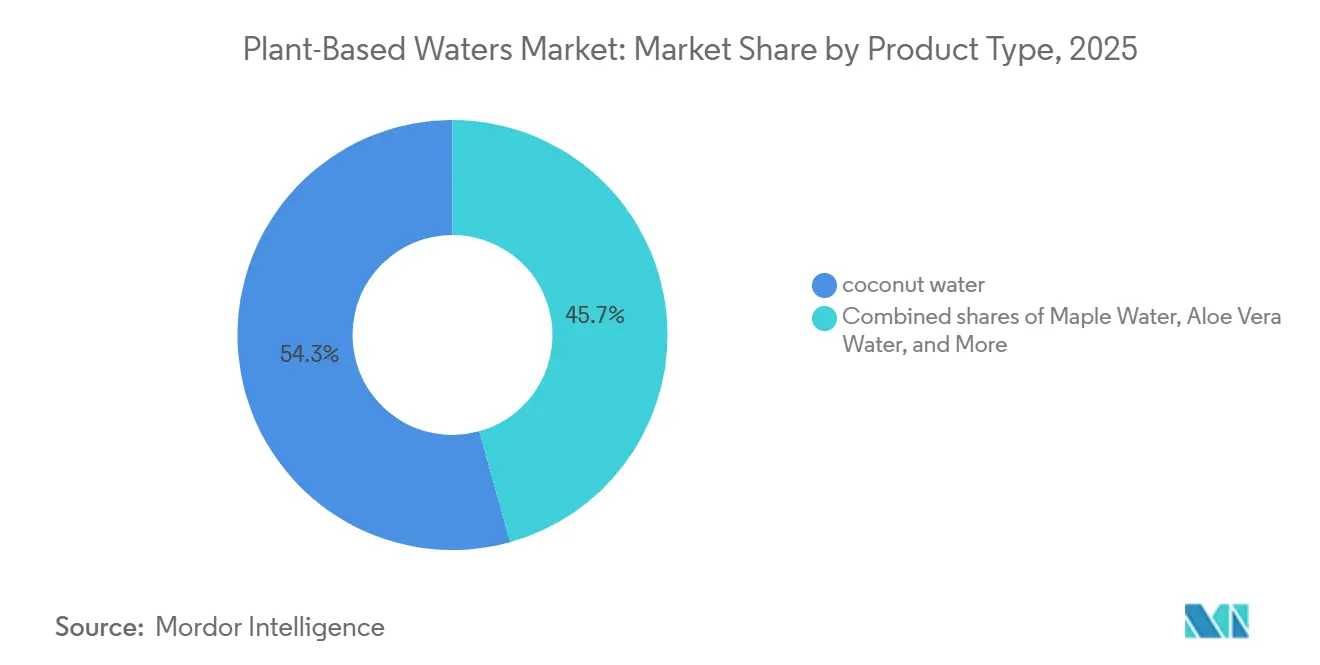
Coconut Water Anchors Category, While Aloe Vera Water Broadens Use CasesCoconut water accounted for 54.32% of the plant-based water market share in 2025, while aloe vera water is projected to grow at a 12.11% CAGR through 2031. Coconut water remains the category anchor because it has established retail distribution, consumer recognition, and a clear hydration use case. Within the sales, Vita Coco generated USD 527.60 million, and Harmless Harvest generated USD 128.90 million. These figures demonstrate the scale of the established coconut segment and its continued relevance in the plant-based water market. Its position is reinforced by refrigerated placement, established recovery occasions, and consumer familiarity with its natural electrolyte profile. Supply constraints remain the central issue because sustained demand depends on access to quality coconuts and dependable processing capacity.
Aloe vera water is gaining attention through use cases linked to digestive wellness and skin hydration. Its higher growth rate indicates that consumers are willing to consider plant waters beyond the sports recovery setting. OKF Corporation supports broader aloe vera adoption through mass-market pricing and distribution across multiple regions. Maple water, including products from Maple 3 and DRINKmaple, uses sustainable harvesting and naturally low sugar as its main points of distinction. Raspberry lemon and other flavor extensions can make maple water more accessible to consumers outside the core wellness audience. Other plant-based waters, including cactus, birch, and watermelon formats, remain smaller in revenue but are active in product launches. The product type mix is therefore becoming more diverse, while coconut water remains the primary volume driver for the plant-based water market.

By Variant:
Sparkling Products Offer a Lower-Sugar Alternative to Traditional Soft DrinksStandard and non-sparkling products held 48.37% of the category share in 2025, supported by daily hydration and post-exercise use. Their position reflects the familiar role of still coconut and aloe vera drinks in refrigerated beverage cases. Carbonated and sparkling products are forecast to grow at a 11.24% CAGR through 2031. This growth is linked to consumers seeking an alternative to conventional sparkling soft drinks while retaining carbonation and flavor interest. Sparkling coconut and aloe vera waters can serve this need with lower-sugar positioning. The format is especially relevant in European markets where carbonated water consumption is well established. The plant-based water market can use sparkling formats to reach consumers who may not otherwise choose a still functional beverage.
Sparkling products also provide an opening for premium offerings that combine familiar beverage experiences with plant-derived ingredients. This audience can support early adoption, but broader growth requires products that balance flavor, price, and clear benefits. Hybrid beverages using coconut water powder may compete for the same consumer while avoiding branded plant-water shelf space. That creates a risk of substitution for brands that rely only on traditional still products. Companies with their own sparkling products are better placed to respond to this overlap. The variant mix will thus depend on whether brands can retain the clean-label identity of plant water while offering a satisfying carbonated experience.
By Type:
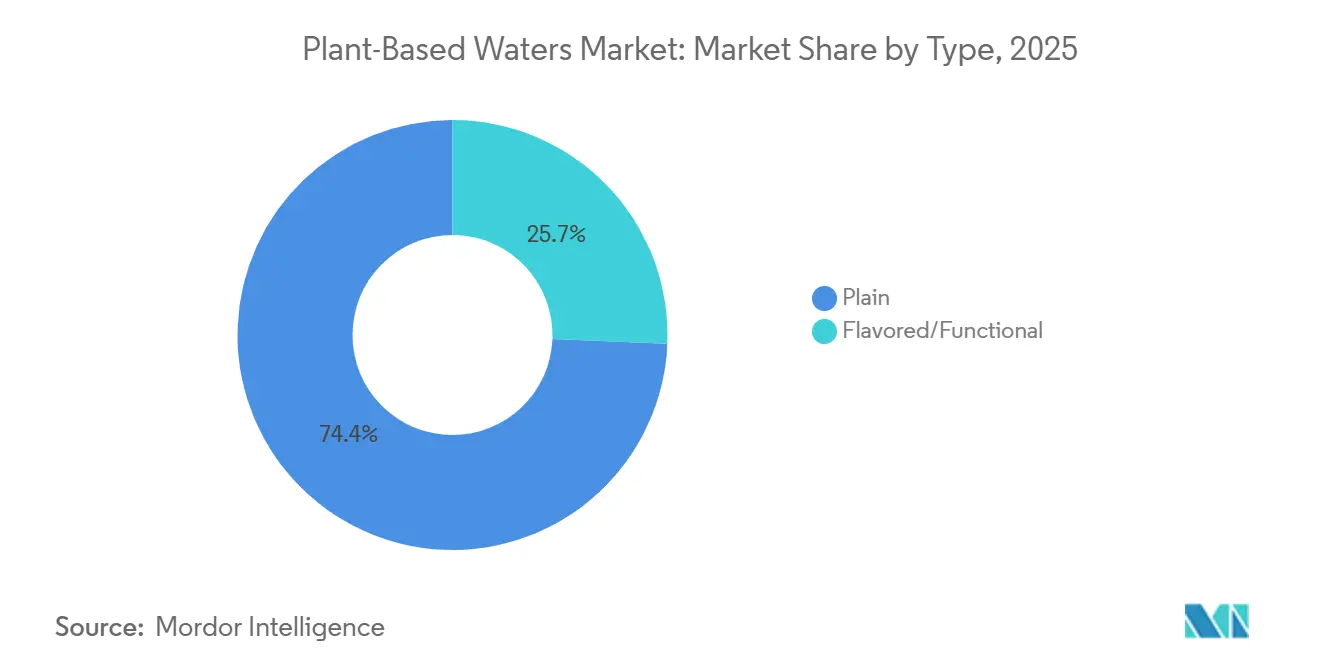
Plain Products Retain Scale, While Flavored and Functional Products Support Repeat PurchasePlain formulations held 74.32% of category share in 2025, reflecting their clean-label and sports-recovery positioning. Consumers who already understand coconut water often choose plain versions because they want a product with no added flavor or functional ingredients. Flavored and functional formats are forecast to grow at a 12.52% CAGR through 2031. Their growth addresses the need to maintain interest among consumers who do not purchase plant-based waters only for athletic recovery. Taste variety can make the category relevant for routine refreshment, social occasions, and seasonal consumption. Functional additions can also give products a more specific role within hydration routines. The plant-based water market therefore needs both product types because plain options establish trust, while flavored products can extend consumption occasions.
Vita Coco launched Frosted Lemonade Treats and a Cherry Vanilla Target-exclusive product in early 2026, expanding its flavored range through a retail-specific strategy. Harmless Harvest introduced Watermelon and Creamy Coconut at The Fresh Market in June 2026, adding fruit-forward and richer options to its portfolio. These launches show that premium and mass-market brands are both using flavor without moving away from their core product identity. However, the added ingredients must not make the formulation or message difficult to understand. The strongest products are likely to preserve the recognizable plant-water base while giving consumers a practical reason to purchase more often. This balance can improve repeat purchase across the plant-based water market.
By Packaging Type:
Bottles Lead Current Sales, While Cans Gain RelevanceBottles accounted for 53.28% of category share in 2025, supported by consumer familiarity and refrigerated distribution systems. Bottled products are easy to merchandise in single-serve formats and remain closely associated with coconut water consumption. Cans are projected to grow at a 11.62% CAGR through 2031. The format gives brands a way to communicate recyclability, portability, and a more premium shelf presentation. It can also be suitable for sparkling products and smaller portions. The packaging choice therefore affects not only logistics but also how consumers understand product quality and intended use. The plant-based water market is likely to maintain bottles at scale while using cans to develop higher-value and more differentiated offerings.
Tan Do Beverage introduced a 250 ml aluminum can for aloe vera drinks in April 2026, targeting original equipment manufacturing and private-label customers with a format positioned above cartons. Ball Corporation and Premium Lindóia launched ASI-certified flavored water cans in July 2026, bringing traceable aluminum packaging into the category. These developments show that packaging suppliers and beverage companies are using can formats to respond to retail sustainability requirements. Cartons also retain a role in larger and ambient products. Vita Coco noted in its first-quarter 2026 results that a major retailer was introducing Tetra Pak private-label coconut water for the first time. That development indicates continuing demand for carton formats in institutional and private-label channels. Packaging competition will remain important because each format addresses a different combination of shelf life, price, convenience, and brand presentation.
By Distribution Channels:
Physical Retail Delivers Volume, While Online Retail Builds DiscoverySupermarkets and hypermarkets held 41.28% of category share in 2025. These stores give brands visibility at scale through refrigerated endcaps and functional beverage aisles. They are particularly important for products that benefit from immediate trial and a chilled serving occasion. Online retail is forecast to expand at a 11.45% CAGR through 2031. It allows smaller brands to introduce niche stock keeping units without securing wide physical shelf space at the start. It also supports bundles, subscriptions, and direct communication with consumers. The plant-based water market needs both routes because high-volume grocery sales and online discovery perform different roles.
Digital platforms can help brands identify demand by flavor, plant source, package size, and consumer location before expanding distribution. This makes online retail valuable for new cactus, maple, and functional extensions that require education and targeted outreach. True Nopal’s move into 2,362 Walmart locations in October 2024 included 914 new stores, demonstrating the value of a large physical retail step after earlier market validation. Convenience and grocery stores remain useful for impulse purchases of chilled single-serve products in urban areas. The economics of physical retail are more demanding because brands need reliable supply, promotional funding, and ongoing shelf velocity. Direct-to-consumer sales can reduce dependence on these conditions, but they cannot fully replace broad retail distribution. The strongest distribution models will combine targeted online activity with disciplined expansion through the physical channels that continue to drive volume.
Geography Analysis
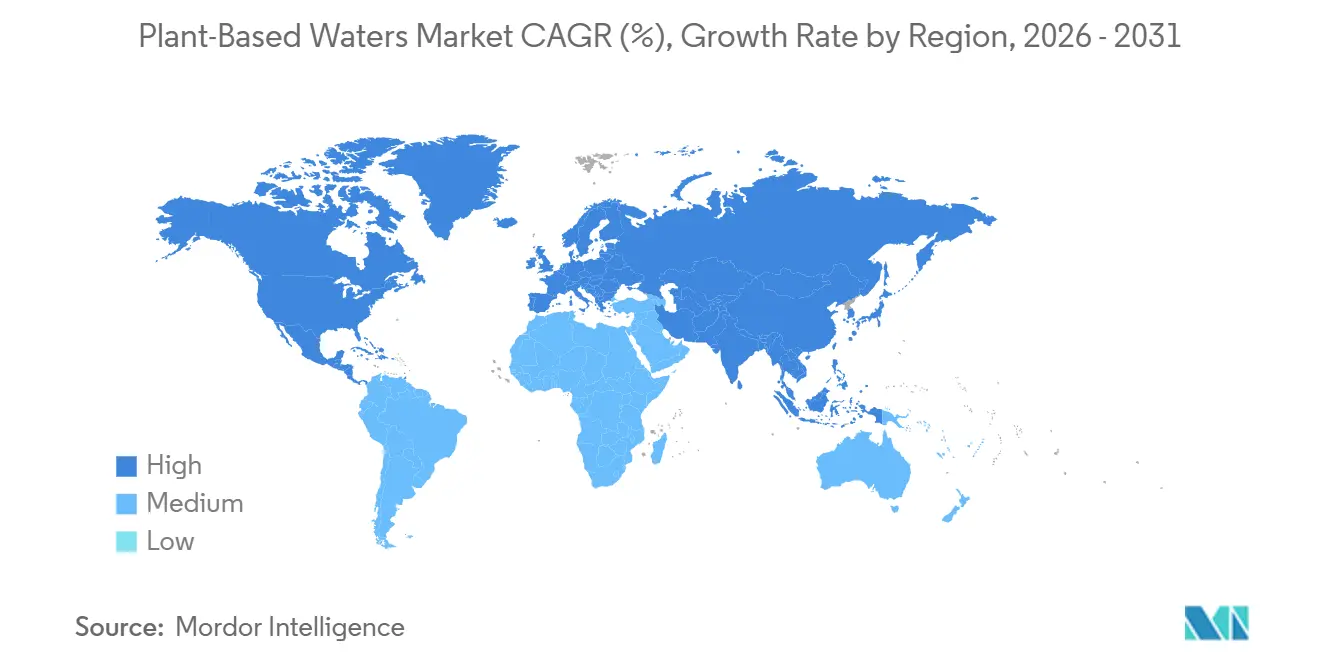
North America held 41.28% of the plant-based water market share in 2025. The region benefits from mature retail systems, high wellness spending, and consumer familiarity with functional hydration. U.S. consumers increasingly treat beverages as part of health and wellness routines, which supports demand for products positioned around recognizable ingredients. Canada offers potential for maple water because health-food retail channels can support early adoption and local production has a relevant consumer story. Mexico provides an additional growth path through modern trade and a growing urban consumer base for functional beverages.
Asia-Pacific is forecast to grow at a 12.82% CAGR through 2031, the highest regional rate in the plant-based water market. China’s growing demand for coconut water has increased raw-coconut flows from Southeast Asia, placing pressure on local processing supply. India has both extensive coconut cultivation and rising packaged beverage demand in Tier 1 and Tier 2 cities. At the same time, supply shortages show that domestic production does not automatically ensure stable ingredient availability. The region is therefore both a major production base and a growing consumption center. This dual role can increase input competition for companies producing for export markets. Vietnam, Indonesia, and South Korea are investing in aseptic packaging to support ambient distribution and reduce dependence on cold-chain systems.
Europe has meaningful demand across Germany, the United Kingdom, France, Italy, and the Netherlands. The region’s health-claim rules can create compliance costs, but they can also strengthen confidence in products that meet the required standards. Cacto Drinks used IFE 2026 in London to introduce prickly pear cactus water in a 330 ml can, showing the role of targeted trade events in new-plant-source launches. South America has a natural advantage through Brazilian coconut production, although distribution outside major cities remains a practical constraint. Argentina, Chile, and Peru have growing urban demand for functional beverages. Harmless Harvest entered the United Arab Emirates in January 2026 through Emirates Snack Foods, identifying the region as a premium import destination. Sub-Saharan Africa remains a longer-term opportunity as formal retail and distribution infrastructure develop.
Competitive Landscape
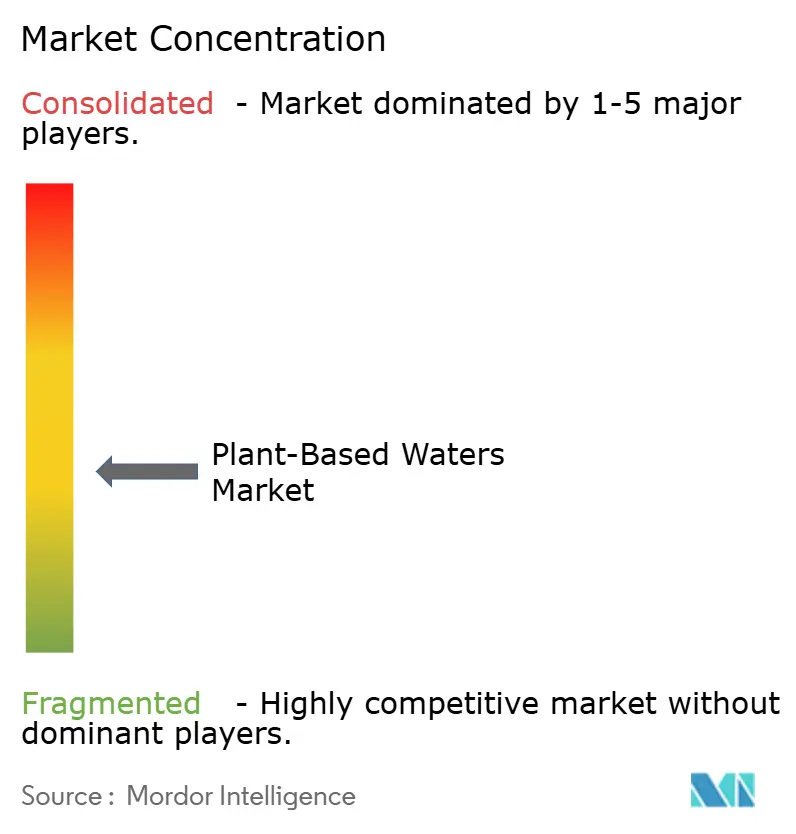
The plant-based water market is moderately consolidated, which reflects a fragmented structure where leading brands have strong recognition but not enough combined share to prevent competition from regional specialists and new plant-source brands. Raw-material access is a central source of competitive strength. The acquisition gave Vita Coco a Thai production platform and an entry point into the super-premium cold-chain segment. Its January 2026 supply agreement with Century Pacific Food, Inc. further strengthened access to coconut water supply. These moves show that a company with scale can use supply agreements and acquisitions together to protect availability and extend its product range.
Harmless Harvest has chosen a different route by extending its shelf-stable range into ambient aisles in May 2026 while maintaining its organic coconut water identity. The company also operates a regenerative agriculture Demo Farm in Thailand, using composting, intercropping, and natural pollination to support its sourcing approach. This can support its positioning with buyers that pay attention to agricultural practices and ingredient traceability. The plant-based water market remains open to companies that can combine a clear product story with stable sourcing. However, new entrants need sufficient funding to support retail execution after they move beyond online sales and limited regional distribution.
Caliwater, True Nopal, and OKF Corporation illustrate the role of smaller and specialized competitors. These companies use approaches such as celebrity associations, online-first distribution, wide regional coverage, and lower-price formats to build demand. Caliwater’s Dragon Fruit launch in April 2026 used artist Benson Boone as a brand ambassador, extending its celebrity-supported product strategy. New categories such as aloe vera functional products, mainstream cactus water, birch water, maple water, and bamboo water remain areas where early brands can establish consumer awareness. Preservation technologies such as high-pressure processing and cold-chain aseptic packaging may become another point of differentiation because they can affect taste, shelf life, and the ability to serve ambient channels. The market’s fragmented structure means that brand scale is useful but does not ensure leadership across every plant source or geography.
Plant-Based Waters Industry Leaders
-
The Vita Coco Company, Inc.
-
The Coca-Cola Company
-
PepsiCo, Inc.
-
Harmless Harvest, Inc.
-
OKF Corporation
- *Disclaimer: Major Players sorted in no particular order
Plant-Based Waters Market Companies Covered in this Report
- The Vita Coco Company, Inc.
- PepsiCo, Inc.
- The Coca-Cola Company
- Harmless Harvest, Inc.
- All Market Inc.
- Caliwater LLC
- WTRMLN WTR
- Maple 3
- Drink Simple
- Sibberi
- C2O Pure Coconut Water
- ZICO Rising
- H2coco
- True Nopal
- DRINKmaple
- Happy Tree Group
- OKF Corporation
- ARTY Water Company
- DrinkSEVA
- Tapped Birch Water
Recent Industry Developments in Plant-Based Waters Market
- June 2026: Tom Brady and Gopuff launched Good Nut, a premium organic coconut water brand available exclusively through Gopuff. Made from organic Vietnamese coconuts with no added sugars, sweeteners, or artificial ingredients, the range debuted in Original, Chocolate, and Sparkling varieties, with the chocolate variant positioned as the first certified organic chocolate coconut water.
- February 2026: Maple3 announced the launch of its 16.9 oz Pure Maple Water bottles at Meijer stores. The expansion strengthens the brand’s presence in mainstream Midwest retail and supports its strategy to scale nationally, while positioning maple water as a low-sugar, low-calorie functional hydration option containing naturally occurring electrolytes, antioxidants, and minerals.
- April 2025: Innocent, a Coca-Cola brand, launched its Kids Juicy Water range in the UK, offering two variants, Apples & Strawberries and Apples & Mangoes. Made with 70% real fruit, the drinks contain no added sugar, sweeteners, or artificial flavors and were initially launched across 549 Burger King restaurants before expanding into convenience stores.
Global Plant-Based Waters Market Report Scope
Plant-based waters are naturally derived functional beverages extracted from the sap, fruits, leaves, or roots of plants. They are rich in electrolytes, vitamins, minerals, and antioxidants and do not contain added artificial sugars.
The plant-based waters market is segmented by product type (coconut water, maple water, and more), variant (standard/non-sparkling, sparkling), type (plain, flavored/functional), packaging (bottles, cans, and more), distribution channel (supermarkets/hypermarkets, convenience stores, pnline retail, others), and geography (North America, Europe, Asia-Pacific, and more). The market forecasts are provided in terms of value (USD).
Source: https://www.mordorintelligence.com/industry-reports/plant-based-waters-market
Segmentation Overview
| Coconut Water |
| Maple Water |
| Aloe Vera Water |
| Other Plant-Based Water |
| Standard/Non-Sparkling |
| Carbonated/Sparkling |
| Plain |
| Flavored/Functional |
| Bottles |
| Cans |
| Cartons |
| Others |
| Supermarkets/Hypermarkets |
| Convenience/Grocery Stores |
| Online Retail Channels |
| Other Distribution Channels |
| North America | United States |
| Canada | |
| Mexico | |
| Rest of North America | |
| Europe | Germany |
| United Kingdom | |
| France | |
| Italy | |
| Spain | |
| Netherlands | |
| Sweden | |
| Poland | |
| Belgium | |
| Rest of Europe | |
| Asia-Pacific | China |
| India | |
| Japan | |
| Australia | |
| South Korea | |
| Vietnam | |
| Indonesia | |
| Rest of Asia-Pacific | |
| South America | Brazil |
| Argentina | |
| Chile | |
| Peru | |
| Colombia | |
| Rest of South America | |
| Middle East and Africa | United Arab Emirates |
| Saudi Arabia | |
| South Africa | |
| Nigeria | |
| Rest of Middle East and Africa |
| By Product Type | Coconut Water | |
| Maple Water | ||
| Aloe Vera Water | ||
| Other Plant-Based Water | ||
| By Variant Type | Standard/Non-Sparkling | |
| Carbonated/Sparkling | ||
| By Type | Plain | |
| Flavored/Functional | ||
| By Packaging Type | Bottles | |
| Cans | ||
| Cartons | ||
| Others | ||
| By Distribution Channels | Supermarkets/Hypermarkets | |
| Convenience/Grocery Stores | ||
| Online Retail Channels | ||
| Other Distribution Channels | ||
| By Geography | North America | United States |
| Canada | ||
| Mexico | ||
| Rest of North America | ||
| Europe | Germany | |
| United Kingdom | ||
| France | ||
| Italy | ||
| Spain | ||
| Netherlands | ||
| Sweden | ||
| Poland | ||
| Belgium | ||
| Rest of Europe | ||
| Asia-Pacific | China | |
| India | ||
| Japan | ||
| Australia | ||
| South Korea | ||
| Vietnam | ||
| Indonesia | ||
| Rest of Asia-Pacific | ||
| South America | Brazil | |
| Argentina | ||
| Chile | ||
| Peru | ||
| Colombia | ||
| Rest of South America | ||
| Middle East and Africa | United Arab Emirates | |
| Saudi Arabia | ||
| South Africa | ||
| Nigeria | ||
| Rest of Middle East and Africa | ||
Key Questions Answered in the Report
What is the projected value of the plant-based water market by 2031?
The plant-based water market is projected to reach USD 10.86 billion by 2031, growing from USD 6.73 billion in 2026 at an 10.03% CAGR.
Which product category leads plant-based water sales?
Coconut water led with 54.32% share in 2025, supported by established consumer awareness, retail access, and hydration use cases.
Which plant-based water type is expected to grow fastest?
Aloe vera water is forecast to grow at a 12.11% CAGR through 2031, supported by interest in digestive wellness and skin hydration uses.
Why are sparkling plant-based waters gaining attention?
Sparkling products are forecast to grow at a 11.24% CAGR through 2031 because they can provide a lower-sugar alternative to traditional carbonated soft drinks.