
Size and Share of Pipes Market For Data Centers
Market Overview
| Study Period | 2021 - 2031 |
|---|---|
| Market Size (2026) | USD 0.86 Billion |
| Market Size (2031) | USD 1.81 Billion |
| Growth Rate (2026 - 2031) | 15.86 % |
| Fastest Growing Market | Europe |
| Largest Market | North America |
| Market Concentration | Medium |
Major Players *Disclaimer: Major Players sorted in no particular order Image © Mordor Intelligence. Reuse requires attribution under CC BY 4.0. | |
Analysis of Pipes Market For Data Centers by Mordor Intelligence
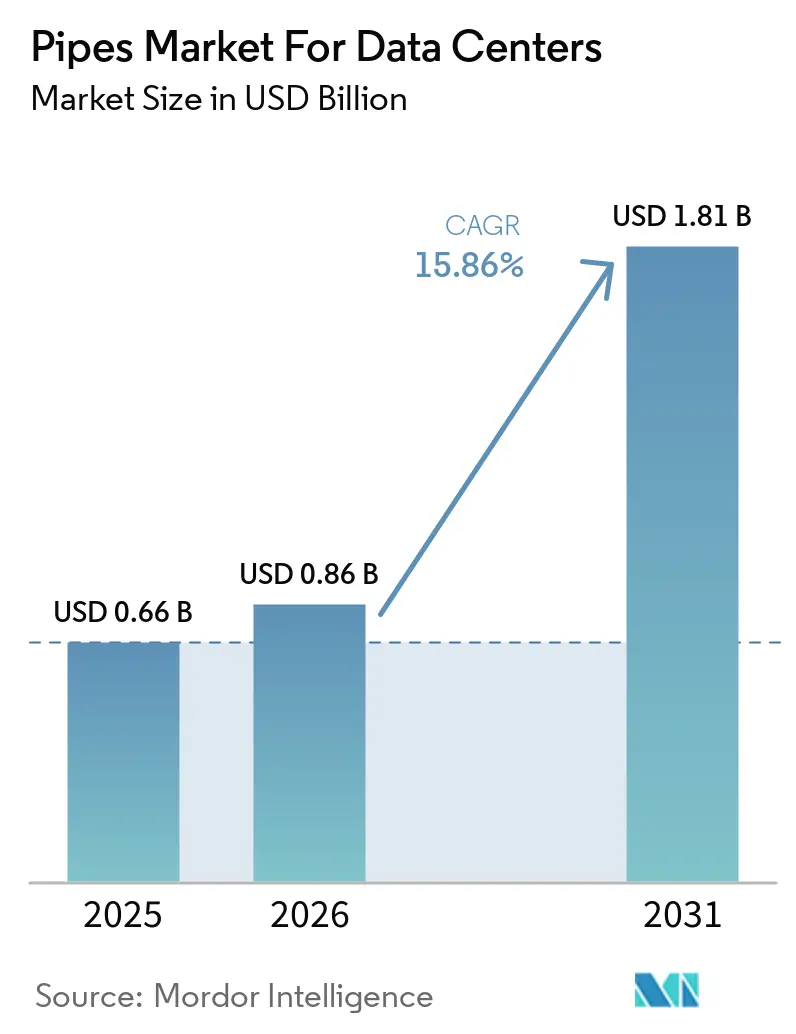
The Pipes Market For Data Centers Industry size is expected to increase from USD 0.66 billion in 2025 to USD 0.86 billion in 2026 and reach USD 1.81 billion by 2031, at a CAGR of 15.86% over 2026-2031. The pipes market for data centers is expanding as artificial intelligence infrastructure increases facility capacity and changes cooling-system design. New halls require chilled-water lines, condenser circuits, fire-suppression headers, and coolant distribution systems that connect equipment across the facility. Higher rack densities also increase the importance of liquid handling, material cleanliness, and reliable joining methods. Suppliers are responding by offering prefabricated assemblies, polymer systems, and designs that support both facility water systems and technology cooling systems. The pipes market for data centers also faces longer project approval cycles, rising construction costs, and conservative procurement practices in which liquid is installed near operating servers.
Key Report Takeaways
- By material type, metal-based pipes held 71.04% of the pipes market for data centers in 2025, while metal-based pipes are projected to advance at a 20.93% CAGR through 2031.
- By application, chilled water distribution held 49.26% of the pipes market for data centers in 2025, while drainage and wastewater systems are projected to advance at a 18.16% CAGR through 2031.
- By cooling technology, air-cooled data centers held 57.43% of the pipes market for data centers in 2025, while liquid-cooled data centers are projected to advance at a 22.32% CAGR through 2031.
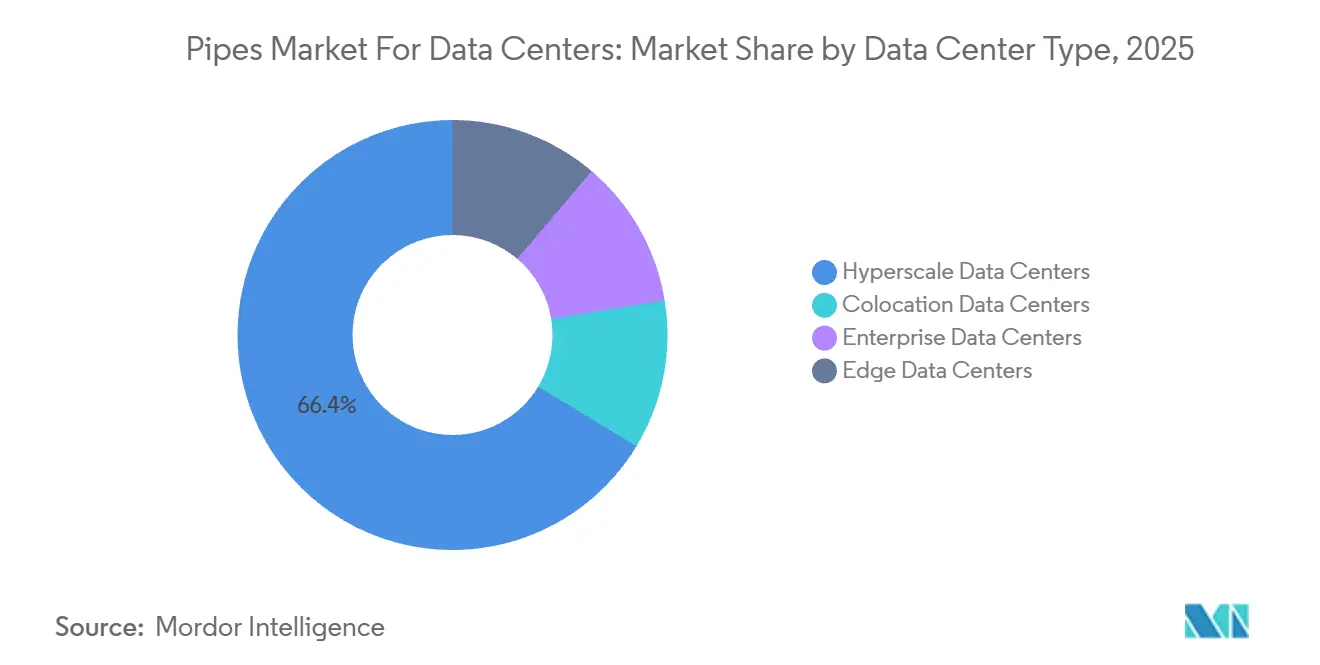
- By data center type, hyperscale data centers held 66.35% of the pipes market for data centers in 2025 and are projected to advance at a 17.01% CAGR through 2031.
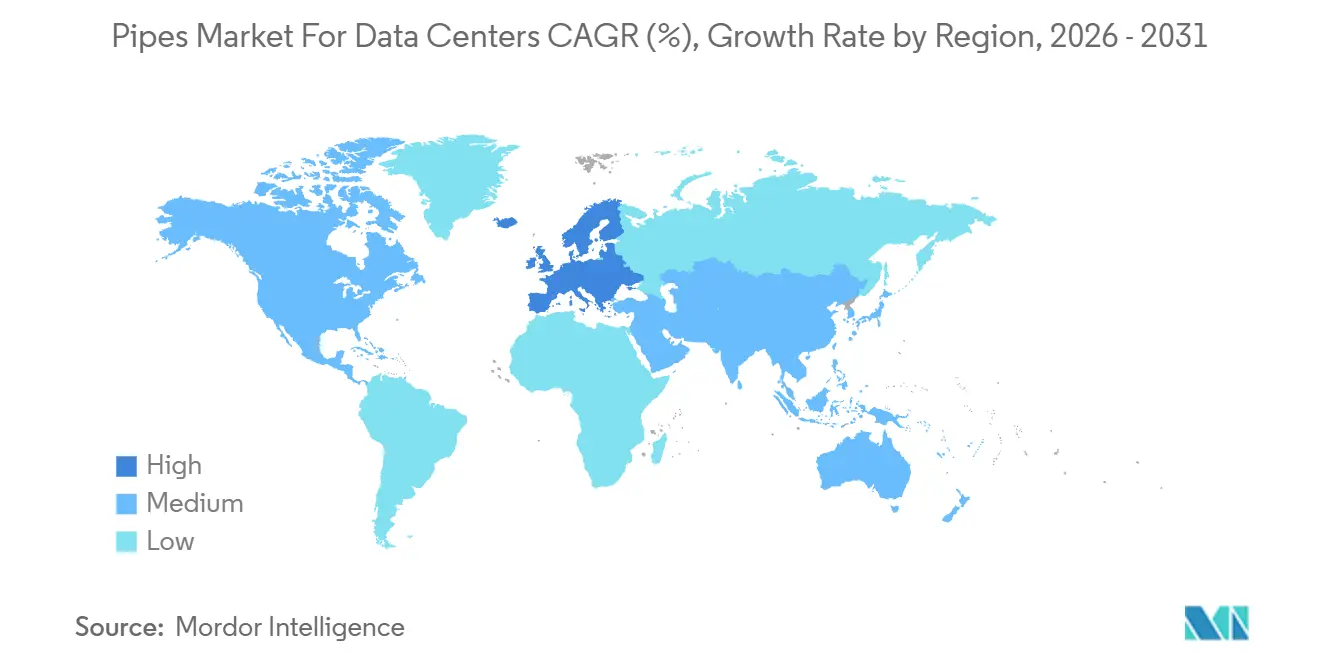
- By geography, North America held 61.73% of the pipes market for data centers in 2025, while Europe is projected to advance at a 18.07% CAGR through 2031.
Note: Market size and forecast figures in this report are generated using Mordor Intelligence’s proprietary estimation framework, updated with the latest available data and insights as of January 2026.
Insights and Trends of Pipes Market For Data Centers
Drivers Impact Analysis*
| Driver | (~) % Impact on CAGR Forecast | Geographic Relevance | Impact Timeline |
|---|---|---|---|
| Rapid Expansion of Hyperscale and Colocation Data Centers | +4.0% | Global; primary concentration in North America and Asia-Pacific | Medium term (2-4 years) |
| Rising AI and High-Performance Computing Workloads | +3.2% | Global; strongest in the United States, China, and European AI corridors | Long term (≥ 4 years) |
| Increasing Adoption of Direct-to-Chip and Immersion Cooling | +2.5% | Global; early adoption in North America, Western Europe, and China | Medium term (2-4 years) |
| Growth of Edge and Modular Data Center Deployments | +1.5% | APAC core with spill-over to Middle East and Africa and South America | Medium term (2-4 years) |
| Demand for Prefabricated and Factory-Tested Piping Systems | +1.0% | Global; highest uptake in North America and Asia-Pacific | Short term (≤ 2 years) |
| Source: Mordor Intelligence | |||
Rapid Expansion of Hyperscale and Colocation Data Centers
The pipes market for data centers benefits when hyperscale and colocation operators build larger facilities on compressed delivery schedules. Each campus needs extensive chilled-water distribution, condenser-water branches, fire-suppression networks, and dedicated manifolds for dense computing areas. New capacity favors suppliers that can provide qualified components and assembled systems before on-site installation begins. Colocation operators also need standardized, tested pipe assemblies that can be installed without disrupting adjacent operating halls. Procurement is moving earlier in project planning because piping must align with cooling equipment, information technology equipment, and building construction schedules. This timing increases the value of suppliers that can coordinate materials, fabrication, testing, and delivery within a single project schedule.
Rising AI and High-Performance Computing Workloads
Artificial intelligence and high-performance computing workloads are changing the thermal requirements of new facilities. NVIDIA stated that its GB200 NVL72 rack can draw more than 120 kW per cabinet, placing greater demands on cooling circuits and coolant delivery equipment. The International Energy Agency projected global data center electricity use to rise from 415 TWh in 2024 to 945 TWh by 2030[1]International Energy Agency, “Energy Demand from AI,” International Energy Agency, iea.org. Cooling infrastructure contributes to this increase and requires reliable fluid movement throughout the building. These conditions favor clean polymer systems where coolant purity and corrosion control matter for cold plates and quick-connect components. The pipes market for data centers, therefore, depends not only on more facilities, but also on greater pipe density within each artificial intelligence-enabled hall.
Increasing Adoption of Direct-to-Chip and Immersion Cooling
Direct-to-chip cooling is becoming more relevant in facilities that host high-density artificial intelligence equipment. A direct-to-chip design uses a facility water system that delivers chilled water to coolant distribution units. It also uses a technology cooling system that transfers coolant from those units to rack manifolds and chip-level cold plates. The International Energy Agency 4E Energy Efficient Demand Side Management Annex reported that single-phase direct-to-chip cooling represented 43% of liquid-cooling revenue in 2026. GF Piping Systems demonstrated a PP-H system with KT Cloud in Seoul that operated at 5 bar pressure and 20 °C to 25 °C, while using prefabricated spools to reduce installation time. The pipes market for data centers gains from this configuration because the two-loop architecture adds connections, branches, and pipe runs that conventional air-cooled rooms do not need.
Growth of Edge and Modular Data Center Deployments
Edge and modular facilities create demand for compact piping systems that arrive ready for installation. Each site still needs cooling circuits, even when the facility is smaller than a hyperscale campus. Modular projects reduce the practicality of extensive field fabrication because the equipment must fit within containerized or tightly planned structures. The Plastics Pipe Institute documented an Aquatherm modular data center application that used heat-fused PP-R piping in 40-rack units. Factory-tested assemblies can reduce the number of site activities and provide a more consistent installation process. The pipes market for data centers can benefit from new edge projects that develop in areas with limited specialized installation labor.
Restraints Impact Analysis*
| Restraint | (~) % Impact on CAGR Forecast | Geographic Relevance | Impact Timeline |
|---|---|---|---|
| High Installation and Infrastructure Costs | -2.1% | Global; most acute in North America and Western Europe due to skilled-labor costs | Medium term (2-4 years) |
| Leakage and Mission-Critical Reliability Risks | -1.5% | Global; highest sensitivity in Tier III/IV hyperscale and colocation facilities | Long term (≥ 4 years) |
| Coolant Compatibility and Water-Chemistry Uncertainty | -0.9% | Global; emerging concern in markets rapidly scaling direct-to-chip deployments | Short term (≤ 2 years) |
| Source: Mordor Intelligence | |||
High Installation and Infrastructure Costs
Piping infrastructure becomes more expensive when liquid-cooled designs add technology cooling system branches to the usual plant-side equipment. Field welding and fusion joining can add labor requirements when a project contains many manifold connections. Design revisions can also require rerouting when hardware layouts change during construction. These costs are harder to absorb in enterprise and edge projects with smaller capital budgets. Requirements under the American Society of Mechanical Engineers B31.3 process-piping standards and the American Society of Heating, Refrigerating and Air-Conditioning Engineers Technical Committee 9.9 guidance can add documentation and testing work for some installations. The pipes market for data centers must, therefore, balance higher initial system complexity against the thermal needs of high-density computing equipment.
Leakage and Mission-Critical Reliability Risks
A liquid leak near active information technology equipment can interrupt operations and create material financial exposure for operators. The Uptime Institute Cooling Systems Survey 2025 identified high cost and perceived risk of system failure as leading barriers to liquid-cooling adoption among 861 respondents. Operators often select proven joining methods, including heat-fused polypropylene, grooved couplings for large steel lines, and double-containment designs. These choices can increase component costs and extend the time needed to qualify a system. Colocation and enterprise operators may first deploy liquid cooling in isolated rows rather than across a full hall. This staged approach can break larger piping requirements into smaller custom orders and limit the purchasing efficiencies available in standardized projects.
*Our forecasts treat driver/restraint impacts as directional, not additive. The impact forecasts reflect baseline growth, mix effects, and variable interactions.
Segment Analysis
By Material Type: Polymer-Based Pipes Advance Across the Full Cooling Chain
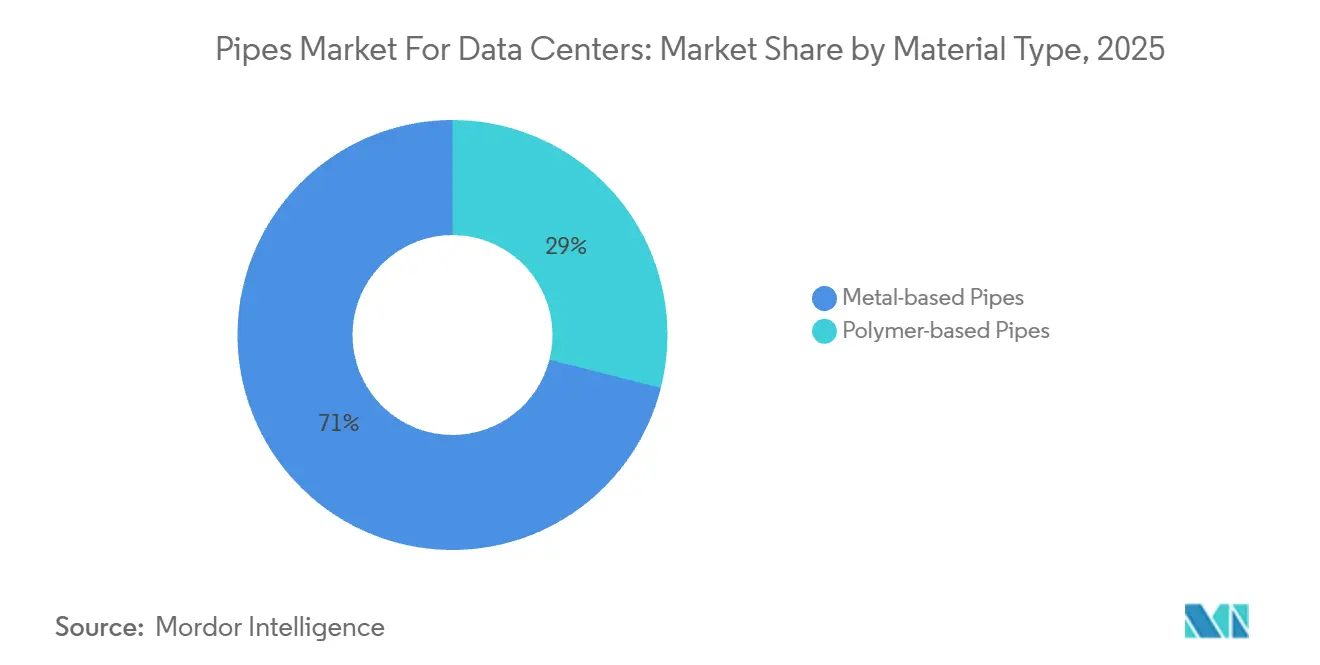
Metal-based pipes accounted for 71.04% of revenue in 2025, supported by their established use in chilled-water distribution, condenser-water systems, plant headers, and other critical data center infrastructure. Their high mechanical strength, pressure-handling capacity, durability, and suitability for large-bore piping networks make them the preferred choice for large-scale and hyperscale facilities. Carbon steel, stainless steel, copper, and ductile iron serve different applications based on pressure, temperature, corrosion exposure, and water-quality requirements. Despite their higher weight and greater corrosion-management needs than polymer alternatives, metal-based pipes remain the dominant material type due to their extensive installed base and ability to support demanding cooling infrastructure.
Polymer-based pipes are projected to be the fastest-growing material type and are expected to register a CAGR of 20.93% during 2026–2031. Their growth is driven by the increasing adoption of lightweight, corrosion-resistant, and low-maintenance piping systems for data center cooling infrastructure. Materials such as polypropylene, high-density polyethylene, chlorinated polyvinyl chloride, and polyvinylidene fluoride resist corrosion and chemical exposure while offering easier handling and installation than conventional metal systems. Their suitability for chilled-water, condenser-water, drainage, and specialized liquid-cooling applications supports their adoption as data center operators increasingly prioritize system durability, cleanliness, and lifecycle performance.


By Application: Chilled Water Distribution Anchors Revenue While Condenser Water Systems Drive Incremental Growth
Chilled water distribution accounted for 49.26% of application revenue in 2025, making it the largest application segment in the data center pipes market. These systems connect cooling plants to cooling equipment and data halls, facilitating chilled-water circulation for heat removal across conventional and high-density computing environments. Their established use in air-cooled data centers and growing integration with liquid-cooling systems continue to drive demand for reliable, high-pressure piping networks.
Drainage and wastewater systems are projected to be the fastest-growing application segment, set to expand at a CAGR of 18.16% during 2026–2031. Growth is driven by the expansion of data center campuses, rising water-management requirements, and increased emphasis on the efficient handling of process water, condensate, and wastewater streams. As data centers increase in scale and cooling-water use, drainage infrastructure must handle larger water volumes while ensuring corrosion resistance and reliable long-term performance. Polymer-based piping systems are gaining importance in these applications due to their resistance to corrosion and chemical exposure, supporting the expansion of drainage and wastewater networks alongside core cooling infrastructure.
By Cooling Technology: Air-cooled Data Centers Baseline Holds, Liquid-cooled Data Centers Drive Structural Demand Shifts
Air-cooled data centers held 57.43% of revenue in 2025 and continued to provide the largest installed base for piping demand. These sites require chilled-water lines for precision air handlers, fire-suppression networks, and domestic-water services, which support maintenance, expansion, and replacement activity. Hybrid systems combine air-cooled areas for lower-density equipment with liquid-cooled areas for graphics processing unit clusters. This arrangement adds separate cooling pathways and requires clear interfaces between older building systems and new rack-level cooling equipment.
Liquid-cooled data centers are projected to advance at a 22.32% CAGR through 2031, supported by demand from artificial intelligence workloads. GF Piping Systems received Open Compute Project-inspired recognition for a polyvinylidene fluoride in-rack manifold designed for direct-to-chip cooling. The recognition provides a reference point for system designs used in Open Compute Project-aligned procurement. Liquid systems add secondary loops from coolant distribution units to racks, which increases the number of required components. The pipes market for data centers responds through products that cover both facility water systems and technology cooling systems.
By Data Center Type: Hyperscale Data Centers Lead Across Both Share and Growth
Hyperscale data centers held 66.35% of revenue in 2025 and are projected to advance at a 17.01% CAGR through 2031. This segment leads because large cloud and artificial intelligence campuses need extensive pipe networks across cooling, fire protection, and water services. Artificial intelligence-ready halls also need technology cooling system manifolds that connect coolant distribution units with racks. The pipes market for data centers is most exposed to this type of project because each site can require substantial large-bore and smaller-diameter pipe runs. Scale also encourages suppliers to offer prefabricated racks and tested assemblies that shorten work at the site.
Colocation providers are expanding liquid-cooling-ready capacity to attract artificial intelligence workloads from tenants. Enterprise facilities continue to require upgrades as operators increase on-premises computing density. Edge facilities favor modular and pre-tested packages because construction sites can have limited space and labor availability. Schneider Electric introduced its Prefabricated Modular EcoStruxure Pod in June 2025 for rack densities of 1 MW and higher. The pipes market for data centers can, therefore, serve both very large, standardized campuses and smaller deployments that prioritize rapid installation.

Geography Analysis
North America held 61.73% of revenue in 2025, representing the largest regional position in the pipes market for data centers. The United States drives requirements for new campuses, cooling retrofits, and liquid-cooling-ready halls. Texas and Indiana have gained activity alongside established Northern Virginia development. This distribution supports regional fabrication and supply arrangements for chilled-water, condenser-water, and technology cooling systems. Telehouse Canada deployed direct-to-chip liquid cooling in Toronto and integrated waste-heat recovery with Enwave’s district energy system.
Asia-Pacific includes new construction in Southeast Asia and capacity additions in India, China, and Japan. Malaysia’s Johor increased operational capacity from 401 MW to 897 MW in 2025, while Mumbai reached 768 MW after a 42% increase. These projects require large-volume procurement and close scheduling between component suppliers and construction teams. The broad regional pipeline supports both outdoor utility applications and rack-level cooling systems.
Europe is projected to advance at a 18.07% CAGR through 2031. The region remains important for higher-specification piping across the Frankfurt, London, Amsterdam, Paris, and Dublin cluster. The European Union Energy Efficiency Directive requires certain data centers above 500 kW to report energy and water data, which increases attention to cooling-water use and system losses[2]European Commission, “Energy Efficiency Directive,” European Commission, energy.ec.europa.eu. ISOPLUS Group supplied DN700 district-heating pipes for Microsoft’s Espoo data center waste-heat project with Fortum. Brazil supports South American demand through hyperscale and colocation development in São Paulo. Saudi Arabia and the United Arab Emirates require reliable liquid-cooling infrastructure because high ambient temperatures increase cooling needs.

Competitive Landscape
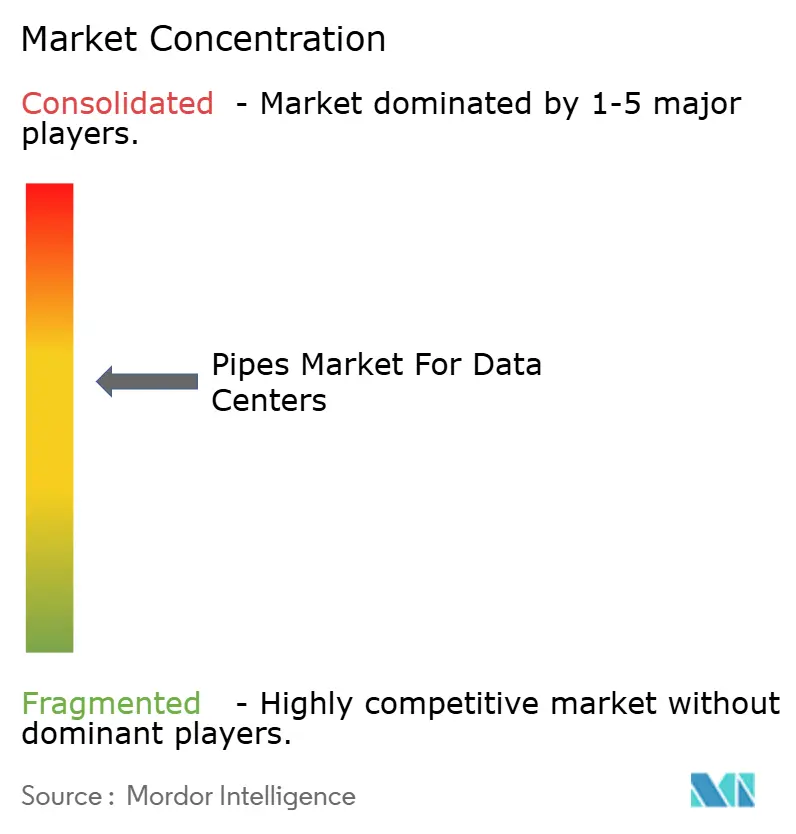
The pipes market for data centers is moderately concentrated, with the top five players including GF Piping Systems, PARKER HANNIFIN CORP, WL Plastics, ASTRAL PIPES, and IPEX Inc. They compete with industrial flow-solution suppliers, thermoplastic manufacturers, and a broad group of steel-pipe providers. Different supplier groups serve distinct requirements across condenser water, fire protection, facility water systems, and technology cooling systems.
GF Piping Systems is pursuing a full-chain approach through its LiquidCore family, covering plant-side lines through in-rack manifold applications. The company introduced LiquidCore in November 2025 as a prefabricated polymer flow solution for single-phase direct-to-chip cooling. In February 2026, GF Piping Systems and Rittal delivered polymer cooling infrastructure for NETMOUNTAINS in Germany, covering facility water, technology cooling, and heating, ventilation, and air-conditioning connections. PARKER HANNIFIN CORP supplies hoses, quick-connect fittings, thermoplastic tubing, and valves for technology cooling systems and immersion loops. It showcased its direct liquid-cooling portfolio at Data Center World 2026 in Washington, D.C.
Opportunities exist in standardized prefabricated pipe racks and water-chemistry services provided with pipe systems. Customers deploying liquid cooling must align material choice, coolant purity, connection methods, and commissioning requirements. IPEX Inc. opened its Centre for Advanced Research in Ontario in April 2025, with a stated focus on thermoplastic product development using artificial intelligence-driven design tools and 3D printing. Suppliers need documentation for process-piping requirements and participation in technical ecosystems used by hyperscale buyers. Prefabrication capability matters where customers want to reduce on-site work and shorten construction sequences.
Leaders of Pipes Market For Data Centers
GF Piping Systems
PARKER HANNIFIN CORP
WL Plastics
ASTRAL PIPES
IPEX Inc.
- *Disclaimer: Major Players sorted in no particular order

Recent Industry Developments
- July 2026: GF Piping Systems reported that data center order intake doubled year-on-year in H1 2026, driven by adoption of its LiquidCore prefabricated polymer piping system for direct-to-chip cooling. The growth highlights rising demand for specialized piping systems in liquid-cooled data center infrastructure.
- April 2026: PARKER HANNIFIN CORP showcased its Direct Liquid Cooling portfolio for single-phase and two-phase direct-to-chip deployments in AI hyperscale and high-performance computing facilities. Its fluid-conveyance hoses, fittings, couplings, and valves support high-pressure cooling loops, strengthening demand for advanced piping and fluid-management components in data centers.


Scope of Report on Pipes Market For Data Centers
Pipes used in data centers are critical infrastructure components that transport water, cooling fluids, and other utilities required for facility operation and thermal management. Their performance depends on factors such as pressure resistance, corrosion protection, temperature tolerance, leak prevention, and compatibility with data center cooling and utility systems.
The Pipes Market for Data Centers is segmented by material type, application, cooling technology, data center type, and geography. By material type, the market is segmented into polymer-based pipes (HDPE pipes, PP-R pipes, PP-RCT pipes, PP-H pipes, CPVC pipes, PVC pipes, PE-X/XLPE Pipes, and other specialty materials, including PVDF, ABS, and composite pipes) and metal-based pipes (carbon steel pipes and stainless steel pipes). By application, the market is segmented into chilled water distribution, condenser water systems, fire protection systems, water supply and treatment, drainage and wastewater systems, and underground utility networks. By cooling technology, the market is segmented into air-cooled data centers, liquid-cooled data centers, and hybrid cooling technologies. By data center type, the market is segmented into hyperscale data centers, colocation data centers, enterprise data centers, and edge data centers. The report also covers the market size and forecasts for the pipes market in data centers in 18 countries across major regions. For each segment, the market sizing and forecasts have been done on the basis of value (USD).
| Polymer-based Pipes | HDPE Pipes |
| PP-R Pipes | |
| PP-RCT Pipes | |
| PP-H Pipes | |
| CPVC Pipes | |
| PVC Pipes | |
| PE-X/XLPE Pipes | |
| Others Specialty Materials(PVDF, ABS, Composite Pipes) | |
| Metal-based Pipes | Carbon Steel Pipes |
| Stainless Steel Pipes |
| Chilled Water Distribution |
| Condenser Water Systems |
| Fire Protection Systems |
| Water Supply and Treatment |
| Drainage and Wastewater Systems |
| Underground Utility Networks |
| Air-cooled Data Centers |
| Liquid-cooled Data Centers |
| Hybrid Cooling Technologies |
| Hyperscale Data Centers |
| Colocation Data Centers |
| Enterprise Data Centers |
| Edge Data Centers |
| Asia-Pacific | China |
| India | |
| Japan | |
| South Korea | |
| Singapore | |
| Australia | |
| Rest of Asia-Pacific | |
| North America | United States |
| Canada | |
| Mexico | |
| Europe | Germany |
| United Kingdom | |
| France | |
| Italy | |
| Spain | |
| Rest of Europe | |
| South America | Brazil |
| Rest of South America | |
| Middle East and Africa | Saudi Arabia |
| United Arab Emirates | |
| South Africa | |
| Rest of Middle East and Africa |
| By Material Type | Polymer-based Pipes | HDPE Pipes |
| PP-R Pipes | ||
| PP-RCT Pipes | ||
| PP-H Pipes | ||
| CPVC Pipes | ||
| PVC Pipes | ||
| PE-X/XLPE Pipes | ||
| Others Specialty Materials(PVDF, ABS, Composite Pipes) | ||
| Metal-based Pipes | Carbon Steel Pipes | |
| Stainless Steel Pipes | ||
| By Application | Chilled Water Distribution | |
| Condenser Water Systems | ||
| Fire Protection Systems | ||
| Water Supply and Treatment | ||
| Drainage and Wastewater Systems | ||
| Underground Utility Networks | ||
| By Cooling Technology | Air-cooled Data Centers | |
| Liquid-cooled Data Centers | ||
| Hybrid Cooling Technologies | ||
| By Data Center Type | Hyperscale Data Centers | |
| Colocation Data Centers | ||
| Enterprise Data Centers | ||
| Edge Data Centers | ||
| By Geography | Asia-Pacific | China |
| India | ||
| Japan | ||
| South Korea | ||
| Singapore | ||
| Australia | ||
| Rest of Asia-Pacific | ||
| North America | United States | |
| Canada | ||
| Mexico | ||
| Europe | Germany | |
| United Kingdom | ||
| France | ||
| Italy | ||
| Spain | ||
| Rest of Europe | ||
| South America | Brazil | |
| Rest of South America | ||
| Middle East and Africa | Saudi Arabia | |
| United Arab Emirates | ||
| South Africa | ||
| Rest of Middle East and Africa | ||


Key Questions Answered in the Report
What is the size of the pipes market for data centers?
The Pipes Market For Data Centers Industry size is expected to increase from USD 0.66 billion in 2025 to USD 0.86 billion in 2026 and reach USD 1.81 billion by 2031, at a CAGR of 15.86% over 2026-2031.
What is driving demand for data center piping?
Artificial intelligence workloads, larger campuses, and direct-to-chip cooling are increasing cooling-system complexity and pipe density.
Which material type led the market demand in 2025?
Metal-based pipes held 71.04% of revenue in 2025.
Which application is expected to grow fastest through 2031?
Drainage and wastewater systems are projected to advance at a 18.16% CAGR through 2031.
Page last updated on:


 Your data is secure and never sold or shared.


