
Piezoelectric Polymers Market Size and Share
Market Overview
| Study Period | 2022 - 2032 |
|---|---|
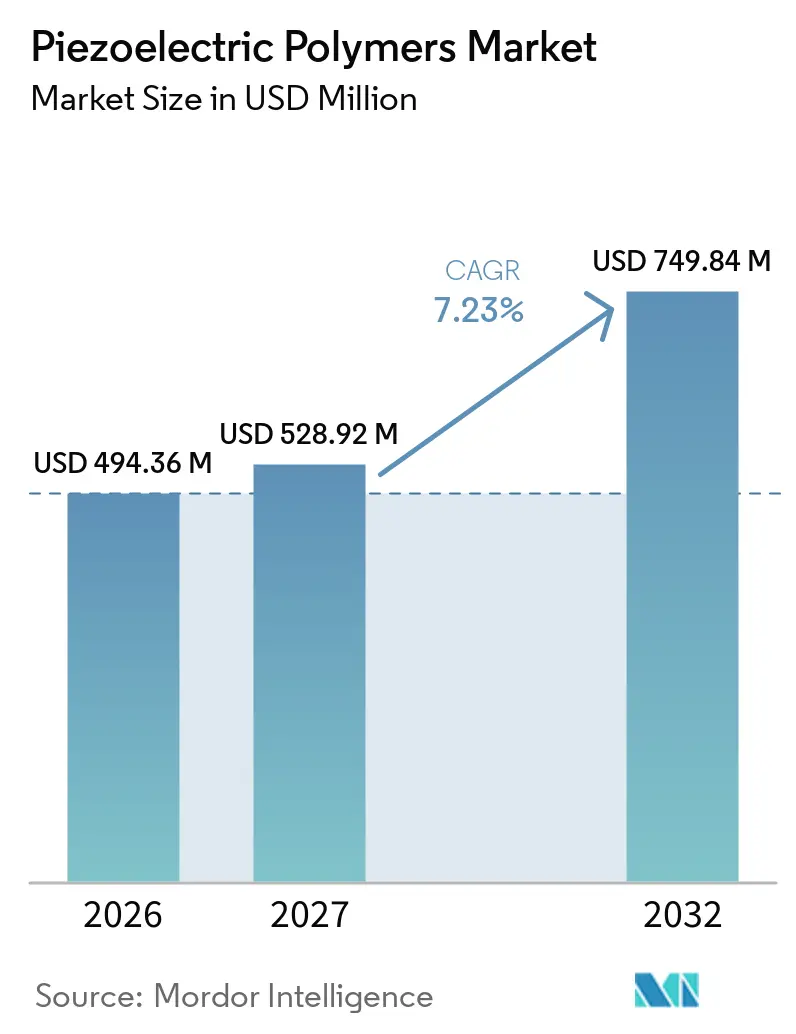
| Market Size (2027) | USD 528.92 Million |
| Market Size (2032) | USD 749.84 Million |
| Growth Rate (2027 - 2032) | 7.23 % |
| Fastest Growing Market | Asia-Pacific |
| Largest Market | Asia-Pacific |
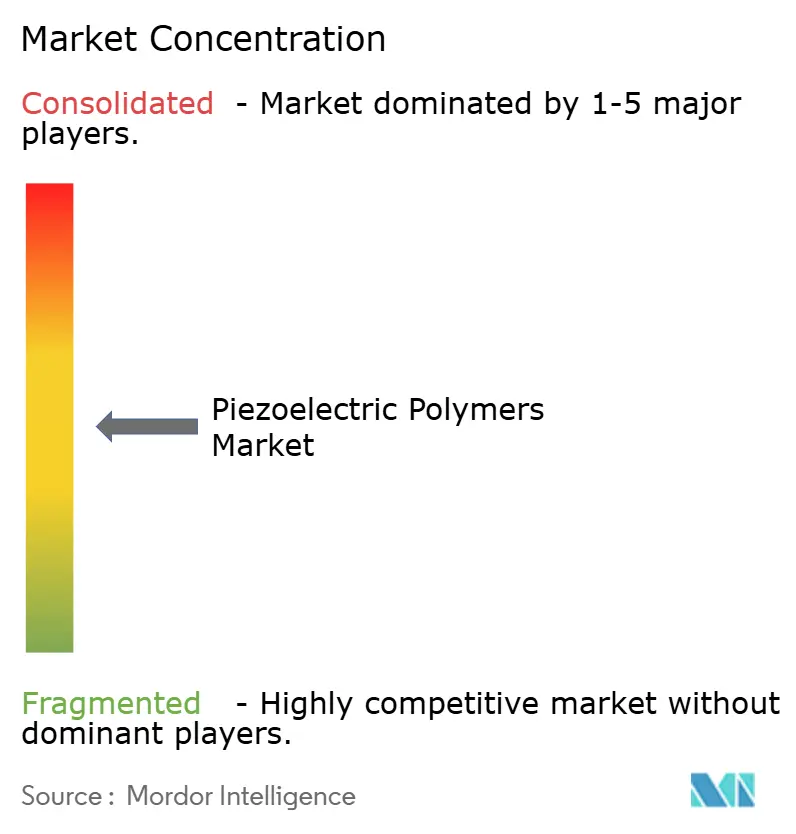
| Market Concentration | Medium |
Major Players *Disclaimer: Major Players sorted in no particular order Image © Mordor Intelligence. Reuse requires attribution under CC BY 4.0. | |
Piezoelectric Polymers Market Analysis by Mordor Intelligence
The Piezoelectric polymers market size was valued at USD 494.36 billion in 2026 and is estimated to grow from USD 528.92 billion in 2027 to USD 749.84 billion by 2032, at a CAGR of 7.23% during the forecast period (2027-2032). The piezoelectric polymers market is shifting toward flexible sensing, condition monitoring, and energy harvesting, rather than relying solely on established device categories. Polymer materials can be cast, extruded, and inkjet-printed onto various substrates, enabling device designs that rigid ceramic materials cannot readily accommodate. Supply chain exposure to fluoromonomers and tighter oversight of per- and polyfluoroalkyl substances (PFAS) are affecting product development and procurement decisions. These pressures favor suppliers that can provide qualified specialty grades, a stable supply, and alternatives to conventional polyvinylidene fluoride (PVDF). The market also presents opportunities in medical monitoring, printed electronics, and industrial retrofit projects, where flexible formats reduce installation constraints. This is particularly relevant when designers need sensing layers that conform to a host surface or when the cost of installing a dedicated power connection is difficult to justify.
Key Report Takeaways
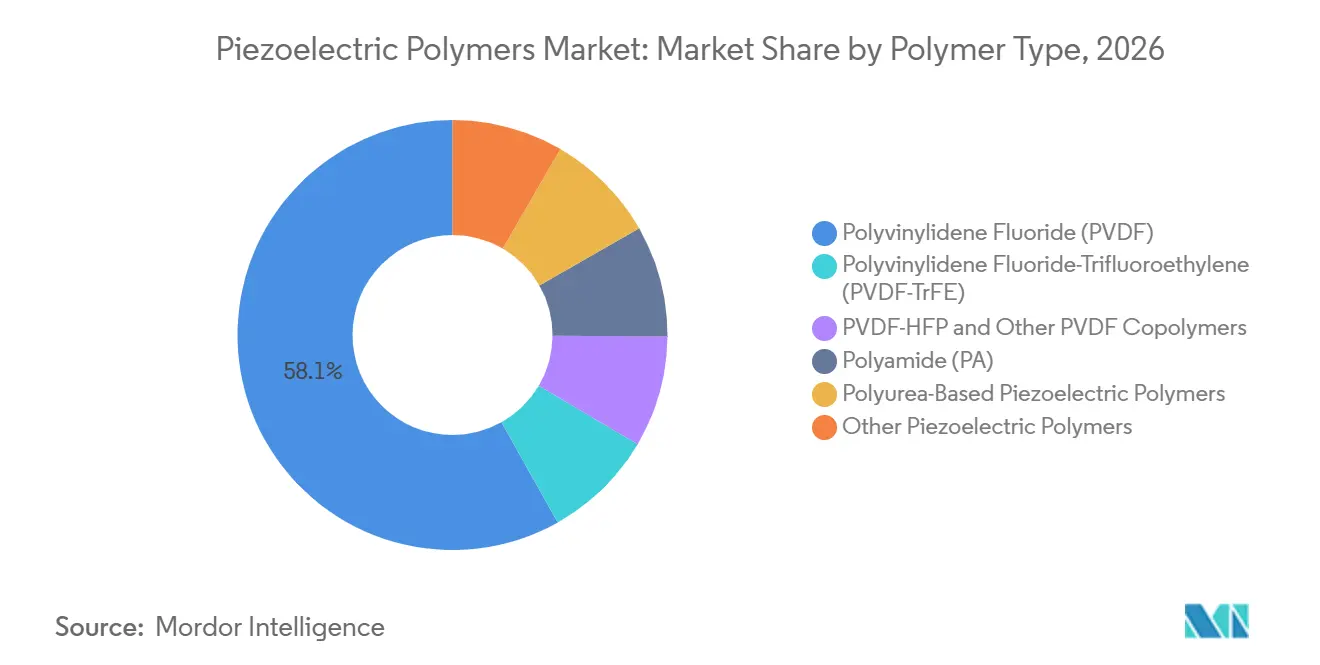
- By polymer type, PVDF held 58.14% of the Piezoelectric polymers market share in 2026, while polyvinylidene fluoride-trifluoroethylene (PVDF-TrFE) is forecast to expand at a 7.87% CAGR through 2032.
- By material form, Films and Sheets held 37.67% of the Piezoelectric polymers market share in 2026, while Coatings and Thin Layers are forecast to expand at an 8.12% CAGR through 2032.
- By application, Sensors held 42.82% of the Piezoelectric polymers market share in 2026, while Generators are forecast to expand at an 8.73% CAGR through 2032.
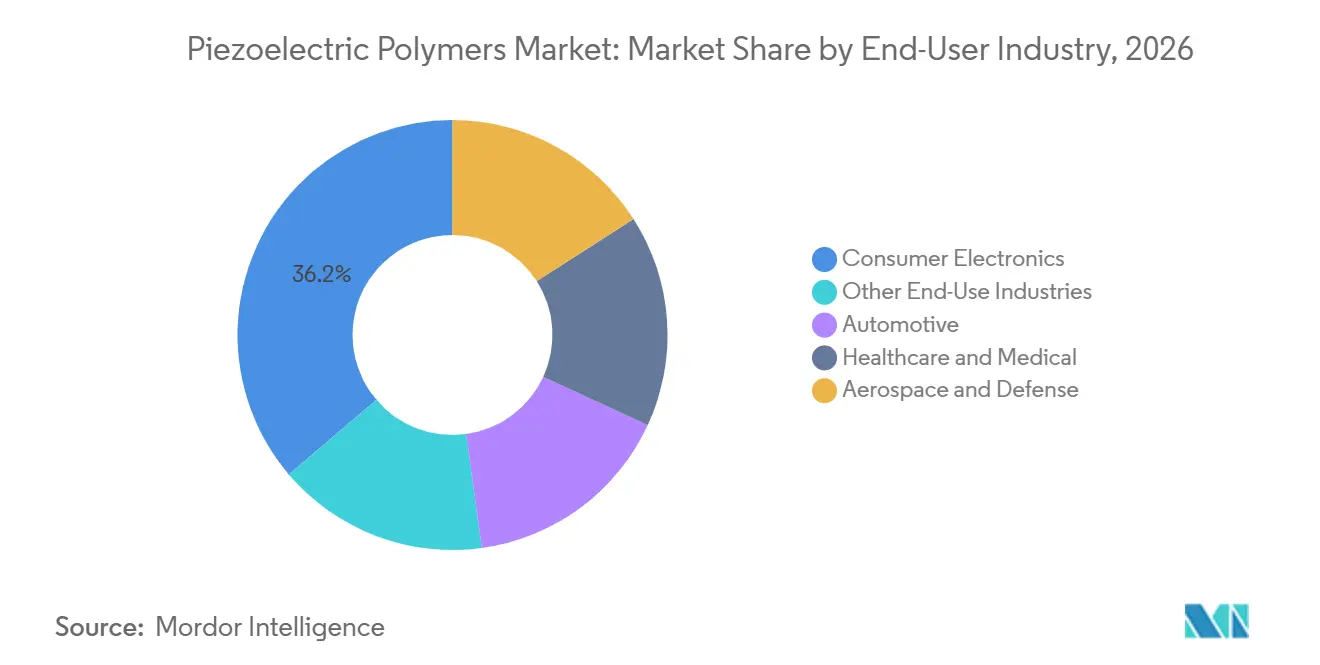
- By end-user industry, Consumer Electronics held 36.23% of the Piezoelectric polymers market share in 2026 and is forecast to expand at a 9.06% CAGR through 2032.
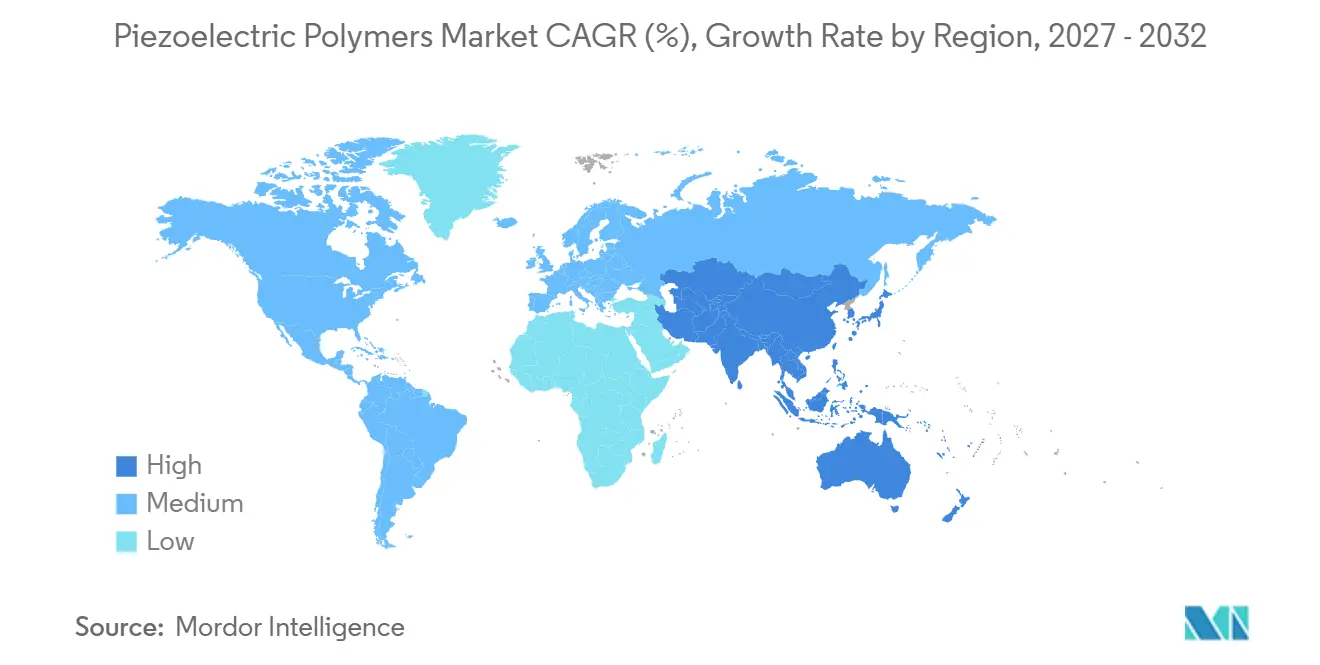
- By geography, Asia-Pacific held 43.71% of the Piezoelectric polymers market share in 2026 and is forecast to expand at an 8.41% CAGR through 2032.
Note: Market numbers in this report are based on Mordor Intelligence's proprietary estimation framework, which combines nine months of actuals with Q4 projections for base year 2026.
Market Trends and Insights
Drivers Impact Analysis of Piezoelectric Polymers Market*
| Drivers | (~) % Impact on CAGR Forecast | Geographic Relevance | Impact Timeline |
|---|---|---|---|
| Flexible and Wearable Electronics Adoption | +2.1% | APAC core, spillover to North America and the EU | Short term (≤ 2 years) |
| Industrial Internet of Things (IoT) and Distributed Condition Monitoring | +1.5% | Global | Medium term (2-4 years) |
| Demand for Self-Powered Sensors and Energy Harvesting | +1.2% | Global, concentrated in APAC and North America | Medium term (2-4 years) |
| Miniaturized Medical Monitoring and Diagnostic Devices | +1.0% | North America, EU, APAC | Medium term (2-4 years) |
| Roll-to-Roll Printable Electroactive Film Processing | +0.6% | North America, EU, APAC | Long term (≥ 4 years) |
| Source: Mordor Intelligence | |||
Flexible and Wearable Electronics Adoption
Smartwatches, foldable smartphones, and electronic-skin health patches require sensing elements that conform to curved, flexing, or stretching surfaces, which limits the use of rigid piezoceramics in several device designs. Wearable poly(vinylidene fluoride-trifluoroethylene) (P(VDF-TrFE))/BaTiO₃ nanocomposite sensors demonstrated sensitivity of 197 mV kPa⁻¹ and durability beyond 5,000 loading cycles for arterial pulse, respiration, and joint-motion monitoring. Korean and Chinese OEMs are using polymer piezoelectrics for haptic feedback and evaluating them as alternatives to discrete Micro-Electro-Mechanical Systems (MEMS) microphones in ultra-thin earbuds. Scalable solution-processed P(VDF-TrFE) achieved a d₃₃ of -90.5 pC N⁻¹, which was 3× the benchmark polyvinylidene fluoride (PVDF) level and was compatible with roll-to-roll coating[1]. These performance improvements enable the piezoelectric polymers market to address designs in which thin, flexible sensing is a basic product requirement. They reduce the material-performance trade-off that has historically limited polymer use to less demanding applications and provide device teams with a route to integrate sensing directly into flexible structures. This allows product engineers to place sensing near the point of movement, pressure, or vibration without increasing device thickness or altering the intended visual and mechanical design.
Industrial IoT and Distributed Condition Monitoring
Piezoelectric polymer films can be laminated onto non-planar bearing housings, pipe elbows, and motor casings. Rigid piezoceramic patches can crack when those surfaces deform repeatedly, making polymer films suitable for large-area structural health monitoring in industrial retrofit applications. A 2025 study reported a piezoelectric transducer ring-based energy-harvesting microelectromechanical system (MEMS) with a maximum DC output of 0.8 V and 43.979 µW RMS power for self-powered bearing fault detection. With more than 25 billion IoT nodes being deployed, power-cable installation is often uneconomic at retrofit locations. The piezoelectric polymers market benefits where mechanical compliance, processing cost, and adaptable form factors matter more than maximum actuation output. This is particularly relevant in retrofit projects where the monitored structure is already installed and has irregular, moving, or space-constrained surfaces. In such cases, a small sensor that can be bonded around an existing part is more practical than redesigning the asset, allowing maintenance teams to place sensing in difficult locations while retaining the existing equipment architecture and avoiding downtime, fabrication work, and power-routing changes.
Demand for Self-Powered Sensors and Energy Harvesting
Self-powered sensing combines vibration energy harvesting with signal generation, reducing the cost of deploying wireless sensor nodes in locations where battery replacement is expensive. PVDF nanofiber harvesters generated 0.12 µW mm⁻² at 5.04 V and 7.7 µA under ultra-low-frequency excitation, supporting IoT-class wearable sensors without an auxiliary battery. A flexible barium titanate (BTO)-PVDF/polydimethylsiloxane (PDMS) hybrid nanogenerator delivered 20.51 V at 20 wt% BaTiO₃ and supported gesture sensing and robotic hand synchronization without external power. Applications such as agricultural telemetry, rail monitoring, and oil pipeline integrity sensing can justify self-powered designs because remote battery servicing incurs additional cost. A sensor architecture that avoids routine battery replacement can improve the operating economics of remote infrastructure monitoring over the life of an installation and reduce service visits where access is costly and disruptive. Additionally, because an energy-harvesting element can serve as both a power source and a sensing component, such a system reduces the number of parts that must be maintained at dispersed monitoring locations.
Miniaturized Medical Monitoring and Diagnostic Devices
PVDF has an acoustic impedance of 4 MRayl, which is closer to that of biological soft tissue (1.5 MRayl) than lead zirconate titanate (PZT) (34 MRayl). This property supports conformal ultrasound probes and intravascular transducers, reducing reliance on thick coupling layers. A wearable PVDF-TrFE-BaTiO₃ sensor demonstrated real-time wireless arterial pulse monitoring. In September 2025, Syensqo introduced medical-grade Solef PVDF for fluid management systems, in vitro diagnostics, and single-use surgical instruments under ISO 10993-aligned biocompatibility requirements. A 2025 study also found that PVDF-TrFE scaffolds functionalized with decellularized extracellular matrix (ECM) reduced foreign body giant cell formation within 7 days and showed vascularization at 28 days after implantation. The piezoelectric polymers market can therefore progress from clinical research toward qualified medical products, where certification creates meaningful switching costs. Suppliers that meet biocompatibility and device-integration requirements are better positioned to support product development through long clinical and regulatory cycles. Medical-device manufacturers need materials that perform consistently through testing, design verification, clinical assessment, and commercial production. This emphasis on qualification favors suppliers with application testing capabilities, materials documentation, and the ability to deliver consistent performance across repeated commercial production batches.
Restraints Impact Analysis of Piezoelectric Polymers Market*
| Restraints | (~) % Impact on CAGR Forecast | Geographic Relevance | Impact Timeline |
|---|---|---|---|
| Lower Electromechanical Output Than Ceramic Alternatives | -0.8% | Global | Long term (≥ 4 years) |
| PFAS and Fluoropolymer Environmental Compliance Pressure | -0.7% | EU core, spillover to North America and APAC | Medium term (2-4 years) |
| Fluoromonomer Qualification and Supply Concentration | -0.5% | Global, concentrated in Europe and North America | Medium term (2-4 years) |
| Source: Mordor Intelligence | |||
Lower Electromechanical Output Than Ceramic Alternatives
Standard PVDF has a d₃₃ of -33 pC N⁻¹, while PZT-5H has a d₃₃ of -585 pC N⁻¹. This gap keeps high-force actuation, ultrasonic transduction, and nanometer-precision displacement applications centered on lead-based ceramics. The actuators segment faces this constraint in industrial valve control, precision inkjet heads, and aerospace morphing structures. Flash annealing raised P(VDF-TrFE) nanofibers to a d₃₃ of -70.89 pm/V, while MXene-loaded PVDF-TrFE composites tripled piezoelectric current output. Translating these results from laboratory to certified components takes 3-5 years. Restriction of Hazardous Substances (RoHS) lead restrictions support polymer adoption in consumer and medical applications, but do not remove the near- to medium-term limitation in precision high-force actuation. In this segment, system designers continue to select ceramics when force output and displacement accuracy are the primary performance criteria. This limits substitution in applications where the component function depends on producing a defined force or precise mechanical movement, rather than detecting motion or vibration. As a result, material selection remains closely tied to the device's intended function, and polymer solutions are not expected to replace ceramics in applications that depend on ceramics' higher output.
PFAS and Fluoropolymer Environmental Compliance Pressure
The European Chemicals Agency (ECHA) Risk Assessment Committee adopted its formal opinion on the broad PFAS restriction proposal in March 2026. This decision process is increasing procurement risk assessments in European Original Equipment Manufacturer (OEM) supply chains, even where high-molecular-weight fluoropolymers such as PVDF could receive time-limited derogations. Industrial sensor replacements commonly require 18-36 months of qualification, while medical device replacements can require more than 5 years. As a result, regulatory intent is already reducing design-in windows before a final decision is made. Syensqo and Arkema have transitioned to fluorosurfactant-free PVDF processing, while smaller entrants that have not completed this transition face a compliance barrier. The Fluoropolymers Product Group issued a Safe Handling Guide for PVDF and related resins in September 2025 while seeking derogations under REACH, underscoring the importance of documented processing practices and ongoing compliance efforts for suppliers serving European customers[2]. A material's commercial position increasingly depends on whether downstream users can maintain compliant products during any future regulatory transition, particularly when component makers must sustain customer deliveries while reviewing alternative formulations and completing the lengthy validation work required to qualify a material change in regulated equipment.
*Our forecasts treat driver/restraint impacts as directional, not additive. The impact forecasts reflect baseline growth, mix effects, and variable interactions.
Piezoelectric Polymers Market Segment Analysis
By Polymer Type:
PVDF Leads Demand While Copolymers Extend PerformancePVDF held 58.14% of the piezoelectric polymers market share in 2026, supported by mature production of high-β-phase stretch-and-pole films and established supply chains. These supply chains link fluoromonomer producers with sensor OEMs and support commercially proven film formats. PolyK Technologies operates roll-to-roll PVDF film lines that produce high-d₃₃ and d₃₁ films ranging from 10 µm to more than 200 µm, in poled and electrode-free versions. This demonstrates how standard PVDF grades can be converted into application-ready piezoelectric substrates at competitive cost. PVDF-HFP and related copolymers provide greater mechanical compliance where a standard homopolymer is not sufficient.
PVDF-TrFE is forecast to grow at a 7.87% CAGR through 2032, making it the fastest-growing polymer type. Its solution-processable and inkjet-compatible formulations support printed, large-area sensing applications. The Arkema Piezotech FC portfolio provides a coupling factor of 0.30, compared with 0.15 for PVDF homopolymer, and thermal stability up to 130°C in powder and ink formats. Polyamide- and polyurea-based materials provide lead-free, biocompatible options for biosensing. Other piezoelectric polymers, including chiral polylactic acid, are being studied for biodegradable and bioresorbable implantable devices. The piezoelectric polymers market is therefore extending beyond standard PVDF while retaining PVDF as its core commercial material. Copolymers and non-fluorinated materials address applications requiring improved processability, thermal tolerance, mechanical compliance, or well-defined biocompatibility and biodegradability profiles. This allows suppliers to address different customer priorities across wearable, medical, industrial, and consumer products without relying on a single material chemistry to meet every requirement.

By Material Form:
Films Sustain Scale While Coatings Improve IntegrationFilms and sheets represented 37.67% of the piezoelectric polymers market share in 2026. Their scale reflects compatibility with ultrasonic transducers, wearable pressure patches, and other downstream processes. Kureha's KF Piezo was the first industrially manufactured PVDF piezoelectric film and has been used as a space-dust sensor on JAXA's IKAROS solar sail spacecraft. This space qualification supports its relevance to demanding aerospace sensing applications. Fibers and nonwoven mats serve as wearable textiles and implantable scaffolds, while molded components address acoustic and structural products that require three-dimensional geometries.
Coatings and thin layers are forecast to record an 8.12% CAGR through 2032. The segment benefits from gravure and inkjet printing, as well as demand for sub-micron piezoelectric layers in flexible electronics and industrial sensors. Solution-processed sensors on flexible polyimide with a 289-nm-thick active P(VDF-TrFE) layer achieved a remanent polarization of 7.9 µC cm⁻² and a d₃₃ of 12.4 pC N⁻¹. These results indicate that coating-derived performance is approaching that of conventionally processed film. Daikin holds US Patent 12686734 for a fluorine-containing polymer coating with crystallinity of 50% or more and elongation at break of 400% or more. Such properties enable piezoelectric response under large deformation cycles in flexible robotics and soft-actuator applications, where repeated bending and stretching can otherwise reduce the stability of a thin active layer and limit device reliability. This is particularly relevant when an active piezoelectric layer must be applied over a wide, flexible surface and continue to respond after the device has been folded, stretched, pressed, or subjected to repeated vibration during normal use.
By Application:
Sensors Hold Scale While Generators Gain from Energy AutonomySensors account for 42.82% of the piezoelectric polymers market share in 2026. The segment includes hydrophones, industrial vibration monitors, medical ultrasound transducers, and consumer touch interfaces. TE Connectivity offers PVDF vibration sensors, including silver-ink-electrode film sensors in its LDT and DT series, for condition monitoring and dynamic strain measurement. Piezoelectric patch data combined with multi-task convolutional neural networks enabled real-time classification of 12 combined bearing and gearbox health states in rotating machinery. This software layer increases the value of installed polymer sensor hardware. Actuators remain relevant for haptics, MEMS microfluidics, and soft robotics, while transducers support ultrasound imaging and nondestructive testing.
Generators are forecast to expand at an 8.73% CAGR through 2032. Their growth is linked to remote IoT installations where replacing a battery costs more than deploying a self-powered transducer. PVDF-TrFE hybrid piezoelectric-triboelectric generators demonstrated gesture monitoring and robotic synchronization without external power at an optimized BaTiO₃ loading. The EU Battery Regulation 2023/1542 provides a policy incentive for architectures that reduce e-waste obligations and lifecycle costs. PVDF's acoustic impedance near water at 4 MRayl also supports transducer designs with lower coupling-media complexity than those of hard piezoceramics. These strengths are applicable across energy harvesting, sensing, and acoustic applications, although the performance fit differs by use case. High-force actuation continues to favor ceramic technologies where output remains the primary selection criterion, which keeps the application landscape differentiated. Lower-cost or more flexible polymer devices are not displacing ceramic solutions across all categories at the same pace.
By End-User Industry:
Consumer Electronics Combines Scale and GrowthConsumer electronics holds 36.23% of the piezoelectric polymers market share in 2026 and are projected to grow at a 9.06% CAGR through 2032. It is both the largest and fastest-growing end-user segment. Next-generation smartphones, hearables, and wearables drive demand rather than a mature replacement cycle. Directly printed or coated piezoelectric layers in foldable displays can reduce assembly steps and enable in-plane pressure sensing without adding component thickness. A P(VDF-TrFE) ion-gated organic electrochemical transistor demonstrated on-site signal amplification for mechanomyography and speech recognition in hearable electronics. RoHS lead restrictions also support polymer alternatives to PZT-based components in high-volume consumer devices.
Healthcare and medical is the second-largest end-user segment and remains a high-priority area for suppliers. Remote patient monitoring and ISO 10993 biocompatibility requirements support the case for qualified polymer grades. Once a grade is certified, these requirements can create high switching costs. Automotive, aerospace, and defense applications use these materials for structural health monitoring, active noise reduction, and vibration control. Heat-resistant polymer materials rated above 200°C target near-engine, under-hood, and space-sensor requirements that conventional PVDF does not meet. Defense programs for aircraft and naval-vessel monitoring add long-cycle demand with high product-life requirements and low price sensitivity. The need to monitor structures over long service periods can favor material systems that are lightweight, conformable, and compatible with difficult installation geometries. This adds a specialized demand stream that rewards reliability, qualification capability, and continued technical support over the extended service life of a defense platform.
Geography Analysis
APAC Piezoelectric Polymers Market
Asia-Pacific held 43.71% of the piezoelectric polymers market share in 2026 and is forecast to grow at an 8.41% CAGR through 2032. China's production base accounts for more than 60% of global PVDF capacity, while South Korea and Japan have established ecosystems for consumer electronics and specialty materials. China serves wearable electronics, industrial robotics, and IoT sensor manufacturing at scale. Japan contributes high-value precision sensors, acoustic transducers, and medical piezoelectric films. Kureha's KF Piezo and Toray's heat-resistant polymer reflect Japan's long-standing investment in specialty polymer research.
North America and Europe Piezoelectric Polymers Market
North America is the second-largest region in the piezoelectric polymers market, with defense and aerospace procurement, advanced medical device production, and industrial IoT expansion shaping regional demand. Arkema announced a USD 20 million expansion that increased PVDF capacity by 15% at Calvert City, Kentucky, with startup planned for mid-2026. The investment supports domestic supply chain resilience for high-performance fluoropolymers. Europe combines formulation innovation led by Arkema Piezotech in France and Syensqo in Belgium with compliance pressure from the PFAS restriction process. Germany's industrial automation and robotics sector drives demand for predictive maintenance, while the ECHA opinion heightens the urgency of reformulation efforts.
MEA and South America Piezoelectric Polymers Market
South America, the Middle East, and Africa are early-stage but expanding regions. Brazil drives South American demand through oil and gas monitoring, automotive component production, and mining. Polymer sensors suit complex equipment geometries in these settings better than rigid ceramic alternatives. In the Middle East and Africa, Saudi Arabia's Vision 2030 industrial diversification program and South Africa's mining sector support demand for structural monitoring. Safety monitoring of underground equipment is a particular use case in mining. Both regions primarily adopt proven PVDF sensor platforms rather than early-stage copolymers or printed electronics systems, with technology adoption running 2-3 years behind Asia-Pacific and North America.
Competitive Landscape
The piezoelectric polymers market is moderately fragmented in upstream polymer production but more concentrated in specialty P(VDF-TrFE) copolymers and in the supply of medical-grade film. Arkema, Syensqo, Kureha, and Daikin hold vertically integrated positions in feedstock and functional-film capacity. Their established presence in regulated end markets makes it difficult for converters to quickly replicate their positions. These companies invest simultaneously in capacity, specialty grades, and intellectual property. Syensqo reported multi-year Solef PVDF supply contracts with cumulative net sales exceeding EUR 150 million (~USD 167.78 million) in the first quarter of 2025 and introduced medical-grade Solef PVDF in September 2025.
Arkema expanded its Calvert City PVDF facility by 15% with a USD 20 million investment and continued developing printable Piezotech materials. Daikin strengthened its position in 2025 through patents on high-residual-polarization copolymer films and high-elongation polymer films for wearables and soft actuators. Toray disclosed a lead-free, fluorine-free piezoelectric polymer that maintains polarization above 200°C and targets commercialization from 2028. This material addresses thermal constraints as well as PFAS and RoHS considerations. Competition in the piezoelectric polymers market is therefore based on supply assurance, qualified grades, processing capability, and material performance, factors that are particularly important in medical, aerospace, and advanced-sensor applications.
Intellectual property is shifting toward process and system capabilities. US Patent 12225822 covers roll-to-roll piezoelectric printing with continuous corona poling, US Patent 12391809 covers high-d₃₃ thin-film processing, and Kureha's US Patent 12299225 addresses touch-sensing PVDF film. White-space areas include biodegradable piezoelectric polymers, hybrid MXene-polymer composites at industrially qualified yields, and sub-micron coatings for implantable MEMS. PolyK Technologies, Precision Acoustics, and Unictron Technologies compete through customized formats and OEM-specific technical support. These application-layer specialists fill an integration role that large polymer producers do not serve directly. The resulting market structure combines upstream scale with downstream specialization.
Piezoelectric Polymers Industry Leaders
-
Syensqo
-
Arkema
-
KUREHA CORPORATION
-
DAIKIN INDUSTRIES, Ltd.
-
TORAY INDUSTRIES, INC.
- *Disclaimer: Major Players sorted in no particular order
Piezoelectric Polymers Market Companies Covered in this Report
- Arkema
- DAIKIN INDUSTRIES, Ltd.
- Fluoever New Materials (Shanghai) Co., Ltd.
- KUREHA CORPORATION
- Murata Manufacturing Co., Ltd.
- Piezo Direct
- Piezo Smart
- PolyK Technologies
- Precision Acoustics Ltd.
- SanSan Intelligent Technology (Suzhou) Co., Ltd.
- Syensqo
- TE Connectivity
- TORAY INDUSTRIES, INC.
- Unictron Technologies Corporation
- WeProFab
Recent Industry Developments in Piezoelectric Polymers Market
- March 2026: The European Chemicals Agency (ECHA) Risk Assessment Committee adopted its formal opinion on the broad PFAS restriction proposal under REACH. This decision advances the European Commission's formal process for a restriction that directly governs fluoropolymer-based piezoelectric materials and upstream fluoromonomer production chains, increasing OEM reformulation urgency across European industrial and medical supply chains.
- January 2026: Toray Industries announced the development of a piezoelectric polymer with heat resistance exceeding 200°C, reported as a world first. The lead-free and fluorine-free material complies with RoHS requirements and emerging PFAS regulatory frameworks, and is available in varnish, film, or nonwoven fabric form. Target applications for this piezoelectric polymer include mobility, robotics, aerospace, and industrial machinery, with commercial availability expected from 2028.
Global Piezoelectric Polymers Market Report Scope
Piezoelectric polymers are lightweight, flexible organic materials that generate an electrical charge when subjected to mechanical stress, strain, or pressure (direct effect), or change shape when exposed to an electric field (inverse effect).
The piezoelectric polymers market is segmented by polymer type, material form, application, end-user industry, and geography. By polymer type, the market is segmented into polyvinylidene fluoride (PVDF), polyvinylidene fluoride-trifluoroethylene (PVDF-TrFE), PVDF-HFP and other PVDF copolymers, polyamide (PA), polyurea-based piezoelectric polymers, and other piezoelectric polymers. By material form, the market is segmented into films and sheets, fibers and nonwoven mats, coatings and thin layers, molded components, and other material forms. By application, the market is segmented into sensors, actuators, generators, transducers, and other applications. By end-user industry, the market is segmented into consumer electronics, automotive, healthcare and medical, aerospace and defense, and other end-use industries. The report also covers market sizes and forecasts for the piezoelectric polymers across 15 countries in major regions. The market sizes and forecasts are provided in terms of value (USD).
Segmentation Overview
| Polyvinylidene Fluoride (PVDF) |
| Polyvinylidene Fluoride-Trifluoroethylene (PVDF-TrFE) |
| PVDF-HFP and Other PVDF Copolymers |
| Polyamide (PA) |
| Polyurea-Based Piezoelectric Polymers |
| Other Piezoelectric Polymers |
| Films and Sheets |
| Fibers and Nonwoven Mats |
| Coatings and Thin Layers |
| Molded Components |
| Other Material Forms |
| Sensors |
| Actuators |
| Generators |
| Transducers |
| Other Applications |
| Consumer Electronics |
| Automotive |
| Healthcare and Medical |
| Aerospace and Defense |
| Other End-Use Industries |
| Asia-Pacific | China |
| India | |
| Japan | |
| South Korea | |
| ASEAN Countries | |
| Rest of Asia-Pacific | |
| North America | United States |
| Canada | |
| Mexico | |
| Europe | Germany |
| United Kingdom | |
| France | |
| Italy | |
| NORDIC Countries | |
| Rest of Europe | |
| South America | Brazil |
| Argentina | |
| Rest of South America | |
| Middle East and Africa | Saudi Arabia |
| South Africa | |
| Rest of Middle East and Africa |
| By Polymer Type | Polyvinylidene Fluoride (PVDF) | |
| Polyvinylidene Fluoride-Trifluoroethylene (PVDF-TrFE) | ||
| PVDF-HFP and Other PVDF Copolymers | ||
| Polyamide (PA) | ||
| Polyurea-Based Piezoelectric Polymers | ||
| Other Piezoelectric Polymers | ||
| By Material Form | Films and Sheets | |
| Fibers and Nonwoven Mats | ||
| Coatings and Thin Layers | ||
| Molded Components | ||
| Other Material Forms | ||
| By Application | Sensors | |
| Actuators | ||
| Generators | ||
| Transducers | ||
| Other Applications | ||
| By End-User Industry | Consumer Electronics | |
| Automotive | ||
| Healthcare and Medical | ||
| Aerospace and Defense | ||
| Other End-Use Industries | ||
| By Geography | Asia-Pacific | China |
| India | ||
| Japan | ||
| South Korea | ||
| ASEAN Countries | ||
| Rest of Asia-Pacific | ||
| North America | United States | |
| Canada | ||
| Mexico | ||
| Europe | Germany | |
| United Kingdom | ||
| France | ||
| Italy | ||
| NORDIC Countries | ||
| Rest of Europe | ||
| South America | Brazil | |
| Argentina | ||
| Rest of South America | ||
| Middle East and Africa | Saudi Arabia | |
| South Africa | ||
| Rest of Middle East and Africa | ||
Key Questions Answered in the Report
What is current market size of Piezoelectric Polymers Market?
The Piezoelectric polymers market size was valued at USD 494.36 billion in 2026 and is estimated to grow from USD 528.92 billion in 2027 to USD 749.84 billion by 2032, at a CAGR of 7.23% during the forecast period (2027-2032).
Why are flexible materials preferred in wearables?
Polymer piezoelectrics conform to curved and moving surfaces, supporting thin wearable sensors, foldable devices, and health patches. They can be cast, extruded, or printed onto various substrates, enabling designers to incorporate sensing without relying on the rigid geometry of ceramic components. This physical adaptability is important for components mounted on curved housings, folded display structures, textiles, and physiological monitoring patches that move with the wearer.
Which region has the strongest demand?
Asia-Pacific leads with a 43.71% share in 2026 and is forecast to expand at an 8.41% CAGR through 2032. China's polyvinylidene fluoride (PVDF) production base, South Korea’s consumer electronics manufacturing, and Japan’s specialty-material expertise provide the region with an established production and demand base.
What is the main limitation of ceramic materials?
Standard PVDF has lower electromechanical output than lead zirconate titanate (PZT), limiting its use in high-force actuation and precision displacement applications. Polymer materials remain more suitable when flexibility, low mass, form-factor adaptability, or the ability to conform to a structure is more important than peak force output. Advances in PVDF-TrFE processing and composite formulations are improving the performance of polymer devices, but they do not eliminate the current advantage of PZT in the most force-intensive applications.