
Pickup Truck Market Size and Share
Market Overview
| Study Period | 2020 - 2032 |
|---|---|
| Market Size (2027) | USD 240.11 Billion |
| Market Size (2032) | USD 308.21 Billion |
| Growth Rate (2027 - 2032) | 5.12 % |
| Fastest Growing Market | Asia-Pacific |
| Largest Market | Asia-Pacific |
| Market Concentration | Medium |
Major Players *Disclaimer: Major Players sorted in no particular order Image © Mordor Intelligence. Reuse requires attribution under CC BY 4.0. | |
Pickup Truck Market Analysis by Mordor Intelligence
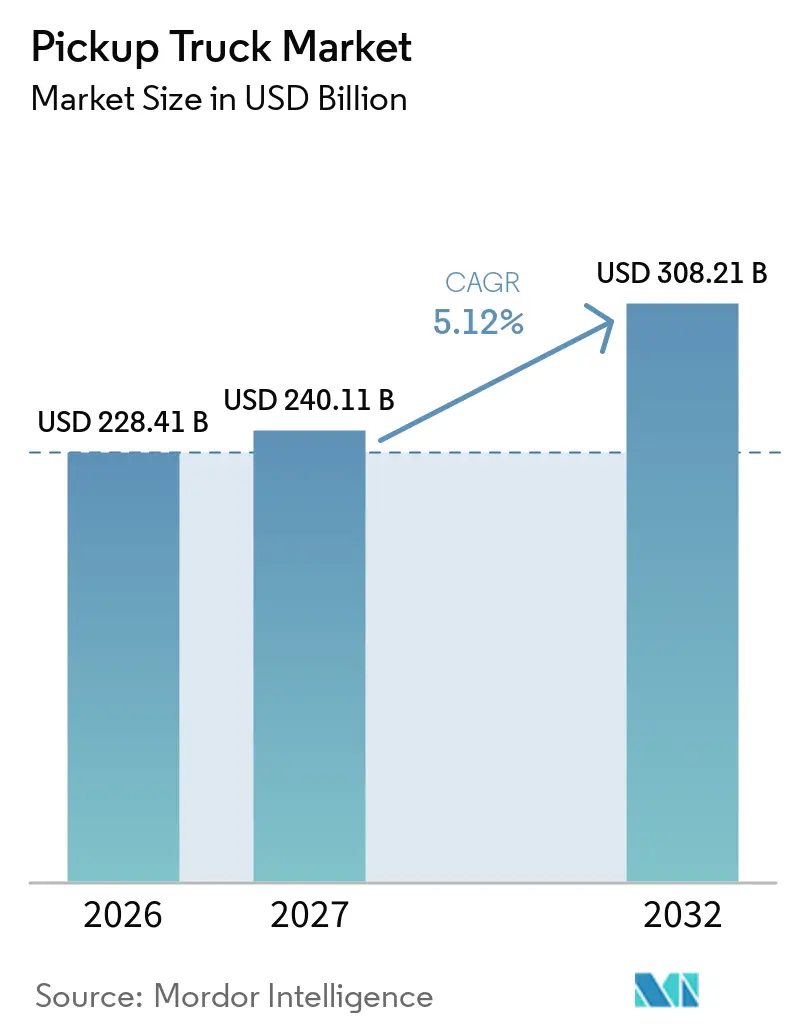
The pickup truck market size was valued at USD 228.41 billion in 2026, is expected to reach USD 240.11 billion in 2027, and is projected to reach USD 308.21 billion by 2032, growing at a CAGR of 5.12% from 2027 to 2032. Fleet replacement in construction, agriculture, and logistics supports demand because buyers depend on payload, towing, and road access for daily operations. Higher-content trims also lift revenue in mature markets, although higher purchase prices and financing costs limit affordability for many buyers. Powertrain plans are becoming more regional, with diesel retaining utility-led demand while hybrid and battery-electric models address regulatory requirements and changing buyer preferences. Manufacturing investment in Thailand and other right-hand-drive production centers gives manufacturers a practical route to serve several export markets from a single location. Competitive advantage therefore depends on reliable after-sales service, usable powertrains, and the ability to manage compliance costs alongside price-sensitive commercial demand.
Key Report Takeaways
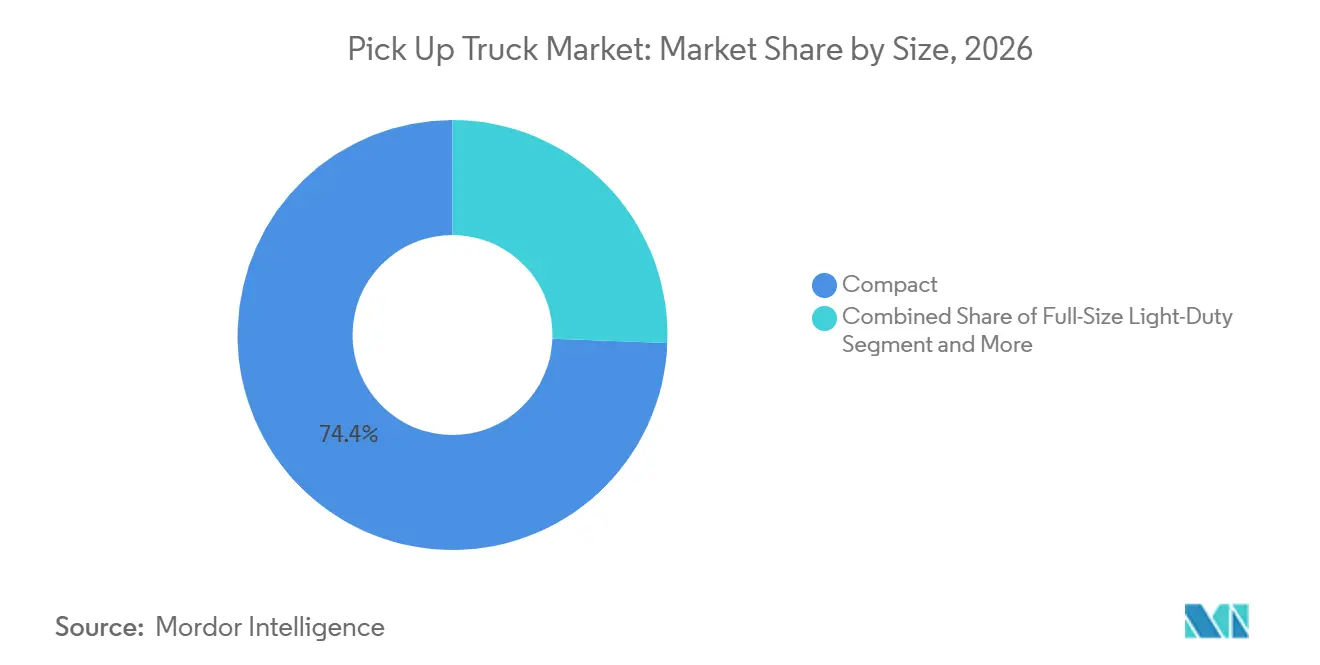
- By size/class, compact trucks held 74.35% of global pickup share in 2026, while full-size light-duty trucks are forecast to grow at a 6.17% CAGR through 2032.
- By cab type, regular and single cabs held 67.21% of global pickup share in 2026, while extended and super cabs are forecast to grow at a 6.25% CAGR through 2032.
- By fuel type, diesel held 63.47% of global pickup share in 2026, while battery-electric pickups are forecast to grow at a 6.35% CAGR through 2032.
- By drivetrain, 4WD/AWD held 64.27% of global pickup share in 2026 and is forecast to grow at a 6.07% CAGR through 2032.
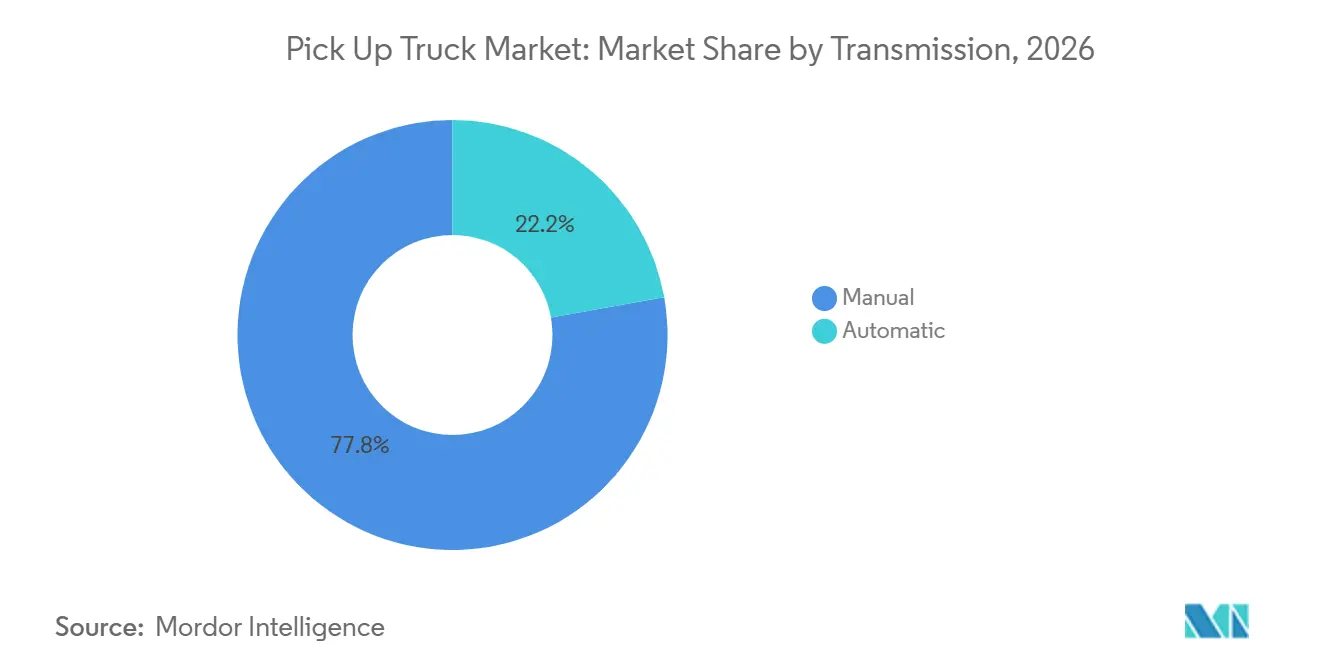
- By transmission, manual transmissions held 77.81% of global pickup share in 2026, while automatic transmissions are forecast to grow at a 6.41% CAGR through 2032.
- By end use, commercial use held 65.68% of global pickup share in 2026 and is forecast to grow at a 6.64% CAGR through 2032.
- By geography, Asia-Pacific held 38.91% of global pickup share in 2026 and is forecast to grow at a 7.01% CAGR through 2032.
Note: Market numbers in this report are based on Mordor Intelligence's proprietary estimation framework, which combines nine months of actuals with Q4 projections for base year 2026.
Market Trends and Insights
Drivers Impact Analysis of Pickup Truck Market*
| Driver | ~% Impact on CAGR Forecast | Geographic Relevance | Impact Timeline |
|---|---|---|---|
| Construction, Agriculture and Logistics Fleet Replacement Demand | +1.5% | Global; core in Asia-Pacific, South America, Middle East and Africa | Medium term (2–4 years) |
| Pickup Truck Premiumization for Lifestyle and Off-Road Use | +0.9% | North America, Australia, Middle East | Long term (≥ 4 years) |
| Hybrid and Battery Electric Powertrains Expand the Addressable Buyer Pool | +0.8% | North America, Europe, China | Medium term (2–4 years) |
| Right-Hand-Drive Export Hubs Accelerate Multi-Region Model Rollouts | +0.7% | Thailand, Australia, South Africa, United Kingdom | Short term (≤ 2 years) |
| Commercialization of Small Businesses in Emerging Pickup Markets | +0.6% | Asia-Pacific, South America, Middle East and Africa | Medium term (2–4 years) |
| Integrated Power Export and Software Features Increase Vehicle Utility | +0.5% | North America, Europe, Asia-Pacific | Long term (≥ 4 years) |
| Source: Mordor Intelligence | |||
Construction, Agriculture, and Logistics Fleet Replacement Demand
Replacement demand remains a core support for the pickup truck market because fleets cannot delay purchases indefinitely when operating assets become older and less dependable. The average age of commercial trucks operating in the United States reached 12.8 years in 2025, which pointed to a long replacement cycle across work-vehicle fleets. Ford Pro reported that Super Duty volume rose 10% in 2025, while its business generated USD 6.8 billion in EBIT on USD 66.3 billion in revenue. These results show that work-focused customers continue to replace vehicles when uptime, service access, and operating cost become more important than delaying capital spending. Construction work, farm activity, and goods movement create demand across different regions, reducing reliance on any single consumer trend. In South America, agricultural and mineral logistics also support commercial vehicle use, even as product availability and competitive conditions vary between markets. Fleet buyers generally place more weight on operating reliability, residual value, parts availability, and fuel use than on the initial purchase price alone. This favors manufacturers with established dealer networks and repair capability, while creating a high bar for new entrants that have not yet built dependable service coverage.
Pickup Truck Premiumization for Lifestyle and Off-Road Use
Premium models broaden revenue opportunities for the pickup truck market because buyers increasingly choose trucks for personal use as well as work. United States pickup owners spent more than USD 15 billion on off-road, utility, and recreational modifications in 2025, representing 30% of the USD 52.92 billion accessories and performance-parts category. SEMA also reported that nearly 13 million pickups were accessorized during the year, showing that customization has become a meaningful part of ownership. Buyers can therefore move toward higher-trim trucks even when regular off-road use is limited. This supports pickup truck market revenue from specialized appearance packages, tires, suspension parts, connected services, and power export equipment. In India, Toyota positioned the Hilux as a lifestyle vehicle with capabilities distinct from an SUV, which shows how manufacturers can introduce this use case in markets where pickups have traditionally been viewed mainly as commercial assets. The approach benefits manufacturers with recognizable brands and extensive accessory programs, but it also raises exposure to financing costs because premium vehicle purchases are more sensitive to monthly payment levels.
Hybrid and Battery-Electric Powertrains Expand the Addressable Buyer Pool
Hybrid systems provide a practical transition for the pickup truck market because many buyers still need towing, payload, and long-distance capability. Ford sold 84,934 F-150 Hybrid trucks in 2025 and 81,034 Maverick Hybrid units, both record results for the company. Toyota also reported more than 60,000 combined hybrid sales for Tacoma and Tundra models using its i-FORCE MAX system during the same period. [1] Hybrid trucks can appeal to buyers concerned about fuel use or regulation without requiring them to accept the charging and range limits of a full battery-electric pickup. China showed strong momentum in new-energy pickups, with sales reaching 67,000 units through November 2025, up 335% from the prior year. The rate of adoption remains uneven because commercial users judge electric models by real payload, towing range, charging access, and operating economics. Manufacturers are responding differently, as Ford maintains hybrid volume while Stellantis shifted its full-size electric Ram plan toward a range-extended vehicle. This divergence means that no single powertrain will define the category across all countries during the forecast period.
Right-Hand-Drive Export Hubs Accelerate Multi-Region Model Rollouts
Thailand remains an important manufacturing base for the pickup truck market because it allows manufacturers to supply several right-hand-drive and left-hand-drive export destinations. Isuzu began mass production of the battery-electric D-Max in Thailand in May 2025 and sent left-hand-drive vehicles to Europe during the third quarter of 2025. Toyota introduced the ninth-generation Hilux in Bangkok in November 2025 with diesel, 48V mild-hybrid, battery-electric, and future hydrogen fuel-cell options. Thailand’s Board of Investment approved more than THB 15 billion, equivalent to USD 430 million, for Isuzu projects involving automation upgrades and Euro 6-ready production in April 2026. [2] These investments help manufacturers shorten model launch cycles and spread development costs across more than one market. Changan’s Rayong plant started right-hand-drive production in May 2025 with an annual capacity of 100,000 units, adding another export-oriented production base in the country. The continued buildout of localized capacity means production decisions in Thailand influence vehicle availability in ASEAN, Australia, South Africa, and other right-hand-drive markets. It also puts greater pressure on incumbent brands to maintain local supply chains, product updates, and export competitiveness.
Restraints Impact Analysis of Pickup Truck Market*
| Restraint | ~% Impact on CAGR Forecast | Geographic Relevance | Impact Timeline |
|---|---|---|---|
| High Vehicle Prices and Financing Costs | -0.8% | Global; most acute in Thailand, Argentina, South Asia | Short term (≤ 2 years) |
| Emissions and Fuel-Economy Compliance Costs | -0.5% | North America, Europe | Medium term (2–4 years) |
| After-Sales Coverage and Residual-Value Uncertainty in Emerging Markets | -0.4% | Asia-Pacific, Middle East and Africa, South America | Long term (≥ 4 years) |
| Payload and Towing Range Penalties Constrain Commercial Electric Pickups | -0.3% | North America, Europe | Medium term (2–4 years) |
| Source: Mordor Intelligence | |||
High Vehicle Prices and Financing Costs
High prices and tighter lending conditions constrain the pickup truck market, especially where small businesses and agricultural households depend on vehicle financing. Thailand recorded 143,789 domestic pickup registrations in 2025, the lowest level in 24 years. The draft also identified tight lending conditions and weak middle-income household income as central reasons for continued weakness in that market. Entry-level and compact products can limit the impact of higher prices, but buyers may still postpone a replacement when credit approval becomes more difficult. In markets with sharp cost pressure, customers can shift toward used vehicles, single-cab designs, or lower-content models instead of purchasing new double-cab vehicles. This creates a split between higher-income buyers who can select premium trims and buyers who must protect cash flow. The result is weaker demand for mid-tier new vehicles, where the balance between capability and price is often hardest to maintain. Manufacturers can reduce the risk with local sourcing, financing support, and simpler product ranges, although these actions may limit margin or product choice.
Emissions and Fuel-Economy Compliance Costs
Compliance costs place pressure on the pickup truck market because diesel and utility-focused models require continual engineering work to meet new rules. European ministers formally adopted Euro 7 in April 2025, introducing requirements for real-world emissions verification, brake-particle limits, and monitoring of fuel and energy consumption. The standards for cars and vans apply from July 2027, which requires manufacturers to prepare product, calibration, and supplier plans before that date. In the United States, the proposed SAFE Vehicles Rule III would recalibrate fuel-economy requirements for model years 2022 through 2031. Shifting policy expectations add transition costs even if a final rule reduces some compliance pressure, because product programs and credit strategies may need to change. General Motors’ decision to develop an improved diesel engine for the next-generation Silverado and Sierra shows that manufacturers continue to make different judgments about the likely regulatory path. Smaller-volume models are more exposed because their development costs cannot be spread across large production runs as easily as those of global platforms.
*Our forecasts treat driver/restraint impacts as directional, not additive. The impact forecasts reflect baseline growth, mix effects, and variable interactions.
Pickup Truck Market Segment Analysis
By Size/Class:
Compact Trucks Lead Volume While Full-Size Light-Duty AdvancesCompact trucks accounted for 74.35% of the pickup truck market share in 2026. Their position reflects the need for lower acquisition and operating costs across commercial, agricultural, and distribution users in Asia, Africa, and Latin America. Compact designs fit narrow roads and smaller work sites while providing load capability that suits many local businesses. Buyers in these markets often prioritize durability, fuel use, and repair access over cabin size or premium equipment. This makes compact products central to volume demand even when higher-value full-size models generate more revenue per unit. The segment also benefits from a broad customer base that includes smallholder farms, building contractors, local transport operators, and municipal users.
Full-size light-duty trucks are forecast to expand at a 6.17% CAGR through 2032. Demand is strongest where buyers value towing capacity, comfort, connected features, and lifestyle positioning. North America remains important for this class because buyers frequently select high-specification trims and off-road packages. Higher-income buyers in Australia and the Middle East also support demand for larger pickups. The pickup truck industry therefore has a clear split between compact products that preserve volume and full-size light-duty products that raise average transaction value. Mid-size models sit between these poles and remain relevant where buyers want stronger utility without the size and cost of a full-size pickup. Full-size heavy-duty trucks continue to serve government, utility, and large commercial fleets, where specialized capability matters more than broad consumer appeal.

By Cab Type:
Cost-Led Single Cabs and Higher-Content Double Cabs Serve Different NeedsRegular and single-cab pickups held 67.21% of the global pickup share in 2026. This result reflects cost-focused procurement in markets where pickups remain primarily work vehicles. Single-cab and extended-cab models can provide useful cargo area and payload without requiring the price of a larger passenger cabin. In Thailand, single-cab and extended-cab configurations in the THB 600,000 to THB 800,000 range, equivalent to USD 17,000 to USD 23,000, increased their combined share from 58% in 2023 to 62% in 2025. The shift indicates how financing pressure can directly influence cab selection. Small businesses and rural operators may accept less passenger space when affordability is the deciding factor.
Extended and super cabs are projected to grow at a 6.25% CAGR through 2032. These models offer limited rear-seat capacity for crews while keeping cost and size below many double-cab alternatives. They are suitable for small fleet operators in Southeast Asia and Latin America that need flexibility for both workers and equipment. Crew and double cabs occupy a different part of the pickup truck market because they increasingly serve personal, family, and lifestyle buyers. Toyota’s ninth-generation Hilux standardized the double-cab body style across its range, underlining the importance of passenger comfort in the product’s higher-value use cases. The cab mix is therefore becoming more divided between affordable commercial configurations and higher-margin passenger-oriented designs. Manufacturers must manage this split carefully because each cab style requires a different price, feature, and distribution strategy.
By Fuel Type:
Diesel Retains Utility Strength as Electrification Builds RegionallyDiesel held 63.47% of the global pickup share in 2026. Diesel remains well suited to demanding work because towing, payload, and longer operating range are important to commercial buyers. Its established fuel supply and repair familiarity also support continued use across many emerging markets. Diesel’s position does not mean product plans are static, since tighter emissions rules increase development needs in Europe and other regulated markets. Manufacturers must also maintain diesel offerings where buyers rely on the torque and energy density needed for difficult terrain and heavy loads. These practical operating needs make diesel more resilient in pickups than in many smaller passenger-vehicle categories.
Battery-electric pickups are forecast to grow at a 6.35% CAGR through 2032. China provides an early example of rapid new-energy pickup uptake, with 67,000 units sold through November 2025 after 335% year-on-year growth. The United States showed a different pattern, where electric pickup sales were still a small share of total pickup demand in 2025, according to the supplied draft. Hybrid systems help bridge the gap because they can lower fuel consumption while preserving familiar vehicle use. Ford’s record F-150 Hybrid sales demonstrate that buyers will adopt electrified powertrains when they remain compatible with work and personal use. Gasoline models remain important in North American personal-use applications, while flex-fuel and CNG options address regional fuel requirements. The pickup truck industry will likely continue to use several powertrain options rather than moving at a uniform pace toward one technology.
By Drivetrain:
4WD/AWD Combines Scale with Continued Growth4WD/AWD accounted for 64.27% of the global pickup share in 2026. Within the Pickup truck market, the configuration also has the highest forecast growth within the drivetrain category, with a 6.07% CAGR through 2032. Buyers choose it for work on unpaved surfaces, poor weather, construction sites, farms, and recreational trails. It can also support higher-value positioning even when the vehicle spends most of its time on paved roads. Saudi Arabia illustrates the importance of this capability, where mid-size 4WD pickups represented 91.31% of registered volume in 2025 according to the supplied draft. Infrastructure and energy-sector procurement create a clear operating case for four-wheel-drive vehicles in that market.
4WD/AWD demand also rises with the spread of off-road packages and premium trim levels. Buyers in India and parts of Southeast Asia are becoming more likely to consider four-wheel drive in categories once dominated by basic two-wheel-drive work trucks. This gives manufacturers an opportunity to combine practical capability with feature-led pricing. Two-wheel-drive and rear-wheel-drive models remain important for urban logistics and local delivery because they can reduce operating costs and meet routine road-use needs. Electrified pickups may also expand the use of all-wheel-drive systems, particularly where compliance requirements encourage new powertrain platforms. The pickup truck market will therefore continue to contain both simpler utility models and more capable four-wheel-drive designs. Product planners need to preserve affordable two-wheel-drive choices while developing four-wheel-drive products that support higher margin and broader use.
By Transmission:
Manual Volume Persists While Automatic Adoption RisesManual transmissions held 77.81% of the global pickup share in 2026. The large share reflects the concentration of global pickup demand in Thailand, Indonesia, India, Sub-Saharan Africa, and much of Latin America. In many of these markets, manual vehicles remain familiar to commercial operators and can be less expensive to purchase and maintain. Manual systems are often paired with lower-cost work-focused configurations, especially single-cab products. Their continuing importance shows that the pickup truck market cannot be understood only through higher-income consumer trends. Manufacturers that remove manual options too quickly could lose access to price-sensitive users that still form a major part of global volume.
Automatic transmissions are forecast to grow at a 6.41% CAGR through 2032. Pickup truck market growth comes from buyers moving toward higher-content vehicles and from the wider adoption of electrified powertrains, which commonly use automatic or single-speed systems. Isuzu replaced the 1.9-liter engine in the D-Max MY25.5 with a 2.2-liter unit paired with an 8-speed automatic and removed the manual option from that drivetrain. This change shows how a leading right-hand-drive product can influence customer expectations across ASEAN and Australasia. Automatic systems can improve ease of use for personal buyers and support more sophisticated driver-assistance and powertrain features. The change will be gradual because affordability and maintenance preferences remain relevant in high-volume work-vehicle markets. Manufacturers must therefore offer transmission choices that align with local income levels, use patterns, and service capability.
By End Use:
Commercial Demand Supports Both Volume and GrowthCommercial applications accounted for 65.68% of the global pickup share in 2026 and are forecast to grow at a 6.64% CAGR through 2032. Construction, agriculture, logistics, and adjacent work uses make pickups essential assets rather than discretionary purchases. Fleet replacement is supported by infrastructure activity in Gulf Cooperation Council countries and agricultural transport needs in South America and Sub-Saharan Africa. Commercial operators generally judge products by uptime, load capacity, service access, and fuel or energy cost. This favors established brands that can provide parts and maintenance across dispersed operating areas. Government and defense demand is smaller but stable, particularly where reliability and local support matter more than new powertrain technology.
Electrified commercial pickups face a distinct challenge because payload and towing use can reduce practical range. The supplied draft noted a 30% to 50% total-cost-of-ownership gap versus diesel for many commercial duty cycles. This limits short-term replacement of diesel in demanding fleet applications, despite wider interest in electrification. Personal and lifestyle buyers form a smaller share of volume but often contribute more revenue per vehicle through premium trims, accessories, off-road packages, and connected features. The pickup truck market therefore depends on commercial demand for scale and lifestyle demand for margin. Brands must avoid treating these users as interchangeable because their purchasing priorities, finance needs, and product requirements differ. A product portfolio that serves both uses can reduce risk when either commercial spending or consumer confidence weakens.
Geography Analysis
Asia-Pacific: Production Capacity and Electrification Shape Regional Demand
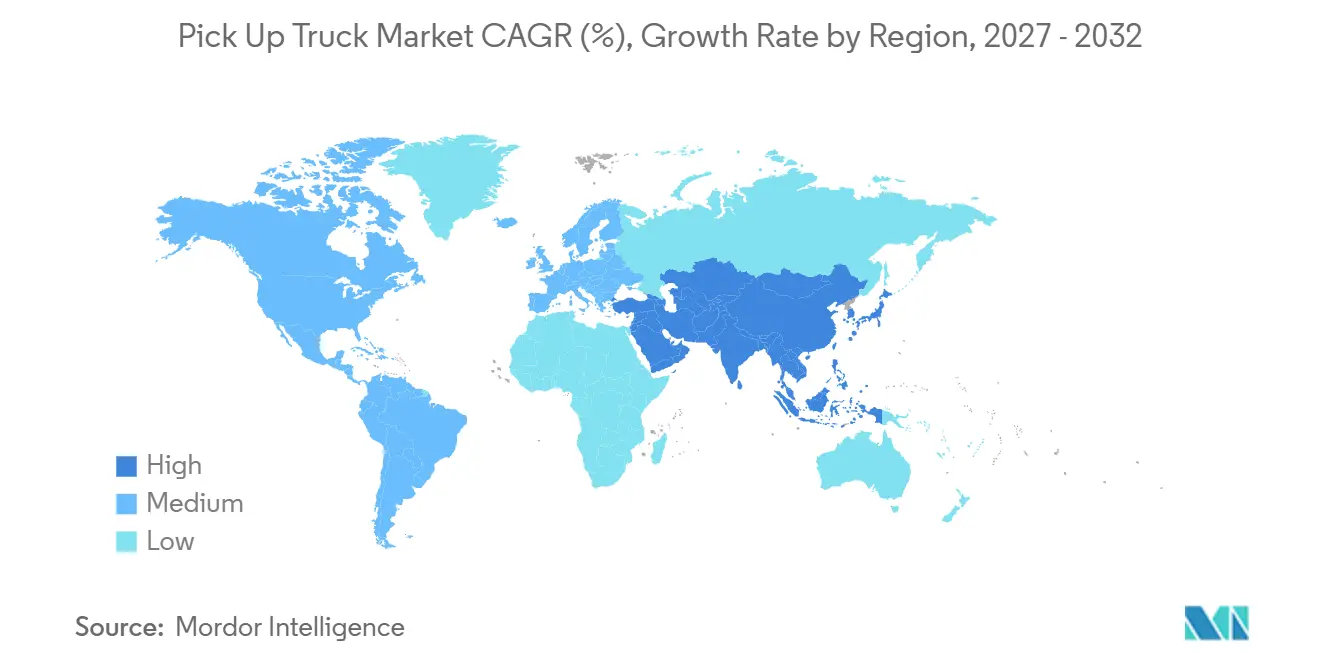
Asia-Pacific accounted for 38.91% of the pickup truck market share in 2026 and is forecast to expand at a 7.01% CAGR through 2032. China sold 537,000 pickups during the first 11 months of 2025, up 12% year on year, according to the supplied research draft. New-energy pickups reached 67,000 units in the same period, which gives China a larger role in global electric pickup planning. Thailand remains important even though domestic registrations fell, because its production base supports export demand across several regions. Isuzu’s two Thai plants can produce up to 385,000 vehicles a year, and the company’s 2026 investment program supports automation and Euro 6-ready pickup production. Toyota’s Hilux launch in Bangkok and Changan’s new right-hand-drive production facility also confirm that Thailand retains a central role in regional product planning. Thailand’s EV 30@30 policy direction and tighter emissions requirements in India are compliance factors that guide investment toward lower-emission variants. These conditions make Asia-Pacific important not only for vehicle volume but also for the development of export-ready powertrains and localized supply chains.
North America: High Transaction Values Meet Divergent Powertrain Strategies
North America remains a high-revenue pickup region because full-size models are often sold with substantial equipment and premium trims. Ford’s F-Series result of 828,832 units in 2025 demonstrates the scale of established truck demand in the United States. The region also shows a clear split in powertrain strategy. Ford achieved record hybrid volumes through the F-150 Hybrid, while General Motors chose an improved diesel engine for its next Silverado and Sierra generation. Stellantis discontinued its planned full-size battery-electric Ram pickup and positioned the range-extended Ram 1500 REV as its electrified alternative. The proposed SAFE Vehicles Rule III is a key regulatory influence because it affects fuel-economy planning and the value of electric-vehicle credit strategies. [3] Mexico also matters as a production and supply-chain location for North American and Latin American demand. The region’s next product cycle will depend on whether manufacturers can maintain truck capability while limiting price increases and adapting to shifting compliance expectations.
Europe, South America, and the Middle East and Africa: Regulation, Fleet Demand, and New Local Production
Europe is moving toward more electrified and higher-value pickup offerings as Euro 7 requirements apply from July 2027. Isuzu shipped left-hand-drive D-Max EV vehicles from Thailand to Europe in the third quarter of 2025, while Toyota planned a battery-electric Hilux variant for the United Kingdom. South America retains strong demand for mid-size products, supported by agricultural and commercial activity. Brazil is also becoming a more important production center after Great Wall Motor established its first Latin American plant to produce the Poer pickup and electrified models. In the Middle East and Africa, pickups remain relevant to infrastructure, energy, mining, agricultural, and public-sector fleets. South Africa’s bakkie segment remains especially important within light commercial vehicles, and new product arrivals support replacement activity. Regional growth will depend on service support, parts supply, financing access, and the ability to offer powertrains appropriate to local fuel, terrain, and regulatory conditions. Together, these geographies create a diversified demand base, but they require more localization than North America or Asia-Pacific.
Competitive Landscape
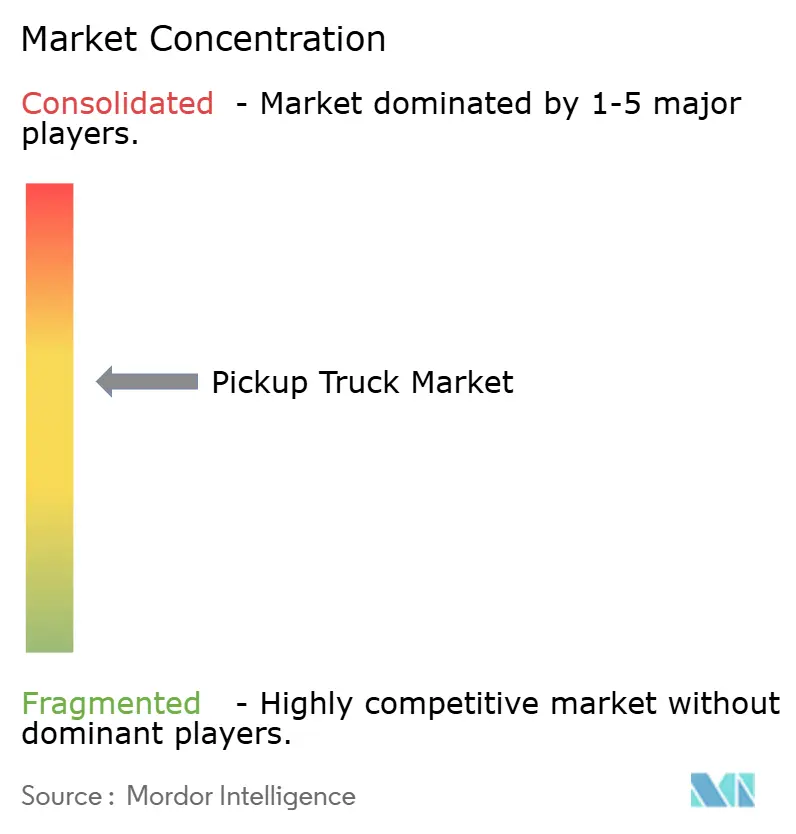
The pickup truck market is moderately consolidated at the leading-brand level, but competition differs sharply by region and powertrain. Ford, General Motors, Toyota, Isuzu, and Stellantis have established positions through dealer coverage, long operating histories, parts availability, and residual-value confidence. Ford’s 2025 F-Series volume illustrates the scale of this advantage in North America. Toyota and Isuzu have similarly deep roots in right-hand-drive markets, where durable utility products and service support are critical. Chinese manufacturers are expanding their export presence with lower purchase prices and broader specifications. Great Wall Motor’s overseas pickup sales reached 30,083 units in the first half of 2025, up 24.3% year on year, according to the supplied draft. This raises competitive pressure in countries where local supply, pricing, and product availability can influence fleet decisions.
Product strategy is now a major competitive differentiator. Ford continues to build hybrid pickup demand, while General Motors is emphasizing an improved diesel engine in its next full-size generation. Stellantis shifted from a planned full-size battery-electric Ram toward a range-extended option, reflecting a more cautious response to current demand conditions. Toyota’s new Hilux includes diesel, mild-hybrid, battery-electric, and future hydrogen fuel-cell plans, showing how a global pickup platform can offer different choices across regions. Isuzu has also moved into battery-electric production with the D-Max in Thailand. These moves indicate that market leaders are not making identical technology decisions, even when they serve many of the same customers.
Competition increasingly extends beyond the vehicle itself. Buyers evaluate the availability of maintenance, replacement parts, financing, connected services, accessories, and energy-related features. General Motors has linked bidirectional charging to Silverado EV and Sierra EV products, which makes vehicle-to-load capability part of the ownership proposition. New entrants can use competitive pricing to win initial sales, but their longer-term position depends on whether they can support vehicles throughout the ownership cycle. Regulatory compliance will further favor companies that can fund multiple powertrain paths and update products across several regions. The pickup truck market remains competitive because no single company holds a dominant position across North America, Asia-Pacific, Europe, South America, and the Middle East and Africa. This creates opportunities for challengers, but also preserves the value of established service networks and local production.
Pickup Truck Industry Leaders
-
Ford Motor Company
-
General Motors Company
-
Stellantis N.V.
-
Toyota Motor Corporation
-
Nissan Motor Co., Ltd.
- *Disclaimer: Major Players sorted in no particular order
Pickup Truck Market Companies Covered in this Report
- Ford Motor Company
- General Motors Company
- Stellantis N.V.
- Toyota Motor Corporation
- Nissan Motor Co., Ltd.
- Isuzu Motors Limited
- Mitsubishi Motors Corporation
- Mahindra & Mahindra Ltd.
- Tata Motors Limited
- Great Wall Motor Company Limited
- BYD Company Limited
- Volkswagen AG
- Hyundai Motor Company
- Honda Motor Co., Ltd.
- Mazda Motor Corporation
- Rivian Automotive, Inc.
- Tesla, Inc.
- JAC Motors
- SAIC Motor Corporation Limited
- Beiqi Foton Motor Co., Ltd.
Recent Industry Developments in Pickup Truck Market
- October 2026: General Motors commenced production of the all-new 2027 Chevrolet Silverado 1500 and GMC Sierra 1500, its first full platform redesign since 2019, at the Silao, Mexico plant. GM expects to build the same number of trucks in 2027 as in 2026, with incremental capacity for growth in 2028.
- September 2026: General Motors confirmed that the next-generation Silverado and Sierra will feature an improved diesel engine delivering over 900 miles of highway range, explicitly diverging from the hybrid strategy adopted by Ford and Stellantis.
- March 2026: Geely Riddara confirmed local assembly plans for the battery-electric RD6 pickup in Thailand, targeting ASEAN export from a regional right-hand-drive production hub after selling 670 imported units in Thailand in 2025.
Global Pickup Truck Market Report Scope
The pickup truck market is segmented by Size/Class, Cab Type, Fuel Type, Drivetrain, Transmission, End Use, and Geography. By Size/Class, the market is segmented into Compact, Mid-Size, Full-Size Light-Duty, and Full-Size Heavy-Duty. By Cab Type, the market is segmented into Regular/Single Cab, Extended/Super Cab, and Crew/Double Cab. By Fuel Type, the market is segmented into Gasoline, Diesel, Hybrid, Battery Electric, and Others (CNG, Flex-Fuel). By Drivetrain, the market is segmented into 2WD (RWD) and 4WD/AWD. By Transmission, the market is segmented into Manual and Automatic. By End Use, the market is segmented into Personal/Lifestyle, Commercial (Construction, Agriculture, Logistics, Others), and Government and Defense. By Geography, the market is segmented into North America (United States, Canada, Mexico, and Rest of North America), Europe (Germany, United Kingdom, France, Italy, Spain, Sweden, Poland, Netherlands, Russia, and Rest of Europe), Asia-Pacific (China, India, Japan, Thailand, Australia, Indonesia, South Korea, Philippines, Malaysia, New Zealand, and Rest of Asia-Pacific), South America (Brazil, Argentina, Chile, Colombia, Peru, and Rest of South America), and Middle East and Africa (Saudi Arabia, United Arab Emirates, Qatar, Kuwait, Oman, Israel, Türkiye, South Africa, Egypt, Nigeria, Kenya, Morocco, Algeria, and Rest of Middle East and Africa). Market forecasts are provided in terms of Value (USD) and Volume (Units).
Segmentation Overview
| Compact |
| Mid-Size |
| Full-Size Light-Duty |
| Full-Size Heavy-Duty |
| Regular/Single Cab |
| Extended/Super Cab |
| Crew/Double Cab |
| Gasoline |
| Diesel |
| Hybrid |
| Battery Electric |
| Others (CNG, Flex-Fuel) |
| 2WD (RWD) |
| 4WD/AWD |
| Manual |
| Automatic |
| Personal/Lifestyle |
| Commercial (Construction, Agriculture, Logistics, Others) |
| Government and Defense |
| North America | United States |
| Canada | |
| Mexico | |
| Rest of North America | |
| Europe | Germany |
| United Kingdom | |
| France | |
| Italy | |
| Spain | |
| Sweden | |
| Poland | |
| Netherlands | |
| Russia | |
| Rest of Europe | |
| Asia-Pacific | China |
| India | |
| Japan | |
| Thailand | |
| Australia | |
| Indonesia | |
| South Korea | |
| Philippines | |
| Malaysia | |
| New Zealand | |
| Rest of Asia-Pacific | |
| South America | Brazil |
| Argentina | |
| Chile | |
| Colombia | |
| Peru | |
| Rest of South America | |
| Middle East and Africa | Saudi Arabia |
| United Arab Emirates | |
| Qatar | |
| Kuwait | |
| Oman | |
| Israel | |
| South Africa | |
| Egypt | |
| Nigeria | |
| Kenya | |
| Morocco | |
| Algeria | |
| Rest of Middle East and Africa |
| By Size/Class | Compact | |
| Mid-Size | ||
| Full-Size Light-Duty | ||
| Full-Size Heavy-Duty | ||
| By Cab Type | Regular/Single Cab | |
| Extended/Super Cab | ||
| Crew/Double Cab | ||
| By Fuel Type | Gasoline | |
| Diesel | ||
| Hybrid | ||
| Battery Electric | ||
| Others (CNG, Flex-Fuel) | ||
| By Drivetrain | 2WD (RWD) | |
| 4WD/AWD | ||
| By Transmission | Manual | |
| Automatic | ||
| By End Use | Personal/Lifestyle | |
| Commercial (Construction, Agriculture, Logistics, Others) | ||
| Government and Defense | ||
| By Geography | North America | United States |
| Canada | ||
| Mexico | ||
| Rest of North America | ||
| Europe | Germany | |
| United Kingdom | ||
| France | ||
| Italy | ||
| Spain | ||
| Sweden | ||
| Poland | ||
| Netherlands | ||
| Russia | ||
| Rest of Europe | ||
| Asia-Pacific | China | |
| India | ||
| Japan | ||
| Thailand | ||
| Australia | ||
| Indonesia | ||
| South Korea | ||
| Philippines | ||
| Malaysia | ||
| New Zealand | ||
| Rest of Asia-Pacific | ||
| South America | Brazil | |
| Argentina | ||
| Chile | ||
| Colombia | ||
| Peru | ||
| Rest of South America | ||
| Middle East and Africa | Saudi Arabia | |
| United Arab Emirates | ||
| Qatar | ||
| Kuwait | ||
| Oman | ||
| Israel | ||
| South Africa | ||
| Egypt | ||
| Nigeria | ||
| Kenya | ||
| Morocco | ||
| Algeria | ||
| Rest of Middle East and Africa | ||
Key Questions Answered in the Report
What is the expected growth rate for pickup trucks through 2032?
The pickup truck market is forecast to grow at a 5.12% CAGR from 2027 to 2032 and reach USD 308.21 billion by 2032.
Which pickup truck class has the largest share?
Compact trucks lead with a 74.35% share in 2026 because they meet commercial and agricultural needs at lower acquisition and operating costs.
Which pickup powertrain is growing fastest?
Battery-electric pickups are projected to grow at a 6.35% CAGR through 2032, although diesel remains the largest propulsion type with a 63.47% share in 2026.
Why do commercial buyers remain important for pickup manufacturers?
Commercial use held a 65.68% share in 2026 and is projected to expand at a 6.64% CAGR, supported by construction, agriculture, logistics, and fleet replacement demand.
Which region is expected to grow fastest for pickup sales?
Asia-Pacific is projected to grow at a 7.01% CAGR through 2032, supported by Chinese new-energy demand and Thailand’s export production base.
What factors limit electric pickup adoption among fleet operators?
Payload and towing can reduce operating range, while the supplied research notes a 30% to 50% total-cost-of-ownership gap versus diesel for many commercial duty cycles.