
Physical AI For Precision Assembly and Rework Market Size and Share
Market Overview
| Study Period | 2021 - 2032 |
|---|---|
| Market Size (2027) | USD 0.91 Billion |
| Market Size (2032) | USD 2.59 Billion |
| Growth Rate (2027 - 2032) | 23.27 % |
| Fastest Growing Market | North America |
| Largest Market | Asia-Pacific |
| Market Concentration | Medium |
Major Players *Disclaimer: Major Players sorted in no particular order Image © Mordor Intelligence. Reuse requires attribution under CC BY 4.0. | |
Physical AI For Precision Assembly and Rework Market Analysis by Mordor Intelligence
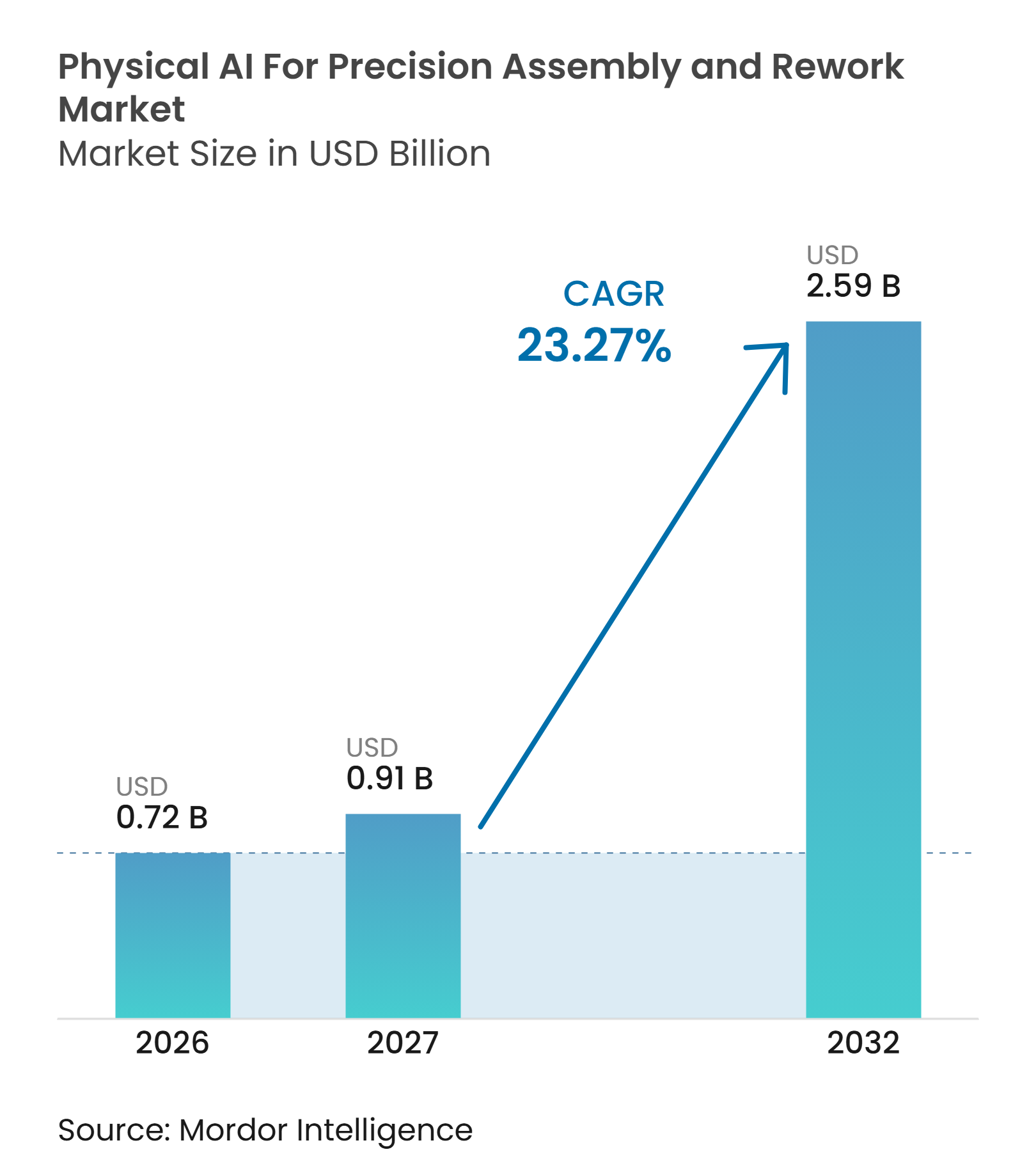
The Physical AI For Precision Assembly And Rework Market size is projected to be USD 0.72 billion in 2026, USD 0.91 billion in 2027, and reach USD 2.59 billion by 2032, growing at a CAGR of 23.27% from 2027 to 2032.
The physical AI for precision assembly and rework market is gaining momentum as electronics designs become more complex and manufacturers face higher labor costs across high-volume and regulated production environments. Real-time sensing, adaptive control, closed-loop inspection, and precise rework distinguish these systems from conventional industrial automation. Semiconductor packaging, advanced electronics assembly, and aerospace electronics rework require capabilities that generic automation cannot consistently provide. Supply-chain restructuring is also directing investment toward new assembly capacity designed for automated operation. Competition increasingly depends on turnkey deployment, credible total-cost evidence, and a path to returns within 24 months of commissioning.
Key Report Takeaways
- By application, Printed Circuit Board and Electronics Assembly held 25.76% of the physical AI market share for precision assembly and rework in 2026, while Semiconductor and Advanced Packaging Assembly is projected to expand at a 25.12% CAGR through 2032.
- By end user, Electronics Manufacturing Services Providers held a 22.12% share in 2026, while Semiconductor and Electronics Equipment Manufacturers are projected to expand at a 24.13% CAGR through 2032.
- By component, Hardware held a 39.87% share in 2026, while AI and Robotics Software is projected to expand at a 25.76% CAGR through 2032.
- By deployment model, On-Premise Capital Equipment held a 37.86% share in 2026, while Hybrid Edge-Cloud Deployment is projected to expand at a 24.67% CAGR through 2032.
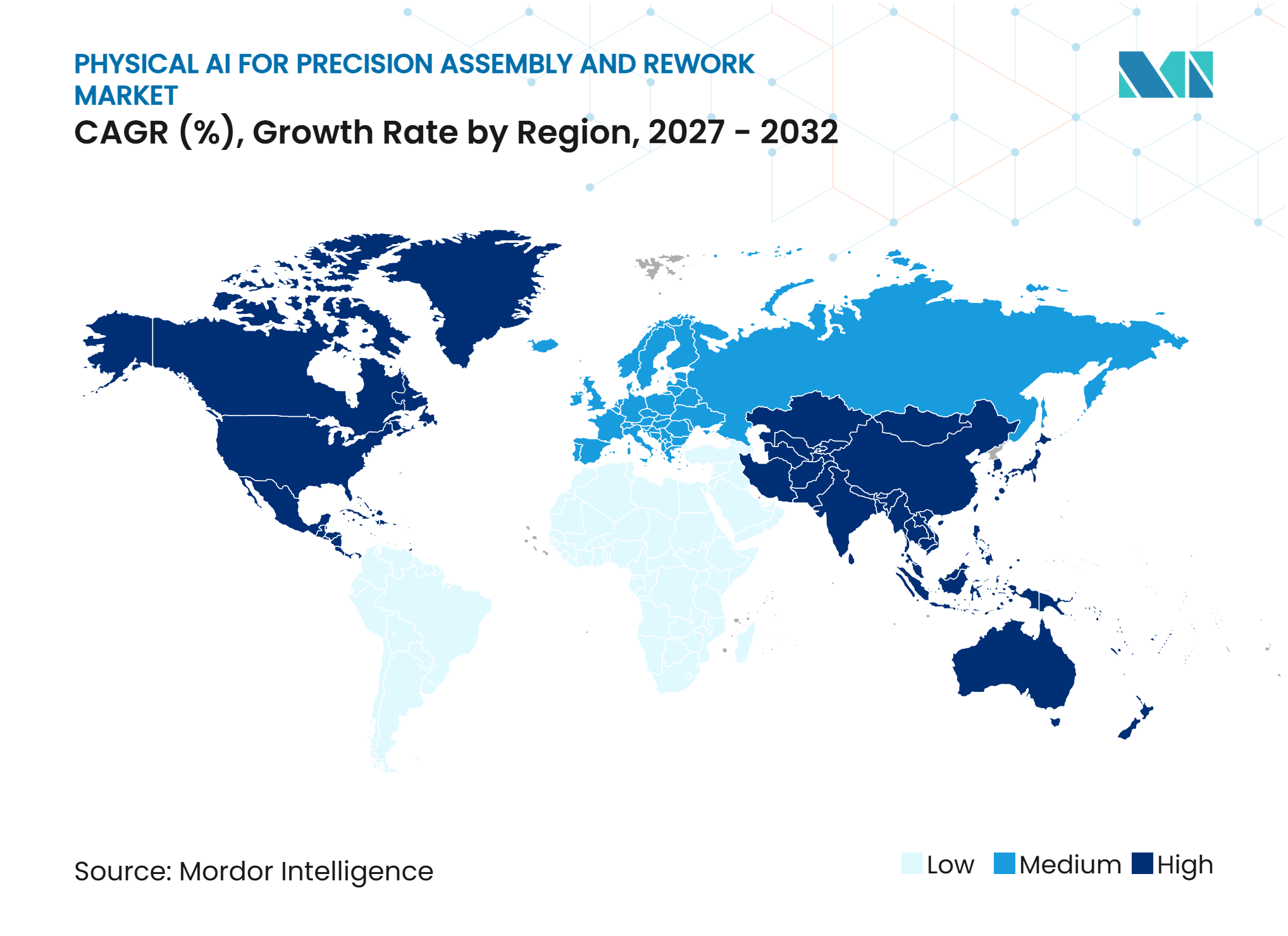
- By geography, Asia-Pacific held a 27.67% share in 2026, while North America is projected to expand at a 25.88% CAGR through 2032.
Note: Market numbers in this report are based on Mordor Intelligence's proprietary estimation framework, which combines nine months of actuals with Q4 projections for base year 2026.
Market Trends and Insights
Drivers Impact Analysis of Physical AI for Precision Assembly and Rework Market*
| Driver | (~) % Impact on CAGR Forecast | Geographic Relevance | Impact Timeline |
|---|---|---|---|
| Workforce Shortages and Wage Inflation | +5.2% | Global, with highest intensity in North America and Western Europe | Short term (≤ 2 years) |
| Demand for Flexible High-Mix Production | +4.6% | Global, particularly Asia-Pacific and North America | Short term (≤ 2 years) |
| Electronics Miniaturization and Tighter Tolerances | +3.9% | Asia-Pacific core, spill-over to North America and Europe | Medium term (2-4 years) |
| Nearshoring and Supply-Chain Resilience | +3.1% | North America and Europe | Medium term (2-4 years) |
| Closed-Loop Inspection-to-Action | +2.4% | Global | Medium term (2-4 years) |
| Simulation-to-Deployment Compression | +1.8% | Global, led by North America and East Asia | Long term (≥ 4 years) |
| Source: Mordor Intelligence | |||
Workforce Shortages and Wage Inflation Are Pushing Automation Thresholds
The labor gap in electronics and semiconductor manufacturing has become difficult to address through hiring alone. The Global Electronics Association reported in 2025 that 63% of firms faced talent shortages that constrained growth, while 54% absorbed higher labor costs.[1] Nearly 33% of the manufacturing workforce is over 55, which raises the risk of losing experienced precision-assembly knowledge as workers retire. The physical AI for precision assembly and rework market benefits when systems can learn from technician demonstrations and retain process knowledge from repeatable precision tasks. That capability supports continuity in tasks where conventional automation has not captured tacit operating practices.
Demand for Flexible High-Mix Production Favors Adaptive Robotic Cells
Consumer electronics product cycles have shortened to 12-18 months, while industrial and automotive electronics increasingly require short production runs with many variants. These conditions make fixed hard-automation tools less suitable when setup changes take weeks. Manufacturers therefore value cells that can be reconfigured within hours for a new product or process. Yaskawa stated that its MOTOMAN NEXT platform has been validated in more than 200 customer use cases and uses on-robot computing for adaptive motion planning.[2] The physical AI for precision assembly and rework market responds to this requirement by integrating adaptive vision and computing into the robot, allowing a cell to handle variation without a separate cloud connection. Contract manufacturers increasingly need to demonstrate the ability to make rapid changeovers when competing for production programs.
Electronics Miniaturization and Tighter Tolerances Demand Sub-Micron AI Control
Shrinking component geometries are testing the limits of conventional vision-guided robotics. ASMPT introduced its INFINITE bonder in May 2025 with ±12.5 µm placement accuracy at 3σ in high-precision mode, and the ability to process dies as thin as 75 µm.[3] The system was designed for silicon carbide and gallium nitride power devices, 5G components, and AI chiplet packaging. IEC and ISO work on semiconductor packaging tolerances adds compliance pressure to how equipment is specified and validated. A misplaced die on a USD 2,000-or-higher AI processor substrate can create rejection costs far beyond the operating costs of a precision assembly cell. AI-enabled rework also addresses the resolution and ergonomic limitations that technicians face when working with sub-millimeter components.
Nearshoring and Supply-Chain Resilience Are Creating New Demand Centers
Assembly capacity is being redistributed from Asia toward North America and Europe. The Reshoring Initiative recorded 247,000 announced reshoring and foreign direct investment manufacturing jobs in 2025, with computer and electronic products representing 18% of the total.[4] Taiwan firms disclosed USD 5.3 billion in planned foreign direct investment in Texas during 2025, while Mexico's data-center equipment exports to the United States exceeded USD 70 billion in 2025.[5] These facilities incorporate PCB subassemblies, cable harnesses, and rack assembly. Greenfield sites are generally planned for automation at launch rather than upgraded after decades of manual operation. The physical AI market for precision assembly and rework is therefore seeing demand in facilities where deployment can be incorporated into the original production design.
Restraints Impact Analysis of Physical AI for Precision Assembly and Rework Market*
| Restraint | (~) % Impact on CAGR Forecast | Geographic Relevance | Impact Timeline |
|---|---|---|---|
| High Integration and Validation Costs | -3.4% | Global, most acute in North America and Europe | Short term (≤ 2 years) |
| Sparse, Non-Standardized Training Data for Rare Defects | -2.3% | Global | Medium term (2-4 years) |
| Safety, Liability, and Change-Control Requirements | -1.6% | North America and Europe, FDA-regulated and AS9100 environments | Medium term (2-4 years) |
| Thermal and Process Variability in Precision Rework | -1.1% | Global | Long term (≥ 4 years) |
| Source: Mordor Intelligence | |||
High Integration and Validation Costs Constrain Faster Uptake
The capital cost of physical AI hardware is becoming more competitive, but integration costs remain a major barrier to adoption. Legacy systems require data collection, system interfaces, evaluation, safety compliance, and operating processes before a deployment can scale. These activities can be more demanding in North America and Europe, where many facilities operate established production systems. Quality and validation requirements can extend commissioning schedules, even where the robot hardware is available. The physical AI for precision assembly and rework market must therefore compete on implementation support as well as technical capability, especially where internal engineering teams have limited capacity. Vendors that provide a clearer route through qualification and integration can reduce a key purchasing concern.
Sparse Training Data for Rare Defects Limits Closed-Loop Model Reliability
Precision assembly systems require defect-detection models trained across a sufficient range of fault modes. The rarest and most damaging defects are often underrepresented in production data. Defect taxonomies also vary among original equipment manufacturers, limiting model transferability between facilities with similar processes. Competitive sensitivity makes firms reluctant to share defect libraries through industry groups. NVIDIA described Amazon Devices' use of AI and digital twins for zero-touch manufacturing, showing how physics-based synthetic data can support model development. Synthetic-to-real validation still needs to account for production variability. As components become smaller, new defect modes may emerge faster than training pipelines can incorporate them.
*Our forecasts treat driver/restraint impacts as directional, not additive. The impact forecasts reflect baseline growth, mix effects, and variable interactions.
Physical AI For Precision Assembly and Rework Market Segment Analysis
By Application:
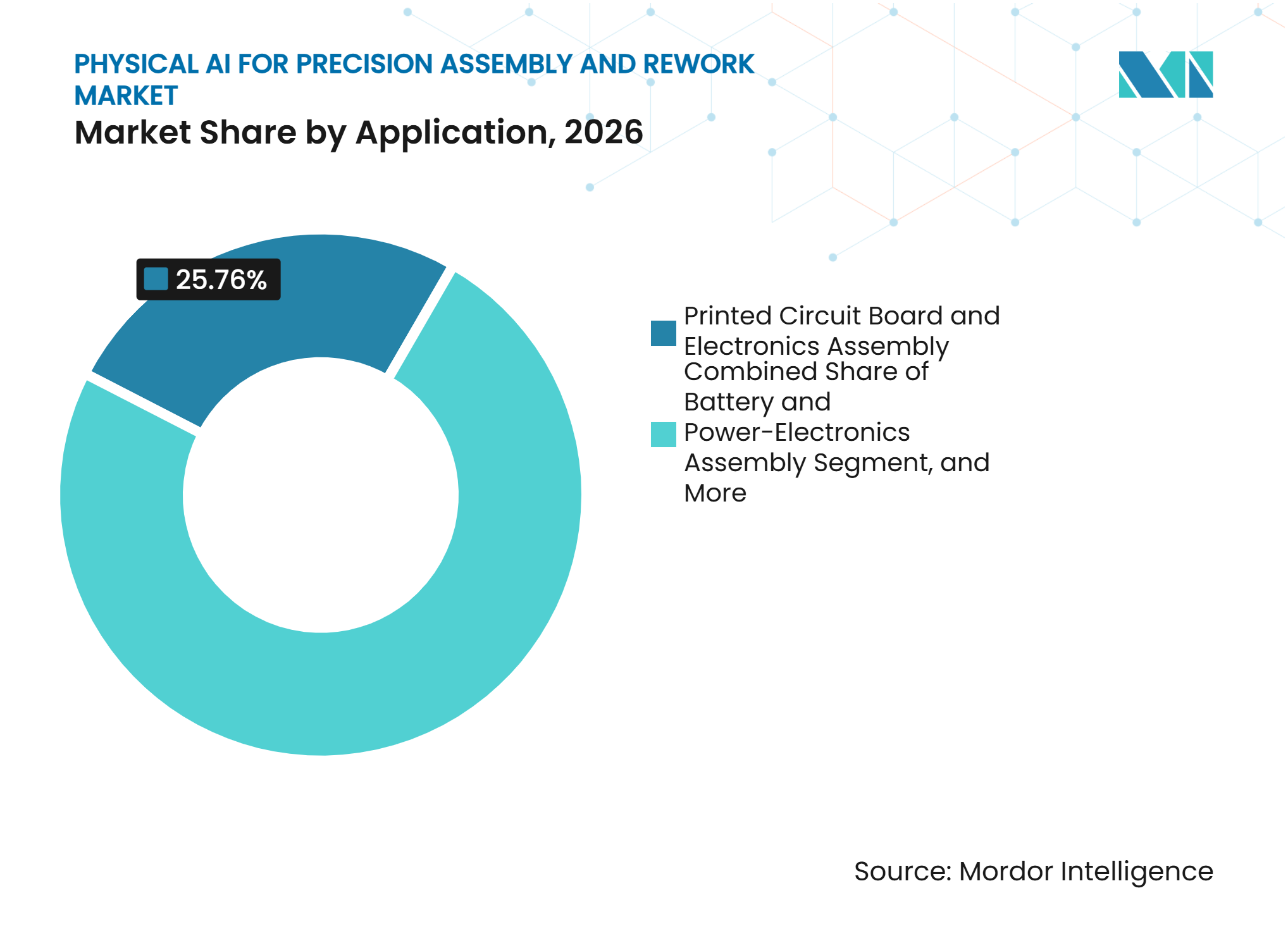
PCB and Electronics Assembly Leads While Semiconductor Packaging AcceleratesPrinted Circuit Board and Electronics Assembly is expected to account for 25.76% of the physical AI for precision assembly and rework market in 2026. Its leading position reflects high global board-level production volumes and the widespread use of AI-enabled automated optical inspection and adaptive pick-and-place systems. Surface-mount devices are transitioning toward 0201 metric and 01005 imperial footprints. At these dimensions, rule-based machine vision systems face increasing difficulty in consistently identifying misplaced components. Consequently, the physical AI for precision assembly and rework industry relies on adaptive placement and sensing technologies to support repeatable board-level operations.
Semiconductor and Advanced Packaging Assembly is projected to register a 25.12% CAGR through 2032. Chiplet architectures, fan-out wafer-level packaging, and HBM stacking are entering volume production and require highly precise die placement. ASMPT is expected to demonstrate full-process, closed-loop automation spanning wafer dicing, die placement, and final inspection at SEMICON Taiwan 2025. Aerospace and defense assembly must comply with the requirements of AS9100 Rev D and DO-178C. Although these requirements can extend adoption timelines, they can also foster durable customer relationships following qualification. Battery and power electronics assembly, along with automotive and electric-vehicle assembly, meet demand associated with EV powertrain production.



By End User:
EMS Providers Lead While Equipment Manufacturers AccelerateElectronics Manufacturing Services Providers are expected to hold 22.12% of the physical AI for precision assembly and rework market in 2026. These providers assemble consumer electronics, networking equipment, and industrial control boards at high volumes. Their deployments focus on improving yield and reducing direct labor costs. A 1% improvement in first-pass yield across millions of annual units can generate seven-figure annual savings. In the physical AI for precision assembly and rework market, this benefit shifts the business case from cost avoidance to production revenue protection.
Semiconductor and Electronics Equipment Manufacturers are projected to expand at a 24.13% CAGR through 2032. These companies are embedding AI directly into bonders, pick-and-place machines, and inspection tools. In the physical AI for precision assembly and rework market, physical AI is becoming an integrated tool feature rather than an additional system layer. This approach changes how value is captured across the assembly automation stack. Automotive Tier 1 suppliers are adopting these systems to manage the complexity of EV powertrains, including battery module assembly and power electronics rework. Contract manufacturers and job shops remain more price-sensitive and often rely on Robot-as-a-Service models to reduce capital expenditure barriers.
By Component:
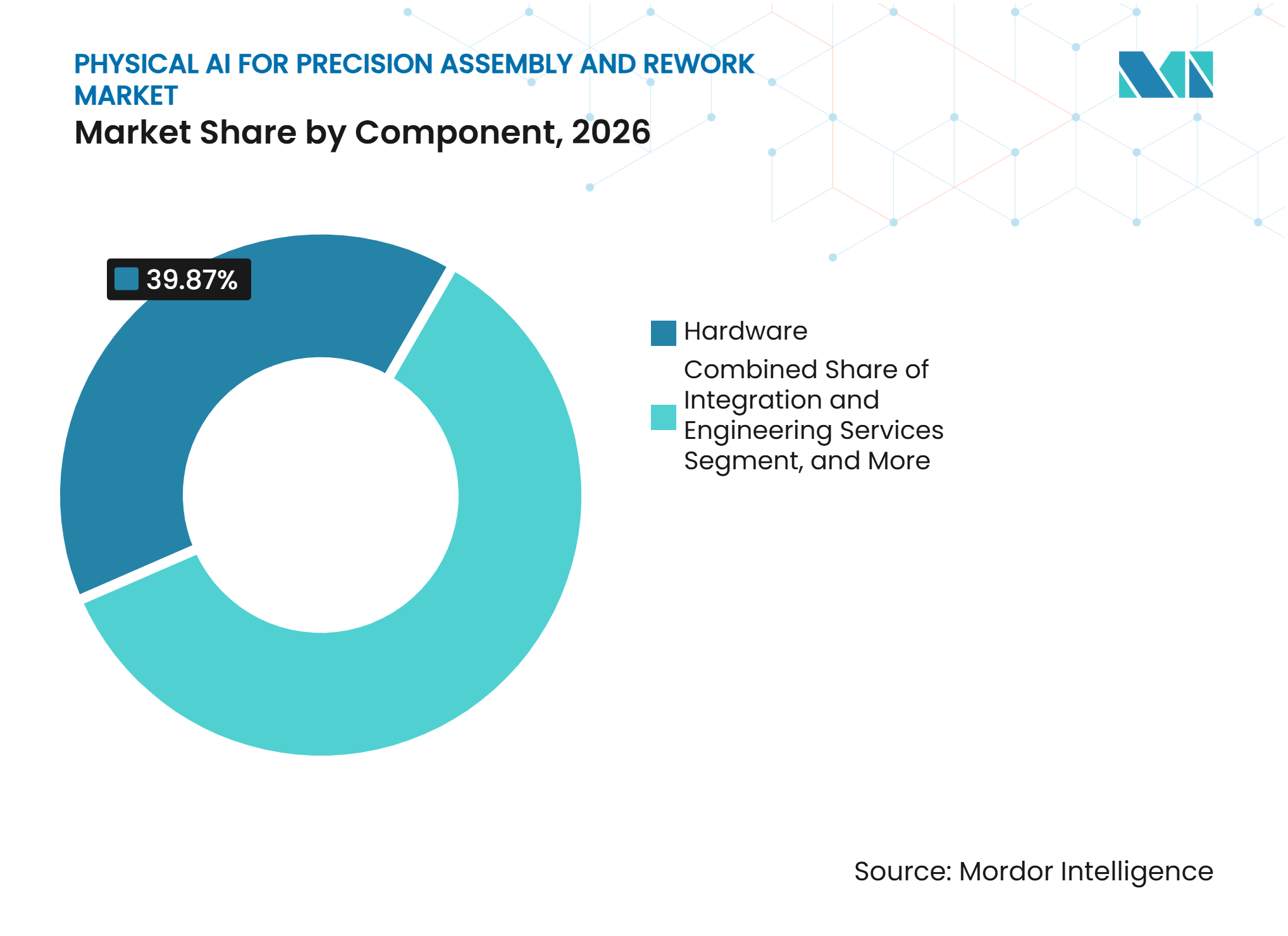
Hardware Holds the Largest Share While AI Software Changes Value CaptureHardware is expected to command 39.87% of the physical AI for precision assembly and rework market in 2026. This category includes robotic arms, collaborative robots, force-torque sensors, vision systems, and specialized end-of-arm tools designed for sub-millimeter manipulation. As capable robotic arms become more widely available, mechanical repeatability alone is becoming less of a differentiator. On-robot computing is gaining importance because it enables real-time force control at production-line cycle times. Consequently, the market is shifting toward integrated sensing and computing within equipment rather than treating robots and their intelligence as separate purchases.
AI and Robotics Software is projected to advance at a 25.76% CAGR through 2032. Foundation models, simulation-to-deployment tools, and software-defined robots reduce the time required to adapt equipment for new part types. Natural-language prompts can also reduce dependence on teach-pendant programming. Maintenance, training, and managed services further support outcome-based engagements and can capture a larger share of system lifetime value. While hardware unit volumes may continue to rise, software and services may place pressure on hardware margins.

By Deployment Model:
On-Premise Equipment Retains Its Base While Hybrid Deployment AdvancesOn-Premise Capital Equipment is expected to hold a 37.86% share in 2026. Cleanroom requirements in semiconductor packaging and aerospace environments can limit the use of shared cloud connectivity. Tier 1 suppliers also prefer air-gapped production systems. Qualification protocols under IATF 16949 for automotive electronics and ISO 13485 for medical devices can extend commissioning timelines. These controls reinforce the role of owned equipment in regulated operations.
Hybrid Edge-Cloud Deployment is projected to expand at a 24.67% CAGR through 2032. Manufacturers use edge inference for low-latency, closed-loop control and cloud services for fleet management and model retraining. This model is particularly relevant for organizations operating facilities across multiple locations. Robot-as-a-Service is gaining traction among contract manufacturers and job shops that face uncertain volume commitments. Cloud-connected fleet management can provide smaller facilities with access to foundation-model updates, while hybrid architectures reduce the need for extensive on-site AI engineering resources.
Geography Analysis
Asia-Pacific
Asia-Pacific is projected to hold a 27.67% market share in 2026. The region’s physical AI for precision assembly and rework market combines dense electronics contract manufacturing, semiconductor back-end operations, and EV powertrain assembly. FANUC, Yaskawa, and OMRON are embedding physical AI into their own production environments before commercializing these solutions. Yaskawa plans to commission Robot Plant No. 5 in Kitakyushu in fiscal 2026, using MOTOMAN NEXT and its i3-Mechatronics framework. Advanced semiconductor packaging requires alignment accuracy below 10 µm, placing significant demands on systems deployed across the region.
North America
North America is projected to register a 25.88% CAGR from 2027 to 2032. Investments under the CHIPS Act, defense electronics reshoring, and EV assembly are directing capital toward new manufacturing facilities. The Reshoring Initiative is expected to characterize semiconductor investment as exceptionally strong in its 2025 report. For the physical AI for precision assembly and rework market, these new facilities can integrate automation during the design phase, avoiding the retrofit costs associated with legacy production sites. NVIDIA expects Skild AI and Foxconn to deploy AI-driven dual-arm manipulators on Blackwell production lines for multi-step busbar and connector assembly with adaptive recovery.
Europe Leads While Emerging Regions Diversify the Pipeline
European demand is concentrated in Germany, where automotive Tier 1 suppliers and industrial equipment manufacturers have established collaborative robot ecosystems. The United Kingdom and France are expanding their aerospace electronics rework and military assembly capabilities, while Italy and Spain generate demand through automotive electronics and industrial automation. South America remains in its early stages, with Brazil serving as the primary demand center due to Foxconn and BYD's assembly investments. Argentina and other South American markets rely more heavily on imported equipment. The United Arab Emirates and Saudi Arabia are investing in advanced manufacturing through policies aligned with Vision 2030, while South Africa’s automotive supply chain represents Africa’s most organized near-term opportunity.
Competitive Landscape
Market Concentration
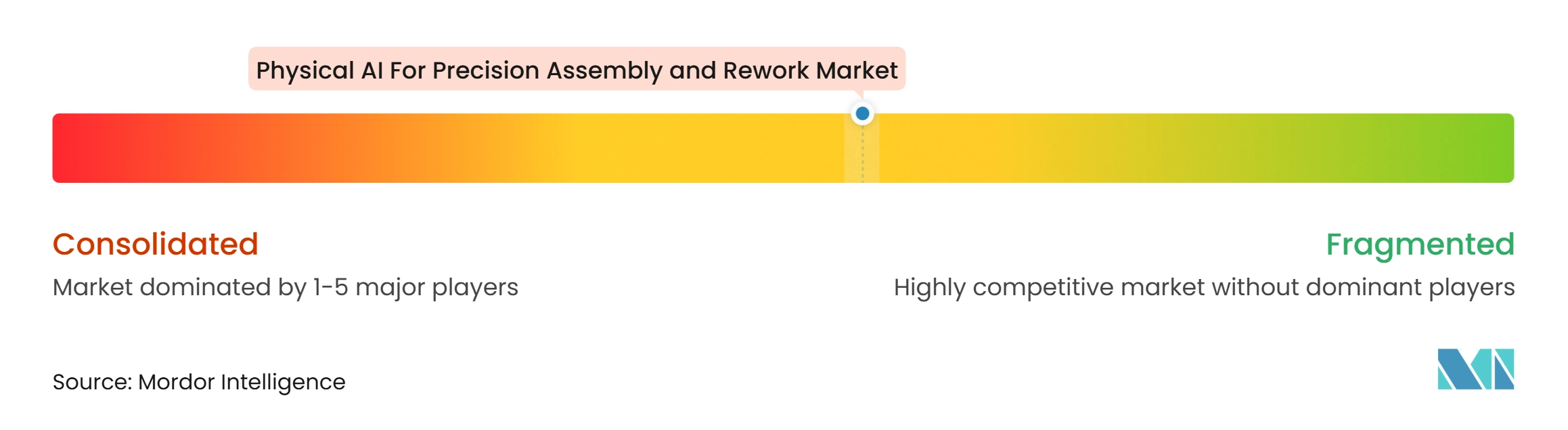
The physical AI for precision assembly and rework market features a moderately consolidated platform layer, although specialized software and application providers remain numerous. FANUC, ABB Robotics, Yaskawa, and KUKA collectively have an installed base of more than 2 million robots. The intelligence and application layers remain fragmented, with participation from AI-native companies and specialized equipment vendors. Leading robotics companies are integrating AI capabilities at the controller level within their established hardware platforms. NVIDIA announced ecosystem partnerships with FANUC, ABB Robotics, Yaskawa, KUKA, and Universal Robots in March 2026 to integrate Omniverse libraries and Isaac simulation frameworks into virtual commissioning platforms.
In the physical AI for precision assembly and rework market, competitive barriers are shifting from mechanical arm design toward perception-action systems, software, and training data. This transition creates opportunities for AI-native companies with differentiated model architectures that lack an established legacy in robotics hardware. ASMPT’s closed-loop AI platform for semiconductor packaging and Hanwha Semitech’s TC bonder and hybrid bonder product lines demonstrate a vertically integrated strategy. These companies embed physical AI capabilities within their equipment, reducing reliance on system integrators. In March 2026, ABB partnered with NVIDIA to scale industrial physical AI across its automation portfolio.
A significant opportunity remains in AI-native rework for advanced semiconductor packaging. Closed-loop autonomous rework remains underserved at scale despite growing demand from chiplet and high-bandwidth memory (HBM) production. GrayMatter Robotics generates robot programs using CAD models and sensor data, reducing dependence on expert teach-pendant programming. ABB stated that RobotStudio HyperReality integrates NVIDIA Omniverse and can achieve simulation fidelity of up to 99%, potentially shortening qualification cycles in regulated end markets.
Physical AI For Precision Assembly and Rework Industry Leaders
-
ABB Ltd.
-
Applied Materials, Inc.
-
DENSO CORPORATION
-
FANUC CORPORATION
-
Jabil Inc.
- *Disclaimer: Major Players sorted in no particular order
Physical AI For Precision Assembly and Rework Market Companies Covered in this Report
- ABB Ltd.
- ASMPT Limited
- Comau S.p.A.
- DENSO CORPORATION
- FANUC CORPORATION
- FUJI CORPORATION
- GrayMatter Robotics, Inc.
- Hanwha Semitech Co., Ltd.
- KUKA AG
- Kurtz Ersa Smart Production GmbH
- Mitsubishi Electric Corporation
- OMRON Corporation
- Rockwell Automation, Inc.
- Siemens AG
- Stäubli International AG
- Teradyne, Inc.
- Universal Robots A/S
- VJ Electronix, Inc.
- Yaskawa Electric Corporation
Recent Industry Developments in Physical AI For Precision Assembly and Rework Market
- October 2026: ABB Robotics launched the IRB 1700 and IRB 1700ID precision industrial robots, delivering up to 20% faster cycle times, 0.03 mm path repeatability at a 6- 12 kg payload range, and up to 15% lower energy consumption compared to the IRB 1600 series. The robots target AI server rack assembly and high-speed electronics manufacturing, integrating ABB's OmniCore controller and AI Robot Trainer software for adaptive, autonomous operation, with a footprint reduced by 50% compared to the prior generation.
- October 2026: FANUC launched the AI Masterless Vision product, eliminating teach-pendant vision programming for precision pick-and-place applications. The system enables natural-language part identification, recognizing cylindrical or irregular workpieces from a verbal instruction without prior 3D model teaching, and was demonstrated at JIMTOF 2026 in Tokyo. Volume shipments are planned for January 2027.
- September 2026: Hitachi and FANUC announced a strategic partnership to commercialize physical AI, combining Hitachi's short-cycle learning AI, HMAX Industry, with FANUC industrial robots. Joint validation is underway at Hitachi's Ibaraki factory as "Customer Zero," targeting commercialization in fiscal 2027 and also covering validation of Hitachi's edge AI semiconductor integrated with FANUC robot controllers.
- September 2026: Hanwha Semitech exhibited 4 next-generation advanced packaging equipment systems at SEMICON Taiwan 2026, including the first public showing of the SFM5 Square FOPLP machine operating on 600×600 mm square panels, alongside the 3D TC bonder SFM5 Expert, the 2.5D CoW bonder SFM5 TnR, and the SHB2 Nano hybrid bonder with 0.1 µm placement precision for HBM applications.
Global Physical AI For Precision Assembly and Rework Market Report Scope
The Physical AI for Precision Assembly and Rework Market Report is Segmented by Application (Printed Circuit Board and Electronics Assembly, Semiconductor and Advanced Packaging Assembly, Battery and Power-Electronics Assembly, Automotive and Electric Vehicle Assembly, and Aerospace and Defense Assembly), End User (OEMs, EMS Providers, Automotive Tier 1 Suppliers, Semiconductor and Electronics Equipment Manufacturers, and Contract Manufacturers and Job Shops), Component (Hardware, AI and Robotics Software, Integration and Engineering Services, and Maintenance, Training, and Managed Services), Deployment Model (On-Premise, Robot-as-a-Service, Cloud-Connected Fleet Management, and Hybrid Edge-Cloud Deployment), and Geography ((North America, South America, Europe, Asia-Pacific, and the Middle East and Africa). The Market Forecasts are Provided in Terms of Value (USD).
Segmentation Overview
| Printed Circuit Board and Electronics Assembly |
| Semiconductor and Advanced Packaging Assembly |
| Battery and Power-Electronics Assembly |
| Automotive and Electric Vehicle Assembly |
| Aerospace and Defense Assembly |
| Other Applications |
| Original Equipment Manufacturers |
| Electronics Manufacturing Services Providers |
| Automotive Tier 1 Suppliers |
| Semiconductor and Electronics Equipment Manufacturers |
| Contract Manufacturers and Job Shops |
| Other End Users |
| Hardware |
| AI and Robotics Software |
| Integration and Engineering Services |
| Maintenance, Training, and Managed Services |
| On-Premise Capital Equipment |
| Robot-as-a-Service |
| Cloud-Connected Fleet Management |
| Hybrid Edge-Cloud Deployment |
| North America | United States |
| Canada | |
| Mexico | |
| South America | Brazil |
| Argentina | |
| Rest of South America | |
| Europe | Germany |
| United Kingdom | |
| France | |
| Italy | |
| Spain | |
| Rest of Europe | |
| Asia-Pacific | China |
| Japan | |
| India | |
| South Korea | |
| Rest of Asia-Pacific | |
| Middle East | United Arab Emirates |
| Saudi Arabia | |
| Rest of Middle East | |
| Africa | South Africa |
| Nigeria | |
| Rest of Africa |
| By Application | Printed Circuit Board and Electronics Assembly | |
| Semiconductor and Advanced Packaging Assembly | ||
| Battery and Power-Electronics Assembly | ||
| Automotive and Electric Vehicle Assembly | ||
| Aerospace and Defense Assembly | ||
| Other Applications | ||
| By End User | Original Equipment Manufacturers | |
| Electronics Manufacturing Services Providers | ||
| Automotive Tier 1 Suppliers | ||
| Semiconductor and Electronics Equipment Manufacturers | ||
| Contract Manufacturers and Job Shops | ||
| Other End Users | ||
| By Component | Hardware | |
| AI and Robotics Software | ||
| Integration and Engineering Services | ||
| Maintenance, Training, and Managed Services | ||
| By Deployment Model | On-Premise Capital Equipment | |
| Robot-as-a-Service | ||
| Cloud-Connected Fleet Management | ||
| Hybrid Edge-Cloud Deployment | ||
| By Geography | North America | United States |
| Canada | ||
| Mexico | ||
| South America | Brazil | |
| Argentina | ||
| Rest of South America | ||
| Europe | Germany | |
| United Kingdom | ||
| France | ||
| Italy | ||
| Spain | ||
| Rest of Europe | ||
| Asia-Pacific | China | |
| Japan | ||
| India | ||
| South Korea | ||
| Rest of Asia-Pacific | ||
| Middle East | United Arab Emirates | |
| Saudi Arabia | ||
| Rest of Middle East | ||
| Africa | South Africa | |
| Nigeria | ||
| Rest of Africa | ||
Key Questions Answered in the Report
What is the physical AI market size for precision assembly and rework?
The physical AI for precision assembly and rework market is projected to rise from USD 0.72 billion in 2026 to USD 0.91 billion in 2027, and to USD 2.59 billion by 2032, at a 23.27% CAGR. Adoption is supported by adaptive sensing, closed-loop inspection, and rework requirements in electronics production. Manufacturers are considering these capabilities when traditional automation cannot respond reliably to product variation or tight placement tolerances. The outlook also reflects investment in new assembly capacity designed for automated operation, particularly where manufacturers seek more consistent inspection, placement, and rework performance across varied product programs.
Which application leads physical AI for precision assembly and rework?
Printed Circuit Board and Electronics Assembly leads with a 25.76% share in 2026. Semiconductor and Advanced Packaging Assembly is the fastest-growing application, with a 25.12% CAGR through 2032, as chiplet architectures, fan-out wafer-level packaging, and HBM stacking enter volume production. These production methods require accurate die placement and more integrated inspection, thereby increasing the relevance of adaptive control in semiconductor assembly.
Which region has the strongest position in precision assembly and rework?
Asia-Pacific holds a 27.67% share in 2026 because it is a major hub for electronics manufacturing, semiconductor back-end operations, and EV powertrain assembly. The region also operates demanding high-volume precision environments for advanced packaging. Japan, South Korea, and Taiwan contribute robotics, semiconductor packaging, and electronics production capability, while China remains important for consumer electronics and EV assembly.
Why is North America expanding quickly in this field?
North America is projected to record a 25.88% CAGR through 2032, as CHIPS Act investments, reshoring, defense electronics, and EV assembly support the construction of new automated facilities. Greenfield sites can integrate automation at the design stage rather than retrofit established lines. This can support shorter deployment schedules because equipment design, process qualification, and production layout can be considered together.
What component category is expanding most quickly?
AI and Robotics Software is projected to advance at a 25.76% CAGR through 2032 as manufacturers use foundation models and simulation-to-deployment tools. Software-defined robots can also reduce the time required to adapt equipment for a new part type. Maintenance, training, and managed services are becoming more relevant as buyers seek outcome-based engagements over the full operating life of a system.
What limits wider adoption of physical AI systems?
Integration and validation work can slow implementation, while limited training data for rare defects can constrain closed-loop model reliability. Safety compliance, process qualification, and defect taxonomies can add to the work required before a system scales. These matters are important in cleanrooms, aerospace environments, and other settings where operating changes must be documented and validated. Buyers also need a clear process for connecting models, sensors, controllers, and existing production systems before operations can expand.