
Physical AI For Industrial Inspection and Robotic Intervention Market Size and Share
Market Overview
| Study Period | 2021 - 2032 |
|---|---|
| Market Size (2027) | USD 1.08 Billion |
| Market Size (2032) | USD 3.21 Billion |
| Growth Rate (2027 - 2032) | 24.34 % |
| Fastest Growing Market | North America |
| Largest Market | Asia-Pacific |
| Market Concentration | Medium |
Major Players *Disclaimer: Major Players sorted in no particular order Image © Mordor Intelligence. Reuse requires attribution under CC BY 4.0. | |
Physical AI For Industrial Inspection and Robotic Intervention Market Analysis by Mordor Intelligence
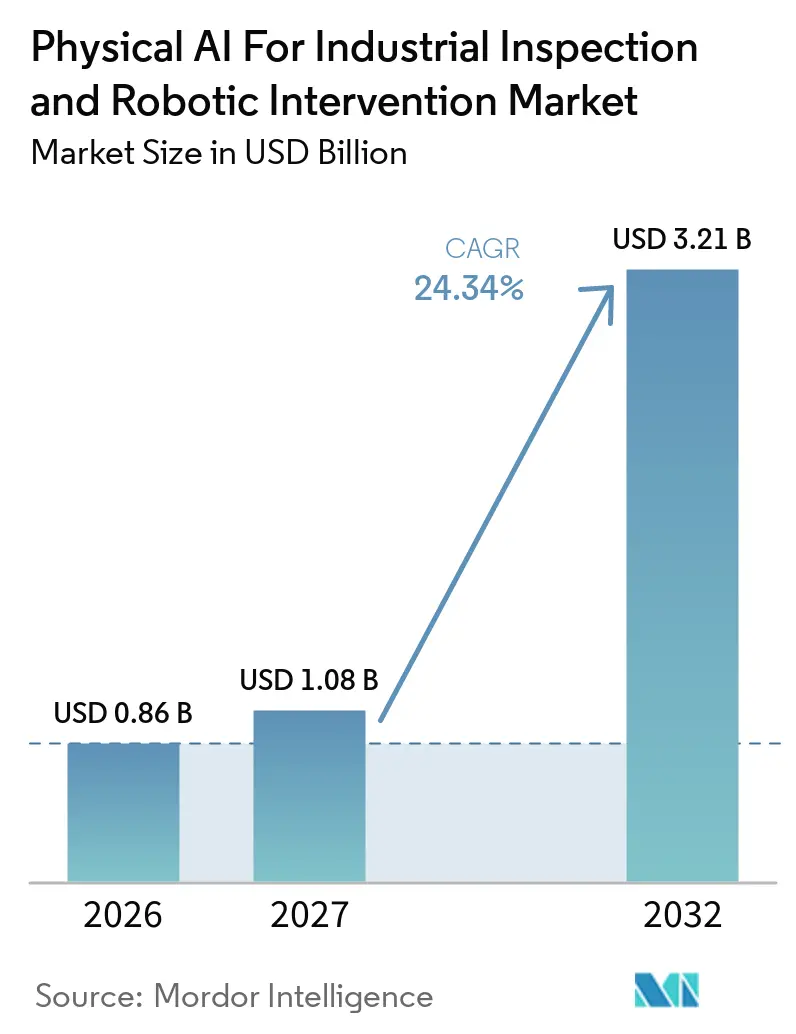
The physical AI for industrial inspection and robotic intervention market size is valued at USD 0.86 billion in 2026 and is forecast to reach USD 3.21 billion by 2032, expanding at a CAGR of 24.34% during 2027-2032. The physical AI for industrial inspection and robotic intervention market is moving from limited trials toward wider plant-level use, as companies seek systems that can perceive equipment conditions and act within operating environments. Persistent shortages of skilled industrial workers are changing purchasing decisions, particularly in roles that are hazardous, remote, or difficult to staff. The value case is also linked to maintenance, because autonomous inspection can detect faults before they trigger costly shutdowns. Hardware remains central to current spending, while recurring software, fleet management, and analytics are becoming more important as deployments expand. Integration with older equipment, safety requirements, and limited data on rare faults remain important constraints on the physical AI for industrial inspection and robotic intervention market.
Key Report Takeaways
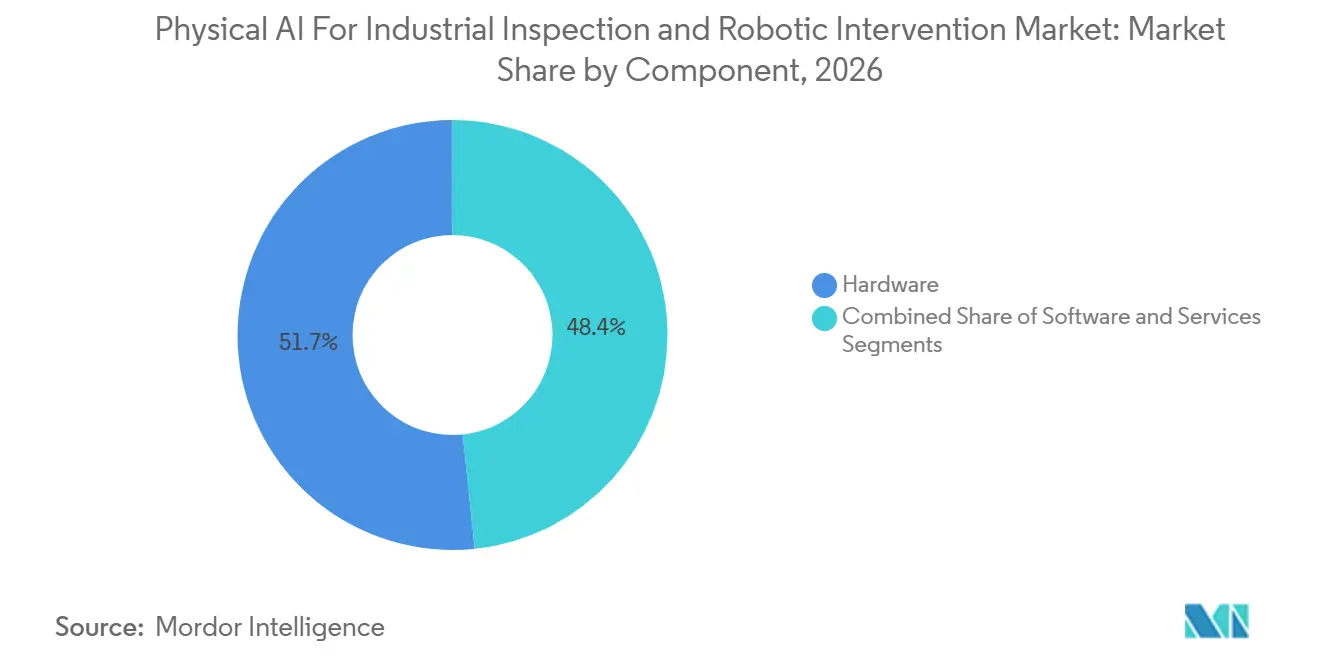
- By component, hardware accounted for 51.65% of revenue in 2026, while software is projected to grow at a 25.11% CAGR through 2032 in the Physical AI for Industrial Inspection and Robotic Intervention Market.
- By intervention type, inspection-only deployments accounted for 32.76% of revenue in 2026, while valve, door, and hatch manipulation is projected to expand at a 26.98% CAGR through 2032.
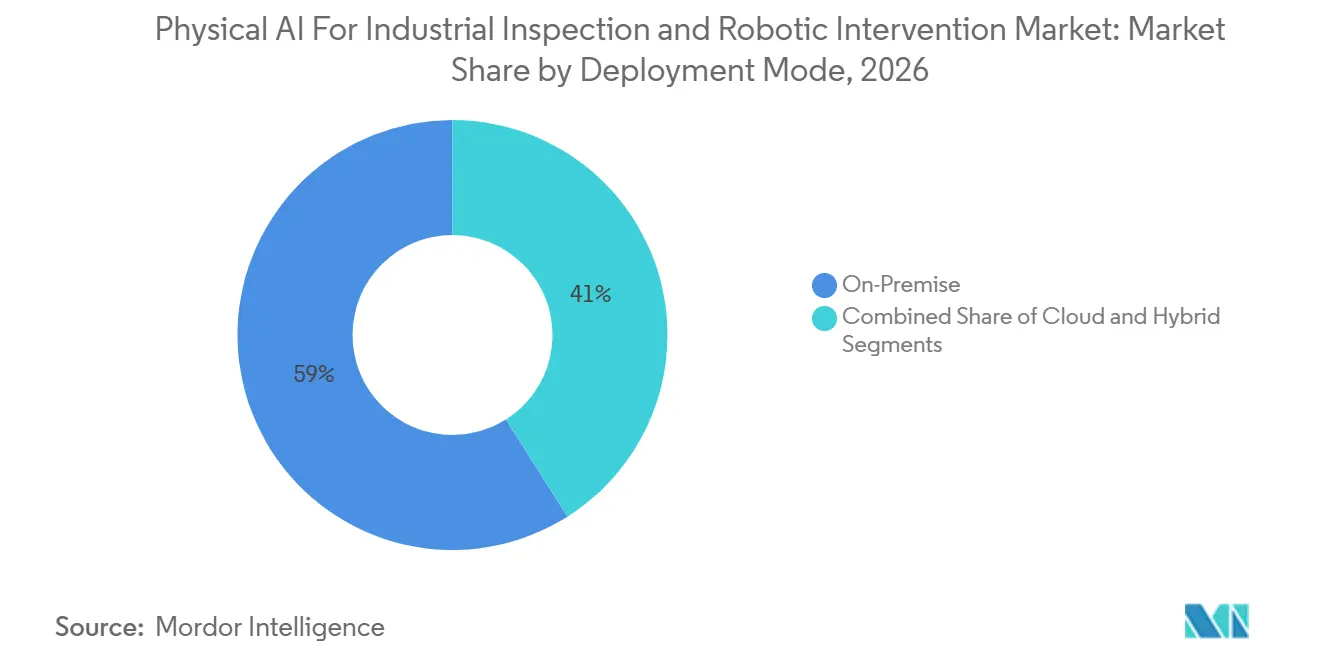
- By deployment mode, on-premises systems accounted for 58.98% of revenue in 2026, while hybrid systems are projected to expand at a 25.76% CAGR through 2032 in the Physical AI for Industrial Inspection and Robotic Intervention Market.
- By level of autonomy, supervised autonomy held 35.77% of revenue in 2026, while fully autonomous systems are projected to expand at a 26.32% CAGR through 2032.
- By end-user industry, oil and gas accounted for 21.31% of revenue in 2026, while electronics, semiconductors, and battery manufacturing are projected to expand at a 25.14% CAGR through 2032.
- By geography, Asia-Pacific held 27.18% of revenue in 2026, while North America is projected to expand at a 26.74% CAGR through 2032.
Note: Market numbers in this report are based on Mordor Intelligence's proprietary estimation framework, which combines nine months of actuals with Q4 projections for base year 2026.
Market Trends and Insights
Drivers Impact Analysis of Physical AI For Industrial Inspection and Robotic Intervention Market*
| DRIVER | (~) % IMPACT ON CAGR FORECAST | GEOGRAPHIC RELEVANCE | IMPACT TIMELINE | |
|---|---|---|---|---|
| Acute Industrial Labor Shortages Driving Autonomous Platform Adoption | +5.20% | Global, with concentrated pressure in North America, Japan, and Germany | Short term (≤ 2 years) | |
| Predictive Maintenance Economics and Downtime Cost Reduction | +4.80% | Global, with early gains in North America and EU process industries | Medium term (2-4 years) | |
| Edge AI Hardware Advances Enabling Real-Time On-Device Inference | +4.10% | Global, Asia-Pacific core, with spillover to North America and Europe | Medium term (2-4 years) | |
| High-Mix, Low-Volume Manufacturing Adoption of Flexible Inspection | +3.30% | North America, Europe, and the Asia-Pacific advanced manufacturing clusters | Medium term (2-4 years) | |
| Digital Twin Integration Compressing Fault Detection Latency | +2.60% | Europe and Asia-Pacific, with spillover to North America and the Middle East | Long term (≥ 4 years) | |
| Compounding Inspection Data Reinforcing Model Accuracy Over Time | +2.00% | Global, accelerating in locations with 3 or more years of deployment history | Long term (≥ 4 years) | |
| Source: Mordor Intelligence | ||||
Acute Industrial Labor Shortages Accelerating Autonomous Platform Adoption
The physical AI for industrial inspection and robotic intervention market is supported by a workforce shortage that is geographic and occupational rather than temporary. Advanced economies face shortages of skilled workers for industrial roles, especially at facilities where employees must work near hazardous machinery or in remote locations. Mitsui identified labor shortages as a key barrier to industrial continuity in its 2026 economic assessment.[1] The U.S. Special Competitive Studies Project also identified autonomous inspection as a way to help address industrial labor constraints in hazardous settings. These conditions make the physical AI for industrial inspection and robotic intervention market relevant even where labor costs alone would not have justified automation. Plants with limited staffing can place greater value on continuous equipment coverage, faster response, and reduced worker exposure.
Predictive Maintenance Economics Creating Self-Reinforcing Value Loops
The physical AI for industrial inspection and robotic intervention market benefits when each inspection creates data that can improve later inspections. ANYbotics reported that its Shift platform had more than 200 active deployments in October 2026 and that it connected inspection activity to SAP, IBM Maximo, GE Vernova APM, and Cognite.[2] The company stated that Vigier Cement completed more than 33,000 automated inspections and avoided USD 660,000 in maintenance costs through the platform. Such records can help operators distinguish recurring equipment behavior from events that need a maintenance response. A 2025 review in Frontiers in Mechanical Engineering found that integrated artificial intelligence and robotics maintenance systems can improve precision over extended operating periods. Longer operating histories can therefore strengthen the physical AI for the industrial inspection and robotic intervention market by reducing false alerts and directing maintenance teams toward higher-priority equipment issues.
Edge AI Hardware Advances Enabling Real-Time On-Device Inference
The physical AI for industrial inspection and robotic intervention market requires local computing that can interpret sensor signals without relying on a cloud connection. NVIDIA announced its Jetson Thor T4000 module in January 2026 with 1,200 FP4 TFLOPS within a 70-watt thermal envelope and a USD 1,999 unit price at 1,000-unit volumes.[3] This type of hardware provides mobile robots with greater processing capacity while keeping power and space requirements within practical limits. A 2025 study in Scientific Reports reported a 3.2-millisecond response time, 98.7% detection accuracy, and 60% lower processing latency for a multimodal sensor fusion approach. Local inference can help physical AI in the industrial inspection and robotic intervention markets make faster decisions near equipment, workers, or safety boundaries. It can also help facilities keep sensitive operating data within their own controlled environments.
High-Mix, Low-Volume Manufacturing Driving Demand for Flexible Inspection
The physical AI market for industrial inspection and robotic intervention has a clear opening in plants that produce changing product mixes at relatively low volumes. Aerospace, medical device, and premium electronics producers often change designs and production schedules too often for fixed machine-vision rules. Cognex stated in 2025 that artificial intelligence vision systems can reduce changeover work between product variants. Japan's New Energy and Industrial Technology Development Organization included automotive surface anomaly inspection in its June 2026 Robot Solutions Challenge.[4] The program shows that flexible inspection is being treated as an important manufacturing capability in a major production economy. These systems can give operators in the physical AI for industrial inspection and robotic intervention market more consistent checks when product variation makes manual inspection difficult to scale.
Restraints Impact Analysis of Physical AI For Industrial Inspection and Robotic Intervention Market*
| RESTRAINT | (~) % IMPACT ON CAGR FORECAST | GEOGRAPHIC RELEVANCE | IMPACT TIMELINE | |
|---|---|---|---|---|
| High Integration Costs and Brownfield Infrastructure Complexity | -3.80% | Global, most acute in aging European and North American industrial bases | Short term (≤ 2 years) | |
| Functional Safety Certification Cycles Under Evolving International Standards | -3.20% | Europe, North America, and the Asia-Pacific regulated industries | Medium term (2-4 years) | |
| Long-Tail Anomaly Data Scarcity Limiting Production-Grade Model Accuracy | -2.10% | Global, most acute in new deployment geographies | Long term (≥ 4 years) | |
| Battery Life and Wireless Connectivity Constraints on Mobile Platforms | -1.60% | Asia-Pacific dense-facility environments and remote oil and gas sites | Medium term (2-4 years) | |
| Source: Mordor Intelligence | ||||
High Integration Costs and Brownfield Complexity Limiting Enterprise Scaling
The physical AI for industrial inspection and robotic intervention market faces a significant barrier in facilities that were built without compatible data interfaces. A robot can require custom links to plant control systems, asset registers, alarm systems, and site-specific security policies before it can deliver routine value. This work adds cost at each site and can extend the commissioning period beyond the initial pilot. A 2026 MDPI benchmark found that 77% of industrial artificial intelligence inspection deployments reached production accuracy targets at prototype or pilot scale. The result shows that controlled demonstrations do not always transfer cleanly into varied operating environments. Facilities with different equipment vintages and data formats may therefore take longer to replicate a successful project across several locations.
Functional Safety Certification Cycles Constraining Deployment Velocity
The physical AI for industrial inspection and robotic intervention market must meet several safety and cybersecurity requirements when systems operate alongside people. TÜV Rheinland identifies ISO 10218-1/2:2025, IEC 61508, and IEC 62443 as relevant frameworks for autonomous inspection platforms. Mobile autonomous platforms also face collaborative robot safety requirements in North America. Operators need to validate how the robot senses its surroundings, how it fails safely, and how it resists cyber risks before a routine deployment can begin. These reviews can be more demanding in energy, chemicals, and semiconductor operations because an error can interrupt critical processes. Smaller suppliers may find the burden particularly difficult when they lack dedicated safety and regulatory teams.
*Our forecasts treat driver/restraint impacts as directional, not additive. The impact forecasts reflect baseline growth, mix effects, and variable interactions.
Physical AI For Industrial Inspection and Robotic Intervention Market Segment Analysis
By Component:
Hardware Anchors Revenue as Software Margin ExpandsHardware is expected to account for 51.65% of the physical AI market share in the industrial inspection and robotic intervention market in 2026, as autonomous platforms require robots, sensors, onboard computers, and communications equipment. Initial purchases also include equipment that enables robots to operate reliably in industrial environments characterized by dust, vibration, heat, or restricted access. Boston Dynamics is expected to release Spot 5.2 in October 2026, featuring the Gemini artificial intelligence visual inspection module, gas sensing for more than 20 compound types, vibration analysis, and partial discharge detection. These additions demonstrate how a single hardware platform can support additional tasks through new payloads and sensing capabilities. Hardware will remain important as customers establish their first inspection fleets. As procurement volumes increase, buyers are likely to evaluate platforms more closely based on usable payload capacity, serviceability, and compatibility with existing plant systems.
Software is projected to expand at a CAGR of 25.11% through 2032, as customers require model retraining, fleet coordination, records management, and inspection analysis after deploying robots. Honeywell is expected to launch Forge Cognition with NVIDIA and Dell in October 2026 and has indicated that the platform will process data from more than 300,000 industrial sites. Honeywell also expects the platform to reduce alert volumes by 90% and deliver 10% energy savings through AI-driven anomaly prioritization. These capabilities shift part of the value proposition toward software that prioritizes findings and links them to operational decisions. Services will remain relevant because operators require support for installation, worker training, data preparation, and ongoing system management. The component mix, therefore, combines high initial equipment expenditure with recurring software and service requirements throughout the deployment lifecycle.

By Intervention Type:
Active Manipulation Closes the Inspection-to-Action GapInspection-only deployments are expected to account for 32.76% of the physical AI for industrial inspection and robotic intervention market size in 2026 and will remain the typical starting point for new users. These deployments enable operators to collect visual, thermal, acoustic, or gas-related observations while human teams retain responsibility for physical repairs. This approach gives sites time to evaluate the reliability of alerts before assigning greater authority to machines. An MDPI study expected in 2026 is anticipated to report that AI inspection systems exceed 95% accuracy in controlled settings and achieve 77% accuracy at the prototype scale. The difference between these settings explains why many buyers prefer a gradual transition from observation to action. Inspection-only systems can also generate the data records needed to identify tasks suitable for later automation.
Valve, door, and hatch manipulation is projected to expand at a CAGR of 26.98% through 2032, as users connect detection capabilities with defined physical responses. This category is relevant where robots can perform routine actions without exposing workers to hazardous or remote locations. ANYbotics states that Shift can link anomaly findings with enterprise asset management systems and generate intervention work orders. This integration can reduce the time between an inspection finding and the delivery of a clear task to a maintenance team. Fluid sampling, cleaning, and minor equipment adjustments represent additional intervention options that expand the range of available tasks. Adoption will depend on demonstrated task reliability, site safety requirements, and the extent to which equipment controls enable robotic interaction.
By Deployment Mode:
Hybrid Architecture Bridges Latency and ScaleOn-premise systems are expected to account for 58.98% of revenue in 2026, reflecting the need for low-latency processing and controlled data handling in oil and gas, chemical, and semiconductor operations. Many operators prefer not to route sensitive process data through public cloud services when robots must make time-sensitive decisions. A Springer Nature study expected in 2026 is anticipated to report 98.2% physical-digital similarity in a digital twin model and a 28.4% improvement in fault detection. Such outcomes depend on timely data exchange between the inspection system and the operational model. On-premise computing also enables facilities to maintain local control when network connectivity is limited or disrupted. These requirements will sustain demand for systems installed within customer environments.
Hybrid deployment is projected to grow at a CAGR of 25.76% through 2032, as it combines local responsiveness with centralized analysis. The physical AI for industrial inspection and robotic intervention market uses this model when robots must interpret raw sensor data at the edge while operators require broader fleet-level reporting. Edge nodes process raw sensor streams near the equipment, while selected inspection records support subsequent model improvements. This approach enables immediate action without losing the broader information required for fleet-level review. Cloud-only systems remain better suited to smaller sites or newer facilities with fewer data governance restrictions. The choice of deployment mode will therefore depend on operational risk, connectivity, cybersecurity policies, and the scale of the robot fleet.
By Level of Autonomy:
Supervised Systems Dominate as Full Autonomy AcceleratesSupervised autonomy is expected to account for 35.77% of revenue in 2026 and represents the operating model most widely used for enterprise deployments. Under this model, a human operator reviews or overrides automated findings before the system takes a consequential action. This approach improves labor efficiency while preserving human responsibility for complex decisions and safety-sensitive exceptions. A 2025 review in Frontiers in Mechanical Engineering is expected to characterize supervised autonomy as a transitional stage toward more independent maintenance operations. The approach is particularly suitable for sites that are building confidence in robot behavior and maintenance workflows. It can also simplify early adoption where internal policies require visible human oversight.
Fully autonomous systems are projected to expand at a CAGR of 26.32% through 2032 as local models become faster and more capable. A 2025 study in Sensors is expected to report that bidirectional LSTM edge models reduce inference latency from 15 milliseconds to 5 milliseconds and lower energy use by 22%. Faster local decision-making can reduce the need for continuous confirmation when operating conditions are well understood. Teleoperated and semi-autonomous systems will continue to serve facilities where network conditions, task complexity, or safety requirements necessitate human involvement. Full autonomy will be most credible for repeatable tasks with a clear operating envelope and a proven safety response. The transition will occur at different rates across industries because each facility has its own tolerance for operational risk.
By End-User Industry:
Oil and Gas Leads as Electronics Manufacturing AcceleratesOil and gas are expected to account for 21.31% of revenue in 2026 because offshore platforms, pipelines, and processing facilities require inspections in hazardous and remote environments. The physical AI for industrial inspection and robotic intervention market supports this sector by reducing the need for personnel to enter explosive areas or travel frequently to hard-to-reach equipment. ANYbotics is expected to deploy ANYmal D at Equinor's Northern Lights carbon capture and storage facility in March 2026. ExRobotics has also indicated a planned deployment with Pluspetrol in Peru for autonomous inspection. These projects demonstrate that energy infrastructure provides a practical environment for early operational deployment. Automotive, aerospace, and chemical operations will add demand from sites that also place a high value on equipment reliability and worker safety.
Electronics, semiconductors, and battery manufacturing are projected to expand at a CAGR of 25.14% through 2032, as manufacturers seek faster and more consistent quality inspections. South Korea's Ministry of Trade, Industry, and Resources is expected to report in February 2026 that AI-enabled robotic inspection reduced semiconductor production cycle time by 33% at Shinhan Diamond. The ministry is also expected to report a 90% reduction in electric vehicle battery inspection time at Asan Sungwoo Hitech. Intel Foundry is expected to deploy its proprietary Chip robot across fabrication facilities in 2025 to conduct 16 types of visual, thermal, and acoustic inspections. These manufacturing environments reward accurate detection because defects can cause material losses, rework, and disruptions to tightly coordinated production schedules. Investment is likely to focus on systems that can inspect changing products without slowing production lines.
Geography Analysis
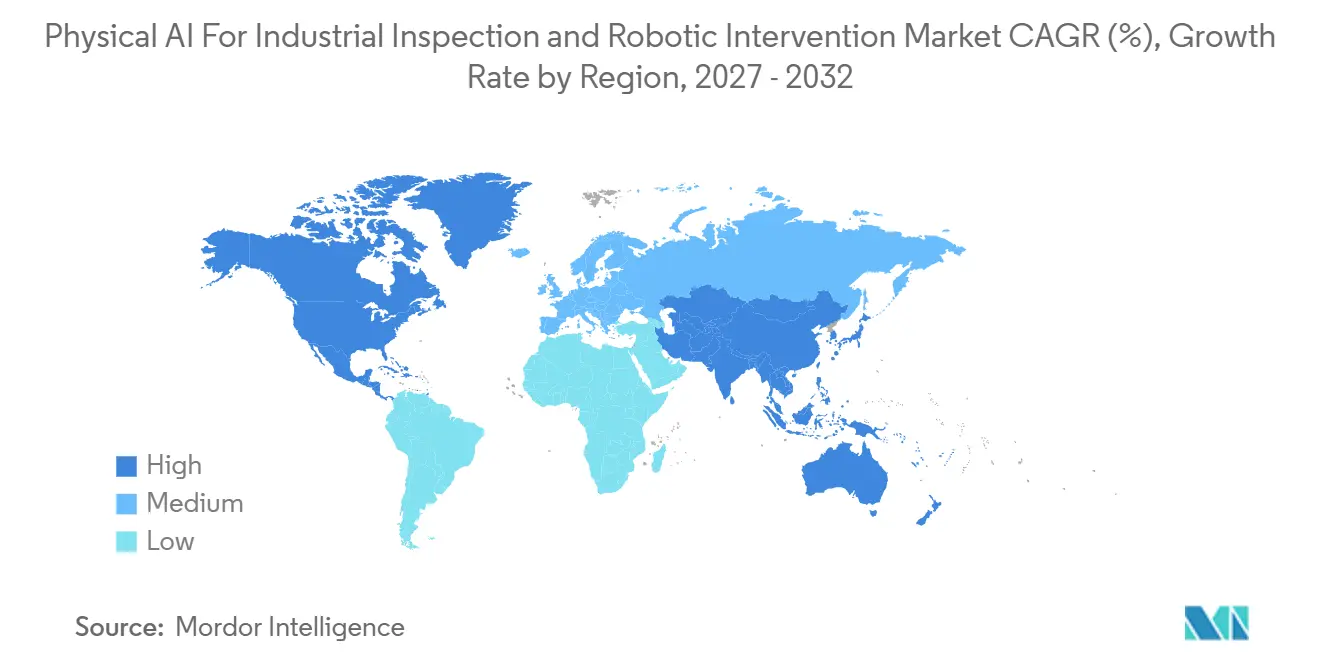
Asia-Pacific is projected to hold a 27.18% share of the physical AI for industrial inspection and robotic intervention market in 2026, supported by large manufacturing bases in China, Japan, South Korea, and Southeast Asia. The region combines strong robot supply capabilities with a large base of electronics, automotive, and industrial production facilities. According to NEDO, Japan is expected to launch its artificial intelligence multimodal foundation model program for 2026–2030 and host the Robot Solutions Challenge in June 2026. The challenge will identify industrial inspection applications that can enhance manufacturing flexibility and quality. According to the Korea Ministry of Trade, Industry, and Resources, South Korea's reported semiconductor and battery inspection results also indicate areas where regional demand is likely to develop. Consequently, Asia-Pacific represents an important hub for both platform development and high-volume customer deployment.
North America is projected to expand at a CAGR of 26.74% through 2032, driven by factory investments, semiconductor capacity expansion, and technical labor shortages. The U.S. Special Competitive Studies Project identified autonomous inspection as a strategic response to constraints in the industrial workforce. NVIDIA Investor Relations indicates that NVIDIA is expected to introduce Cosmos foundation models and the Jetson Thor T4000 module in January 2026, expanding computing options for robotics developers. Honeywell's Forge Cognition also reflects the role of established industrial software suppliers in the region, according to Honeywell. The North American physical AI for industrial inspection and robotic intervention market benefits from a combination of technology suppliers, industrial customers, and the need to maintain output amid limited specialist staffing. The region is likely to favor deployments that integrate with existing automation and maintenance software.
Europe maintains a significant position, led by Germany, Scandinavia, and the United Kingdom, where industrial automation, energy assets, and stringent manufacturing quality requirements support adoption. Fraunhofer IMS is developing the KIMIPA project to integrate edge AI inspection systems with OPC UA and MQTT industrial protocols. This initiative supports compatibility with established industrial communication standards. Safety and product liability requirements also make compliance a key criterion for platform selection across European industrial sites.
The Middle East is emerging as a market for autonomous inspection trials at hydrocarbon facilities, where remote and hazardous operating environments increase the technology's value. South America and Africa remain at earlier stages of adoption; however, energy projects may provide practical entry points where site conditions create strong operational requirements. Geographic adoption will vary based on installed equipment, safety regulations, skilled labor availability, and the scale of capital investment in industrial upgrades.
Competitive Landscape
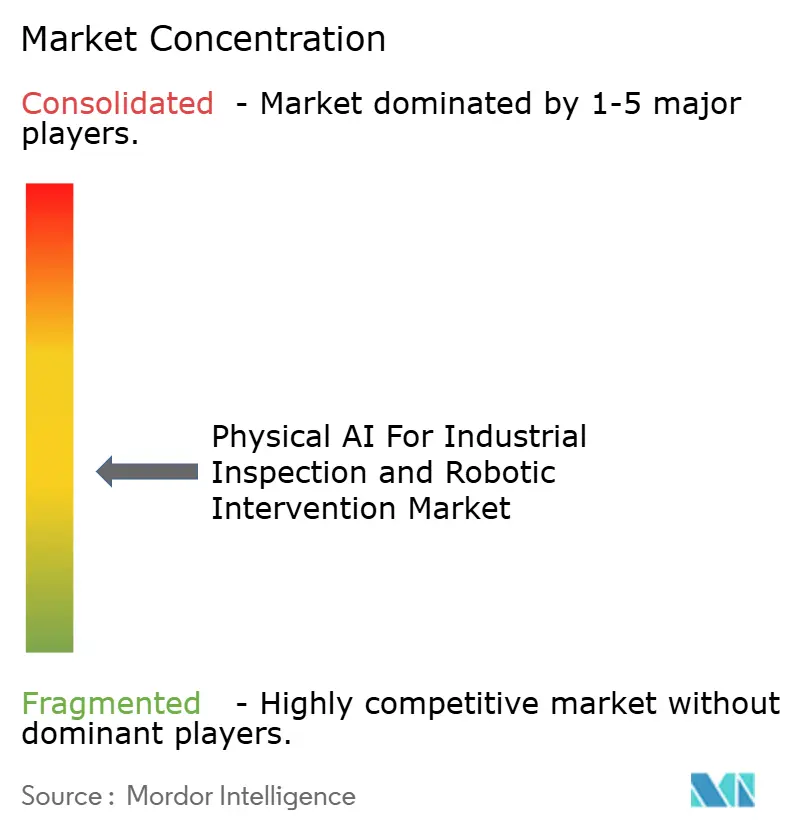
The physical AI for industrial inspection and robotic intervention market includes specialized robotics providers, industrial automation companies, and compute platform suppliers. ANYbotics, DEEP Robotics, and ExRobotics compete with larger companies, including Honeywell, ABB, Siemens, and KUKA, across different parts of the value chain. NVIDIA and Intel provide computing technologies that support robotic perception and local inference. No company currently leads across robot hardware, artificial intelligence software, asset integration, and site services. This fragmented structure provides customers with multiple options, but can increase the effort required to integrate products from different vendors. Competition, therefore, depends on system reliability, safety assurance, integration capabilities, and access to operational inspection data.
Companies are increasingly focusing on the software layer because it can connect robot findings with maintenance and operational decision-making. Honeywell plans to introduce Forge Cognition in October 2026 to support AI-driven anomaly prioritization across industrial sites. Boston Dynamics plans to expand Spot 5.2 in October 2026 with the Gemini visual inspection module, gas sensing, vibration analysis, and partial discharge detection capabilities. KUKA plans to launch iiQWorks in April 2025 to connect robotic inspection data with production quality workflows. These developments indicate that vendors are adding software, sensing capabilities, and workflow integrations to increase the value of robotics deployments after installation. They also increase the importance of enterprise software compatibility, as customers require inspection outputs to reach the teams responsible for equipment maintenance.
Multi-robot fleet coordination remains an emerging area, as many facilities use different robots, sensors, and software systems. ANYbotics Shift addresses part of this requirement through integrations with enterprise asset management systems. A common data structure can enable sites to aggregate inspection records from different platforms. Data collected through multi-year deployments can become valuable when it includes unusual conditions that are difficult to replicate during testing. Vendors with extensive inspection data sets may improve their models more rapidly, particularly for anomaly detection and navigation.
Physical AI For Industrial Inspection and Robotic Intervention Industry Leaders
-
ANYbotics AG
-
DEEP Robotics Co., Ltd.
-
FANUC Corporation
-
ABB Ltd.
-
Boston Dynamics, Inc.
- *Disclaimer: Major Players sorted in no particular order
Physical AI For Industrial Inspection and Robotic Intervention Market Companies Covered in this Report
- ABB Ltd.
- ANYbotics AG
- Boston Dynamics, Inc.
- Cognex Corporation
- DEEP Robotics Co., Ltd.
- FANUC Corporation
- General Electric Company
- Honeywell International Inc.
- Intrinsic Innovation LLC
- KUKA AG
- NVIDIA Corporation
- OMRON Corporation
- Rockwell Automation, Inc.
- Siemens AG
- Taurob GmbH
- Teradyne, Inc.
- Universal Robots A/S
- Yaskawa Electric Corporation
- ExRobotics B.V.
- Kudan Inc.
- AIVEX Co., Ltd.
Recent Industry Developments in Physical AI For Industrial Inspection and Robotic Intervention Market
- October 2026: ANYbotics launched the Shift enterprise inspection management platform, connecting 200+ active deployments to SAP, IBM Maximo, GE Vernova APM, and Cognite. Vigier Cement recorded 33,000+ automated inspections and USD 660,000 in avoided maintenance costs through the platform.
- October 2026: Honeywell launched Forge Cognition in partnership with NVIDIA and Dell, processing data from over 300,000 industrial sites and delivering a 90% reduction in alert volume alongside a 10% energy saving through artificial intelligence-driven anomaly prioritization.
- October 2026: Boston Dynamics released Spot 5.2, incorporating the Gemini AI visual inspection module, gas sensing for over 20 compound types, vibration analysis, and partial discharge detection, substantially expanding Spot's autonomous inspection capability across industrial hazard types.
- March 2026: ANYbotics deployed ANYmal D at Equinor's Northern Lights carbon capture and storage facility, extending physical AI inspection into offshore CO₂ infrastructure and demonstrating use in remote, regulated energy environments.
Global Physical AI For Industrial Inspection and Robotic Intervention Market Report Scope
The Physical AI for Industrial Inspection and Robotic Intervention Market Report is Segmented by Component (Hardware, Software, and Services), Robotic Intervention Type (Inspection-Only and Data-Collection Operations, Remote Visual and Thermal Verification, Button, Switch, and Control-Panel Operation, and Valve, Door, and Hatch Manipulation), Deployment Mode (Cloud, On-Premise, and Hybrid), Level of Autonomy (Assisted Operation, Supervised Autonomy, Advanced Adaptive Autonomy, and Fully Autonomous Inspection and Intervention), End-User Industry (Automotive and Mobility Manufacturing, Electronics, Semiconductors, and Battery Manufacturing, Aerospace and Defense Manufacturing, Oil and Gas, and Chemicals and Petrochemicals), and Geography (North America, South America, Europe, Asia-Pacific, and the Middle East and Africa). The Market Forecasts are Provided in Value (USD).
Segmentation Overview
| Hardware |
| Software |
| Services |
| Inspection-Only and Data-Collection Operations |
| Remote Visual and Thermal Verification |
| Button, Switch, and Control-Panel Operation |
| Valve, Door, and Hatch Manipulation |
| Other Robotic Intervention Types |
| Cloud |
| On Premise |
| Hybrid |
| Assisted Operation |
| Supervised Autonomy |
| Advanced Adaptive Autonomy |
| Fully Autonomous Inspection and Intervention |
| Automotive and Mobility Manufacturing |
| Electronics, Semiconductors, and Battery Manufacturing |
| Aerospace and Defense Manufacturing |
| Oil and Gas |
| Chemicals and Petrochemicals |
| Other End-user Industries |
| North America | United States |
| Canada | |
| Mexico | |
| South America | Argentina |
| Brazil | |
| Rest of South America | |
| Europe | Germany |
| United Kingdom | |
| France | |
| Italy | |
| Spain | |
| Rest of Europe | |
| Asia-Pacific | China |
| Japan | |
| South Korea | |
| India | |
| Australia | |
| Rest of Asia-Pacific | |
| Middle East | Saudi Arabia |
| United Arab Emirates | |
| Rest of Middle East | |
| Africa | South Africa |
| Nigeria | |
| Rest of Africa |
| By Component | Hardware | |
| Software | ||
| Services | ||
| By Robotic Intervention Type | Inspection-Only and Data-Collection Operations | |
| Remote Visual and Thermal Verification | ||
| Button, Switch, and Control-Panel Operation | ||
| Valve, Door, and Hatch Manipulation | ||
| Other Robotic Intervention Types | ||
| By Deployment Mode | Cloud | |
| On Premise | ||
| Hybrid | ||
| By Level of Autonomy | Assisted Operation | |
| Supervised Autonomy | ||
| Advanced Adaptive Autonomy | ||
| Fully Autonomous Inspection and Intervention | ||
| By End-User Industry | Automotive and Mobility Manufacturing | |
| Electronics, Semiconductors, and Battery Manufacturing | ||
| Aerospace and Defense Manufacturing | ||
| Oil and Gas | ||
| Chemicals and Petrochemicals | ||
| Other End-user Industries | ||
| By Geography | North America | United States |
| Canada | ||
| Mexico | ||
| South America | Argentina | |
| Brazil | ||
| Rest of South America | ||
| Europe | Germany | |
| United Kingdom | ||
| France | ||
| Italy | ||
| Spain | ||
| Rest of Europe | ||
| Asia-Pacific | China | |
| Japan | ||
| South Korea | ||
| India | ||
| Australia | ||
| Rest of Asia-Pacific | ||
| Middle East | Saudi Arabia | |
| United Arab Emirates | ||
| Rest of Middle East | ||
| Africa | South Africa | |
| Nigeria | ||
| Rest of Africa | ||
Key Questions Answered in the Report
What is the physical AI market size for industrial inspection and robotic intervention?
The physical AI for industrial inspection and robotic intervention market size is USD 0.86 billion in 2026 and is forecast to reach USD 3.21 billion by 2032 at a 24.34% CAGR.
Which component generates the most revenue?
Hardware leads with 51.65% revenue share in 2026 because robots, sensing equipment, onboard computing, and communications require substantial initial investment.
Which deployment model is expanding fastest?
Hybrid deployment is projected to expand at a 25.76% CAGR through 2032 because it combines local processing for immediate decisions with centralized analytics.
Why are oil and gas operators using physical AI systems?
Oil and gas leads end-user demand, with a 21.31% revenue share in 2026, because inspections often occur in remote, hazardous, or explosive environments.
Which region is expanding most quickly?
North America is projected to expand at a 26.74% CAGR through 2032, supported by manufacturing investment and persistent shortages of skilled industrial labor.
What limits the wider use of autonomous industrial inspection?
Complex brownfield integration, safety certification work, limited data for uncommon anomalies, and mobile platform power and connectivity constraints can slow adoption.