
Philippines Residential Real Estate Market Size and Share
Market Overview
| Study Period | 2021 - 2032 |
|---|---|
| Forecast Data Period | 2027 - 2032 |
| Base Year Market Size (2026) | USD 37.20 Billion |
| Market Size (2027) | USD 39.11 Billion |
| Market Size (2032) | USD 50.23 Billion |
| Growth Rate (2027 - 2032) | 5.13 % |
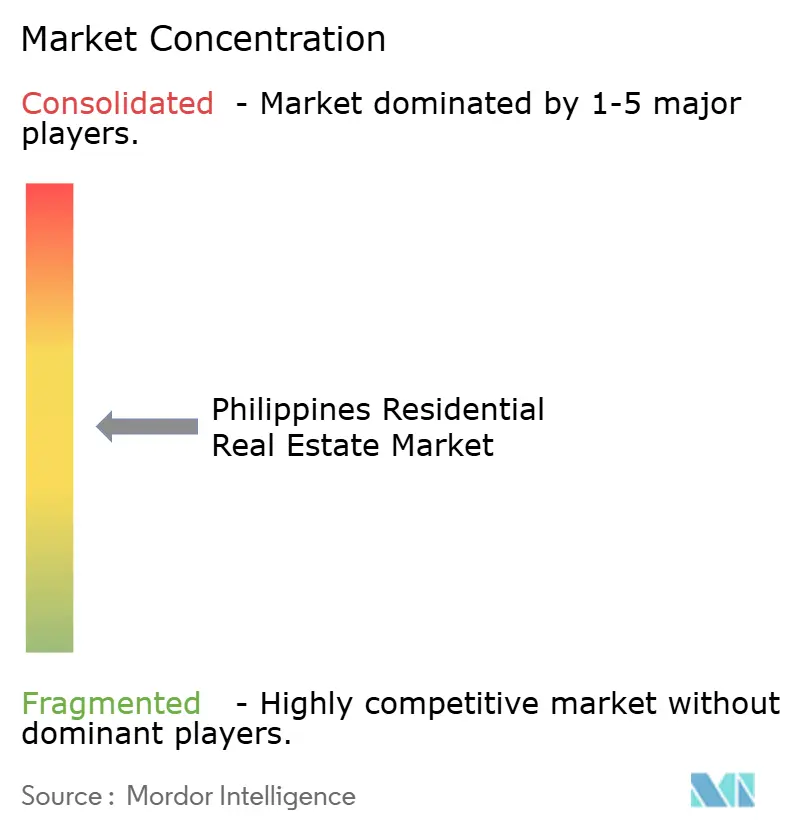
| Market Concentration | Medium |
Major Players *Disclaimer: Major Players sorted in no particular order Image © Mordor Intelligence. Reuse requires attribution under CC BY 4.0. | |
Philippines Residential Real Estate Market Analysis by Mordor Intelligence
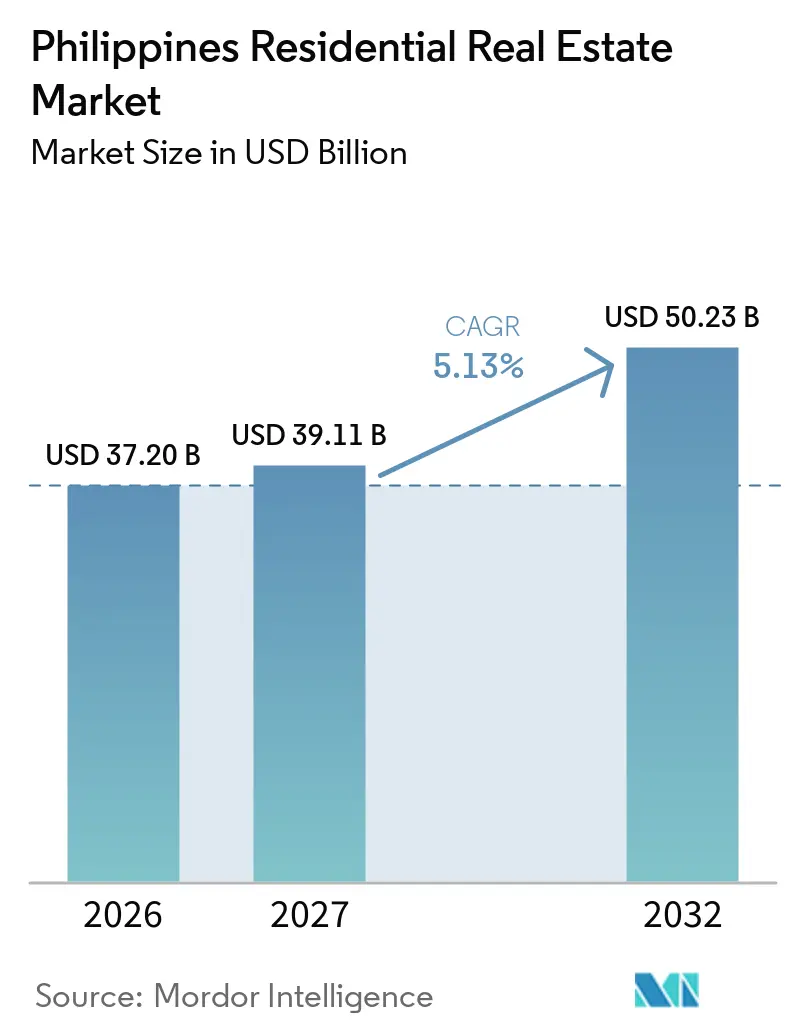
The Philippines Residential Real Estate Market size was valued at USD 37.20 billion in 2026 and is estimated to grow from USD 39.11 billion in 2027 to reach USD 50.23 billion by 2032, at a CAGR of 5.13% during the forecast period (2027-2032).
Government housing delivery and mortgage support are moving more demand toward socialized and economic homes. The Philippines residential real estate market is also being reshaped by new transport links and employment growth outside Metro Manila. This creates stronger opportunities for developers with provincial land, attainable products, and access to housing finance. At the same time, weaker purchasing power and unsold condominium stock in parts of Metro Manila limit the pace of recovery in the middle-income segment. The Philippines residential real estate market therefore has different conditions across location, price point, and property format.
Key Report Takeaways
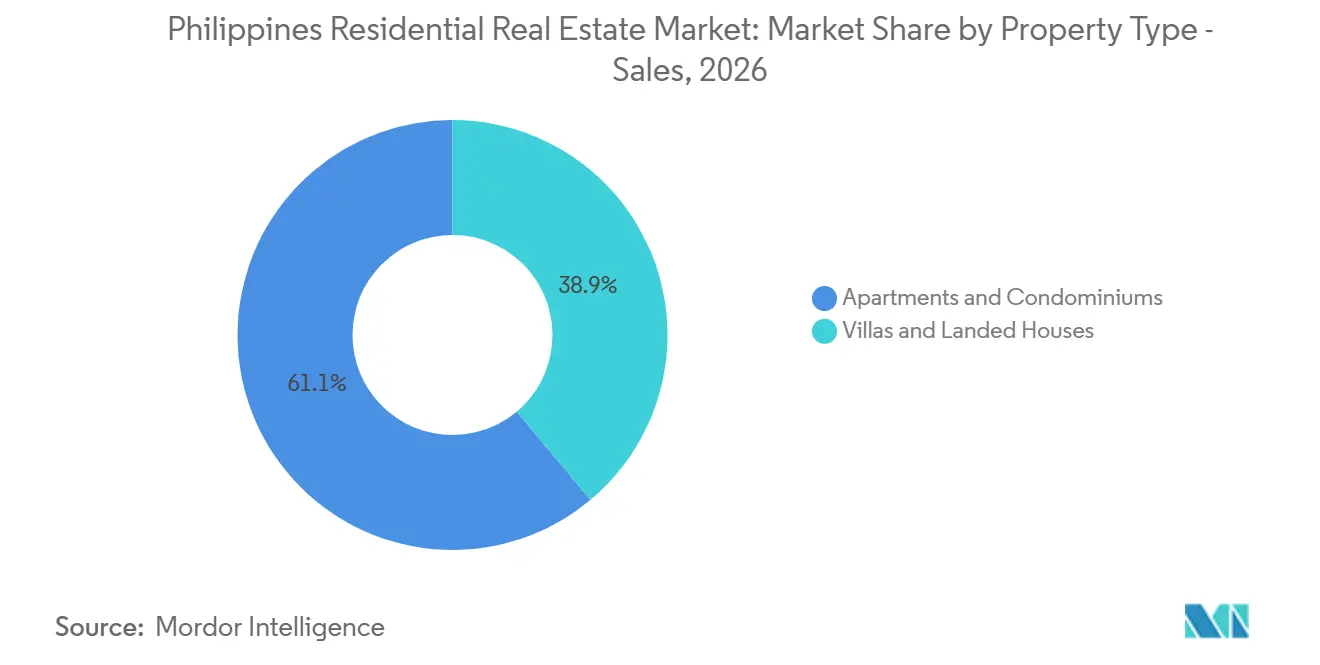
- By property type in sales, Apartments and Condominiums held 61.1% of the Philippines residential real estate market share in 2026, while Villas and Landed Houses are projected to grow at a 5.95% CAGR through 2032.
- By price band in sales, Mid-Market held 41.1% of the Philippines residential real estate market share in 2026, while Affordable is projected to grow at a 6.11% CAGR through 2032.
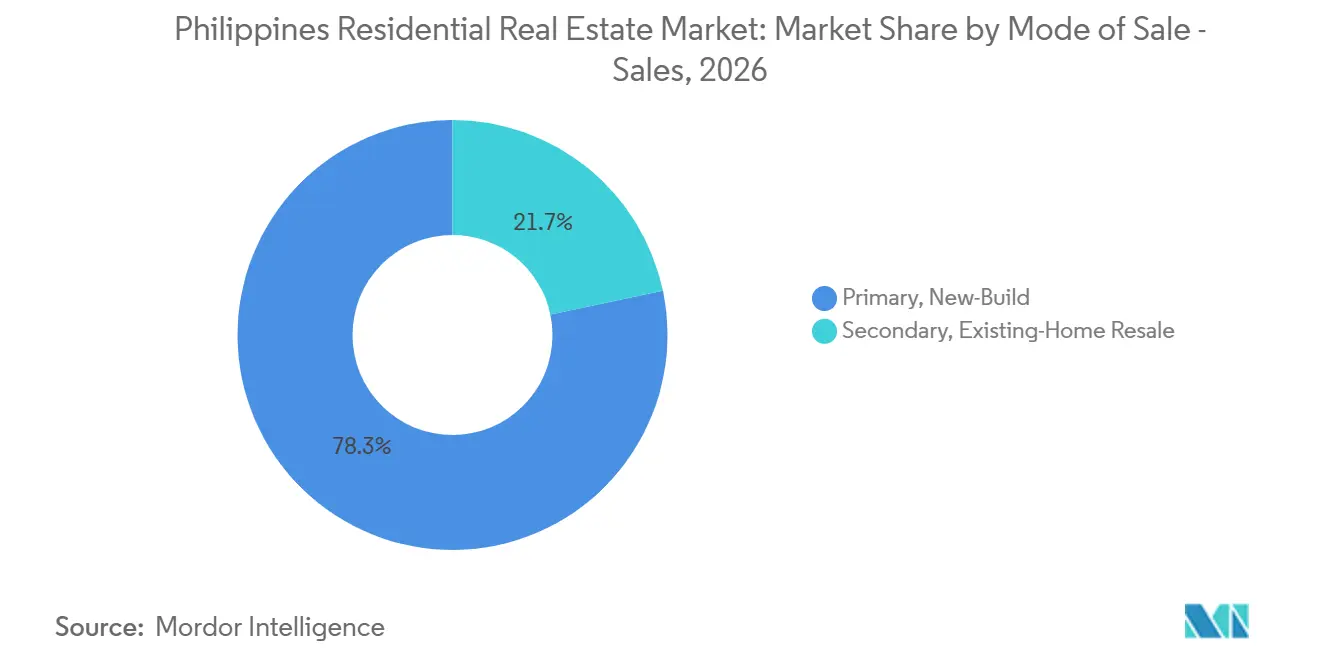
- By mode of sale in sales, Primary New-Build held 78.3% of the Philippines residential real estate market share in 2026, while Secondary Existing-Home Resale is projected to grow at a 6.21% CAGR through 2032.
- By key region in sales, National Capital Region (NCR) Metro Manila held 34.5% of the Philippines residential real estate market share in 2026, while Central Luzon is projected to grow at a 6.67% CAGR through 2032.
- By property type in rentals, Apartments and Condominiums held 76.7% of the Philippines residential real estate market share in 2026, while Villas and Landed Houses are projected to grow at a 5.91% CAGR through 2032.
Note: Market numbers in this report are based on Mordor Intelligence's proprietary estimation framework, which combines nine months of actuals with Q4 projections for base year 2026.
Market Trends and Insights
Drivers Impact Analysis of Philippines Residential Real Estate Market*
| Drivers | (~) % Impact on CAGR Forecast | Geographic Relevance | Impact Timeline |
|---|---|---|---|
| Expanded 4PH Support for Affordable Housing | +1.1% | National, with delivery focused in NCR, Bulacan, Pampanga, Laguna, Batangas, Cavite, and Tarlac | Short term (≤ 2 years) |
| Pag-IBIG Mortgage Access | +0.9% | National, especially socialized and economic housing areas in NCR and Luzon growth corridors | Short term (≤ 2 years) |
| Transport Infrastructure and Suburban Connectivity | +0.8% | Central Luzon, Calabarzon, Ninoy Aquino International Airport environs, fringe NCR, Metro Cebu, and Davao | Medium term (2-4 years) |
| Provincial Employment Hub Expansion | +0.7% | Central Luzon, Calabarzon, Metro Cebu, and Davao | Medium term (2-4 years) |
| Overseas Filipino Remittances Supporting Household Housing Investment | +0.6% | National, especially Cavite, Laguna, Batangas, Central Luzon, Cebu, Davao, and Iloilo | Short term (≤ 2 years) |
| Tourism Supporting Leisure-Oriented Residential Demand | +0.4% | Batangas, Palawan, Boracay, Bohol, Siargao, Tagaytay, and Cebu | Long-term (≥ 4 years) |
| Source: Mordor Intelligence | |||
Government-Backed Expanded 4PH Program Reshaping Affordable Housing Supply.
The Expanded Pambansang Pabahay para sa Pilipino Program is directing public and private activity toward socialized housing. The Department of Human Settlements and Urban Development reported 135,758 delivered units under Expanded 4PH modalities as of October 2026, and the program targets 200,000 units during 2026. More than 500,000 homes have been built or financed since the program began, based on the 2026 State of the Nation Address. Developers including Megawide, Filinvest Land, Amaia, Avida, and SMDC are part of the wider delivery pipeline described in the supplied research. The proposed USD 19.3 million budget for 2027, compared with USD 603,400 in 2026, signals continued policy support for housing delivery[1].
Pag-IBIG Fund Mortgage Expansion Widening the Borrower Base
Pag-IBIG mortgage programs are supporting the Philippines residential real estate market by widening access to formal housing finance. Housing loan releases reached USD 2.4 billion in 2025, compared with USD 2.2 billion in 2024. Housing and wholesale loan releases reached USD 1.5 billion from January through July 2026, a 12% year-on-year increase, while gross housing-related assets exceeded USD 17.4 billion in July. The fund raised the maximum housing loan to USD 172,400 per borrower and offered subsidized rates for socialized housing. Socialized housing loans rose 118% in value and 132% in unit count during the first half of 2026, which supports demand at the entry level.
Infrastructure Development Anchoring Suburban Residential Demand
Transport investment is expanding the set of locations that can serve workers linked to Metro Manila[2]. The Build Better More program included 207 approved Infrastructure Flagship Projects valued at USD 178 billion as of April 2025. The Manila-Clark section of the North-South Commuter Railway was 65% complete in 2026 and is expected to reduce north-south travel from more than 3 hours by road to less than 1 hour by rail. CALAX, CLLEX, and the planned New Manila International Airport are also improving the investment case for residential projects outside the capital. The Philippines residential real estate market can therefore gain from demand in connected suburban corridors rather than only from the core capital region.
Provincial Employment Hub Expansion Generating Sustained Housing Demand
Employment growth outside Metro Manila is broadening the base for owner-occupied homes in provincial centers. Pampanga ended 2025 with 538,000 square meters of office stock and 49,000 square meters of net take-up, while its vacancy rate improved to 16.8% from 24.6% in 2024. Clark Freeport Zone and surrounding industrial areas are attracting employers that can create durable local housing needs. The supplied research identifies demand from local workers in the USD 51,700 to USD 120,700 range as an important part of this activity. Developers including Ayala Land, Megaworld, Rockwell Land, SMDC, and Vista Land have established a presence in Central Luzon.
Restraints Impact Analysis of Philippines Residential Real Estate Market*
| Restraints | (~) % Impact on CAGR Forecast | Geographic Relevance | Impact Timeline |
|---|---|---|---|
| Metro Manila Condominium Inventory Overhang | -1.0% | NCR Metro Manila, especially Bay Area, Quezon City, and Parañaque, with secondary effects in Calabarzon | Short term (≤ 2 years) |
| Household Purchasing Power and Financing Costs | -0.8% | National, most acute for mid-income buyers in NCR and large urban centers | Medium term (2-4 years) |
| Rising Construction and Development Costs | -0.5% | National, with the greatest pressure in NCR and Calabarzon | Medium term (2-4 years) |
| Soft Rental Yields in Selected Condominium Submarkets | -0.3% | NCR Metro Manila Bay Area, Quezon City, Parañaque, Pasay, Bonifacio Global City, and Makati | Short term (≤ 2 years) |
| Source: Mordor Intelligence | |||
Metro Manila Condominium Inventory Overhang Constraining Recovery
Unsold condominium inventory in Metro Manila remains a major constraint on the Philippines residential real estate market. The supplied research recorded 82,900 unsold units in the second quarter of 2026, including 32,600 ready-for-occupancy homes. The lower mid-income and affordable tiers hold a large part of this ready inventory, concentrated in Quezon City, Manila, Pasig, and Parañaque. Premium homes in Bonifacio Global City and Makati have recovered more strongly than other condominium locations. This uneven pattern limits new launches and can keep pressure on developer cash flow in the affected districts.
Household Purchasing Power Constraints and Financing Cost Pressures
Household purchasing power is limiting demand in the middle-income housing range[3]. The Residential Property Price Index showed 0.4% year-on-year residential price growth in the second quarter of 2026. The policy rate reached 4.75% after a 25-basis-point increase in June 2026, while commercial bank home-loan rates ranged from 6.25% to 8.0%. Tighter credit standards and weaker loan demand have reduced the number of buyers who can obtain financing. The Philippines residential real estate market remains more accessible to households that qualify for subsidized programs than to buyers using standard bank financing.
*Our forecasts treat driver/restraint impacts as directional, not additive. The impact forecasts reflect baseline growth, mix effects, and variable interactions.
Philippines Residential Real Estate Market Segment Analysis
By Property Type in Sales:
Condominiums Lead and Landed Homes Build MomentumApartments and Condominiums held 61.1% of the Philippines residential real estate market share for sales in 2026. Their position reflects the large number of vertical projects in Metro Manila and the role of apartments in private and public housing delivery. Developers continue to use condominiums to serve locations where land is scarce, and employment density is high. The segment also benefits from the established pre-selling model used in large urban projects. Yet the concentration of supply in some capital districts has slowed sales absorption. This makes the format important to the Philippines residential real estate market, while also exposing it to the effects of unsold inventory.
Villas and Landed Houses are the fastest-growing sales format, with a projected 5.95% CAGR through 2032. House-and-lot take-up reached 89% in Pampanga, 94% in Bulacan, and 88% in Tarlac at the end of 2025. Lower-density living, improved road access, and provincial development are supporting this demand. Homes in these locations can also better match the needs of family households. Economic and affordable condominiums priced from USD 31,000 to USD 61,900 represented 67% of Metro Manila condominium take-up in the first half of 2026. The mix shows that attainable housing remains central even as buyers increasingly consider landed options.
By Price Band in Sales:
Mid-Market Holds Scale and Affordable Homes AccelerateMid-Market represented 41.1% of residential sales value in 2026. The segment covers homes priced from USD 62,100 to USD 206,900 in the supplied research. It has established developer pipelines, mature secondary demand, and land positions in established locations. These features support its current scale within the Philippines residential real estate market. However, higher borrowing costs and the condominium overhang weigh on absorption. Buyers in this range are especially exposed to financing conditions because they are more likely to rely on conventional bank loans.
Affordable housing is projected to record a 6.11% CAGR through 2032. Expanded 4PH is increasing the supply and financing focus for homes below USD 62,100. The December 2025 rules set maximum selling prices of PHP 950,000 for socialized horizontal housing and PHP1.8 million for socialized condominium developments, subject to applicable specifications. Provincial land costs can improve the feasibility of supplying homes at this lower price level. The 99-year land-lease law signed in September 2025 may create a further buyer pool for luxury homes. This leaves the Philippines residential real estate market with demand drivers at both the lower end and selected premium locations.
By Mode of Sale in Sales:
New-Build Leads and Resale Gains WeightPrimary New-Build accounted for 78.3% of sales in 2026. The format is supported by a pre-selling system where buyers often commit 2 to 4 years before completion. Installment payments can make purchases possible before a home is delivered. This approach also makes developers dependent on buyer confidence at the time of launch. The supplied research states that 77.6% of residential real estate loans in the first quarter of 2026 financed new housing. Primary sales therefore remain central to the Philippines residential real estate market and its developer funding model.
Secondary Existing-Home Resale is projected to grow at a 6.21% CAGR through 2032. Completed stock gives buyers an alternative when new projects are not affordable. Resale homes can also offer immediate occupancy, which matters to end users and relocating households. Secondary sales cover previously owned homes resold by existing owners; completed units sold for the first time by developers remain within Primary New-Build. This may improve market liquidity as the number of completed homes grows. A deeper resale channel can reduce dependence on pre-selling without eliminating the importance of new development.
By Property Type in Rental:
Condominiums Anchor Supply and Landed Homes GrowApartments and Condominiums accounted for 76.7% of the rental segment in 2026. The share reflects the concentration of formal condominium stock in Metro Manila, Cebu City, and other large urban centers. These locations have the most established tenant base and the greatest stock of professionally managed units. Small apartment formats remain relevant for workers and smaller households. Some condominium districts, however, face vacancy and weaker investor demand. The rental structure of the Philippines residential real estate market is therefore still centered on urban vertical housing.
Villas and Landed Houses are projected to grow at a 5.91% CAGR through 2032. Hybrid work supports interest in larger living areas outside dense urban centers. Returning overseas Filipino worker households and expatriate families can also favor family-sized rental homes. Provincial cities and suburban corridors need adequate jobs and services for this demand to deepen. Greater availability of larger rental homes would make tenant options more varied. The change is gradual, but it gives the rental sector a broader base beyond apartments and condominiums.
Geography Analysis
NCR Metro Manila held 34.5% of sales value in 2026, the largest regional position in the Philippines residential real estate market. The region remains the country's main employment and residential center. Economic and affordable condominiums support activity in parts of the capital. Premium landed communities in Alabang, Parañaque, and fringe Taguig serve a different buyer group. Mid-market condominium districts in Quezon City, Pasig, and Parañaque continue to face slower absorption. The Residential Property Price Index recorded 6% condominium price growth in NCR in the second quarter of 2026.
Central Luzon is set to expand at a 6.67% CAGR through 2032, the fastest regional rate in the supplied research. Clark Freeport Zone attracted USD 1.3 billion in new investments in the cited reporting year. The Manila-Clark rail project can make Malolos, San Fernando, Angeles, and Tarlac City more practical residential locations for workers. Pampanga and Bulacan recorded residential take-up between 82% and 86% at the end of 2025. Central Luzon received USD 570.3 million in approved foreign capital in the first quarter of 2026, or 77.6% of the national approved total. This investment base can support housing demand through direct jobs and related services.
Calabarzon benefits from its role as the most direct residential overflow area for Metro Manila. CALAX, the LRT-1 extension, and existing expressways improve access across Cavite, Laguna, and Batangas. Southern Luzon house-and-lot take-up reached 94% in mid-2025. Metro Cebu and Davao also have growing development commitments from national developers. Ayala Land began the Ascenda estate in Davao in October 2025, with planned investment of USD 177.6 million. Cebu Landmasters acquired a 78.8-hectare site in Liloan for an integrated township in September 2025.
Competitive Landscape
The Philippines residential real estate market is moderately concentrated in premium and mid-market development. Ayala Land, SM Development Corporation, and Megaworld have broad land banks, strong brands, and wide operating footprints. Their scale supports large projects across multiple cities and price ranges. Affordable and provincial development is more fragmented. 8990 Holdings, Ovialand, Suntrust Properties, and Property Company of Friends compete with Amaia and SMDC's attainable-housing lines. This split means national groups lead in scale, while regional specialists can compete in local housing niches.
Real estate investment trust (REIT) structures strengthen the ability of major groups to recycle capital. AREIT and MREIT allow their sponsoring groups to monetize commercial assets and redeploy capital into development. MREIT received Securities and Exchange Commission approval for a USD 465.7 million Wave 5 property-for-share transaction in September 2026. The transaction involved 12 income-generating assets with 303,936 square meters of gross leasable area. This type of capital management provides an advantage to companies that control sizable income-producing properties. Smaller developers are less able to replicate this funding approach at the same scale.
Japanese partnerships are also bringing new design and sustainability standards into selected projects. Arthaland and Mitsui Fudosan entered a joint venture in February 2026 for the 37-story Sondris condominium in Makati. Cebu Landmasters also partnered with NTT UD Asia on a residential and retail project in Pasig. Such partnerships can help provincial developers build recognition in a broader national market. The clearest opening remains mid-market landed housing in smaller Visayas and Mindanao cities, where land economics can support accessible projects.
Philippines Residential Real Estate Industry Leaders
-
Ayala Land, Inc.
-
SM Development Corporation
-
Megaworld Corporation
-
Filinvest Land, Inc.
-
Robinsons Land Corporation
- *Disclaimer: Major Players sorted in no particular order
Philippines Residential Real Estate Market Companies Covered in this Report
- Ayala Land, Inc.
- SM Development Corporation
- Megaworld Corporation
- Filinvest Land, Inc.
- Robinsons Land Corporation
- DMCI Homes
- Vista Land and Lifescapes, Inc.
- Century Properties Group Inc.
- Rockwell Land Corporation
- Shang Properties, Inc.
- Federal Land, Inc.
- Cebu Landmasters, Inc.
- Arthaland Corporation
- 8990 Holdings, Inc.
- Ovialand, Inc.
- Sta. Lucia Land, Inc.
- Empire East Land Holdings, Inc.
- Suntrust Properties, Inc.
- Property Company of Friends, Inc.
- Phirst Park Homes, Inc.
Recent Industry Developments in Philippines Residential Real Estate Market
- September 2026: The Securities and Exchange Commission approved the merger of Century Properties Group Inc. and PHirst Park Homes Inc., with Century Properties Group as the surviving entity.
- August 2026: Ayala Land Inc. raised its capital expenditure budget to USD 1.0 billion from USD 862.1 million to support the completion of strategic residential and leasing projects. Ayala Land announced its first residential project launch in the Cresendo estate in Tarlac, targeting buyers near major infrastructure projects including the Cavite-Laguna Expressway (CALAX), the Subic-Clark-Tarlac Expressway (SCTEX) Luisita Extension, and the upcoming North-South Commuter Railway (NSCR).
- June 2026: President Marcos highlighted that more than 500,000 homes have been built or financed under the Expanded 4PH Programme during his 2026 State of the Nation Address. Pag-IBIG Fund's gross housing-related assets surpassed USD 17.4 billion as of July 2026, and the fund's housing and wholesale loan releases grew 12% year on year to USD 1.5 billion from January to July 2026.
Philippines Residential Real Estate Market Report Scope
Segmentation Overview
| Apartments and Condominiums |
| Villas and Landed Houses |
| By Property Type | Apartments and Condominiums |
| Villas and Landed Houses |
Key Questions Answered in the Report
What is the forecast for residential real estate in the Philippines?
The Philippines residential real estate market is projected to reach USD 50.23 billion by 2032, expanding at a 5.13% CAGR from 2027.
Which housing format has the largest share in the Philippines?
Apartments and Condominiums led sales with a 61.1% share in 2026.
Which price range is growing the fastest?
Affordable homes are projected to grow at a 6.11% CAGR through 2032.
Why is Central Luzon important for housing developers?
Central Luzon is forecast to grow at a 6.67% CAGR through 2032, supported by rail, industrial, and employment growth.
What is limiting condominium sales in Metro Manila?
High unsold condominium stock and tighter affordability conditions are reducing sales absorption in selected capital districts.
How is Pag-IBIG affecting home purchases?
Pag-IBIG expanded its maximum loan ceiling to USD 172,400 and continues to support buyers through subsidized housing finance.