
Personalized Orthopedic Implant Market Size and Share
Market Overview
| Study Period | 2021 - 2032 |
|---|---|
| Market Size (2027) | USD 9.04 Billion |
| Market Size (2032) | USD 14.08 Billion |
| Growth Rate (2027 - 2032) | 9.27 % |
| Fastest Growing Market | Asia-Pacific |
| Largest Market | North America |
| Market Concentration | Medium |
Major Players *Disclaimer: Major Players sorted in no particular order Image © Mordor Intelligence. Reuse requires attribution under CC BY 4.0. | |
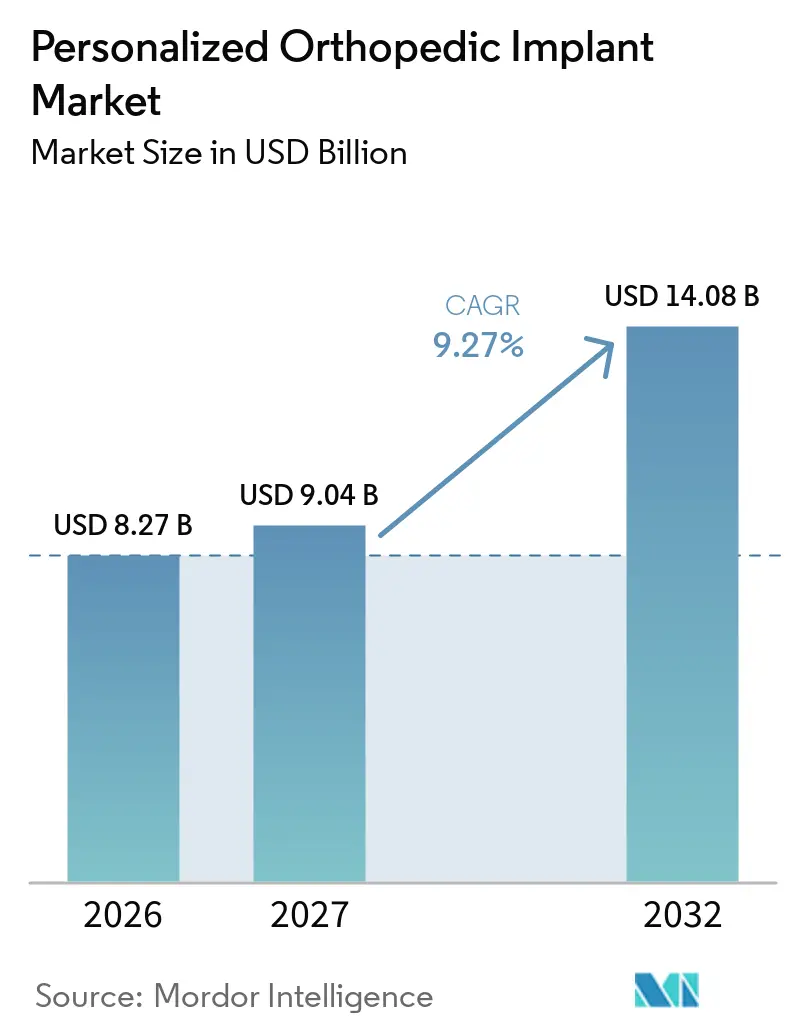
Personalized Orthopedic Implant Market Analysis by Mordor Intelligence
The Personalized Orthopedic Implant Market size is expected to increase from USD 8.27 billion in 2026 to USD 9.04 billion in 2027 and reach USD 14.08 billion by 2032, growing at a CAGR of 9.27% over 2027-2032.
Patient-matched designs are becoming more practical because computed tomography planning, additive manufacturing, and automated design tools can now support complex orthopedic procedures. The Personalized orthopedic implant market is supported by the growing number of revision procedures, where bone loss, infection, and altered anatomy can make standard implants unsuitable. Manufacturers are shifting from inventory-led supply toward digital workflows that create devices for a defined patient and procedure. This change creates opportunities for companies that can combine clinical evidence, regulated production, and reliable surgical planning. It also raises the importance of reimbursement policies and secure supplies of medical-grade materials.
Key Report Takeaways
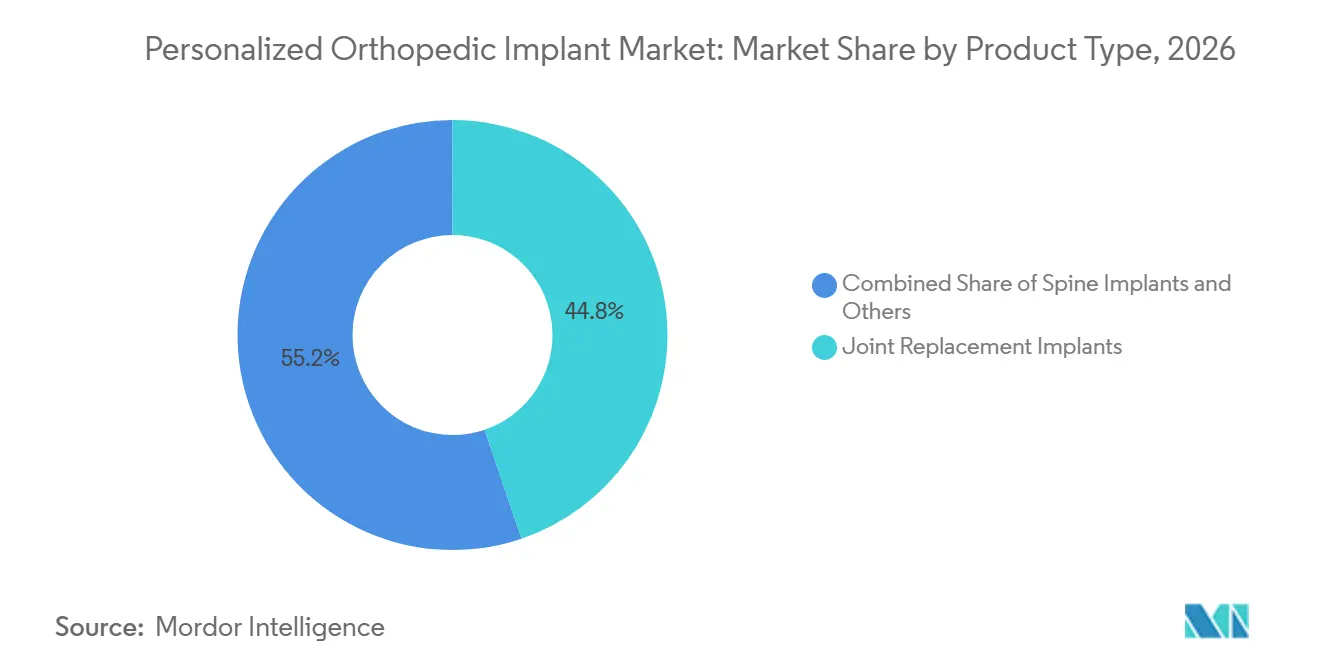
- By product type, joint replacement implants held 44.8% of the personalized orthopedic implant market share in 2026, while tumor and limb-salvage implants are forecast to expand at an 11.8% CAGR through 2032.
- By material, titanium and titanium alloys held 48.6% of the personalized orthopedic implant market share in 2026, while PEEK and PEKK are forecast to grow at a 12.4% CAGR through 2032.
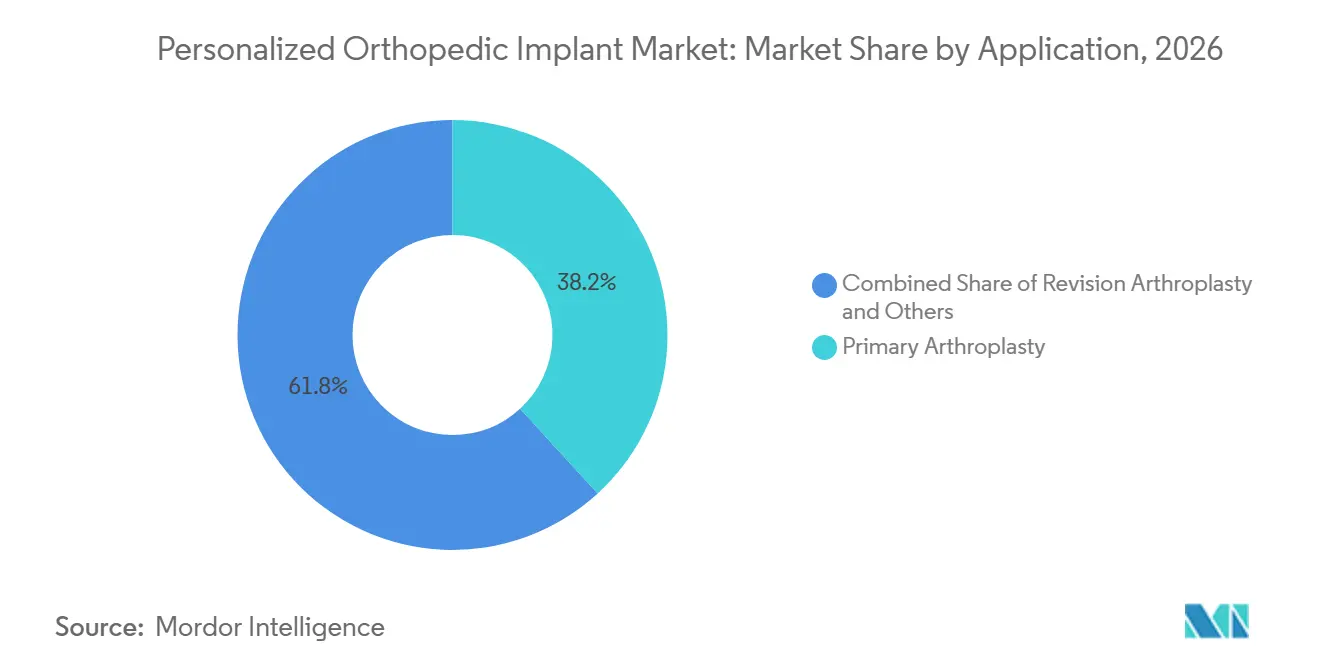
- By application, primary arthroplasty accounted for 38.2% of the personalized orthopedic implant market size in 2026, while complex bone loss and deformity reconstruction is forecast to grow at an 11.9% CAGR through 2032.
- By end user, hospitals held 72.4% revenue share of the personalized orthopedic implant market size in 2026, while orthopedic specialty clinics are forecast to expand at a 10.7% CAGR through 2032.
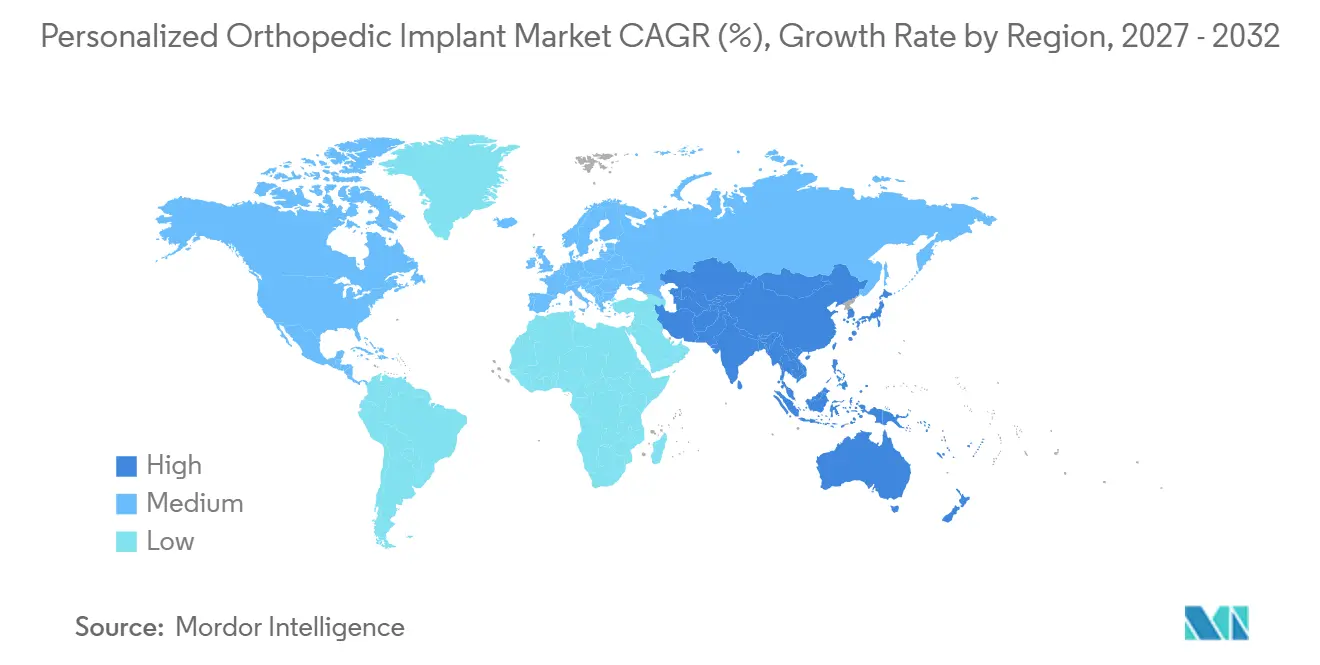
- By geography, North America held a 41.9% revenue share of the personalized orthopedic implant market size in 2026, while Asia-Pacific is forecast to grow at a 10.2% CAGR through 2032.
Note: Market numbers in this report are based on Mordor Intelligence's proprietary estimation framework, which combines nine months of actuals with Q4 projections for base year 2026.
Market Trends and Insights
Drivers Impact Analysis of Personalized Orthopedic Implant Market*
| Driver | (~) % Impact on CAGR Forecast | Geographic Relevance | Impact Timeline |
|---|---|---|---|
| Rising Burden of Complex Orthopedic Disease and Revision Procedures | +2.3% | Global, with concentration in North America and Western Europe | Medium term (2-4 years) |
| Advances in Medical Imaging, AI Planning, and Additive Manufacturing | +1.9% | Global, with early adoption in North America and Europe and rapid scaling in Asia-Pacific | Long term (≥ 4 years) |
| Shift Toward Minimally Invasive and Value-Based Orthopedic Care | +1.5% | North America and the EU, with spillover to Asia-Pacific and South America | Medium term (2-4 years) |
| Hospital and Surgeon Demand for Better Anatomical Fit and Surgical Precision | +1.0% | Global, focused on high-volume orthopedic centers in North America and Europe | Short term (≤ 2 years) |
| AI-Automated Design and Distributed Manufacturing Workflows | +1.2% | North America and Europe, with emerging activity in China and India | Long term (≥ 4 years) |
| Patient-Specific Porous Structures for Difficult Bone-Stock and Fixation Cases | +0.8% | Global, with strongest near-term demand in North America and the EU | Medium term (2-4 years) |
| Source: Mordor Intelligence | |||
Rising Burden of Complex Orthopedic Disease and Revision Procedures
Revision arthroplasty volumes are a direct source of demand for the Personalized orthopedic implant market. A 2025 study projected that revision total knee arthroplasty could reach 227,515 annual procedures by 2040, rising at 5.7% a year. Revision cases often involve impaired bone stock, altered biomechanics, and scarring from prior operations. These conditions increase the clinical value of an implant designed around the remaining anatomy. A 2025 registry review reported that revision hip and knee procedures cost 76% more than primary procedures, which increases pressure to avoid repeat intervention. The 2025 American Joint Replacement Registry also reported infection as the cause of 52% of revision total knee arthroplasty cases, compared with 31% in 2012.
Advances in Medical Imaging, AI Planning, and Additive Manufacturing
Automated imaging and design systems are reducing the time required to develop customized devices. A 2025 PLOS One study described an automated workflow that segmented knee anatomy, reconstructed bone geometry, and designed a patient-specific total knee implant in 15 minutes. Shorter design cycles can improve planning consistency and reduce the production premium associated with one-off manufacturing. Metal additive manufacturing also supports porous structures that can facilitate cementless fixation. The Personalized orthopedic implant market therefore depends increasingly on validated digital workflows rather than individual design effort alone. FDA quality system requirements and ISO 13485 remain important because manufacturers must document process control, traceability, and device quality[1].
Shift Toward Minimally Invasive and Value-Based Orthopedic Care
Outpatient migration is changing how orthopedic providers assess the value of personalized devices. Medicare-certified ambulatory surgical centers increased 2.5% to 6,308 facilities in 2023, and total knee arthroplasty volumes in ambulatory surgical centers grew 33% in that year. Procedures performed outside hospitals require predictable instruments, shorter operating room workflows, and clear preparation before surgery. Patient-specific instruments and sterile kits can support these needs when the clinical pathway is well defined. The Personalized orthopedic implant market may benefit when providers can show that tailored devices reduce procedural variation without creating a burdensome purchasing process. Reimbursement and evidence standards will still determine how far this shift extends into complex cases.
AI-Automated Design and Distributed Manufacturing Workflows
Digital manufacturing networks can link imaging data, implant design, production, and surgical preparation in a single workflow. Carlsmed reported that its aprevo system uses patient imaging and planning software to create personalized titanium interbody implants with procedure-specific instruments. CMS granted New Technology Add-On Payment authorization for eligible Aprevo cervical fusion procedures, with additional payment of up to USD 21,125 effective October 2025. This decision provides a reference point for reimbursement discussions in other personalized orthopedic categories. The Personalized orthopedic implant industry will require strong cybersecurity, device traceability, and production oversight as these connected workflows expand. Clinical adoption will depend on whether hospitals view the service as reliable across routine and difficult cases.
Restraints Impact Analysis of Personalized Orthopedic Implant Market*
| Restraint | (~) % Impact on CAGR Forecast | Geographic Relevance | Impact Timeline |
|---|---|---|---|
| High Capital and Process-Validation Costs | -1.2% | Global, with the greatest effect on mid-market and emerging-market manufacturers | Long term (≥ 4 years) |
| Fragmented Reimbursement and Uncertain Cost-Outcome Evidence | -1.0% | Global, particularly acute in the EU, Japan, and middle-income markets | Medium term (2-4 years) |
| Medical-Grade Titanium and Cobalt-Chrome Powder Supply Concentration | -0.7% | Global, with concentrated risk for manufacturers reliant on Russia- and China-sourced aerospace-grade sponge | Long term (≥ 4 years) |
| Limited Long-Term Survivorship Evidence for New Personalized Geometries | -0.5% | Global, with the strongest constraint on conservative hospital procurement committees | Long term (≥ 4 years) |
| Source: Mordor Intelligence | |||
High Capital and Process-Validation Costs
Medical implant production requires qualified equipment, documented powder controls, post-processing validation, and measurement of final dimensions. These activities are regulated under the FDA Quality Management System Regulation and ISO 13485 quality management requirements. A metal powder-bed fusion system suitable for medical-grade titanium can cost more than USD 1 million before cleanroom infrastructure and regulatory work are considered. Manufacturers also need to maintain traceability from raw material through the finished implant. The European Medical Device Regulation adds compliance work where the classification of industrially produced custom devices is uncertain. These requirements give established suppliers an advantage because they can spread fixed validation costs over larger device volumes.
Fragmented Reimbursement and Uncertain Cost-Outcome Evidence
Payers often reimburse personalized orthopedic devices through codes developed for standard implants. The resulting gap can transfer the device premium to a hospital or the patient. CMS authorization for Carlsmed's cervical Aprevo system shows that a separate reimbursement pathway is possible, but it does not apply automatically to joint replacement or extremity procedures. Procurement committees will continue to require comparative evidence on survivorship, complications, and total treatment cost. This favors initial use in revision, oncology, and deformity cases where standard options have clear limitations. It may limit broader adoption in elective procedures until longer-term registry data is available.
*Our forecasts treat driver/restraint impacts as directional, not additive. The impact forecasts reflect baseline growth, mix effects, and variable interactions.
Personalized Orthopedic Implant Market Segment Analysis
By Product Type:
Revision and Oncology Cases Support Premium PersonalizationJoint replacement implants held 44.80% of revenue in 2026, making them the largest product group in the Personalized orthopedic implant market. Primary total knee arthroplasty volume in Medicare data rose from 603,704 procedures in 2013 to more than 1.01 million in 2022, and was projected to reach 2.79 million annual procedures by 2040. This procedure base supports demand for customized knee, hip, and shoulder solutions. Patient matching is especially relevant in cases with bone loss, infection, or anatomy modified by prior surgery. Standard inventories may not provide the required fit in these cases. Spine implants also remain an important product category because alignment targets and vertebral anatomy vary substantially between patients.
Tumor and limb-salvage implants are forecast to grow at an 11.80% CAGR through 2032. These devices are used after tumor resection, where the reconstruction often must replace an irregular defect while restoring limb function. A 2025 case series described bone-prosthesis integration without aseptic loosening at a mean 35-month follow-up for customized 3D-printed metatarsal reconstructions. The product category also includes cranio-maxillofacial, trauma and fixation, and extremity implants. Each of these groups addresses anatomy where small differences can affect fixation and surgical access. Their adoption depends on surgeon experience, imaging quality, and the ability to provide a validated device within the clinical timeline. The Personalized orthopedic implant market gains value in these settings because a standard design can require greater intraoperative adjustment.

By Material:
Titanium Retains the Largest Position as Polymer Use ExpandsTitanium and titanium alloys held 48.60% of material revenue in 2026. Their position reflects established biocompatibility, a long record of clinical use, and compatibility with powder-bed fusion. The process can create porous lattice surfaces that support cementless fixation. A 2025 meta-analysis found that titanium-coated PEEK cages had higher early fusion rates at 6 months than uncoated PEEK cages. Titanium thus remains relevant in both fully metallic implants and hybrid designs. The Personalized orthopedic implant market also faces material sourcing risk because the European Commission lists titanium as a critical raw material.
PEEK and PEKK are forecast to grow at a 12.40% CAGR through 2032, the highest rate among material groups. Their radiolucency and elastic properties can be useful where imaging follow-up and stress distribution are important. Invibio and Maxx Orthopedics reported the first U.S. cases in an investigational study of a metal-free PEEK-OPTIMA femoral total knee component in 2025. A 2025 randomized trial also reported better functional scores for a PEEK knee group than for a cobalt-chromium-molybdenum group at 3 years. Cobalt-chrome alloys and stainless steel remain necessary for high-load trauma and revision uses. Ceramics, other polymers, and bioresorbable materials serve narrower roles in pediatric, coating, and specialized reconstruction applications[2].
By Application:
Complex Reconstruction Grows Faster Than Volume-Based Primary SurgeryPrimary arthroplasty accounted for 38.20% of the Personalized orthopedic implant market size in 2026. The category benefits from the large volume of elective hip, knee, and shoulder procedures. Osteoarthritis creates a substantial clinical base for joint replacement planning. Primary procedures also support investment in imaging software, planning systems, and regulated production capacity. Patient-specific components can be used when anatomy, alignment objectives, or bone quality create a need beyond standard sizing. Routine cases still require clear evidence that customization provides a practical benefit. This makes primary arthroplasty a volume foundation rather than the sole source of premium demand.
Complex bone loss and deformity reconstruction is forecast to grow at an 11.90% CAGR through 2032. It includes cases involving major bone deficits, post-tumor resection voids, and severe angular deformity. A 2025 study of patient-specific implants and 3D-printed drilling guides in multiplanar corrective osteotomies reported a median ante-recurvation error of 1.2°, compared with 43.8° using standard 3D-guided methods. Revision arthroplasty, orthopedic oncology and limb salvage, spinal fusion, congenital and pediatric conditions, sports injury reconstruction, and trauma reconstruction each require different planning pathways. These applications can benefit from a device designed around the defect rather than around standard inventory dimensions. Evidence from these procedures may influence wider adoption because they provide clear examples of personalization solving an otherwise difficult surgical problem.
By End User:
Specialty Clinics Gain Volume as Procedures Move Beyond HospitalsHospitals held 72.40% of revenue in 2026. Their share reflects the concentration of complex arthroplasty, oncology, and revision cases in tertiary inpatient settings. Hospitals can maintain the documentation, imaging access, and multidisciplinary review required for many personalized workflows. They also manage complications and patients with greater clinical acuity. The Personalized orthopedic implant market remains linked to hospital procurement because many patient-matched cases require coordinated preoperative planning. Hospital use will remain particularly important for tumor resection and extensive reconstruction. These facilities are also better positioned to meet device traceability and quality requirements.
Orthopedic specialty clinics are forecast to grow at a 10.70% CAGR through 2032. The rise of ambulatory surgical centers is expanding the setting for selected joint procedures. MedPAC reported that ambulatory surgical center total knee arthroplasty grew 33% in 2023. Compact, pre-navigated sterile kits can help clinics work with personalized implants without duplicating a hospital-level manufacturing infrastructure. Zimmer Biomet introduced ZBX as an ambulatory surgical center-focused offering at AAOS 2025. Specialty clinics will still need supplier support for imaging, case approval, delivery timing, and post-market documentation. Their growth is therefore tied to service models that simplify the path from scan to surgery.
Geography Analysis
North America
North America held 41.90% of revenue in 2026. The Personalized orthopedic implant market in the region combines high procedure volumes with established FDA pathways for additive-manufactured medical devices. Hospitals and ambulatory surgery centers also have substantial access to robotic systems and digital planning tools. Carlsmed received CMS New Technology Add-On Payment authorization for eligible cervical aprevo procedures, providing up to USD 21,125 in additional reimbursement from October 2025. The decision gives providers a defined payment reference for a patient-specific spine device. FDA quality system controls and ISO 13485 certification shape how manufacturers validate workflows and maintain device records. Canada and Mexico can benefit from hospital modernization and the clinical links between their orthopedic practices and U.S. treatment protocols[3].
Asia-Pacific
Asia-Pacific is forecast to grow at a 10.20% CAGR through 2032. The Personalized orthopedic implant market in the region is supported by a high procedure base. IQVIA reported that Asia accounted for 43% of global orthopedic procedure volume in 2025. Aging populations, wider access to surgery, and urban hospital development support the regional outlook. China is central to regional manufacturing and demand for personalized devices. Xi'an Sailong reported that a 3D-printed titanium alloy vertebral body developed with Wuhan Mindray Orthopedic received National Medical Products Administration Class III registration in 2025. Regulatory modernization and local production capacity can reduce lead times for patient-matched implants. Japan and South Korea add stable demand through mature hospital networks and quality systems aligned with international standards.
Europe, the Middle East and Africa, and South America
Europe holds a stable position through Germany, France, the United Kingdom, Italy, and Spain. 3D Systems and University Hospital Basel announced an MDR-compliant point-of-care 3D-printed PEEK facial implant in 2025, indicating how regulated decentralized production can develop in the region. The European Medical Device Regulation remains a key compliance factor, particularly for industrially produced devices described as custom-made. RWTH Aachen University is developing patient-specific bioresorbable zinc-magnesium alloy implants, which could support future pediatric and critical bone-defect applications. The Middle East and Africa is emerging through healthcare investment in GCC countries, especially in advanced hospital services. South America is gaining relevance through orthopedic centers in Brazil and Argentina, although reimbursement fragmentation limits broader access. The Personalized orthopedic implant market size in these mixed regions will depend on whether local production, regulatory clarity, and coverage policy advance together.
Competitive Landscape
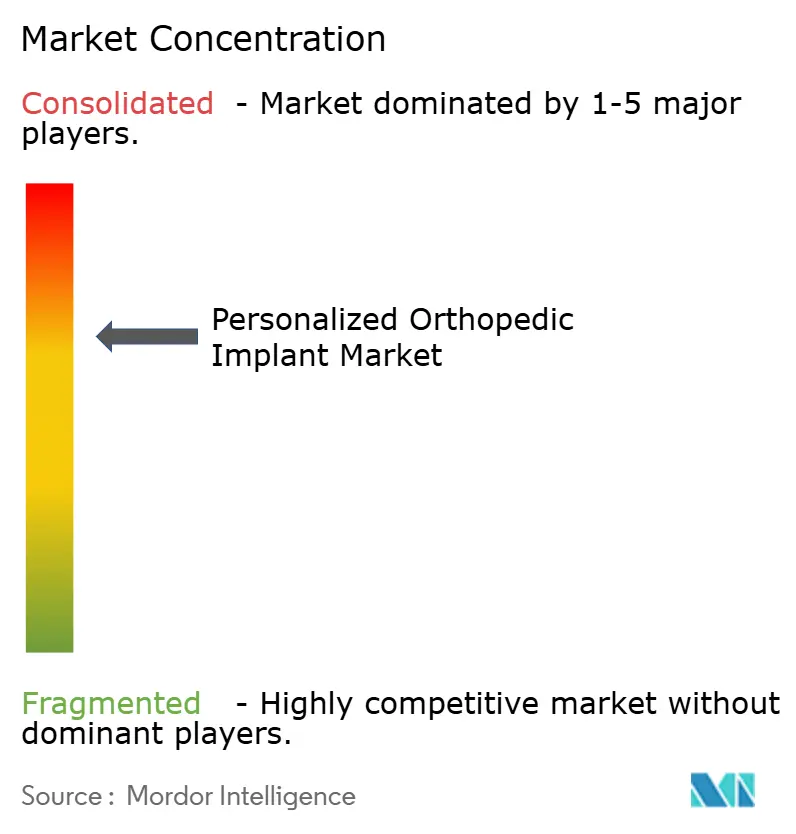
The personalized orthopedic implant market is moderately concentrated among major orthopedic manufacturers, while specialized companies compete in defined clinical niches. Stryker, Zimmer Biomet, and Johnson & Johnson MedTech have established portfolios, surgeon relationships, and distribution capacity. Their robotics, planning platforms, and porous implant technologies give them a strong base for incorporating personalized features. Zimmer Biomet announced plans to acquire Monogram Orthopedics in 2025 for an equity value of USD 177 million, expanding its access to robotics-integrated personalized implant capabilities. This move indicates that large manufacturers view patient-matched design as a capability that can be acquired as well as developed internally. The Personalized orthopedic implant market also includes companies focused on personalized spine, tumor, and complex reconstruction procedures.
Large manufacturers are embedding patient-matched tools into mainstream product lines. Zimmer Biomet highlighted the Persona OsseoTi Keel Tibia, a cementless component with a 3D-printed porous tray, alongside its ambulatory surgery center-focused ZBX offering. Carlsmed commercially launched its aprevo platform for cervical fusion surgeries in December 2025, extending its personalized spine platform beyond lumbar procedures. These actions show competition moving across implant design, planning software, instruments, and reimbursement support. The personalized orthopedic implant market increasingly rewards integrated service pathways. The companies that can reduce planning friction may have an advantage in outpatient and hospital settings. FDA controls, ISO 13485 certification, and ISO 10993 biocompatibility assessment remain meaningful barriers for less established entrants.
Specialist companies can compete where speed, fixation design, or infection control matter more than broad purchasing scale. Onkos Surgical focuses on complex revision and tumor reconstruction, while restor3d and Carlsmed focus on patient-matched orthopedic and spine pathways. Materialise has also developed patient-specific guides and implants, illustrating the role of software-led production expertise in this field. Companies must continue to show clinical performance because procurement committees place high value on survivorship and revision outcomes. They must also manage powder quality, manufacturing validation, and delivery reliability as part of the clinical offering. The Personalized orthopedic implant market favors companies that can connect surgical evidence with regulated operations.
Personalized Orthopedic Implant Industry Leaders
-
Conformis Inc.
-
Zimmer Biomet Holdings Inc.
-
Johnson & Johnson MedTech (DePuy Synthes)
-
Medacta International SA
-
restor3d Inc.
- *Disclaimer: Major Players sorted in no particular order
Personalized Orthopedic Implant Market Companies Covered in this Report
- 3D Systems
- Additive Orthopaedics LLC
- ALLUMIN8 Inc.
- Axial3D
- Carlsmed Inc.
- Conformis Inc.
- Enovis Corporation
- Exactech
- Globus Medical
- Johnson & Johnson MedTech (DePuy Synthes)
- LimaCorporate SpA
- Materialise
- Maxx Orthopedics Inc.
- Medacta International SA
- MedCAD Inc.
- Medtronic
- Monogram Orthopaedics Inc.
- Onkos Surgical Inc.
- Oxford Performance Materials Inc.
- Pixee Medical
- restor3d Inc.
- Smith+Nephew PLC
- Stryker
- Tangible Solutions Inc.
- Zimmer Biomet
Recent Industry Developments in Personalized Orthopedic Implant Market
- September 2026: restor3d, a key player in personalized 3D-printed orthopedic solutions, announced the launch of the MyFit by restor3d Digital Suite. This new patient engagement ecosystem is designed to give patients greater visibility into their personalized orthopedic journey while facilitating seamless connectivity among patients, surgeons, and long-term clinical outcomes.
- December 2025: Carlsmed Inc. commercially launched its Aprevo Technology Platform for cervical fusion surgeries at the Cervical Spine Research Society 53rd Annual Meeting, expanding from lumbar to cervical indications. The 3D-printed, AI-planned patient-specific cervical interbody system builds on a lumbar platform that has demonstrated lower complication and revision rates than standard stock implants. Early clinical data presented at CSRS showed efficient workflow integration and improved sagittal and coronal alignment relative to stock implants.
Global Personalized Orthopedic Implant Market Report Scope
As per the scope of the report, personalized orthopedic implants are patient-specific implantable devices designed using an individual patient's anatomical, biomechanical, and clinical data to optimize fit, functionality, and surgical outcomes. These implants are typically developed using advanced imaging technologies, computer-aided design (CAD), artificial intelligence-driven planning tools, and additive manufacturing (3D printing) techniques.
The personalized orthopedic implant market is segmented by product type into joint replacement implants, spine implants, trauma and fixation implants, extremity implants, tumor and limb-salvage implants, and cranio-maxillofacial implants; by material into titanium and titanium alloys, cobalt-chrome alloys, stainless steel, PEEK and PEKK, ceramics, polymer and composite materials, bio-resorbable materials, and others; by application into primary arthroplasty, revision arthroplasty, complex bone loss and deformity reconstruction, trauma and fracture reconstruction, orthopedic oncology and limb salvage, congenital and pediatric orthopedic conditions, sports injury reconstruction, spinal fusion and motion-preservation surgery, and other applications; by end user into hospitals, ambulatory surgical centers, orthopedic specialty clinics, and other end users; and by geography into North America, Europe, Asia-Pacific, Middle East and Africa, and South America. The market report also covers the estimated market sizes and trends for 17 countries across major regions globally. For each segment, the market size and forecast are provided in terms of value (USD).
Segmentation Overview
| Joint Replacement Implants | Hip Implants |
| Knee Implants | |
| Shoulder Implants | |
| Ankle Implants | |
| Temporomandibular Joint Implants | |
| Spine Implants | |
| Trauma and Fixation Implants | Plates |
| Screws | |
| Nails | |
| Patient-Specific Guides and Cutting Instruments | |
| Extremity Implants | Foot and Ankle Implants |
| Hand and Wrist Implants | |
| Digit Implants | |
| Tumor and Limb-Salvage Implants | |
| Cranio-Maxillofacial Implants |
| Titanium and Titanium Alloys |
| Cobalt-Chrome Alloys |
| Stainless Steel |
| PEEK and PEKK |
| Ceramics |
| Polymer and Composite Materials |
| Bio-Resorbable Materials |
| Others |
| Primary Arthroplasty |
| Revision Arthroplasty |
| Complex Bone Loss and Deformity Reconstruction |
| Trauma and Fracture Reconstruction |
| Orthopedic Oncology and Limb Salvage |
| Congenital and Pediatric Orthopedic Conditions |
| Sports Injury Reconstruction |
| Spinal Fusion and Motion-Preservation Surgery |
| Others |
| Hospitals |
| Ambulatory Surgical Centers |
| Orthopedic Specialty Clinics |
| Others |
| North America | United States |
| Canada | |
| Mexico | |
| Europe | Germany |
| United Kingdom | |
| France | |
| Italy | |
| Spain | |
| Rest of Europe | |
| Asia-Pacific | China |
| Japan | |
| India | |
| Australia | |
| South Korea | |
| Rest of Asia-Pacific | |
| Middle East and Africa | GCC |
| South Africa | |
| Rest of Middle East and Africa | |
| South America | Brazil |
| Argentina | |
| Rest of South America |
| By Product Type | Joint Replacement Implants | Hip Implants |
| Knee Implants | ||
| Shoulder Implants | ||
| Ankle Implants | ||
| Temporomandibular Joint Implants | ||
| Spine Implants | ||
| Trauma and Fixation Implants | Plates | |
| Screws | ||
| Nails | ||
| Patient-Specific Guides and Cutting Instruments | ||
| Extremity Implants | Foot and Ankle Implants | |
| Hand and Wrist Implants | ||
| Digit Implants | ||
| Tumor and Limb-Salvage Implants | ||
| Cranio-Maxillofacial Implants | ||
| By Material | Titanium and Titanium Alloys | |
| Cobalt-Chrome Alloys | ||
| Stainless Steel | ||
| PEEK and PEKK | ||
| Ceramics | ||
| Polymer and Composite Materials | ||
| Bio-Resorbable Materials | ||
| Others | ||
| By Application | Primary Arthroplasty | |
| Revision Arthroplasty | ||
| Complex Bone Loss and Deformity Reconstruction | ||
| Trauma and Fracture Reconstruction | ||
| Orthopedic Oncology and Limb Salvage | ||
| Congenital and Pediatric Orthopedic Conditions | ||
| Sports Injury Reconstruction | ||
| Spinal Fusion and Motion-Preservation Surgery | ||
| Others | ||
| By End User | Hospitals | |
| Ambulatory Surgical Centers | ||
| Orthopedic Specialty Clinics | ||
| Others | ||
| By Geography | North America | United States |
| Canada | ||
| Mexico | ||
| Europe | Germany | |
| United Kingdom | ||
| France | ||
| Italy | ||
| Spain | ||
| Rest of Europe | ||
| Asia-Pacific | China | |
| Japan | ||
| India | ||
| Australia | ||
| South Korea | ||
| Rest of Asia-Pacific | ||
| Middle East and Africa | GCC | |
| South Africa | ||
| Rest of Middle East and Africa | ||
| South America | Brazil | |
| Argentina | ||
| Rest of South America | ||
Key Questions Answered in the Report
What is driving demand for personalized orthopedic implants?
Revision procedures, complex bone loss, infection-related failures, and the wider use of digital planning are supporting demand for patient-matched devices.
How large is the Personalized orthopedic implant market?
The Personalized orthopedic implant market is valued at USD 8.27 billion in 2026 and is projected to reach USD 14.08 billion by 2032 at a 9.30% CAGR.
Which product category holds the largest revenue share?
Joint replacement implants hold 44.80% of revenue in 2026, supported by the large base of primary hip, knee, and shoulder procedures.
Which material is growing fastest for customized orthopedic devices?
PEEK and PEKK are forecast to grow at a 12.40% CAGR through 2032, supported by radiolucency and material properties relevant to orthopedic reconstruction.
Why do hospitals remain the leading end users?
Hospitals hold 72.40% of revenue because they manage many complex revision, oncology, and inpatient reconstruction procedures.
Which region is growing fastest for personalized orthopedic devices?
Asia-Pacific is forecast to expand at a 10.20% CAGR through 2032, supported by procedure volume, aging populations, access to surgery, and manufacturing development.