
Personal Loan Market Size and Share
Market Overview
| Study Period | 2021 - 2032 |
|---|---|
| Market Size (2027) | USD 2.10 Trillion |
| Market Size (2032) | USD 2.9 Trillion |
| Growth Rate (2027 - 2032) | 6.70 % |
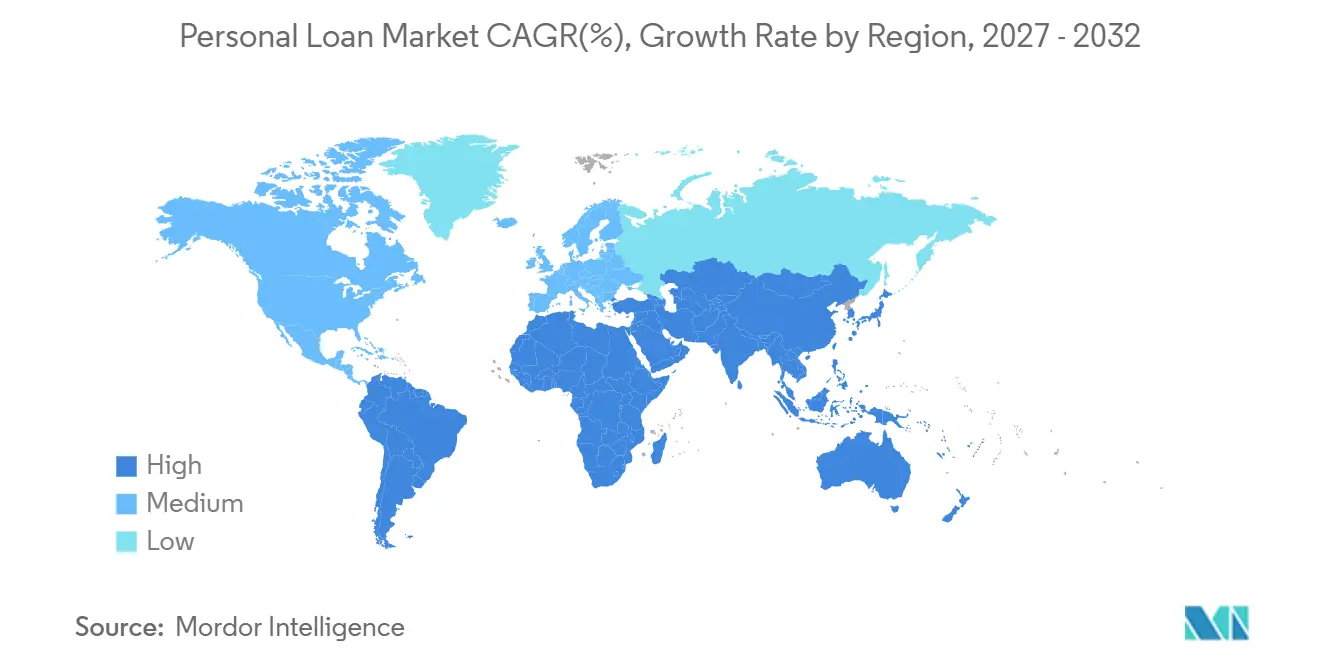
| Fastest Growing Market | Asia-Pacific |
| Largest Market | North America |
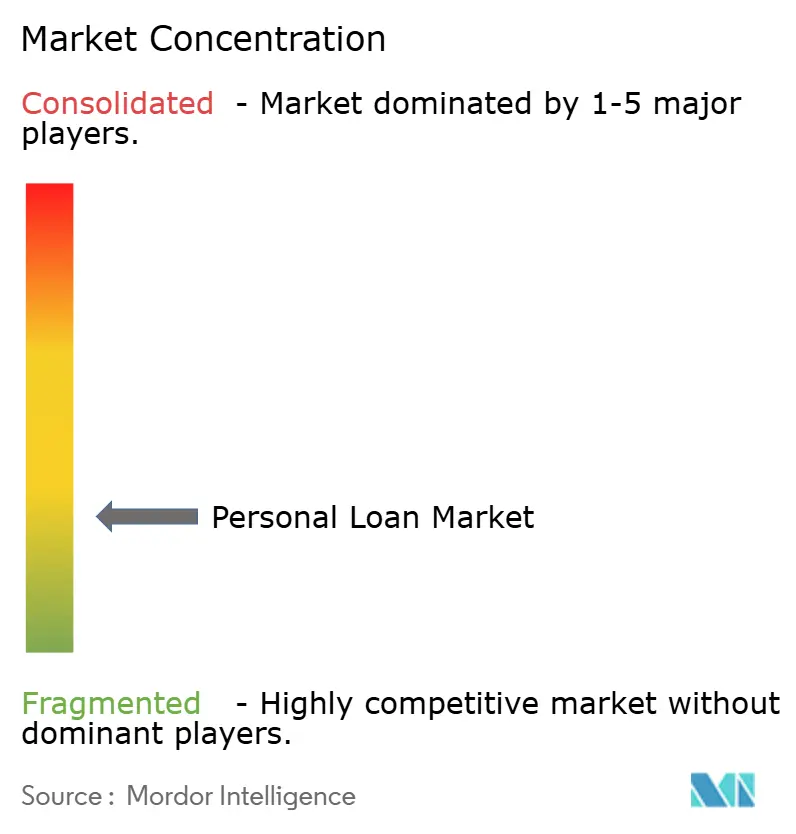
| Market Concentration | Low |
Major Players *Disclaimer: Major Players sorted in no particular order Image © Mordor Intelligence. Reuse requires attribution under CC BY 4.0. | |
Personal Loan Market Analysis by Mordor Intelligence
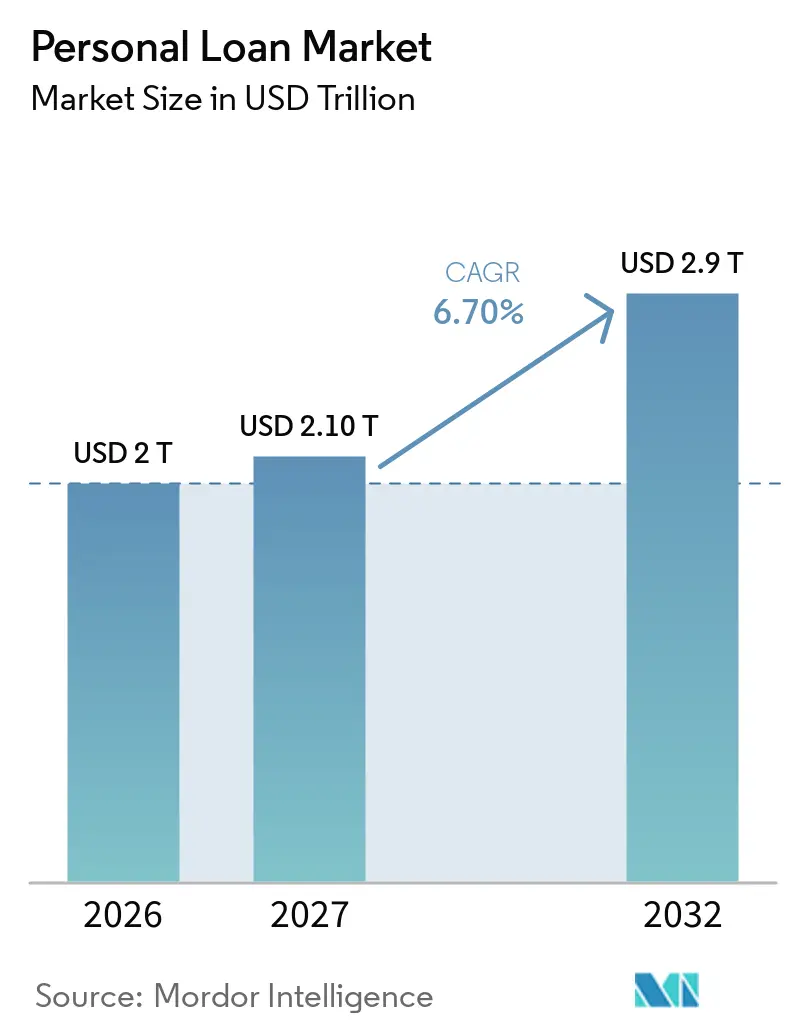
The Personal Loan Market size is expected to grow from USD 2 trillion in 2026 to USD 2.10 trillion in 2027 and is forecast to reach USD 2.9 trillion by 2032 at 6.70% CAGR over 2027-2032.
Digital origination, debt consolidation, and AI-supported underwriting are changing how lenders acquire, assess, and serve borrowers. The personal loan market is increasingly shaped by borrowers who seek fixed-rate alternatives to revolving credit and by lenders that can make faster, better-documented decisions. This shift also raises the importance of funding access, fraud controls, and responsible lending practices. North America remains the largest regional market, while Asia-Pacific has the fastest projected growth as digital lending capacity expands in India and Southeast Asia.
Key Report Takeaways
- By loan type, unsecured personal loans captured 60.2% of the personal loan market share in 2026 and are projected to grow at a 6.8% CAGR through 2032.
- By loan purpose, debt consolidation accounted for 34.5% of the personal loan market share in 2026, while emergency expenses are projected to grow at a 9.7% CAGR through 2032.
- By loan tenure, medium-term loans held 48.1% of the personal loan market share in 2026, while short-term loans are projected to grow at an 8.1% CAGR through 2032.
- By borrower credit tier, super-prime and prime borrowers captured 54.9% of the personal loan market share in 2026 and are projected to grow at a 9.3% CAGR through 2032.
- By lending institution, banks held 52.4% of the personal loan market share in 2026, while specialty and fintech lenders are projected to grow at a 10.8% CAGR through 2032.
- By geography, North America accounted for 40.2% of the personal loan market share in 2026, while Asia-Pacific is projected to grow at an 8.9% CAGR through 2032.
Note: Market numbers in this report are based on Mordor Intelligence's proprietary estimation framework, which combines nine months of actuals with Q4 projections for base year 2026.
Market Trends and Insights
Drivers Impact Analysis of Personal Loan Market*
| Driver | (~) % Impact on CAGR Forecast | Geographic Relevance | Impact Timeline |
|---|---|---|---|
| Digital-First Personal Loan Origination and Instant Disbursement | +1.5% | Global, led by North America, India, Southeast Asia | Short term (≤ 2 years) |
| Demand for Debt Consolidation and High-Cost Credit Refinancing | +1.4% | North America, Europe | Short term (≤ 2 years) |
| AI-Driven Credit Underwriting and Thin-File Borrower Assessment | +1.2% | Global | Medium term (2-4 years) |
| Rising Demand for Unsecured Consumer Credit and Flexible Financing | +1.0% | North America, Asia-Pacific core | Medium term (2-4 years) |
| Payroll-Linked Lending and Verified-Income-Based Personal Loans | +0.7% | North America, United Kingdom, Brazil | Medium term (2-4 years) |
| Embedded Personal Loans Through Digital Platforms and Financial Ecosystems | +0.8% | Global, with early gains in North America, Europe, Asia-Pacific | Long-term (≥ 4 years) |
| Source: Mordor Intelligence | |||
Digital-First Personal Loan Origination and Instant Disbursement
Digital origination has become a core operating requirement for lenders competing in the personal loan market. Fintech nonbank financial companies in India sanctioned 13.2 crore personal loans worth INR 2.15 lakh crore (USD 25.7 billion) in fiscal year 2026, with digital lenders accounting for 77% of personal loan originations, according to the Fintech Association for Consumer Empowerment[1]. Digital personal loan sanction value in India grew 53% year over year in the third quarter of fiscal year 2026. Upstart processed 456,000 loan transactions in the fourth quarter of 2025, and more than 90% were fully automated. Faster processing lowers the value of branch access and makes product range and service quality more important in lender selection. Lenders must also preserve clear borrower communication as approval and funding processes become faster. Experian expanded its AI decisioning product, Experian Activate, to a network serving more than 80 million members in 2026, showing how data and distribution can strengthen lender reach.
Demand for Debt Consolidation and High-Cost Credit Refinancing
Debt consolidation remains an important demand driver for the United States personal loan market, as borrowers seek structured repayment options and potentially lower borrowing costs when replacing high-interest credit card balances. Money Management International (MMI) enrolled nearly 15,000 new clients in debt-management plans during the first half of 2026, the highest year-to-date total in its records dating back to 2017, with average unsecured debt approaching USD 40,000[2]. TransUnion revised its forecast for growth in new unsecured personal loan originations in 2026 from 5.7% to 11.2% in February, reflecting continued lending activity and demand for personal credit. More recent MMI data showed that 48% of its new clients had an existing unsecured personal loan in the third quarter of 2026, with an average personal loan balance of USD 19,300. These trends highlight the importance of repayment-management tools, transparent loan terms, and responsible underwriting in supporting borrowers who use personal loans to consolidate debt.
AI-Driven Credit Underwriting and Thin-File Borrower Assessment
AI-supported underwriting is expanding lenders’ ability to assess borrowers using information beyond conventional credit scores. Upstart reported that its personal loan underwriting model used more than 2,500 variables and was trained on nearly 104 million repayment events as of December 2025[3]. In the first quarter of 2026, super-prime borrowers accounted for 33% of Upstart’s personal loan originations, compared with 27% in the fourth quarter of 2025. In India, digital loan sanctions reached INR 2.2 trillion (USD 26.3 billion) in fiscal year 2026, up from INR 0.15 trillion (USD 1.8 billion) five years earlier, reflecting the expansion of digital lending. As algorithmic underwriting expands, lenders must maintain transparent credit decisions, fair-lending safeguards, and reliable documentation. In the United States, lenders must provide specific reasons for adverse credit decisions, even when complex algorithms inform the decision-making process. Competitive advantage will depend on combining effective risk assessment with responsible lending practices and consistent model governance.
Rising Demand for Unsecured Consumer Credit and Flexible Financing
Rising demand for unsecured credit is supporting the United States personal loan market across a broad range of borrower profiles. Unsecured personal loan balances reached USD 277 billion across 32.6 million accounts in the first quarter of 2026, with 26.4 million consumers carrying balances[4]. In the third quarter of 2025, unsecured personal loan originations increased by 32.5% year over year among subprime borrowers and 21.5% among both near-prime and super-prime borrowers, highlighting demand across different credit-risk segments. Experian reported that the average personal loan balance reached USD 19,333 in September 2025, while 38% of United States consumers had a personal loan on their credit reports. SoFi introduced interest-only repayment periods for eligible personal loans in the third quarter of 2025, providing borrowers with lower required payments during the initial six months before payments increase to include principal and interest.
Restraints Impact Analysis of Personal Loan Market*
| Restraint | (~) % Impact on CAGR Forecast | Geographic Relevance | Impact Timeline |
|---|---|---|---|
| Rising Delinquencies and Borrower Over-Indebtedness | -1.2% | North America, Europe | Short term (≤ 2 years) |
| High Funding Costs and Pressure on Risk-Adjusted Lending Margins | -0.9% | Global, pronounced in nonbank lenders | Short term (≤ 2 years) |
| Credit Fraud, Synthetic Identities and First-Party Default Risk | -0.7% | Global | Medium term (2-4 years) |
| Responsible Lending, Affordability and Algorithmic-Bias Constraints | -0.5% | North America, Europe | Medium term (2-4 years) |
| Source: Mordor Intelligence | |||
Rising Delinquencies and Borrower Over-Indebtedness
Delinquency risk remains a material restraint on the United States personal loan market because rising repayment stress can increase credit losses and encourage lenders to tighten underwriting standards. TransUnion reported that the borrower-level 60-plus-days-past-due delinquency rate for unsecured personal loans increased to 3.98% in the first quarter of 2026, compared with 3.49% a year earlier[4]. Equifax reported that United States consumer debt reached USD 18.19 trillion in March 2026, while the 90-plus-days-past-due rate for student loans rose to 17.01%. Separately, the Federal Reserve Bank of New York reported that 4.7% of outstanding household debt was delinquent to some degree in the second quarter of 2026. These indicators reinforce the importance of assessing income stability, existing debt obligations, and repayment capacity to manage credit risk as personal lending expands.
High Funding Costs and Pressure on Risk-Adjusted Lending Margins
Funding conditions remain a constraint for nonbank participants in the United States personal loan market, as borrowing costs and access to stable funding influence lending economics. The Federal Reserve Bank of St. Louis reported that bank net interest margins declined from 3.30% in the fourth quarter of 2025 to 3.22% in the first quarter of 2026, while loan yields fell from 6.75% to 6.51%. In July 2026, the Office of the Comptroller of the Currency granted conditional approval for Upstart to establish Upstart Bank, N.A., which could allow the company to accept insured deposits, subject to further regulatory approvals and satisfaction of outstanding conditions. Funding costs and access to capital will therefore remain important factors in lenders’ ability to price personal loans competitively while maintaining sustainable risk-adjusted returns.
*Our forecasts treat driver/restraint impacts as directional, not additive. The impact forecasts reflect baseline growth, mix effects, and variable interactions.
Personal Loan Market Segment Analysis
By Loan Type, Unsecured Credit Expands While Secured Products Serve Niche Borrowers
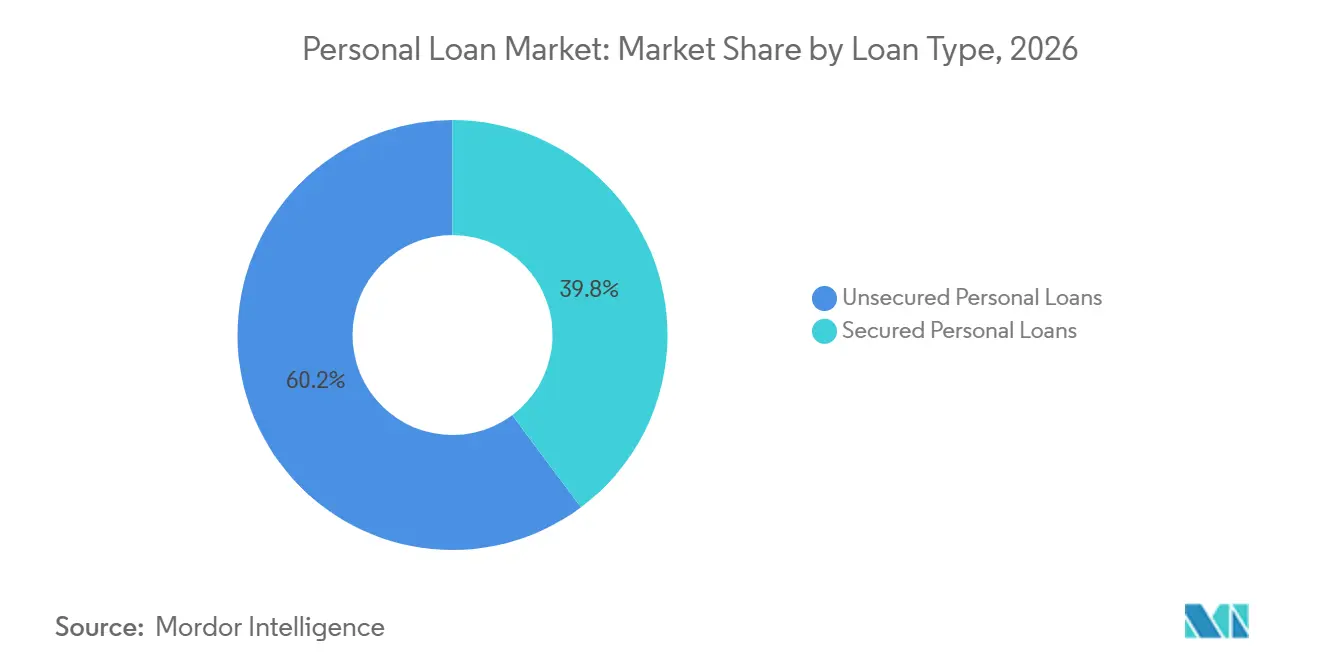
Unsecured personal loans captured 60.2% of the personal loan market share in 2026 and are projected to grow at a 6.8% CAGR through 2032. The scale of unsecured lending reflects demand for credit that does not require a vehicle, property, or other asset as collateral. TransUnion reported that fintech lenders held more than half of outstanding United States unsecured personal loan balances in the third quarter of 2025, compared with 21% for banks.
Unsecured consumer loan asset-backed securities issuance increased 54% in 2025, indicating stronger institutional demand for this asset class. Secured products remain relevant for borrowers who can pledge assets to support their applications or potentially obtain more favorable terms. OneMain Financial offers personal loans secured by automobiles and other titled property, alongside unsecured products. At December 31, 2025, 53% of its personal loan receivables were secured by titled property, compared with 50% at the end of 2024. Secured and unsecured products therefore serve different borrower needs, with the choice depending on creditworthiness, pricing, collateral availability, and repayment capacity.
By Loan Purpose, Consolidation Anchors Demand While Emergency Credit Grows Faster
Debt consolidation held 34.5% of the personal loan market size in 2026. The category is supported by borrowers seeking to replace higher-cost revolving balances with structured repayments. Money Management International enrolled nearly 15,000 new clients in debt-management plans during the first half of 2026, with average unsecured debt approaching USD 40,000. Personal loans can help eligible borrowers consolidate debt when the new loan offers a lower overall borrowing cost and a suitable repayment schedule. The market therefore remains closely linked to household debt-management needs.
Emergency expenses are projected to grow at a 9.7% CAGR through 2032. Experian's February 2026 report found that 42% of surveyed consumers were more likely to use a personal loan in 2026 because of economic conditions, reflecting both anticipated funding needs and the appeal of lower borrowing rates. The report also identified emergency expenses and home improvement among the purposes consumers cited when considering personal loans. Medical and essential expenses can create additional demand, particularly when households lack sufficient liquid savings. Lenders need to assess affordability and existing debt obligations carefully, as repeat borrowing can increase repayment pressure.
By Loan Tenure, Medium-Term Loans Hold Scale While Short-Term Credit Expands
Medium-term loans with terms of more than 2 to 4 years held a 48.1% share in 2026. These terms can suit debt-consolidation and home-improvement needs by spreading repayments over several years. They may also accommodate larger loan amounts than short-duration products, although longer repayment periods can increase total interest costs. The personal loan market size for this tenure group is supported by borrowers seeking predictable payments and alternatives to revolving credit. Lenders use loan duration to balance monthly affordability, total borrowing costs, and credit risk.
Short-term loans of up to 2 years are projected to grow at an 8.1% CAGR through 2032. In India, digital personal loan volumes reached 35 million in the third quarter of fiscal year 2026, up from 32 million a year earlier, while their value rose 52.86% to INR 56,892 crore (USD 6.85 billion). These figures indicate expanding digital personal lending. Shorter terms can suit smaller emergency needs, while longer loans remain relevant for larger consolidation balances. Borrowers benefit when repayment schedules reflect their income patterns and capacity to repay.
By Borrower Credit Tier, Prime Cohorts Lead While Technology Broadens Access
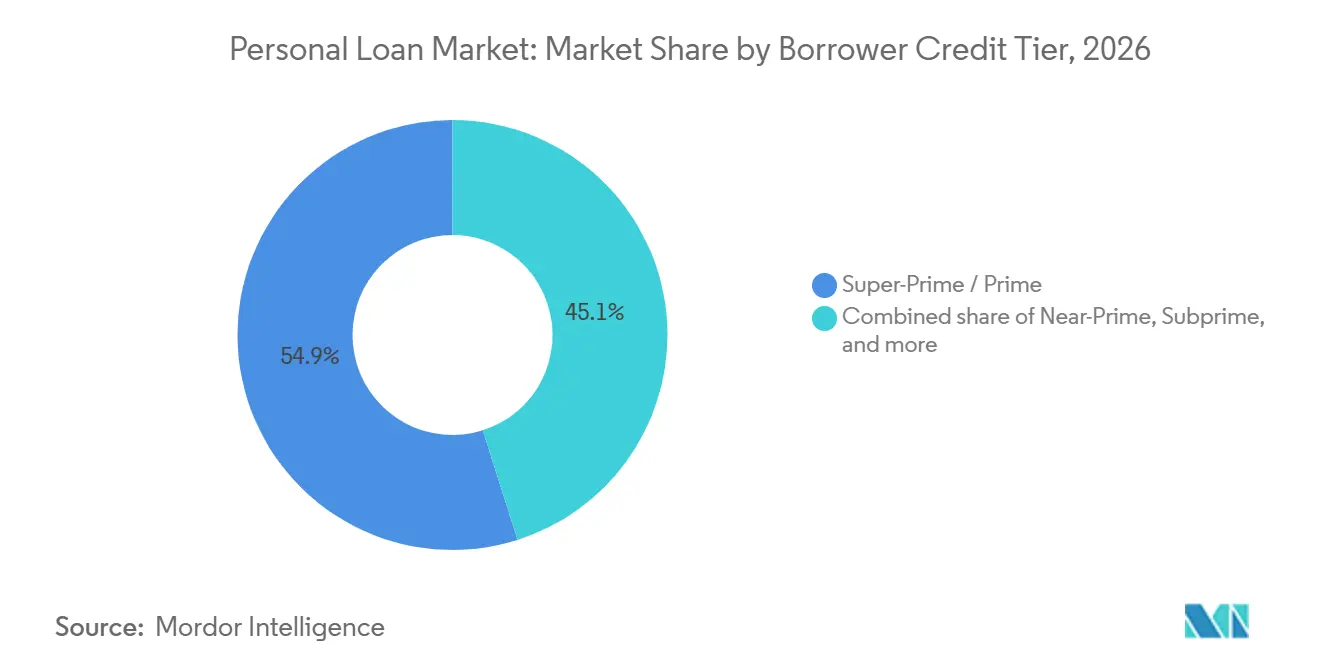
Super-prime and prime borrowers captured 54.9% of the personal loan market share in 2026 and are projected to grow at a 9.3% CAGR through 2032. These borrowers generally present lower expected credit risk, making them attractive to lenders seeking predictable portfolio performance. SoFi offers personal loans to eligible borrowers, with approval and pricing determined by creditworthiness, income, and other underwriting factors. Lenders can expand selectively into adjacent credit tiers while maintaining affordability standards and disciplined underwriting.
Near-prime and subprime borrowers also contribute to market activity. TransUnion reported that unsecured personal loan originations in the third quarter of 2025 increased year over year across risk tiers, with particularly strong growth among subprime borrowers. Alternative data and technology-enabled underwriting may help lenders assess applicants who have limited traditional credit histories. Oportun and other specialist lenders serve borrowers who may have fewer financing options, although loan pricing and terms vary by product and credit profile. Expanding access sustainably requires lenders to balance approval rates against default risk and total borrowing costs.
By Lending Institution, Banks Retain Scale While Fintech Lenders Gain Originations
Banks held a 52.4% share in 2026, supported by deposit funding, established customer relationships, and existing distribution networks. Their position is particularly relevant for customers seeking personal credit through an existing banking relationship. Wells Fargo offers personal loans to eligible customers, while availability, loan limits, and pricing depend on the lender's current criteria.
Specialty and fintech lenders are projected to grow at a 10.8% CAGR through 2032. TransUnion reported that fintech lenders accounted for more than 40% of new unsecured personal loan originations in the third quarter of 2025 and held more than half of outstanding balances. Digital lenders compete through online applications, automated underwriting and targeted distribution, while credit unions continue to serve members through established community and employer relationships. In July 2026, Upstart received conditional approval from the Office of the Comptroller of the Currency to establish Upstart Bank. Competition will continue to depend on funding access, underwriting performance, distribution efficiency, and servicing quality.
Geography Analysis
North America accounted for a 40.2% share in 2026. United States unsecured personal loan balances reached USD 281 billion in the second quarter of 2026, increasing 9.6% year over year. Unsecured personal loan originations reached a record 7.2 million in the third quarter of 2025, marking the second consecutive quarterly high. Fintech lenders accounted for 42% of originations, up from approximately one-third a year earlier. Personal loans continued to serve as a financing option for debt consolidation and refinancing, including for consumers seeking to manage revolving debt.
Asia-Pacific is projected to grow at an 8.9% CAGR from 2027 to 2032. In India, digital-first non-banking financial companies sanctioned 13.2 crore personal loans worth INR 2.15 lakh crore (USD 25.8 billion) in fiscal year 2026, representing 77% of personal loan volume but 19% of total sanctioned value. In Europe, the Consumer Credit Directive (EU) 2023/2225 is scheduled to apply from 20 November 2026, strengthening consumer protection, creditworthiness assessments, and disclosure requirements for covered credit agreements, including certain short-term and buy now, pay later products.
In South America, Nubank began offering Brazil's Crédito do Trabalhador private-sector payroll loan on 1 April 2025. Eligible formal-sector employees can initiate the process through the CTPS Digital platform and complete the loan process through Nubank's application. The programme opened a digital payroll-lending channel for a potential base of 47 million formally employed workers. The Middle East and Africa are developing digital financial services and consumer lending channels, but the original claims about fintech licensing and expanding formal credit access in the United Arab Emirates and Saudi Arabia require additional country-specific evidence.
Competitive Landscape
The United States personal loan market is fragmented, with competition among large banks, credit unions, fintech platforms, and nonbank lenders. SoFi reported total loan originations of USD 14.8 billion in the second quarter of 2026, including record personal loan originations of USD 10.7 billion, up 54% year over year. During the second quarter, SoFi acquired Peach Finance, a loan management and servicing platform, and Composer Securities, an investing platform, expanding its technology capabilities across financial services.
Upstart announced a multiyear forward-flow agreement with Castlelake in July 2026, under which Castlelake-managed funds agreed to purchase up to USD 4 billion of consumer loans originated through Upstart's platform over a period of up to 24 months. The agreement expanded Upstart's institutional funding relationships and supported its marketplace lending model. In July 2026, Upstart also received conditional approval from the Office of the Comptroller of the Currency to establish Upstart Bank, subject to remaining regulatory steps. Equifax introduced its Synthetic Identity Risk product in January 2026, using artificial intelligence and machine learning to help lenders detect potentially fraudulent identities. Strong identity verification and fraud detection are increasingly important competitive capabilities as lenders seek to manage credit losses while maintaining efficient application processes.
Competitive opportunities remain among thin-file borrowers with stable employment, gig-economy workers with verifiable cash flows, and near-prime consumers whose credit profiles may not be fully represented by conventional scoring models. Banks, fintechs, credit unions, and specialist lenders compete by differentiating their underwriting models, loan terms, customer experience, funding arrangements, and servicing capabilities. Payroll integrations can help lenders verify income and distribute loans, while embedded lending partnerships can connect borrowers with credit through platforms they already use.
Personal Loan Industry Leaders
-
SoFi Technologies, Inc.
-
JPMorgan Chase
-
Wells Fargo
-
LendingClub Corporation
-
Upstart Network, Inc.
- *Disclaimer: Major Players sorted in no particular order
Personal Loan Market Companies Covered in this Report
- SoFi Technologies, Inc.
- Happen Bank (formerly LendingClub)
- Upstart Network, Inc.
- Prosper Marketplace, Inc.
- Avant, LLC
- OneMain Financial
- Wells Fargo
- JPMorgan Chase
- Citigroup
- Capital One Financial Corporation
- American Express
- Barclays
- HSBC Holdings
- Deutsche Bank
- Santander Group
- DBS Bank
- WeBank
- Bank of America
- Truist Financial Corporation
- Upgrade, Inc.
Recent Industry Developments in Personal Loan Market
- July 2026: Upstart received conditional OCC approval to establish Upstart Bank, enabling deposit-funded originations at a materially lower cost of funds. In the same month, Upstart secured a multi-year USD 4 billion forward-flow agreement with Castlelake.
- July 2026: SoFi Technologies acquired Composer, a Toronto-based AI-powered investing startup, for undisclosed terms. SoFi's second-quarter 2026 personal loan originations reached a record USD 10.7 billion, up 69% year over year.
- July 2026: ClearScore partnered with Stream to integrate automated debt-consolidation technology, Clearer, into payroll-linked lending infrastructure, enabling personal loan repayment through payroll for 3 million United Kingdom workers.
- May 2026: SoFi Technologies acquired Peach Finance, a lending-infrastructure startup specializing in loan servicing software, to upgrade its loan management platform and reduce third-party dependency.
Global Personal Loan Market Report Scope
Segmentation Overview
| Secured Personal Loans |
| Unsecured Personal Loans |
| Debt Consolidation |
| Home Improvement |
| Medical Expenses |
| Education Expenses |
| Emergency Expenses |
| Other Purposes |
| Short-Term Loans (Up to 2 Years) |
| Medium-Term Loans (More Than 2 to 4 Years) |
| Long-Term Loans (More Than 4 Years) |
| Super-Prime / Prime |
| Near-Prime |
| Subprime |
| Deep Subprime |
| Thin-File and No-File Borrowers |
| Banks |
| Credit Unions and Cooperative Lenders |
| Non-Bank Consumer-Finance Companies |
| Specialty / Fintech Lenders and Others |
| North America | United States |
| Canada | |
| Mexico | |
| South America | Brazil |
| Argentina | |
| Rest of South America | |
| Europe | United Kingdom |
| Germany | |
| France | |
| Italy | |
| Spain | |
| Rest of Europe | |
| Asia-Pacific | China |
| India | |
| Japan | |
| Australia | |
| Rest of Asia-Pacific | |
| Middle East & Africa | United Arab Emirates |
| Saudi Arabia | |
| South Africa | |
| Rest of Middle East & Africa |
| By Loan Type | Secured Personal Loans | |
| Unsecured Personal Loans | ||
| By Loan Purpose | Debt Consolidation | |
| Home Improvement | ||
| Medical Expenses | ||
| Education Expenses | ||
| Emergency Expenses | ||
| Other Purposes | ||
| By Loan Tenure | Short-Term Loans (Up to 2 Years) | |
| Medium-Term Loans (More Than 2 to 4 Years) | ||
| Long-Term Loans (More Than 4 Years) | ||
| By Borrower Credit Tier | Super-Prime / Prime | |
| Near-Prime | ||
| Subprime | ||
| Deep Subprime | ||
| Thin-File and No-File Borrowers | ||
| By Lending Institution | Banks | |
| Credit Unions and Cooperative Lenders | ||
| Non-Bank Consumer-Finance Companies | ||
| Specialty / Fintech Lenders and Others | ||
| By Geography | North America | United States |
| Canada | ||
| Mexico | ||
| South America | Brazil | |
| Argentina | ||
| Rest of South America | ||
| Europe | United Kingdom | |
| Germany | ||
| France | ||
| Italy | ||
| Spain | ||
| Rest of Europe | ||
| Asia-Pacific | China | |
| India | ||
| Japan | ||
| Australia | ||
| Rest of Asia-Pacific | ||
| Middle East & Africa | United Arab Emirates | |
| Saudi Arabia | ||
| South Africa | ||
| Rest of Middle East & Africa | ||
Key Questions Answered in the Report
What is the projected value of the personal loan sector by 2032?
The personal loan market is projected to reach USD 2.9 trillion by 2032, growing at a 6.7% CAGR from 2027.
Which loan type has the largest share in personal lending?
Unsecured personal loans held 60.2% share in 2026 and are projected to grow at a 6.8% CAGR through 2032.
Why do borrowers use personal loans for debt consolidation?
Debt consolidation held 34.5% share in 2026, supported by the gap between personal loan rates and credit card rates. Borrowers can replace revolving balances with fixed payments and a defined repayment schedule.
Which borrower groups are expanding fastest in personal lending?
Super-prime and prime borrowers are projected to grow at a 9.3% CAGR. Technology-led underwriting can also widen access for borrowers who have verified income but limited traditional credit history.
Which region is growing fastest for personal lending?
Asia-Pacific is projected to grow at an 8.9% CAGR through 2032. Growth is supported by digital lending activity in India and Southeast Asia, alongside wider access to formal consumer credit.
How are lenders reducing fraud risk in personal lending?
Lenders are adopting identity verification and machine-learning tools at origination to address synthetic identity and first-party fraud risks. These controls help protect approval speed while limiting avoidable credit losses.