
Personal Accident Insurance Market Size and Share
Market Overview
| Study Period | 2020 - 2031 |
|---|---|
| Market Size (2026) | USD 40.30 Billion |
| Market Size (2031) | USD 50.20 Billion |
| Growth Rate (2026 - 2031) | 4.50 % |
| Fastest Growing Market | Asia-Pacific |
| Largest Market | North America |
| Market Concentration | High |
Major Players *Disclaimer: Major Players sorted in no particular order Image © Mordor Intelligence. Reuse requires attribution under CC BY 4.0. | |
Personal Accident Insurance Market Analysis by Mordor Intelligence
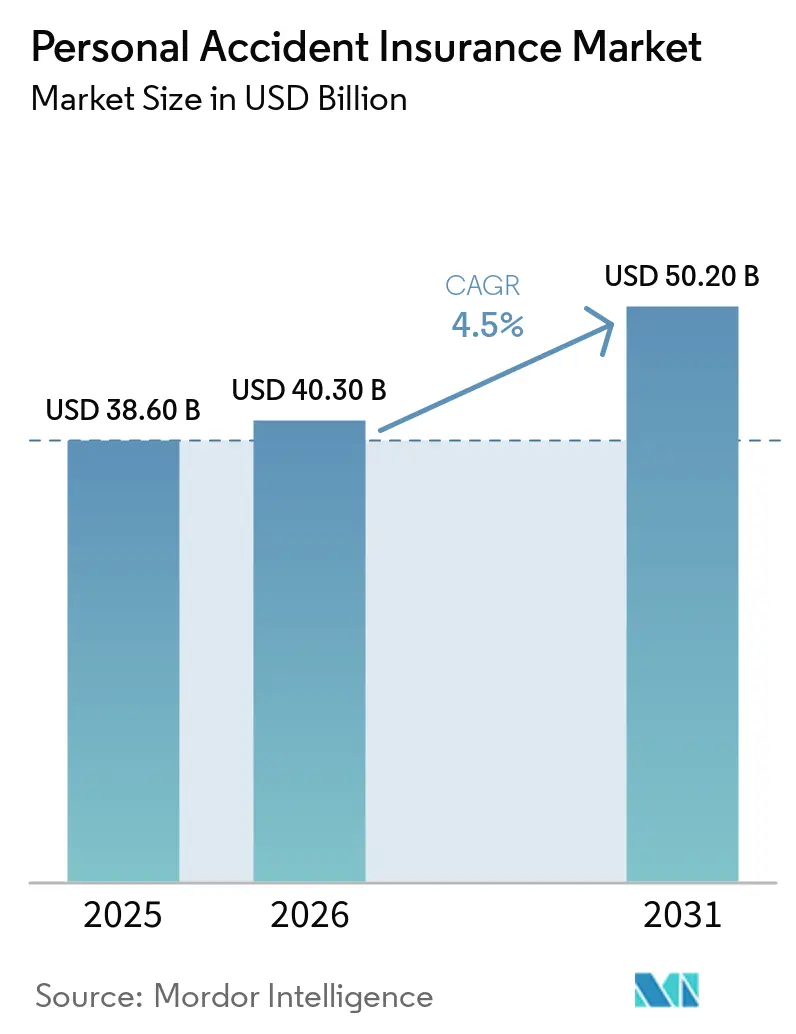
The Personal Accident Insurance Market size is expected to grow from USD 38.60 billion in 2025 to USD 40.30 billion in 2026 and is forecast to reach USD 50.20 billion by 2031 at 4.5% CAGR over 2026-2031.
Higher claim severity is changing product design, pricing, and distribution across the personal accident insurance market. The aging workforce and limited income replacement under public programs increase the need for cover beyond workers' compensation arrangements. Voluntary employer benefits and direct-to-consumer channels can reach people who are not fully covered through workplace programs. Digital distribution is widening access while reducing reliance on traditional agency models. Insurers are also balancing stronger demand against premium sensitivity, limited policy understanding, and differing regulatory requirements across countries.
Key Report Takeaways
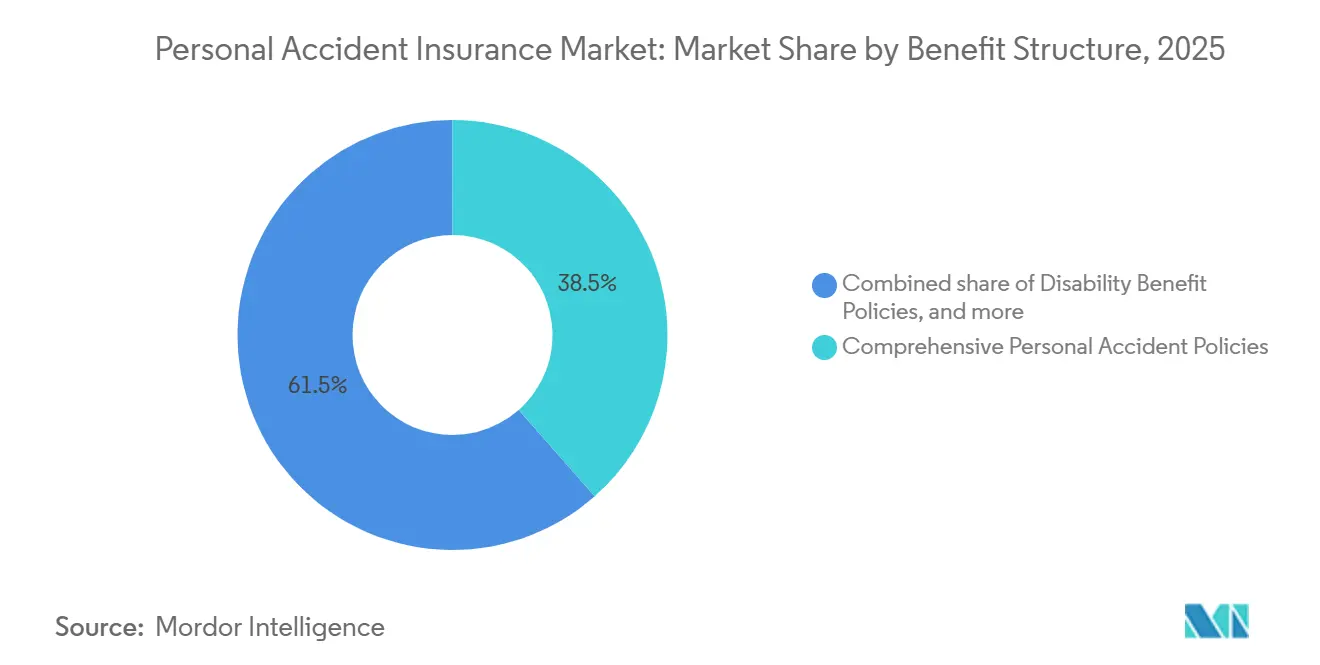
- By benefit structure, comprehensive personal accident policies captured 38.5% of the personal accident insurance market share in 2025 and are projected to grow at 5.1% CAGR through 2031.
- By policyholder type, group policies captured 59.6% of the personal accident insurance market share in 2025 and are projected to grow at 4.9% CAGR through 2031.
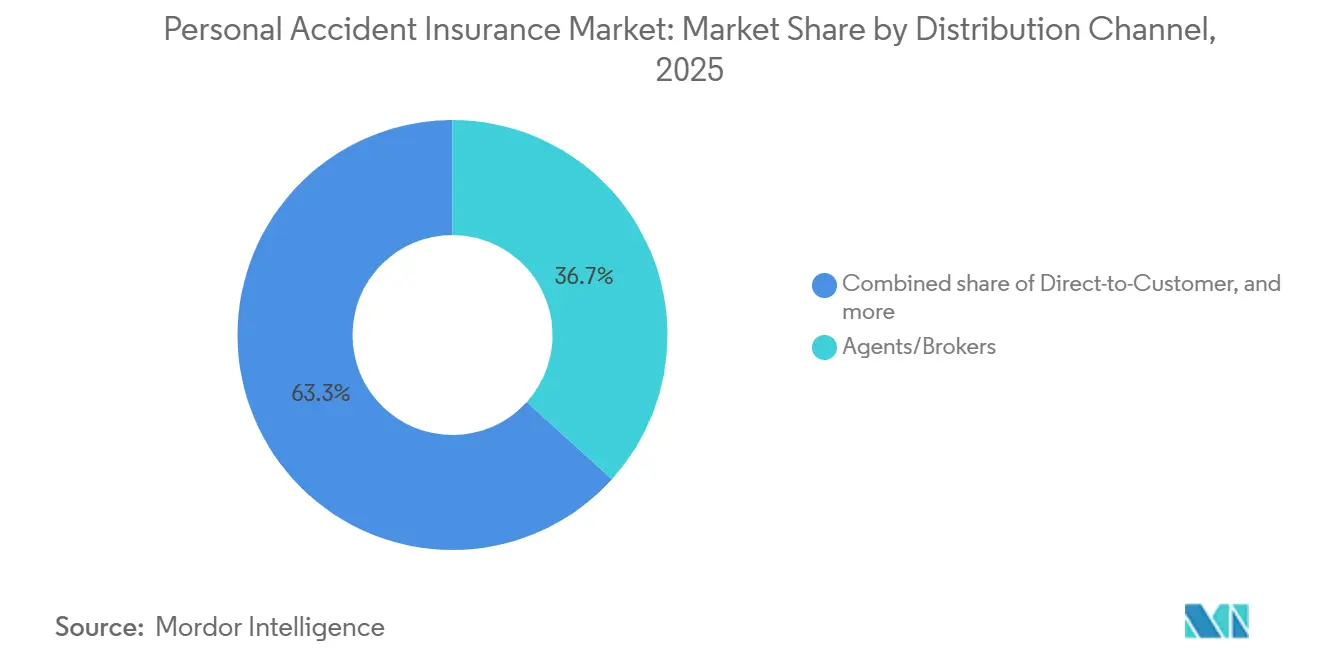
- By distribution channel, agents and brokers captured 36.7% of the personal accident insurance market share in 2025, while affinity/partnership distribution is projected to grow at 5.8% CAGR through 2031.
- By policy term, annual renewable policies captured 76.2% of the personal accident insurance market share in 2025, while multi-year policies are projected to grow at 5.3% CAGR through 2031.
- By geography, North America captured 26.8% of the personal accident insurance market in 2025, while Asia-Pacific is projected to grow at 5.2% CAGR through 2031.
Note: Market size and forecast figures in this report are generated using Mordor Intelligence’s proprietary estimation framework, updated with the latest available data and insights as of January 2026.
Global Personal Accident Insurance Market Trends and Insights
Drivers Impact Analysis*
| Driver | (~) % Impact on CAGR Forecast | Geographic Relevance | Impact Timeline |
|---|---|---|---|
| Rising Accident-Related Medical and Income-Replacement Costs | +1.2% | Global, with a concentration in North America and the Asia-Pacific | Short term (≤ 2 years) |
| Increasing Consumer Awareness of Financial Protection | +0.7% | Asia-Pacific, with spillover to the Middle East, Africa, and South America | Medium term (2-4 years) |
| Expansion of Digital and Embedded Insurance Distribution | +1.0% | Global | Short term (≤ 2 years) |
| Employer Demand for Flexible Group and Commute-Related Cover | +0.8% | North America and Europe | Short term (≤ 2 years) |
| Gig-Economy and Temporary-Worker Coverage Gaps | +0.6% | Asia-Pacific, North America, and the European Union | Medium term (2-4 years) |
| Growth of Microinsurance and Usage-Based Accident Products | +0.4% | Asia-Pacific, Middle East and Africa, and South America | Long term (≥ 4 years) |
| Source: Mordor Intelligence | |||
Rising Accident-Related Medical and Income-Replacement Costs
Claim severity has become more commercially important than claim frequency for the personal accident insurance market. Employees aged 60 and above missed nearly 97 workdays per injury during 2020 to 2024. This was almost 14 days above the overall average and 17 days above the pre-pandemic period[1]. The National Safety Council estimated the cost of a medically consulted injury at USD 48,000 in 2025. Older workers can increase accident costs because injuries may require longer absences and more support. Insurers with detailed occupation and age risk models can price these exposures more precisely. Rising health benefit costs also encourage employers to add accident medical expense and hospital cash benefits to their voluntary benefits programs.
Increasing Consumer Awareness of Financial Protection
Financial protection awareness is becoming more relevant in markets with low insurance penetration. Consumers are more likely to consider accident cover when they understand the gap between medical expenses, lost income, and public benefits. This need is most visible in Asia-Pacific, the Middle East and Africa, and South America, where many households remain underinsured. Simpler product descriptions can make benefit triggers easier to understand for first-time buyers. Digital enrollment tools can also show how disability, hospital cash, and medical reimbursement benefits apply after an accident. These changes can support more consistent adoption of personal accident insurance products without altering the core need for affordable premiums.
Expansion of Digital and Embedded Insurance Distribution
Embedded insurance is moving accident policy purchases into payment apps, e-commerce checkouts, and digital banking journeys. Chubb introduced an artificial intelligence-powered optimization engine in Chubb Studio in November 2025[2]. The platform enables partners in 54 countries to personalize accident and health coverage at the point of sale. Securian Financial launched FlexTech in March 2026 with an embedded insurance platform, Walnut. The service enables financial institutions and fintechs to add accident and income-loss cover to digital journeys within weeks. Income Insurance transferred its HIVE API-first platform to Embed Financial Group Holdings in June 2026, creating infrastructure that can support multiple carriers.
Employer Demand for Flexible Group and Commute-Related Cover
Employers are using accident protection to address gaps created by higher employee deductibles and out-of-pocket costs. In the United States, 59% of surveyed employers planned cost-cutting changes in 2026, compared with 48% in 2025[3]. The United Kingdom group risk sector paid GBP 2.69 billion (USD 3.4 billion) in claims during 2025. That total was GBP 96.7 million (USD 122.0 million) higher than in 2024. New York Life expanded its Business Travel Accident product in July 2025 with multiyear prepaid cover and no medical examination requirements. Carriers can also tailor cover to commute exposure as return-to-office policies increase daily travel frequency.
Restraints Impact Analysis*
| Restraint | (~) % Impact on CAGR Forecast | Geographic Relevance | Impact Timeline |
|---|---|---|---|
| Low Policy Literacy and Coverage Confusion | -0.9% | Asia-Pacific, South America, the Middle East, and Africa | Medium term (2-4 years) |
| Premium Sensitivity in Underinsured Households | -0.8% | Asia-Pacific, South America, the Middle East, and Africa | Long term (≥ 4 years) |
| Fragmented Product, Licensing, and Data-Privacy Regulation | -0.6% | Global, especially cross-border distribution | Medium term (2-4 years) |
| Employer Self-Insurance and Public-Scheme Substitution | -0.5% | North America, Europe, and India | Medium term (2-4 years) |
| Source: Mordor Intelligence | |||
Low Policy Literacy and Coverage Confusion
Coverage confusion can reduce purchases when buyers cannot distinguish between accidental death, disability income, and medical reimbursement benefits. Many first-time buyers choose not to purchase when they are unsure how a policy will respond after an accident. The issue is particularly important in Southeast Asia, South America, and Sub-Saharan Africa. Comprehensive products can be harder to compare because disability riders, hospital cash, fracture benefits, and benefit schedules differ by carrier. Plain-language policy documents and pre-populated benefit illustrations can reduce this friction. Digital decision-support tools can also lower enrollment abandonment by helping buyers compare benefit structures before purchasing.
Premium Sensitivity in Underinsured Households
Premium sensitivity can restrict adoption when the collection schedule or benefit design does not match household income. ShopeePay and Allianz Malaysia offered accident plans at annual premiums of MYR 50 to MYR 75 (USD 11 to USD 16) in September 2025. The plans were eligible for Malaysia’s Perlindungan Tenang Voucher program, which subsidized premiums for up to 2 million recipients. Uganda’s microinsurance premiums rose sharply during the second quarter of 2025, although total volume remained small relative to the uninsured population. Insurers can face resource allocation pressure if adverse microinsurance loss ratios require reserves that would otherwise support commercial underwriting.
*Our forecasts treat driver/restraint impacts as directional, not additive. The impact forecasts reflect baseline growth, mix effects, and variable interactions.
Segment Analysis
By Benefit Structure: Comprehensive Policies Consolidate Multi-Risk Demand
Comprehensive Personal Accident Policies held 38.5% of the benefit-structure segment in 2025. This format combines accidental death, permanent disability, temporary disability, medical reimbursement, and hospital cash benefits. Bundled cover can generate a higher premium per policy than a single-risk product. The personal accident insurance market size for comprehensive policies is projected to expand at a 5.1% CAGR from 2026 to 2031. This supports broader benefit packages in employer and consumer channels.
Standalone Accidental Death and Dismemberment policies remain lower-cost entry options in voluntary benefits platforms. Disability Benefit Policies are gaining relevance among professional and white-collar employers in North America and Western Europe. These employers may require focused income-replacement protection for higher-salaried staff. Accident Medical Reimbursement and Hospital Cash products provide accessible entry cover in urban Asia-Pacific markets. These products can support movement into comprehensive plans as consumers seek wider protection.
By Policyholder Type: Group Policies Anchor Employer-Driven Distribution
Group policies held 59.6% of the personal accident insurance market by policyholder type in 2025. Employers provide a low-cost distribution route because payroll systems can support premium collection, enrollment, and claims communication. AIA Group reported more than 16 million group insurance scheme participants across 18 Asian markets in its 2025 results. The personal accident insurance market size for group policies is forecast to grow at 4.9% CAGR from 2026 to 2031. This outlook reflects employer demand and coverage obligations for gig and platform workers.
Individual policies serve self-employed workers, retirees, and high-net-worth individuals who need cover beyond employer-plan limits. Family policies are expanding in India, Indonesia, and Brazil, where household decisions often cover several people. A family benefit structure can reduce the cost per insured person and improve financial protection after an accident. New York Life introduced expanded group accident and health products for employers, associations, and affinity communities in July 2025. This move shows that the personal accident insurance market continues to value institutional relationships alongside direct digital sales.
By Distribution Channel: Agents Lead, Affinity Partnerships Accelerate
Agents and brokers held 36.7% of the distribution segment in 2025. Their role remains important in group negotiations involving benefit design, network access, and claims advocacy. In India, brokers accounted for 49.6% of group health insurance distribution, compared with 28.4% for direct sales. This difference reflects the complexity of negotiating group accident and health benefits. Direct-to-customer channels face challenges because many consumers need support to assess claim triggers and policy conditions.
Bancassurance remains a long-term and capital-intensive distribution commitment. RHB Bank signed a 20-year exclusive bancassurance agreement with Tokio Marine Life Insurance Malaysia in August 2025. The projected access fee was up to MYR 1.6 billion (USD 360 million) based on projected business volume. Affinity/partnership distribution in the personal accident insurance market is forecast to grow at 5.8% CAGR from 2026 to 2031. Chubb and UnionDigital Bank Philippines introduced savings-linked personal accident coverage in June 2026.
By Policy Term: Annual Renewables Dominate, Multi-Year Policies Build Momentum
Annual Renewable Policies held 76.2% of the personal accident insurance market by policy term in 2025. Their structure fits employer benefits calendars, annual enrollment periods, and household budgeting patterns. In United States employer plans, biweekly deductions for individual low-plan accident cover ranged from USD 1.69 to USD 2.64. These deductions can make annual protection easier to manage as a recurring household expense. Allianz Malaysia offered 25% additional cover on Allianz Shield Plus accident policies in January 2026, with accidental death cover of up to MYR 3 million (USD 675,000).
Short-Term Policies meet episodic needs such as travel cover, event cover, per-trip platform-worker protection, and daily commuter plans. These products suit exposures that are limited in time. Multi-Year Policies in the personal accident insurance market are forecast to grow at 5.3% CAGR from 2026 to 2031. New York Life’s Business Travel Accident product included an optional multiyear prepaid structure in July 2025. Insurers can use multiyear plans to lower re-enrollment costs and collect behavioral data for risk segmentation.
Geography Analysis
North America held 26.8% of the global personal accident insurance market in 2025. The United States supported this position through a mature employer-sponsored voluntary benefits system. Accident cover is often used as a deductible-bridging product in United States health plans. Employer health benefit costs were projected to rise 6.5% per employee in 2026 across a Mercer survey of more than 1,700 employers. Canada has a smaller but developed group accident market, while Mexico’s formal-economy employers are expanding voluntary benefits adoption.
Europe has a significant secondary regional presence, with mature Western European markets and lower-penetration Southern and Central-Eastern markets. In the United Kingdom, group risk policies paid GBP 2.69 billion (USD 3.4 billion) in claims during 2025. The United Kingdom also reported a 68% return-to-work rate for newly absent employees who used group income protection schemes. The European Union Platform Work Directive may extend social protection requirements to an estimated 28 million platform workers. Germany favors corporate policies, while Spain, Italy, and the rest of Europe offer digital distribution opportunities.
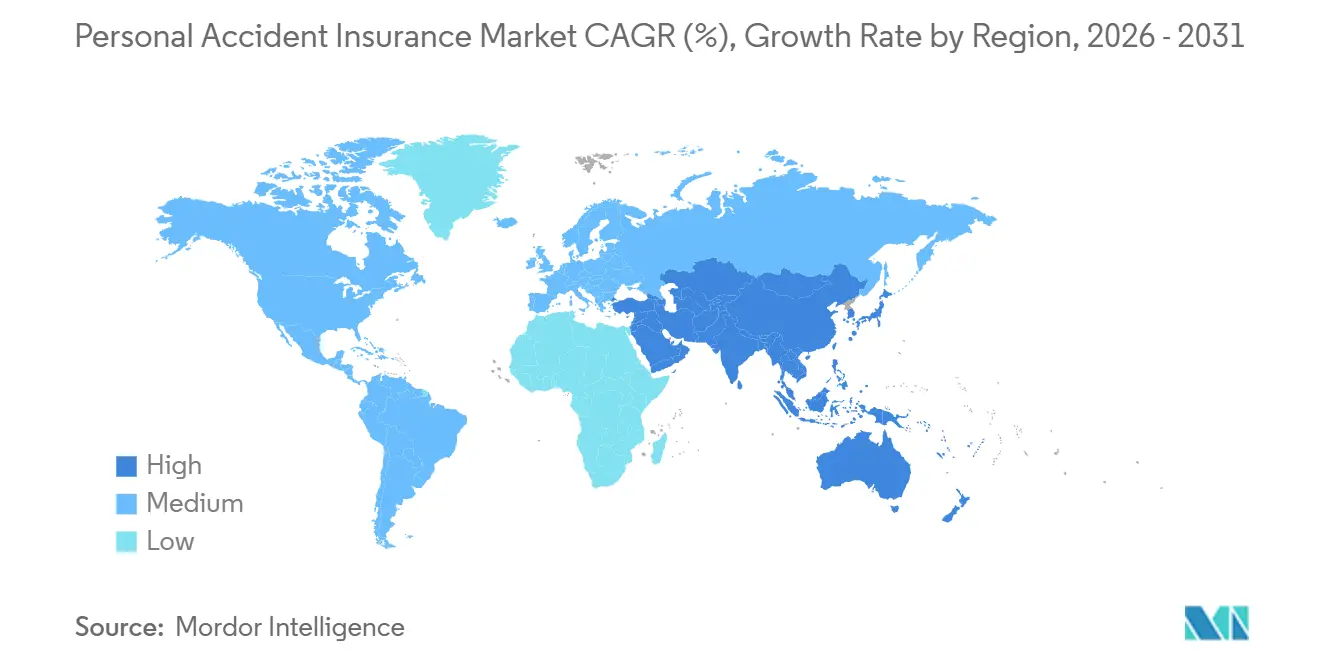
Asia-Pacific in the personal accident insurance market is projected to grow at 5.2% CAGR from 2026 to 2031. India’s personal accident premiums increased 27.6% in March 2026 from March 2025. Swiss Re expects India’s real insurance premium growth to average 6.9% annually during 2026 to 2030. Southeast Asia is using embedded distribution through financial platforms and digital wallets. The Middle East and Africa have smaller absolute volumes, while South America is expanding through bancassurance and affinity channels.
Competitive Landscape
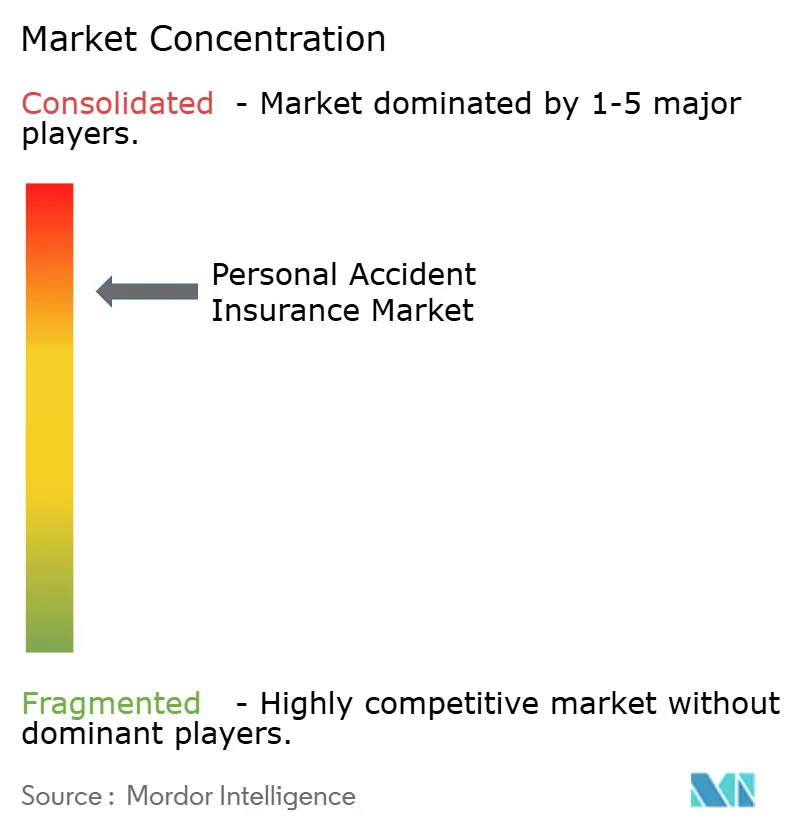
The personal accident insurance market is consolidated. Allianz, AXA, AIA, Chubb, Zurich, MetLife, and Tokio Marine are active leading carriers. Scale remains important, but digital distribution and microinsurance can make platform capability more important than traditional size. AIA entered 2026 with an operating profit of USD 7.1 billion, up 12% on a constant-exchange-rate basis. The group served 44 million individual policyholders and more than 16 million group insurance scheme participants across 18 Asian markets.
Some carriers are pursuing international expansion through acquisitions and strategic partnerships. Sompo Holdings completed its USD 3.5 billion acquisition of Aspen Insurance in February 2026 after receiving regulatory approvals. Tokio Marine formed a strategic partnership with Berkshire Hathaway in March 2026. Berkshire acquired a 2.49% stake valued at USD 1.8 billion, and the companies planned collaboration on reinsurance and large-scale acquisitions. AXA reported EUR 116 billion (USD 125.5 billion) in gross written premiums and other revenue for 2025.
The personal accident insurance market is also moving toward embedded infrastructure and faster digital integration. Chubb’s Chubb Studio engine enables partner-led personalization of accident and health cover at the point of sale. Securian Financial’s FlexTech gives financial institutions and fintechs a way to include accident and income-loss protection in existing digital journeys. Portable accident protection for multi-employer and cross-border workers remains underserved by standard annual group and individual products. Parametric triggers and artificial intelligence-supported claims automation are becoming points of differentiation because faster claims handling can improve customer experience and renewals.
Personal Accident Insurance Industry Leaders
-
Allianz SE
-
AXA S.A.
-
American International Group, Inc.
-
Chubb Limited
-
Zurich Insurance Group Ltd.
- *Disclaimer: Major Players sorted in no particular order
Recent Industry Developments
- May 2026: True Balance partnered with IndusInd General Insurance to launch a Group Personal Accident (GPA) insurance product in India, targeting underinsured and first-time insurance customers across Tier 2–4 markets. The product is embedded directly within the True Balance app, including home-screen and repayment journeys, expanding digital and contextual distribution of accident protection to lower-income and underserved customer segments.
- March 2026: PFI Mega Life, a joint venture between Prudential Financial and CT Corporation, and Antavaya announced a personal accident insurance partnership in Indonesia, embedding accidental death, total permanent disability, and hospital confinement coverage into the Antavaya travel and tourism booking platform.
- February 2026: Sompo Holdings completed its USD 3.5 billion acquisition of Aspen Insurance Holdings, receiving all required antitrust and insurance regulatory approvals in February 2026 following the August 2025 announcement. The deal adds a top-tier Lloyd’s syndicate and global specialty reinsurance capacity to Sompo’s international platform, accelerating geographic diversification beyond the Japanese domestic market, where organic growth is structurally constrained.
- November 2025: Chubb unveiled an AI-powered optimization engine within its Chubb Studio global embedded insurance platform at the Singapore Fintech Festival, enabling digital distribution partners in 54 countries to serve personalized accident and health insurance at the point of sale. The engine uses proprietary AI to segment customer personas, recommend coverage, and deploy click-to-engage technology for higher-value products, the first solution of its kind at scale.
Global Personal Accident Insurance Market Report Scope
| Standalone Accidental Death & Dismemberment (AD&D) |
| Disability Benefit Policies |
| Accident Medical Reimbursement / Hospital Cash |
| Comprehensive Personal Accident Policies (Multi-Benefit Packages) |
| Individual Policies |
| Family Policies |
| Group Policies |
| Agents and Brokers |
| Direct-to-Customer |
| Bancassurance |
| Affinity / Partnership Distribution |
| Short-Term Policies |
| Annual Renewable Policies |
| Multi-Year Policies |
| North America | United States |
| Canada | |
| Mexico | |
| South America | Brazil |
| Argentina | |
| Rest of South America | |
| Europe | United Kingdom |
| Germany | |
| France | |
| Italy | |
| Spain | |
| Rest of Europe | |
| Asia-Pacific | China |
| Japan | |
| India | |
| South Korea | |
| Australia | |
| Indonesia | |
| Thailand | |
| Malaysia | |
| Singapore | |
| Vietnam | |
| Rest of Asia-Pacific | |
| Middle East and Africa | Saudi Arabia |
| United Arab Emirates | |
| Turkey | |
| South Africa | |
| Egypt | |
| Rest of Middle East and Africa |
| By Benefit Structure | Standalone Accidental Death & Dismemberment (AD&D) | |
| Disability Benefit Policies | ||
| Accident Medical Reimbursement / Hospital Cash | ||
| Comprehensive Personal Accident Policies (Multi-Benefit Packages) | ||
| By Policyholder Type | Individual Policies | |
| Family Policies | ||
| Group Policies | ||
| By Distribution Channel | Agents and Brokers | |
| Direct-to-Customer | ||
| Bancassurance | ||
| Affinity / Partnership Distribution | ||
| By Policy Term | Short-Term Policies | |
| Annual Renewable Policies | ||
| Multi-Year Policies | ||
| By Geography | North America | United States |
| Canada | ||
| Mexico | ||
| South America | Brazil | |
| Argentina | ||
| Rest of South America | ||
| Europe | United Kingdom | |
| Germany | ||
| France | ||
| Italy | ||
| Spain | ||
| Rest of Europe | ||
| Asia-Pacific | China | |
| Japan | ||
| India | ||
| South Korea | ||
| Australia | ||
| Indonesia | ||
| Thailand | ||
| Malaysia | ||
| Singapore | ||
| Vietnam | ||
| Rest of Asia-Pacific | ||
| Middle East and Africa | Saudi Arabia | |
| United Arab Emirates | ||
| Turkey | ||
| South Africa | ||
| Egypt | ||
| Rest of Middle East and Africa | ||
Key Questions Answered in the Report
What is the projected growth rate for personal accident insurance through 2031?
The sector is projected to grow at a 4.5% CAGR from 2026 to 2031, reaching USD 50.2 billion by 2031. This outlook reflects the impact of claim severity and wider digital distribution.
Which benefit structure leads personal accident coverage?
Comprehensive Personal Accident Policies led the benefit-structure segment with 38.5% in 2025 and are projected to grow at 5.1% CAGR through 2031. The format combines several benefits in a single policy.
Why are employers adding accident protection to benefits programs?
Employers are using accident cover to help address higher deductibles, out-of-pocket costs, and income-loss exposure after an injury. Group distribution can also simplify enrollment and premium collection.
Which distribution channel is growing fastest for accident cover?
Affinity/Partnership Distribution is projected to grow at 5.8% CAGR through 2031 as platforms embed coverage into digital customer journeys. The personal accident insurance market can reach buyers at payment, banking, and e-commerce interactions.
Which region will grow fastest through 2031?
Asia-Pacific is projected to grow at 5.2% CAGR from 2026 to 2031, supported by India and embedded distribution across Southeast Asia. The region also has significant underinsurance and expanding digital access.
How are gig workers affecting demand for accident protection?
Coverage gaps and regulatory requirements in India and the European Union are increasing demand for accident benefits designed for gig and platform workers. The personal accident insurance market needs coverage that fits temporary and platform-based work.