
Perovskite Solar Cell Market Size and Share
Market Overview
| Study Period | 2021 - 2031 |
|---|---|
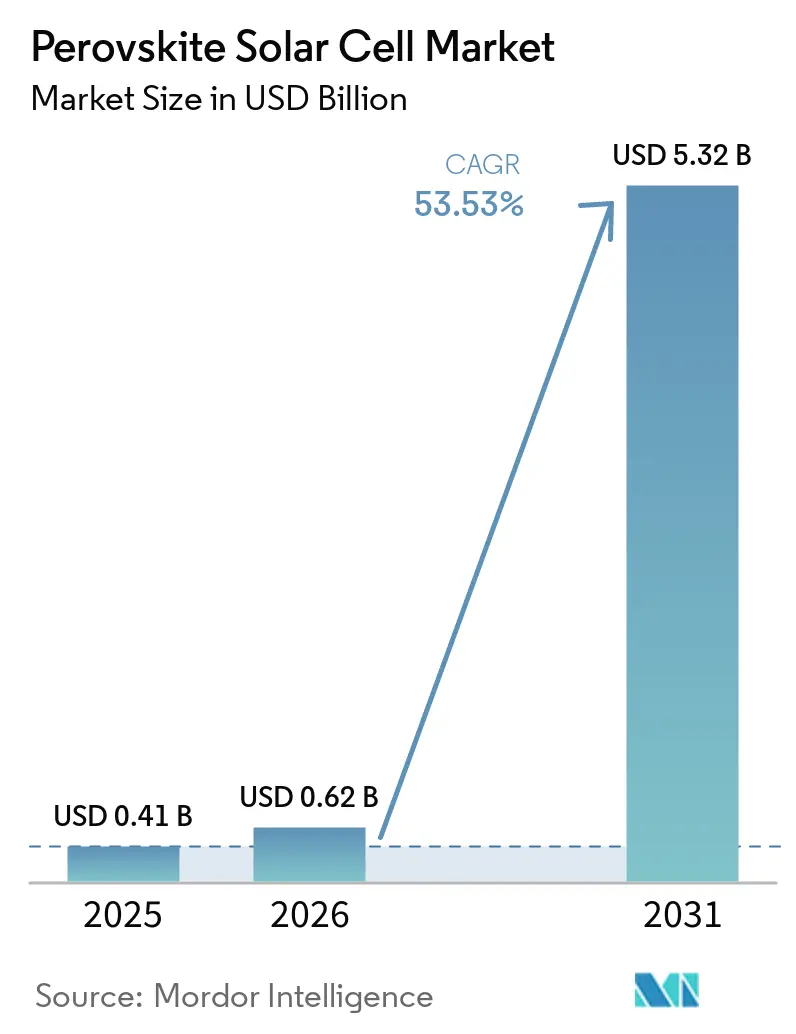
| Market Size (2026) | USD 0.62 Billion |
| Market Size (2031) | USD 5.32 Billion |
| Growth Rate (2026 - 2031) | 53.53 % |
| Fastest Growing Market | North America |
| Largest Market | Asia-Pacific |
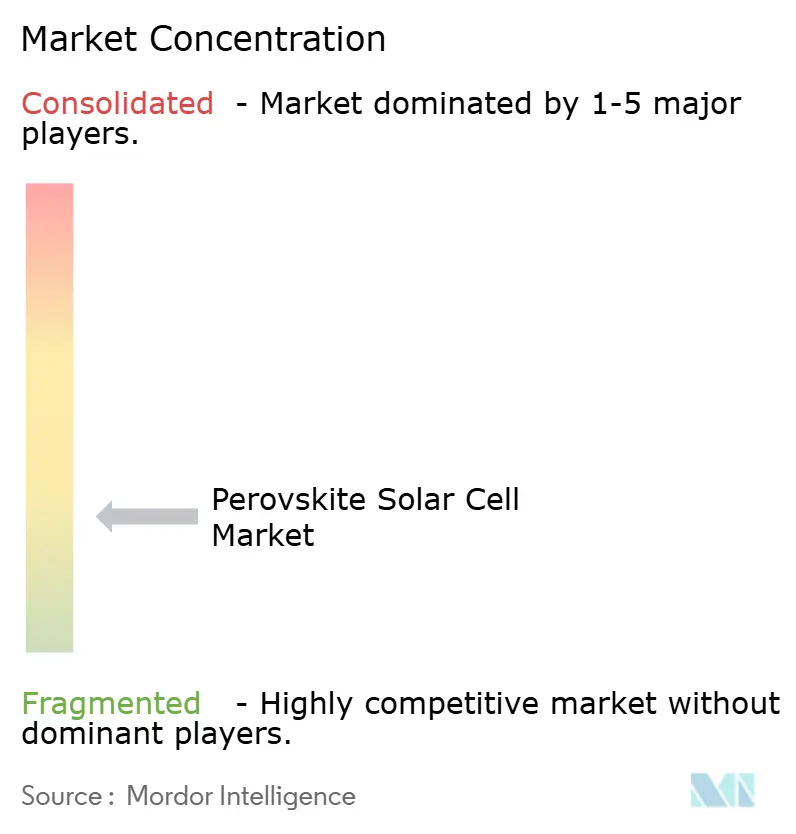
| Market Concentration | Low |
Major Players *Disclaimer: Major Players sorted in no particular order Image © Mordor Intelligence. Reuse requires attribution under CC BY 4.0. | |
Perovskite Solar Cell Market Analysis by Mordor Intelligence
The Perovskite solar cell market size is projected to expand from USD 0.41 billion in 2025 and USD 0.62 billion in 2026 to USD 5.32 billion by 2031, registering a CAGR of 53.5% between 2026 to 2031. Commercial activity is moving from laboratory validation toward early manufacturing, supported by higher certified efficiencies and expanding production capacity. Perovskite-silicon tandem designs are becoming a practical upgrade path for utility solar because higher output can reduce the number of modules required at a site. LONGi reported a 35.5% certified power-conversion efficiency for a two-terminal tandem cell in July 2026, while scalable ambient processing reached certified efficiencies of 26.6% for modules and 33% for tandem cells[1]“Scalable Ambient Fabrication of Single-Junction and Perovskite–Silicon Tandem Solar Cells,” Nature Sustainability, nature.com. Manufacturers are also using certification, supply agreements, and licensing to address procurement requirements before long field-performance records are available. The Perovskite solar cell market therefore has opportunities in standard panels, building-integrated systems, and lightweight products, although durability and financing requirements remain material constraints.
Key Report Takeaways
- By vertical, utility applications held 35.4% of the Perovskite solar cell sector share in 2025, while residential recorded the highest projected CAGR at 53.7% through 2031.
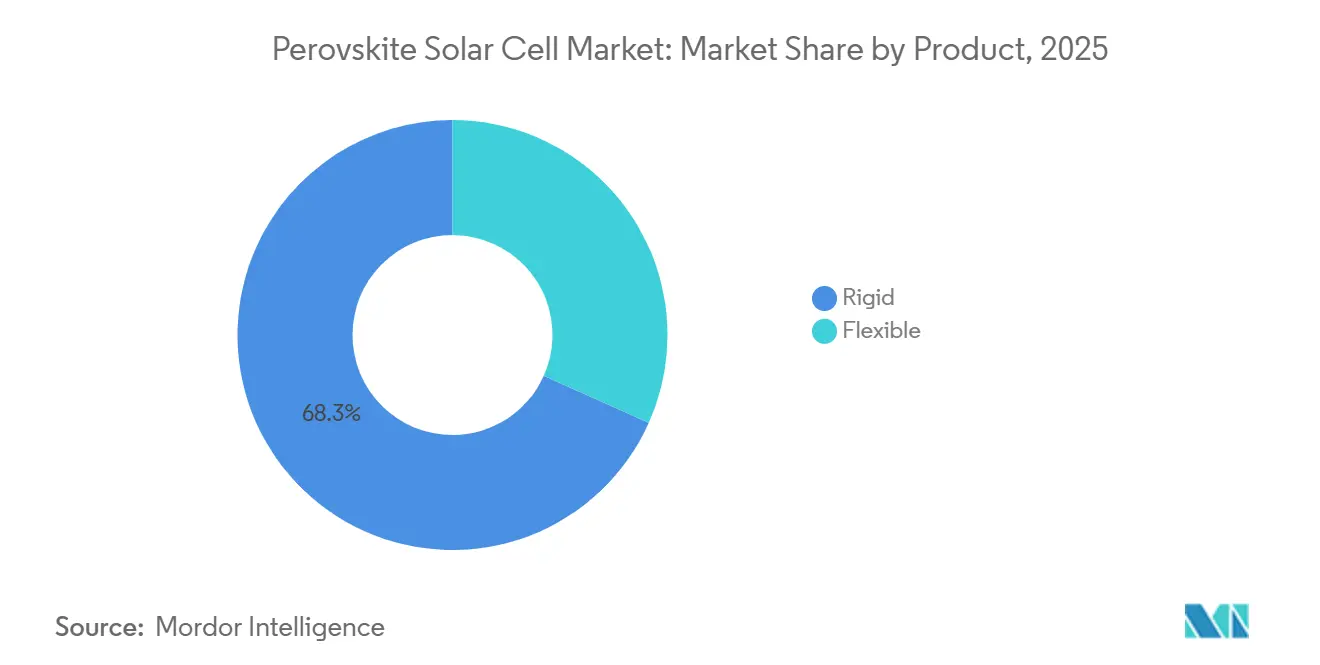
- By product, rigid modules accounted for 68.3% of the Perovskite solar cell market size in 2025, while flexible modules are forecast to grow at a 54.1% CAGR through 2031.
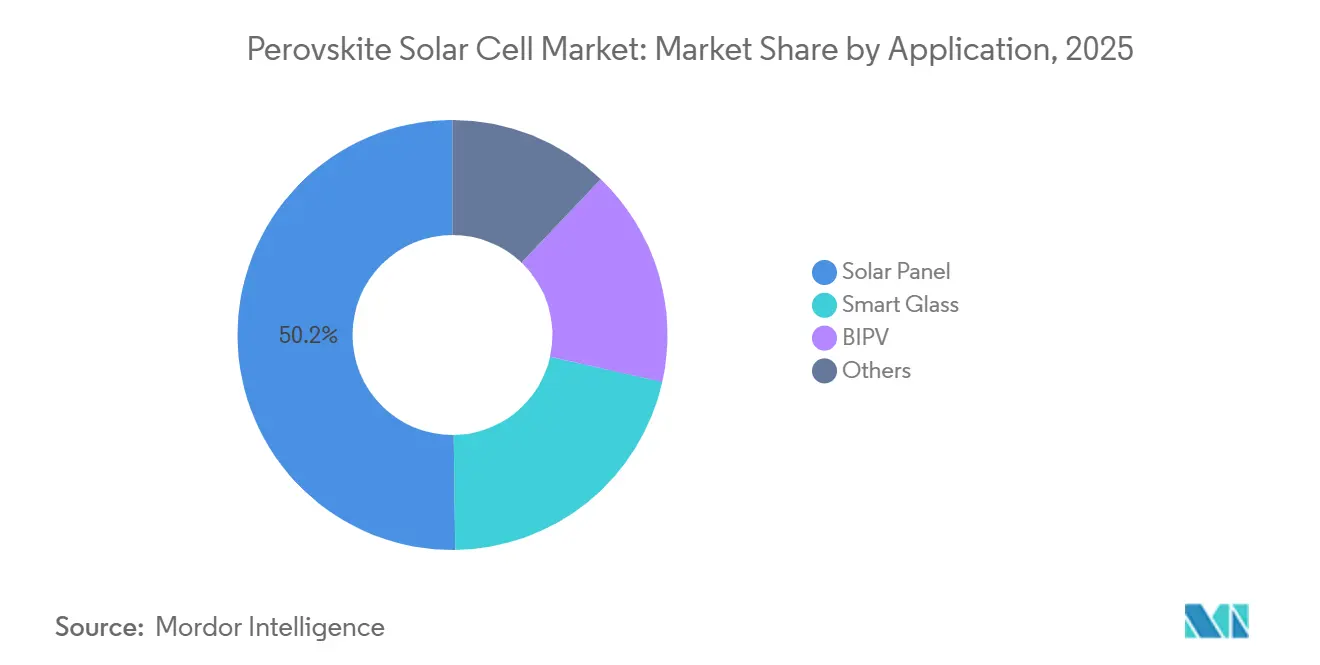
- By application, solar panels held 50.2% of revenue in 2025, while building-integrated photovoltaics, or BIPV, is projected to expand at a 54.8% CAGR through 2031.
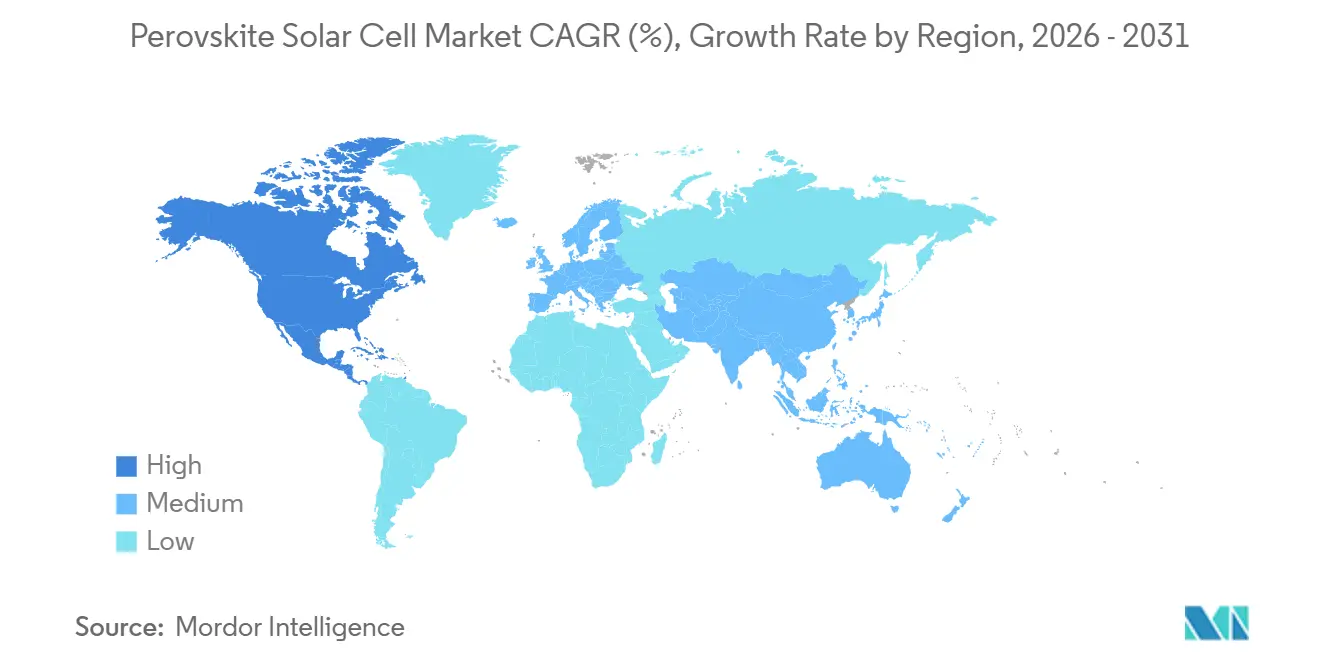
- By geography, Asia-Pacific held 52.7% of 2025 revenue, while North America is forecast to record a 57.4% CAGR through 2031.
Note: Market size and forecast figures in this report are generated using Mordor Intelligence’s proprietary estimation framework, updated with the latest available data and insights as of January 2026.
Global Perovskite Solar Cell Market Trends and Insights
Drivers Impact Analysis*
| Driver | % Impact on CAGR Forecast | Geographic Relevance | Impact Timeline |
|---|---|---|---|
| Higher Power-Conversion Efficiency and Tandem Performance | +18.00% | Global, concentrated in China, US, Germany | Short term (≤ 2 years) |
| Lightweight, Flexible, and Semitransparent Form Factors | +10.00% | APAC, Europe (BIPV), North America (defense/low-load) | Medium term (2–4 years) |
| Renewable-Energy Targets and Public R&D Funding | +10.00% | Japan, China, EU, United States | Medium term (2–4 years) |
| BIPV and Distributed-Generation Adoption | +8.00% | Europe, APAC core; spill-over to North America | Medium term (2–4 years) |
| Retrofit Economics for Existing Silicon PV Manufacturing | +5.50% | China, Germany, US (established silicon lines) | Long term (≥ 4 years) |
| Demand for Low-Load and Irregular-Surface Power Generation | +4.00% | Global, early gains in Japan, South Korea, US defense | Long term (≥ 4 years) |
| Source: Mordor Intelligence | |||
Higher Power-Conversion Efficiency and Tandem Performance
The Perovskite solar cell market is gaining support from the widening efficiency difference between tandem devices and conventional crystalline silicon modules. Tandem PV introduced a production-quality module with 30.4% efficiency in 2026 and reported letters of intent totaling USD 1 billion from utility-scale independent power producers. Higher module output can lower balance-of-system cost per watt because fewer modules are needed for each megawatt of capacity. Oxford PV targeted a 26% module with a 15-year lifetime in 2026 and a 27% module with a 20-year lifetime by 2027. Its plans place levelized cost of energy ahead of upfront module price in procurement discussions. Ambient-air blade-coated tandem cells achieved 33% certified efficiency, showing a scalable route that does not depend on high-vacuum deposition.
BIPV and Distributed-Generation Adoption
BIPV is supporting the Perovskite solar cell market because perovskite layers can provide semitransparent and colored products for building surfaces. This flexibility reduces the tradeoff between energy generation and visual design that has limited silicon-based building products. A Japanese five-year demonstration by Panasonic HD and AGC began at commercial and public facilities in late 2025, with mass production targeted around 2030. The project reported 18.1% conversion efficiency on 30 cm by 30 cm devices and near 80% retention after 20 simulated years. The same development path can support smart glass applications where integration requirements are more important than module-only pricing. Flexible module deployment by Swift Solar at Camp Pendleton also showed that distributed applications can value low weight and conformability over initial module cost.
Lightweight, Flexible, and Semitransparent Form Factors
Flexible products extend the Perovskite solar cell market to surfaces that cannot readily support glass-glass silicon modules. Renshine Solar invested CNY 1.25 billion in 2025, equivalent to USD 170 million, in a GW-scale flexible module facility. Its 1.2 m by 0.6 m modules achieved 20% efficiency and were certified by NREL and TÜV Rheinland. The EU-funded PEARL consortium, coordinated by Fraunhofer FEP, demonstrated roll-to-roll pilot production in July 2025 for BIPV and IoT uses[2]“07-2025, Milestone in Flexible Perovskite Solar Cells, EU-Funded PEARL Consortium Demonstrates Roll-to-Roll Production,” Fraunhofer FEP, fraunhofer.de. Flexible modules can serve low-load rooftops, irregular surfaces, defense equipment, and other applications where module weight determines the feasible installation. This production approach can also reduce capital requirements per megawatt compared with vacuum-based manufacturing, although throughput remains important for scale.
Renewable-Energy Targets and Public R&D Funding
Public targets and manufacturing support are creating a clearer demand signal for the Perovskite solar cell market. Japan’s 7th Energy Basic Plan, approved in February 2025, set a 20 GW domestic perovskite installation target for 2040. The plan also calls for public and private coordination on production scale-up and demand development. In the United States, Tandem PV received a USD 7.7 million ARPA-E SCALEUP Ready grant for domestic manufacturing work. Such programs can reduce early development risk when production equipment and qualification procedures are still evolving. They can also create an architecture risk if a funded manufacturing line is built around a design that is overtaken by faster efficiency improvements. Existing silicon lines provide a potential retrofit base, which could make tandem production more economical as commercial volumes rise.
Restraints Impact Analysis*
| Restraint | % Impact on CAGR Forecast | Geographic Relevance | Impact Timeline |
|---|---|---|---|
| Moisture, Heat, UV, and Ion-Migration Degradation | -6.00% | Global; most acute in humid climates (Southeast Asia, MEA coasts) | Short term (≤ 2 years) |
| Lead Management and End-of-Life Compliance | -4.00% | Europe (RoHS), and increasingly North America and APAC | Medium term (2–4 years) |
| Bankability Gap from Limited Field-Life Data | -5.00% | Global — acute for utility-scale project finance | Short term (≤ 2 years) |
| Large-Area Yield and Encapsulation Supply-Chain Constraints | -4.50% | China, Germany, US (GW lines ramping) | Medium term (2–4 years) |
| Source: Mordor Intelligence | |||
Moisture, Heat, UV, and Ion-Migration Degradation
Durability remains a core constraint for the Perovskite solar cell market because module failure pathways differ from those of silicon. Ion migration, interface breakdown, and encapsulation failure may not be fully represented by testing designed around conventional silicon behavior. A 2026 analysis examined the technological pathways and tradeoffs required for long-term operation of perovskite modules[3]“Challenges, Technological Pathways and Trade-Offs of Perovskite Solar Modules for Long-Term Operation,” Nature Energy, nature.com. A separate model estimated survival of 26 months in arid Phoenix and 42 months in temperate Seattle for a tandem cell meeting minimum ISOS-L2 stability thresholds[4]“Modelling and Predicting Real-World Lifetime of Perovskite–Silicon Tandem Solar Cells,” EES Solar, pubs.rsc.org. China Huaneng commissioned a 5 MW Qinghai demonstration plant in August 2025 to generate field evidence on ultraviolet exposure, sand abrasion, and high-altitude conditions. The results matter because qualification methods, encapsulation materials, and installation climate can all influence deployment confidence.
Bankability Gap from Limited Field-Life Data
The Perovskite solar cell market faces a financing gap because lenders need long and comparable performance records before they support extended warranties. The first commercial shipments by Oxford PV to U.S. utility customers began in late 2024, leaving limited time for multi-year field validation. Utility-scale procurement faces the highest requirement because it depends on institutional lenders, tax-equity investors, insurers, and independent engineers. Large-area yield and reliable encapsulation add to this issue because laboratory power-conversion efficiency alone does not establish reproducible field performance. A 2026 commercialization framework identified the need to link laboratory results with large-area, statistically reliable, IEC-qualified module data. Lead management creates an additional compliance requirement, and research has shown that closed-loop recovery can capture more than 99% of lead from end-of-life perovskite cells.
*Our forecasts treat driver/restraint impacts as directional, not additive. The impact forecasts reflect baseline growth, mix effects, and variable interactions.
Segment Analysis
By Vertical: Utility Anchors Revenue as Residential Leads the Growth Forecast
Utility applications held 35.4% of the Perovskite solar cell market share in 2025, making them the largest vertical. Early independent power producers are using higher energy density to reduce land requirements at large solar sites. Utility buyers also require formal evidence on performance, reliability, and certification before they make larger commitments. GCL Optoelectronic supplied IEC 61215 and IEC 61730 certified tandem modules for China Huaneng’s Qinghai demonstration plant. The project required mass-production efficiency of at least 26% and a 25-year performance warranty. That order shows how early institutional buyers can use controlled demonstration projects to qualify a new module technology. It also shows why early utility demand tends to focus on designs with clear manufacturing and certification pathways. The Perovskite solar cell industry depends on this type of field deployment to establish a record that project financiers can assess.
Residential is forecast to be the fastest-growing vertical at a 53.7% CAGR through 2031. Space-constrained urban rooftops can benefit from tandem panels that generate more watt-hours per square meter. Higher energy density can shorten the expected system payback period compared with silicon systems of the same size. Residential and commercial installers may also accept shorter warranties while large utility financiers wait for more field data. Industrial rooftops offer a middle ground because they provide useful scale without the full scrutiny applied to utility financing. Commercial BIPV projects can support integrated, semitransparent designs where building requirements influence the purchase decision. The others category includes defense, aerospace, and IoT applications. Swift Solar’s Camp Pendleton deployment illustrates a setting where power-to-weight performance can justify an early technology premium.
By Product: Rigid Format Defines the Market, Flexible Drives the Next Chapter
Rigid modules accounted for 68.3% of the Perovskite solar cell market size in 2025. Their position reflects established glass-substrate production, mature glass-glass encapsulation supply chains, and compatibility with familiar certification workflows. GCL Optoelectronic’s 500 MW Kunshan line achieved IEC 61215 and IEC 61730 certification for a 2 m² tandem module. The company targeted 50 MW to 70 MW of 2026 shipments, placing its line in early commercial production. Rigid formats suit utility and commercial customers that favor conventional module dimensions and mounting systems. They also provide a clearer route for manufacturers seeking higher throughput at larger production scales. GCL expects cost at 3 GW of production capacity to approach silicon parity. This cost path supports continued rigid-module leadership while the wider Perovskite solar cell market develops.
Flexible modules are forecast to grow at a 54.1% CAGR through 2031. Their lower starting base and use across BIPV, low-load rooftops, defense systems, and irregular surfaces support this faster rate. Renshine Solar’s flexible facility investment shows that large-scale equipment decisions are already being made for this format. The company also reported a certified 27.5% efficiency for a flexible all-perovskite cell made with industrial-scale blade coating. Fraunhofer FEP’s PEARL pilot demonstrated a roll-to-roll route that could support European flexible production. Flexible designs require reliable encapsulation and supply access for conductive materials and protective films. These requirements may slow scale-up outside China, even where lightweight modules have a strong use case.


By Application: Solar Panel Leads in Scale, BIPV Sets the Pace for Value
Solar panels represented 50.2% of 2025 revenue in the Perovskite solar cell market. Standard ground-mounted and rooftop panels can be assessed as higher-output alternatives to silicon modules. Their established installation formats make the value proposition easier for utility and rooftop buyers to understand. Early shipments by Oxford PV and GCL supported this route to commercialization. Purchasers can compare these products through energy yield, module efficiency, and levelized cost of energy. Solar-panel demand also creates the field data needed to improve financing terms and warranty confidence. The broad installed base of conventional solar equipment may make tandem adoption easier where mounting and electrical designs remain compatible. This application therefore supports scale while other product categories develop specialized demand.
BIPV is projected to grow at a 54.8% CAGR through 2031, the fastest rate among applications. Semitransparent and tinted products can be incorporated into facades and other building elements. Panasonic HD and AGC used a five-year Japanese demonstration to examine glass-integrated perovskite products for public and commercial buildings. Building owners can evaluate a facade system as part of the building envelope rather than only as a module purchase. That approach can support higher selling prices where visual and structural integration matter. The others application group includes indoor photovoltaics for IoT devices and consumer electronics. Perovskite’s tunable bandgap can improve spectral matching under warm-white indoor light. These specialized applications remain smaller but add product routes outside conventional outdoor solar installations.
Geography Analysis
Asia-Pacific held 52.7% of the Perovskite solar cell market share in 2025 and remained the leading commercial region. China has GW-era manufacturing activity at companies including GCL Optoelectronic and Renshine Solar. China Huaneng’s 5 MW Qinghai plant, commissioned in August 2025, is testing performance under strong ultraviolet exposure, sand abrasion, and high-altitude pressure. These field conditions can provide evidence that is not captured by standard laboratory tests. Japan is using a government and private-sector model built around its 20 GW domestic installation target for 2040. Panasonic HD and AGC are also testing glass-integrated products in commercial and public settings. South Korea contributes through thin-film tandem research, while Vietnam, Thailand, Indonesia, and Australia remain secondary markets for off-grid flexible applications.
North America is forecast to grow at a 57.4% CAGR through 2031, the highest rate among geographic segments. Tandem PV shipped its first production-quality panel from its Fremont, California, facility in 2026 and reported USD 1 billion in letters of intent. Caelux signed 13 GW of five-year supply agreements across 3 manufacturers on 2 continents by mid-2026. Its approach adds perovskite-coated Active Glass to existing silicon-module production lines. U.S. activity is supported by domestic manufacturing policy, defense procurement, and commercial module introductions. The combination of early orders and local production targets can help build a domestic supply base, but long-term financing remains dependent on field data.
Europe has a smaller current base but retains a meaningful role in research, BIPV, and flexible manufacturing. Fraunhofer ISE worked with Oxford PV on module design and shingled interconnection technology. Fraunhofer FEP coordinated the PEARL consortium’s roll-to-roll flexible-cell pilot for BIPV and IoT uses. South America and the Middle East and Africa currently represent smaller revenue shares. Brazil, Chile, Argentina, Saudi Arabia, the UAE, Egypt, South Africa, and Morocco have potential for distributed and off-grid applications in high-irradiance settings. Their relevance is tied to flexible products and the cost of extending the grid to remote areas.

Competitive Landscape
The Perovskite solar cell market is moderately fragmented overall, although commercial-scale manufacturing is concentrated among fewer than 10 companies operating or commissioning GW-class production lines in mid-2026. Chinese volume manufacturers, Western tandem specialists, and glass innovators are following distinct routes to commercial scale. GCL Optoelectronic is expanding rigid tandem manufacturing, using large-format certification and a target of silicon-cost parity at 3 GW of production. Oxford PV competes through efficiency development and intellectual property, with more than 400 granted perovskite patents. It also entered a licensing and technology cooperation agreement that enables Trina Solar sublicensees to manufacture tandem modules in China. Caelux uses an asset-light approach that applies perovskite-coated glass to existing silicon module lines. These models reflect different approaches to manufacturing investment, technology control, and the path to volume sales.
Certification is a central competitive requirement because institutional buyers look to IEC 61215 and IEC 61730 as procurement thresholds. GCL’s dual certification for a large-format tandem module provides an early benchmark for rivals. Oxford PV and Fraunhofer ISE presented a 25.6% shingled tandem prototype in June 2026 that was made at Oxford PV’s Brandenburg an der Havel facility. The design was described as compatible with mass production. Caelux and Solx announced a 5-year, 3 GW partnership in April 2026 for production in Aguadilla, Puerto Rico. The partners targeted commercial U.S. volumes by 2027 and 28% module efficiency. These actions show that leading companies are pairing technology claims with manufacturing, licensing, or supply commitments.
Flexible encapsulation, space-grade photovoltaics, and end-of-life lead recovery remain specialized areas of competition. The supply chain for conductive glass and encapsulation films is not fully de-risked outside China. GCL reported efficiency above 30% for space-grade devices, creating a possible route into applications where output and weight are important. Research on biodegradable chelator-biosorbent recovery reported lead capture above 99%, which could support a compliance service layer for European deployment. Saule Technologies, Microquanta Semiconductor, and UtmoLight operate in niche BIPV and distributed-generation areas where volumes are lower and product value can be higher. Market-share positions could change after 2027 as commercial modules accumulate 2 to 3 years of field results.
Recent Indu
Perovskite Solar Cell Industry Leaders
Oxford PV
Microquanta Semiconductor Co., Ltd.
UtmoLight Co., Ltd.
Greatcell Energy
Saule Technologies
- *Disclaimer: Major Players sorted in no particular order

Recent Industry Developments
- July 2026: India's Ministry of New and Renewable Energy has earmarked USD 24 million for a Perovskite PV Manufacturing Pilot Line and associated projects under its Renewable Energy Research and Technology Development program for 2026–27 to 2030–31.
- July 2026: China's LONGi announced a new world-record conversion efficiency of 35.5% for an independently developed crystalline silicon/perovskite two-terminal tandem solar cell. The result was certified by the European Solar Test Installation (ESTI), providing third-party validation of the reported efficiency. LONGi announced the achievement at its 2026 Solar and Energy Storage Innovation Conference.
- June 2026: Kyocera began testing Sekisui Chemical's perovskite solar modules under real-world outdoor conditions at six facilities in Japan.
- April 2026: Caelux and Solx announced a five-year, 3 GW strategic partnership to produce perovskite-silicon hybrid tandem modules at Solx's Aguadilla, Puerto Rico facility, targeting US commercial volumes by 2027. The partnership integrates Caelux's Active Glass technology into Solx's Aurora module platform to deliver 28% module efficiency and a greater-than-20% LCOE improvement over conventional silicon.


Global Perovskite Solar Cell Market Report Scope
A perovskite solar cell (PSC) is a photovoltaic device that uses a perovskite-structured semiconductor material as the light-absorbing layer to convert sunlight into electricity. These materials typically have a structure represented by ABX₃, where A is an organic or inorganic cation, B is a metal such as lead or tin, and X is a halide such as iodine, bromine, or chlorine. Perovskite solar cells are characterized by high power conversion efficiency, strong light absorption, tunable bandgaps, and the potential for low-cost manufacturing. They can be produced in rigid or flexible formats and are being developed for single-junction and tandem solar applications, including perovskite-silicon tandem cells.
The global perovskite solar cell market is segmented by vertical, product, application, and geography. By vertical, the market is segmented into utility, industrial, commercial, residential, and other verticals. By product, the market is segmented into rigid and flexible perovskite solar cells. By application, the market is segmented into smart glass, solar panels, building-integrated photovoltaics (BIPV), and other applications. The report also covers the market size and forecasts for the global perovskite solar cell market across 26 countries in key regions. For each segment, the market sizing and forecasts have been provided on the basis of value (USD).
| Utility |
| Industrial |
| Commercial |
| Residential |
| Others |
| Rigid |
| Flexible |
| Smart Glass |
| Solar Panel |
| BIPV |
| Others |
| North America | United States |
| Canada | |
| Mexico | |
| Europe | Germany |
| France | |
| Italy | |
| Spain | |
| United Kingdom | |
| Poland | |
| Russia | |
| Rest of Europe | |
| Asia-Pacific | China |
| India | |
| Japan | |
| South Korea | |
| Australia | |
| Indonesia | |
| Vietnam | |
| Thailand | |
| Rest of Asia-Pacific | |
| South America | Brazil |
| Argentina | |
| Chile | |
| Rest of South America | |
| Middle East and Africa | Saudi Arabia |
| United Arab Emirates | |
| Egypt | |
| South Africa | |
| Morocco | |
| Rest of Middle East and Africa |
| By Vertical | Utility | |
| Industrial | ||
| Commercial | ||
| Residential | ||
| Others | ||
| By Product | Rigid | |
| Flexible | ||
| By Application | Smart Glass | |
| Solar Panel | ||
| BIPV | ||
| Others | ||
| By Geography | North America | United States |
| Canada | ||
| Mexico | ||
| Europe | Germany | |
| France | ||
| Italy | ||
| Spain | ||
| United Kingdom | ||
| Poland | ||
| Russia | ||
| Rest of Europe | ||
| Asia-Pacific | China | |
| India | ||
| Japan | ||
| South Korea | ||
| Australia | ||
| Indonesia | ||
| Vietnam | ||
| Thailand | ||
| Rest of Asia-Pacific | ||
| South America | Brazil | |
| Argentina | ||
| Chile | ||
| Rest of South America | ||
| Middle East and Africa | Saudi Arabia | |
| United Arab Emirates | ||
| Egypt | ||
| South Africa | ||
| Morocco | ||
| Rest of Middle East and Africa | ||


Key Questions Answered in the Report
What is the projected value of the Perovskite solar cell market by 2031?
The market is projected to reach USD 5.32 billion by 2031, from USD 0.62 billion in 2026, at a 53.53% CAGR.
Which Perovskite solar cell application is growing fastest?
BIPV is projected to record the highest application CAGR at 54.8% through 2031, supported by semitransparent and colored building products.
Why are tandem solar modules important for project economics?
Perovskite-silicon tandems can increase output per module, reducing module count and related balance-of-system costs at a site.
What is limiting wider utility-scale adoption?
Long-term performance records, bankability, large-area yield, encapsulation reliability, and financing requirements remain the main limits.
Which region is expanding most rapidly?
North America is forecast to grow at a 57.4% CAGR through 2031, supported by manufacturing activity, defense demand, and module launches.
What role do flexible perovskite modules play?
Flexible modules serve low-load rooftops, building facades, defense systems, and irregular surfaces, and are forecast to grow at a 54.1% CAGR.
Page last updated on:





