
Perishable Air Freight Cold Chain Logistics Market Size and Share
Market Overview
| Study Period | 2020 - 2031 |
|---|---|
| Market Size (2026) | USD 16.61 Billion |
| Market Size (2031) | USD 21.23 Billion |
| Growth Rate (2026 - 2031) | 5.04 % |
| Fastest Growing Market | Asia-Pacific |
| Largest Market | Asia-Pacific |
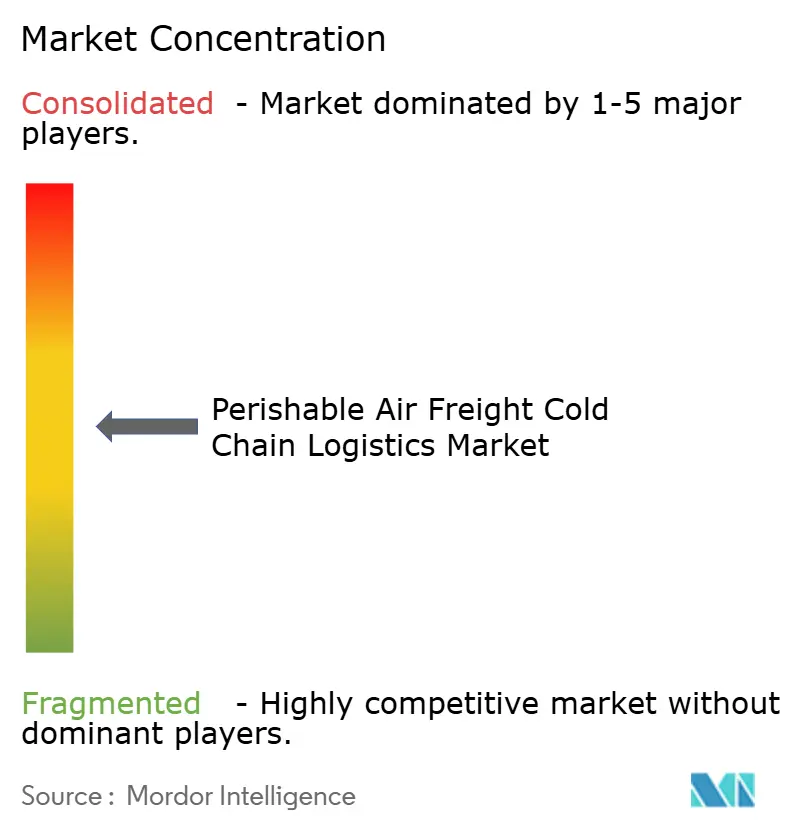
| Market Concentration | Medium |
Major Players *Disclaimer: Major Players sorted in no particular order Image © Mordor Intelligence. Reuse requires attribution under CC BY 4.0. | |
Perishable Air Freight Cold Chain Logistics Market Analysis by Mordor Intelligence
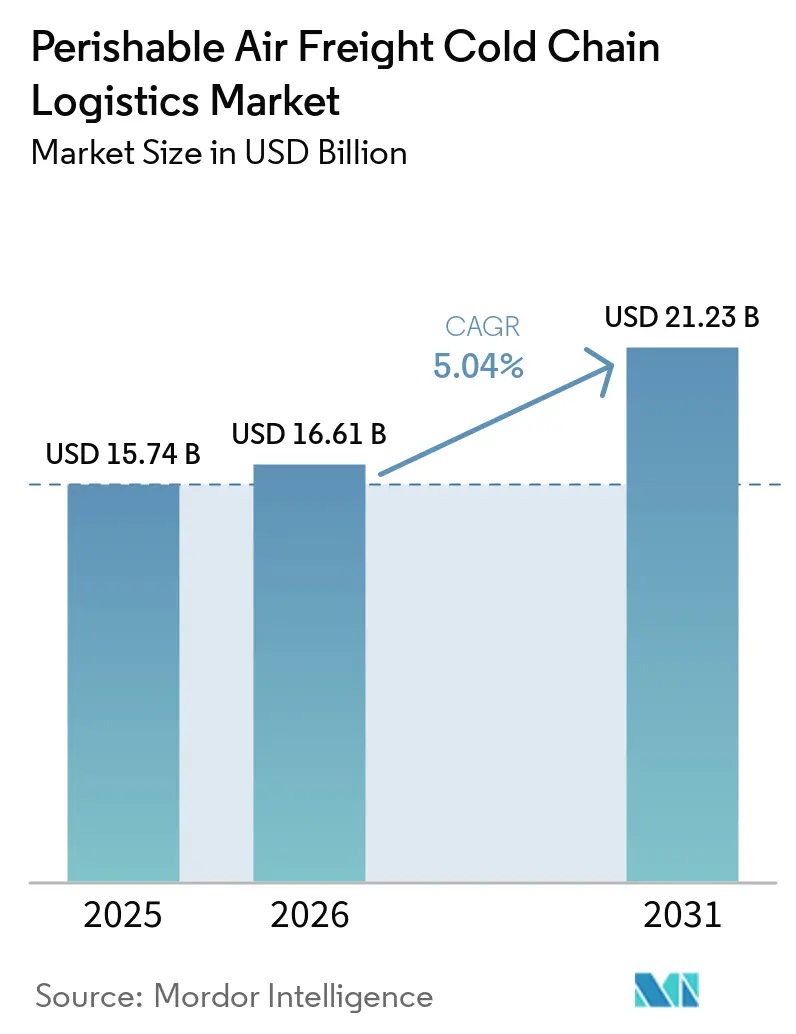
The perishable air freight cold chain logistics market size was valued at USD 15.74 billion in 2025 and is estimated to grow from USD 16.61 billion in 2026 to reach USD 21.23 billion by 2031, at a CAGR of 5.04% during the forecast period (2026-2031).
The market serves shipments that need both short transit times and controlled temperatures across long international routes. Biologics, cell and gene therapies, premium seafood, and cut flowers support demand because their value, shelf-life requirements, or viability windows make surface transport unsuitable. Demand comes from both healthcare and food systems, which provide some protection from changes in general air cargo activity. Operators are building certified handling networks, dedicated capacity arrangements, and digital monitoring services to protect cargo and document compliance. Higher freight costs, tarmac exposure, customs delays, and fragmented shipment data continue to limit the addressable base for lower-value goods.[1]
Key Report Takeaways
- By service type, freight transport held 70.24% of the perishable air freight cold chain logistics market share in 2025, while other value-added services are forecast to register a 6.84% CAGR through 2031.
- By product category, fresh fruits and vegetables accounted for 28.50% of the perishable air freight cold chain logistics market size in 2025, while seafood and fishery products are forecast to advance at a 6.72% CAGR through 2031.
- By temperature range, chilled/refrigerated held 43.15% of the perishable air freight cold chain logistics market share in 2025, while deep-frozen/ultra-low temperature is forecast to register a 6.94% CAGR through 2031.
- By geography, Asia-Pacific held 38.30% of the perishable air freight cold chain logistics market size in 2025 and is forecast to register a 6.58% CAGR through 2031.
Note: Market size and forecast figures in this report are generated using Mordor Intelligence’s proprietary estimation framework, updated with the latest available data and insights as of January 2026.
Global Perishable Air Freight Cold Chain Logistics Market Trends and Insights
Drivers Impact Analysis*
| Driver | (~) % Impact on CAGR Forecast | Geographic Relevance | Impact Timeline |
|---|---|---|---|
| Biologics, Cell Therapies, and Time-Critical Healthcare Cargo | +1.4% | Global, concentrated in North America, Europe, and the Asia-Pacific pharmaceutical hubs | Long term (≥ 4 years) |
| Cross-Border Demand for Premium Produce, Seafood, and Floriculture | +1.1% | Latin America, Asia-Pacific, and Africa as supply regions, with Europe, North America, and the Middle East as demand centers | Short term (≤ 2 years) |
| Food Safety, Traceability, and Temperature-Control Compliance | +0.9% | Global, with the highest regulatory intensity in North America and Europe | Medium term (2-4 years) |
| Integrated Airport Cold-Chain Infrastructure and CEIV-Certified Handling | +0.7% | Global, with early activity in Brussels, Singapore, Frankfurt, Dubai, and Cincinnati | Medium term (2-4 years) |
| Airport Digital Twins and Predictive Exception Management | +0.5% | Europe and the Middle East as early movers, with Asia-Pacific expanding | Long term (≥ 4 years) |
| Reusable Thermal Packaging and Reverse Logistics | +0.3% | Global, concentrated on high-frequency pharmaceutical corridors | Long term (≥ 4 years) |
| Source: Mordor Intelligence | |||
Growth of Biologics, Cell Therapies, and High-Value Time-Critical Healthcare Cargo
Biologics and cell and gene therapies are increasing the demand for specialized cold chain air freight because a temperature failure can result in complete product loss. Some cell and gene therapy shipments carry values above USD 1 million per kilogram, while autologous therapies may have viability windows measured in hours. These products need cryogenic transport between -60 °C and -196 °C using specialized active containers and dedicated air freight. In January 2026, the FDA introduced a flexible approach to certain chemistry, manufacturing, and controls requirements to support the commercialization of novel cell and gene therapies.[2] The IATA CEIV Pharma program provides a common handling framework for airlines, ground handlers, and forwarders across multi-leg routes.[3] Healthcare providers can bear logistics costs that would be unsuitable for most other products, making this premium freight less sensitive to general rate movements.
Rising Cross-Border Demand for Premium Fresh Produce, Seafood, and Floriculture
Premium perishables move by air when their destination price and freshness requirement justify the added logistics cost. Latin America supplied 1.3 million tons of food and perishables by air in 2025, representing 26% of global food and perishable air freight volumes, including Colombian and Ecuadorian flowers, Chilean berries, and Peruvian asparagus. The Africa-to-Europe perishable corridor grew 5% in 2025, supported by Kenyan horticulture and fresh vegetables. Ecuador and Kenya have established production, handling, and air freight networks that are difficult to replace quickly. IATA Perishable Cargo Regulations define packaging, labeling, and documentation responsibilities for these shipments. These requirements affect loss rates and support destination-market food-safety compliance.
Stricter Food Safety, Traceability, and Temperature-Control Compliance
Food safety rules are changing traceability from an administrative task into an operational requirement. The FDA Food Traceability Final Rule requires covered entities to maintain key data elements at critical tracking events for covered food items. The rule has a January 20, 2026, compliance date and requires records within 24 hours of an FDA request. It covers products including leafy greens, seafood, and shell eggs, raising the value of operators that maintain digital records through air transport. IATA’s PCR 26th edition includes competency-based training recommendations for perishable cargo personnel when it will take effect in 2027. WHO guidance also calls for qualified routes, validated packaging, and documented temperature monitoring for pharmaceutical products.
Expansion of Integrated Airport Cold-Chain Infrastructure and CEIV-Certified Handling
CEIV Pharma-certified cargo communities are influencing where pharmaceutical and premium perishable shipments move because they can provide controlled handling between aircraft, storage, and onward transport. The IATA program evaluates safety, compliance, efficiency, and staff training against Good Distribution Practice-aligned standards. Between November 2025 and March 2026, Lufthansa Cargo received comprehensive CEIV Pharma certification across Frankfurt, Munich, and Chicago hubs, as well as several stations. Its network included 230 passive temperature-support stations and 120 active temperature-control stations. Dallas Fort Worth International Airport also developed a CEIV Pharma community with handlers, cold-storage operators, and forwarders. Validated equipment, acceptance checklists, and risk controls developed for pharmaceutical traffic are also being applied to high-value produce.
Restraints Impact Analysis*
| Restraint | (~) % Impact on CAGR Forecast | Geographic Relevance | Impact Timeline |
|---|---|---|---|
| High Air-Freight Cost and Limited Viability for Low-Value Cargo | -1.3% | Global, most acute in Africa, Latin America, and Southeast Asia origin markets | Short term (≤ 2 years) |
| Temperature Excursion Risk at Tarmac, Transit, and Customs Interfaces | -0.9% | Global, with the highest exposure at tropical and high-temperature origin airports | Medium term (2-4 years) |
| Fragmented Data Ownership Across Airlines, Ground Handlers, Forwarders, and Shippers | -0.7% | Global, most pronounced on multi-leg intercontinental routes | Medium term (2-4 years) |
| Climate-Driven Airport Disruption and Refrigerant or Energy Cost Exposure | -0.5% | Equatorial and Middle East hubs, with emerging exposure in Southern Europe | Long term (≥ 4 years) |
| Source: Mordor Intelligence | |||
High Air-Freight Cost and Limited Economic Viability for Low-Value Cargo
Air freight rates remain well above pre-pandemic levels, which restricts the perishable air freight cold chain logistics market to products with high value density or urgent delivery needs. IATA reported that cargo yields declined 1.5% in 2025 but remained 37.2% above 2019 levels. The WTO reported that global goods trade reached USD 34.89 trillion in 2025, but most agricultural shipments still moved by ocean because air freight was too costly for staple crops.[4] IATA PCR can reduce product loss but does not change the core cost of air freight. Grains, standard vegetables, and commodity fruits generally lack margins for dedicated cold-chain air transport. This leaves a clear boundary between premium perishables that can travel by air and lower-value products that must use lower-cost modes.
Temperature Excursion Risk During Tarmac, Transit, and Customs Interfaces
Airport tarmac transfers create a major thermal risk because shipments can be exposed between aircraft offload and entry into temperature-controlled storage. Surface temperatures can exceed 60 °C at some equatorial and Middle Eastern locations during summer, and high traffic periods can extend exposure time. WHO guidance, effective from October 2025, requires documented temperature control, trained personnel, and validated packaging across the transport chain for infectious substances and related biological products. Some pharmaceutical products have ambient transfer windows of only 30 minutes under IATA handling guidance. The United States Pharmacopeia proposed a 2025 chapter on lane temperature mapping and qualification, formalizing route-level risk management. Airside transfer vehicles, short-dock facilities, and real-time monitoring can reduce thermal risk, while a lack of investment can weaken carrier reputation and shipper confidence.
*Our forecasts treat driver/restraint impacts as directional, not additive. The impact forecasts reflect baseline growth, mix effects, and variable interactions.
Segment Analysis
By Service Type: Compliance Services Grow Faster Than Core Freight
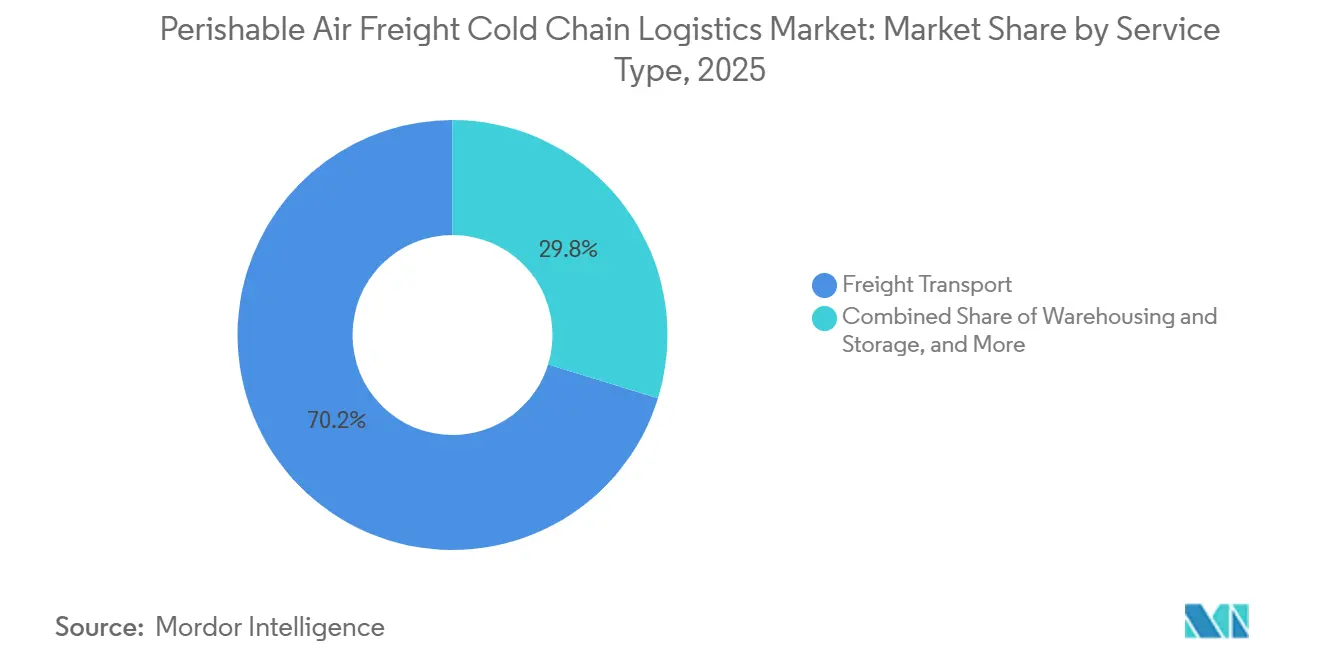
Freight transport held 70.24% of the perishable air freight cold chain logistics market size in 2025. Its position reflects dedicated capacity agreements and block-space arrangements on certified pharmaceutical and perishable routes. Freight Forwarding coordinates multi-modal transfers, exception escalation, and documentation across airlines and ground handlers. Warehousing and storage are gaining importance because airport-adjacent GDP-compliant facilities can reduce tarmac exposure and speed customs clearance.
Other value-added services are forecast to register a 6.84% CAGR through 2031. This category includes temperature-excursion documentation, customs pre-clearance, real-time monitoring, and temperature-continuity insurance. IATA’s PCR 26th edition will increase the importance of trained personnel for perishable handling when it becomes effective in 2027. The Perishable air freight cold chain logistics market may see value-added service revenue rise faster than transport revenue as documentation and data become more important.
By Product Category: Seafood Has the Fastest Growth Outlook
Fresh fruits and vegetables accounted for 28.50% of the perishable air freight cold chain logistics market size in 2025. The category benefits from year-round demand in Europe, the Gulf, and Northeast Asia for tropical fruit, off-season berries, and premium salads. Meat and poultry volumes are supported by Halal-certified beef exports from Australia and South America to Gulf markets. Flowers and Horticultural Products retain demand during Valentine’s Day, Chinese New Year, and Mother’s Day.
Seafood and fishery products are forecast to register a 6.72% CAGR through 2031. Norwegian salmon, Vietnamese pangasius, Chilean sea bass, and Japanese yellowtail illustrate the geographic distance between premium supply and consumption markets. General and other temperature-sensitive perishables include pharmaceutical cargo, specialty dairy, and precision-fermented food products. Food categories are increasingly managed with pharmaceutical-style controls because destination rules require temperature records, custody records, and validated packaging.
By Temperature Range: Ultra-Low Temperature Cargo Drives Faster Growth
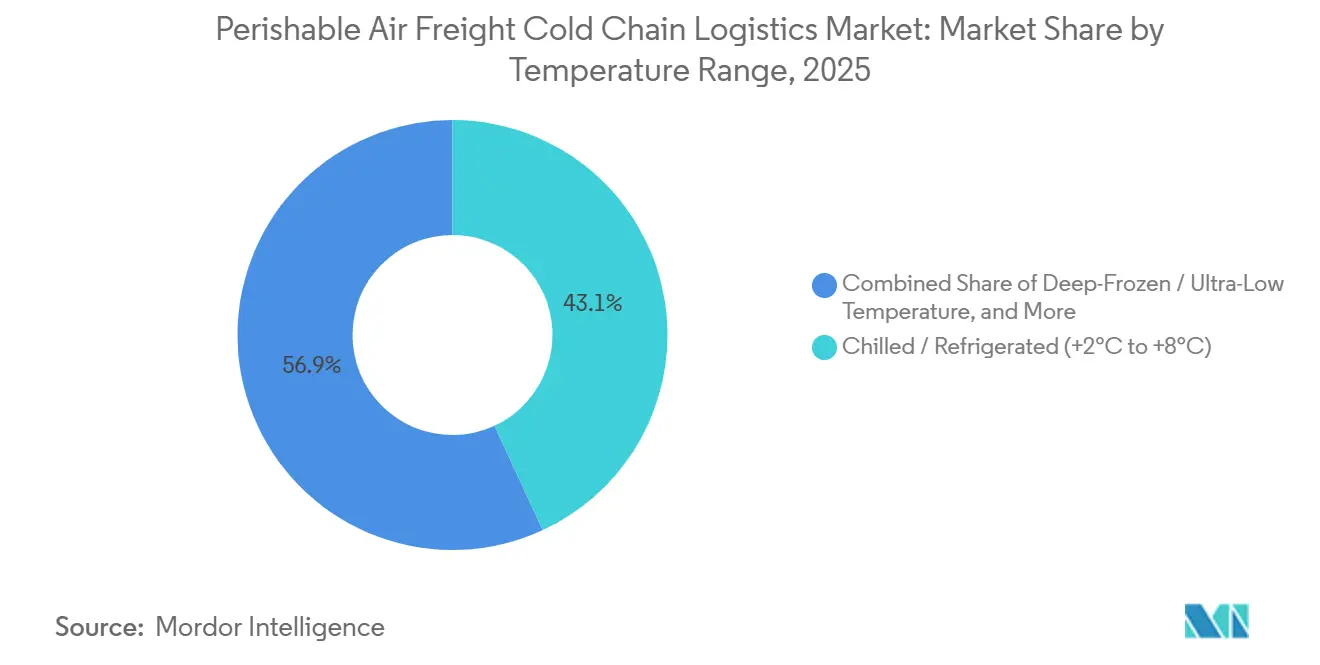
Chilled/refrigerated cargo at +2 °C to +8 °C held 43.15% of the perishable air freight cold chain logistics market share in 2025. It serves conventional pharmaceuticals, fresh produce, flowers, and standard biologics across major air freight routes. Controlled ambient cargo at +15 °C to +25 °C serves oral solid dosage forms, some vaccines, and temperature-sensitive diagnostics. Frozen cargo at -15 °C to -25 °C supports conventional frozen meat and seafood trade on established hub routes.
Deep-frozen/ultra-low temperature cargo below -60 °C is forecast to register a 6.94% CAGR through 2031. It serves cell and gene therapies that require cryogenic conditions between -60 °C and -196 °C, as well as frozen seafood moving from remote processing areas. WHO technical guidance provides baseline standards for qualified packaging and temperature monitoring across relevant bands. Active containers with 199-hour to 300-hour runtimes can protect cargo during customs delays or missed connections, making equipment capability an important procurement criterion.
Geography Analysis
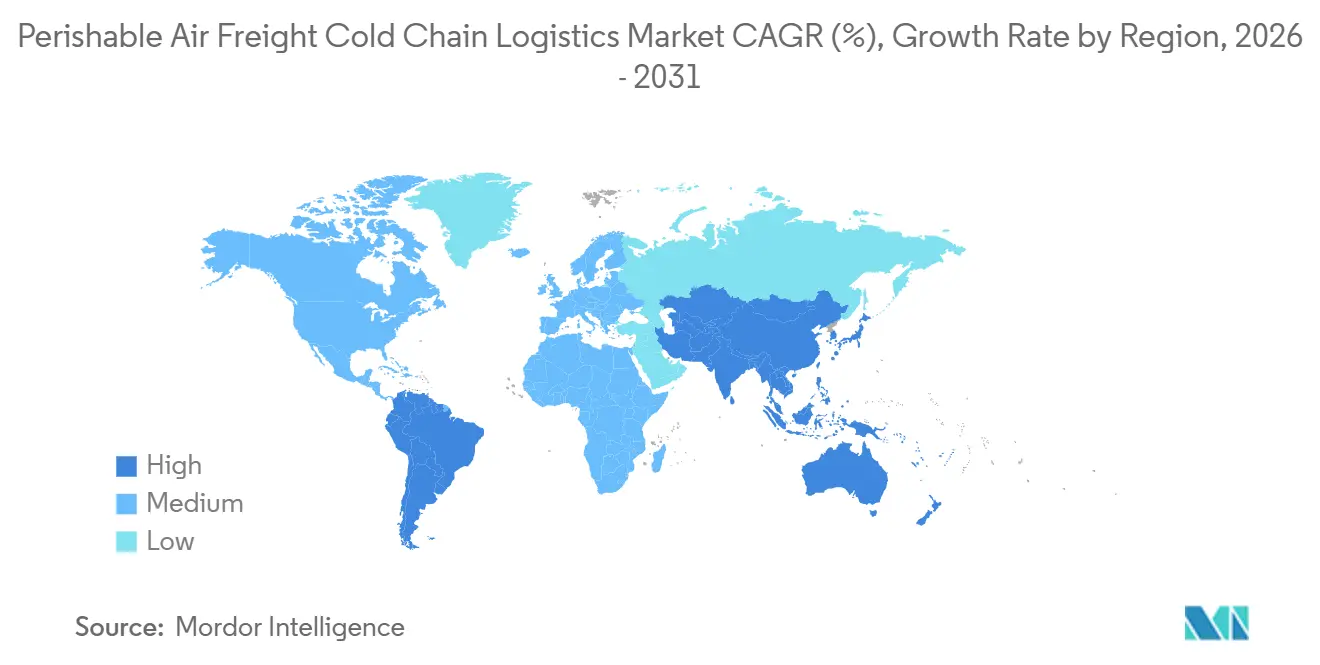
Asia-Pacific held 38.30% of the perishable air freight cold chain logistics market share in 2025 and is forecast to register a 6.58% CAGR through 2031. The region is both a major origin for perishables and a growing center for pharmaceutical production and consumption. Asia-Pacific carriers recorded 8.4% cargo ton-kilometer growth in 2025, the strongest result among global carrier regions. The Europe-Asia route grew 10.3% in cargo ton-kilometers during the same year. India, Singapore, and Hong Kong are important origins for temperature-controlled pharmaceutical traffic.
Global air cargo demand grew 4.6% year-over-year in the fourth quarter of 2025, with Asia-Pacific contributing much of the above-average performance. This supports investment in cold chain capacity at hubs including Singapore Changi, Guangzhou Baiyun, and Kansai International Airport. North America remained the most compliance-intensive area in 2025 because of its pharmaceutical manufacturing base, CEIV-certified communities, and food imports from Latin America. North American carriers recorded a 1.3% cargo ton-kilometer decline in 2025, partly because Asia-North America traffic declined 0.8% after tariff-related route changes.
Domestic pharmaceutical and food cold chain activity in North America remained supported by FSMA-related investment and biologics distribution from certified hubs. Latin America supplied 26% of global food and perishable air freight volumes in 2025. Europe acts as both a pharmaceutical export center and an importer of premium perishables, while the Africa-to-Europe lane grew 5% in 2025. The Middle East provides transshipment hubs between Europe, South Asia, and Southeast Asia, and the Middle East-Asia corridor grew 5.8% in 2025, while Africa recorded 6% cargo ton-kilometer growth. Infrastructure constraints at secondary African airports remain a limitation, but also create room for certified ground-handling investment.
Competitive Landscape
The perishable air freight cold chain logistics market has a moderately fragmented, tiered structure. Global integrators, cargo airlines, specialized ground handlers, and active thermal-container providers serve different parts of the value chain. Competition centers on certified infrastructure, network coverage, handling quality, and the ability to document custody. Operators with broad CEIV Pharma-certified networks can charge premium prices for pharmaceutical traffic. Active-container providers such as SkyCell, Envirotainer, and CSafe compete through runtime, data connectivity, and reusable packaging.
DHL Group expanded its airfreight cold-chain network through a EUR 2 billion (USD 2.35 billion) health logistics investment. Its Brussels-Cincinnati route uses a dedicated Boeing 777 freighter and connects more than 30 GDP-compliant aviation hubs. This gives DHL greater control over handling at the carrier interface and reduces reliance on third-party belly capacity.
Competitive opportunities remain in secondary pharmaceutical origins, including India’s tier-2 airports and Southeast Asian generic-drug centers where certified handling is limited. Reverse logistics for reusable thermal packaging remains fragmented across international lanes and can leave value unrecovered for shippers. Digital tools can support real-time exception management without requiring every airline or ground handler to replace existing infrastructure. CEIV Pharma and EU GDP requirements create high barriers because certification demands audits, training, quality systems, and renewal activity. The perishable air freight cold chain logistics market is shaped by long-term operating capability rather than a single asset purchase.
Perishable Air Freight Cold Chain Logistics Industry Leaders
-
Deutsche Post DHL Group
-
Kuehne + Nagel International AG
-
DSV A/S
-
FedEx Corporation
-
United Parcel Service, Inc.
- *Disclaimer: Major Players sorted in no particular order
Recent Industry Developments
- September 2026: FedEx announced plans to develop a new integrated air cargo hub at GMR Cargo City, Delhi’s Indira Gandhi International Airport, representing a long-term investment of USD 150 million across 230,000 ft². The facility, designed with full automation, will strengthen cold chain connectivity across North and East India and integrate international gateway and pickup-and-delivery operations within a single facility to reduce dwell time for temperature-sensitive healthcare cargo.
- July 2026: Kuehne+Nagel expanded its Cool Corridor pharmaceutical airfreight network to 12 dedicated lanes by adding Frankfurt-Atlanta, Chicago-Narita, Brussels-Sao Paulo, and Chicago-Sao Paulo routes. The Frankfurt-Atlanta corridor is supported by dedicated weekly capacity on Kuehne+Nagel’s Boeing 747-8 freighter.
- February 2026: DHL Group launched a dedicated Boeing 777 freighter on the Brussels-Cincinnati cold chain route as a core element of its EUR 2 billion (USD 2.35 billion) DHL Health Logistics investment, connecting over 30 GDP-compliant aviation hubs worldwide for pharmaceutical, vaccine, and biologics transport.
- October 2025: Japan Airlines renewed its CEIV Pharma certification at Narita Airport, becoming the first Japanese airline to include ground transportation within the certification scope. The certification covers GDP-compliant inter-airport trucking connecting Narita, Haneda, and Kansai airports.
Global Perishable Air Freight Cold Chain Logistics Market Report Scope
| Freight Transport |
| Warehousing and Storage |
| Freight Forwarding |
| Other Value-Added Services (Customs brokerage, documentation, insurance, etc.) |
| Fresh Fruits and Vegetables |
| Meat and Poultry |
| Seafood and Fishery Products |
| Flowers and Horticultural Products |
| Pharmaceuticals and Life Science |
| General and Other Temperature-Sensitive Perishables |
| Chilled / Refrigerated (+2 °C to +8 °C) |
| Controlled Ambient (+15 °C to +25 °C) |
| Frozen (-15 °C to -25 °C) |
| Deep-Frozen / Ultra-Low Temperature (below -60 °C) |
| North America | United States |
| Canada | |
| Mexico | |
| South America | Brazil |
| Argentina | |
| Peru | |
| Chile | |
| Rest of South America | |
| Europe | Germany |
| United Kingdom | |
| France | |
| Italy | |
| Spain | |
| Russia | |
| Nordics (Denmark, Finland, Iceland, Norway, and Sweden) | |
| Rest of Europe | |
| Asia-Pacific | China |
| India | |
| Japan | |
| South Korea | |
| Australia | |
| Southeast Asia (ASEAN) | |
| Rest of Asia-Pacific | |
| Middle East and Africa | Saudi Arabia |
| United Arab Emirates | |
| Qatar | |
| South Africa | |
| Nigeria | |
| Egypt | |
| Rest of Middle East and Africa |
| By Service Type | Freight Transport | |
| Warehousing and Storage | ||
| Freight Forwarding | ||
| Other Value-Added Services (Customs brokerage, documentation, insurance, etc.) | ||
| By Product Category | Fresh Fruits and Vegetables | |
| Meat and Poultry | ||
| Seafood and Fishery Products | ||
| Flowers and Horticultural Products | ||
| Pharmaceuticals and Life Science | ||
| General and Other Temperature-Sensitive Perishables | ||
| By Temperature Range | Chilled / Refrigerated (+2 °C to +8 °C) | |
| Controlled Ambient (+15 °C to +25 °C) | ||
| Frozen (-15 °C to -25 °C) | ||
| Deep-Frozen / Ultra-Low Temperature (below -60 °C) | ||
| By Geography | North America | United States |
| Canada | ||
| Mexico | ||
| South America | Brazil | |
| Argentina | ||
| Peru | ||
| Chile | ||
| Rest of South America | ||
| Europe | Germany | |
| United Kingdom | ||
| France | ||
| Italy | ||
| Spain | ||
| Russia | ||
| Nordics (Denmark, Finland, Iceland, Norway, and Sweden) | ||
| Rest of Europe | ||
| Asia-Pacific | China | |
| India | ||
| Japan | ||
| South Korea | ||
| Australia | ||
| Southeast Asia (ASEAN) | ||
| Rest of Asia-Pacific | ||
| Middle East and Africa | Saudi Arabia | |
| United Arab Emirates | ||
| Qatar | ||
| South Africa | ||
| Nigeria | ||
| Egypt | ||
| Rest of Middle East and Africa | ||
Key Questions Answered in the Report
What is the expected growth rate for perishable air freight cold chain logistics?
The Perishable air freight cold chain logistics market is forecast to register a 5.04% CAGR from 2026 to 2031, reaching USD 21.23 billion.
Which service has the strongest growth outlook through 2031?
Other value-added services are forecast to register a 6.84% CAGR as monitoring, documentation, pre-clearance, and insurance become more important.
Which product category will grow fastest in air freight cold chain logistics?
Seafood and fishery products are forecast to register a 6.72% CAGR through 2031 because distant supply and consumption locations require fast transport.
Why is ultra-low temperature logistics becoming more important?
Deep-frozen/ultra-low temperature cargo is forecast to register a 6.94% CAGR, supported by cell and gene therapies that need cryogenic shipment conditions.
Which region leads perishable air freight cold chain logistics?
Asia-Pacific held a 38.30% share in 2025 and is forecast to register a 6.58% CAGR through 2031.
What are the main operating risks for temperature-sensitive air shipments?
High freight rates, tarmac exposure, customs delays, fragmented data, and climate-related airport disruption can compromise economics or temperature control.