
Pension Finance Market Size and Share
Market Overview
| Study Period | 2020 - 2031 |
|---|---|
| Market Size (2026) | USD 76.60 Trillion |
| Market Size (2031) | USD 103.5 Trillion |
| Growth Rate (2026 - 2031) | 6.20 % |
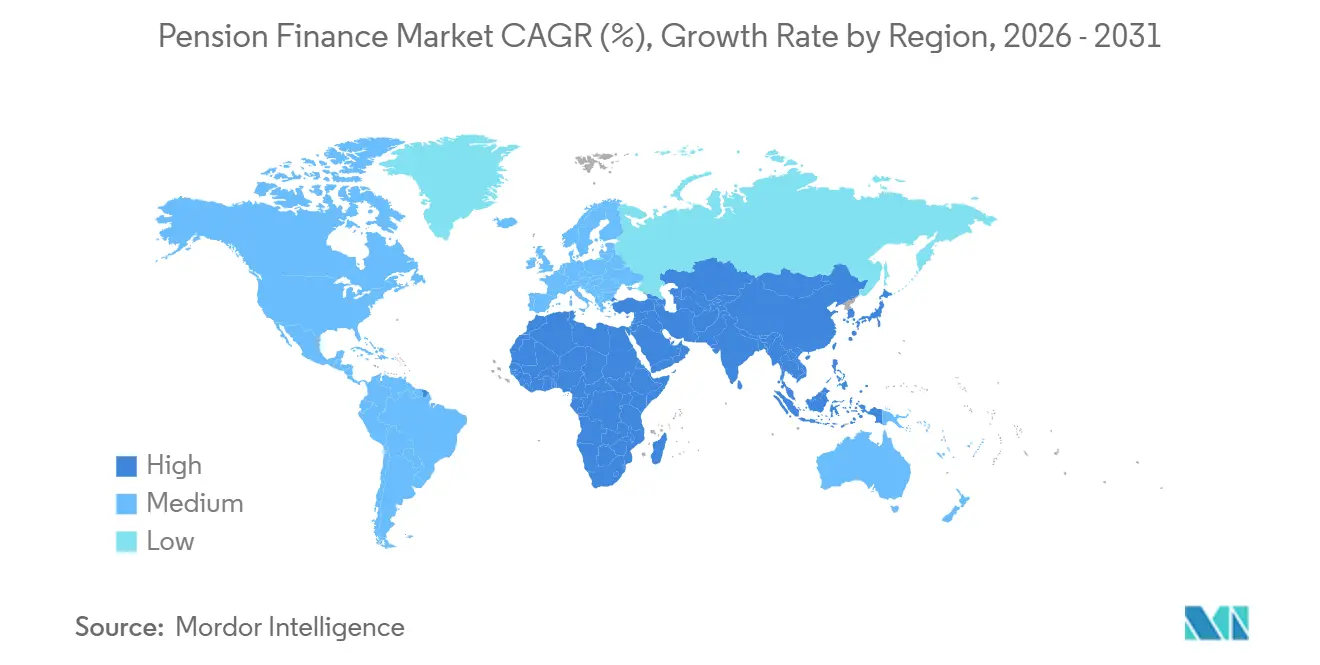
| Fastest Growing Market | Asia-Pacific |
| Largest Market | North America |
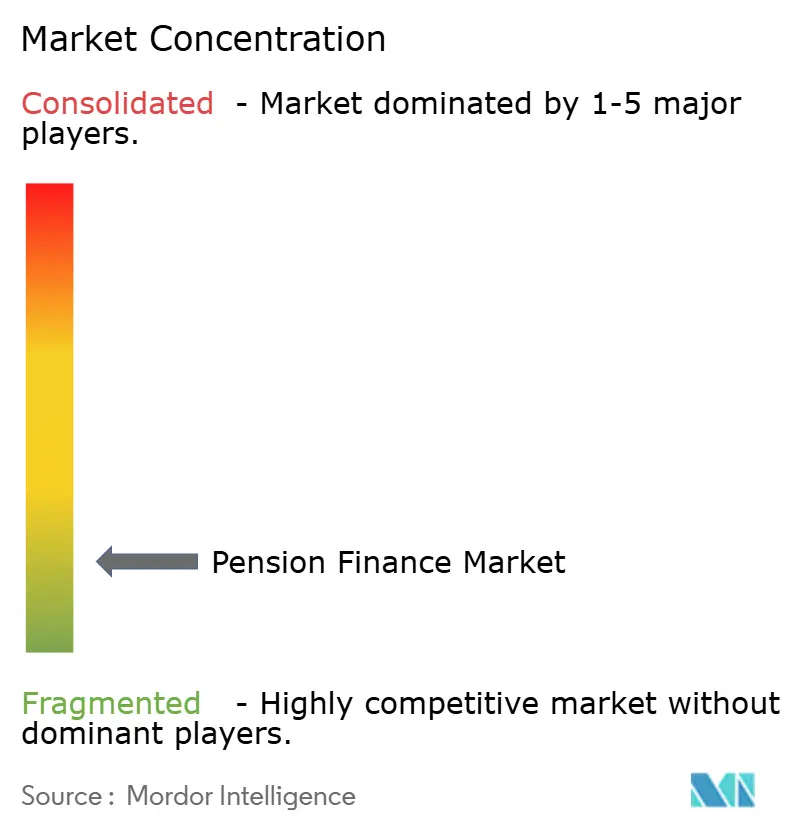
| Market Concentration | Low |
Major Players *Disclaimer: Major Players sorted in no particular order Image © Mordor Intelligence. Reuse requires attribution under CC BY 4.0. | |
Pension Finance Market Analysis by Mordor Intelligence
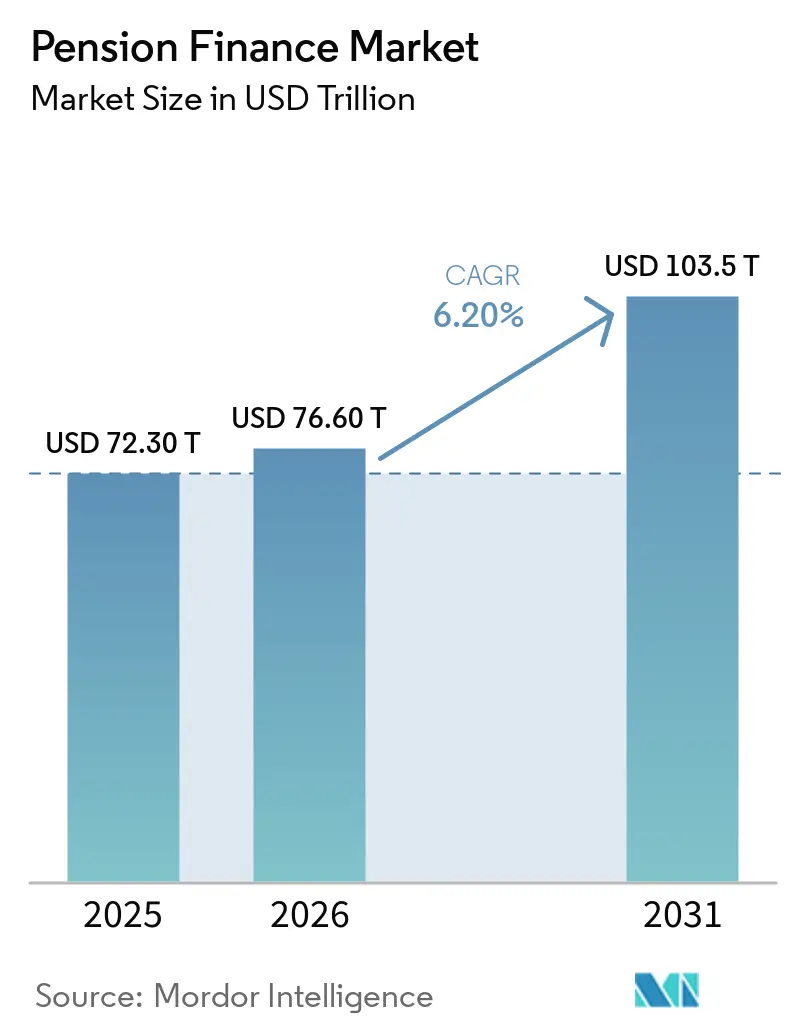
The Pension Finance Market size was valued at USD 72.30 trillion in 2025 and is estimated to grow from USD 76.60 trillion in 2026 to reach USD 103.5 trillion by 2031, at a CAGR of 6.20% during the forecast period (2026-2031).
Population aging, wider mandatory participation, and greater use of private assets support the pension finance market across major economies. Defined contribution plans are changing the demand profile from sponsor-led liability management toward savings accumulation, income planning, administration, and investment advice. This shift favors providers that can combine investment management, recordkeeping, and retirement-income capabilities. The pension finance market also faces pressure from interest-rate changes, funding volatility, and the risk that retirees outlive their savings. Competition is therefore increasingly shaped by scale, investment capability, technology, and the ability to support retirement income.
Key Report Takeaways
- By plan type, defined contribution plans captured 56.3% of the pension finance market share in 2025 and are projected to grow at a 7.1% CAGR through 2031.
- By access type, occupational plans accounted for 62.1% of the pension finance market size in 2025, while personal plans are forecast to grow at a 6.9% CAGR through 2031.
- By asset allocation, equities captured 42.6% of the pension finance market size in 2025, while private equity and other alternatives are projected to grow at a 7.7% CAGR through 2031.
- By financing vehicle, pension funds held 62.2% of the pension finance market size in 2025, while bank and investment-managed products are forecast to grow at a 7.4% CAGR through 2031.
- By participation rule, voluntary schemes accounted for 73.3% of the pension finance market share in 2025, while mandatory and quasi-mandatory schemes are projected to grow at an 8.0% CAGR through 2031.
- By worker and sponsor sector, private-sector workers captured 69.7% of the pension finance market share in 2025 and are projected to grow at a 6.7% CAGR through 2031.
- By geography, North America captured 67.2% of the pension finance market in 2025, while Asia-Pacific is projected to grow at an 8.2% CAGR through 2031.
Note: Market size and forecast figures in this report are generated using Mordor Intelligence’s proprietary estimation framework, updated with the latest available data and insights as of January 2026.
Market Trends and Insights
Drivers Impact Analysis of Pension Finance Market*
| Driver | (~) % Impact on CAGR Forecast | Geographic Relevance | Impact Timeline |
|---|---|---|---|
| Aging populations and longer retirement periods | +1.5% | Global, with stronger pressure in Japan, Western Europe, South Korea, and China | Long term (≥ 4 years) |
| Shift from defined benefit to defined contribution plans | +1.2% | Global, particularly the United Kingdom, the Netherlands, and the Asia-Pacific | Medium term (2-4 years) |
| Mandatory contributions and auto-enrollment expansion | +1.0% | European Union, Türkiye, and emerging Asia-Pacific markets | Short term (≤ 2 years) |
| Alternative assets and infrastructure allocations | +0.9% | Global, led by North America and Europe, and expanding in the Asia-Pacific | Long term (≥ 4 years) |
| Retirement income and decumulation demand | +0.7% | Global, with emphasis on the United States, Australia, the United Kingdom, and Canada | Medium term (2-4 years) |
| Pension administration and investment management digitalization | +0.5% | Global, with rapid adoption in the United States, South Korea, Australia, and Northern Europe | Short term (≤ 2 years) |
| Source: Mordor Intelligence | |||
Aging Populations and Longer Retirement Periods
Population aging is extending pension liabilities while increasing the number of people who need retirement savings. China, Indonesia, Thailand, and Vietnam are projected to have 485 million people aged over 65 by 2050. HelpAge International reported that 1 in 4 people in the Asia-Pacific region will be over 60 by 2050[1]. Governments are responding by expanding funded retirement systems and reassessing social pension arrangements. Longer life expectancy can also expose gaps in mortality assumptions and in the reserves that support pension commitments. These conditions support the pension finance market because retirement assets may need to grow faster than replacement-rate targets alone would suggest.
Shift from Defined Benefit to Defined Contribution Pension Plans
The move from defined benefit plans to defined contribution plans transfers more retirement risk from sponsors to individuals. Occupational defined contribution assets grew by 11.4% in 2024, compared with 4% growth in occupational defined benefit assets[2]. Defined benefit plans accounted for 31.9% of total pension assets in 2024. The Netherlands requires defined benefit plans to transition to defined contribution structures by 2028, providing a regulatory example for other European systems. The United Kingdom’s Value for Money framework also increases pressure on smaller defined contribution providers to demonstrate performance and scale. This transition expands opportunities in the pension finance market for asset managers, recordkeepers, advisors, and digital platforms.
Mandatory Contributions and Auto-Enrollment Expansion
Mandatory participation turns retirement saving from an individual choice into a regular flow of contributions. Ireland launched MyFutureFund in January 2026, creating 760,000 new pension savers through its automatic enrollment system. Initial minimum contributions are set at 3.5% of qualifying earnings. Germany expanded occupational pension access for lower-income workers and small businesses through its second company pension strengthening legislation[3]. Türkiye also published plans to move from a voluntary automatic enrollment structure toward a mandatory second-pillar model for large private-sector employers. The resulting inflows can favor low-cost default fund providers, especially when scale and fee limits are part of the system design.
Alternative Assets and Infrastructure Allocations
Pension funds are increasing allocations to private equity, private credit, real assets, and infrastructure to pursue returns and diversification. CalPERS committed more than USD 14 billion across private equity, credit, and real assets in late 2025 activity. Its infrastructure program generated an 8.9% return during the period. The American Investment Council reported that 89% of United States public pension funds held private equity allocations in 2025, with a dollar-weighted average allocation of 14%[4]. Japan’s Government Pension Investment Fund began developing an alternative-assets information system in 2025 as part of its medium-term plan. The pension finance market gains investment-management and information-service opportunities as these holdings require specialist sourcing, valuation, and oversight.
Restraints Impact Analysis of Pension Finance Market*
| Restraint | (~) % Impact on CAGR Forecast | Geographic Relevance | Impact Timeline |
|---|---|---|---|
| Pension funding gaps and liability-market volatility | -0.8% | Primarily the United States and the United Kingdom, with spillover risk to continental Europe | Short term (≤ 2 years) |
| Low investment returns and interest-rate uncertainty | -0.9% | Global, especially defined benefit-heavy European systems, and underfunded public plans | Medium term (2-4 years) |
| Limited domestic investment options for large portfolios | -0.5% | Smaller OECD and non-OECD markets with limited capital-market depth | Long term (≥ 4 years) |
| Longevity, decumulation, and retirement-income sustainability risk | -0.6% | Global defined contribution systems, including the United States, Australia, the United Kingdom, Canada, and emerging Asia-Pacific markets | Long term (≥ 4 years) |
| Source: Mordor Intelligence | |||
Pension Funding Gaps and Liability-Market Volatility
Funded-status improvements can lead sponsors to reduce risk, which may limit the asset growth of defined benefit plans. Milliman estimated that the average United States discount rate fell by 12 basis points in 2025, increasing pension liabilities by 7% on an economic basis. The average funded ratio for the 200 largest United States corporate plans reached 107.7% at December 31, 2025, and 112.8% by August 2026. Sponsors responding to surpluses often follow liability-driven investment paths and lower equity exposure. The Pension Benefit Guaranty Corporation framework in the United States and supervisory requirements in the United Kingdom reinforce careful funding and de-risking practices. A sustained decline in rates without offsetting asset returns could reduce funding surpluses and constrain the pension finance market.
Low Investment Returns and Interest-Rate Uncertainty
Interest-rate uncertainty affects both pension liabilities and the expected return on fixed-income assets. United States liability discount rates stayed above 5% through 2025 within a 35-basis-point range. Stable measurement conditions can still conceal sensitivity in long-duration portfolios when rates move. Corporate-bond downgrades may also weaken the return from assets used to hedge pension obligations. Smaller pension systems may have limited domestic bond markets and must diversify abroad, which adds foreign-exchange exposure and regulatory complexity. Defined benefit plans in Japan and continental Europe may remain under pressure when domestic sovereign yields stay below the returns assumed in plan funding models. These constraints can slow the pension finance market by making long-term return targets harder to achieve.
*Our forecasts treat driver/restraint impacts as directional, not additive. The impact forecasts reflect baseline growth, mix effects, and variable interactions.
Pension Finance Market Segment Analysis
By Plan Type:
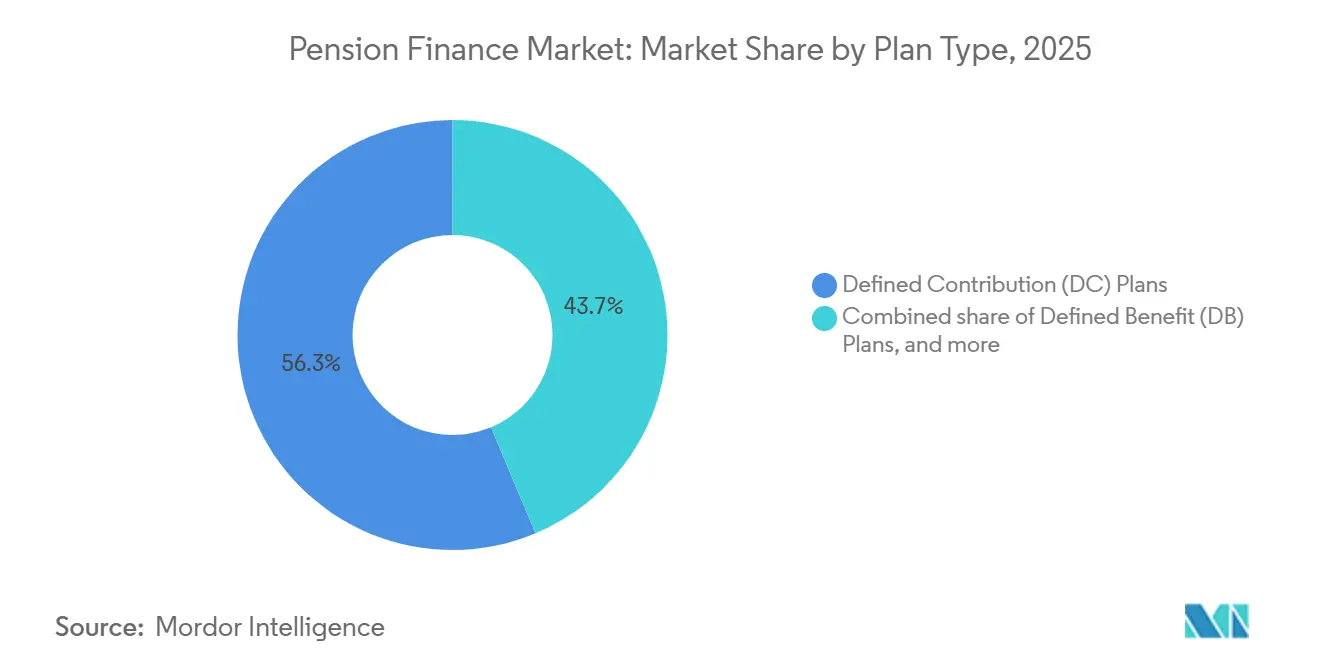
Defined Contribution Plans Lead Structural ChangeDefined contribution plans held 56.3% of the pension finance market in 2025 and are forecast to expand at a 7.1% CAGR through 2031. Occupational defined contribution assets grew 11.4% in 2024, while occupational defined benefit assets grew 4%. Defined benefit plans remain important where legacy systems are large. Canada retained 57.4% of assets in defined benefit arrangements, and the Netherlands retained 97.5%. The Netherlands is moving all defined benefit plans toward defined contribution structures by 2028. Hybrid and mixed arrangements remain relevant for sponsors seeking predictable contributions alongside some income-guarantee features.
Collective defined contribution schemes provide one example of this hybrid approach, including the first such scheme opened in the United Kingdom in 2024. The United Kingdom’s Value for Money requirements favor larger multi-employer trusts and provider platforms. This may increase consolidation among smaller plan providers. Leading defined contribution organizations identified retirement income as their main challenge for the next decade. Deferred-income annuities within target-date funds can improve late-life consumption security for longer-lived members. The pension finance industry is therefore developing both accumulation and decumulation capabilities.
By Asset Allocation:
Equities Lead While Alternatives ExpandEquities held 42.6% of the pension finance market in 2025. This allocation supports long-term return objectives, especially in defined contribution systems where members bear more investment risk. The average pension fund equity allocation reached a high in 2026. Equity exposure is higher in several systems, including Australian lifecycle defaults and many United States public plans. Bills and bonds remain central to liability matching in defined benefit arrangements and capital preservation for older defined contribution members. Cash, deposits, real estate, and other assets balance liquidity, return, and inflation-management needs.
Private equity and other alternatives are projected to grow at a 7.7% CAGR through 2031. CalPERS increased its net asset value in infrastructure by USD 4.6 billion in 2025 and committed USD 1 billion each to traditional and digital infrastructure in one quarter. Infrastructure has drawn new interest because of the capital needed for data centers and energy-transition assets. Private equity and infrastructure have also been identified as stronger expected-return sources across several macroeconomic scenarios. France’s AIFMD II implementation in April 2026 creates another regulated path for private-credit activity. These investments require robust due diligence, liquidity planning, and information management.
By Financing Vehicle:
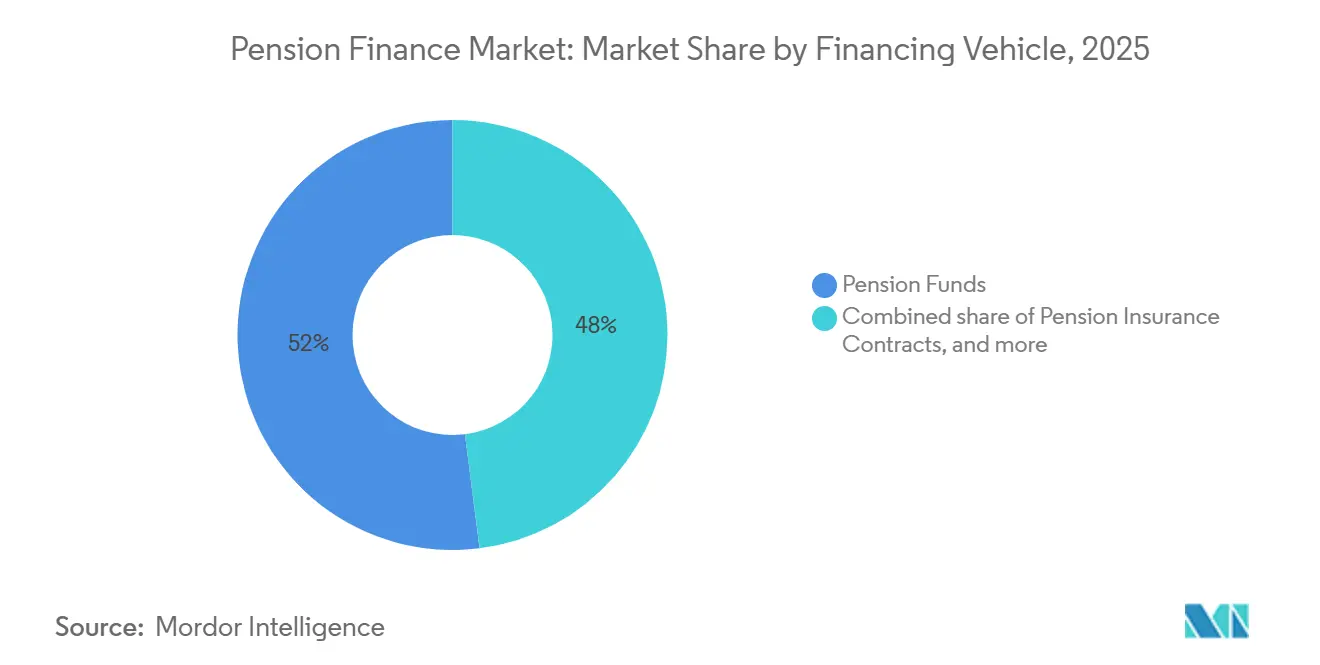
Pension Funds Remain the Core VehiclePension funds captured 62.2% of the pension finance market in 2025. They benefit from tax treatment, regulatory recognition, and investment mandates aligned with long retirement horizons. Pension insurance contracts are the second-largest financing vehicle. The United States pension risk transfer market recorded USD 48.7 billion in premiums across 697 transactions in 2025. Buy-in transactions accounted for USD 17.5 billion, an increase of 372% from 2024. Book-reserve arrangements remain relevant in Germany and Japan but face pressure to transition toward funded structures.
Bank- and investment-managed retirement products are forecast to grow at a 7.4% CAGR through 2031. Their expansion reflects retirement rollovers, retail superannuation alternatives, and workplace offerings from large banks. JPMorgan Asset Management and Goldman Sachs are among the firms expanding retirement capabilities alongside pension fund services. Bank-administered products can be subject to both banking and securities regulations, giving large, diversified institutions an advantage. Single-premium pension risk transfer assets across buy-out and buy-in contracts reached USD 339.8 billion in the second quarter of 2026. This total was 9% higher than in the second quarter of 2025.
By Access Type:
Occupational Plans Hold the Largest Asset BaseOccupational plans accounted for 62.1% of the pension finance market in 2025. Their position reflects employer-sponsored contributions and established plan infrastructure across OECD economies. Mandatory occupational systems are particularly important in Australia, the Netherlands, and Switzerland. Pension assets exceeded 100% of gross domestic product in Denmark at 206.4%, Iceland at 191.3%, and Switzerland at 166.9% in 2024. Occupational providers face stronger governance requirements under the proposed review of the European Union’s IORP II framework.
Personal plans are projected to grow at a 6.9% CAGR through 2031. Growth is linked to coverage gaps among self-employed, part-time, and gig workers who may not have employer-sponsored plans. Personal pension assets in covered Asia-Pacific markets stood at USD 40 billion at the end of 2025, compared with regional retirement assets of USD 1.7 trillion. Ireland’s MyFutureFund combines personal savings with employer contributions and may shape similar designs in markets with uneven workplace coverage. Singapore’s Central Provident Fund held USD 514 billion, demonstrating how mandatory savings can coexist with personal investment options. These models broaden access while requiring clear communication and appropriate investment choices.
By Participation Rule:
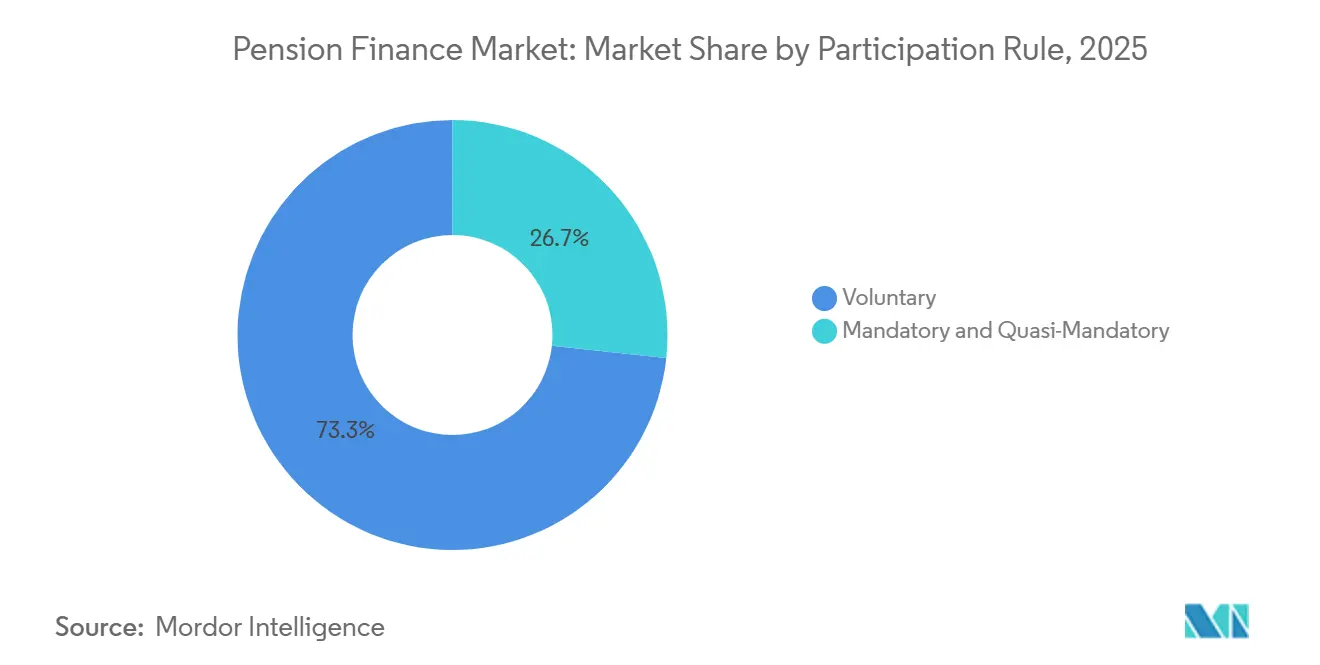
Voluntary Plans Lead but Mandates Grow FasterVoluntary schemes are projected to represent 73.3% of the pension finance market in 2025. Their large asset base reflects the long history of voluntary retirement saving in developed economies. Mandatory and quasi-mandatory schemes are projected to grow at an 8.0% CAGR through 2031. Ireland’s new automatic enrollment scheme will add 800,000 pension savers. Türkiye’s planned second-pillar approach and Germany’s expanded occupational provisions will also extend participation. Mandates can increase saving volumes but often apply strict rules to default funds and charges.
The United Kingdom’s 2026 Workplace Pensions Roadmap will require defined contribution multi-employer automatic enrollment schemes to hold at least GBP 25 billion (USD 32.5 billion) in one main default arrangement. This policy will use scale requirements to reshape the automatic enrollment system. Australia’s superannuation system has recorded a 10-year annualized growth rate of 6.6%, while defined contribution assets represent 90% of total pension assets. United Kingdom defined contribution assets are expected to surpass defined benefit assets in the late 2020s. The pension finance market is becoming increasingly dependent on policy design, default investment choices, and efficient administration. Scale can lower costs but may also narrow the range of providers receiving contributions.
By Worker and Sponsor Sector:
Private-Sector Workers Drive VolumePrivate-sector workers held 69.7% of the pension finance market in 2025 and are projected to grow at a 6.7% CAGR through 2031. This position reflects the broad global base of private employment and wider retirement plan provision among smaller companies. A 2026 Fidelity study of more than 1,300 plan sponsors found that nearly 70% said their plan was meeting its objectives. The study also found that 41% preferred advisors with full discretion over investment menu decisions. This points to greater use of outsourced investment support. Public-sector systems remain substantial but face fiscal pressure, especially where benefit promises are generous, and populations are aging.
Outsourced chief investment officer models are concentrating investment decisions among specialized providers. BlackRock reported that 39% of United States defined benefit plans used an outsourced chief investment officer model in 2026, up from 29% in 2020. Private-sector plans are also a key setting for retirement income product development. Employer liability concerns and product integration complexity remain barriers to annuity adoption in defined contribution plans. BlackRock announced LifePath Solutions in September 2026, combining public stocks, bonds, private assets, and annuities in customizable target-date fund structures for 401(k) plans. These products show how providers are trying to address income needs within workplace savings plans.
Geography Analysis
North America Pension Finance Market
North America held 67.2% of the pension finance market share in 2025. The United States managed USD 44.8 trillion through pension providers at the end of 2024, representing 71% of the OECD total and 153.3% of gross domestic product. Canada became the second-largest global pension market in 2025 after 12% year-on-year growth. United States corporate defined benefit plans entered 2026 with funded ratios near 108%. CalPERS committed more than USD 14 billion to private markets in late 2025. The Department of Labor’s January 2026 guidance on pension risk transfer is changing how United States sponsors assess annuity buyout decisions.
APAC Pension Finance Market
Asia-Pacific is projected to grow at an 8.2% CAGR through 2031. Japan and Australia were among the five largest global pension markets in 2025, while South Korea ranked eighth and China ranked ninth. Asia-Pacific retirement assets grew by 9% to USD 1.7 trillion in 2025 and are expected to reach USD 2.5 trillion by 2029. Population aging strengthens the case for wider funded coverage in China. India introduced the Balanced Life Cycle Fund within the National Pension System in October 2024 for more than 70 million subscribers. Asia-Pacific represented 45.5% of the 300 largest pension funds in 2025, compared with 22.5% previously.
EMEA and South America Pension Finance Market
Europe, South America, the Middle East, and Africa have distinct conditions in the pension finance market. Gulf Cooperation Council states are formalizing occupational systems as part of economic diversification efforts. Formal pension coverage in Sub-Saharan Africa remains limited by low formal employment and shallow capital markets.
Competitive Landscape
The pension finance market is fragmented in asset management and administration. BlackRock managed USD 15.3 trillion in assets at mid-2026, Vanguard managed USD 12 trillion, and Fidelity managed USD 6.8 trillion. These firms influence pension flows through index strategies, recordkeeping, and target-date funds. State Street managed USD 27 billion of New York City pension index assets, which were subject to a competitive rebid in June 2026. In the United States pension risk transfer market, 22 active insurers competed for USD 48.7 billion in premiums in 2025, and 9 insurers each exceeded USD 2 billion. Legal & General held a global pension risk transfer annuity portfolio of GBP 73 billion (USD 94.9 billion) at mid-2026.
Scale in underwriting and asset origination remains important for pension risk transfer providers. Legal & General’s GBP 73 billion (USD 94.9 billion) pension risk transfer annuity portfolio at mid-2026 demonstrates the importance of insurance capacity and asset-origination capabilities. BlackRock completed its acquisition of HPS Investment Partners for USD 12 billion in July 2025. The acquisition added USD 148 billion in credit assets and expanded BlackRock’s private-credit offering for pension clients. Vanguard announced the acquisition of Altruist for USD 4 billion in August 2026. The transaction expands Vanguard’s access to independent financial advisors and wealth technology. These moves show that firms are adding private-market, advisory, custody, and distribution capabilities around core investment products.
Technology is also becoming an important source of differentiation in the pension finance market. South Korea’s National Pension Service partnered with LG AI Research in 2026 to develop foreign-exchange tools for fund management. Australia’s Aware Super completed Project Odin in June 2026, upgrading its investment platform with information and analytical tools. Remaining opportunities center on retirement-income products, portable plans for workers without stable employer coverage, and investment vehicles that can accept pension capital without creating unmanageable liquidity constraints.
Pension Finance Industry Leaders
-
BlackRock, Inc.
-
The Vanguard Group, Inc.
-
Fidelity Investments
-
State Street Corporation
-
JPMorgan Chase & Co.
- *Disclaimer: Major Players sorted in no particular order
Pension Finance Market Companies Covered in this Report
- BlackRock, Inc.
- The Vanguard Group, Inc.
- Fidelity Investments
- State Street Corporation
- JPMorgan Chase & Co.
- Legal & General Group plc
- Allianz SE
- Prudential Financial, Inc.
- AXA Group
- UBS Group AG
- Goldman Sachs Group, Inc.
- The Bank of New York Mellon Corporation
- Northern Trust Corporation
- Capital Group
- Aon plc
- Mercer LLC
- WTW
- T. Rowe Price Group, Inc.
- Principal Financial Group, Inc.
- Manulife Financial Corporation
Recent Industry Developments in Pension Finance Market
- September 2026: Legal & General completed a GBP 1.65 billion (USD 2.1 billion) buy-in with the Wood Pension Plan, securing benefits for 16,400 members in the largest bulk annuity transaction announced in 2026 to date, with member experience cited as the principal insurer-selection criterion by the trustee board. This signals a shift in United Kingdom pension risk transfer procurement criteria from pure price optimization toward service quality and member-outcome metrics.
- August 2026: Vanguard announced the acquisition of Altruist, an artificial intelligence-focused wealth technology and custody platform for independent financial advisors, in a deal valued at USD 4 billion. The transaction materially expands Vanguard’s distribution reach into the independent registered investment advisor channel.
- August 2026: Shinhan Investment Corp. launched Shinhan SOL Robo Pension, an artificial intelligence-based automated investment service for individual retirement pension customers that supports exchange-traded fund allocation, stock selection, and rebalancing.
- July 2026: M&G’s wholly owned subsidiary, Prudential Assurance, completed a GBP 100 million (USD 130 million) BPA Plus transaction with Miller Insurance’s pension scheme, securing 550 members. BPA Plus combines annuity security with potential bonuses from future investment outperformance.
Global Pension Finance Market Report Scope
Segmentation Overview
| Defined Contribution (DC) Plans |
| Defined Benefit (DB) Plans |
| Hybrid and Mixed Plans |
| Occupational Pension Plans |
| Personal Pension Plans |
| Equities |
| Bills and Bonds |
| Cash and Deposits |
| Real Estate |
| Private Equity and Other Alternatives |
| Other Investments |
| Pension Funds |
| Pension Insurance Contracts |
| Bank/Investment-Managed Retirement Products |
| Book-Reserve Arrangements |
| Mandatory and Quasi-Mandatory |
| Voluntary |
| Private-Sector Workers |
| Public-Sector Workers |
| North America | United States |
| Canada | |
| Mexico | |
| South America | Brazil |
| Argentina | |
| Rest of South America | |
| Europe | United Kingdom |
| Germany | |
| France | |
| Italy | |
| Spain | |
| Rest of Europe | |
| Asia-Pacific | China |
| Japan | |
| India | |
| South Korea | |
| Australia | |
| Indonesia | |
| Thailand | |
| Malaysia | |
| Singapore | |
| Vietnam | |
| Rest of Asia-Pacific | |
| Middle East and Africa | Saudi Arabia |
| United Arab Emirates | |
| Turkey | |
| South Africa | |
| Egypt | |
| Rest of Middle East and Africa |
| By Plan Type | Defined Contribution (DC) Plans | |
| Defined Benefit (DB) Plans | ||
| Hybrid and Mixed Plans | ||
| By Access Type | Occupational Pension Plans | |
| Personal Pension Plans | ||
| By Asset Allocation | Equities | |
| Bills and Bonds | ||
| Cash and Deposits | ||
| Real Estate | ||
| Private Equity and Other Alternatives | ||
| Other Investments | ||
| By Financing Vehicle | Pension Funds | |
| Pension Insurance Contracts | ||
| Bank/Investment-Managed Retirement Products | ||
| Book-Reserve Arrangements | ||
| By Participation Rule | Mandatory and Quasi-Mandatory | |
| Voluntary | ||
| By Worker / Sponsor Sector | Private-Sector Workers | |
| Public-Sector Workers | ||
| By Geography | North America | United States |
| Canada | ||
| Mexico | ||
| South America | Brazil | |
| Argentina | ||
| Rest of South America | ||
| Europe | United Kingdom | |
| Germany | ||
| France | ||
| Italy | ||
| Spain | ||
| Rest of Europe | ||
| Asia-Pacific | China | |
| Japan | ||
| India | ||
| South Korea | ||
| Australia | ||
| Indonesia | ||
| Thailand | ||
| Malaysia | ||
| Singapore | ||
| Vietnam | ||
| Rest of Asia-Pacific | ||
| Middle East and Africa | Saudi Arabia | |
| United Arab Emirates | ||
| Turkey | ||
| South Africa | ||
| Egypt | ||
| Rest of Middle East and Africa | ||
Key Questions Answered in the Report
What is the projected value of pension finance by 2031?
The pension finance market is forecast to reach USD 103.5 trillion by 2031, growing at a 6.2% CAGR from 2026.
Which pension plan structure is growing fastest?
Defined contribution plans are the fastest-growing plan type, with a projected 7.1% CAGR through 2031.
Why are mandatory retirement contributions expanding?
Governments are using automatic enrollment and wider occupational coverage to increase retirement saving, including Ireland’s MyFutureFund program.
Which investments are gaining importance in pension portfolios?
Private equity and other alternatives are projected to grow at a 7.7% CAGR through 2031, supported by return and diversification needs.
Which region has the largest retirement asset base?
North America held 67.2% of the global pension finance market in 2025.
What is affecting pension risk transfer activity?
Improved defined benefit funding and insurer capacity are supporting buy-in and buyout activity, including USD 48.7 billion of United States premium in 2025.