
Paper Recycling Surfactants Market Size and Share
Market Overview
| Study Period | 2022 - 2032 |
|---|---|
| Market Size (2027) | USD 702.77 Million |
| Market Size (2032) | USD 979.70 Million |
| Growth Rate (2027 - 2032) | 6.87 % |
| Fastest Growing Market | Asia-Pacific |
| Largest Market | Asia-Pacific |
| Market Concentration | Medium |
Major Players *Disclaimer: Major Players sorted in no particular order Image © Mordor Intelligence. Reuse requires attribution under CC BY 4.0. | |
Paper Recycling Surfactants Market Analysis by Mordor Intelligence
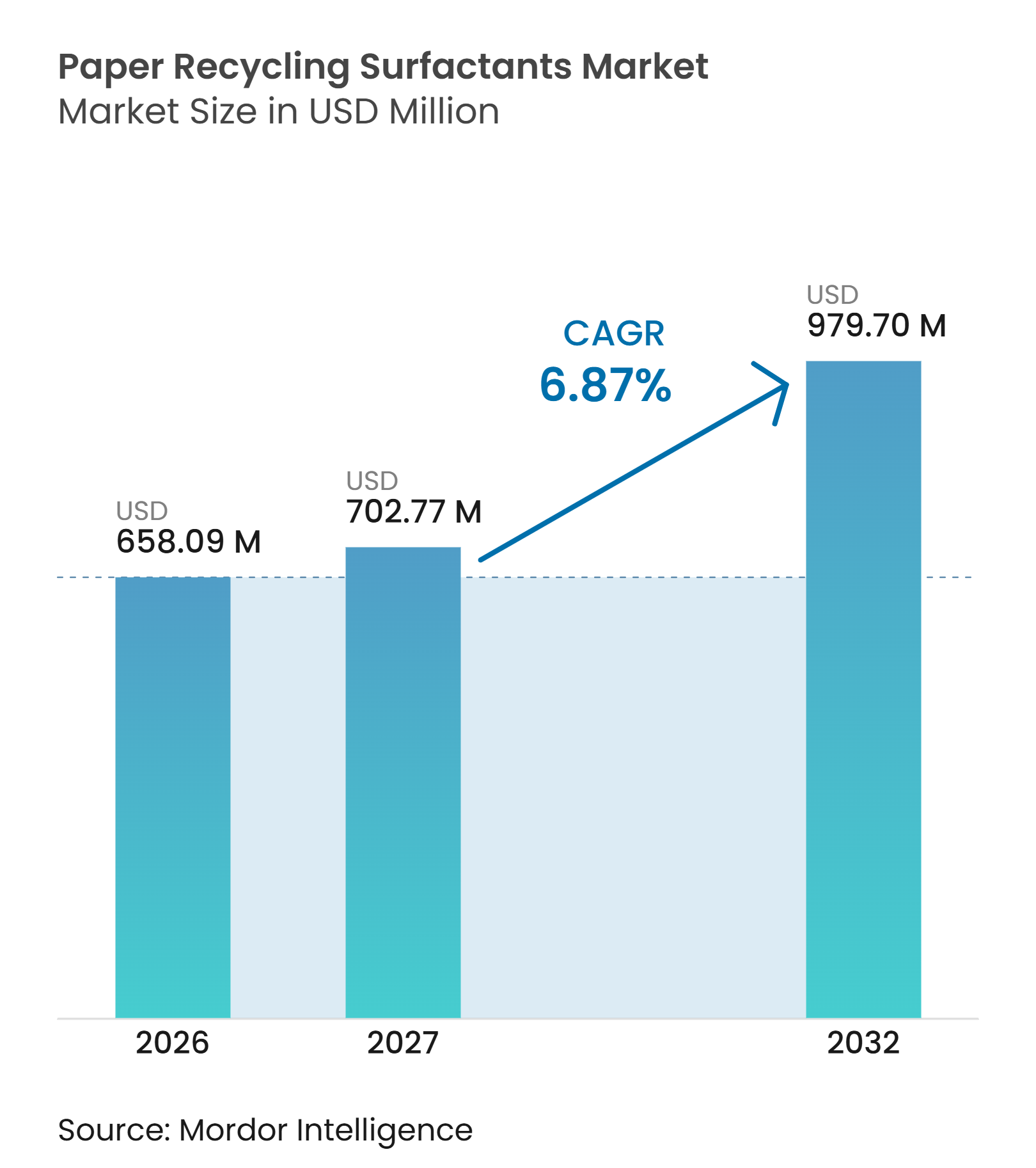
The Paper Recycling Surfactants Market size was valued at USD 658.09 million in 2026 and is estimated to grow from USD 702.77 million in 2027 to reach USD 979.70 million by 2032, at a CAGR of 6.87% during the forecast period (2027-2032). Regulatory requirements for recycled packaging are directing investment toward recovered-fiber processing, especially in Europe and North America. The paper recycling surfactants market benefits because deinking, stickies control, and fiber dispersion need chemistry that can manage varied recovered-paper feedstocks. Closed-loop water systems also increase chemical demand per metric ton of fiber by concentrating dissolved and colloidal material. Suppliers are responding through bio-based formulations, digital dosing, and technical service programs that are embedded at mill level. These capabilities create opportunities for established suppliers, while volatile ethoxylate and fatty-acid feedstocks remain a constraint.
Key Report Takeaways
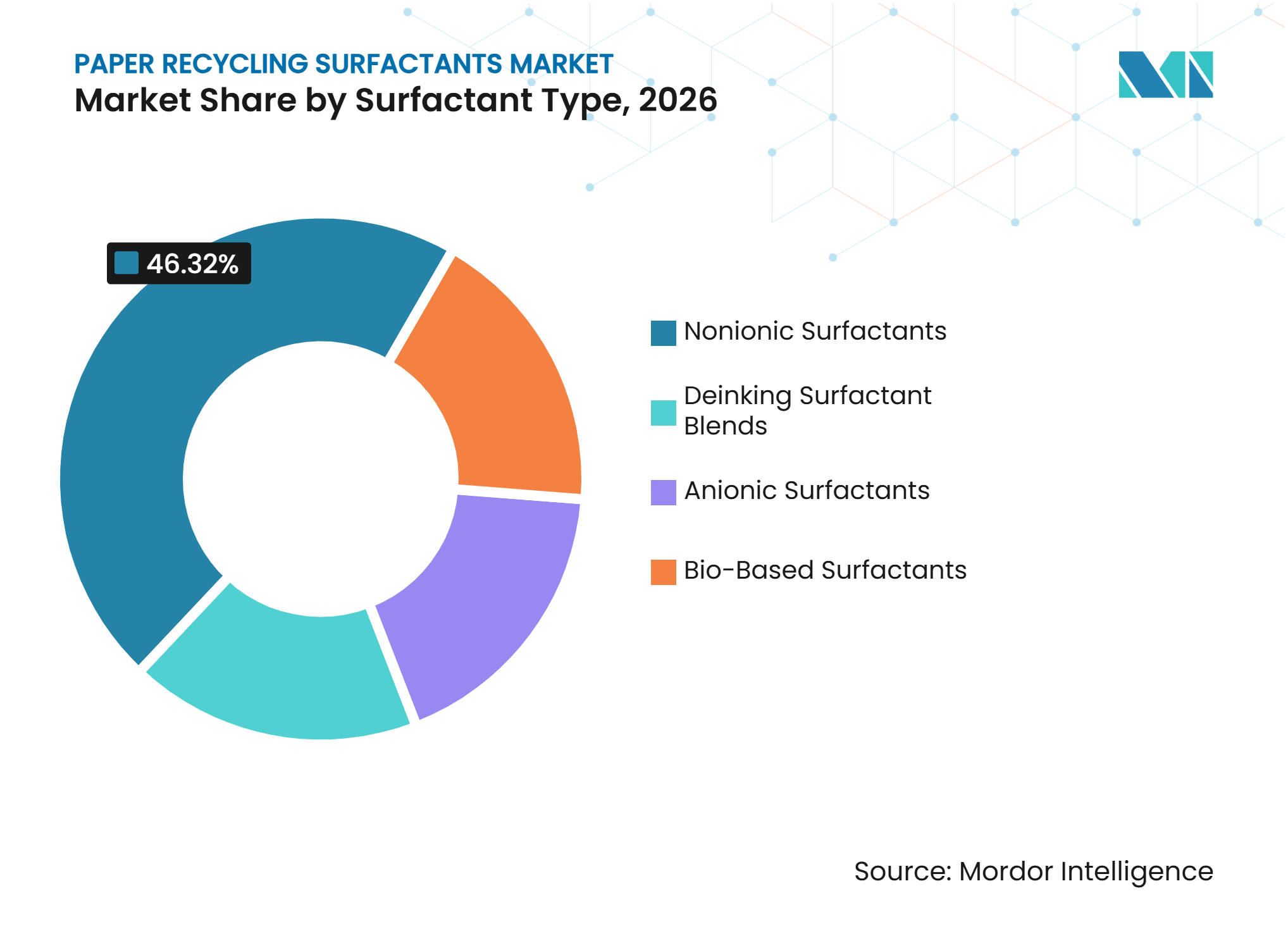
- By surfactant type, nonionic surfactants held 46.32% of the paper recycling surfactants market share in 2026, while bio-based surfactants are forecast to advance at a 7.23% CAGR through 2032.
- By application, deinking held 41.47% of the paper recycling surfactants market share in 2026, while stickies control is forecast to advance at a 7.67% CAGR through 2032.
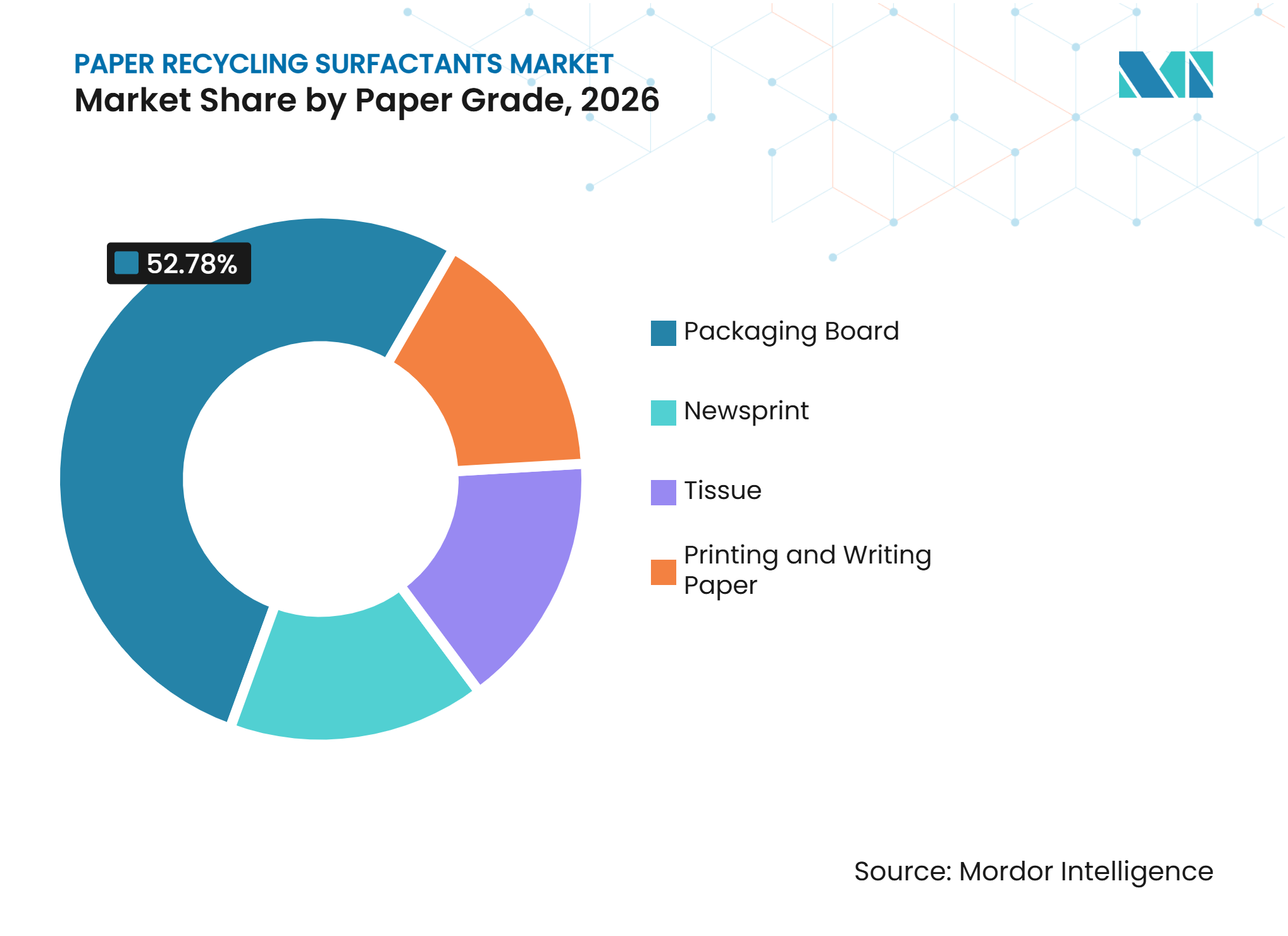
- By paper grade, packaging board held 52.78% of the paper recycling surfactants market share in 2026 and is forecast to advance at an 8.05% CAGR through 2032.
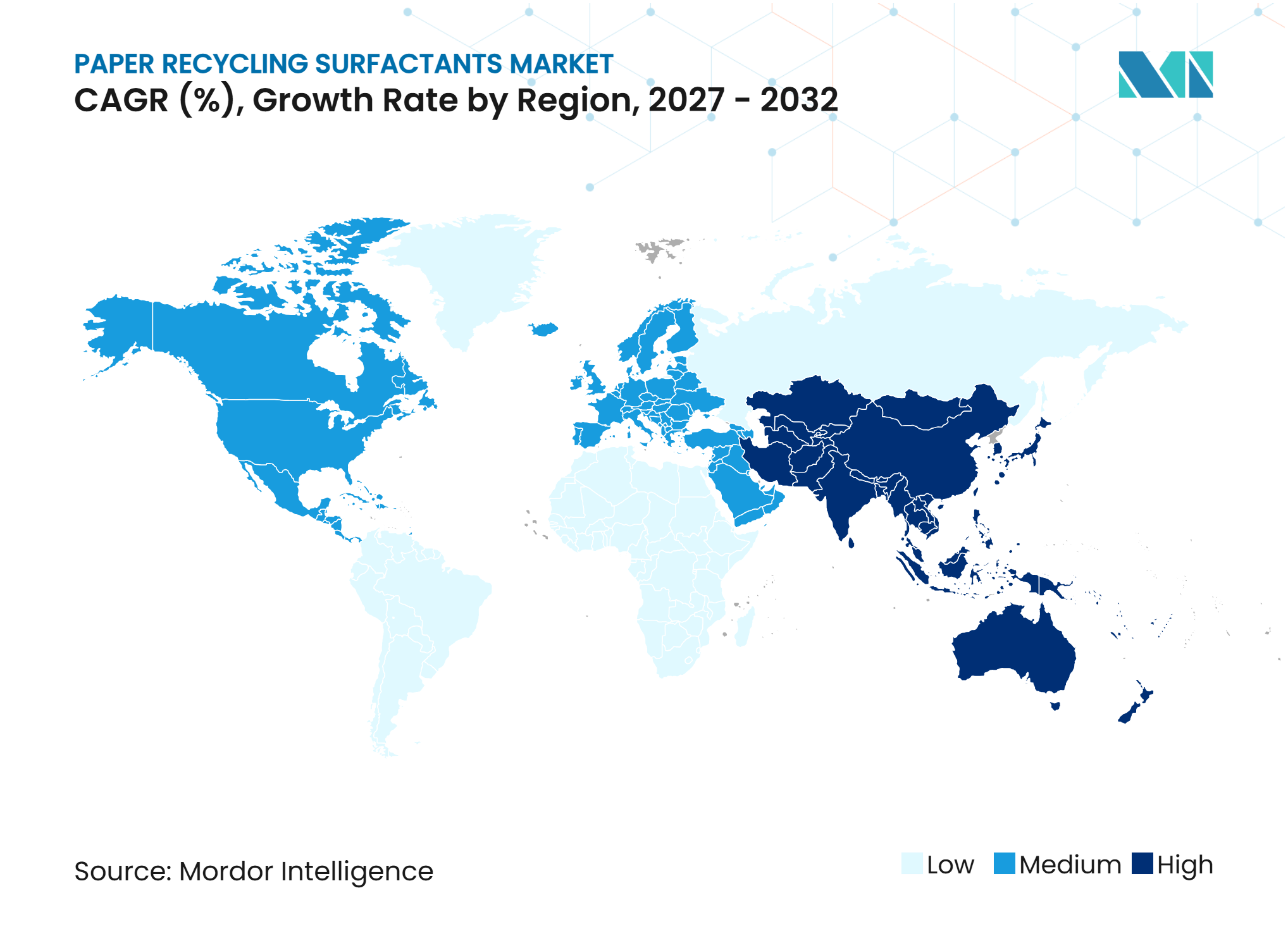
- By geography, Asia-Pacific held 43.33% of the paper recycling surfactants market share in 2026 and is forecast to advance at a 7.78% CAGR through 2032.
Note: Market numbers in this report are based on Mordor Intelligence's proprietary estimation framework, which combines nine months of actuals with Q4 projections for base year 2026.
Market Trends and Insights
Drivers Impact Analysis of Paper Recycling Surfactants Market*
| Driver | (~) % Impact on CAGR Forecast | Geographic Relevance | Impact Timeline |
|---|---|---|---|
| Recycled Content Requirements for Packaging | +2.1% | Global, most acute in EU and North America | Short term (≤ 2 years) |
| Expansion of Recycled Containerboard Capacity | +1.7% | APAC, Europe, North America | Medium term (2-4 years) |
| Rising Contaminant Load in Recovered Paper | +1.4% | Global, highest in APAC and North America | Medium term (2-4 years) |
| Mill Demand for Higher Fiber Yield and Brightness | +0.9% | Global, particularly APAC and EU | Long term (≥ 4 years) |
| Closed-Loop Water Systems Increasing Chemical Intensity | +0.6% | Global, led by EU regulatory influence | Medium term (2-4 years) |
| Source: Mordor Intelligence | |||
Recycled Content Requirements for Packaging
Mandatory recycled-content targets for packaging are a major commercial driver for the paper recycling surfactants market. Regulation (EU) 2025/40 sets paper and board packaging recycling targets of 75% from 2025 and 85% from 2030[1]. Oregon launched a fully operational Extended Producer Responsibility program for packaging and paper products on July 1, 2025, while Maryland enacted similar legislation in May 2025. Colorado requires 40% post-consumer recycled content in paper and paper packaging by 2030. These rules encourage mills to raise recovered-fiber use, which expands the need for deinking, stickies management, and dispersion chemistry.
Expansion of Recycled Containerboard Capacity
New recycled containerboard projects are converting potential demand into sustained chemical consumption in the paper recycling surfactants market. Mondi started its Duino mill in Italy in April 2025, and the site produces 420,000 metric tons of recycled containerboard each year from 100% recovered fiber. Norske Skog began recycled containerboard production at Golbey in May 2025, adding 550,000 metric tons of annual capacity. Modern Karton started its PM6 line in Turkey in September 2025 with a capacity of 640,000 metric tons per year. Recovered corrugated containers and mixed-paper feedstocks carry stickies, flexographic ink residues, and adhesives that need more demanding flotation treatment than virgin furnish. Chemical additions can be 30% to 50% higher per metric ton than on virgin furnish, so each added unit of recycled board capacity supports disproportionately higher surfactant use.
Rising Contaminant Load in Recovered Paper
Recovered-paper contamination is increasing as packaging formats expand and sorting quality remains uneven. Pressure-sensitive labels, silicone-release papers, hot-melt adhesives, and polymer-coated packaging create stickies that affect machine operation and product quality. A 2025 study found that combined surfactant pretreatment improved the removal of persistent organic contaminants from recycled fiber and reduced surface tension to 47 mN/m. China tightened requirements for imported recycled pulp under GB/T 43393 in October 2025, with contaminant content capped at 0.50%. Mills that cannot meet output requirements with existing programs must adopt higher-performance surfactant blends. This raises the value of stickies-control formulations within the paper recycling surfactants market.
Closed-Loop Water Systems Increasing Chemical Intensity
The move toward closed-loop and near-closed water systems is raising chemical intensity at paper mills. Effluent requirements, including the EU Industrial Emissions Directive and China’s GB 3544 paper-industry discharge standard, encourage mills to reduce water discharge. Tighter water circuits concentrate dissolved organic matter, residual surfactants, and colloidal material. Higher background ionic strength can reduce the performance of formulations designed for cleaner process water. Mills then need either higher dose rates or chemistries that tolerate the more demanding system conditions.
Restraints Impact Analysis of Paper Recycling Surfactants Market*
| Restraint | (~) % Impact on CAGR Forecast | Geographic Relevance | Impact Timeline |
|---|---|---|---|
| Variable Recovered Paper Quality and Contamination | -1.2% | Global, most acute in APAC and North America | Short term (≤ 2 years) |
| Feedstock Cost Volatility for Ethoxylates and Fatty Acids | -0.9% | Global | Medium term (2-4 years) |
| Fiber Weakening and Declining Recyclability Across Multiple Cycles | -0.7% | Global, most critical in EU and APAC markets with high recycling rates | Long term (≥ 4 years) |
| Source: Mordor Intelligence | |||
Variable Recovered Paper Quality and Contamination
Inconsistent recovered-paper quality makes it difficult for mills to standardize surfactant dosing programs. As fibers complete more recycling cycles, the proportion of short and weak fibers rises alongside non-fiber contaminants. China’s Ministry of Commerce sought public comment on a recovered-paper classification standard in February 2025, reflecting the need for tighter grade definitions[2]. The Recycled Materials Association updated its Institute of Scrap Recycling Industries (ISRI) Specifications in June 2025 to broaden allowable paper commodity definitions for inbound residential streams. Variable feedstock limits the performance range that a single formulation can deliver. Producers must provide customized products and technical support, which can reduce margins and constrain the scale of the paper recycling surfactants market.
Feedstock Cost Volatility for Ethoxylates and Fatty Acids
Nonionic surfactants for paper recycling are often based on fatty alcohol ethoxylates or alkylphenol ethoxylate derivatives. Their costs are linked to ethylene oxide and oleochemical fatty-acid feedstocks. These supply chains are exposed to crude-oil movements and agricultural commodity cycles. Buckman announced a 3% to 5% surcharge on product lines affected by tariffs, effective June 1, 2025, which showed how upstream changes can pass through to customers. Bio-based producers face a different cost structure, but plant-based feedstocks also carry agricultural-yield and energy-cost risk. Production cost benchmarks of USD 2 per kg to USD 3.8 per kg can limit the near-term competitiveness of fermentation-based products.
*Our forecasts treat driver/restraint impacts as directional, not additive. The impact forecasts reflect baseline growth, mix effects, and variable interactions.
Paper Recycling Surfactants Market Segment Analysis
By Surfactant Type:
Nonionic Surfactants Lead, While Bio-Based Surfactants ExpandNonionic surfactants commanded 46.32% of the paper recycling surfactants market share in 2026. Their position reflects established use in flotation deinking circuits, where low foam and stable emulsification are important. Alcohol ethoxylates and fatty-acid ethoxylates remain widely used because their hydrophilic-lipophilic balance can be adjusted across alkaline deinking conditions. Anionic surfactants provide collector functions in flotation cells by helping hydrophobic ink particles form floatable froth. Their use remains relevant to newsprint and graphic-paper deinking lines. Deinking surfactant blends are gaining adoption among smaller mills that do not have formulation resources.
Bio-based surfactants are projected to advance at a 7.23% CAGR through 2032, exceeding the overall rate. Evonik Industries AG launched TEGO Wet 570 Terra and TEGO Wet 580 Terra in March 2025 as plant-derived and readily biodegradable biosurfactants made through fermentation. Nouryon reported that eco-premium solutions represented 36% of 2025 revenue, while 76% of its research and development pipeline targeted bio-based feedstock benefits. These product actions show growing supplier attention to sustainability procurement needs. Organisation for Economic Co-operation and Development (OECD) biodegradability protocols and the EU Registration, Evaluation, Authorisation and Restriction of Chemicals (REACH) framework also influence formulation choices. The paper recycling surfactants industry is therefore moving toward products that meet both process-performance and environmental requirements.



By Application:
Deinking Leads, While Stickies Control ExpandsDeinking accounted for 41.47% of the paper recycling surfactants market in 2026. Brightness and cleanliness remain basic acceptance requirements for graphic paper and tissue made from recovered fiber. Flotation deinking separates ink particles from fiber slurry through air-bubble attachment supported by surfactant-collector chemistry. Foam control and wetting and dispersion address separate problems in flotation circuits and reslushing operations. All application groups benefit as recovered-fiber furnish increases, although chemical requirements differ by mill design and feedstock quality.
Stickies control is projected to advance at a 7.67% CAGR through 2032. E-commerce packaging has raised adhesive contamination in old, corrugated container streams through tape seals, labels, and hot-melt case sealers. A 2025 peer-reviewed study found that optimized nonionic alcohol-ethoxylate pretreatment of old corrugated container pulp lowered water retention value by 13% and increased drainage rate by 1.56 times. Better drainage supports machine runnability in recycled containerboard production. Solenis is investing in programs that combine stickies control with process-optimization feedback. This application is becoming more important as mixed packaging waste enters the paper recycling surfactants market.
By Paper Grade:
Packaging Board Drives a Self-Reinforcing Demand CyclePackaging board held 52.78% of the paper recycling surfactants market in 2026. It is the largest paper-grade outlet because containerboard depends heavily on old, corrugated container furnish. Mondi’s Duino project added 420,000 metric tons per year in April 2025, and Norske Skog Golbey added 550,000 metric tons per year in May 2025. Packaging and Packaging Waste Regulation (PPWR) recyclability grades encourage producers to improve recycled-pulp quality. This supports continuing demand for chemistry that controls stickies and supports deinking.
Packaging board is projected to advance at an 8.05% CAGR through 2032. The segment combines a leading position with the highest forecast growth among paper grades. Newsprint remains a relevant application in Asia and South America, although print circulation continues to decline. Tissue is gaining importance in Asia and the Middle East, where hygiene requirements support demand for high-brightness deinked pulp. Printing and Writing Paper remains a narrower use case because it competes with virgin pulp on brightness. The 4evergreen alliance expanded its Recyclability Evaluation Protocol to include assessment schemes for flotation-deinking processes.

Geography Analysis
Asia-Pacific: Dominant Scale and Fastest Growth Converge
Asia-Pacific held 43.33% of the paper recycling surfactants market in 2026 and is projected to advance at a 7.78% CAGR through 2032. China is the regional anchor because its National Development and Reform Commission action plan targets annual domestic recovered-paper recycling volumes above 80 million tons by 2030. Packaging is a stated priority in the plan. China also tightened standards for imported recycled pulp under GB/T 43393, which capped contaminants at 0.50% in October 2025. This rule favors stronger processing of locally collected recovered fiber. India and Association of Southeast Asian Nations (ASEAN) markets are expanding organized retail and e-commerce, which support old, corrugated container collection. Japan has a recovery rate above 80% and provides a mature outlet for advanced chemistry on difficult-to-deink fiber grades.
North America: Regulatory Architecture Transforming the Chemical Value Chain
North America has a large and stable recovered-fiber base, with U.S. mills recycling 45 million tons of paper in 2025. The paper recycling surfactants market in the region is shaped more by regulatory requirements than by new capacity additions. Oregon’s Extended Producer Responsibility program and Maryland’s 2025 legislation are making recycled-content verification more important for brand owners and packaging suppliers. Colorado’s 40% post-consumer recycled-content requirement for paper packaging by 2030 strengthens demand for chemistry that can handle residential old corrugated container and mixed-paper streams. Nearly 4 million metric tons of containerboard capacity closed during the first 8 months of 2025. The change redirects procurement toward mills using higher recycled-content furnish. Program-oriented suppliers with established mill relationships can benefit from higher chemical demand per metric ton of output.
Regional Diversification Shapes the Global Demand Map
Europe maintained a paper and board recycling rate of 75.1% in 2025, which put it near the PPWR’s short-term 2025 target. Germany, the United Kingdom, and Nordic countries have technically advanced deinking mills that value premium surfactant performance. The updated 4evergreen Recyclability Evaluation Protocol adds a flotation-deinking assessment module and raises the importance of measured process results. South America, led by Brazil and Argentina, is adding recovered-fiber capacity as packaging demand grows. The Middle East and Africa remain earlier-stage markets, but circular-economy packaging policies in Gulf Cooperation Council countries are supporting paper-based alternatives to plastics. These policies need recovered-fiber infrastructure and related chemical programs. The paper recycling surfactants market therefore has different demand patterns across mature, expanding, and emerging regions.
Competitive Landscape
Market Concentration
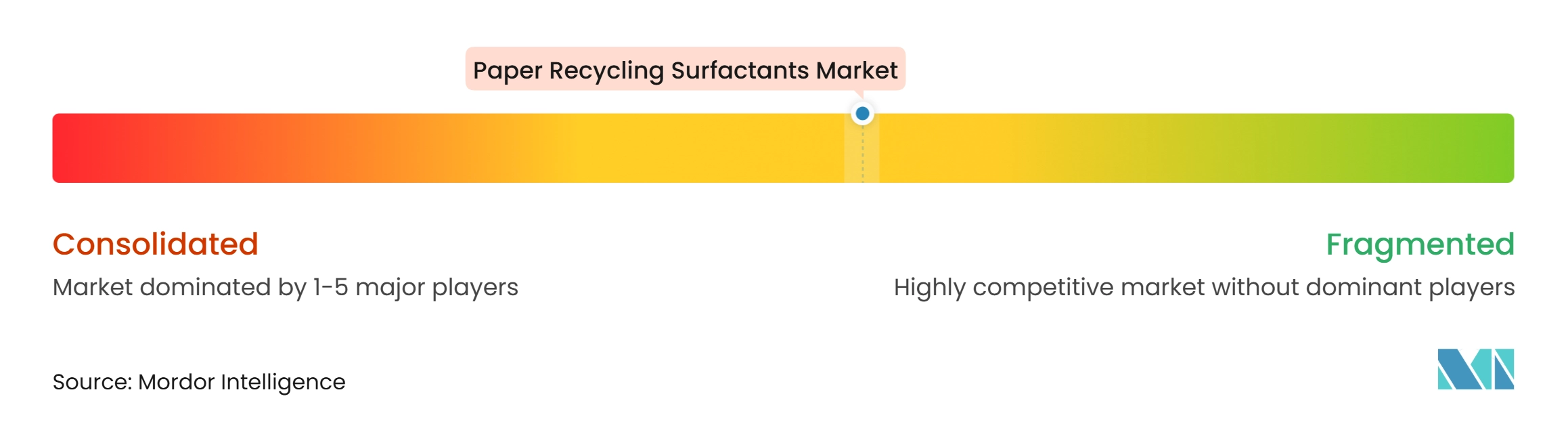
The paper recycling surfactants market is moderately concentrated, with the top five players including Kemira Oyj, Solenis, BASF, Ecolab Inc., and Buckman. These companies offer paper-process programs that cover deinking, retention, drainage, strength, and water treatment. This broad offering allows mills to reduce the number of chemical suppliers they manage. It also enables suppliers to combine surfactants with higher-value specialty products. That structure makes displacement difficult for smaller surfactant-only companies. Buckman and CHT Group compete through application expertise, technical service, and tailored chemistry.
Supplier strategies focus on bio-based products, digital dosing, predictive process control, and expansion in Asia-Pacific. Solenis is pursuing this model through a USD 193 million expansion in Virginia and a Global Research Center in Wilmington. Buckman invested more than USD 10 million in a Memphis pilot plant in January 2025 to advance chemical and digital innovation. CLARIANT launched its VITA range of 100% bio-based surfactants and polyethylene glycols in April 2025. Kemira Oyj and Bluepha also formed a 3-year partnership for polyhydroxyalkanoate-based barrier coatings for paper, board, and molded fiber.
Opportunities in the paper recycling surfactants market include chemistry for ultraviolet-cured and digital inkjet inks, which conventional fatty-acid collectors handle poorly. Integrated stickies-control programs can combine surfactants, enzymes, and mechanical cleaning. Evonik Industries AG launched TEGO Res 1100 in March 2025, a deinking co-binder for solventborne inks that accelerates deinking of nitrocellulose inks by up to 9 times at 40 °C. ISO 12507:2025 and PPWR recyclability grades are making supplier performance claims easier to test. This favors companies with laboratory capacity and application-engineering resources. Smaller suppliers can still compete where local technical support and faster customization matter, especially in Southeast Asia and South America.
Paper Recycling Surfactants Industry Leaders
-
Kemira Oyj
-
Solenis
-
BASF
-
Ecolab Inc.
-
Buckman
- *Disclaimer: Major Players sorted in no particular order
Paper Recycling Surfactants Market Companies Covered in this Report
- Arakawa Chemical Industries, Ltd.
- Ashland
- BASF
- Buckman
- CHT Group
- CLARIANT
- Dow
- Ecolab Inc.
- Evonik Industries AG
- Harima Chemicals Group, Inc.
- Kao Corporation
- Kemira Oyj
- Nouryon
- SNF Group
- Solenis
Recent Industry Developments in Paper Recycling Surfactants Market
- August 2026: Luterra Advanced Materials reported successful industrial applications of its Solid Deinking Agent (P-01A) and Liquid Deinking Agent (P-01B) across recycled paper mills in Southeast Asia. The formulations improved deinked pulp brightness and fibre yield while reducing chemical consumption and wastewater chemical oxygen demand (COD), supporting the paper recycling surfactants market through improved deinking efficiency and process economics.
- January 2026: Lenzing Papier launched an advanced deinking plant in Austria following an investment exceeding EUR 50 million (approximately USD 58.5 million). The facility is designed to process up to 150,000 metric tons of recovered paper annually using flotation cells and high-efficiency washing systems, supporting the paper recycling surfactants market through increased demand for deinking chemicals and process additives.
Global Paper Recycling Surfactants Market Report Scope
Paper recycling surfactants are specialty chemicals used during the recovery and processing of wastepaper into reusable pulp. They improve ink removal, control contaminants and foam, and support efficient separation of fibers during recycling operations.
The Paper Recycling Surfactants Market is segmented by surfactant type, application, paper grade, and geography. By surfactant type, the market is segmented into nonionic surfactants, anionic surfactants, deinking surfactant blends, and bio-based surfactants. By application, the market is segmented into deinking, stickies control, foam control, and wetting and dispersion. By paper grade, the market is segmented into packaging board, newsprint, tissue, and printing and writing paper. The report also covers the market size and forecasts for paper recycling surfactants across 15 countries. For each segment, the market sizing and forecasts have been done on the basis of value (USD).
Segmentation Overview
| Nonionic Surfactants |
| Anionic Surfactants |
| Deinking Surfactant Blends |
| Bio-Based Surfactants |
| Deinking |
| Stickies Control |
| Foam Control |
| Wetting and Dispersion |
| Packaging Board |
| Newsprint |
| Tissue |
| Printing and Writing Paper |
| Asia-Pacific | China |
| India | |
| Japan | |
| South Korea | |
| ASEAN Countries | |
| Rest of Asia-Pacific | |
| North America | United States |
| Canada | |
| Mexico | |
| Europe | Germany |
| United Kingdom | |
| France | |
| Italy | |
| NORDIC Countries | |
| Rest of Europe | |
| South America | Brazil |
| Argentina | |
| Rest of South America | |
| Middle East and Africa | Saudi Arabia |
| South Africa | |
| Rest of Middle East and Africa |
| By Surfactant Type | Nonionic Surfactants | |
| Anionic Surfactants | ||
| Deinking Surfactant Blends | ||
| Bio-Based Surfactants | ||
| By Application | Deinking | |
| Stickies Control | ||
| Foam Control | ||
| Wetting and Dispersion | ||
| By Paper Grade | Packaging Board | |
| Newsprint | ||
| Tissue | ||
| Printing and Writing Paper | ||
| By Geography | Asia-Pacific | China |
| India | ||
| Japan | ||
| South Korea | ||
| ASEAN Countries | ||
| Rest of Asia-Pacific | ||
| North America | United States | |
| Canada | ||
| Mexico | ||
| Europe | Germany | |
| United Kingdom | ||
| France | ||
| Italy | ||
| NORDIC Countries | ||
| Rest of Europe | ||
| South America | Brazil | |
| Argentina | ||
| Rest of South America | ||
| Middle East and Africa | Saudi Arabia | |
| South Africa | ||
| Rest of Middle East and Africa | ||
Key Questions Answered in the Report
What is the size of the paper recycling surfactants market?
The paper recycling surfactants market size was valued at USD 658.09 million in 2026 and is estimated to grow from USD 702.77 million in 2027 to reach USD 979.70 million by 2032, at a CAGR of 6.87% during the forecast period (2027-2032).
What is driving demand for paper recycling surfactants?
Recycled-content mandates, new recycled containerboard capacity, higher contaminant loads, and closed-loop water systems are increasing demand for surfactant-based processing.
Which surfactant type held the largest share in 2026?
Nonionic surfactants held a 46.32% share in 2026 because they are well suited to flotation deinking systems.
Which application is expected to grow fastest through 2032?
Stickies control is projected to advance at a 7.67% CAGR through 2032 as adhesives and labels increase contamination in recovered-fiber streams.